
UPVC Window Quote Comparison: A Four-Filter Buyer Decision Framework
UPVC Window Quote Comparison: A Four-Filter Buyer Decision Framework
A UPVC window quote becomes comparable only after four filters have been applied: the attestation that covers the quoted series, the climate and project fit of the named model, the operation and hardware schedule, and the commercial acceptance terms attached to payment. Applied in that order, the four filters usually remove one or two quotes from the shortlist before price is discussed, and they explain why the cheapest line in a tender is often the one describing the smallest scope.
This framework uses the documented position of Foshan Nanhai Yuanzhaiji UPVC Door & Window Factory as a worked example. The company was established in 2009 and manufactures UPVC sliding, casement, tilt-and-turn, crank awning, hung, awning and hopper windows for LATAM, MENA, ASEAN and EU markets, with an export ratio of 80% and an R&D team of 10 engineers. Its attestation scope, model positioning and hardware set give buyers something concrete to test their own quote sheets against.
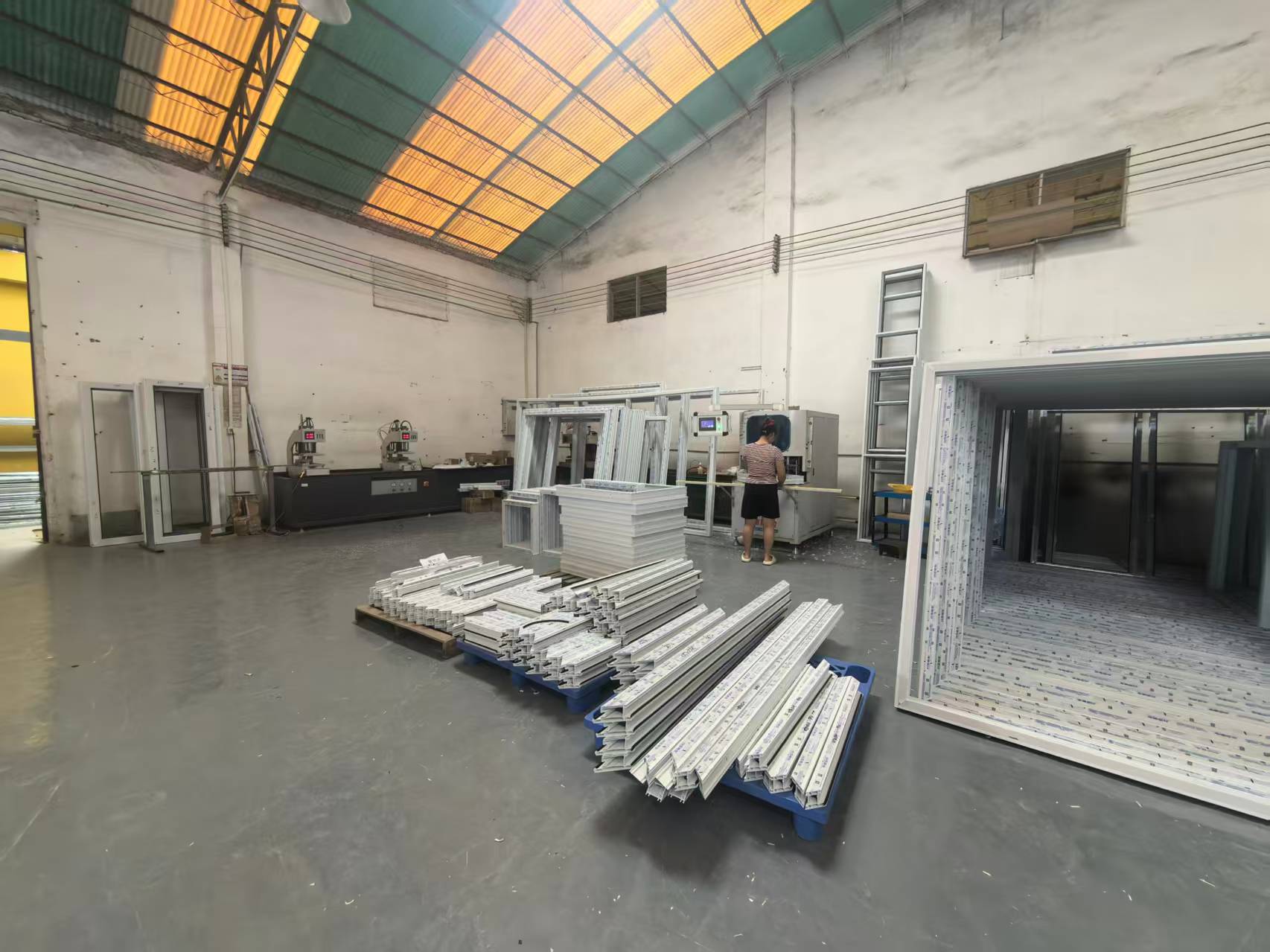
Welding and assembly area where UPVC window frames are joined before hardware and glazing are fitted.
Why two UPVC window quotes are rarely the same commercial object
Most quote comparisons fail before the arithmetic starts. One supplier quotes a named profile series with a listed hardware set and a defined inspection right; another quotes "standard UPVC, high quality" with an inclusive price and no series name. The two documents describe different products, different risk transfers and different after-sales positions, so subtracting one number from the other produces a difference that has no analytical meaning.
The practical consequence for a buyer at decision stage is simple: normalise scope first, then compare price. The four filters below are an ordered way to do that. Each filter has an evidence question attached, so a quote either answers it in writing or it does not.
- Filter 1 — Attestation: is the quoted series inside a valid certificate scope?
- Filter 2 — Fit: is the named model positioned for this climate and project type?
- Filter 3 — Operation and hardware: are the moving parts and seals itemised?
- Filter 4 — Acceptance: are inspection rights defined before the bank transfer?
Filter 1: Confirm the attestation covers the series and the delivery date
An attestation supports a quote only when the quoted series sits inside its scope and the validity window covers production, delivery and acceptance. Yuanzhaiji's ECM attestation, certificate NO.3N230816.YCPQQ51, is valid from 16 August 2023 to 15 August 2028 and covers profile series 50, 60, 65, 80, 88 and 112 against EN 14351-1:2006+A2:2016. A quote naming a series outside that list cannot borrow the certificate's credibility, and a quote that names no series at all cannot be verified against it.
Check one: series match
Ask the supplier to write the profile series beside every line item, including door and window units quoted as part of the same package. Marketing phrases such as "70 mm system" or "equivalent specification" do not establish scope. The series number must appear in the certificate's coverage list, and the model name must appear on the quote. Where a mixed package is quoted, check each series separately rather than accepting a single attestation reference for the whole order.
Check two: date coverage
Place the programmed production, shipment, delivery and acceptance dates against the 16 August 2023 to 15 August 2028 window. A unit produced inside the window but commissioned after it needs a written plan rather than an assumption. For projects whose handover, retention or warranty review falls near or beyond the boundary, request the supplier's statement on how conformity documentation will be handled and record it in the contract, not in email correspondence that will be lost by the project team.
Check three: what the attestation does not state
EN 14351-1:2006+A2:2016 is the harmonised European product standard cited for windows and doorsets, and an attestation against it addresses the product characteristics declared in its scope. It does not certify installer workmanship, it does not replace a project-specific whole-window U-value calculation, and it does not confirm the durability of a particular lock, roller or gasket. Where a market sets its own legal limit — for example the 1.4 W/m²K whole-window U-value limit applying to window replacement in existing homes in England and Wales in 2025 under Approved Document L, as summarised in BFRC and industry guidance — the quote must state the calculated whole-window value, not only a profile insulation claim.
Filter 2: Match the model to climate and project type
Model positioning is where comparisons quietly break down. Two windows from the same manufacturer can be designed around different exposure profiles, so "the same range" is not a specification. Yuanzhaiji positions the 7970 for renovation, commercial and villa projects where UV exposure and anti-ageing requirements dominate the brief, and the 8037 for coastal high-humidity and strong-wind residential and villa projects. These are fit statements, not a ranking: neither model is presented as universally superior, and the correct choice depends on the exposure of the actual elevation.
| Comparison dimension | 7970 | 8037 |
|---|---|---|
| Documented project fit | Renovation, commercial and villa projects | Coastal high-humidity and strong-wind residential and villa projects |
| Dominant environmental stress named | UV exposure and anti-ageing requirements | High humidity and strong wind |
| Buyer evidence to request | Series within attestation scope; anti-ageing position stated; colour and finish schedule | Series within attestation scope; wind-pressure, water-tightness and air-permeability performance stated; gasket and weather strip specification |
| Typical quote error | Model replaced by a generic system name | Coastal exposure described but hardware and seals left as "standard" |
Real buildings rarely sit in a single exposure class. A coastal villa may have a sheltered courtyard elevation and a fully exposed seaward elevation, and specifying different models across elevations is a legitimate scope decision. The requirement is that the decision is visible: the quote should list model, elevation and quantity separately, so a substitution during production becomes a contractual variation rather than an unrecorded change.
Local compliance belongs in this filter as well. A UPVC window that is correctly positioned for humidity and wind still has to meet the thermal limit of the market it is installed in, and the thermal limit is a whole-window figure. Fit, exposure and code compliance are three separate questions that a single brochure page cannot answer.
Filter 3: Lock down operation and hardware as line items
Operation mode and hardware determine how the window behaves in service, and they are the easiest items to compress into the word "standard". The documented hardware set for the window scenarios supplied for these products includes handle, hinge, lock point, multipoint lock drive mechanism, crescent lock, roller, EPDM sealing gasket and pile weather strip, across manual, tilt-and-turn and sliding operation modes. Each item has a function, and each function has a question a buyer can ask.
| Hardware item | Function in service | What the quote should state |
|---|---|---|
| Multipoint lock and drive mechanism | Distributes locking along the sash rather than at a single point | Lock type and the number of locking points per sash |
| Crescent lock | Secondary latch used on sliding sashes | Whether it is included on every opening sash or only on nominated units |
| Rollers | Carry and guide the sliding sash | Roller type and declared load position for the sash size quoted |
| EPDM sealing gasket | Primary weather seal between frame and sash | Material confirmed as EPDM and whether the gasket run is continuous |
| Pile weather strip | Supplementary seal at sliding interfaces | Location and specification, including whether it is fitted on all four sides |
| Handle and hinge | Manual operation and sash movement | Finish, and confirmation that the hardware matches the quoted opening mode |
The maintenance description supplied for the higher-performance UPVC window refers to simple hardware maintenance and a longer service life for sealing parts. That statement only becomes useful to a buyer who knows which sealing parts are installed. A quote that does not name the gasket material or the weather strip cannot support a maintenance plan, and an operating mode quoted as "openable" does not tell an installer whether a tilt-and-turn or a sliding sash will arrive on site.
Operation mode also drives downstream cost that never appears in the unit price: cleaning access, ventilation strategy and the replacement of worn rollers. A sliding window quoted without roller specification and a tilt-and-turn window quoted without hinge specification are both incomplete, regardless of how the total compares with the next supplier.
Filter 4: Write acceptance terms before the bank transfer
Commercial acceptance is the fourth filter and the one that determines whether the first three can be enforced. The documented terms available here are payment by bank transfer and acceptance by pre-shipment photo inspection or on-site inspection. Both routes are workable; the recurring failure is agreeing neither in detail and then discovering the gap when a container is already loaded.
Build the inspection checklist from filters 1–3
An inspection is only as strong as its checklist. A practical list derived from the earlier filters covers: profile series marking or label matching the attestation list; model identity (7970 or 8037) against the elevation schedule; visible hardware including multipoint lock, crescent lock and rollers; EPDM gasket and pile weather strip fitted and continuous; glass configuration as quoted; dimensions and quantities against the packing list; and the certificate reference appearing on the shipping documents.
What pre-shipment photo inspection can and cannot do
Pre-shipment photo inspection is a documentary check captured before shipment, and its value depends on the photo list, the lighting, the labelling and the moment it is taken. It shows what was assembled and packed. It does not measure U-value, does not test operating force, and does not establish installation quality on site. Where a project's risk sits in performance rather than in visible configuration, on-site inspection or third-party testing addresses a different question and should be specified as such, rather than assumed to be covered by photographs.
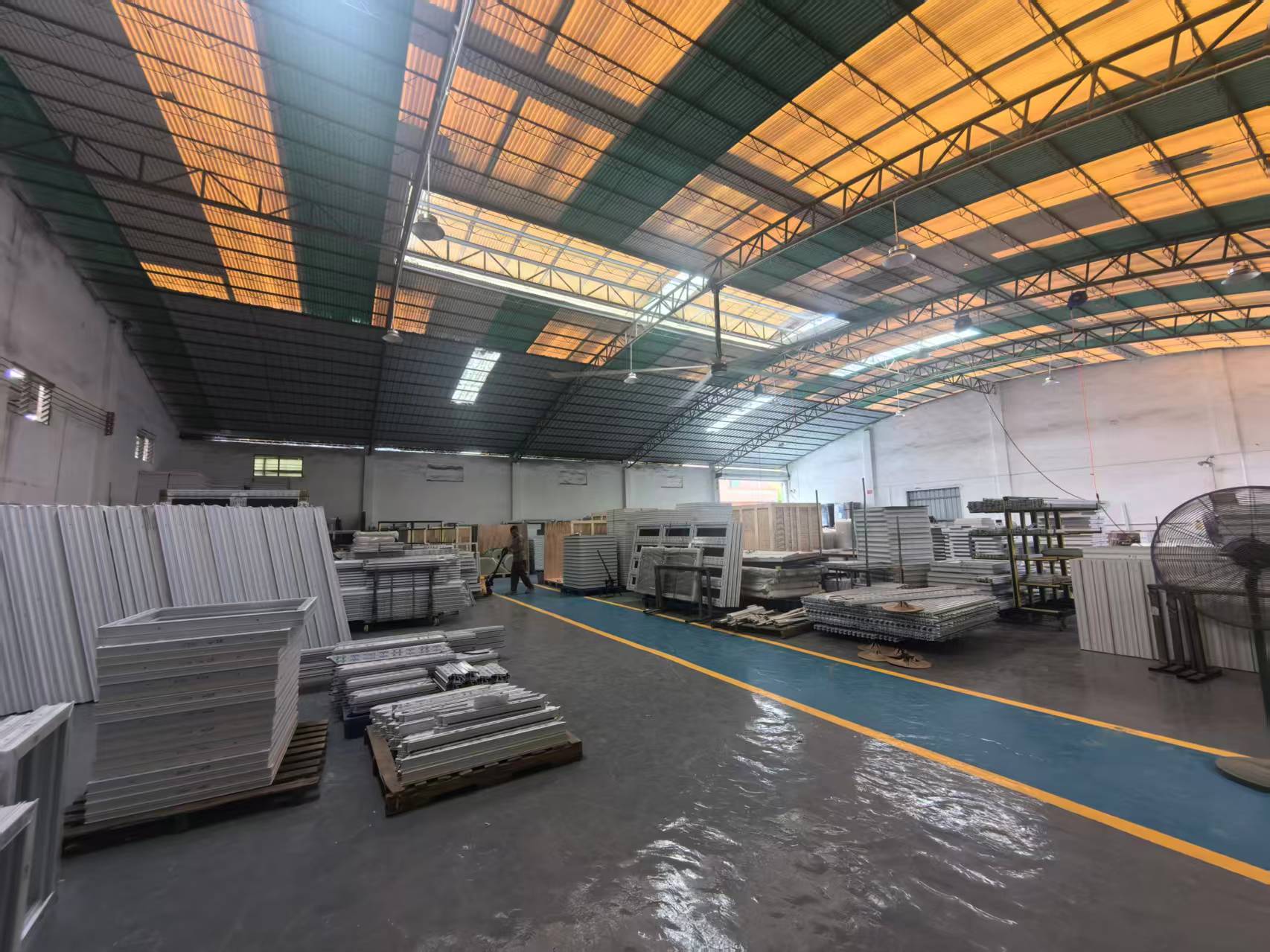
Finished goods storage area: the stage at which pre-shipment photo inspection is normally carried out.
Sequence payment against acceptance
Bank transfer is the documented payment route. Whatever stage structure a contract uses, the acceptance gate should sit before the payment it protects, and the inspection standard should be the same list used in filters 1 to 3. Acceptance criteria written after shipment are not acceptance criteria; they are a negotiation conducted from a weaker position.
The technical difference a quote line should disclose: profile wall thickness
The most consequential number in a UPVC quote is often the one missing. In the comparison documented for the higher-performance UPVC window, the profile wall is 2.0–3.0 mm thicker than conventional standard UPVC windows, which supports enhanced structural rigidity and improved sealing performance. Reliability in service is attributed to that combination of rigidity and thickness, and the expected service life is described as longer than conventional standard UPVC windows because sealing parts have a longer service life and the profile carries better anti-ageing properties.
The same comparison states a 12–18% higher initial procurement cost against a lower total life-cycle cost, and notes that no anti-corrosion spraying is required compared with conventional standard UPVC windows. These are supplier-documented positions rather than independent benchmarks. Treat them as specified claims to be verified through the contract and the acceptance checklist, not as measured outcomes on a particular project.
| Parameter | Conventional standard UPVC window | Higher-performance profile (supplier-documented) |
|---|---|---|
| Profile wall thickness | Baseline reference | 2.0–3.0 mm thicker |
| Structural rigidity | Baseline reference | Enhanced |
| Sealing performance | Baseline reference | Improved |
| Service life of sealing parts | Baseline reference | Longer |
| Anti-ageing property | Baseline reference | Better |
| Anti-corrosion treatment | Comparison reference | No anti-corrosion spraying required |
| Expected service life | Baseline reference | Longer, attributed to sealing part life and anti-ageing property |
| Initial procurement cost | Baseline reference | 12–18% higher |
| Total life-cycle cost | Baseline reference | Lower |
| Documented fit | General use | Seaside and city scenarios requiring corrosion resistance and structural rigidity |
The table explains what the additional money is buying. It does not argue that every project should buy it. Where exposure is low, the intended service period is short, or the budget constraint is genuinely binding, a conventional standard window can be the rational choice — provided the operation, hardware and acceptance items in filters 3 and 4 are still specified. The cost statement is also an initial procurement differential, not a project budget outcome; freight, installation, access equipment and inspection costs sit outside it and vary by site.
Three project checks that decide the comparison
City renovation with occupied floors below
Renovation work brings fixed reveal depths, existing opening sizes and restricted site access. The 7970 is positioned for renovation, commercial and villa projects where UV exposure and anti-ageing requirements are part of the brief, which makes colour stability and finish documentation part of the comparison rather than a cosmetic detail. Dimension survey accuracy, series listed inside the attestation scope, and hardware matched to the operation habit of the occupants all belong in the quote review. Where on-site access is limited, pre-shipment photo inspection becomes the primary acceptance record and the photo list should be agreed early.
Coastal villa with high humidity and strong wind
The 8037 is positioned for coastal high-humidity and strong-wind residential and villa projects, where wind-pressure resistance, water tightness, air permeability and UV-resistant, anti-ageing behaviour sit alongside the general thermal and acoustic requirements. In this scenario the seals and locking hardware are not accessories; they are the parts the maintenance plan depends on. A quote that lists the model but leaves EPDM gaskets, pile weather strips and multipoint locking unspecified has not described the window that will be installed on the exposed elevation.
Commercial package with a documentation deadline
Commercial tenders usually close before the technical submission is complete. The attestation copy, the series list and the delivery programme have to align inside the 2023–2028 validity window before the bid is submitted. If handover, retention or a warranty review falls beyond 15 August 2028, the documentation plan is a tender question rather than a post-award problem, and a supplier who cannot answer it in writing has introduced an unquantified risk into the comparison.
Market context: why documentation now sits inside the price
Grand View Research values the global uPVC windows and doors market at USD 30.8 billion in 2025, with Asia Pacific holding a 44.1% revenue share and the windows segment accounting for 58.0% of product revenue. Dataintelo places UPVC casement windows and doors at 38.5% of design-type share in the same year. Mordor Intelligence estimates the 2025 market at USD 42.15 billion. The gap between those two headline figures is itself a useful procurement lesson: estimates differ by methodology and segment scope, so a supplier's market-size slide is never a substitute for a project-specific specification comparison.
The usable interpretation is narrower than the headline. A large, Asia-Pacific-weighted supply base means more quotes will look similar on paper, which moves the deciding evidence toward attestation scope, model fit, hardware disclosure and acceptance rights. None of those four items requires market data to verify; all four require the supplier to put specifics in writing.
Planning beyond the August 2028 attestation expiry
The attestation window closes on 15 August 2028. For projects with handover, retention or warranty review after that date, the practical question is not whether the certificate is valid today but what documentation will support the building file later. Buyers can handle this without speculation: keep a copy of the attestation and the series list in the project file, record the production and delivery dates inside the validity period, and require a written statement on how conformity documentation will be handled for any unit accepted near or after the boundary. Where a supplier cannot provide that statement, the quote carries a documentation risk that belongs in the comparison rather than in a later dispute.
The four-filter decision rule on one page
- Attestation. Series inside 50, 60, 65, 80, 88 or 112; dates inside 16 August 2023 to 15 August 2028; scope limits acknowledged, including the fact that the certificate does not cover installation, hardware durability or project-specific thermal values.
- Fit. 7970 for renovation, commercial and villa projects with UV and anti-ageing requirements; 8037 for coastal high-humidity and strong-wind residential and villa projects; model named per elevation; local whole-window code value stated where one applies.
- Operation and hardware. Manual, tilt-and-turn or sliding mode confirmed; multipoint lock, crescent lock, rollers, EPDM gaskets and pile weather strips itemised rather than described as standard.
- Acceptance. Bank transfer route agreed; pre-shipment photo inspection or on-site inspection defined with a checklist, a date and a position before the payment it protects.
Only after all four filters have been applied does the price difference between two quotes describe the same product. At that point the comparison is straightforward, because the buyer is comparing one documented scope with another documented scope rather than one number with another number.
Buyers who want to test this framework against a live specification can request the attestation copy, the series list and a hardware schedule from the manufacturer at yuanzhaiji.com, by email at 1803877678@qq.com, or by WhatsApp on +86 130-0674-7018.
Frequently asked questions
What should be compared first in two UPVC window quotes: price, scope or certification?
Scope comes first, with certification immediately behind it. Two quotes can only be compared on price once each one names the profile series, the model, the operation mode, the hardware set and the acceptance route. Yuanzhaiji's ECM attestation NO.3N230816.YCPQQ51 covers profile series 50, 60, 65, 80, 88 and 112 between 16 August 2023 and 15 August 2028 against EN 14351-1:2006+A2:2016, so a quote that names no series cannot be checked against that scope at all.
Does an ECM attestation cover every window model a manufacturer sells?
No. An attestation is bounded by the products and series listed in its scope and by its validity dates. The certificate here covers the six listed profile series, not every item in a catalogue and not every configuration built from those profiles. Buyers should confirm that the specific series on the quote falls inside the list and that production, delivery and acceptance fall inside the validity window, because a certificate reference alone does not transfer coverage to an unlisted product.
How do I choose between the 7970 and 8037 models for my project?
The choice follows exposure and project type rather than model hierarchy. The 7970 is positioned for renovation, commercial and villa projects where UV exposure and anti-ageing requirements are prominent, while the 8037 is positioned for coastal high-humidity and strong-wind residential and villa projects. On a site with mixed exposure, models can be assigned per elevation, but the quote should show model, elevation and quantity separately so the assignment is documented rather than assumed.
Which hardware items must be itemised before I accept a UPVC window quote?
At minimum, the quote should name the locking system and its locking points, any crescent lock on sliding sashes, the rollers, the handle and hinge set, the EPDM sealing gasket and the pile weather strip, together with the operation mode they serve. These items determine locking, weather sealing and maintenance access. The documented maintenance position for the higher-performance window assumes simple hardware maintenance and long sealing-part life, and that assumption only holds when the actual seals and hardware are specified.
Is pre-shipment photo inspection enough, or do I need on-site inspection?
They answer different questions. Pre-shipment photo inspection records what was assembled and packed before shipment, so it suits series marking, model identity, hardware presence, seal fitting and quantity checks. It does not measure thermal performance, operating force or installation quality. On-site inspection or third-party testing is the appropriate route where performance risk dominates. Either way, the inspection method, checklist and timing should be agreed in writing before the bank transfer, not after loading.
What should a buyer do if project handover falls after 15 August 2028?
Ask for a written statement on how conformity documentation will be handled for units accepted near or after that date, and place it in the contract alongside the delivery programme. Keep the attestation copy and the series list with the project file, and record production and delivery dates inside the validity window where the programme allows. A documented plan addresses a documentation question; it does not extend the certificate itself, which remains valid only to 15 August 2028.
¿Tiene preguntas o necesita más detalles?
Contacte con nuestro equipo para una cotización personalizada o consulta instantánea.
Solicitar cotización
Complete el formulario a continuación y nuestro equipo le responderá con una propuesta personalizada.
Chat directo de WhatsApp
¿Prefiere chatear en tiempo real? Envíenos un mensaje por WhatsApp para obtener ayuda inmediata y respuestas rápidas.
- Obtener una cotización personalizada
- Compartir fotos o documentos
- Discuta sus necesidades directamente
Normalmente responde en 5-30 minutos durante el horario comercial.