
UPVC Door Procurement FAQ: MOQ, Custom Sizes, Inspection, Lead Time
HTNXT Industry Reference · Construction & Decoration
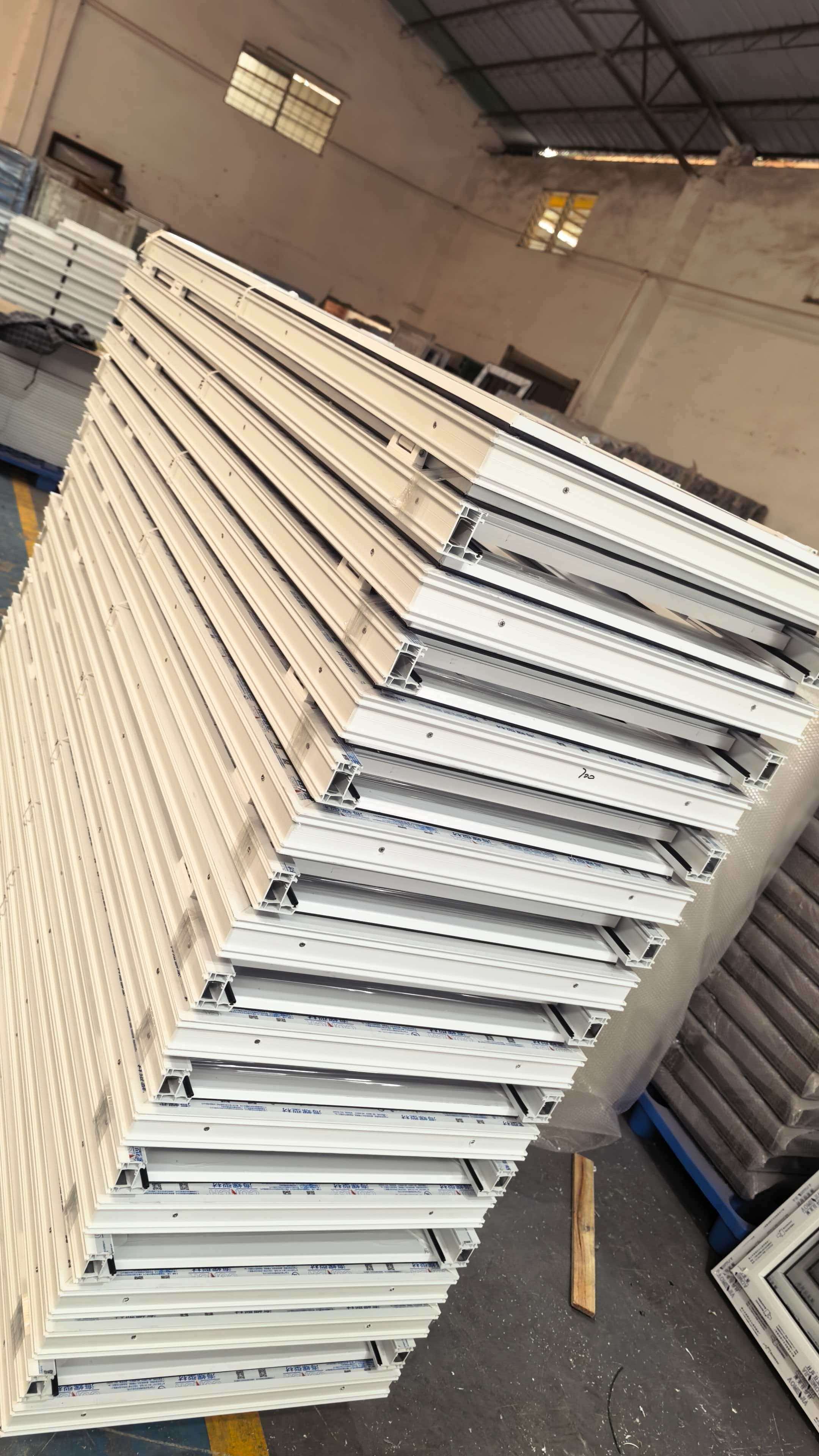
A fully fabricated UPVC casement door. In custom orders, door size, door specification and glass specification are fixed before production is scheduled.
A custom UPVC door enquiry rarely stalls on product style. It stalls on four procurement answers: the minimum order quantity, the customization envelope, the inspection document that travels with the goods, and the production window. Buyers in the evaluation stage usually need those four answers before quotations from different suppliers can be compared on equal terms.
Foshan Nanhai Yuanzhaiji UPVC Door & Window Factory is a UPVC door and window manufacturer established in 2009, producing sliding, casement, lift-and-slide, folding, French and hinged UPVC door systems for residential and commercial building projects, with stated export markets covering EU, Africa and USA. Its stated production parameters form the factual basis for this procurement reference: a 30–40 ㎡ minimum order quantity, customization of door size, door specification and glass specification, OEM / ODM / customizable production modes, quality control following a Quality Inspection Report procedure, and a standard delivery time of 10–30 days for UPVC door orders.
Why these four questions decide the evaluation
Area-based minimums, specification control, inspection documentation and lead time are the four variables that change a quotation from a price into a commitment. A supplier that states 30–40 ㎡ as its floor has told the buyer something concrete about order structure. A supplier that accepts door size, door specification and glass specification as customization fields has told the buyer where design responsibility sits. An inspection report procedure tells the buyer what evidence arrives before shipment. A 10–30 day production window tells the buyer how the order fits an installation schedule.
For project buyers, these answers convert into risk. If the minimum quantity is area-based rather than unit-based, a mixed schedule of doors must be totalled before pricing is meaningful. If glass specification is a customization field, then thermal and acoustic performance are design decisions rather than fixed product attributes. If inspection is procedural, the buyer can specify what the report must cover. If lead time is a range, the buyer can plan around the position within that range rather than the headline number.
MOQ: what 30–40 ㎡ means in practice
The stated minimum order quantity is 30–40 ㎡. It is expressed as door area, not as a number of door leaves. That distinction matters at the quotation stage: a package containing several different door sizes produces one total area, and that total is what is compared against the minimum.
The figure should be read alongside production capacity. The factory states a monthly capacity of 4,000 ㎡, an annual output of 50,000 units, a 3,000 ㎡ production floor, around 20 staff and a 10-engineer technical team. Within that structure, a 30–40 ㎡ order is a small production slot, while a project-scale order consumes a visible share of a month. Buyers consolidating a residential or commercial schedule should therefore calculate total door area before requesting pricing, and should confirm whether the quoted minimum applies per order or per specification group.
The boundary is equally clear. A single-door replacement, a sample door, or a small repair package that falls below 30 ㎡ is outside the stated minimum and cannot be treated as a standard custom order. Buyers in that position normally have two realistic routes: consolidate the requirement with other openings in the same project, or source a catalogue-standard product instead of a custom-engineered one.
Custom sizes, door specification and glass specification
Three customization fields are stated: door size, door specification and glass specification. In procurement terms these are not cosmetic options. They define the fabrication drawing, the material take-off and the performance assumption the buyer is accepting.
Profile availability sets the outer boundary of that envelope. The attested product scope covers UPVC windows and doors across profile series 50 / 60 / 65 / 80 / 88 / 112, and the factory states long-term supply of Conch profiles in 60, 65 and 88 series, with co-extruded colour, laminated wood-grain finishes and solid colours including dark grey and black. UPVC door models referenced in the product documentation are HF60, WYK75-1 and HF88-L. Opening configurations stated across the door range include sliding, casement, lift-and-slide, folding, French and hinged.
Door specification is the field most often under-specified in enquiries. It covers the opening mode, the reinforcement inside the profile, the hardware set and the sealing system — matched equipment listed for these doors includes handles, hinges, rollers, anti-collision stoppers, dust-proof pile weatherstrip and EPDM sealing gaskets. The sealing and hardware package is what determines wind resistance, water tightness and air permeability in service, particularly in coastal high-humidity and strong-wind locations. A useful acceptance check, drawn from the manufacturer’s own product guidance, is to confirm galvanised steel liners inside the profile cavities at goods receipt; profiles without liners are not appropriate for exterior or high-rise door applications.
| Customization field | What the buyer defines | Procurement consequence |
|---|---|---|
| Door size | Opening dimensions per location, reconciled against the total area used for the MOQ | Drives the material take-off and the position of the order against the 30–40 ㎡ floor |
| Door specification | Opening mode, profile series, reinforcement, hardware set, sealing system | Defines wind, water and air performance assumptions and the inspection checklist |
| Glass specification | Glazing build-up matched to thermal, acoustic and impact requirements | Shifts thermal and sound performance, cost, and the position within the lead-time range |
Customization fields as stated by the manufacturer; consequences are procurement interpretation for evaluation purposes.
OEM, ODM and customizable production: matching the mode to the buyer
Three production modes are offered: OEM, ODM and customizable. For an evaluation-stage buyer, the practical question is not which label sounds most flexible, but who owns the design input.
In OEM production, the buyer supplies the specification or drawing set and the manufacturer fabricates to it. Design responsibility, dimensional tolerances and performance assumptions sit with the buyer, which is appropriate for importers and brand owners who already control a product file. In ODM production, a supplier-originated design is adapted to the buyer’s requirement — a realistic route for distributors entering a door category for the first time. Customizable production sits closest to the standard range: a defined door system is adjusted through the three customization fields of size, specification and glass, without changing the underlying platform.
The 10-engineer technical team is the resource that makes this distinction operational, since specification review and drawing confirmation happen before production. Buyers should ask, in writing, which party signs off the fabrication drawing and which party is responsible if the delivered door dimensions differ from site measurements. That single question separates a workable OEM arrangement from an ambiguous one.
Quality Inspection Report: what the buyer receives
Quality control follows a Quality Inspection Report procedure, and a Quality Inspection Report is provided for door production. For procurement purposes, the report is the handover document between fabrication and shipment: it should be tied to the specific order rather than to the product family, and it should reference the profile series, the glass build-up, the hardware set and the confirmed dimensions.
Material reference values stated for the UPVC door models HF60, WYK75-1 and HF88-L give the buyer a baseline against which profile documentation can be checked.
| Parameter | Stated value |
|---|---|
| Vicat softening point | 86 °C |
| Flexural modulus of elasticity | 2,840 MPa |
| Tensile yield stress | 43 MPa |
| Tensile strain at break | 186% |
| Density | 1,520 kg/m³ |
Material parameters as stated for UPVC Door models HF60, WYK75-1 and HF88-L.
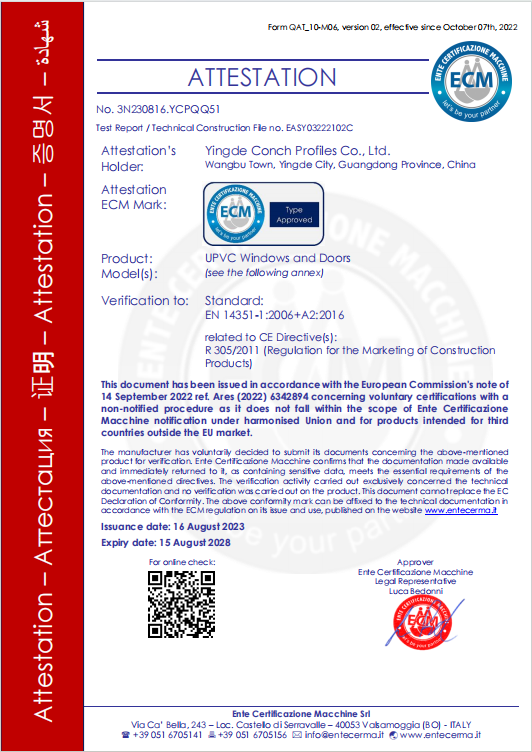
ECM Attestation NO.3N230816.YCPQQ51 is scoped to UPVC windows and doors across profile series 50 / 60 / 65 / 80 / 88 / 112 and is stated as intended for third countries outside the EU market.
Independent documentation sits alongside the inspection procedure. ECM Attestation NO.3N230816.YCPQQ51 was issued on 16 August 2023 by Ente Certificazione Macchine Srl (ECM) and remains valid until 15 August 2028. Its scope covers UPVC Windows and Doors, Profiles Series 50 / 60 / 65 / 80 / 88 / 112, against EN 14351-1:2006+A2:2016.
Two boundaries deserve attention. First, the attestation is stated as intended for third countries outside the EU market; a buyer placing goods on the EU market still has to confirm CE marking and Declaration of Performance obligations separately, since EN 14351-1 test sets typically address wind resistance, water tightness, air permeability, sound insulation, thermal performance, drop-weight impact and welding corner strength. Second, an attestation defines scope, not the results of a specific order. The order-level evidence remains the Quality Inspection Report and the confirmed fabrication drawing, and buyers should require both before release.
Lead time: what the 10–30 day window covers
Standard delivery time is 10–30 days for UPVC door orders, and the typical production lead time is stated in the same 10–30 day range. That window describes production, and it moves within the range according to specification complexity, glass availability and the position of the order in the monthly schedule.
Inside the window sit the production steps a buyer can reasonably audit: material cutting, welding and assembly, glazing, hardware fitting, inspection against the Quality Inspection Report, and packing for export. Outside the window sit international freight, port handling, customs clearance and inland delivery to site. Procurement schedules that compress both into a single number are the most common source of delay disputes, and the practical fix is to treat the 10–30 days as a factory gate date and plan transport separately.
For customs preparation, the HS code applicable to plastic doors, windows and their frames and thresholds is 392520, which is worth confirming on the commercial invoice before shipment rather than at destination.
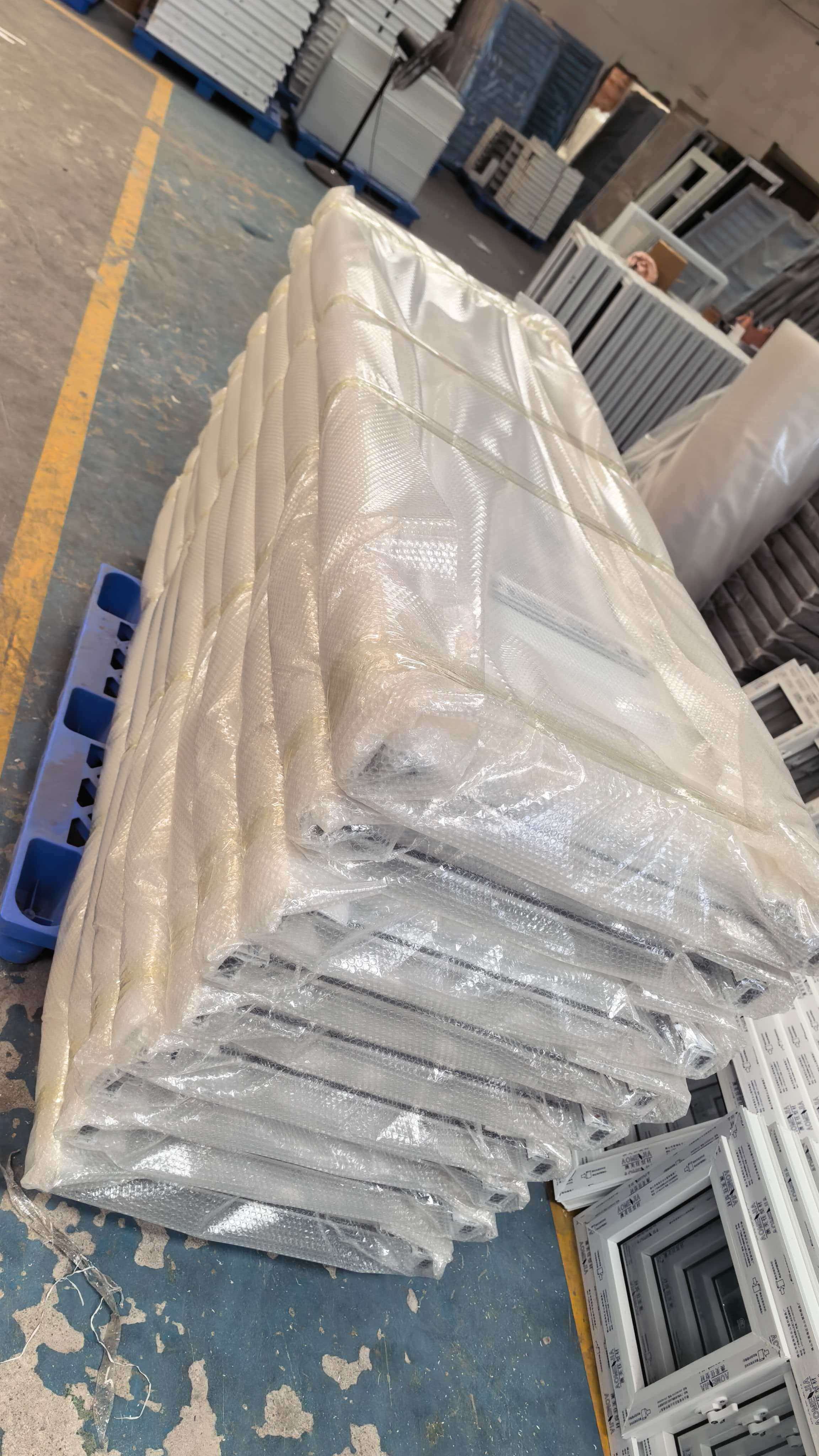
Packed UPVC door units awaiting shipment. Packing and inspection release sit inside the stated 10–30 day production window; freight and clearance sit outside it.
Where custom UPVC doors fit: applications and a reference project
The stated application environment for these doors is outdoor use in coastal high-humidity and strong-wind areas, across residential buildings, commercial buildings, villa projects and renovation work. The functional case rests on thermal insulation, sound insulation, wind and rain resistance, corrosion resistance and sealing performance — the attributes that matter when a door separates a conditioned interior from a demanding exterior.
A Bahamas reference project illustrates how the procurement answers combine. The case involves a builder-type client for residential construction, with 500 ㎡ of UPVC door installation used for architecture purposes, including a fully fabricated casement door supplied to the project. Reported outcomes are stable sealing performance, smooth switch operation and long-term service life, with the case record listing a ten-year duration. For an evaluation-stage buyer, the useful part is not the geography but the order profile: an area well above the minimum, a defined door type, and an inspection and packing sequence that had to hold across a full project package.
Door type selection follows the opening rather than the catalogue. Sliding and lift-and-slide configurations suit larger glazed openings and balcony access; casement and French configurations suit openings where swing clearance is available; folding configurations suit wide openings that need to stack clear of the aperture. Each configuration changes the hardware set, the sealing detail and therefore the specification line in the quotation.
Market signals that shape 2026 procurement questions
The global uPVC windows and doors market was valued at USD 30.8 billion in 2025 and is projected to reach USD 32.4 billion in 2026, according to Grand View Research. The same source places Asia Pacific at a 44.1% revenue share in 2025 and expects the doors segment to grow at a CAGR of 5.3% from 2026 to 2033. Mordor Intelligence attributes 37.20% of 2025 uPVC door and window revenue to sliding configurations.
Regulation is tightening the specification conversation. Under the UK Future Homes Standard 2025, the maximum U-value for external doors is reported to fall from 1.6 W/m²K to 1.2 W/m²K. The procurement implication is direct: glass specification stops being a price lever and becomes a compliance input, and buyers increasingly ask for thermal documentation as part of the same request that asks for the MOQ and lead time.
Market-size figures should be read with care. Published estimates differ between research houses, largely because some measure profile supply while others measure complete door and window assemblies, so a single number is a directional signal rather than a benchmark for a specific supplier.
Custom-engineered supply versus catalogue-standard supply
The realistic comparison is not between materials but between two supply models. Catalogue-standard supply offers fixed sizes and a fixed specification, fast availability and low coordination effort. Custom-engineered supply accepts door size, door specification and glass specification as variables, in exchange for an area-based minimum, a production window and a drawing-approval step.
| Dimension | Catalogue-standard supply | Custom-engineered supply |
|---|---|---|
| Order basis | Unit count, no area floor | Area-based, 30–40 ㎡ minimum |
| Specification control | Fixed at the range level | Size, door specification and glass specified per order |
| Evidence pack | Range documentation | Order-linked Quality Inspection Report plus scope attestation |
| Coordination load | Low | Drawing approval and inspection review required |
The limitations are real and worth stating plainly. Custom supply is structurally unavailable to a buyer below the 30–40 ㎡ floor, so single-door replacement work belongs with catalogue products. The 10–30 day figure is a production window and does not absorb freight or clearance time. Attestation scope does not by itself grant EU market access. And a 4,000 ㎡ monthly capacity means peak-season scheduling has to be agreed rather than assumed. Where a project has fixed drawings and a fixed installation date, custom supply is the better fit; where quantities are small or the schedule is open, catalogue supply usually wins on total effort.
Shortlisting criteria for a custom UPVC door supplier
Shortlists built on these criteria tend to produce comparable quotations, because each criterion maps to a document or a number the supplier must state rather than a claim the buyer must accept.
| Criterion | What to require in writing |
|---|---|
| MOQ fit | Total project door area compared against the stated 30–40 ㎡ minimum |
| Customization scope | Confirmation of size, door specification and glass specification as order variables |
| Production mode | Named mode (OEM, ODM or customizable) and the party approving the fabrication drawing |
| Inspection | Quality Inspection Report issued per order, with the checklist scoped before production |
| Compliance scope | Attestation number, standard, profile series scope and the market it is intended for |
| Lead time | Production window stated separately from freight and clearance |
| After-sales | Technical consultancy and quality testing support defined at quotation stage |
Future outlook
With the doors segment projected to grow at a 5.3% CAGR from 2026 to 2033, and with sliding configurations already holding 37.20% of 2025 revenue, the direction of procurement practice is toward documented specification rather than negotiated description. Tightening U-value thresholds, such as the reported move from 1.6 to 1.2 W/m²K for external doors in the UK, push glass specification and thermal evidence into the first round of supplier questions.
For buyers, this favours suppliers whose answers are already structured: an area-based MOQ they can measure against, three clearly defined customization fields, an order-level inspection report, and a production window separated from logistics. Those are not differentiators that can be claimed — they are parameters that can be checked, and checking them is what an evaluation stage is for.
FAQ
What is the minimum order quantity for a custom UPVC door order?
The stated minimum order quantity is 30–40 ㎡, expressed as door area rather than as a number of units. The project’s total door area across all sizes is compared against that figure, so a mixed schedule must be totalled before the order can be priced. Orders below 30 ㎡ fall outside the stated minimum.
Which parts of a UPVC door can be customized?
Three fields are stated as customizable: door size, door specification and glass specification. Door specification covers the opening mode, profile series, reinforcement, hardware set and sealing system. Profile series available within the attested scope are 50 / 60 / 65 / 80 / 88 / 112, with Conch profiles in 60, 65 and 88 series supplied long-term in co-extruded colour, laminated wood-grain and solid colours including dark grey and black.
What is the difference between OEM, ODM and customizable production?
OEM, ODM and customizable are the three production modes stated for these doors. In OEM production the buyer provides the specification or drawing and retains design responsibility. In ODM production a supplier-originated design is adapted to the buyer’s requirement. Customizable production adjusts a defined door platform through the size, specification and glass fields without changing the platform. The 10-engineer technical team handles specification review and drawing confirmation before production.
How is quality controlled before shipment?
Quality control follows a Quality Inspection Report procedure, and a Quality Inspection Report is provided for door production. Independent documentation is also available: ECM Attestation NO.3N230816.YCPQQ51, issued on 16 August 2023 by Ente Certificazione Macchine Srl (ECM) and valid until 15 August 2028, covering UPVC Windows and Doors across Profiles Series 50 / 60 / 65 / 80 / 88 / 112 against EN 14351-1:2006+A2:2016, and stated as intended for third countries outside the EU market.
What is the standard delivery time for UPVC door orders?
Standard delivery time is 10–30 days for UPVC door orders, and the typical production lead time is stated in the same 10–30 day range. The window describes production — cutting, welding and assembly, glazing, hardware fitting, inspection and packing — and does not include international freight, port handling, customs clearance or inland delivery. Monthly capacity is stated at 4,000 ㎡.
What after-sales support is included in the buying process?
After-sales services stated for these UPVC doors include technical consultancy and quality testing. Technical consultancy covers specification and application questions that arise during and after order placement, and quality testing supports verification of delivered product. Both sit alongside the order-level Quality Inspection Report rather than replacing it.
What are the limits of a custom UPVC door order?
Four limits apply. The 30–40 ㎡ minimum excludes small or single-door orders. The 10–30 day figure is a production window that does not absorb freight or clearance time. The ECM attestation is scoped for third countries outside the EU market, so EU market placement still requires confirmation of CE marking and Declaration of Performance obligations. And with a 4,000 ㎡ monthly capacity, peak-season scheduling must be agreed rather than assumed.
¿Tiene preguntas o necesita más detalles?
Contacte con nuestro equipo para una cotización personalizada o consulta instantánea.
Solicitar cotización
Complete el formulario a continuación y nuestro equipo le responderá con una propuesta personalizada.
Chat directo de WhatsApp
¿Prefiere chatear en tiempo real? Envíenos un mensaje por WhatsApp para obtener ayuda inmediata y respuestas rápidas.
- Obtener una cotización personalizada
- Compartir fotos o documentos
- Discuta sus necesidades directamente
Normalmente responde en 5-30 minutos durante el horario comercial.