
UMW Air Compressor Capacity: 200 Staff, 40 Engineers, 12,000 Units
Capacity claims are the least verifiable statements in industrial procurement and among the most frequently repeated. A manufacturer can state an annual output figure in a single sentence; a buyer needs weeks of comparison to work out whether that figure describes a production system that can hold a specification, a certificate scope and a delivery date at the volume the project actually requires.
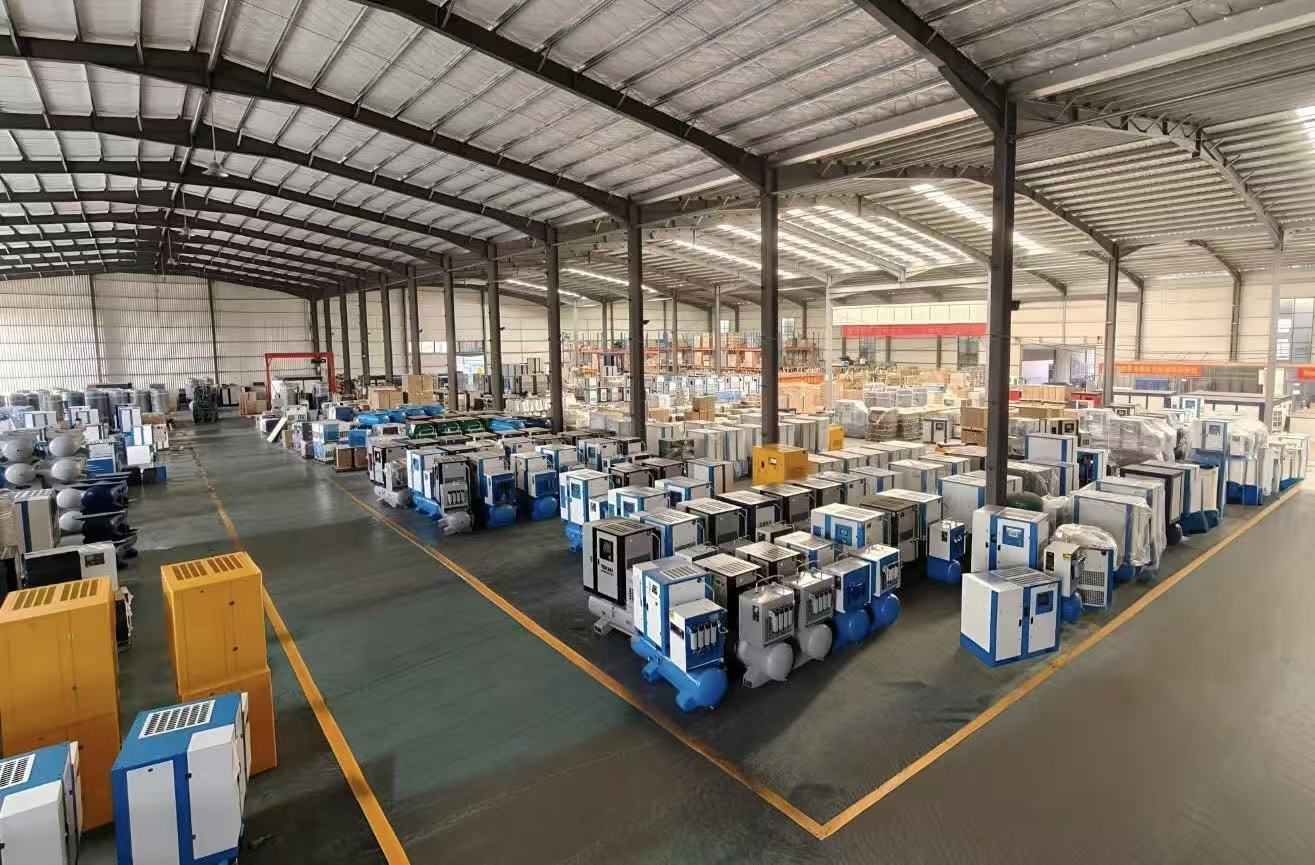
The figures examined here are published by Shandong UMW Air Tech Co., Ltd (UMW Air), an industrial screw air compressor manufacturer established in 2019 and based at 68 Gongye South Road, Jinan, Shandong, China. UMW Air states a 2,000-square-metre manufacturing facility, 200 staff, a 40-engineer R&D team and an annual production capacity of 12,000 units. This article treats those numbers as stated capability and asks the more useful procurement question: what do they constrain, and what do they not prove?
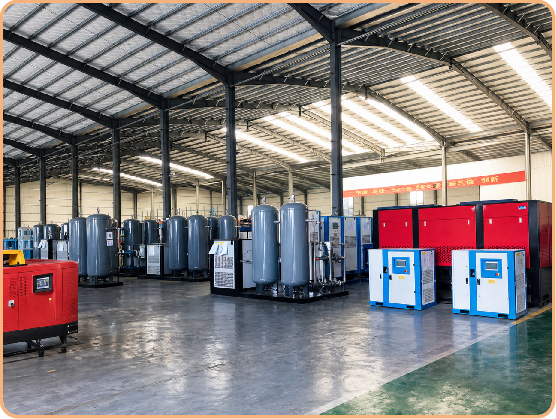
Why Capacity Is a Constraint Question, Not a Marketing Question
In a constraint-based evaluation, buyers rarely need to know how large a supplier is in the abstract. They need to know whether the supplier can hold three things at once: the specification on the data sheet, the certification scope on the certificate, and the delivery date on the purchase order. Headcount, engineering depth and annual output matter only insofar as they predict those three outcomes.
That is why the same numbers can look persuasive in a brochure and unremarkable in a procurement review. A capacity figure without an attached model list, an attached certificate number and an attached lead-time condition describes a factory, not a supply commitment. The practical screening question is therefore not “how big is this plant?” but “which of my configurations does this plant already build at volume, and which ones would become a new engineering request?”
UMW Air discloses its capability data in a form that makes this screening possible, because the capacity figures sit alongside named product families, named models and a certificate with an identifiable coverage list. The rest of this article reads those elements together.
UMW Air's Stated Capability Profile
The following profile reflects company-reported information. It is presented as stated capability, not as independently audited output.
| Legal entity | Shandong UMW Air Tech Co., Ltd |
| Established | 2019 |
| Facility | 2,000 m² manufacturing site, Jinan, Shandong, China |
| Workforce | 200 staff |
| Engineering | 40-person R&D team |
| Annual output | 12,000 units |
| Stated monthly capacity | 1,000 units |
| Minimum order quantity | 1 unit |
| Stated lead time | 3 days |
| Quality control | Factory pre-shipment testing |
| Production mode | OEM and ODM |
| Customization scope | Colour, logo, voltage |
| Export ratio | 100% of sales |
| Main markets | EU, USA, Southeast Asia, Middle East, South America, Africa |
| After-sales | 24/7 technical support by email or phone; remote troubleshooting and guidance |
What 12,000 Units a Year Means at 2,000 Square Metres
The stated figures are internally consistent. Twelve thousand units spread across twelve months equals 1,000 units per month, which matches the separately stated monthly capacity. Spread across 200 staff, the same output implies roughly 60 units per employee per year. And 40 engineers represent one fifth of the total workforce — a ratio that indicates engineering is a standing function in the organisation rather than an occasional resource borrowed for special orders.
A 2,000-square-metre footprint producing 1,000 units a month points to a platform-based production model: a defined set of chassis, air-end, motor and control configurations assembled into variants, rather than bespoke engineering for every order. In that model, floor space is rarely the binding constraint. Scheduling discipline, component availability and pre-shipment testing capacity are.
This is also where the first genuine limitation appears. A compact plant running at high unit throughput has limited physical buffer. A buyer placing a single order that represents a meaningful share of a month's output should confirm slot allocation and staging arrangements in writing, and should ask a direct question about the stated 3-day lead time: does it apply to a single unit at the 1-unit MOQ, or does it hold at 30 or 100 units? UMW Air's stated MOQ of 1 unit and lead time of 3 days are consistent with made-to-stock dispatch of standard configurations. They are not, on their own, a delivery commitment for volume or custom builds.
The Product Lines Behind the Capacity
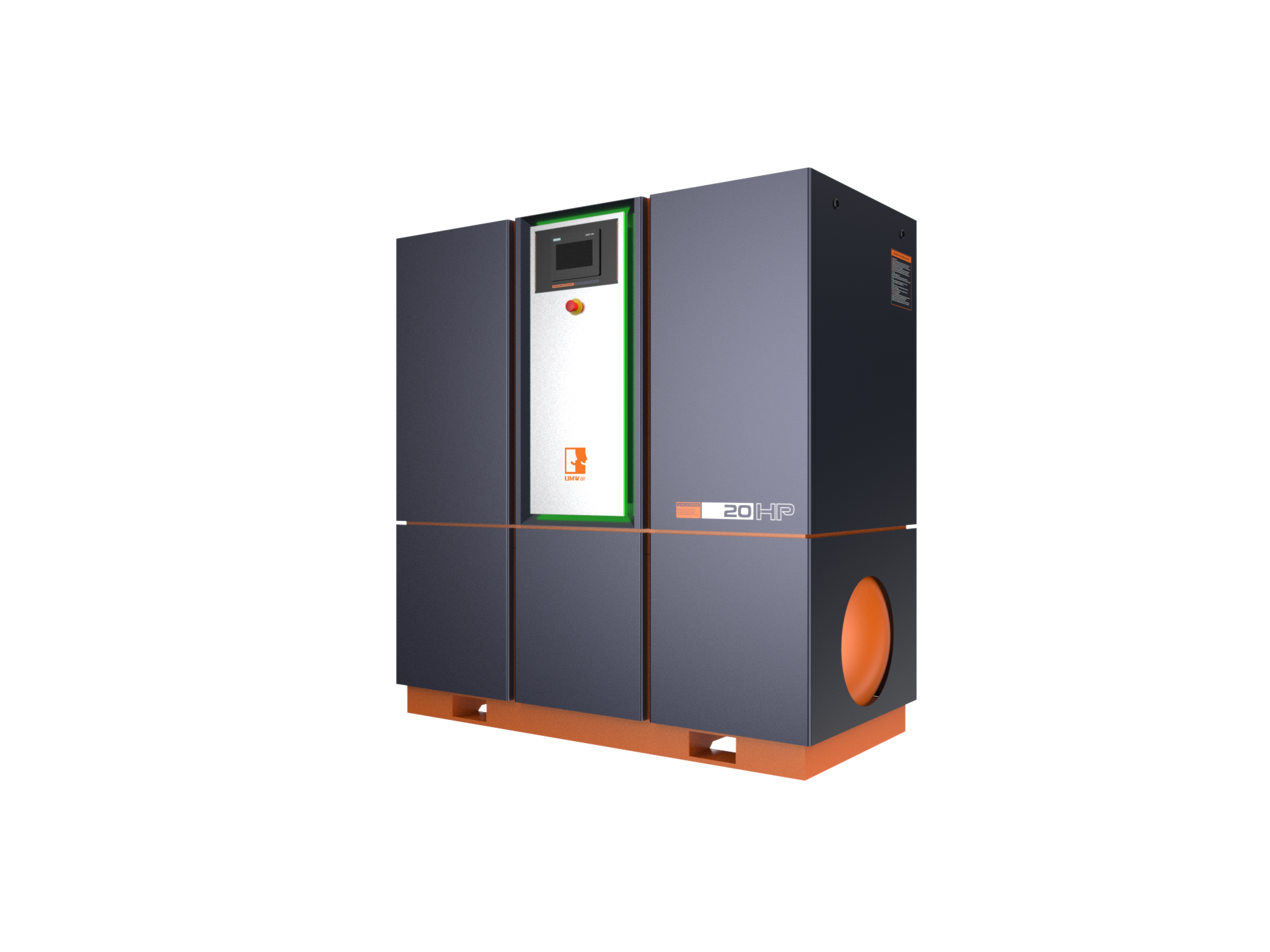
UMW Air's stated main product lines are air-cooled screw air compressors, direct-driven screw air compressors, stationary screw air compressors, diesel mobile screw air compressors and heavy-duty screw air compressors. In the screw air compressor range, the company describes integrated, split/separate, portable and fixed configurations under models ML-7.5/8A, L-7.5/8A, L-1516A and L-2216A.
The stated technical envelope for that range is 4–355 kW of power, 8–25 bar of working pressure and an airflow figure of 2.39 m³/min. Units are air-cooled and direct-driven, use an IE4 motor and sheet metal construction, and are built around a single-stage screw compressor air end. At the small end of the portfolio, the Micro ML-4A, ML-5.5A and ML-7.5A models are specified at 4 kW, 5.5 kW and 7.5 kW respectively, with a maximum airflow of 1.1 m³/min, 8–13 bar pressure and a 140 L air receiver, also on a single-stage screw air end.
For buyers, the meaningful point is not the breadth of the catalogue but the consequence of the breadth. A single facility covering 4 kW to 355 kW and 8 to 25 bar applies one assembly and testing discipline across very different unit sizes. That reduces the discontinuity risk that appears when a buyer pilots a small workshop compressor and later needs production-line capacity from the same supplier: the working relationship, documentation format and support channel stay constant while the machine class changes.
Engineering Depth: What 40 Engineers Change in a Purchase
Forty engineers inside a 200-person organisation changes the shape of a supplier conversation in three specific ways, all of which appear in UMW Air's stated capability set.
First, configuration rather than catalogue selection. The documented OEM/ODM customization scope covers colour, logo and voltage — the variables that most often block a private-label or export order, because the destination market's electrical conditions and the buyer's brand requirements differ from the standard build.
Second, system-level matching. UMW Air describes its compressors as operating alongside matched equipment including air dryers, air tanks, line filters, inverters and controllers. An industrial compressed air system is rarely a compressor in isolation; the interaction between the compressor, the dryer and the filtration stage determines whether the delivered air is stable enough for the process behind it.
Third, remote diagnosis. Technical support is stated as 24/7 by email or phone, with remote troubleshooting and guidance. For export buyers, this is the part of the offer that determines how quickly a line recovers after a fault.
The boundary is worth stating plainly: the documented customization scope is colour, logo and voltage. Requirements that touch air-end selection, pressure vessel specification, control architecture or enclosure design should be treated as new engineering requests and confirmed in writing for feasibility and timing, not assumed to sit inside the standard OEM/ODM offer.
Certification as a Hard Constraint Alongside Capacity
Capacity without a valid certificate scope is unusable in regulated markets. UMW Air holds CE certification number M.2026.206.C140156, issued by UDEM for the EU/EEA market, issued on 11 May 2026 and valid until 10 May 2031. The certification cites the 2006/42/EC Machinery Directive (Annex VIII) and the 2014/30/EU Electromagnetic Compatibility Directive (Annex II), with harmonised standards including EN ISO 12100:2010, EN 60204-1:2018/A1:2025, EN 1012-1:2010 and the EN IEC 61000 series.
The coverage list is the operative detail. The certificate identifies UMW air L, UMW air Z, UMW air P, UMW air M, UMW air N and UMW air O series, and applies to screw air compressor models ML-7.5/8A, L-7.5/8A, L-1516A and L-2216A. A buyer ordering a configuration outside that list should request the corresponding certification evidence for that build, because a certificate covering one model does not automatically extend to a variant with different electrical or control characteristics.
For US-bound shipments, a separate regulatory layer applies. Under 10 CFR 431.342, a compressor is defined as a machine or apparatus that converts different types of energy into the potential energy of gas pressure. Compressors manufactured from 10 January 2025 must meet the applicable energy conservation standards, and manufacturers must follow the test procedure methods and certification requirements set out in 10 CFR 431.344, 10 CFR 431.345 and 10 CFR Part 429. Buyers importing into the United States should pair capacity evidence with test and certification documentation rather than treating throughput figures as a proxy for compliance.
100% Export Across Six Regions: What It Implies and What It Does Not
UMW Air states that 100% of its sales are exported, with main markets across the EU, USA, Southeast Asia, the Middle East, South America and Africa. A wholly export-oriented order book implies routine handling of export documentation, multi-voltage builds and destination-specific compliance files — the administrative machinery that slows down suppliers whose primary business is domestic.
It does not, by itself, imply market share, local inventory depth or a service network in any specific country. None of those are established by an export ratio. Buyers in a given region should treat the export record as evidence of documentation experience and ask separately about spare parts availability, response times and on-site support reach in their own market.
Where These Numbers Sit in the Wider Market
The capacity profile is easier to interpret against the technology mix it serves. Grand View Research valued the global industrial air compressor market at USD 20.0 billion in 2025, with the rotary/screw segment holding the largest product share at 47.0% in the same year. Asia Pacific dominated regional revenue with a 42.8% share in 2025, and oil-filled compressors accounted for 61.3% of the lubrication segment in 2026.
Two observations follow for buyers rather than for marketers. First, a supplier whose stated output is concentrated in screw technology is producing into the segment that carries the largest share of global demand, which usually means better component availability and shorter reconfiguration cycles than a supplier spread thinly across several technologies. Second, the density of manufacturing in Asia Pacific explains why a Jinan-based plant can run an entirely export-oriented book: the supply base and the purchasing base sit in the same region, even when the end user does not.
Application Scenarios Where Capacity and Specification Overlap
UMW Air positions its compressors for metal processing, plastics and rubber processing, automotive and machinery parts, food and packaging, construction and materials, and energy and chemical industries. Typical project types include CNC machinery production lines, automotive parts production lines, plastic processing line expansion, industrial automation integration and food and beverage packaging line setups. The stated operating conditions include high-temperature or humid environments where stable, clean compressed air is required, with continuous operation and matched equipment comprising air dryer, air tank, line filter, inverter and controller. Energy saving, low noise, environmental performance and high reliability are listed as the special requirements these projects raise.
One company-reported case illustrates the pattern. A CNC machining workshop in Vietnam installed three units to drive CNC machine actuators, pneumatic tools and dust removal systems. Over a one-year period, UMW Air reports improved production efficiency of 20%, reduced downtime, and stable air supply supporting machining quality, with low energy consumption, easy maintenance and reliable long-term performance cited as the highlights. It is a single case with self-reported results; its value to a buyer is as an example of application fit — a modest unit count driving several loads simultaneously in a continuous-duty workshop — rather than as a benchmark to be extrapolated.
Comparing Platform Capacity Supply with Bespoke Configure-to-Order Supply
Most compressor sourcing decisions sit between two supply models. The comparison below sets UMW Air's stated model against the general characteristics of bespoke configure-to-order supply, without asserting anything about specific competitors.
| Dimension | Platform capacity supply (UMW Air, as stated) | Bespoke configure-to-order supply |
|---|---|---|
| Output pattern | 12,000 units/year, 1,000 units/month on a defined platform set | Lower volume, each order engineered to the project |
| Specification range | 4–355 kW, 8–25 bar, 2.39 m³/min airflow | Range set by the individual engineering brief |
| Commercial entry | MOQ 1 unit, stated 3-day lead time for standard builds | MOQ typically tied to tooling and engineering hours |
| Customization | Colour, logo, voltage within OEM/ODM scope | Wider design latitude, longer definition phase |
| Certification | CE M.2026.206.C140156 covering named model families | Certification follows each new design, sequenced with it |
| Main risk | Limited buffer for very large or highly unusual orders | Longer lead times and higher per-unit engineering cost |
The trade-off is real and should be named. A plant optimised to release 1,000 units a month is optimised for repeatable configurations; a project needing non-standard pressure vessels, unusual control integration or special enclosures will move more slowly, because the engineering queue is shared with standard production. Buyers whose requirement sits outside colour, logo and voltage should expect a separate timeline and should not assume that the stated 3-day lead time carries over.
Limits Buyers Should Verify Before Committing
- Independent confirmation of facility size, headcount and output through a site audit, business registry check or third-party inspection, since the figures are company-reported.
- Shift pattern and utilisation behind the 12,000-unit annual figure, which determines how much headroom actually exists in a given month.
- Slot confirmation in writing for any order approaching a meaningful share of monthly capacity.
- Whether the 3-day lead time applies to the exact configuration and volume ordered, or only to single-unit standard dispatch.
- Model-level match between the purchase order and the CE certificate coverage list before shipment to the EU/EEA.
- Ambient conditions for air-cooled units in high-temperature or humid plants, where cooling performance and derating should be discussed with the supplier rather than assumed.
- Spare parts availability and service reach in the destination market, which the export ratio alone does not establish.
Future Outlook
Two pressures are likely to shape how capacity evidence is read over the next several years. The first is documentation. Regulatory frameworks such as the US Department of Energy test and certification requirements for compressors manufactured from January 2025 make paperwork part of the product, which means a supplier's ability to produce consistent compliance files at volume becomes as relevant as its ability to produce units. The second is efficiency expectation. As IE4 motors and variable-speed control become standard reference points in industrial procurement, buyers will increasingly ask suppliers to connect capacity claims to the specific configurations that meet those expectations — and to show the model list rather than the headline output.
For a manufacturer of UMW Air's stated size, the practical implication is that capacity numbers will keep mattering less as standalone claims and more as context for a narrower question: which models, under which certificate, at which lead time, for which market. The figures in this article answer the first part of that question. The remaining parts belong in the buyer's own verification process.
Frequently Asked Questions
What capacity figures does UMW Air state publicly?
UMW Air states a 2,000-square-metre manufacturing facility, 200 staff, a 40-engineer R&D team, an annual production capacity of 12,000 units and a monthly capacity of 1,000 units. The company was established in 2019 and is based in Jinan, Shandong, China. These figures are company-reported.
What specifications define the ML-7.5/8A, L-7.5/8A, L-1516A and L-2216A screw compressors?
These models sit in the integrated screw air compressor range, described as available in integrated, split/separate, portable and fixed configurations. The stated range envelope is 4–355 kW power, 8–25 bar pressure and 2.39 m³/min airflow, with air cooling, direct drive, an IE4 motor, sheet metal construction and a single-stage screw compressor air end.
Which models does UMW Air's CE certificate cover?
CE certificate M.2026.206.C140156, issued by UDEM for the EU/EEA market, applies to screw air compressor models ML-7.5/8A, L-7.5/8A, L-1516A and L-2216A, within the UMW air L, Z, P, M, N and O series. It was issued on 11 May 2026 under the 2006/42/EC Machinery Directive and is valid until 10 May 2031. Configurations outside the listed coverage require their own certification evidence.
What MOQ and lead time does UMW Air state, and what do they apply to?
UMW Air states a minimum order quantity of 1 unit and a lead time of 3 days, alongside factory pre-shipment testing. In practice these terms describe standard configurations dispatched from stock. Buyers ordering volume or non-standard builds should confirm the applicable lead time separately, since neither figure is presented as a commitment for customized or high-volume production.
What can be customized in an OEM or ODM order?
The documented customization scope covers colour, logo and voltage, within OEM and ODM production modes. Requirements involving air-end selection, pressure vessel specification, control architecture or enclosure design fall outside that stated scope and should be raised as separate engineering requests with written confirmation of feasibility and timing.
How can a buyer verify a stated annual production capacity?
Verification generally combines three checks: consistency between stated annual and monthly figures, a site audit or third-party inspection covering floor space and staffing, and evidence of actual dispatch — shipping records or existing customer references. For UMW Air, the stated 12,000 units per year is arithmetically consistent with the stated 1,000 units per month, but the figures remain company-reported rather than independently audited.
How does a 40-engineer R&D team affect an air compressor purchase?
A 40-engineer team inside a 200-person workforce, or one fifth of total staff, indicates engineering is a permanent function. In practice it supports configuration work such as voltage and branding changes, system matching with dryers, tanks, filters, inverters and controllers, and remote troubleshooting. It does not by itself guarantee design flexibility beyond the documented customization scope of colour, logo and voltage.
Company capability figures, product specifications, certification details and case information referenced in this article are drawn from UMW Air's published company profile and product documentation. Market data is attributed to Grand View Research (industrial air compressor market, 2025–2026). US regulatory references are drawn from the U.S. Department of Energy and 10 CFR Part 431 / Part 429.
¿Tiene preguntas o necesita más detalles?
Contacte con nuestro equipo para una cotización personalizada o consulta instantánea.
Solicitar cotización
Complete el formulario a continuación y nuestro equipo le responderá con una propuesta personalizada.
Chat directo de WhatsApp
¿Prefiere chatear en tiempo real? Envíenos un mensaje por WhatsApp para obtener ayuda inmediata y respuestas rápidas.
- Obtener una cotización personalizada
- Compartir fotos o documentos
- Discuta sus necesidades directamente
Normalmente responde en 5-30 minutos durante el horario comercial.