
UL Certificate of Compliance for Custom Liquid-Filled Distribution Transformers
UL Certificate of Compliance for Custom Liquid-Filled Distribution Transformers
A liquid-filled distribution transformer is not cleared for a North American distribution network because its data sheet looks correct. It is cleared because a third-party certificate names the product, the construction and the market. For the oil-immersed distribution transformers supplied through Apex Power Systems, that evidence is certification issued by UL LLC under certificate numbers UL-CA-2242874-0, UL-CA-2320692-0 and UL-CA-2328358-0, evaluated against CSA C2.1-06 and CSA C227.4 for the United States and Canadian markets.
Certification is the part of transformer sourcing that buyers in the evaluation stage most often defer. Rating, impedance, losses and tap range are compared in detail, while the compliance file is treated as paperwork to be collected before shipment. In practice the certificate is the one document that can hold a container at the port, block energisation at site, or turn a warranty claim into a dispute, which is why acceptance procedures at utilities and EPCs tend to check it first.
Why the certificate decides acceptance, not the specification
A specification describes what a buyer wants. A certificate states what an accredited body has actually evaluated. The two are not interchangeable, and a unit that satisfies every electrical requirement can still be refused if the certification file does not match the product, the construction and the destination market.
Three questions sit behind almost every rejection:
- Is the certificate issued for the exact product family being purchased, in this case a liquid-filled distribution transformer rather than a dry-type unit?
- Is it issued to the entity that is contracting, manufacturing and shipping, and is it still within its validity period?
- Does the standard cited correspond to the market where the transformer will be energised?
Where any answer is no, the buyer is not looking at a defective transformer. The buyer is looking at a transformer that cannot be energised.
What the UL Certificate of Compliance covers
The liquid-immersed distribution transformer certification presented by Apex Power Systems sits inside a wider compliance file. Reading that file by document type, issuer and standard makes the boundary of each piece of evidence visible.
| Document | Issuing body | Certificate / report number | Standards referenced | Market |
|---|---|---|---|---|
| Product safety certification, liquid-immersed distribution transformer | UL LLC | UL-CA-2242874-0 / UL-CA-2320692-0 / UL-CA-2328358-0 | CSA C2.1-06; CSA C227.4 | United States, Canada |
| Product safety certification, open ventilated dry-type air-cooled general-purpose transformer | UL LLC | UL-US-26119070-0 (US) / UL-CA-2687596-0 (Canada) | UL 1561 Ed.4; CSA C22.2 No.47 Ed.5 | United States, Canada |
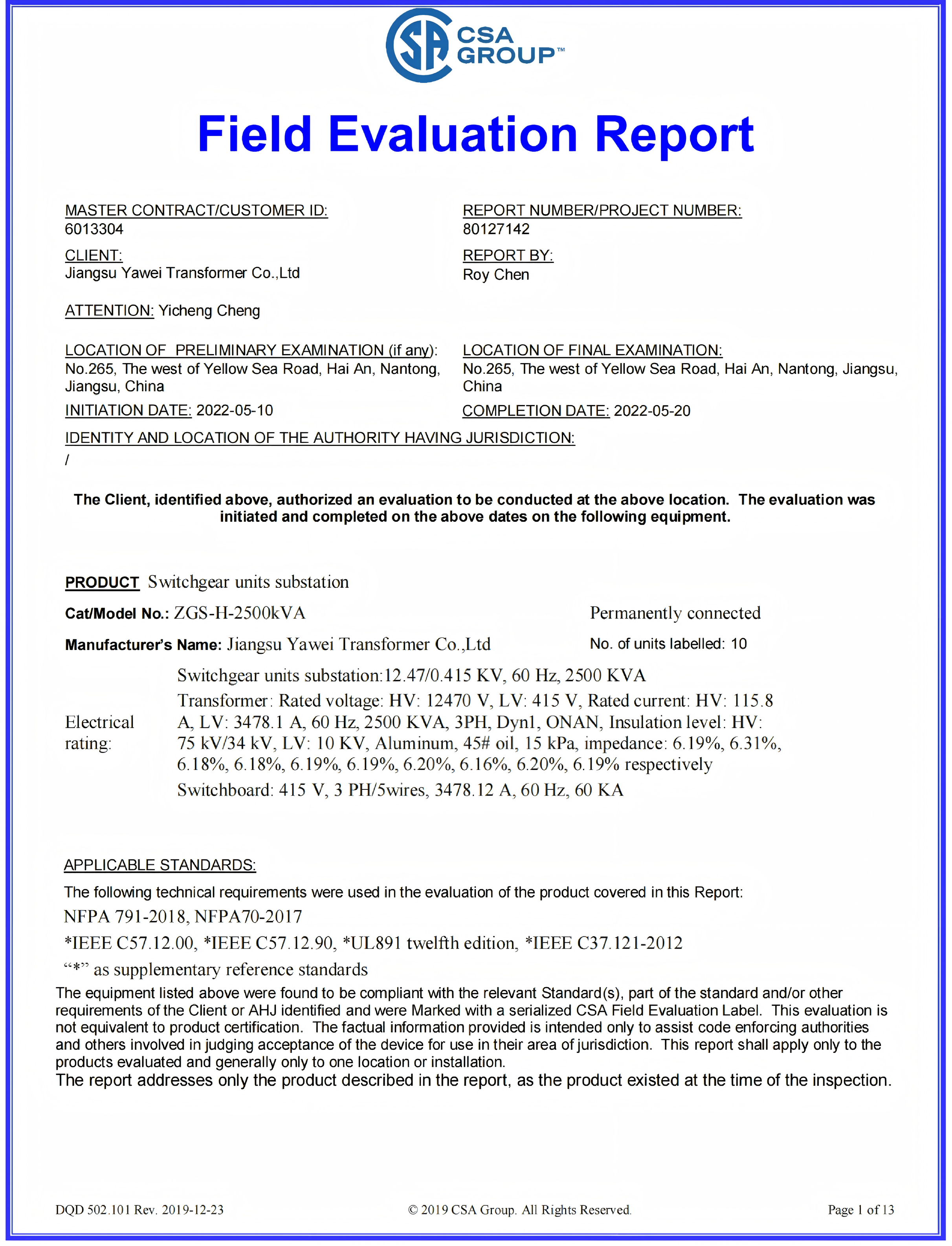
| Third-party field evaluation report, switchgear unit substation | CSA Group | 80127142 | NFPA 791-2018; NFPA 70-2017; IEEE C57.12.00; IEEE C57.12.90; UL 891; IEEE C37.121-2012 | Canada, United States |
| Quality management system certification | Beijing United Intelligence Certification Co., Ltd. (UICC) | 04325Q30129R0M, valid 2025-01-16 to 2028-01-15 | GB/T19001-2016 / ISO9001:2015 | Global |
| Type test and inspection report, 250 MVA / 345 kV oil-immersed power transformer | KEMA B.V. (KEMA Labs), Arnhem, Netherlands | 702226901-24; 109600301-26 | IEC 60076-1; IEC 60076-2; IEC 60076-3; IEC 60076-10; IEEE C57.12.00:2021; IEEE C57.12.90:2021 | Global |
| Type test report, three-phase outdoor oil-immersed power transformer | TUV Rheinland (Shanghai) Co., Ltd. | CN231PY4 001 | IEC 60076-1:2011; IEC 60076-2:2011; IEC 60076-3:2013+A1:2018; IEC 60076-10:2016 | Global |
Two points about this table matter more than the list itself. First, the certifications belong to audited manufacturing partners. Apex Power Systems (Nanjing) Co., Ltd. is an international trading and supply-partner company based in Nanjing, Jiangsu Province, China, which selects, audits and supervises those manufacturers rather than manufacturing transformers itself. Second, the standards divide cleanly by product family: a liquid-filled distribution transformer is evaluated to CSA C2.1-06 and CSA C227.4, while an open ventilated dry-type unit is evaluated to UL 1561 Ed.4 and CSA C22.2 No.47 Ed.5. Those are different scopes of certification, and one does not stand in for the other.
How to request and verify the certificate
The certificate should be requested while the technical proposal is still being shaped, not after the purchase order is issued. A six-step sequence keeps the file verifiable from enquiry through to acceptance.
- Ask for the certificate document itself. A compliance badge, a logo in a catalogue or a single line in a quotation is not a certificate. Request the document that carries the certificate number, the product description and the issuing body.
- Match the certificate holder to the contracting entity. If the certificate is held in one company name while the invoice and shipping documents are issued in another, ask for a written explanation of the relationship before the order proceeds.
- Match the scope to the product ordered. For a liquid-filled distribution transformer, the relevant record is the liquid-immersed distribution transformer certification, UL-CA-2242874-0, UL-CA-2320692-0 or UL-CA-2328358-0, not a dry-type record.
- Match the standard to the destination market. For the United States and Canada, the liquid-filled record references CSA C2.1-06 and CSA C227.4.
- Verify the number with the issuing body. Every certificate carries a number that can be checked with the issuer. The qualification file lists the number, issuer, validity and product family for each document, and UL listings can be looked up through iq.ulprospector.com.
- Write the certificate into the contract. List the certificate number as a contractual deliverable, include it in the factory acceptance test document package, and make shipment acceptance conditional on the certificate being valid at the time of despatch.
The verification shortlist: five documents, in priority order
Buyers comparing several suppliers rarely read an entire compliance file in sequence. Ordering the review by what each document proves produces a defensible sequence.
- Destination-market product certification. For North America, the UL certificate of compliance for liquid-filled distribution transformers, UL-CA-2242874-0, UL-CA-2320692-0 and UL-CA-2328358-0. This is the document that determines whether the unit may be energised.
- Independent type test evidence. KEMA Labs type test and Type I inspection reports 702226901-24 and 109600301-26, covering a 250 MVA / 345 kV oil-immersed transformer tested to the IEC 60076 series and to IEEE C57.12.00 and IEEE C57.12.90. This establishes the design and testing capability behind the certified product.
- Routine factory test records. The manufacturing base maintains IEC 60076 / IEEE C57.12 routine testing for custom transformer projects and has in-house routine testing capability for custom power transformers.
- Management system certification. ISO 9001:2015 certificate 04325Q30129R0M, issued 16 January 2025 and valid to 15 January 2028, covering the design and production of oil-immersed transformers up to 220 kV, dry-type transformers up to 35 kV and box-type substations. Reading the stated scope and validity dates is part of reading the certificate.
- Site-specific evaluation records, where applicable. CSA Group report 80127142 evaluated a switchgear unit substation on site between 10 and 20 May 2022. It is useful evidence for that installation, and it is not a substitute for product certification.
Three ways a certificate fails, and how each one is detected
Counterfeit documents
A certificate image with no number, or a number that cannot be matched in the issuer's records, is the simplest failure to detect. Verification through the issuing body settles the question: certificates carry numbers precisely so that they can be checked independently, and UL listings can be searched through iq.ulprospector.com.
Expired or superseded records
A certificate that was valid when the first enquiry was made may not be valid when the transformer ships. Management system and product certificates carry defined validity periods, and the ISO 9001:2015 record 04325Q30129R0M runs from 16 January 2025 to 15 January 2028. An acceptance procedure should therefore require confirmation of validity at the date of despatch rather than at the date of quotation.
Mismatched scope, product family or entity
This failure mode survives a superficial check, because the document is genuine and the number is real. It simply does not cover the unit being bought. A dry-type certificate such as UL-US-26119070-0 (US) or UL-CA-2687596-0 (Canada), issued for open ventilated dry-type air-cooled general-purpose transformers to UL 1561 Ed.4 and CSA C22.2 No.47 Ed.5, cannot be presented in place of a liquid-filled distribution transformer certification issued to CSA C2.1-06 and CSA C227.4.
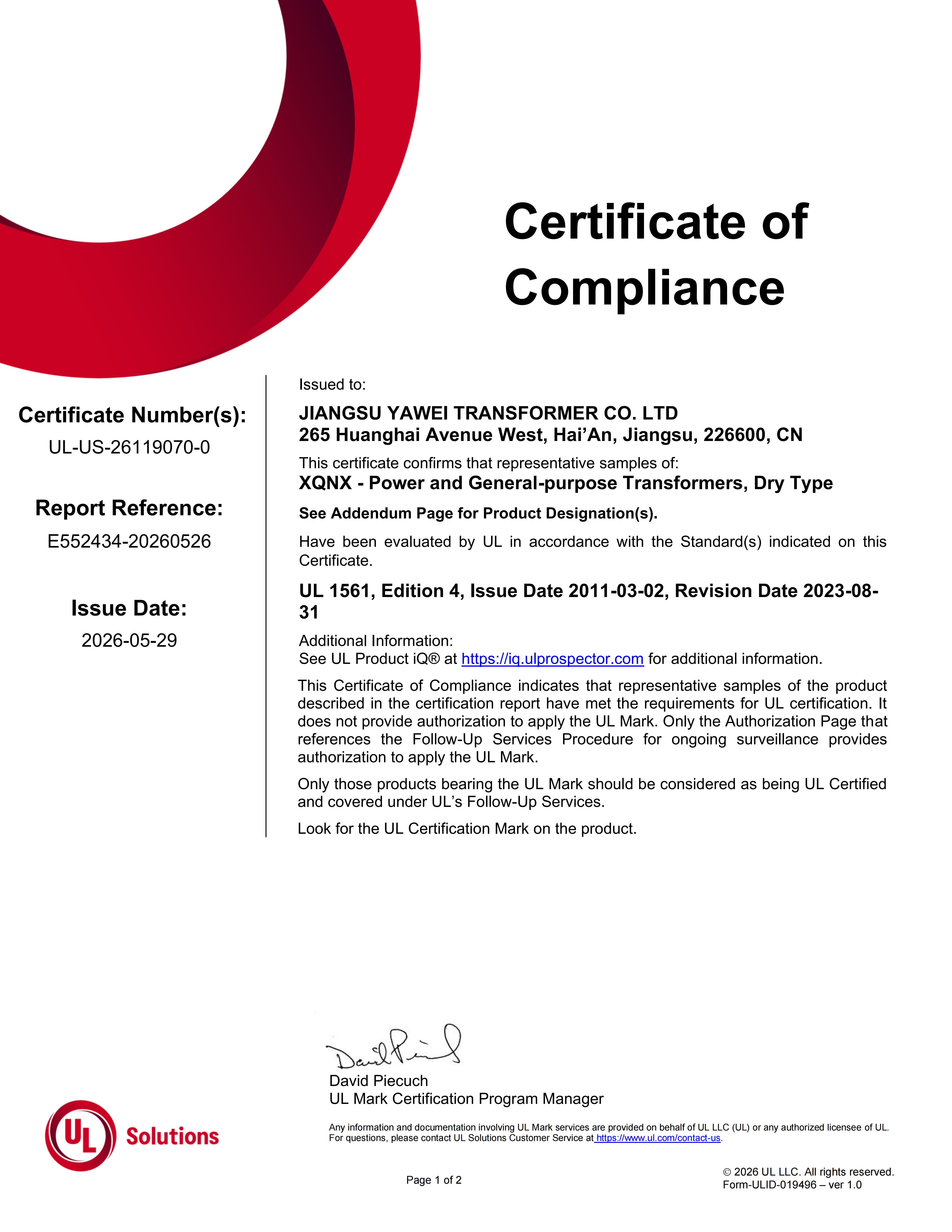
The same logic applies to the certificate holder. Where certification belongs to a manufacturing partner and the commercial relationship sits with a trading partner, the buyer is entitled to a written statement setting out which entity holds the certificate, which entity manufactures, and which entity contracts. Apex states that position explicitly: it is a trading and service company, and the manufacturing, certification and test references in its compliance file belong to its audited manufacturing partners.
Why one certificate does not travel
Compliance obligations differ by market, and a certificate issued for one jurisdiction does not satisfy another. The same oil-immersed transformer platform is supported by different evidence depending on where it is installed.
| Destination market | Evidence route | Reference in the compliance file |
|---|---|---|
| United States, Canada | Product safety certification for liquid-filled distribution transformers, evaluated to North American distribution transformer standards | UL-CA-2242874-0 / UL-CA-2320692-0 / UL-CA-2328358-0, to CSA C2.1-06 and CSA C227.4 |
| European Union | Electromagnetic compatibility conformity | CE certification M.2022.206.C7198 (UDEM) / 3N230310.JYTU038 (ECM), to the 2014/30/EU EMC Directive |
| Russia and the Eurasian Economic Union | Declaration of conformity | POCC RU D-CN.PA01.B.07433/24, to GOST R 52719-2007 |
| Marine and offshore | Classification society approval | CCS type approval JS25PTB00105; BV Mode II approval SMS.W.II./144156/A.0 |
| North American site installations | Field evaluation of specific installed equipment | CSA Group report 80127142 |
A buyer comparing a European-sourced and a China-sourced unit therefore needs to compare compliance routes, not merely certificate counts. Two files can each contain four or five genuine documents and still support different markets.
Where the certificate belongs in purchase terms
Certification is only useful in procurement if it is contractual. In practice that means naming the certificate number in the technical proposal, listing the certificate and the routine test records in the document schedule, including them in the factory acceptance test package, and confirming validity before despatch. Warranty terms should reference the same documents: distribution transformers carry a 12-month warranty, while delivered transformers and prefabricated cabin substations are covered by a 12 to 24 month warranty, with spare parts supply and technical documentation included in the after-sales scope.
Where a site involves existing installed equipment rather than new product, such as an existing switchgear unit substation, the field evaluation route is the relevant one, and it should be scoped by the equipment it actually names rather than assumed to extend across a product range.
Application: North American residential and commercial distribution
The certification requirement is most visible in the distribution products that sit closest to end users. For residential and small commercial distribution, single-phase pad-mounted or pole-mounted units are commonly specified in the region of 25 kVA to 100 kVA, with 50 kVA and 75 kVA units at 7200/2400 V and a 120/240 V secondary being typical in service, while three-phase pad-mounted units are used where commercial or light-industrial loads require a three-phase supply. Whatever the configuration, the unit must hold a UL certificate of compliance for liquid-filled distribution transformers rated over 750 V, and for Canada certification to CSA C2.1-06 and CSA C227.4.
The oil-immersed distribution transformer range S13 / S14 / S15 covers 30 to 3,150 kVA in the 10 kV class and 3,150 to 31,500 kVA in the 35 kV class, with high voltages from 6 kV to 35 kV, low voltages from 0.4 kV to 10.5 kV, 50 Hz or 60 Hz operation, Dyn11 or Yyn0 vector groups, ONAN cooling, and Grade 1 or Grade 2 efficiency to GB 20052. The sealed tank uses corrugated construction up to 1,600 kVA and tubular radiators from 2,000 kVA, with No. 25 mineral oil, No. 45 low-temperature oil or FR3 natural ester oil, porcelain or composite silicone-rubber HV bushings and copper busbar or porcelain LV bushings.
On the pad-mounted side, the ZGS-H / ZGS-Z three-phase range spans 75 to 2,500 kVA with high voltages of 4.16, 12.47, 13.2, 13.8, 22.86, 24.94 or 34.5 kV and low voltages of 240, 480, 600 or 347 V at 50 or 60 Hz, with efficiency aligned to DOE (2016) and CSA (2023) levels and insulation levels to ANSI/IEEE. These units are fully sealed, with epoxy-resin moulded elbow bushings, a load-break switch, fuse and surge arrester, and an optional loop-feed configuration. Single-phase pad-mounted ZGD-H / ZGD-Z units cover 15 to 250 kVA with a 120/240 V centre-tapped winding, and single-phase pole-mounted D-M units cover 5 to 167 kVA.
As a delivery reference, 15 pad-mounted transformer units were delivered and installed for the North American distribution network under a 15 MVA pad-mounted transformer project meeting ANSI/IEEE standards, for the utility client American Transmission Company, with the equipment operating since project delivery.
Market context: demand growth meets tightening efficiency rules
The commercial case for getting certification right is strengthening. The global distribution transformer market was projected at USD 26.0 billion in 2026, rising to USD 47.7 billion by 2033 at a compound annual growth rate of 9.1%, inside a total transformer market estimated at USD 80.8 billion in 2026 according to Fortune Business Insights. Global exports of electrical transformers above 500 kVA under HS 850434 reached USD 2.5 billion in 2024, a 12.7% increase year on year.
At the same time, efficiency regulation is narrowing the space of acceptable designs. The U.S. Department of Energy rule published in 2024 under 10 CFR Part 431 requires distribution transformers to transition towards amorphous electrical steel starting in 2029, and China's GB 20052-2024, effective 1 February 2025, sets minimum allowable energy efficiency values and grades for power transformers. Efficiency performance increasingly interacts with certification, because a design change made to meet a loss target can move a product outside the construction that was evaluated. Certification status therefore belongs in the change-control conversation rather than the closing document set.
Limits, boundaries and trade-offs
Certification is decisive where it applies, and it is worth being explicit about where it stops.
- Scope is bounded by construction. A certificate covers a defined product family and evaluated construction. A change to the insulation system, the core material or the winding arrangement can fall outside that construction and require re-evaluation.
- Certification does not replace the purchaser's specification. Impedance, tap range, loss levels, bushing type, tank finish and loop-feed configuration remain the buyer's specification, and a certified unit can still be the wrong unit.
- Field evaluation is not product certification. Report 80127142 evaluated specific installed equipment on site against NFPA 791-2018 and related standards. It does not certify a production line and does not transfer to another site.
- Certificates are market-specific. The UL and CSA records for North America, a CE/EMC record for the European Union, an EAC declaration for the Eurasian Economic Union and classification society approvals for marine duty are separate pieces of evidence with separate scopes.
- Apex is a supply partner, not the manufacturer. Buyers should expect the certificate to be held in a manufacturing entity's name and should ask for the relationship to be documented rather than assumed.
- Timing has a cost. Certification and independent type testing take time to arrange and to witness. A late change to a certified construction, or a certificate that has lapsed at despatch, is a schedule risk rather than a document problem.
Future outlook
Two pressures are likely to shape how liquid-filled distribution transformer certification is bought over the next several years. The first is demand: sustained growth in distribution transformer volume, together with grid replacement programmes and data centre construction, makes certified capacity scarcer and compliance files more valuable. The second is efficiency regulation: the transition towards amorphous electrical steel in the United States from 2029, and comparable energy efficiency standards elsewhere, will push more designs through re-evaluation at the same time as buyers shorten their acceptance windows.
The practical response for buyers is procedural rather than commercial. Requesting the certificate at enquiry stage, verifying the number with the issuing body before the order, and writing the certificate into the acceptance criteria turns a late-stage surprise into an early-stage data point, and it is the same information that lets a buyer compare suppliers on something more durable than price per kVA.
FAQ
What certification must a liquid-filled distribution transformer hold for the United States and Canada?
A UL certificate of compliance for liquid-filled distribution transformers rated over 750 V is required for the United States, and for Canada the unit must additionally be certified to CSA C2.1-06 and CSA C227.4. In the compliance file presented by Apex Power Systems, the liquid-immersed distribution transformer certification is held under UL LLC certificate numbers UL-CA-2242874-0, UL-CA-2320692-0 and UL-CA-2328358-0.
How can a buyer check that a UL certificate of compliance is genuine and still valid?
By verifying the certificate number with the issuing body rather than relying on the document image. Every certificate carries a number that can be checked with the issuer, UL listings can be searched through iq.ulprospector.com, and the qualification file lists the number, issuer, validity and product family for each document so that the record can be compared against the unit being purchased.
What is the difference between a UL product certification and a CSA field evaluation report?
Product certification is issued in advance for a defined product family and construction, and applies to units built to that construction. A field evaluation report applies to specific equipment already installed at a specific site: CSA Group report 80127142 evaluated a switchgear unit substation on site between 10 and 20 May 2022 against NFPA 791-2018, NFPA 70-2017, IEEE C57.12.00, IEEE C57.12.90, UL 891 and IEEE C37.121-2012. A field evaluation does not certify a production line and does not transfer to other equipment.
Does a dry-type transformer certification cover a liquid-filled distribution transformer?
No. The two product families are evaluated to different standards. Open ventilated dry-type air-cooled general-purpose transformers are certified under UL-US-26119070-0 (US) and UL-CA-2687596-0 (Canada), evaluated to UL 1561 Ed.4 and CSA C22.2 No.47 Ed.5. Liquid-filled distribution transformers are certified to CSA C2.1-06 and CSA C227.4. A certificate from one family does not apply to the other.
Which ratings and voltages are typical for North American residential and commercial distribution transformers?
For residential and small commercial distribution, single-phase pad-mounted or pole-mounted units are commonly used in the region of 25 kVA to 100 kVA, with 50 kVA and 75 kVA units at 7200/2400 V and a 120/240 V secondary typical in service, and three-phase pad-mounted units are used where commercial or light-industrial loads need a three-phase supply. Available ranges include the three-phase pad-mounted ZGS-H / ZGS-Z series at 75 to 2,500 kVA with 4.16 to 34.5 kV high voltage and 240/480/600/347 V low voltage, the single-phase pad-mounted ZGD-H / ZGD-Z series at 15 to 250 kVA with a 120/240 V centre-tapped winding, and the pole-mounted D-M series at 5 to 167 kVA.
What happens if a transformer arrives without a valid certificate for the destination market?
The unit cannot be accepted onto the network in its intended market until the correct evidence exists, which typically means either obtaining the applicable certification or arranging a site-specific field evaluation of the installed equipment. Both routes absorb schedule and cost after the equipment has already been shipped, which is why the certificate number is best treated as a contract deliverable and included in the factory acceptance test package, with validity confirmed at the date of despatch.
The Apex Power Systems product and certification catalogue, including oil-immersed distribution transformers and pad-mounted ranges, is available for download: Apex Power Systems catalogue (PDF).