
UL 891 Switchboard Capability: Beyond the Standard Listing
Independent Industry Reference — Low-Voltage Power Distribution
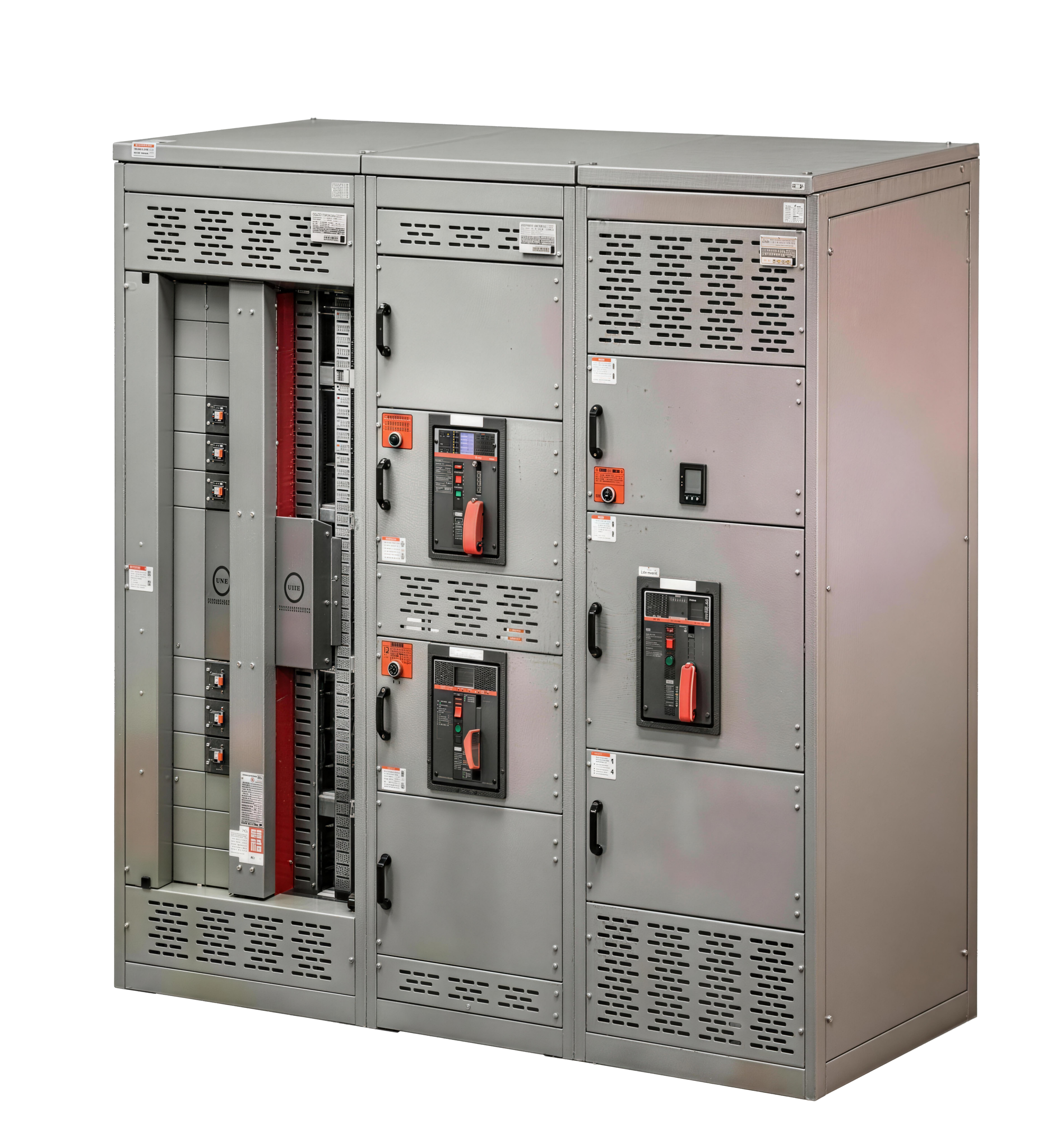
UL 891 switchboard — low-voltage distribution assembly.
UL 891 is the UL standard that covers switchboards. That single sentence defines a product category, not a catalogue number, and the difference becomes visible only at the evaluation and execution stage. A switchboard is a coordinated low-voltage assembly that consolidates incoming mains, feeder and distribution circuits, metering, generator and automatic transfer functions into one lineup. The question a specifier actually faces is narrower and harder: can this assembly be built to my one-line diagram, my short-circuit duty, my equipment room and my delivery schedule, without turning into a one-off engineering project?
That is a capability question, and it is answered by configuration range, documented electrical limits, factory process and commercial terms — not by the presence of a listing mark alone. This reference walks through what UL 891 covers, what a configurable switchboard line offers in practice, where the category boundaries sit, and which points should be confirmed before a project is released to build.
UL 891 in the North American Standards Map
UL 891 covers switchboards, as stated in UL low-voltage switchgear service information. That description sits inside a family of North American standards that each govern a different assembly type, and the categories are not interchangeable.
| Standard | Product category covered |
|---|---|
| UL 891 | Switchboards |
| UL 1558 | Metal-enclosed low-voltage power circuit breaker switchgear assemblies |
| UL 845 | Motor control centers |
| UL 67 | Panelboards |
| UL 508A | Industrial control panels |
Category separation per published UL standard coverage; the evidence supports product-category distinctions, not market sizing.
Two practical consequences follow. First, a UL 891 listing is evidence about a switchboard, and it does not transfer to switchgear, motor control centres or panelboards. Second, because the categories are distinct, a procurement specification should name the standard that matches the physical assembly being purchased. Confusing switchboard and switchgear is one of the more common causes of late-stage rework in North American low-voltage packages, because the two terms describe different assemblies, different compartmentalisation expectations and different applicable standards.
A UL 1558 reference, for example, is typically associated with metal-enclosed low-voltage power circuit breaker switchgear assemblies serving circuits at nominal AC voltages of not more than 1,000 volts. A UL 891 switchboard is a different assembly class, and the selection logic between them is an application judgement rather than a quality ranking.
The Capability Question: Configuration, Not Catalogue Number
Configurability is where a UL 891 switchboard supplier is genuinely tested. A catalogue product answers one layout; a build-to-project line answers a range of layouts using the same certified platform. The distinction shows up in model count, access design, device ratings and enclosure dimensions.
The FP-LSB series is a UL 891 switchboard platform offered in four models with differentiated access arrangements. FP-LSB1-I and FP-LSB1-G provide mainly front access; FP-LSB2-I is designed for rear-only access; FP-LSB2-G supports both front and rear access for flexible operation and maintenance.
| Model | Access | Main ACB | Main MCCB | Feeder MCCB |
|---|---|---|---|---|
| FP-LSB1-I | Mainly front access | 800–4000 A | 800–1200 A | 800–1200 A |
| FP-LSB1-G | Mainly front access | 800–4000 A | — | 100–1200 A |
| FP-LSB2-I | Rear-only access | 800–6000 A | — | — |
| FP-LSB2-G | Front and rear access | 800–6000 A | — | 100–1200 A |
Switching device current ratings by model. Feeder ACB ratings follow the same range as the main circuit. A dash indicates the combination is not listed for that model.
The same platform covers main incoming, feeder, distribution, service entrance, metering, generator and automatic transfer switchboard configurations. For an evaluating buyer, this matters because the incoming section, the distribution section and the metering section can be engineered as one coordinated lineup rather than three separately specified assemblies joined on site.
A practical evaluation order for a UL 891 switchboard specification is:
- Confirm which UL standard governs the assembly being purchased.
- Confirm system voltage and the available short-circuit current at the point of installation.
- Confirm main and feeder device ratings required by the load schedule.
- Confirm busbar ampacity required for present and near-term load.
- Confirm the equipment room layout and the access arrangement it permits.
- Confirm cable entry direction, enclosure width and shipping split.
Technical Explanation: What Drives the Configuration
Three numbers dominate the configuration of a UL 891 switchboard: system voltage, short-circuit duty and continuous current. On the FP-LSB platform, all models deliver a short-circuit withstand current of up to 100 kA at 480 V, and the rated operating voltage for the full product line is up to 480 V. Main busbar ampacity in lug-type construction reaches up to 4000 A for the LSB1 series and up to 6000 A for the LSB2 series.
Those two limits — voltage and short-circuit withstand — define where this assembly is technically appropriate. They also explain why busbar sizing and device selection move together: a higher continuous current requirement pushes the lineup toward the LSB2 series, while a higher available fault current at the point of installation makes the 100 kA withstand rating the binding constraint regardless of load size.
Enclosure width is not a free variable either. It follows the physical device frames selected. With MCCB frames in the 800–1200 AF range, enclosure width is 26 inches for FP-LSB1-I and 42 to 50 inches for FP-LSB1-G and FP-LSB2-G. With ACB_D frames in the 800–1600 AF range, width measures 26 inches for FP-LSB1-I, 42 to 50 inches for FP-LSB1-G, 32 inches for FP-LSB2-I and 42 to 50 inches for FP-LSB2-G. All configurations support both top and bottom cable entry, which gives the installer flexibility on routing but does not change the footprint.
Construction follows the electrical duty. Enclosures use high-strength galvanised steel or cold-rolled steel with a protective coating; main busbars are high-conductivity copper or aluminium sized to rated current and short-circuit requirement; circuit breakers, switches and protective devices are UL-listed components selected against the system configuration; insulation includes moulded insulation components, barriers and supports; cable terminations use copper or aluminium terminals and lugs matched to the specified current rating.
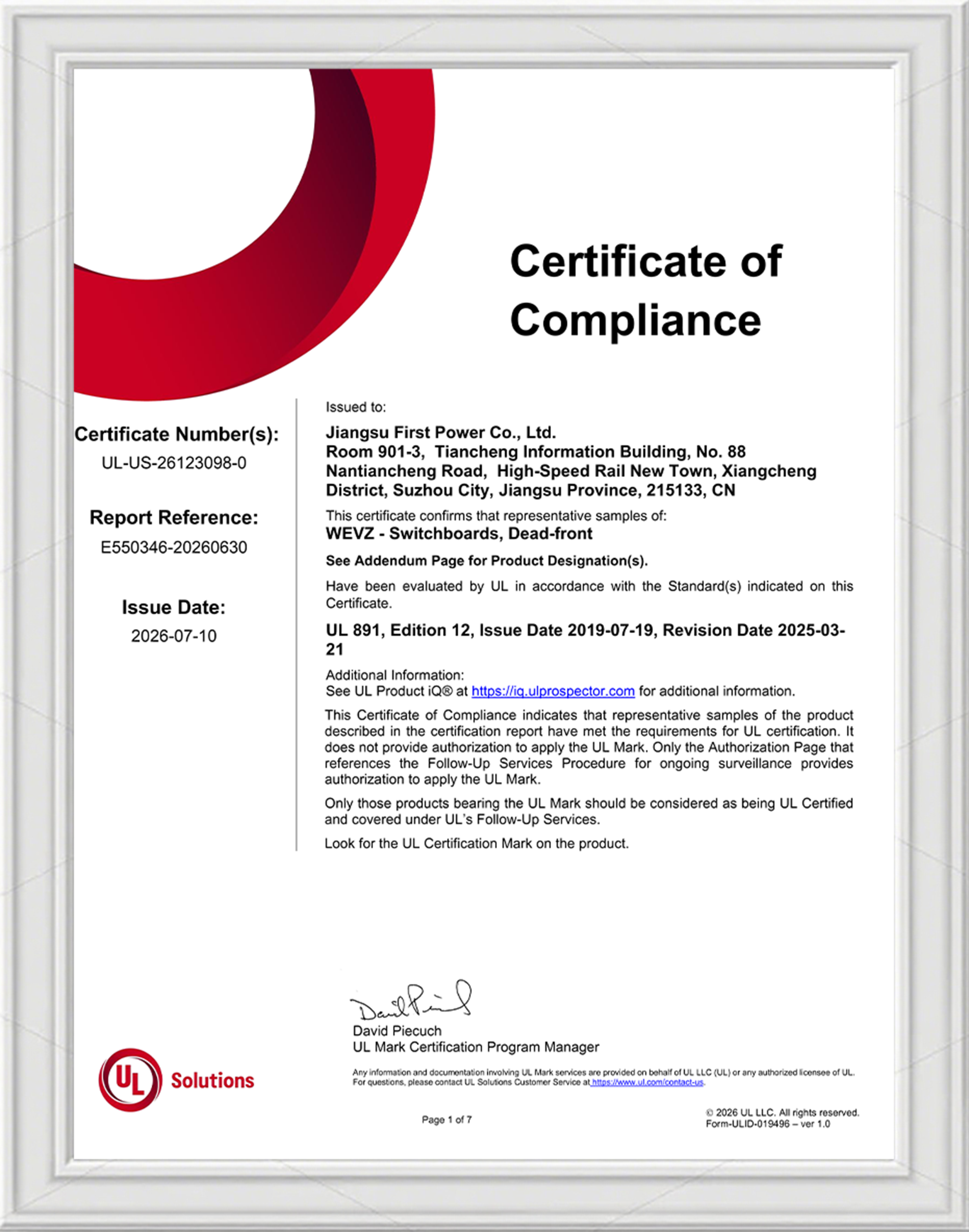
UL certification record listing UL 891 as the covered product scope.
What a Build-to-Project Supplier Looks Like
Jiangsu Dinghong Power Co., Ltd. is a manufacturer of power transmission and distribution equipment based in Hai'an City, Nantong, Jiangsu Province, operating in collaboration with Jiangsu First Power Co., Ltd. under a dual-base model of research and manufacturing in Hai'an and global marketing in Suzhou. The company's UL certification for the switchboard line is held under certificate UL-US-26123098-0, issued by UL LLC with a scope of UL 891 and an issue date of 10 July 2026; the certified product is the UL 891 switchboard, model FP-LSB.
Capability at this supplier is expressed in three separate layers, and buyers should keep them distinct.
Switchboard configuration, by contrast, is defined through the model, device rating, busbar and enclosure selections described above — it is a configuration exercise within a certified platform rather than a redesign of the assembly class.
The manufacturing base is stated as 20,708 square metres of factory space, 120 employees, a 30-engineer research and development team, an annual output of 1000 units and an export ratio of 80 percent. The company maintains ISO 9001 quality management system certification under certificate 03423Q51172R0S, valid to 22 September 2029, alongside management systems covering environmental and occupational health and safety. Production is managed through an ERP digital system with closed-loop control across procurement, production, processing and delivery, and quality control covers incoming material inspection, control of critical production steps, and comprehensive testing of finished products before shipment. Copper bar and busbar processing is performed in house.
Commercial terms and verification steps are equally part of the capability picture. Minimum order quantity is 1 unit. Lead time is typically 6 to 12 weeks, subject to product specification and order quantity. Routine testing is performed on 100 percent of units before delivery, with type tests and special tests available on request. Delivery can be arranged through road transport, port handling or customer pickup, and acceptance is by joint inspection of both parties followed by signing of the acceptance certificate. Payment terms are structured as 30 percent deposit, 30 percent before shipment, 30 percent upon site delivery and 10 percent after acceptance. After-sales support covers technical consultation, installation guidance, commissioning support, operation and maintenance guidance, and spare parts supply.
Where UL 891 Switchboards Are Applied
The application list for this platform reflects where low-voltage distribution duty is concentrated: data centres, commercial buildings, industrial facilities, healthcare facilities, infrastructure projects, renewable energy including solar PV and wind power, oil and gas, utilities, and critical facilities. Each of those environments asks a slightly different question of the same assembly.
- Data centres and critical facilities typically push on continuity and on the service entrance and automatic transfer configurations, where the switchboard is the point at which utility supply, generator supply and distribution feeders are coordinated.
- Industrial and commercial facilities tend to push on feeder count and distribution flexibility, which is where the wider feeder MCCB range on the G models (100–1200 A) becomes relevant.
- Healthcare and infrastructure projects place weight on verifiable component listings and documented testing, because acceptance documentation forms part of the project record.
- Renewable energy and utility applications often combine low-voltage switchboards with medium-voltage equipment in the same electrical room, which is where clear standard boundaries matter most.
One reference in the company's project record is a power utility project in Tajikistan covering 30 units for substation power transformation, associated with a broad product lineup that includes UL 891 switchboards among other switchgear families. The stated project highlight is operation in a high-altitude, dusty environment where reliability was the governing requirement. For buyers evaluating comparable sites, the relevant lesson is not the location but the specification pattern: environmental conditions and reliability expectations were treated as primary inputs rather than afterthoughts.
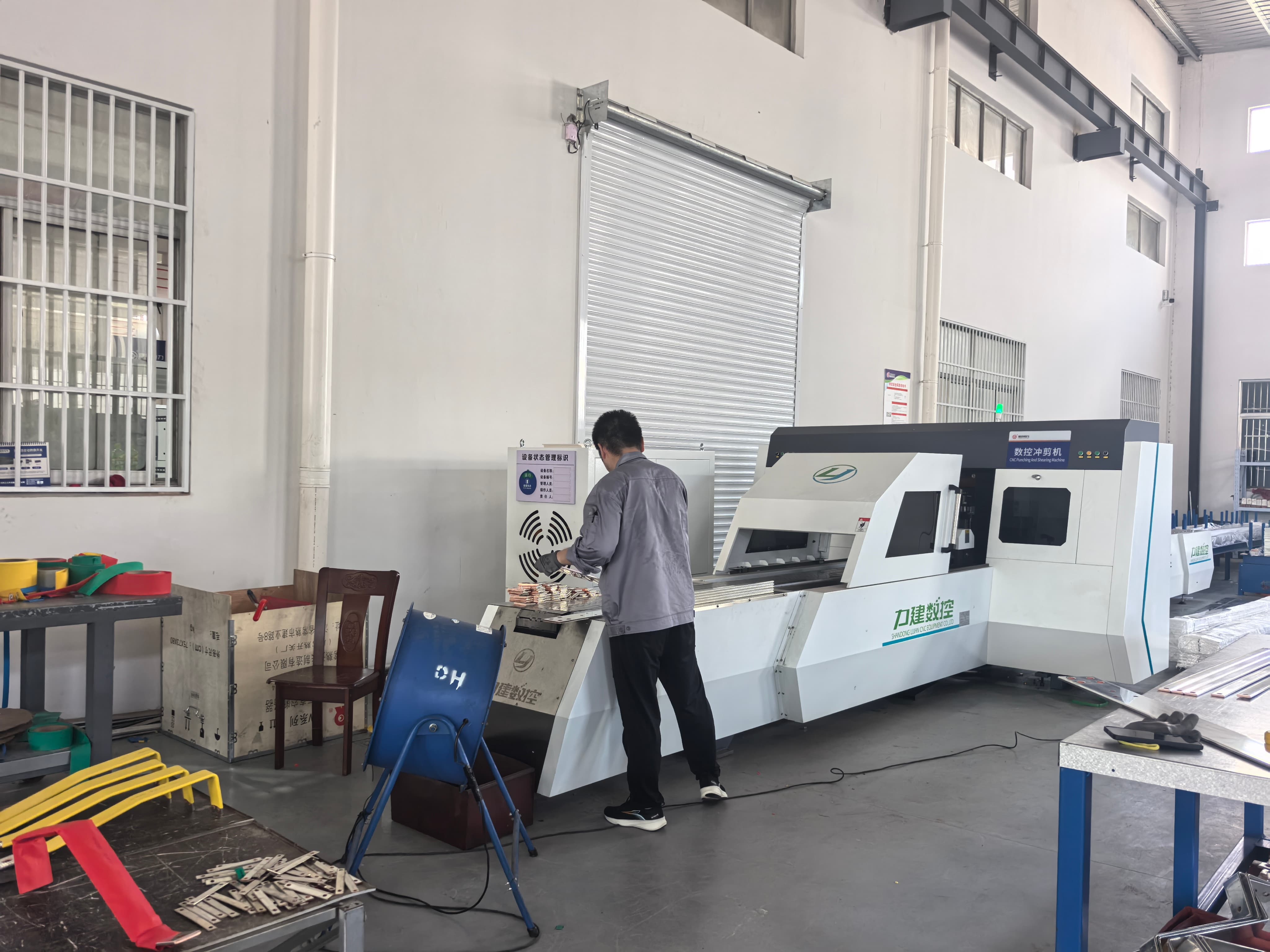
Copper bar and busbar processing, performed in house.
Compared With Traditional Approaches — and the Boundaries
A traditional low-voltage distribution approach splits functions across separate assemblies: panelboards for branch circuits, motor control centres for motor loads, and switchgear or switchboard sections for incoming and feeder distribution, specified independently and coordinated on site. A UL 891 switchboard takes a different route by consolidating incoming, feeder, distribution, service entrance, metering, generator and automatic transfer functions into one coordinated lineup, assembled and tested as a unit before shipment.
The advantage is coordination: fewer interfaces, one set of drawings, one factory test routine covering the complete lineup. The limitation is equally clear, and it should be stated plainly.
A UL 891 switchboard is not a substitute for UL 1558 switchgear. Where a project specification calls for metal-enclosed low-voltage power circuit breaker switchgear assemblies — the category UL 1558 describes — a UL 891 switchboard does not satisfy that requirement, and the two should not be treated as interchangeable during value engineering.
Voltage scope is bounded. The FP-LSB platform is rated for operating voltage up to 480 V. Distribution at medium voltage is a different equipment class entirely; the company's UL Listed Medium Voltage Switchgear, model FP-MVSG-38, covers a 5 kV to 38 kV range, which is where such requirements belong.
Access configuration constrains room design. FP-LSB2-I is a rear-only access model, so it requires rear clearance for operation and maintenance. Front-access models suit rooms where rear access is unavailable, but they trade that flexibility for a narrower device range on some configurations.
Feeder device range varies by model. Feeder MCCBs cover 800–1200 A on FP-LSB1-I, but 100–1200 A on both FP-LSB1-G and FP-LSB2-G. A specification that requires small feeder ratings at low current should therefore not default to the LSB1-I model without checking the device schedule.
Two further verification habits are worth adopting regardless of supplier. First, confirm the certification scope and certificate number directly against the certification body's listing rather than against a brochure. Second, confirm that the assembly standard named in the specification matches the assembly being quoted — switchboard, switchgear, motor control centre and panelboard are four different purchases.
Market and Standards Signals
The most dependable signal in this segment is not a growth figure but a documentation pattern. The North American standards landscape maintains explicit category separation between switchboards, switchgear, motor control centres, panelboards and industrial control panels, and selection guidance in the market consistently frames the decision as matching the standard to the application. That framing encourages buyers to specify the assembly class first and the supplier second, which in turn rewards suppliers who can state their certification scope precisely.
A second signal comes from the demand side. The applications this platform is built around — data centres, renewable energy, industrial facilities, healthcare, infrastructure and critical facilities — are the environments where low-voltage distribution equipment is specified as part of larger packaged power systems rather than as standalone line items. The company's parallel development of prefabricated E-House pod power systems for US projects, integrating high and low-voltage switchgear, transformers, monitoring and cooling into containerised units, is consistent with that pattern: the electrical assembly is increasingly purchased as part of a coordinated package.
Future Outlook
Three directions appear likely to shape UL 891 switchboard procurement over the next planning cycles. First, factory-tested assemblies will continue to displace site-assembled distribution arrangements in projects where schedule risk carries real cost, because testing before shipment moves defect discovery earlier. Second, packaged and skid-mounted power systems will absorb more low-voltage switchboard content, which raises the importance of interface documentation between the switchboard, the transformer and the medium-voltage section. Third, supplier differentiation will increasingly rest on evidence quality — certificate scope, test documentation, and the ability to state configuration limits accurately — rather than on catalogue breadth.
For buyers, the practical implication is straightforward: treat UL 891 switchboard selection as a configuration and verification exercise. Confirm the standard, confirm the numbers, confirm the certificate scope, and confirm the boundaries before release to build.
FAQ
What does UL 891 cover, and how does it differ from UL 1558 or UL 845?
UL 891 covers switchboards. UL 1558 covers metal-enclosed low-voltage power circuit breaker switchgear assemblies, UL 845 covers motor control centres, UL 67 covers panelboards and UL 508A covers industrial control panels. These are separate product categories, so a UL 891 listing does not establish compliance for a switchgear, motor control centre or panelboard application, and a listing under another standard does not cover a switchboard.
How many configurations does the FP-LSB UL 891 switchboard line include?
The platform includes four models. FP-LSB1-I and FP-LSB1-G provide mainly front access; FP-LSB2-I is designed for rear-only access; FP-LSB2-G supports both front and rear access. Main circuit air circuit breaker ratings cover 800–4000 A for the LSB1 series and 800–6000 A for the LSB2 series. A main moulded case circuit breaker rated 800–1200 A is available only on FP-LSB1-I.
What electrical performance can be specified on this platform?
All models deliver a short-circuit withstand current of up to 100 kA at 480 V, and the rated operating voltage across the product line is up to 480 V. Main busbar ampacity in lug-type construction reaches up to 4000 A on the LSB1 series and up to 6000 A on the LSB2 series. Feeder circuit ACB ratings follow the same range as the main circuit.
What installation and enclosure options affect the equipment room layout?
All configurations support both top and bottom cable entry. Enclosure width depends on the device frame selected. With MCCB frames of 800–1200 AF, width is 26 inches for FP-LSB1-I and 42 to 50 inches for FP-LSB1-G and FP-LSB2-G. With ACB_D frames of 800–1600 AF, width is 26 inches for FP-LSB1-I, 42 to 50 inches for FP-LSB1-G, 32 inches for FP-LSB2-I and 42 to 50 inches for FP-LSB2-G. Because FP-LSB2-I is rear-only access, it requires rear clearance for operation and maintenance.
What commercial and acceptance terms apply to an order?
Minimum order quantity is 1 unit and lead time is typically 6 to 12 weeks, subject to product specification and order quantity. Routine testing is performed on 100 percent of units before delivery, with type tests and special tests available on request. Delivery can be arranged through road transport, port handling or customer pickup. Acceptance is by joint inspection of both parties, followed by signing of the acceptance certificate. Payment terms are 30 percent deposit, 30 percent before shipment, 30 percent upon site delivery and 10 percent after acceptance.
Reference Material
Jiangsu Dinghong Power Co., Ltd. publishes its product brochure covering switchgear, switchboards, motor control centres and transformers, available for download: product brochure (PDF). Company information is also published at firstpowerglobal.com.