
UL 508A Industrial Control Panels: Scope, SCCR and Compliance
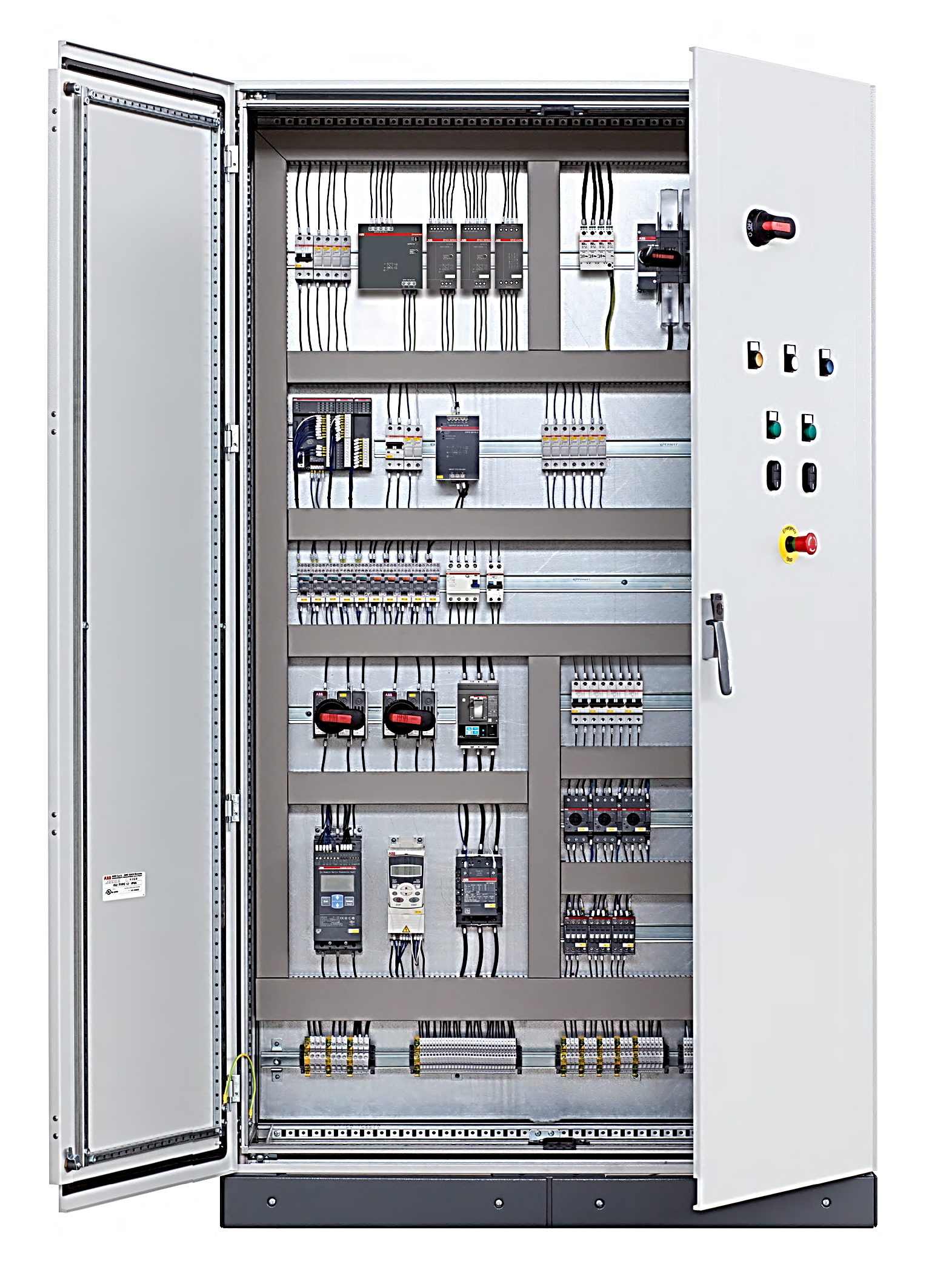
UL 508A governs industrial control panels. That single sentence resolves a large share of specification disputes on North American industrial and data center projects, because the word “panel” is routinely used for at least five different assemblies that are governed by five different standards.
On most electrical packages the control panel is the last assembly designed and one of the first items an inspector opens, since it is built to order and it forms the interface between the plant distribution system and the machine, line or process it controls. Buyers at evaluation stage rarely lose time on the standard itself; they lose time on scope. A submittal that cites UL 891 for an assembly that is in fact an industrial control panel, or a package that assumes an assembly-level short-circuit rating that no component combination can deliver, both create rework that is easier to avoid than to fix.
The useful question is therefore not which standard sounds most demanding, but which standard matches the assembly being purchased, what it requires the supplier to declare, and where its coverage stops.
UL 508A in the Family of North American Low-Voltage Standards
North American low-voltage equipment standards are organised by product category rather than by voltage band or by project size. UL 508A governs industrial control panels. UL 891 covers switchboards. UL 845 covers motor control centers. UL 67 covers panelboards. UL 1558 covers metal-enclosed low-voltage power circuit breaker switchgear assemblies, and is described in publicly available standard summaries as applying to assemblies that service circuits operating at nominal AC voltages of not more than 1,000 volts.
| Standard | Product category it governs | Why the distinction matters at evaluation |
|---|---|---|
| UL 508A | Industrial control panels | Applies to the shop-built panel that houses control, motor control, VFD or process control components for a specific process or machine. |
| UL 891 | Switchboards | Applies to the power distribution assembly, not to the control assembly downstream of it. |
| UL 845 | Motor control centers | Applies to the modular MCC lineup; an MCC control section is a related but distinct document path from a standalone control panel. |
| UL 67 | Panelboards | Applies to branch-circuit and lighting distribution boards, which are often confused with control panels in bid packages. |
| UL 1558 | Metal-enclosed low-voltage power circuit breaker switchgear assemblies | Applies to the main low-voltage power switching assembly, commonly at the incoming end of the plant. |
These are separate product categories rather than a ranking from basic to advanced. The same project typically needs several of them at once, and each one is judged against its own scope. Medium-voltage assemblies sit in a different framework again: the UL Listed Medium Voltage Switchgear in the Jiangsu Dinghong Power Co., Ltd. portfolio is built to UL 347 and ANSI/IEEE C37.20.2, covering a 5 kV to 38 kV voltage range.
Why the Scope Question Surfaces During Evaluation, Not After Award
Scope mismatches are expensive because they are discovered late. They usually appear in three places: a consultant specification that names the wrong UL standard for the assembly; a vendor quotation that answers the specification literally without flagging the mismatch; and a factory or site inspection that applies the correct standard to the delivered equipment.
Each of those failures has a different cost. A wrong standard in the specification forces a redesign cycle before the panel can be released for build. A quotation that accepts the wrong standard transfers the risk to the buyer at delivery. An inspection finding can push commissioning dates, because re-marking or re-testing a completed assembly is rarely a same-day activity.
The opportunity sits on the same point. Once the assembly is correctly identified as an industrial control panel, suppliers can be compared on the variables that genuinely differ between them: busbar current capability, how the assembly short-circuit current rating is established and coordinated, enclosure selection against the installation environment, the ambient temperature envelope the panel is designed for, documentation produced for the project, and the marking that goes on the finished unit. Those are engineering and production decisions, not marketing claims, and they are the decisions that determine whether a panel passes inspection and stays in service.
The Engineering Content Behind a UL 508A Panel
A UL 508A industrial control panel is defined by declared ratings rather than by appearance. In the Jiangsu Dinghong Power Co., Ltd. portfolio the corresponding product is the UL 508A industrial control panel, model FP-LCP, offered in eight configurations: PLC control panel, VFD control panel, motor control panel, MCC control section, process control panel, HVAC control panel, power distribution and control panel, and OEM machine control panel.
Declared ratings and construction parameters (FP-LCP)
- Applicable standard: UL 508A
- Rated voltage: up to and including 600 V AC, 50/60 Hz
- Main busbar current: 100 A – 600 A
- Panel SCCR (short-circuit current rating): up to 100 kA rms at 480 V
- Main busbar short-time withstand: 150 kA rms / 1 s
- Power frequency withstand voltage: 2200 V AC / 1 min (power circuit); 1000 V AC / 1 min (control circuit)
- Insulation resistance: ≥ 100 MΩ at 500 V DC
- Standard operating temperature: −10 °C to +40 °C
- Enclosure rating: NEMA 1 / 2 / 3R / 4 / 4X (optional)
- Busbar material: tin-plated electrolytic copper
- Nameplate marking: rated parameters, SCCR value and UL certification mark
Two of those items carry more weight than their position in the list suggests. The first is the panel SCCR. A short-circuit current rating is a property of the assembly, not of the enclosure or the incoming breaker alone. It depends on the combination of components actually installed inside the panel and on how they are coordinated, which is why it must appear on the nameplate rather than being inferred from a catalogue. A panel with a high main busbar short-time withstand figure can still have a modest assembly SCCR if the protective device combination does not support more.
The second is component recognition. The panel bill of materials in this configuration specifies UL Recognized or UL Listed control components — contactors, relays, circuit breakers, disconnects, terminal blocks and power supplies — together with high-performance insulation materials, wiring ducts, terminal blocks and insulated supports. From a buyer’s perspective, that is the difference between a panel assembled from catalogued equipment and a panel assembled from whatever was available: the recognition status of each device feeds directly into the assembly-level rating that will be marked on the nameplate.
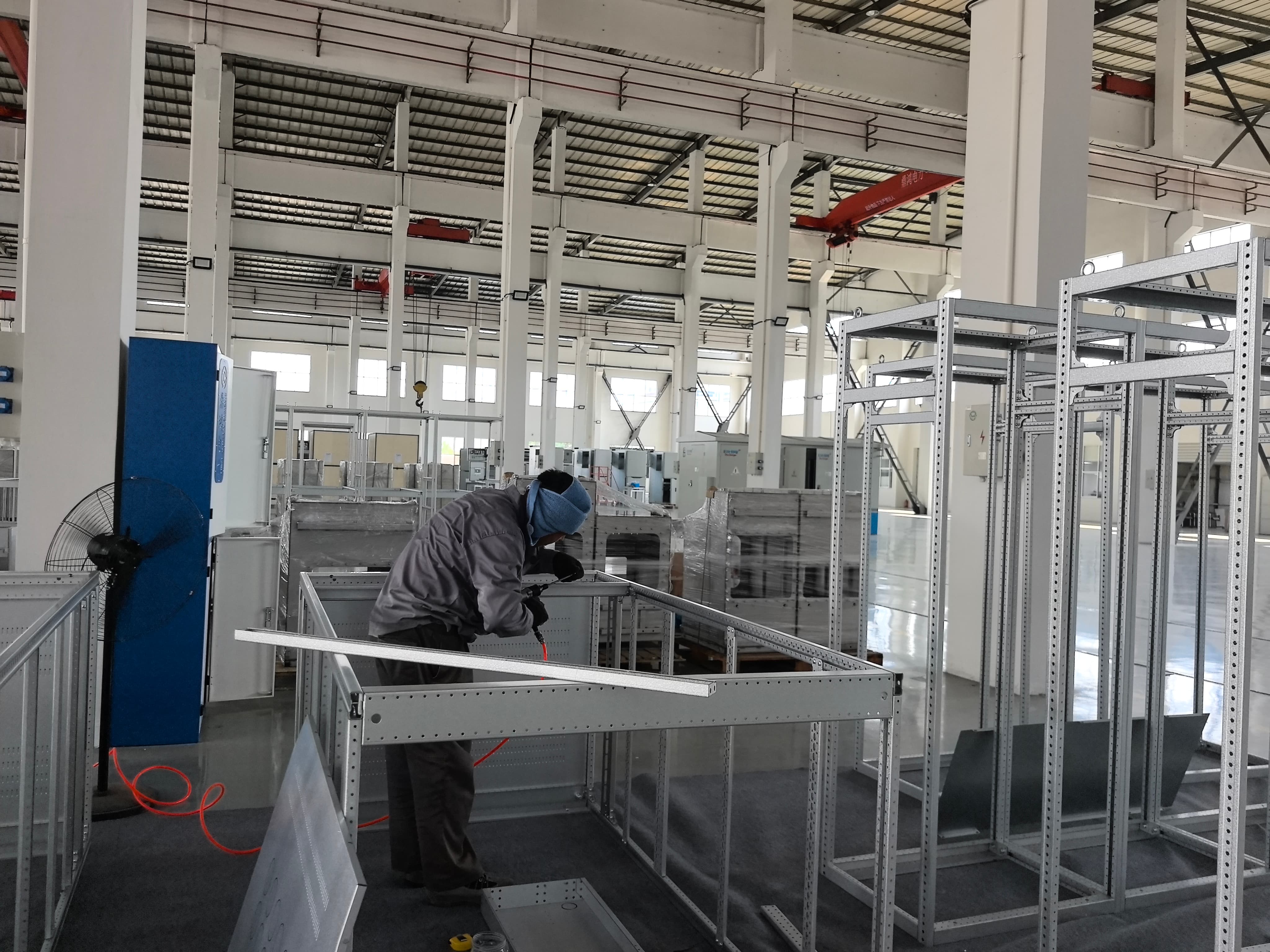
Construction follows the same logic. Enclosures are built from carbon steel, galvanised steel or stainless steel according to the installation environment; internal mounting uses powder-coated steel mounting plates, DIN rails and reinforced structural components; busbars are sized against the current-carrying and short-circuit requirements of the specific project rather than a single fixed design.
How a Control Panel Fits the Wider Power Distribution Chain
A UL 508A panel is one link in a chain that is usually assembled by different suppliers and governed by different standards. Power arrives through medium-voltage switchgear, is stepped down by a transformer, distributed by low-voltage switchgear, a switchboard or panelboards, and is finally converted into control, motor starting and drive functions inside an industrial control panel or a motor control centre section next to the process it serves.
That position explains several recurring procurement requirements. Because the panel sits closest to the process, it is the assembly most often modified late in the project, and the one most exposed to site conditions such as washdown, dust, corrosion or elevated ambient temperature. Because it sits downstream of the short-circuit study, it inherits a required SCCR from the system design and must be able to hold it. And because it is often the OEM machine builder’s interface point, its terminal arrangement, cable entry and marking practice affect how quickly a line can be commissioned.
For buyers comparing offers, the practical implication is that a control panel quotation should be read together with the assembly it connects to. If the required SCCR, the enclosure type and the ambient envelope are not stated on both documents, the gap tends to be discovered during site acceptance rather than during bid evaluation.
Building Panels to UL 508A as a Manufacturing Capability
Jiangsu Dinghong Power Co., Ltd. is a power transmission and distribution equipment manufacturer based in Hai’an City, Nantong, Jiangsu Province, China, operating in collaboration with Jiangsu First Power Co., Ltd. under a dual-base model of research and manufacturing in Hai’an and global marketing in Suzhou, with a stated strategic focus on the United States market. Its product portfolio covers high- and low-voltage switchgear, dry-type and oil-immersed transformers, main transformers, containerised substations and prefabricated E-House power modules, including the UL 508A industrial control panel.
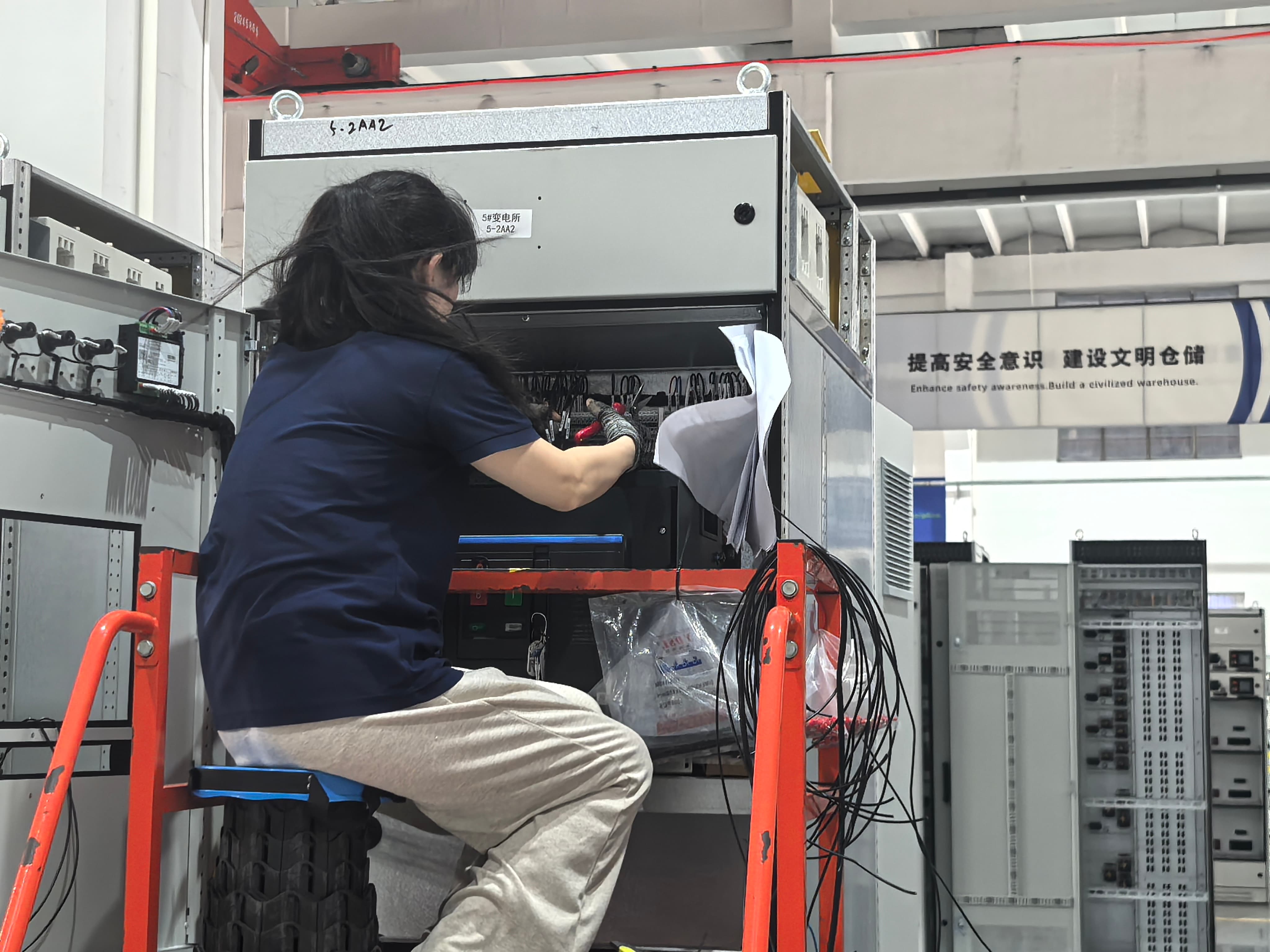
Capacity and process control are the parts of that profile that matter most for a panel order. The company operates a 20,708 m² facility with 120 employees, an annual output of 1,000 units and a 30-engineer research and development team, and reports an export ratio of 80% across North America, Latin America, Europe, the Middle East, Southeast Asia, Africa and Central Asia. Production is managed through an ERP digital management system with closed-loop control across procurement, production, processing and delivery, supported by a multi-level inspection process covering incoming material inspection, control of critical production steps and comprehensive finished-product testing before shipment.
Quality management is certified under ISO 9001 (certificate 03423Q51172R0S), ISO 14001 (03423E30565R0S) and ISO 45001 (03423S20477R0S). The UL 508A industrial control panel is included among the products covered by the ISO 9001 certification scope. The company’s UL certification portfolio also includes the UL 891 switchboard, model FP-LSB, certified by UL LLC under certificate UL-US-26123098-0, dry-type transformers certified under UL 1561 (UL-US-26127184-0), and oil-immersed transformers certified under IEEE C57.12.20 (UL-US-2563812-0) and IEEE C57.12.28 (UL-US-2554252-0).
Where a project also includes the transformer or substation side of the power train, an OEM production mode is offered for power transformers, oil-immersed transformers, dry-type transformers and pad-mounted transformers, under which customised units are built to buyer specifications. Customisable design and performance parameters include core material, winding material in copper or aluminium, winding configuration, no-load loss, load loss, temperature rise, noise level and cooling method such as ONAN, ONAF, OFAF or ODAF. These are transformer-side options rather than panel options, but they matter to panel buyers because they determine the supply characteristics that the control panel will see on the secondary side.
Commercial and delivery terms are stated in general manufacturing terms: a minimum order quantity of one unit; a lead time typically of six to twelve weeks depending on specification and order quantity; and quality control based on 100% routine testing before delivery, with type tests and special tests available on request. After-sales support covers technical consultation, installation guidance, commissioning support, operation and maintenance guidance, and spare parts supply.
Application Scenarios Where UL 508A Panels Are Specified
Industrial control panels appear wherever a distribution system has to be translated into machine-level control and protection. The scenarios listed for the FP-LCP configuration illustrate the range: industrial automation production lines and control systems; general manufacturing and mechanical equipment; water and wastewater treatment systems; oil, gas and energy facilities; chemical and petrochemical production facilities; food and beverage production lines; mining, metallurgy and heavy industry; HVAC and building automation; and renewable energy control systems including solar and energy storage.
The common thread is not the industry but the duty. A water treatment panel and a food processing panel are both expected to combine motor starting, protection and process control in one enclosure, but they diverge sharply on enclosure selection: washdown duty pushes towards NEMA 4 or 4X, while an indoor electrical room typically accepts NEMA 1 or 2. A renewable energy control panel may be evaluated mainly on drive and inverter interfaces, while an oil and gas panel is judged on how it behaves in an area with constrained maintenance access. Enclosure rating is therefore an optional configuration rather than a fixed attribute, and it should be selected against the installation environment rather than the industry label.
Data centre projects use the same product category in a different way. Control panels for monitoring, mechanical plant and auxiliary systems sit alongside larger low-voltage assemblies such as switchboards and switchgear; the supplier’s project record includes a United States data centre programme with more than 200 transformer units delivered against a long operating horizon, which indicates the documentation and testing discipline that data centre procurement teams expect from equipment in this environment.
Boundaries: What UL 508A Compliance Does Not Cover
The scope of a UL 508A panel is deliberately bounded, and buyers get more value from stating those boundaries than from assuming the standard extends further than it does.
- It is a panel standard, not a distribution standard. If the deliverable is a switchboard, a motor control centre lineup, a panelboard or a metal-enclosed power circuit breaker switchgear assembly, the applicable standards are UL 891, UL 845, UL 67 and UL 1558 respectively. Specifying UL 508A for those assemblies does not make the submittal stronger; it makes it wrong.
- The assembly SCCR is a combination property. A high busbar withstand figure does not by itself deliver a high panel SCCR. The rating is limited by the component combination actually installed and must be marked on the nameplate after that combination is fixed. Late component substitutions can therefore reduce the rating of an already-approved design.
- The voltage boundary is real. The FP-LCP configuration is rated up to 600 V AC at 50/60 Hz. Medium-voltage distribution is outside this scope and is handled through a different document path, as in the UL Listed Medium Voltage Switchgear built to UL 347 and ANSI/IEEE C37.20.2.
- Ambient and enclosure limits are declared, not implied. The standard operating temperature of −10 °C to +40 °C is part of the product specification. Sites that operate outside that envelope need the configuration reviewed rather than assumed.
- Market regimes differ. The UL framework is a North American framework. European switchgear assembly certification in the same portfolio is issued against IEC 61439-1 and IEC 61439-2, and isolation transformers are certified against EN IEC 61558-1. Equipment assembled for one regime is not automatically accepted in the other without review.
- Panel compliance is not machine compliance. A compliant panel confirms the construction and protection of the assembly; it does not validate the process logic, control program or machine function that the panel supports.
Evaluation Checklist for Control Panel Buyers
| What to verify | Why it matters | Evidence to request |
|---|---|---|
| Standard named in the specification | A control panel, switchboard, MCC or panelboard each follow a different standard. | Specification clause and the supplier’s compliance statement naming UL 508A for control panels. |
| Required assembly SCCR | It is inherited from the short-circuit study and is a combination property of the installed devices. | System study value versus the SCCR the supplier will declare and mark, for example up to 100 kA rms at 480 V. |
| Nameplate content | Rated parameters and SCCR must be visible to the inspector on the finished unit. | Sample nameplate showing rated parameters, SCCR value and UL certification mark. |
| Component recognition status | The devices inside the panel determine what the assembly can be rated for. | Bill of materials identifying UL Recognized or UL Listed control components. |
| Enclosure and ambient envelope | NEMA 1/2/3R/4/4X and the −10 °C to +40 °C band must match the installation. | Configuration sheet stating enclosure rating and declared operating temperature. |
| Testing and acceptance | Routine testing before shipment and joint acceptance reduce site surprises. | Routine test record; availability of type and special tests; joint inspection and acceptance certificate procedure. |
| Delivery and lead time | Interface dates drive commissioning schedules. | Stated lead time (typically six to twelve weeks) and delivery arrangement: road transport, port handling or customer pickup. |
Market Trend: Standards Discipline as a Procurement Filter
The clearest shift visible in North American low-voltage procurement is not a new technology but tighter documentation discipline. Standards are being used as a category filter rather than as a quality label: submissions are expected to name the correct standard for each assembly, state the assembly rating that follows from it, and show the evidence behind the declaration. Publicly available standard summaries reinforce that separation by describing UL 1558, UL 891, UL 845, UL 67 and UL 508A as distinct product categories.
A second, related shift is the packaging of equipment. Prefabricated E-House and containerised substation solutions combine high- and low-voltage switchgear, transformers, monitoring and cooling systems inside a single transportable enclosure, which compresses site work and moves more of the verification into the factory. For control panels, that direction raises the value of factory acceptance testing and of documentation prepared before shipment rather than during commissioning.
For suppliers, the trend favours manufacturers whose certification coverage spans more than one assembly type. Jiangsu Dinghong Power Co., Ltd. illustrates the pattern: a portfolio that runs from UL 508A industrial control panels through UL 891 switchboards to UL-certified dry-type and oil-immersed transformers, an 80% export ratio, and a stated focus on serving North American projects with modular E-House solutions as well as individual assemblies.
Future Outlook
Over the next several years, the discussion around industrial control panels is likely to move from “is it UL 508A?” to “what does the marked rating actually support?” Three developments support that expectation. First, short-circuit levels in dense industrial and data centre environments continue to make assembly-level SCCR a design constraint rather than a formality. Second, the growth of intelligent and VFD-based control sections — both already present in the FP-LCP and FP-MCC configuration lists — increases the share of the panel that is electronic rather than electromechanical, which places more weight on thermal management, insulation and component recognition. Third, modular delivery through E-House and containerised substations moves commissioning work upstream into the factory, which raises the value of pre-shipment inspection and of documentation that travels with the equipment.
None of these developments changes the scope rule that started this article. UL 508A governs industrial control panels, and the buyer’s advantage lies in applying the correct standard to the correct assembly, then requiring the supplier to state the ratings, testing and marking that follow from it.
FAQ
Which standard applies to an industrial control panel — UL 508A or UL 891?
UL 508A governs industrial control panels. UL 891 covers switchboards. The two are separate product categories, as are UL 845 for motor control centres, UL 67 for panelboards and UL 1558 for metal-enclosed low-voltage power circuit breaker switchgear assemblies. A project may require several of these assemblies at once, but each is evaluated against its own standard.
What does the SCCR value marked on a panel nameplate mean?
The short-circuit current rating is a property of the complete assembly. It is determined by the combination of protective and switching devices installed in the panel and how they are coordinated, and it is limited by the weakest combination in that design. Because it depends on the finished bill of materials, it is declared on the nameplate after the configuration is fixed; in the FP-LCP configuration it is stated as up to 100 kA rms at 480 V. Substituting components after approval can change the rating.
What electrical parameters can a UL 508A industrial control panel be specified with?
The FP-LCP configuration is rated up to 600 V AC at 50/60 Hz, with a main busbar current of 100 A to 600 A and a main busbar short-time withstand of 150 kA rms for 1 second. Dielectric verification is defined as a 2200 V AC / 1 minute power frequency withstand for the power circuit and 1000 V AC / 1 minute for the control circuit, with insulation resistance of at least 100 MΩ at 500 V DC. Busbars are tin-plated electrolytic copper.
How are enclosure type and operating temperature selected?
Enclosure rating is a configuration option rather than a fixed attribute. The available ratings are NEMA 1, 2, 3R, 4 and 4X, selected against the installation environment — indoor electrical rooms generally tolerate NEMA 1 or 2, while washdown or outdoor exposure calls for a higher rating. The standard operating temperature band is −10 °C to +40 °C. Sites outside that band require the configuration to be reviewed rather than assumed to be compliant.
How is a built panel verified before shipment, and how is acceptance handled?
Quality control is based on 100% routine testing before delivery, with type tests and special tests available upon request. Acceptance is carried out through joint inspection and acceptance by both parties, followed by signing of the acceptance certificate. The agreed delivery arrangement can be road transport, port handling or customer pickup, and lead time is typically six to twelve weeks depending on product specification and order quantity, with a minimum order quantity of one unit.
What support is available after a control panel is delivered?
Post-delivery support covers technical consultation, installation guidance, commissioning support, operation and maintenance guidance, and spare parts supply. This support sits alongside the manufacturer’s certified management systems — ISO 9001, ISO 14001 and ISO 45001 — which cover the quality, environmental and occupational health and safety processes behind production and delivery.
Closing Note
Jiangsu Dinghong Power Co., Ltd., working with Jiangsu First Power Co., Ltd., manufactures UL 508A industrial control panels alongside UL 891 switchboards, medium-voltage switchgear and UL-certified transformers, and supplies domestic and export projects including North American installations. A full product portfolio, including the UL 508A industrial control panel, is documented in the company’s downloadable catalogue: Jiangsu Dinghong Power product catalogue (PDF).