
UHF RFID Reader Shortlist: Four Types for Smart Manufacturing
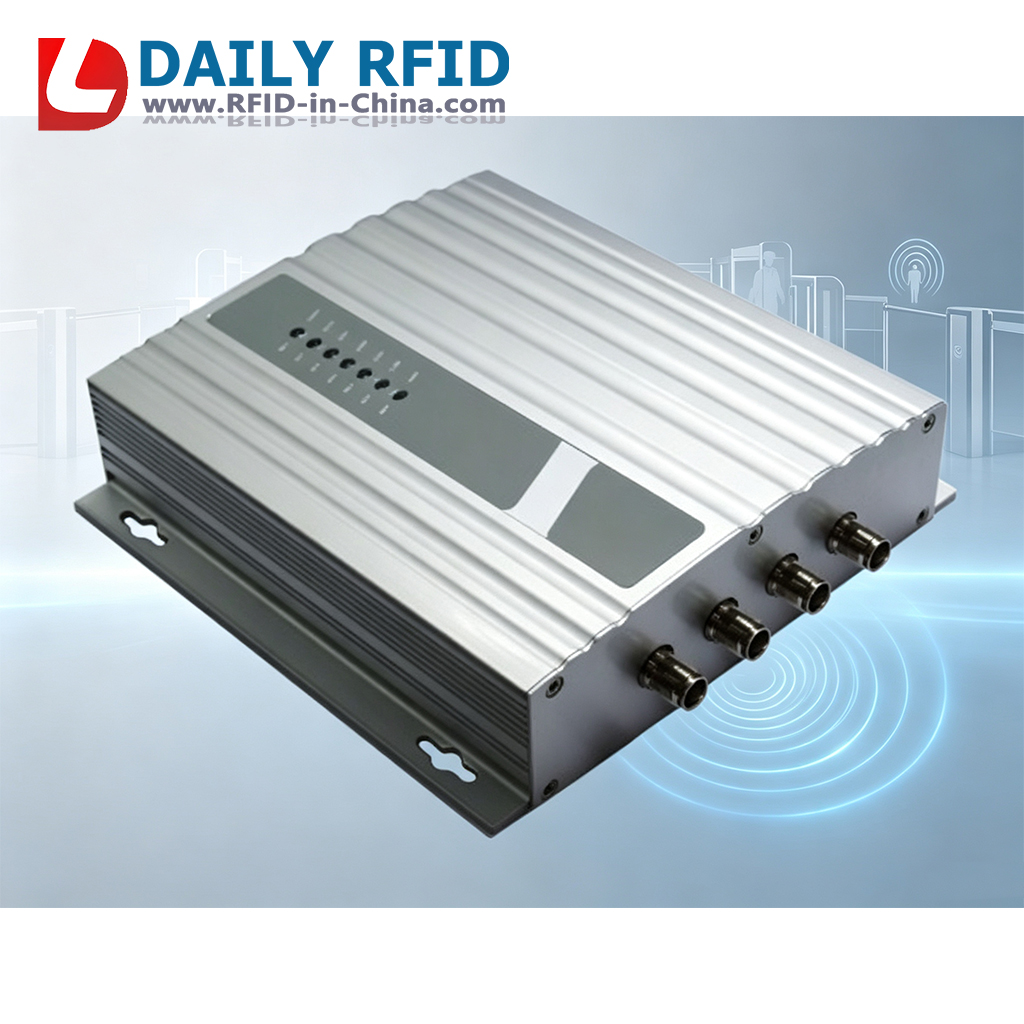
A four-port UHF reader is one of four reader types worth shortlisting for a factory floor; the port count, not the brand, is usually the first design decision.
Why the reader, not the tag, is now the variable in factory UHF
UHF is the frequency band most smart-manufacturing programmes end up specifying. Mordor Intelligence reports that UHF captured 40.72% of total RFID market revenue in 2025, and projects the UHF RFID market to surpass USD 14.9 billion by 2031 at a CAGR of 12.45%. Because the air interface is standardised under EPCglobal Gen2 / ISO/IEC 18000-63, tag-level interoperability between vendors is largely settled. The engineering variability has moved to the reader: where it reads, how many tags it resolves per pass, whether power and network exist at that point, whether a person is holding it, and how its data reaches MES or ERP.
This article is a functional shortlist rather than a brand ranking. It groups UHF RFID reader options into four types that manufacturing buyers actually evaluate — fixed readers, handheld readers, AI-powered readers, and Wi-Fi-connected readers — and it uses the published product catalogue of DAILY RFID CO., LIMITED as the reference set, because that catalogue documents all four types with specifications that can be checked line by line. DAILY RFID is an RFID manufacturer based in Guangzhou, China, founded in 2008, operating a 28,000 m² factory with 180–200 employees and a 38-engineer R&D team; its stated annual reader output is 100,000 units, with 80% of products exported to EU and USA markets.
Short answer for buyers: shortlist one fixed multi-port reader for high-density read zones, one integrated-antenna fixed reader for gates and doorways, one handheld reader for exceptions and commissioning, and one wireless reader wherever cabling is the constraint. Then treat AI-driven reading and edge filtering as a capability layer you test, not as a fifth hardware format.
The six criteria that decide which reader type you need
Reader categories are usually selected in the wrong order — product first, requirement second. Reversing that order makes the shortlist almost self-selecting.
| Criterion | What it determines | Question to put to a supplier |
|---|---|---|
| Read-point geometry | Antenna count, mounting height, coverage shape | Is the read event a portal, a doorway, a conveyor section, an aisle, or an open yard? |
| Tag population per event | Anti-collision performance and processing headroom | How many tags must be resolved in a single pass — 50, 100, 500, or 1,000? |
| Power and network availability | Cabled, Power over Ethernet, Wi-Fi, Bluetooth, or cellular | Can the read point be reached with one Ethernet cable, or does it need wireless backhaul? |
| Operator mobility | Fixed, handheld, or plug-in module | Does a person need to carry the reader, or does the asset pass the reader? |
| Data path | SDK, RS232, RJ45/TCP-IP, GPIO, Wiegand, USB | Which interface does your MES or WMS integrator want to consume? |
| Environment | Ingress protection, temperature range, metal and liquid exposure | Is the zone dusty, wet, washdown, cold, or outdoors? |
The four reader types at a glance
| Reader type | Reference models | Typical role on the floor | Documented range |
|---|---|---|---|
| Fixed multi-port | DL6940 / DL6960 | Dock doors, rack aisles, line-side zones | 25–30 m; up to 1,000 tags |
| Integrated fixed | DL921, DL921P (PoE), DL921 GSM, DL6990 ceiling, DL8330U gate | Doorways, vehicle gates, overhead coverage | 0.1–15 m; 4–7 m gate channel |
| Handheld | DL1280 (UHF/HF/LF), DL1380, DL995 / DL996 (HF) | Cycle counts, commissioning, exception handling | UHF up to 20 m; HF up to 40 cm |
| Wireless fixed | DL920Plus (Wi-Fi), DL930B / W / G | Retrofits, temporary lines, yards, remote sites | 4–15 m |
AI-driven reading is deliberately absent from this table as a row of its own. In the DAILY RFID catalogue it appears as a processing layer inside handheld (DL1380), fixed (DL6940 / DL6960), and desktop testing (DL9702) hardware, so it is covered separately below.
1. Fixed multi-port readers: buy coverage, not a box
A multi-port fixed reader has one network connection and several antenna ports, which means one device can serve several physical read zones. The DAILY RFID DL6940 / DL6960 AI Multi-Antenna 4-Port UHF Reader specifies four external TNC/SMA antenna ports, a reading range of up to 25–30 m, anti-collision for up to 1,000 tags read simultaneously, an average single-tag read time under 10 ms, and a stated data-processing speed 16 times that of ordinary mainstream readers. Power consumption is 5 W from a DC +9 V supply, the enclosure is IP64 rated, the operating range is −30 °C to +70 °C, and the unit measures 230 × 170 × 40 mm at 2,300 g. Interfaces include RS232, RJ45 TCP/IP, GPIO with RS485, and USB, and a free SDK is supplied.
What that means for a procurement decision: four ports let one reader cover a dock door, two rack ends, and a staging lane, which reduces reader count, network drops, and switch ports. The design work moves to antenna cabling and port zoning, and dense metal environments still need a tag that performs on metal. The catalogue's stated application for this model is automated manufacturing production-line raw-material tracking and stable identification in harsh industrial environments, alongside high-volume warehouse, port, and toll applications.
Where a single read face is enough, integrated-antenna fixed readers are simpler. The DL921 family specifies a built-in circular polarised antenna, 26 dBm transmit power, 0.1–15 m range, 50 tags per pass, IP65 protection, −20 °C to +60 °C operation, and relay and trigger I/O that can drive a barrier or alarm directly; the DL921P variant delivers power and data over a single Ethernet cable, and the GSM variant adds 2G/4G cellular backhaul with GPS. The DL6990 ceiling reader specifies 33 dBm, an integrated high-gain antenna, 0.1–5 m range, 50 tags, IP66, and 12 W consumption in a 180 × 180 × 28 mm housing. For a person-height walk-through, the DL8330U gate specifies four built-in transmit/receive antennas across a 4–7 m channel width at 30 dBm.
Field evidence for this reader type is available in the case record: a distribution centre in Poland installed 360 DAILY RFID DL920S readers for conveyor-line parcel reading, carton routing, and outbound verification, and reports a 30–60% reduction in parcel sorting mistakes and 40–70% faster outbound verification, in operation for at least five years. A Spanish automotive parts warehouse deployed 420 four-port long-range readers for inbound pallet reading, dock-door verification, and returnable container tracking, reporting 40–70% less manual inbound receiving and 30–60% fewer missed pallet scans.
2. Handheld readers: the exception layer of any fixed design
No fixed portal reads everything. Handhelds cover the residual — tags behind metal, tags at the back of a stillage, tags applied after the read point — plus commissioning, encoding, and periodic cycle counts. The DAILY RFID DL1280 Industrial PDA is the broadest specification in the reference catalogue: Android 12 on an 8-core 2.0 GHz processor with 4 GB RAM and 64 GB storage, UHF at 0.1–20 m, HF at 0.1–32 cm, LF at 0.1–10 cm, anti-collision for 100 tags, more than 100 tags per second, IP65 protection, a 4500 mAh host battery plus a 6700 mAh grip battery with 18 W fast charging, 680 g with the pistol grip, dual-band 2.4 GHz and 5 GHz Wi-Fi, 4G cellular, Bluetooth 5.0, and multi-constellation GNSS.
The engineering trade-off is weight and cost against capability. A 680 g terminal with three radio bands is a data-collection device for engineers and auditors; a lighter wireless reader paired to a phone may serve a two-person team better. The catalogue offers both, including the DL995 / DL996 HF handheld at 13.56 MHz with a 40 cm working range, dedicated Library and Anti-Theft modes, and offline storage of up to 80,000 tag records — a reminder that some manufacturing sub-tasks, such as tool-crib trays or document control, are close-range HF problems rather than UHF problems.
Case evidence: a railway maintenance operation in the Czech Republic deployed 145 DAILY RFID DL1080 UHF handheld PDAs for trackside asset inspection, spare-parts verification, and route recording, reporting a 50–80% reduction in paper inspection records and a 30–60% improvement in inspection completeness.
3. AI-powered readers: a filtering layer, and a testing step
In this catalogue AI is described at the algorithm level rather than as a product class. Three documented behaviours are worth shortlisting against:
- Dense-tag sorting. The DL1380 AI-Powered RFID Handheld specifies 33 dBm, 0.1–20 m UHF range, AI-driven tag sorting for more than 200 tags simultaneously, an average single-tag verification time under 10 ms, and RSSI-based distance calculation with position tracking to locate an item inside a stacked load.
- Edge processing and duplicate suppression. The DL6940 / DL6960 states AI-driven adaptive dense read mode, up to 1,000 tags simultaneously, and a processing speed 16 times that of ordinary mainstream readers — the specification that matters when a full tote passes an antenna in under a second.
- Tag quality control before deployment. The DL9702 AI RFID Tag Tester & Encoder is a USB-powered desktop unit measuring 107 × 70 × 10 mm at 80 g, drawing 0.25 W, with 17 dBm output and a deliberately short 10–15 cm near-field range so adjacent tags are not mis-read; its AI diagnosis is documented as identifying defective, damaged, and weak tags.
The procurement implication is a process change rather than a hardware upgrade. If tags are verified before they enter the line, the fixed readers downstream see a cleaner tag population, and read-rate disputes during acceptance testing become easier to attribute. The limit is equally clear: the AI claims above are manufacturer-stated algorithm descriptions. The reviewed evidence set contains no independent benchmark of AI filtering performance against a defined tag mix, so a buyer should run a pilot with their own tags, stack density, and conveyor speed before writing the claim into a specification.

Edge AI in this catalogue is applied inside handheld, fixed, and desktop formats; the handheld variant is the one most often used to close out the tags a portal missed.
4. Wi-Fi and wireless readers: remove the cable, accept a new dependency
Wireless readers are chosen when the building is the constraint: leased space, listed buildings, temporary lines, yards, and mezzanines where pulling Ethernet is slow or impossible. The DAILY RFID WiFi RFID Reader DL920Plus specifies an integrated Wi-Fi module, an integrated internal antenna, 30 dBm maximum transmit power adjustable from 20 dBm to 30 dBm, 8–15 m read range with stable write distance up to 7 m, IP64, −30 °C to +70 °C, 6 W consumption, and RS232, RJ45, USB, RS485, and Wiegand interfaces. The DL930 family splits the same idea by backhaul: DL930B for Bluetooth, DL930W for Wi-Fi, DL930G for GPRS, all at 20–30 dBm with 4–8 m read range, IP65/IP66 protection, and −30 °C to +70 °C operation at 1,500 g.
A middle option is often overlooked: PoE. It removes the separate power adapter while keeping a deterministic wired network. In a Malaysian cold-storage deployment, 160 DAILY RFID DL950S-PoE readers were installed for fixed-door reading of cold-room pallets and insulated returnable boxes; the project reports over 90% capture of cold-chain checkpoint movements and a 30–50% reduction in separate power-adapter installation, with the system running for more than five years. A Qatar pop-up retail and exhibition operator deployed 240 DAILY RFID DL9700-WiFi readers and reports 40–70% faster setup of temporary reading points and a 50–80% reduction in manual stock checks.
The boundary to accept: wireless backhaul trades a cable for a radio environment. The reference specifications publish transmit power and range but not roaming-handover behaviour or latency under load, and factory floors with dense Wi-Fi traffic, moving cranes, or shielded rooms are exactly where a pre-deployment site survey earns its cost. Where no local network exists at all, the cellular variants (DL930G, DL921 GSM) are the documented route rather than an improvised bridge.
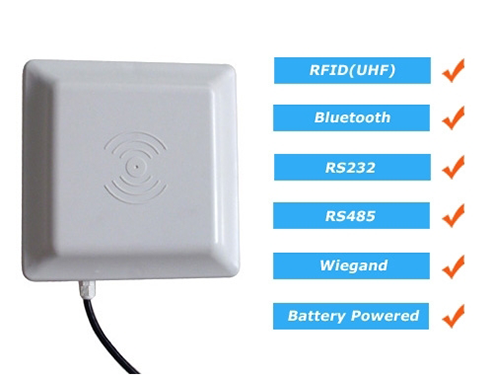
The DL930 family differs only by backhaul — Bluetooth, Wi-Fi, or GPRS — which makes it a useful way to test whether the constraint is really cabling or really network coverage.
Supporting components that complete the checklist
A reader shortlist that stops at readers produces integration surprises. Four component groups belong in the same evaluation:
- Modules for embedded read points. The DL213 Type-C UHF Reader Module specifies 23 dBm, 0.1–10 cm range, up to 5 tags, 45 × 30 × 6 mm, and USB keyboard-simulation mode for plug-in data entry; the DL228 Type-C mobile reader is lighter at 12 dBm and 0.03 kg with IP64 protection. The RFID Smart Cabinet Component supports configurable 4-, 8-, or 16-port antenna layouts, more than 500 tags per partition, 0.1–5 m range, GPIO linkage to electronic locks and door sensors, and optional PoE.
- Fixed trays and counters. The DL6993 tray reader specifies 33 dBm, 0.1–5 m, 80–100 tags simultaneously, and IP66; the DL4130H is a 13.56 MHz HF tray reader for jewellery and small high-value parts with 1.5 W output and 50-tag anti-collision.
- Encoding and print. The High-Speed RFID Label Printer specifies 300 dpi, 254 mm/s, a 5-inch touch display, and an integrated UHF ISO 18000-6C encoder — the step that decides whether tags are commissioned reliably before they reach the line.
- Tags that match the surface. The on-metal tool tag specifies 1–3.5 m read range on metal with a 4 W EIRP handheld and up to 5 m off metal, with −40 °C to +85 °C operation; the passive LED label uses harvested RF energy to illuminate a single targeted tag at 1.5–3.5 m, which is a picking aid rather than a tracking device.
Reference system packages also exist for adjacent use cases — a vehicle access control development kit, a GPRS school attendance system, and an animal tracking development kit — and are useful mainly as worked integration examples when the same reader has to feed a cloud or MES endpoint.
Comparison with traditional identification methods
| Method | Strength | Structural limit |
|---|---|---|
| Manual logging | No infrastructure cost; flexible | Line-of-sight labour per item; error rates rise with volume and shift handovers |
| Barcode | Cheap labels; mature ecosystem | One item per scan; label must be visible and clean; no bulk read of a closed carton |
| Passive UHF RFID | Bulk, non-line-of-sight reading; established Gen2 standard; fixed readers can serve multiple zones | Metal and liquid shift tag performance; every item needs a tag; read zones need RF design and acceptance testing |
The honest limitation of the RFID path is that it moves effort rather than deleting it. The cited cases show the pattern: a German industrial deployment of 120,000 tags for metal tools, fixtures, containers, and production assets reports a 40–70% reduction in tool and fixture search time and a 50–80% reduction in audit preparation, which implies a tagging and zone-design project completed first. Where item value is low and volumes are low, barcode remains the rational choice.
Where this shortlist stops
Three boundaries should be stated plainly, because they are the points where shortlists usually fail at specification stage.
Environmental ratings are model-specific, not brand-wide. In the reference catalogue, the DL6940 is IP64, DL920Plus is IP64, DL921 and DL930B are IP65, and the DL6990 ceiling reader is IP66. For comparison, Turck states that its UHF RFID readers carry IP67 protection for dust, moisture, and temperature fluctuation. A buyer whose process includes washdown should treat IP67 or better as a separate requirement and confirm it per model rather than per vendor.
Integration is SDK-first in this catalogue. The documented interfaces are RS232, RJ45 TCP/IP, GPIO, USB, RS485, and Wiegand, with free SDKs and multi-language platform support. Turck separately states that selected readers support OPC UA through the AutoID Companion Specification for standardised data delivery to PLC, MES, ERP, WMS, or cloud systems. If standardised OPC UA data models are a hard requirement in your architecture, that should be raised and evidenced at the technical shortlist stage, not discovered during commissioning.
Commercial terms are documented unevenly. Published capability records state OEM/ODM customisation of antenna gain and interface for the fixed-reader line, a monthly capacity of 1,000 units, 15–45 day lead time, a one-unit minimum order, factory acceptance testing, and remote support; the tray-reader line is stated at 500 units monthly and the smart-tool-cabinet line at 300 units monthly. Unit prices and total cost of ownership are not part of the reviewed evidence, so cost comparisons should be built from quotations, not from published specifications.
One further caution: 2.4 GHz active systems are not interchangeable with passive UHF. The DL9230 active reader specifies 2.4–2.5 GHz operation, 0–100 m adjustable range, and up to 200 active tags simultaneously, and its FCC Supplier's Declaration of Conformity (FCSE20015006) covers the active tracking system family including the DL9230 series. Mixing active and passive assumptions in one business case is a common source of disappointing pilots.
What to put in the procurement checklist
| Check | What to ask for |
|---|---|
| Protocol scope | Written confirmation of ISO 18000-6C / EPC Gen2 support, and ISO 18000-6B only where legacy tags exist |
| Regional frequency | Confirmation of 860–960 MHz configurability and the specific band used in your country |
| Compliance evidence | CE RED certificate scope listing your model (for example certificate DGE190109029 covers DL920, DL930, DL9230, DL950, DL9700, and DL6940 series models) and FCC documentation where applicable |
| Read-zone proof | A pilot on your tags, your stack density, and your conveyor speed — not a datasheet range |
| Interface fit | SDK documentation, protocol notes, and a named interface set that your integrator already supports |
| Environment | IP rating and temperature range per model, checked against the actual zone |
| Supply terms | MOQ, lead time, QC method, and support route written into the order |
Market context and what it implies for reader choice
Three published figures frame the decision without dictating it. UHF's 40.72% revenue share in 2025 indicates that the ecosystem around passive UHF — chips, inlays, readers, middleware — is the deepest part of the RFID market. The projected UHF RFID market of more than USD 14.9 billion by 2031 at a 12.45% CAGR implies continued model turnover, so interface documentation and SDK continuity matter as much as today's specification. And MarketsandMarkets expects Asia Pacific to hold the largest RFID market share from 2025 to 2034, which is consistent with the supply base: DAILY RFID's production is based in Guangzhou with 80% of output exported to EU and USA markets.
A caution on market numbers: MarketsandMarkets also projects the broader RFID market at USD 30.47 billion by 2034. That figure covers all RFID frequencies and categories, whereas the USD 14.9 billion projection is UHF-specific. The two should not be placed in the same table, and buyers citing market size in an internal business case should state which scope they are quoting.
Future outlook
Three developments are visible in the specifications rather than in forecasts. First, processing is moving to the edge: a 5 W fixed reader with a stated 16-fold data-processing advantage and 1,000-tag anti-collision is doing work that previously required middleware. Second, power and data are consolidating into single-cable designs — PoE variants, USB-powered desktop testers drawing 0.25 W, and Type-C plug-in modules that need no separate supply. Third, the wireless option is fragmenting by backhaul rather than disappearing: Bluetooth, Wi-Fi, GPRS, and 4G variants of the same reader family now exist, which lets a buyer match the radio to the site instead of to the product.
What has not changed is the basis of selection. Gen2 remains the air-interface foundation, metal and liquid still disturb passive UHF fields, and read-zone geometry still decides outcomes more than any single specification line. Buyers who shortlist by function, then verify by pilot, are insulated from most of the model churn the next few years will bring.
FAQ
Which UHF RFID reader type should a first smart-manufacturing pilot start with?
Most pilots start with one integrated-antenna fixed reader at a single controlled choke point, plus one handheld for commissioning and exception checks. The DL921 family, with 26 dBm output, 0.1–15 m range, 50-tag anti-collision, IP65 protection, and relay/trigger outputs for gate control, is the simplest fixed configuration in the reference catalogue; a handheld such as the DL1280 adds encoding, verification, and cycle-count capability at the same site. Multi-port readers are usually added at the second or third read zone, once the first zone's tag performance is known.
How many tags can one fixed reader handle, and what sets that number?
Published anti-collision figures differ by model: the DL921, DL6990, and DL921 GSM specify up to 50 tags simultaneously; the DL6940 / DL6960 specifies up to 1,000 tags; the DL8330U gate is specified for mass-flow identification without a stated tag count. The number is set by the reader's anti-collision algorithm and processing headroom, but the achievable figure on site also depends on tag type, antenna placement, dwell time in the field, and interference — which is why the datasheet number is an input to the pilot, not a result.
Do Wi-Fi-connected readers work where factory network coverage is poor?
The catalogue addresses this by offering the same reader family with different backhauls: DL930B for Bluetooth, DL930W for Wi-Fi, DL930G for GPRS, plus the DL921 GSM variant with 2G/4G cellular and GPS. Where local Wi-Fi is unreliable but a cable can be pulled, Power over Ethernet is the intermediate answer — the DL921P and the cold-storage DL950S-PoE deployments both use single-cable power and data. The specifications do not publish roaming or latency figures, so coverage should be validated by site survey before the read point is fixed.
What do AI-powered reader features actually change on a shop floor?
Three documented changes: AI-driven tag sorting that supports simultaneous reading of more than 200 tags with sub-10 ms average verification (DL1380); AI adaptive dense read mode with up to 1,000-tag anti-collision and a stated 16-fold processing advantage (DL6940 / DL6960); and AI diagnosis in a near-field desktop tester that identifies defective, damaged, and weak tags within a fixed 10–15 cm range (DL9702). In practice the second and third are connected: verifying tags before they enter the line reduces ambiguous reads at the portal.
What compliance evidence should be checked before ordering?
Ask for the certificate scope, not the certificate logo. The CE RED Certificate of Compliance DGE190109029, issued 11 January 2019 by Dongguan NTEK Testing Technology, lists UHF reader and writer models including DL920, DL930, DL920plus, DL920S, DL920W, DL920G, DL920B, DL930plus, DL930W, DL930G, DL930B, DL9230, DL9230plus, DL9230W, DL9230G, DL950, DL950M, DL950S, DL950W, DL950G, DL950L, DL9700, DL9701, DL6920E, DL6940, and DL6950. Separately, the FCC Supplier's Declaration of Conformity FCSE20015006 covers the 2.4 GHz active tracking system and the DL9230 active reader family. Confirm that the exact model and frequency band you are buying appears in the scope.
What are the limits of this shortlist?
It is built from manufacturer-published specifications and company-reported case records, so performance figures describe what the supplier states rather than independently measured results. Ingress protection tops out at IP64 on the DL6940 and DL920Plus and IP66 on the DL6990, which is below the IP67 rating Turck states for its UHF readers; integration is documented through SDKs and industrial interfaces rather than a stated OPC UA AutoID profile; and unit pricing and total cost of ownership are outside the reviewed evidence. Buyers with washdown zones, mandatory OPC UA data models, or strict budget comparison requirements should verify those points separately.
Where to go next
A workable evaluation sequence is: map read points and tag populations, select one reader type per read point from the four above, run a single-zone pilot with your own tags, then scale the model that survived the pilot rather than the model that looked best on paper. Buyers who want the fuller technical and company background can download the DAILY RFID company profile, which covers the manufacturing base, product lines, and certification set referenced in this article.
¿Tiene preguntas o necesita más detalles?
Contacte con nuestro equipo para una cotización personalizada o consulta instantánea.
Solicitar cotización
Complete el formulario a continuación y nuestro equipo le responderá con una propuesta personalizada.
Chat directo de WhatsApp
¿Prefiere chatear en tiempo real? Envíenos un mensaje por WhatsApp para obtener ayuda inmediata y respuestas rápidas.
- Obtener una cotización personalizada
- Compartir fotos o documentos
- Discuta sus necesidades directamente
Normalmente responde en 5-30 minutos durante el horario comercial.