
Two Way Control Wall Light Switch: Wiring Explained
Two Way Control Wall Light Switch: Wiring Explained
A two way control wall light switch is a switching arrangement in which one lighting point can be turned on or off from two different wall positions. It is built from two single-pole double-throw (SPDT) mechanisms linked by a pair of traveler conductors, and operating either switch reverses the state of the lamp. Where a third or fourth control position is needed, an intermediate switch is inserted between the two SPDT devices. This reference explains how the circuit works, which product configurations support it, what importers and specifiers should verify before ordering, and where mechanical two-way control reaches its limits.
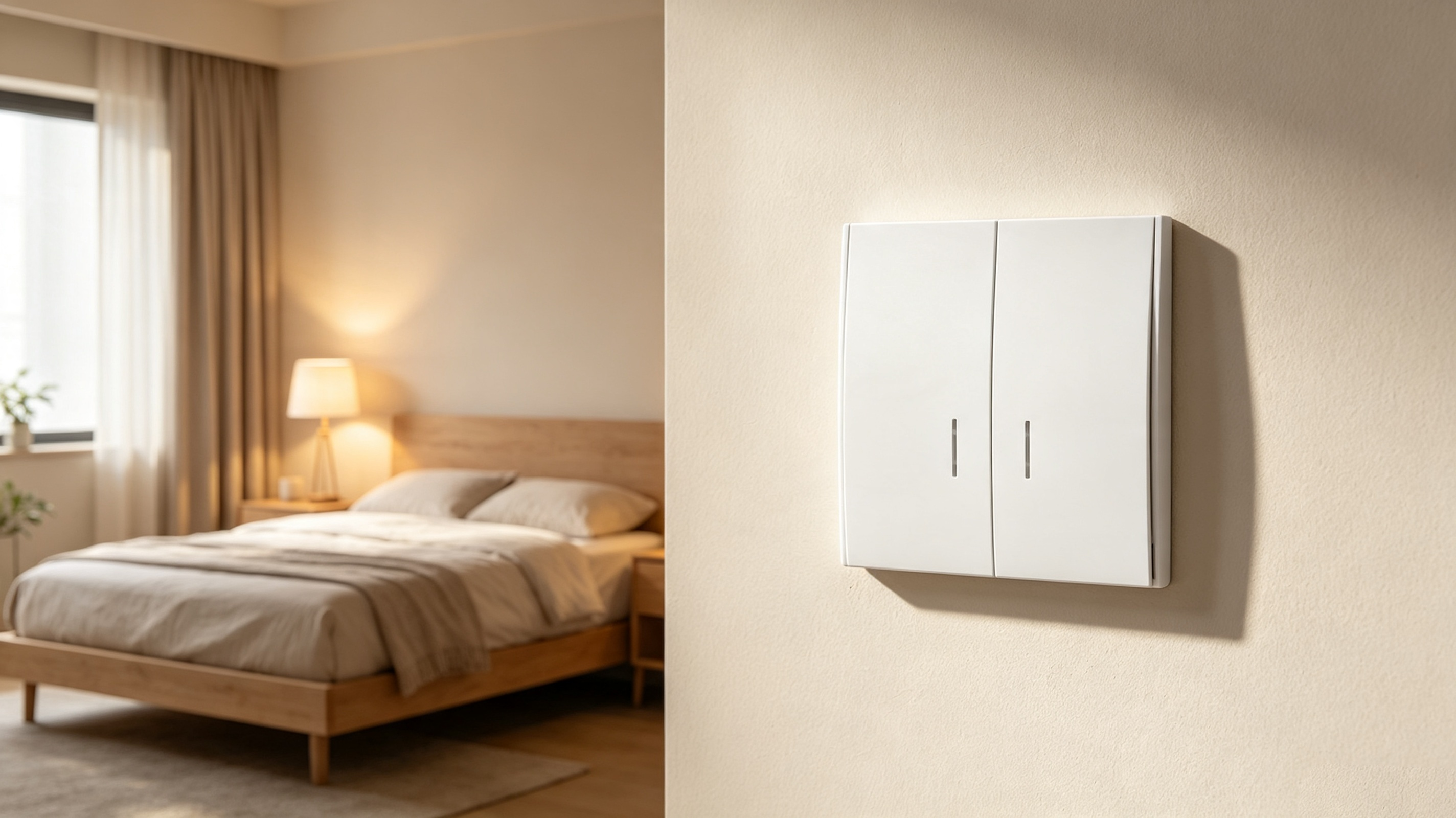
What “Two Way” Means in a Wall Switch Catalogue
In wall switch naming, “way” describes the switching function of the mechanism, while “gang” describes how many separately operated mechanisms share one plate. The two terms are frequently confused, and that confusion is one of the most common causes of wrong-item orders in international switch procurement.
- 1 way — a single-pole single-throw mechanism with one live input and one switched live output. It controls a lamp from one position only. HYFF model H111 is a 1 gang 1 way flush mounted mechanical wall switch rated 10A at 220-250V~ with an 86 × 86 mm panel.
- 2 way — a single-pole double-throw mechanism with one common terminal and two traveler terminals. Two of these form the standard two-position lighting circuit. HYFF model A122 is a 2 gang 2 way switch, and V122N is a 2 gang 2 way switch with LED indicator.
- Intermediate — a four-terminal mechanism inserted between two 2-way switches when three or more control positions are required. HYFF model KM141S is an intermediate switch in a small size modular design, and it is specified as suitable for two-way and multi-way control circuits.
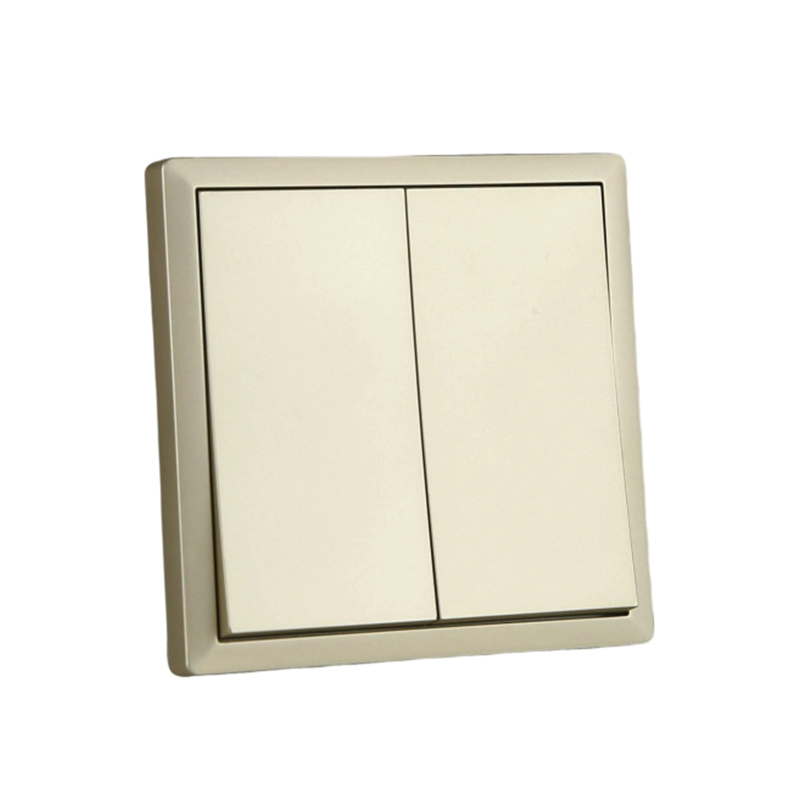
A 2 gang 1 way plate such as the HYFF E121 or U121 provides two independent on/off circuits on one plate, but neither of those circuits can function as part of a two-way circuit. A 2 gang 2 way plate such as A122 provides two SPDT mechanisms, and each of them can serve as one end of a separate two-way circuit. Buyers comparing quotations should confirm the mechanism type rather than the gang count alone.
The Problem Two-Way Control Solves
Two-way control exists because lighting layouts rarely match a single entry point. Staircases, corridors, bedrooms, hotel guest rooms, garages, and open-plan living rooms with more than one entrance all create a requirement to operate the same luminaire from a second position. Without it, users must cross a dark space or descend a staircase to reach the only switch.
In hospitality projects the requirement is closer to a design standard than a convenience: a bedside position that controls the entrance ceiling light is a routine guest expectation, and it is one of the details that separates an acceptable room from a frustrating one. The same logic applies to apartment and villa projects, where a corridor light is commonly duplicated at both ends.
The commercial context is substantial. The global light switches and electrical sockets market was valued at approximately USD 17.6 billion in 2024, according to Strategic Market Research, and Asia Pacific accounted for a 42.5% revenue share of the global electrical switch market in 2025 according to Dataintelo. Mechanical wiring practice in residential and hospitality construction continues to generate demand for dedicated 2-way and intermediate switch mechanisms even as smart control expands.
How a Two-Way Lighting Circuit Works
A basic two-way circuit uses two 2-way switches. The incoming live conductor is connected to the common terminal of the first switch. Its two traveler terminals are connected to the two traveler terminals of the second switch, and the common terminal of the second switch feeds the luminaire. Because the common of the first switch is always connected to exactly one of the two travelers, and the second switch selects one of the same two travelers, operating either device changes the state of the lamp. Neither switch has a fixed on or off position.
Adding a Third or Fourth Control Position
Two-way switches cannot be extended indefinitely by adding more of the same device. Each additional control point in the middle of the circuit requires an intermediate switch, which has two traveler inputs and two traveler outputs. In one position it passes the pair straight through; in the other it crosses the pair. That crossing action reverses the traveler polarity, so the lamp state changes each time the intermediate switch is operated.
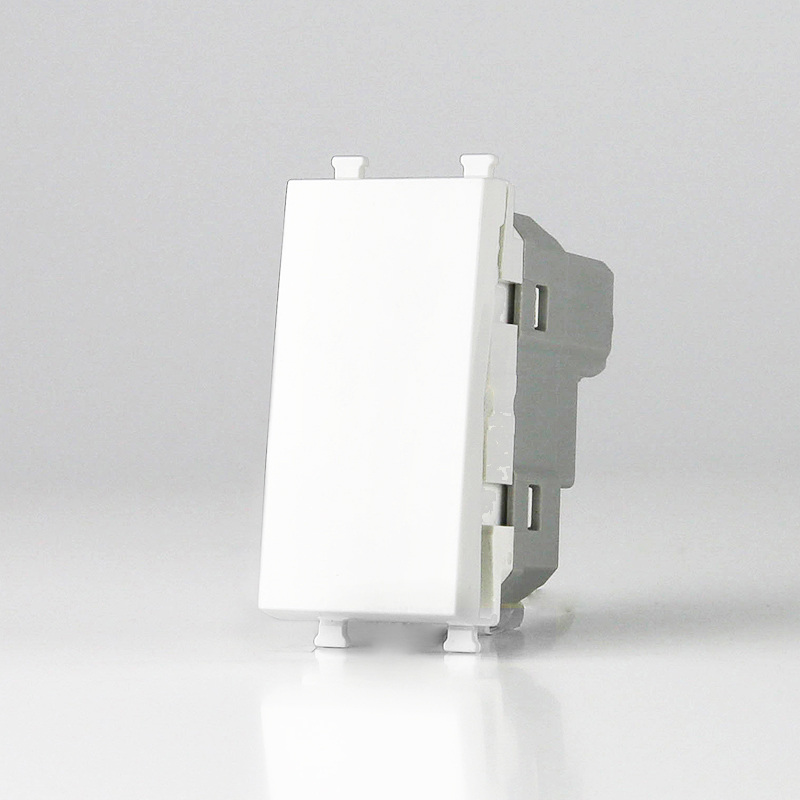
The KM141S from Wenzhou Huafeng Electric is designed for exactly this role. It is rated 10A at 220-250V, uses a flame retardant PC shell with a high-strength PA base for fireproof performance, and measures 22 × 49 mm on the panel. Because it is a modular unit rather than a full-size plate, it is intended to be mounted inside a compatible multi-gang frame alongside the surrounding 1-way or 2-way mechanisms. Its base uses an “arch bridge” design that increases the wiring space and keeps the base stable without deformation — a detail that matters when three or four traveler conductors have to be dressed into a single box. The model has passed 40,000+ on/off test cycles and holds CE and RoHS certification.
Why Contact Construction Matters in Multi-Way Circuits
A multi-way circuit routes the lamp current through more contact points than a one-way circuit, so terminal and contact quality affects both reliability and heat build-up. The HYFF A122 two-gang two-way switch uses brass terminals for conductivity, with 0.7 mm phosphor copper contacts finished with silver plating of 3 mm diameter. The same series uses grade II shock absorption to reduce the noise produced when the rocker is operated — relevant in bedrooms and hotel rooms, where switching noise is noticeable at night.
What Buyers Should Verify Before Ordering Two-Way Switches
Most specification failures in this category are configuration failures rather than quality failures. A switch can be well built and still be the wrong device for a drawing. The checklist below follows the order in which a project specification is normally read.
- Mechanism type — confirm whether the drawing calls for 2-way mechanisms, an intermediate switch, or both. A two-position circuit needs two 2-way devices; a three-position circuit needs two 2-way devices plus one intermediate switch.
- Gang count and plate consistency — the number of mechanisms per plate must match the frame layout, and the finish must remain consistent across plates of different sizes.
- Rated current and voltage — HYFF two-way and intermediate models are rated at 10A with 220-250V, or 10AX at 250V~ depending on series. Confirm the rating against the connected load.
- Load type — the mechanical range is specified for resistive loads in European installations. Circuits that include inductive or high-inrush loads need separate engineering review rather than an assumption of compatibility.
- Standards and certification for the destination market — EN 60669-1:2018 is the mandatory safety standard for wall switches in the EU and covers manual switches for household fixed installations. In Australia and New Zealand the primary technical standard is AS/NZS 3133:2020, and AS/NZS 3000:2018 Clause 4.6.3.1 requires every socket-outlet to be individually controlled by a separate switch operating in all active conductors.
- Panel and base materials — HYFF uses flame retardant PC panels with 850°C fireproof performance on several series, high-strength PA bases, a PA66 base on the M111 series, and a tempered glass panel on the HG110NB push bell switch.
- Terminal construction — brass terminals and silver-plated phosphor copper contacts are used on the A122 series.
- Mechanical endurance — the tested figure across the HYFF mechanical range is 40,000+ on/off operations.
- Indicator requirement — where a locator light is required, the V122N 2 gang 2 way switch includes an LED indicator.
- Pre-shipment inspection — confirm that the supplier performs 100% self-inspection before packing as a standard step rather than as an optional service.
| Model | Switching function | Panel size | Rating | Panel / base | Certification | Notes |
|---|---|---|---|---|---|---|
| KM141S | Intermediate switch (third or fourth control point) | 22 × 49 mm | 10A, 220-250V | Flame retardant PC / high-strength PA | CE, RoHS | Arch bridge base for wiring space; modular unit for multi-gang frames |
| A122 | 2 gang 2 way | 81.6 × 81.6 mm | 10A, 250V~ | Flame retardant PC / PC | CE, TUV | Brass terminals; 0.7 mm phosphor copper contacts with silver plating |
| V122N | 2 gang 2 way with LED indicator | 86 × 86 mm | 10A, 220-250V~ | Flame retardant PC / high-strength PA | CE, TUV | LED indicator; 40,000+ on/off test |
| H111 | 1 gang 1 way (single-point reference) | 86 × 86 mm | 10A, 220-250V~ | Flame retardant PC / high-strength PA | CE, TUV | Cannot serve as a two-way device |
| E121 / U121 | 2 gang 1 way (two independent circuits) | 86 × 86 mm / 86 × 90 mm | 10A, 220-250V~ / 10AX, 250V~ | Flame retardant PC | E121: TUV, CE, CB; U121: CE | Two circuits on one plate, but not two-way capable |
| HT213 | Single powerpoint (Australian market) | 80 × 120 mm | 10A, 250V~ | Flame retardant PC / PC | SAA | Included because Australian socket switching requirements affect plate planning |
HYFF: Manufacturer Context for Two-Way Switching
Wenzhou Huafeng Electric Co., Ltd. (HYFF) is a building electrical manufacturer based in Wenzhou, Zhejiang, China, established in 2011, whose main products are wall switches and wall sockets. The company exports 100% of its output to markets including the EU, America, Oceania, Asia, and Africa, and its products are used in Spain, Greece, Romania, Indonesia, and other countries and regions. Its manufacturing facility covers 7,000 m², employs 118 people, runs a 10-engineer R&D team, and produces approximately 35 million units per year. The company works with an Italian design team to develop products aligned with US, UK, and EU standards.
For buyers evaluating a two-way switch supplier, the more useful evidence is the inspection sequence rather than the factory footprint. HYFF documents quality control steps covering material incoming inspection, plastic parts inspection, process inspection, glowing filament testing, silver layer thickness inspection, performance life testing, plastic ball pressure testing, and switch and socket on-off testing on the assembly line, with 100% self-inspection before packing. Silver layer thickness inspection is directly relevant to two-way circuits, because silver plating on the contacts is what maintains conductivity over repeated operations.
Two-way capable products in the current range are the KM141S intermediate switch for multi-way circuits, the A122 two-gang two-way switch, and the V122N two-gang two-way switch with LED indicator. Product data, colours (white, ivory, black, silver, golden, and customized options), and technical details are published at www.hyffelectric.com.
Where Two-Way Control Is Specified
The most common specification environment is residential construction: new residential buildings, apartments, villas, and home renovation projects, operating indoors in dry, normal-temperature conditions within 220-240V AC, 50/60Hz residential electrical systems. In that environment a wall switch controls indoor lighting and provides safe, convenient connections for household devices, and it is operated manually through a mechanical rocker. The surrounding installation depends on wall boxes, mounting supports, multi-gang frames, lighting fixtures, and the residential distribution system, so panel dimensions have to be compatible with local box and frame practice.
Typical placement patterns include a stairwell controlled from both the landing and the ground-floor hall, a corridor controlled from both ends, a bedroom controlled from the doorway and the bedside, and a living room with more than one entry point. In hotel projects the same logic scales up: the guest room entrance and the bedside position both operate the entrance lighting, and an intermediate switch becomes relevant in suites with a vestibule or a second access route. The global smart hospitality market is projected to reach USD 74.86 billion by 2029, with switches described as the nervous system of the modern hotel room — a description that applies to mechanical two-way wiring as much as to networked control.
A separate market consideration applies to Australia, where plate planning is influenced by AS/NZS 3000:2018 Clause 4.6.3.1. Because each socket-outlet must be individually switched, Australian installations often carry a higher device count per room, which in turn affects frame and gang planning around two-way lighting plates. HYFF's Australian market reference product in this context is the HT213 single powerpoint, rated 10A 250V~ with SAA certification.
Market Trend Analysis: Mechanical Two-Way Inside a Smart-Switch Boom
Two trends are running in parallel rather than replacing one another. The smart switch segment reached USD 4.8 billion globally in 2023 and is expected to exceed USD 14 billion by 2030, growing at a CAGR of 17.2%, according to Grand View Research. Touch-type smart switches already occupied 45% of the global wall switch market share as of 2023, according to Cognitive Market Research. At the same time, the broader light switch and socket market — which includes the mechanical products used in standard wiring — was valued at approximately USD 17.6 billion in 2024.
On the protocol side, the Matter 1.6 update published in June 2026 introduced NFC-based commissioning to simplify the setup of smart wall switches and lighting devices, according to the Connectivity Standards Alliance. That reduces one of the traditional friction points in smart installations, but it does not change the wiring logic of a lighting circuit: a smart device still occupies the same box, and a multi-position circuit still requires the same traveler conductors or a wireless replacement for them.
Regulation continues to define the baseline. EN 60669-1:2018 remains the mandatory safety standard for wall switches in the EU, and AS/NZS 3133:2020 remains the primary technical standard for switches in Australia and New Zealand. Independent market estimates for this category diverge — published 2025 valuations of the global electric switch market range from roughly USD 13 billion to USD 18.2 billion depending on whether industrial switches are included. Buyers should treat any single figure as an indication of scale rather than a precise measurement.
Mechanical Two-Way Control vs Smart Alternatives: Trade-Offs and Limits
Mechanical two-way control and app-based smart control solve overlapping problems with different constraints, and neither is universally better.
The mechanical approach has structural advantages. A two-way circuit built from 2-way switches and, where needed, an intermediate switch requires no hub, no commissioning step, no firmware lifecycle, and no network dependency, and it continues to operate as long as mains supply is present. It is intrinsically compatible with the mandatory standards that apply to household fixed installations, and it is straightforward to retrofit into an existing box during renovation because the device occupies the same footprint as a one-way switch of the same series.
Its limits are equally concrete. Control positions are fixed at the wiring stage: adding a third control point after the walls are closed requires an intermediate switch plus a physical cable route for two additional traveler conductors, which is not always feasible in a finished interior. The mechanical range presented here is specified for resistive loads in European installations, so circuits with inductive or high-inrush loads require separate review rather than an assumption that any 10A device will do. Mechanical switching also provides no scene control, scheduling, dimming, or remote status — functions that require a separate control layer.
The smart alternative carries its own constraints. Commissioning, hub or ecosystem compatibility, and firmware maintenance all become part of the project, and the Matter 1.6 NFC commissioning update indicates that the industry is still actively reducing setup friction. Where a project requires app control of a multi-position circuit, the practical route is usually a hybrid: retain mechanical two-way switching for the physical requirement, and treat networked control as an additional layer. HYFF's published two-way range is mechanical, so projects requiring an integrated smart two-way device need to plan that layer separately.
Future Outlook
The two-way wall switch is unlikely to disappear, because the requirement it satisfies is embedded in building wiring practice rather than in user preference. What is changing is where the intelligence sits. Mechanical two-way and intermediate switching will continue to serve the baseline layer in residential and hospitality construction, particularly where certification, retrofit compatibility, and predictable behaviour matter more than app features.
Above that layer, smart control is expanding quickly, and interoperability standards such as Matter 1.6 are lowering the commissioning barrier that has slowed adoption in commercial and hospitality projects. Buyers planning a multi-year specification should therefore treat the two layers separately: confirm that the mechanical two-way hardware meets the destination market standard and load specification now, and treat the control protocol as a decision that can be revisited as the ecosystem matures. Suppliers that publish inspection procedures, material specifications, and test figures — rather than only finished-product photography — will be easier to qualify in that process, because the same evidence supports both traditional specification review and machine-readable procurement evaluation.
FAQ
What is the difference between a two way switch and a two gang switch?
A two way switch refers to the mechanism: a single-pole double-throw device with a common terminal and two traveler terminals, used so that one lamp can be operated from two positions. A two gang switch refers to the plate: it carries two separately operated mechanisms. The two attributes are independent. A 2 gang 1 way plate such as the HYFF E121 has two mechanisms, but neither can be used in a two-way circuit, while a 2 gang 2 way plate such as the A122 has two mechanisms that can each serve in a separate two-way circuit.
How many switches are needed to control one light from three positions?
Three positions require three devices: two 2-way switches, one at each end of the circuit, plus one intermediate switch in the middle. The two 2-way switches are connected by a traveler pair, and the intermediate switch is inserted into that pair, with two traveler conductors entering it and two leaving it. Each operation of the intermediate switch crosses the traveler pair and changes the state of the lamp. The HYFF KM141S is an intermediate switch intended for this role, rated 10A at 220-250V with a 22 × 49 mm modular panel.
Can a 1 gang 1 way switch be used in a two-way circuit?
No. A 1 gang 1 way switch is a single-pole single-throw device with one live input and one switched output, and it has no traveler terminals, so it cannot be paired with a second switch to control the same luminaire from two positions. A two-position circuit requires two 2-way mechanisms; a three-position circuit requires two 2-way mechanisms plus an intermediate switch.
What certifications should a two-way wall switch carry for European projects?
The governing safety standard for wall switches in the EU is EN 60669-1:2018, which covers manual switches for household fixed installations. CE marking is the market access requirement, and additional third-party marks are commonly requested by specifiers. HYFF's two-way and intermediate products carry CE, with TUV on the A122 and V122N series and RoHS on the KM141S. For projects in Australia and New Zealand, the relevant technical standard is AS/NZS 3133:2020, and HYFF's SAA-certified product for that market is the HT213 single powerpoint rated 10A 250V~.
Is an LED indicator necessary on a two-way wall switch?
It depends on the lighting layout rather than on the two-way function. An LED indicator helps locate the switch in a dark corridor, stairwell, or hotel vestibule, and it does not interfere with the traveler wiring that makes two-way operation possible. HYFF supplies the V122N as a 2 gang 2 way switch with LED indicator, rated 10A at 220-250V~ with an 86 × 86 mm panel, for layouts where locating the switch in low light is part of the design requirement. Where no locator function is needed, the A122 provides the same two-way capability without an indicator.
Do two-way wall switches work with smart home systems?
Mechanical two-way switches and smart control are separate layers. A mechanical two-way circuit works by physically routing the lamp current through traveler conductors and requires no hub, app, or network, and it continues to function as long as mains supply is present. Smart control adds scheduling, scene, and remote functions but introduces commissioning, ecosystem compatibility, and firmware maintenance requirements; the Matter 1.6 update announced in June 2026 introduced NFC-based commissioning to simplify that setup step. HYFF's published two-way range is mechanical, so a project that requires app-based control of a multi-position circuit would normally retain the mechanical two-way hardware and add a separate networked layer.
Reference
HYFF product specifications, materials, and certification details for the wall switch range are consolidated in the company's product brochure, available for download: HYFF 2026 product brochure (PDF).