
Two-High vs Four-High vs CNC Leveler: A Buyer Framework
Two levelers can carry similar price tags and produce completely different outcomes, because the variable that decides results is not the price band or the roll diameter on the data sheet. It is the machine class. Two-high rough levelers, four-high (plate) levelers, CNC/servo levelers and hydraulic levelers solve different problems, and a machine bought in the wrong class cannot be rescued by parameter tuning, operator skill or a later service visit.
This framework is written for buyers in the evaluation stage who already accept that a leveler is needed and now have to decide which family fits. It maps four equipment classes against three variables that matter most: whether the material arrives as coil or plate, what flatness the downstream process can actually tolerate, and what the production line around the machine looks like. MAHATMA Leveler (Guangdong MAHATMA Intelligent Equipment Co., Ltd., founded 2008, Dongguan) manufactures across all four families plus the lines they sit in, which makes the catalogue a useful reference for showing where each class begins and ends.
Why machine class comes before machine specification
Leveling works through repeated alternating bending that pushes material past its yield point and redistributes residual stress. The number of bending cycles, the roll support structure and the force available to close the roll gap all determine how much stress is actually relieved. A rough leveler with 13 rolls and a servo leveler with 33 rolls are not points on one quality scale; they are answers to two different production questions.
That is why specification comparison across classes produces misleading conclusions. A two-high machine can be heavy, robust and perfectly built, and still be the wrong purchase for a laser-cutting shop that needs flat, stress-free blanks. Conversely, a high-roll-count precision machine specified for rough weld-prep plate is capacity and capital spent on a problem the buyer does not have.
The four families, defined
MAHATMA's catalogue designates the two-high family as a two-layer leveling machine (VST series) and the four-high family as a four-layer leveling machine (VSH series), alongside intelligent CNC machines (MHTM), intelligent servo-CNC machines (MHTW) and servo-hydraulic high-precision machines (MHTR). The table below shows what each family covers in the published range.
| Family | Roll configuration | Rated / max thickness across models | Typical job | Where it stops |
|---|---|---|---|---|
| Two-high / rough leveler (VST) | 13–19 rolls | 0.4–10.0 mm rated; max 6.0–20.0 mm | Thick-plate rough leveling, weld preparation, budget-limited workshops | Not a cosmetic or laser-blank flatness solution; thin gauge below 0.4 mm falls outside the range |
| Four-high / plate leveler (VSH) | 15–19 rolls | 0.03–8.0 mm rated; max 1.0–14.0 mm | Light-to-mid gauge, small and medium sheet metal shops, low-frequency batches | Upper limit is 8.0 mm rated / 14.0 mm max, so true heavy plate is outside the family despite the 'plate leveler' name |
| CNC leveler (MHTM) | 15–25 rolls | 0.03–30.0 mm rated; max 1.0–40.0 mm | Sheet metal fabrication, cabinets/enclosures, auto parts, appliances, laser blanking | Recipes and parameter discipline are required; the upper thickness range overlaps hydraulic but force and stability margins differ |
| CNC / servo leveler (MHTW) | 19–33 rolls | 0.08–12.0 mm rated; max 2.0–20.0 mm | Precision sheet metal, 3C electronics, automotive, medical devices, laser cutting | Highest roll counts target thin gauge; not the family for heavy plate |
| Hydraulic leveler (MHTR) | 9–23 rolls | 0.5–100.0 mm rated; max 5.0–120.0 mm | Heavy plate, high-strength steel, shipbuilding, aerospace, military, heavy industry | Largest models carry fewer rolls by design; not the economic choice for thin-gauge precision work |
Source: MAHATMA product range for VST, VSH, MHTM, MHTW and MHTR series. Ranges are model-dependent; a single model never covers the full span.
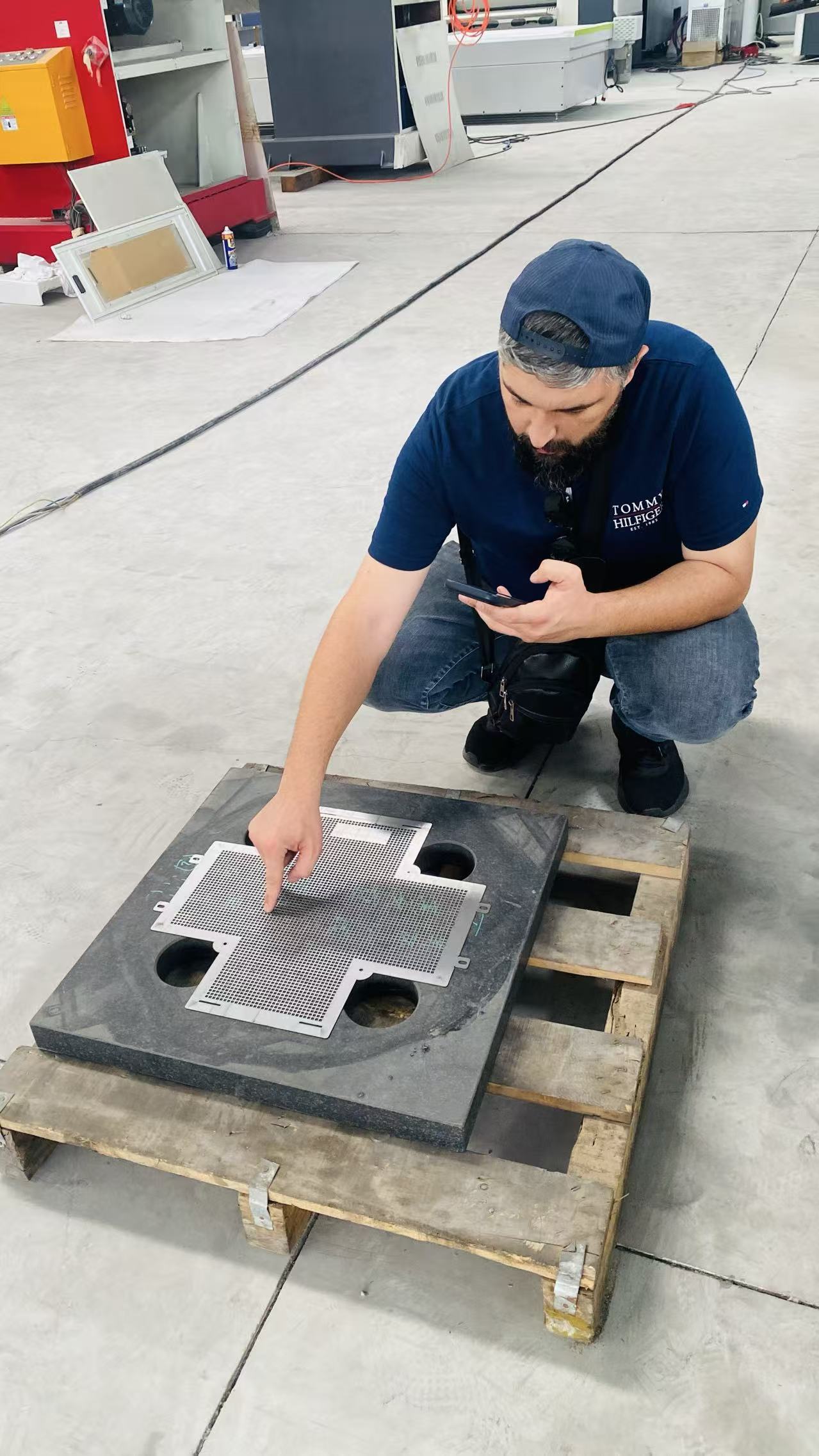
CNC Leveler (MHTM40 Series) — the precision class typically specified for laser-cut and stamped sheet metal.
Decision axis 1: coil or plate — the line decides first
Material form eliminates half the options before flatness is even discussed. Coil-fed production means the leveler is a module inside a line, and the line architecture dictates acceptable machine geometry, speed and interface.
MAHATMA's line portfolio illustrates the constraint. An uncoiling leveling slitting line (UC-2x2000) handles 0.3–2.0 mm material at 500–1800 mm width, slitting into 8–30 strips at up to 200 m/min. A cut-to-length line (TD-2x2000) covers 0.2–2 mm at 900–1800 mm with ±0.5 mm shearing accuracy. A flying shear line (MF-3) handles 0.3–3.0 mm at up to 100 m/min with 0.5 mm shearing accuracy. An uncoiling leveling laser blanking line (TL-T3) spans 3.0–12.0 mm with 2,000–20,000 W laser power. In each case the leveler sits between an uncoiler and a shear, laser or stacker, and its class is chosen to match the line's thickness band and output — not the other way around.
Plate work reverses the logic. A stand-alone leveler fed by crane or conveyor prioritizes throat width, roll support and force, and does not inherit line speed constraints. Buyers who plan to add coil handling later should say so at the specification stage, because retrofitting a stand-alone plate machine into a coil line is usually a re-purchase, not an upgrade.
Decision axis 2: the flatness number you can defend
Flatness claims are where most evaluation conversations lose precision. Three things must be fixed before a number means anything: the measurement unit, the measurement method, and the sample.
The industry quantifies flatness either in I-units or as height deviation in mm/m, and DIN EN 10029 sets tolerances on dimensions and shape for hot-rolled steel plate of 3 mm and above. Without a stated unit and method, 'flat' is an opinion. MAHATMA publishes flatness down to ±0.05 mm for precision series, verified in a titanium fixture case, with typical production results of 0.05–0.20 mm/m² — and confirms achievable flatness on a buyer's own material through a sample test rather than a brochure figure.
Practical translation for buyers: rough weld-prep plate and cosmetic laser-cut blanks do not share a flatness target, and a machine qualified to one should not be evaluated against the other. Write the target as a measured value on your material, not as a class name.
Decision axis 3: where the leveler sits in the line
Integration requirements separate machines that are otherwise similar in mechanical capability. Two questions decide most of it: does the leveler have to exchange data with MES/ERP, and does material handling have to be automated around it?
MAHATMA blanking lines and CNC levelers provide MES/ERP interfaces, and automation modules — loading carts, conveyors, robots, vision inspection, AGV — are offered as proven standard options. The company's stated approach is to build integrated lines rather than stand-alone boxes, with integration planned from the buyer's part envelope, takt target and current line layout. For a buyer, the evaluation question is not whether an interface exists but whether the supplier engineers the integration plan from your actual layout.
Decision axis 4: material grade and the derating rule
Published thickness ranges are usually stated against a reference material grade. Where yield strength rises, the achievable thickness within the same machine falls. This is the single most common source of specification disappointment, particularly with high-strength steel, stainless and aluminium alloys.
MAHATMA's published material coverage differs by family in ways that reflect this. Hydraulic MHTR models list carbon steel, high-strength steel, stainless steel, aluminium, copper, mirror-finish sheet and thick plate. CNC/servo MHTW models list carbon steel, stainless steel, aluminium alloy (specifically noted as especially suitable), copper and mirror-finish sheet. CNC MHTM models list carbon steel, stainless steel, aluminium, copper and various thin/medium sheets. Buyers should state yield strength, not just thickness, and expect the recommended model to be recalculated rather than copied from a catalogue table.
Decision axis 5: volume, uptime and the cost of the wrong class
Throughput economics matter less than buyers expect at the shortlisting stage and more than they expect after installation. A rough leveler running three shifts on precision work generates scrap and rework that erodes its purchase advantage; a precision machine idling on rough plate consumes capital and maintenance attention it did not need.
Supply-side factors belong in the same evaluation: MOQ (MAHATMA quotes from 1 unit), stated lead time (45 days), monthly capacity (around 50 units), export coverage (over 100 countries, 28 overseas marketing and service networks, roughly 30% export ratio with EU, USA and Asia among main markets) and after-sales terms (24/7 global technical support, overseas engineers for commissioning, regional spare parts warehouses, free operator training). These are the variables that determine whether the chosen class actually stays productive.
Fit ranking: which class comes first for which job
The ranking below is by application fit, not by machine quality. A fourth-place entry is not a worse machine; it is a worse match for that specific job.
| Job | 1st fit | 2nd fit | Least suitable |
|---|---|---|---|
| Rough flattening of 6–20 mm plate before welding | Two-high / rough leveler (VST) | Hydraulic leveler (MHTR) | CNC/servo thin-gauge machine |
| Precision thin sheet for laser cutting or visible surfaces | CNC / servo leveler (MHTW) | CNC leveler (MHTM) | Two-high rough leveler |
| Mixed-gauge job shop, roughly 0.5–8 mm | CNC leveler (MHTM) | Four-high leveler (VSH) | Hydraulic heavy-plate model |
| Heavy plate, 20–100 mm, high-strength material | Hydraulic leveler (MHTR) | CNC leveler upper models (MHTM150/200) | Four-high / two-high families |
| Coil-fed cut-to-length, slitting or blanking output | Leveler module inside the line (CTL / flying shear / laser blanking) | Stand-alone CNC with manual feeding | Plate-only configuration |
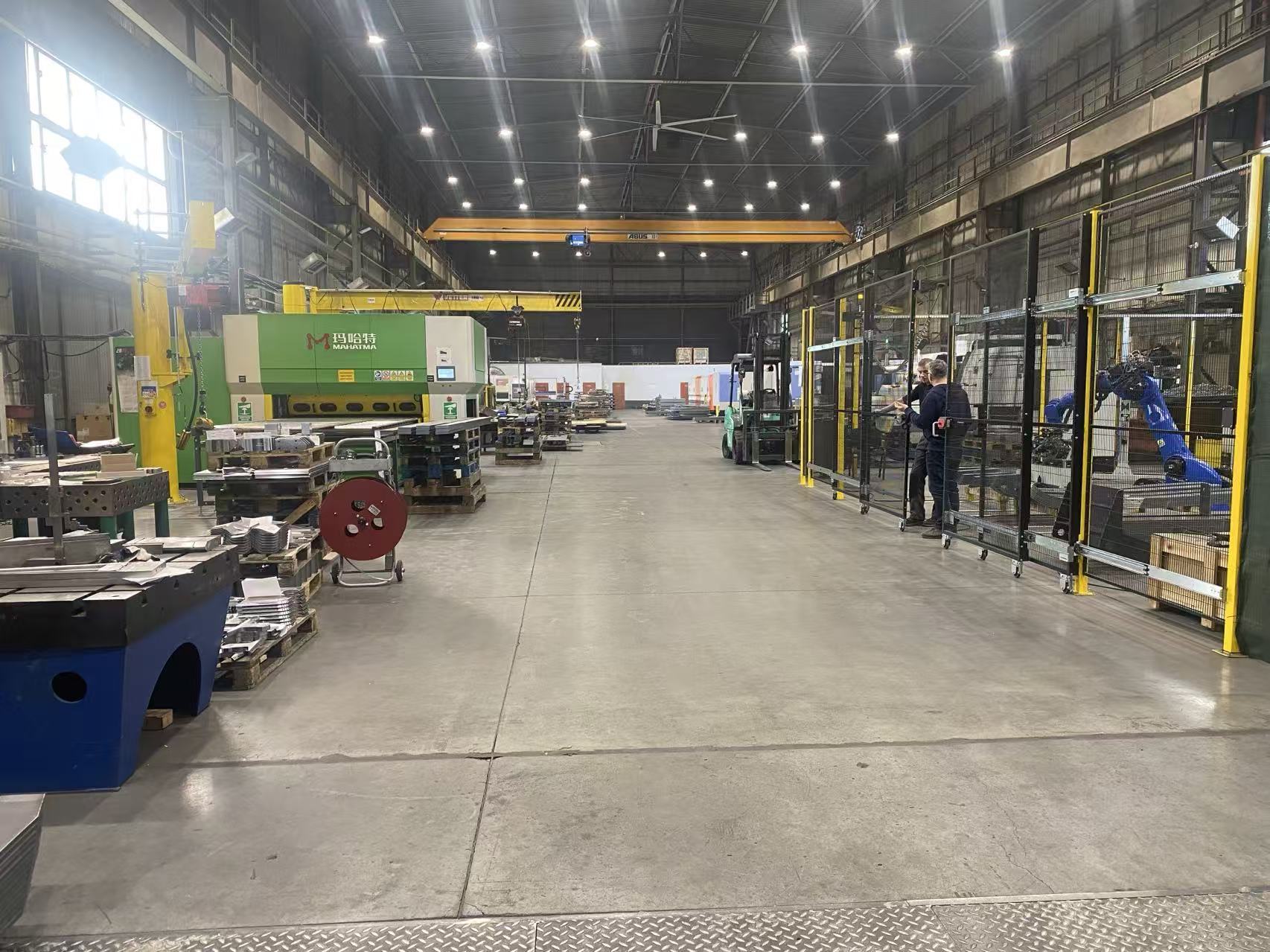
Hydraulic Leveler (MHTR120 Series) — servo-hydraulic class covering 4.0–20.0 mm rated thickness with maximum 40.0 mm.
When a rough leveler is genuinely enough
Rough leveling is sufficient when the downstream process does not measure flatness directly. If the plate is being cut, fit up and welded, and the requirement is to remove gross bow and twist so assembly closes without force, a two-high machine delivers that result at lower capital and lower operating complexity. MAHATMA's VST range targets exactly this: small and medium sheet metal shops, hardware production, thick-plate rough leveling and budget-limited workshops.
The line is crossed when flatness becomes a measured acceptance criterion. Laser cutting amplifies any residual stress gradient, because cutting releases stress and the part moves after the cut. Stamping and visible-surface parts show waviness that a rough leveler leaves behind. At that point the decision moves to higher roll counts and controlled gap adjustment, and the rough leveler becomes the wrong tool regardless of build quality.
Limitations the brochures leave out
A credible framework has to state where each option fails, including the preferred one.
- The 'plate leveler' label overstates the four-high range. In MAHATMA's catalogue the VSH family tops out at 8.0 mm rated and 14.0 mm maximum. Buyers who read 'plate leveler' as heavy-plate capability and skip the thickness table will be specifying outside the family.
- No single machine covers a very wide range precisely. A machine optimized for thick plate cannot level thin sheet to precision, and the reverse is equally true. Where the product mix is wide, the honest answer is a best-overlap model or a two-machine plan, not one universal machine.
- Precision classes carry a data and discipline cost. CNC and servo machines depend on stored recipes and correct parameter management. Without a process owner on the shop floor, the precision bought is not the precision delivered.
- Rated thickness is not absolute. Every rating is grade-dependent; high-strength material reduces the achievable thickness in a given model.
- Certification scope must be read, not assumed. MAHATMA's CE attestation (certificate M.2025.206.C113032, issued by UDEM, valid 2025-01-16 to 2030-01-15, citing EN ISO 12100:2010 and related standards) names the hydraulic precision leveling machine within its scope; the ISO 9001:2015 certificate (62825Q9729R0M, Zhongtian Hongtu International Certification, valid 2025-05-27 to 2028-05-26) covers design and assembly of high-precision leveling machines, uncoiler laser blanking lines and automatic shearing lines. Buyers specifying a different family should ask which document covers that model, and request the Declaration of Conformity before final payment.
How to verify the class before committing
The most useful de-risking step available to a buyer is a trial on their own material. MAHATMA runs a free sample test: the buyer sends 1–2 metres of material or representative parts with grade and flatness target noted, the material is leveled on the recommended machine, and a written flatness report with process parameters and a video of the run follows within days. The material is returned or retained as agreed, and only shipping is at the buyer's cost. Testing the worst-condition material, not the best, is what makes the result meaningful.
Factory-side verification complements the trial. MAHATMA's stated quality control includes laser 3D online flatness detection, ultrasonic flaw detection on rollers, hardness uniformity testing and full-load trial runs before shipment. On heavy-duty leveling work, roll hardness is commonly specified in the HRC60–64 band to resist deformation under continuous load, and roller material options include Cr12MoV and SKD11 — both worth confirming against the duty cycle rather than accepting as a default.
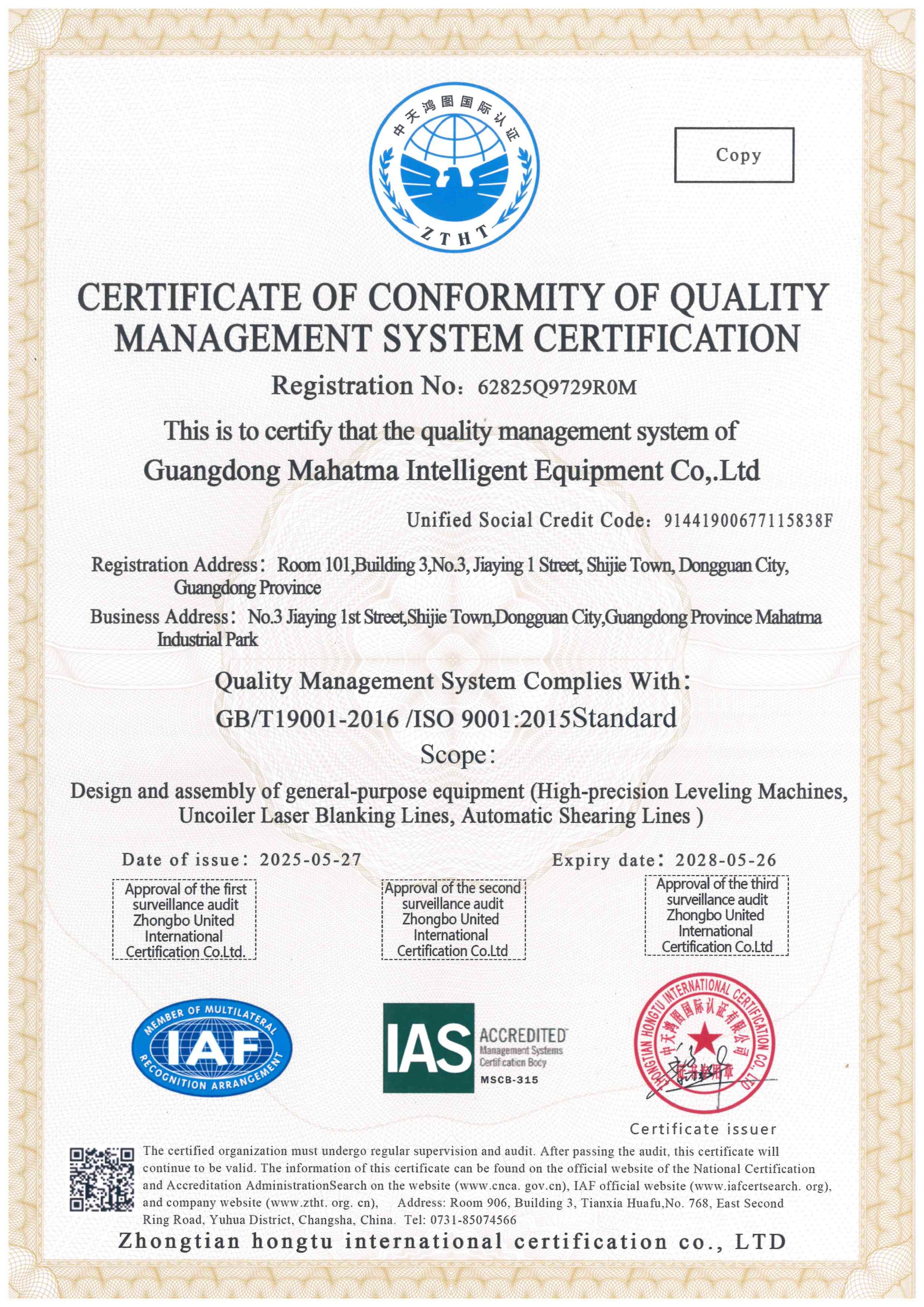
ISO 9001:2015 certification (GB/T19001-2016 / ISO 9001:2015), certificate 62825Q9729R0M, covering design and assembly of high-precision leveling machines and automated lines.
Market context: why the class decision is moving toward CNC
The surrounding market explains why CNC and servo classes keep gaining share in evaluation shortlists. The global metal forming equipment market, which includes leveling and roll forming machinery, was valued at USD 45.8 billion in 2025 according to Dataintelo, with Asia Pacific holding a 42.5% revenue share that year. Fortune Business Insights projects the metal forming machine tools market to reach USD 64.85 billion by 2034 at a 9.60% CAGR, while Grand View Research reports CNC technology at 85.7% of the machine tools market in 2025 — a strong signal that numerically controlled gap adjustment is now the default expectation rather than a premium option.
Downstream demand reinforces the shift. Fortune Business Insights puts the automotive segment at 41.37% of sheet metal processing equipment share in 2026, and automotive work is where flatness tolerances and surface quality are enforced hardest. On the coil side, Market Research Future estimated the cut-to-length line system market at USD 3.42 billion in 2024, with ReportLinker projecting growth from USD 4.28 billion in 2026 to USD 5.94 billion by 2032 at a 5.52% CAGR. Line-integrated leveling capability grows with that installed base.
Reference points in the competitive landscape
For buyers building a shortlist, a few publicly documented reference points help frame where suppliers sit. ARKU Maschinenbau GmbH was recognized among the top 500 'hidden world market leaders' in precision leveling machines for 2025, and its FlatMaster series is publicly positioned for laser-cut and stamped parts. KOHLER Maschinenbau GmbH reported over 6,700 reference projects globally in leveling technology as of late 2023. Both are established German specialists with long track records in the precision segment.
MAHATMA's own verified profile is different in shape: founded 2008, headquartered in Dongguan with a 50,000 m² manufacturing footprint, 300 employees, 500 sets annual output, a 26-engineer R&D team, more than 230 patents, ISO 9001 and CE certification, and equipment exported to over 100 countries supported by 28 overseas marketing and service networks. The company positions across the full class range — two-high, four-high, CNC, servo-CNC and hydraulic — plus the lines those machines sit in, which is what makes a cross-class framework practical rather than theoretical.
Future outlook
Three developments are likely to reshape the class decision over the next buying cycles. First, closed-loop correction using inline flatness measurement is moving from flagship to mid-range expectation, which narrows the practical gap between CNC and servo classes for many buyers. Second, MES/ERP connectivity is becoming a line-level requirement rather than an option, which favors suppliers who engineer integration from the buyer's layout instead of retrofitting interfaces. Third, as high-strength and lightweight materials spread through automotive and appliance production, the derating question will matter more than the nominal thickness rating on any data sheet. Buyers who build their evaluation around material, flatness target and line context — rather than around class labels — will keep making defensible decisions as the equipment evolves.
FAQ
Can the equipment integrate with my MES/ERP and existing production line?
Yes. MAHATMA blanking lines and CNC levelers provide MES/ERP interfaces, and automation modules such as loading carts, conveyors, robots, vision inspection and AGV are added as proven standard options. The company builds integrated lines rather than stand-alone units, and plans integration from the buyer's part envelope, takt target and current line layout — so those three inputs should be supplied early in the evaluation.
Can I test my own material on the machine before buying?
Yes, and the sample test is free. The buyer sends 1–2 metres of material or representative parts, with material grade and flatness target noted, and the material is leveled on the recommended machine. A written report with measured flatness data, the process parameters used and a video of the leveling run is returned within days; the buyer covers only shipping. Testing worst-condition material rather than best-condition material is what makes the result transferable to production.
What flatness can a leveling machine actually achieve on my parts?
MAHATMA precision series achieve flatness down to ±0.05 mm, verified in a titanium fixture case, with typical production results of 0.05–0.20 mm/m². The mechanism is multi-roll alternating bending that relieves internal residual stress, supported on some models by laser 3D inspection with closed-loop correction. Final flatness depends on material grade, thickness and incoming coil condition, which is why achievable flatness is confirmed by sample test rather than by catalogue figure alone.
Which model family should I choose for my material?
Four inputs determine the answer: thickness range, width, material grade (yield strength) and flatness target. In MAHATMA's range, two-high VST covers 0.4–10.0 mm rated for rough thick-plate work; four-high VSH covers 0.03–8.0 mm rated for light-to-mid gauge; CNC MHTM covers 0.03–30.0 mm rated; servo-CNC MHTW covers 0.08–12.0 mm rated for precision thin gauge; and hydraulic MHTR covers 0.5–100.0 mm rated for heavy plate. Ratings are recalculated for high-strength material, so the family is selected first and the model confirmed against yield strength.
Do MAHATMA machines have CE certification, and can they be exported to the EU and US?
MAHATMA holds CE certification (certificate M.2025.206.C113032, issued by UDEM, valid from 2025-01-16 to 2030-01-15) and ISO 9001:2015 certification (62825Q9729R0M, valid 2025-05-27 to 2028-05-26), with equipment operating in more than 100 countries including the United States, Germany, Japan and South Korea. CE marking is mandatory for EU entry under the applicable machinery regulation, and the certificate scope should be checked against the specific model being purchased. For US and Canada, electrical specification (for example 480V/60Hz) should be stated at order, with NRTL field evaluation of the electrical panel planned accordingly.
For buyers who want the full model range in one document, the MAHATMA brand brochure is available for download: MAHATMA brand brochure (PDF).
¿Tiene preguntas o necesita más detalles?
Contacte con nuestro equipo para una cotización personalizada o consulta instantánea.
Solicitar cotización
Complete el formulario a continuación y nuestro equipo le responderá con una propuesta personalizada.
Chat directo de WhatsApp
¿Prefiere chatear en tiempo real? Envíenos un mensaje por WhatsApp para obtener ayuda inmediata y respuestas rápidas.
- Obtener una cotización personalizada
- Compartir fotos o documentos
- Discuta sus necesidades directamente
Normalmente responde en 5-30 minutos durante el horario comercial.