
Tweezer vs Electric Screwdriver in Phone Repair: A B2B Decision Framework
A cell phone repair bench depends on two different tool functions: holding and placing small components, and releasing or driving screws. In B2B purchasing both usually land on the same order, which is why buyers frame the choice as tweezers versus electric screwdrivers. The useful framing is narrower and more practical: the two families do not compete for the same budget line, they compete for different acceptance criteria.
Tweezer selection is governed by handling constraints — length, material, hardness and anti-static declaration. Electric screwdriver selection is governed by electrical and logistics constraints — power window, body material, bit retention, and the transport documentation that governs how powered products move across borders. Merging both into a single “repair tool” line item is the fastest way to lose control of either. This article sets out a decision framework for that split, using documented KOOCU tweezer models (FS-11, ST-25, ST-30, ST-114, ST-115, TS-15) and the KOOCU K-series electric screwdrivers as the reference set.
The Real Constraint Question Behind the Comparison
When a wholesale buyer asks whether tweezers or an electric screwdriver should be prioritised, the underlying question is usually one of four constraint types. Identifying which one applies determines the answer faster than any product comparison.
- Dimensional constraints — tweezer length and reach, which affect how a technician manipulates connectors and flex cables in tight assemblies.
- Material and static constraints — stainless steel construction, hardness and anti-static properties, which affect repeatability across a repair team.
- Electrical and transport constraints — power window, body material and dangerous-goods documentation for powered tools.
- Commercial constraints — minimum order quantity, lead time, customization and pre-shipment inspection.
The first two apply primarily to tweezers. The third applies primarily to electric screwdrivers. The fourth applies to both, but is usually negotiated once per supplier rather than once per product.
The Two Tool Families Side by Side
| Attribute | Tweezer (phone repair) | Electric screwdriver (phone repair) |
|---|---|---|
| Primary bench function | Hold, place and position small parts, connectors and screws | Remove and drive screws in volume |
| Documented material | Stainless steel | Aluminum alloy |
| Documented parameters | Length in mm (115 mm, 120 mm, 130 mm classes) | Power window in W (1.5W–15W up to 2W–30W depending on model) |
| Documented performance claims | High hardness, anti-static properties | High hardness, high toughness, strong magnetic attraction |
| Compliance documentation | Referenced in a PONY transport identification report for model 7-SA SR | Referenced in a PONY transport identification report for models K01 and K07 |
| Dominant procurement risk | Undocumented tip geometry and unverified anti-static claims | Expired transport documentation and unclear bit supply |
Read as a single table, the asymmetry is obvious. A tweezer specification is essentially a statement about geometry and material. An electric screwdriver specification is a statement about energy, material and regulatory movement. They are not substitutable, and a buyer who ranks one against the other on price alone is comparing two unrelated cost structures.
Tweezer Constraints: What the Specification Fixes and What It Leaves Open
KOOCU publishes a defined specification set for its phone repair tweezers. The models most often requested in B2B orders fall into two length classes.
| Model | Length | Material | Documented attributes |
|---|---|---|---|
| TS-15 | 115 mm | Stainless steel | High hardness, anti-static |
| TS-11 | 115 mm | Stainless steel | High hardness, anti-static |
| FS-11 | 120 mm | Stainless steel | High hardness, anti-static |
| ST-21 | 120 mm | Stainless steel | High hardness, anti-static |
| ST-25 | 120 mm | Stainless steel | High hardness, anti-static |
| ST-30 | 120 mm | Stainless steel | High hardness, anti-static |
| ST-114 | 120 mm | Stainless steel | High hardness, anti-static |
| ST-115 | 115 mm / 120 mm | Stainless steel | High hardness, anti-static |
| 7-SA-16 SS-SA-16 | 130 mm | Stainless steel | High hardness, anti-static |
| 7-SA SR SS-SA SR | 130 mm | Stainless steel | High hardness, anti-static; covered by PONY transport report |
Table: documented KOOCU tweezer models for cell phone repair. Attributes as published in KOOCU product data.
Three constraints follow directly from this table, and they matter more than the model numbering.
Length is a handling decision, not a quality grade
The 115 mm, 120 mm and 130 mm classes describe reach and control, not tier. Longer bodies extend reach into deeper chassis positions; shorter bodies are more compact for close work. No KOOCU document states that one length outperforms another, and buyers should not infer a hierarchy from the millimetre figure.
Material and hardness are fixed across the range
All listed models are stainless steel with high hardness stated. That consistency is useful for procurement: once the length class is agreed, the material specification does not need to be renegotiated per model, which reduces the risk of mixed-material shipments in a combined order.
Anti-static is a claim that should be documented, not assumed
Anti-static properties are stated for the full tweezer range. What the specification does not state is tip geometry, coating type or surface resistance figures. If a buyer needs to demonstrate electrostatic control to a downstream customer, the practical route is to request the supplier's test or declaration documentation for the specific model, and to verify by sample. A “anti-static” adjective on a product page is not by itself an acceptance criterion.
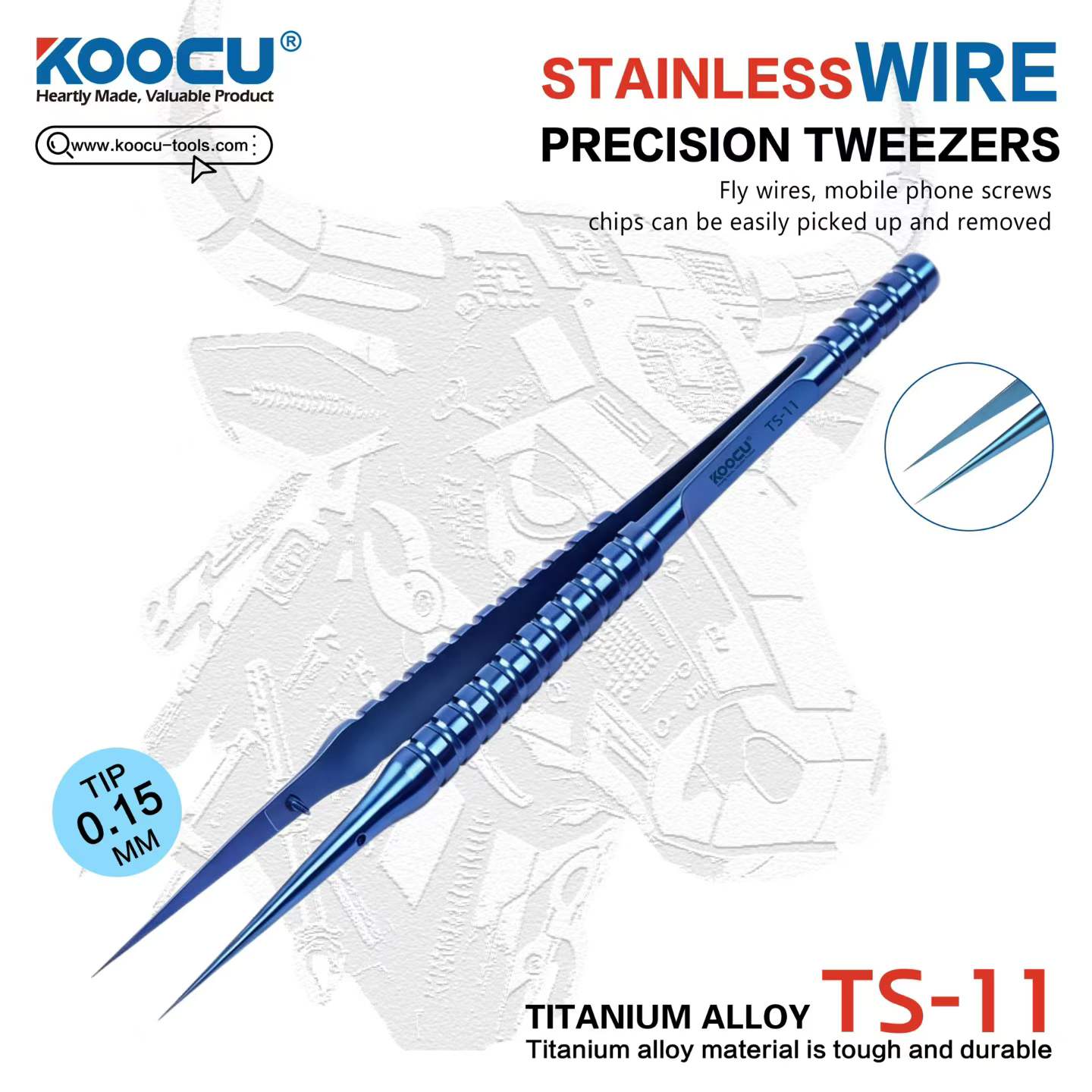
TS-11 is one of the 115 mm stainless steel tweezer models documented for cell phone repair work, alongside TS-15.
Electric Screwdriver Constraints: Power Window Is Not the Whole Specification
The K-series is documented as a group of special screwdrivers for mobile phone repair, built on aluminum alloy bodies with high hardness, high toughness and strong magnetic bit attraction. The principal differentiation inside the range is the power window.
| Model | Documented power window | Body material | Documented attributes |
|---|---|---|---|
| k01 | 1.5W–15W | Aluminum alloy | High hardness, high toughness, strong magnetic attraction |
| k01 pro | 2W–15W | Aluminum alloy | High hardness, high toughness |
| K02 | 2W–20W | Aluminum alloy | High hardness, high toughness, strong magnetic attraction |
| K04 | 2W–20W | Aluminum alloy | High hardness, high toughness, strong magnetic attraction |
| K05 | 2W–30W | Aluminum alloy | High hardness, high toughness, strong magnetic attraction |
| K07 | 2W–30W | Aluminum alloy | High hardness, high toughness, strong magnetic attraction |
Two practical observations follow. First, the power window is a range rather than a fixed output, so the figure a buyer should place on a purchase order is the intended operating setting plus the range it must fall inside — not a single wattage. Supplier material for the K01 additionally describes a torque output of 1–8 N·m, which is the more decision-relevant number for screw removal on phone assemblies; buyers should request written confirmation of torque alongside power when the application is performance-critical.
Second, magnetic bit retention is stated across the range and deserves attention during evaluation. Strong magnetic attraction affects how screws are held during removal and how easily they are released into a tray. It is a handling property that shows up in acceptance testing far more often than wattage does.
What the specification does not cover is equally important. There is no documented statement on battery chemistry beyond the transport report scope, no stated runtime per charge, and no stated bit inventory per unit. Those are commercial questions for the supplier, not product-sheet facts, and they belong in the RFQ rather than in an assumption.
Compliance Evidence: Reading the PONY Transport Report Correctly
Powered repair tools attract more documentation scrutiny than hand tools, and this is where most B2B buyers make an avoidable error: they treat a transport report as if it were a product certification.
KOOCU's documentation set includes a Hazard Classification and Identification Report for Transport of Goods issued by PONY, identified as MTIN67MG7731367U1. The report references the IMO International Maritime Dangerous Goods Code 2024 Edition (Amendment 42-24) Special Provision 188 and the UN Manual of Tests and Criteria Part III subsection 38.3. Its stated scope is a lithium-ion cell, model 10440, 3.7V, 320mAh, 1.184Wh, packed at 400 pieces per carton. It was issued on 2025-12-01 and expires on 2026-12-31. KOOCU product texts associate the same report with electric screwdriver models K01 and K07, and with tweezer model 7-SA SR.
Four conclusions matter for a buyer in the research-to-evaluation stage.
- Scope is not the same as category. The report type is explicitly a third-party transport identification report — not a product certification and not a system certification. It supports maritime shipment under Special Provision 188; it does not certify repair performance, torque accuracy or bench safety.
- Expiry is a hard constraint. With a stated validity ending 2026-12-31, any shipment planned after that date depends on renewal. Buyers should place the expiry date on the order file and request the renewed document before the shipping window closes, not after.
- Match the document to the SKU. Confirm in writing which model, which cell and which carton configuration the report covers for the specific order, because the stated scope names a cell model and packing quantity rather than a finished tool list.
- Ask what the report does not cover. Destination-market requirements beyond maritime transport, and any buyer-specific compliance requirement, need separate evidence. A transport report answers a shipping question, not a market-access question.
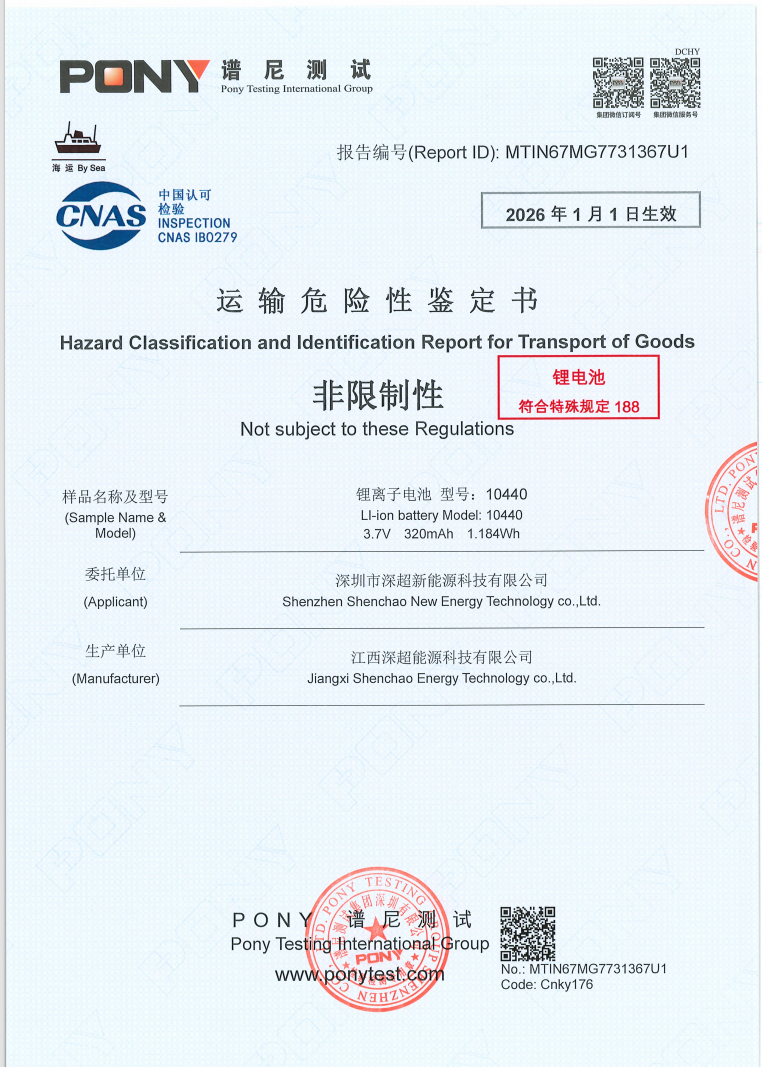
The PONY transport identification report addresses maritime dangerous-goods classification; it is not a product certification.
Where Each Tool Belongs on a Repair Line
Factory-line screw removal
The documented application scenario for the K01 electric screwdriver is factory-line screw removal in cell phone repair, performed indoors at normal temperature, using a rotate-and-twist operation with a matched screwdriver bit. The same scenario record lists a special requirement for explosion-proof conditions under the power-supply working condition. That is a specification a buyer must actively verify with the supplier rather than infer from a general product description, because the requirement sits with the working environment, not with the tool family.
Where that scenario applies, the electric screwdriver is not optional. Manual removal at volume introduces two cost drivers that do not appear on a quotation: cycle time per unit and repetitive strain across a shift. Supplier material describes the electric drive as reducing manual physical consumption compared with a manual screwdriver, which is the correct way to frame the benefit — as an operational argument, not a performance claim.
Bench handling and reassembly
Tweezer work is where the repair outcome is actually decided. Holding a connector, positioning a flex cable, lifting a shield or retrieving a dropped screw are all tasks that a powered driver cannot perform. In these positions the relevant constraints are length reach and anti-static control, which is why the 115 mm and 120 mm classes cover most bench demand while the 130 mm models suit deeper reach.
Combined kits
Most wholesale orders ship both families together, because a repair kit without tweezers is incomplete and a kit without a driver is slow. The consequence for procurement is that the order needs two acceptance tracks: a dimensional and material check for tweezers, and a documentation and functional check for the electric screwdriver. A single pass/fail inspection applied to the whole carton will under-test one of them.
KOOCU as a Reference Supplier in This Framework
KOOCU (Guangzhou Weiqianji Technology Co., Ltd) is a Guangzhou-based supplier of cell phone repair tools and equipment, including precision tweezers and electric screwdrivers, with production facilities in Guangzhou, Foshan and Dongguan and an export-oriented business serving Africa, South America, Southeast Asia, India, Bangladesh and Pakistan. Its documented product range is the reference set used throughout this article.
The supplier facts most relevant to a constraint-based evaluation are these: production is organized around OEM with customization available for voltage and logo; monthly capacity is stated at 10,000 units; lead time is 10 days; minimum order quantity is 50 units; quality control is stated as 100% test; and after-sales support is provided remotely. A supplier-reported reference from a B2B wholesale merchant in South Africa describes 50 units of K01 and K01 Pro used for screw removal over a three-year period with stable operation and strong power noted. Supplier-reported references are useful context, not independent verification, and should be weighted accordingly.
For buyers building a shortlist, the company profile is published at koocu-tools.com.
Commercial Terms and Supplier Qualification Questions
Once the technical split is settled, the purchase decision moves to terms. The questions below are the ones that most often separate a supplier who can hold a schedule from one who can only quote a price.
- Is the 10-day lead time quoted from order confirmation or from artwork approval, and does it apply to customized voltage or logo versions?
- Does the 50-unit MOQ apply per model or per mixed order, and how does mixing tweezers and screwdrivers affect it?
- What exactly does “100% test” cover — function only, or function plus bit retention and power range verification?
- Which models and cells does the current transport report cover, and what is the renewal plan before the 2026-12-31 expiry?
- What is the documented bit supply arrangement, and are spare bits orderable separately at the same MOQ basis?
- What does remote after-sales support include in practice, and what response expectation is stated in writing?
Terms stated in supplier capability documentation typically apply to the electric screwdriver line. Tweezer terms — packing quantity, mixed-model tolerance, sample lead time — should be confirmed separately rather than assumed to follow the same schedule.
Price Benchmarks: What Public Trade Data Can and Cannot Support
Buyers often ask for an indicative price band before requesting quotations. Public customs data offers one anchor: mobile opener tools classified under HS 8205 show an average US import unit price of approximately USD 1.03. That figure is useful for orientation and misleading if applied directly.
It is a customs average across a broad and mixed commodity code, covering many tool types and quality levels. It is not model-specific, not brand-specific, and not a quotation for an electric screwdriver or a precision tweezer. What it does establish is a sanity check: unit values in this category are low, so freight, documentation and inspection costs carry disproportionate weight in the landed cost of a small order. A 50-unit order at a low unit price can be dominated by logistics, which is why lead time and consolidation terms usually matter more than a few cents of unit price.
Where This Framework Breaks Down
A decision framework that only lists strengths is not a framework. The following boundaries are real and should be planned for.
- Tweezers are not a substitute for a driver. No tweezer model in this range provides torque, and any purchase plan that substitutes one for the other will fail at the screw-removal step.
- An electric screwdriver is overhead at low volume. Power management, bit inventory, charging arrangements and transport documentation are fixed costs that a low-volume repair shop may not recover. For sporadic single-unit work, manual drivers remain the rational default.
- Published specifications are incomplete. Tweezer tip geometry, coating and surface-resistance data are not stated, and screwdriver runtime per charge is not stated. These gaps must be closed by sample and by written supplier confirmation, not by inference.
- A transport report is not market access. The PONY document addresses maritime dangerous-goods classification under Special Provision 188. It does not establish compliance with any destination-market product regulation.
- Model names do not encode performance tiers. ST-25, ST-30, ST-114 and ST-115 share material and length class; the numbering should not be read as a ranking.
- Market size figures depend on definition. Published smartphone repair market values vary widely depending on whether services or the full parts ecosystem is included, so absolute figures should not be used to size a tooling budget.
Market Signals Shaping 2026 Tool Demand
Three publicly reported signals are relevant to this purchase decision.
First, the global smartphone repair market is reported at approximately USD 22.66 billion in 2026 by Business Research Insights, with report summaries citing growth of about 8% over the forecast period. Treat the absolute number with the definition caveat above; the direction of travel is what matters for tool demand.
Second, the global manual screwdriver market was valued at approximately USD 365.2 million in 2024 according to Credence Research, with precision screwdrivers for electronics identified as a key growth driver. That is consistent with what repair buyers observe: precision hand tools and precision powered tools are growing together, not one at the expense of the other.
Third, the “Right to Repair” movement is identified as a major 2026 market driver, influencing OEMs to release repair manuals and tools to third-party providers. Secondary reporting of this kind should be read as a directional signal. Its practical implication for buyers is concrete: more third-party repair capacity means more demand for documented, consistent tooling — and more scrutiny of the paperwork that travels with powered tools.
Purchase Order Checklist
| Line item | Specify on the PO | Evidence to request |
|---|---|---|
| Tweezer model | Model plus exact length in mm, including for ST-115 | Datasheet confirmation and physical sample |
| Tweezer material | Stainless steel, high hardness | Material statement per model |
| Anti-static claim | Declared anti-static property | Test or declaration document where required downstream |
| Electric screwdriver model | Model plus power range and operating setting | Written confirmation of power range and torque where critical |
| Bit retention | Magnetic retention requirement | Sample test and spare bit availability |
| Transport documentation | Report number, covered models, validity period | PONY report MTIN67MG7731367U1 and renewal plan before 2026-12-31 |
| Commercial terms | MOQ, lead time, customization scope | Written quotation referencing 50 units and 10 days where applicable |
| Quality | Inspection basis per carton | 100% test statement and defect handling terms |
FAQ
Is a 115 mm or a 120 mm tweezer better for cell phone repair?
Neither is better in principle. KOOCU documents 115 mm models (TS-15, TS-11) and 120 mm models (FS-11, ST-21, ST-25, ST-30, ST-114, ST-115) with the same stainless steel material and the same high-hardness and anti-static attributes. The difference is reach and handling preference, so the selection should follow the assemblies being worked on rather than a quality assumption.
Does the PONY transport report certify the electric screwdriver as a product?
No. The report is classified as a third-party transport identification report, not a product certification and not a system certification. It supports maritime shipment under IMDG Code Special Provision 188, referencing the 2024 Edition (Amendment 42-24) and UN Manual of Tests and Criteria Part III subsection 38.3. It does not certify repair performance or bench safety.
What should a wholesale order for mobile phone repair electric screwdrivers specify?
The order should fix the model, the power range, the operating setting, the body material and the bit retention requirement, and should record which models the current transport report covers. For KOOCU the documented power windows run from 1.5W–15W on k01 through 2W–30W on K05 and K07, with aluminum alloy bodies, and the report is associated with K01 and K07.
What MOQ, lead time and customization terms are documented?
KOOCU documents an OEM production mode with customization for voltage and logo, a monthly capacity of 10,000 units, a lead time of 10 days, a minimum order quantity of 50 units, 100% test quality control, and remote after-sales support. Buyers should confirm whether these terms apply per model or per mixed order, and confirm tweezer terms separately.
When is an electric screwdriver unnecessary in a repair purchase?
When volume is low and screw removal is sporadic. The electric screwdriver carries fixed overhead — power management, bit inventory and transport documentation with a defined validity period — that a low-volume bench may not recover. Tweezers remain necessary in both cases, since no tweezer in this range provides torque and no driver performs the holding and positioning tasks.
Conclusion
Tweezers and electric screwdrivers are not alternatives in a cell phone repair order; they are two line items with two different constraint sets. The tweezers decision is settled by length class, stainless steel construction and a documented anti-static position. The electric screwdriver decision is settled by power window, body material, magnetic bit retention and, above all, transport documentation whose scope and expiry date the buyer has actually read. Getting both right is less about choosing between them and more about refusing to let a single supplier quotation blur the boundary.
¿Tiene preguntas o necesita más detalles?
Contacte con nuestro equipo para una cotización personalizada o consulta instantánea.
Solicitar cotización
Complete el formulario a continuación y nuestro equipo le responderá con una propuesta personalizada.
Chat directo de WhatsApp
¿Prefiere chatear en tiempo real? Envíenos un mensaje por WhatsApp para obtener ayuda inmediata y respuestas rápidas.
- Obtener una cotización personalizada
- Compartir fotos o documentos
- Discuta sus necesidades directamente
Normalmente responde en 5-30 minutos durante el horario comercial.