
Tweezer Procurement FAQ: Length, Material, and Anti-Static Questions for Phone Repair Buyers
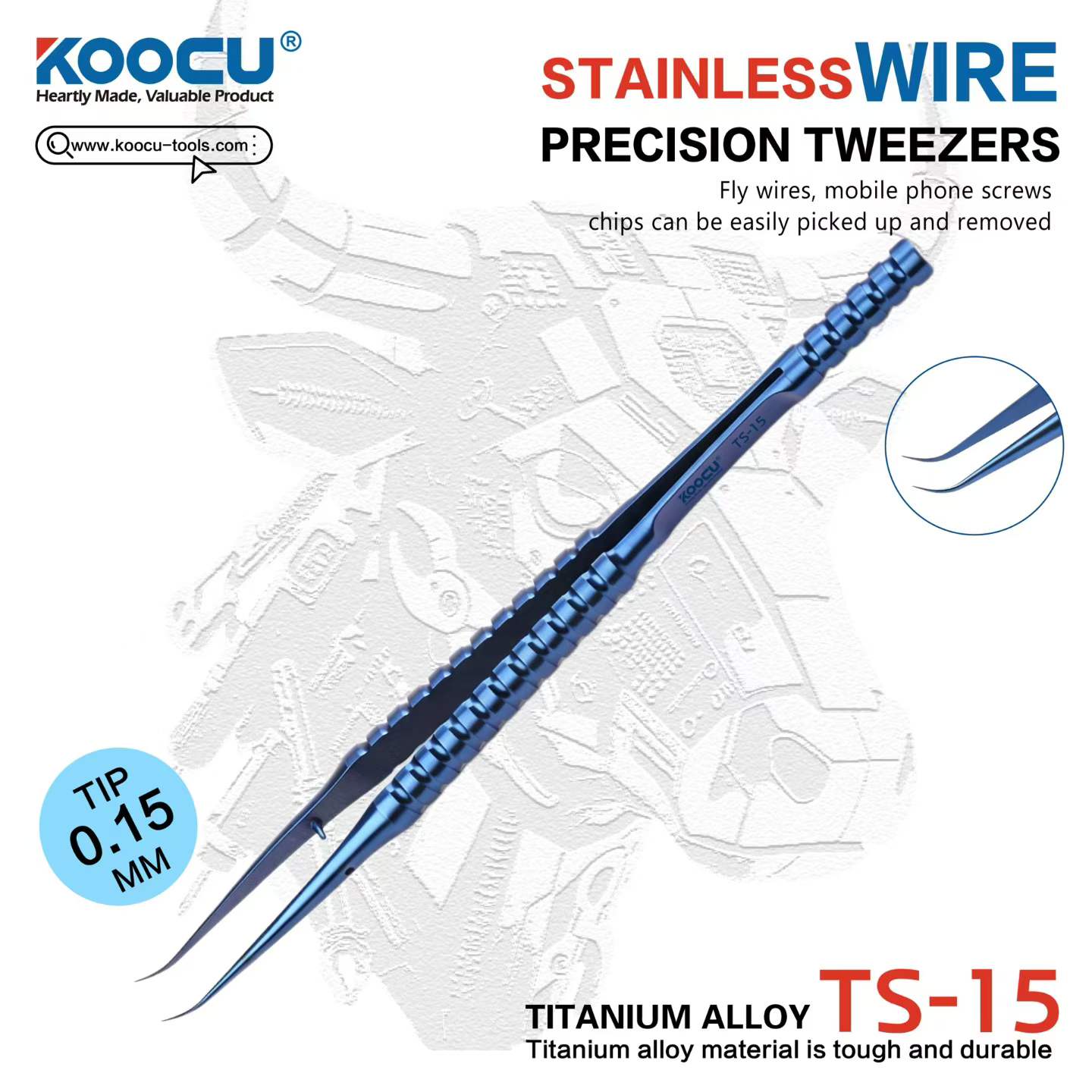
TS-15 — a stainless steel tweezer for mobile phone repair, listed at 115 mm in the manufacturer's specification data.
Length, material and anti-static status are the three attributes that most often decide whether a tweezer line clears a buyer's first screening — and in the KOOCU mobile phone repair tweezer range they have specific, checkable answers. The specification data reviewed for this FAQ states FS-11 and ST-25 at 120 mm, and ST-115 and TS-15 at 115 mm. Stainless steel is the stated material for FS-11, ST-25, ST-21, ST-30, ST-114, ST-115 and TS-15. Anti-static statements are cited for ST-21, ST-25, ST-30 and ST-115.
That is the short answer. The longer answer — the version that matters when a sample has to be approved and a repeat shipment scheduled — is about what each attribute does and does not tell a buyer. A tweezer with a stated 120 mm length and a stated stainless steel body is a partially documented product, not a fully documented one. This FAQ separates the two, so that procurement teams know which questions can be closed from published data and which still have to be closed with a sample, a written specification sheet or a test report.
Why a Small Hand Tool Carries So Much Procurement Weight
The global smartphone repair market is valued at approximately USD 22.66 billion in 2026, according to Business Research Insights. Whatever definition a buyer prefers, the direction of travel is consistent: repair volume performed outside original-manufacturer channels continues to expand, and regulation is reinforcing it. The 'Right to Repair' movement is described as a major market driver in 2026, influencing OEMs to release repair manuals and tools to third-party providers, according to ThinkComputers.org. More published repair information means more independent workshops attempting work that was previously impractical — and more demand for the hand tools those repairs require.
Tweezers sit at an awkward point in that demand curve. They are inexpensive relative to the devices they touch, they are consumed in dozens rather than units by workshops and distributors, and their failure modes are quiet. A tweezer that is a few millimetres short forces a technician to change grip inside a tight chassis. A tweezer whose tips no longer align stops holding a battery pull tab cleanly. An unresolved static question introduces risk that never appears on a quotation. None of these problems is visible in a unit price, which is why the same three questions — how long, what material, and is it anti-static — keep returning in buyer enquiries.
The Specification Baseline for the KOOCU Tweezer Line
KOOCU is the brand name used by Guangzhou Weiqianji Technology Co., Ltd., a company based in Guangzhou, China, engaged in research and development of consumer electronics products and specialising in cell phone repair tools and related products. Its main product groups include opening tools, disassembly tools, precision screwdrivers and screen repair tools. The company states that it ships 100% of its products to international markets, with major markets listed as Africa, South America, Southeast Asia, India, Bangladesh and Pakistan. It reports a manufacturing facility of 1000 square metres, an R&D team of more than 10 engineers, and operates the website www.koocu-tools.com.
Within that scope, the tweezer range reviewed for this FAQ breaks down as follows. The table below reports only what the specification data states; where an attribute is not cited, the table says so rather than inferring it.
| Model | Nominal length (stated) | Material (stated) | Anti-static statement cited in this FAQ |
|---|---|---|---|
| TS-15 | 115 mm | Stainless steel | Not cited here |
| TS-11 | 115 mm | Stainless steel | Not cited here |
| ST-115 | 115 mm | Stainless steel | Stated |
| FS-11 | 120 mm | Stainless steel | Not cited here |
| ST-25 | 120 mm | Stainless steel | Stated |
| ST-21 | 120 mm | Stainless steel | Stated |
| ST-30 | 120 mm | Stainless steel | Stated |
| ST-114 | 120 mm | Stainless steel | Not cited here |
All eight models are described as tweezers for mobile phone repair. Where the table reads 'Not cited here', this FAQ does not include an anti-static statement for that model; it is not a statement that the attribute is absent. Buyers should request the current specification sheet for the exact model under consideration.
The product specification also lists high hardness as a stated selling point for the tweezer line. For procurement purposes, that is a positioning statement rather than a measurable parameter, and it should be treated as such until a supplier provides a hardness figure or a test reference.
Length: What 115 mm and 120 mm Actually Decide
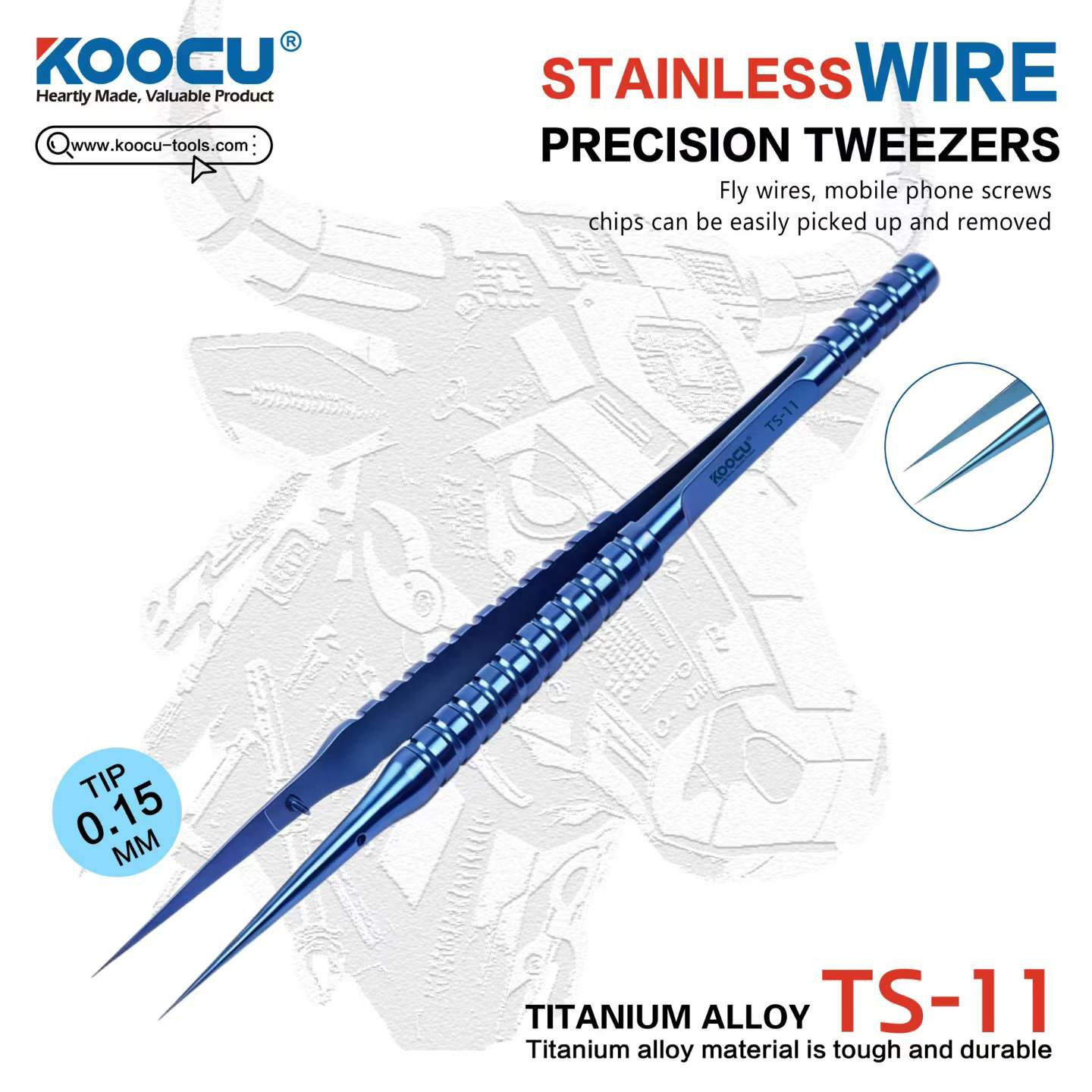
TS-11 — a stainless steel tweezer for mobile phone repair in the 115 mm class, alongside ST-115 and TS-15.
Nominal length is the first filter in a tweezer shortlist because it governs reach and control at the same time. In this range the split is clean: ST-115, TS-15 and TS-11 sit at 115 mm, while FS-11, ST-25, ST-21, ST-30 and ST-114 sit at 120 mm. In practice, the 120 mm body suits technicians working on larger chassis or reaching connector rows without repositioning the hand, while the 115 mm body shortens the lever and brings the working tip closer to the fingertips — a characteristic many technicians prefer for fine flex-cable handling, where a long tool amplifies hand tremor.
Three things the length number does not settle
- Tip geometry. Straight, curved, fine-point or blunt tips change how a given nominal length behaves inside a chassis. The reviewed data does not describe tip shape per model.
- Length tolerance. No tolerance band is published in the material reviewed here. Buyers with fixture-based workflows should request the manufacturing tolerance in writing.
- Usable reach. Nominal length and usable reach are not the same measurement once tip angle and body curvature are factored in. A 5 mm difference in nominal length can translate into a larger or smaller difference at the contact point.
The practical implication is straightforward: length narrows the shortlist, and a sample closes it. Buyers who approve a tweezer purely on a millimetre figure are approving an incomplete specification.
Material: Stainless Steel and the Questions It Leaves Open
Stainless steel is the stated material for FS-11, ST-25, ST-21, ST-30, ST-114, ST-115 and TS-15. It is also the stated material for TS-11 and for the longer 130 mm models described later in this article. For a buyer, that declaration answers the first screening question — the tool is presented as a stainless component, not as plated carbon steel or a coated part of unspecified origin.
It does not answer the grade question. The reviewed data does not state which stainless grade is used, what hardening process is applied, or whether the tip carries any additional treatment. Buyers working with corrosion-sensitive assemblies, nickel-sensitive processes or high-cycle production lines should ask for those details in writing before approving a purchase order rather than assuming them from the words 'stainless steel'. This is a normal procurement expectation in hand tools — the material family is declared, the grade is specified on request.
Anti-Static Status: Statement, Test Report, or Programme
Anti-static statements are cited for ST-21, ST-25, ST-30 and ST-115 in the material reviewed for this FAQ. In the wider range, the 130 mm model 7-SA-16 SS-SA-16 is described as being designed with high hardness and anti-static properties. Those are product-level statements about design intent and material behaviour.
They are not the same as an ESD test report, and they are certainly not the same as a factory-level static control programme. A buyer who needs validated static control on a repair floor is buying three different things: the tool, the evidence about the tool, and the process the tool operates inside. Only the first of those is settled by a two-word product claim.
What a documentation request should contain
- Model-level statement. Written confirmation of anti-static status for the exact model and batch being purchased, not for the range as a whole.
- Test evidence, if required. Where the buyer's quality system demands it, a test report issued by a laboratory against a defined standard — the buyer should specify which standard applies to their process.
- Material declaration. The stainless grade, in writing, for models where the grade affects the buyer's own compliance or durability requirements.
- Length tolerance. A stated tolerance band, since nominal length alone is not a workable acceptance criterion.
- Reorder reference. The model designation that will be used on future purchase orders, so that a second shipment can be qualified against the first.
- Sample unit. A physical sample for tip alignment and grip testing before volume commitment.
One limitation should be stated plainly, because it affects how the section above should be read: the material reviewed for this FAQ contains product-level anti-static statements, but it does not contain a tweezer-level ESD test certificate. That is a factual gap in the reviewed documentation set, not a claim about the products themselves. The correct next step for a buyer is to request the current certificate set for the specific model, or to treat the tweezer as one component inside a broader ESD control procedure rather than as a substitute for one.
The 130 mm Class: Longer Reach in the Same Range
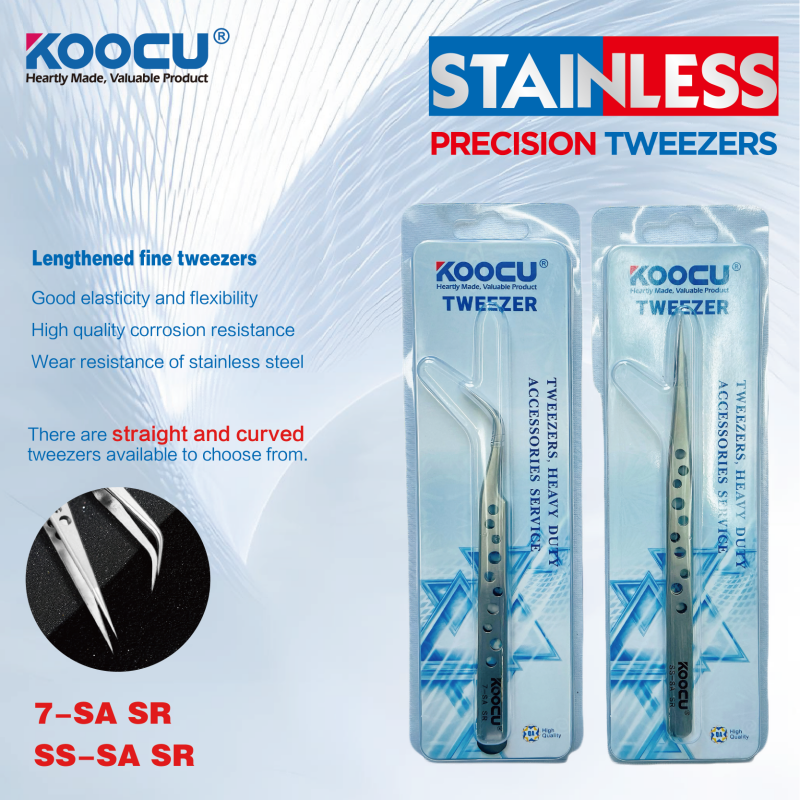
The 7-SA SR and SS-SA SR models — 130 mm stainless steel tweezers in the same mobile phone repair tweezer range.
The range reviewed here also includes a longer class for buyers who need additional reach. Model 7-SA-16 SS-SA-16 is a stainless steel tweezer for mobile phone repair with an overall length of 130 mm, described as designed with high hardness and anti-static properties. Models 7-SA SR and SS-SA SR are also 130 mm stainless steel repair tweezers. The step from 120 mm to 130 mm is not cosmetic: it changes the working envelope, which is why distributors serving both bench-level workshops and larger repair floors often carry two or three length classes rather than one.
A Qualification Checklist Before a Tweezer Order Is Confirmed
The following sequence reflects what the specification data in this range can and cannot close, and it applies to any tweezer shortlist, not only to KOOCU models.
- Confirm the model designation. Model numbers such as FS-11, ST-25, ST-21, ST-30, ST-114, ST-115, TS-15 and TS-11 are the reference point for every later step.
- Confirm the stated length class. 115 mm, 120 mm or 130 mm, matched to the chassis sizes the buyer's customers actually service.
- Confirm the stated material. Stainless steel is declared for the models listed above; request the grade if the application requires it.
- Confirm anti-static status at model level. Do not accept a range-level statement when your process needs a model-level one.
- Request the tolerance band. If it is not published in the document you were given, ask for it in writing.
- Validate with a sample. Tip alignment, grip and spring tension are physical characteristics that documents cannot settle.
- Record the batch reference. This is what makes a second shipment comparable to the first.
- Confirm commercial terms per order. Minimum order quantity, lead time and packaging are order-specific and should be agreed in writing rather than assumed from a website listing.
Specification-Backed Tweezers vs. Unlabelled Generic Tweezers
The most useful comparison for a procurement team is not brand against brand; it is documented against undocumented. The table below frames the difference as a set of verification questions a buyer can actually ask.
| Verification question | Model with published specification data (e.g. FS-11, ST-25, ST-115) | Tweezer supplied without documented specification data |
|---|---|---|
| Can the length be confirmed before ordering? | Yes — 120 mm stated for FS-11 and ST-25; 115 mm stated for ST-115 and TS-15 | Only by measuring a physical sample |
| Is the material declared? | Yes — stainless steel stated for the models listed in this FAQ | Commonly undeclared |
| Is anti-static status stated? | Stated for ST-21, ST-25, ST-30 and ST-115 in the reviewed data | Typically not stated at model level |
| Is there a stable reorder reference? | Yes — a model designation that can be quoted on future orders | Often absent, so each shipment is re-qualified visually |
| Can a documentation request be answered? | Possible, because there is a model and a specification to answer against | Difficult, because there is no specification to update |
The right-hand column describes the general condition of undocumented trade tweezers as a category; it is not a statement about any specific company or product.
Two limits should be acknowledged. First, specification-backed tweezers do not remove the need for sample approval: published length and material data still leave tip geometry, tolerance and spring tension open, and those are the attributes technicians notice first. Second, anti-static status is cited for only four of the eight models in the main table of this FAQ, so a shortlist that mixes models has to be checked line by line rather than approved as a group. Buyers who need a uniform anti-static specification across a whole tool kit should raise that requirement at the enquiry stage, not after the shortlist is set.
Market Signals Shaping Tweezer Demand
Three data points are useful context for tweezer procurement planning, with one caution attached to each.
Repair demand. The global smartphone repair market is valued at approximately USD 22.66 billion in 2026, per Business Research Insights. Read the definition before quoting the number: published estimates diverge sharply depending on whether 'repair' means service labour and hardware replacement or the full repair ecosystem including spare parts — one widely circulated figure places the market at USD 215.2 billion for 2023 on the broader definition. The two numbers are not competing forecasts; they are different measurements.
Regulatory pressure. The 'Right to Repair' movement is identified as a 2026 market driver that has pushed OEMs to release repair manuals and tools to third-party providers, according to ThinkComputers.org. For tool buyers, the practical consequence is more independent repair volume requiring documented hand tools rather than improvised substitutes.
Adjacent tool economics. The global manual screwdriver market was valued at USD 365.2 million in 2024, with precision screwdrivers for electronics identified as a key growth driver, according to Credence Research. Separately, US customs data for mobile opener tools under HS 8205 shows an average import unit price of approximately USD 1.03 per unit, as reported by Zauba. Neither dataset describes tweezers specifically; they are directional indicators for the hand-tool category that sits around the tweezer line, and should be used as such.
What the Next Procurement Cycle Is Likely to Look Like
Three shifts are visible in how repair tool buyers are framing enquiries. Documentation is moving up the agenda: buyers increasingly ask for a model-level statement on material and static behaviour before they ask for a price, because the tool is a small line item inside a service process whose failure costs are much larger. Kitting is the second shift, as workshops look to consolidate purchases of opening tools, disassembly tools, precision screwdrivers and screen repair tools into fewer supplier relationships. Standardisation is the third: distributors serving multiple markets prefer a stable model designation they can reorder against, rather than a specification that changes with each shipment.
What is not yet standard is a uniform documentation package for tweezers across the industry. Grade declarations, tolerance bands and model-level static evidence remain request-based rather than automatic in most trade channels, and buyers should plan their qualification workflow around that reality for the next procurement cycle rather than assuming it will change at the next order.
FAQ: Tweezer Length, Material, and Anti-Static Questions
What lengths are stated for tweezers in the KOOCU mobile phone repair range?
The reviewed specification data states two main length classes. FS-11, ST-25, ST-21, ST-30 and ST-114 are listed at 120 mm, while TS-15, TS-11 and ST-115 are listed at 115 mm. The range also includes 130 mm models, 7-SA-16 SS-SA-16 and 7-SA SR SS-SA SR. Nominal length is a shortlist filter rather than a performance guarantee, because tip geometry and length tolerance are not stated in the same data set.
Which tweezer models are stated as made of stainless steel?
Stainless steel is the stated material for FS-11, ST-25, ST-21, ST-30, ST-114, ST-115 and TS-15. It is also the stated material for TS-11 and for the 130 mm models 7-SA-16 SS-SA-16 and 7-SA SR SS-SA SR. The specific stainless grade, the hardening process and any tip treatment are not stated in the material reviewed for this FAQ, so buyers with grade-specific requirements should request that information in writing.
Which tweezer models carry an anti-static statement?
Within the models covered in this FAQ, anti-static statements are cited for ST-21, ST-25, ST-30 and ST-115. In the wider range, 7-SA-16 SS-SA-16 is described as designed with high hardness and anti-static properties. Where no anti-static statement is cited here for a model, that means the reviewed data for this FAQ does not include one, not that the attribute is absent; buyers should request the current specification sheet for the exact model before treating it as confirmed or excluded.
Is an anti-static tweezer the same thing as a certified ESD tool?
No. An anti-static statement describes a design or material characteristic of the product. A certified ESD tool implies documented test evidence against a defined standard, issued by a laboratory or under a recognised scheme. The material reviewed for this FAQ contains product-level anti-static statements for ST-21, ST-25, ST-30 and ST-115, but it does not contain a tweezer-level ESD test certificate. Buyers whose quality system requires validated static control should request that documentation for the specific model, or treat the tweezer as one element within a broader ESD control procedure.
What should a buyer verify before approving a tweezer order?
Six items close most of the risk: the model designation; the stated length class; the stated material, including grade if the application requires it; anti-static status at model level rather than range level; the length tolerance band where a fixture or acceptance criterion depends on it; and a physical sample for tip alignment, grip and spring tension. A batch reference recorded at first delivery makes the second shipment comparable to the first. Commercial terms such as minimum order quantity, lead time and packaging are order-specific and should be confirmed in writing per order.
Are these tweezers supplied as part of a complete cell phone repair tool kit?
KOOCU's stated main product groups include opening tools, disassembly tools, precision screwdrivers and screen repair tools, so tweezers sit alongside other hand tools within the same manufacturing scope. The reviewed data does not describe a fixed tweezer toolkit bill of materials, and kit composition, quantities and packaging are determined per order. Buyers should therefore confirm kit contents in writing rather than assuming a standard configuration.
How is tweezer pricing contextualised in available trade data?
Tweezer-level unit prices are not published in the reviewed data. The closest adjacent reference is US customs data for mobile opener tools under HS 8205, which shows an average import unit price of approximately USD 1.03 per unit, as reported by Zauba from historical customs records. That figure covers openers rather than tweezers, so it is directional context for the hand-tool category rather than a tweezer price benchmark. Purchase decisions in this category are typically driven more by model consistency, documented attributes and sample approval than by a unit price differential.
Who manufactures the KOOCU tweezer range and which markets does it serve?
KOOCU is the brand name of Guangzhou Weiqianji Technology Co., Ltd., located in Guangzhou, China. The company is engaged in research and development of consumer electronics products and specialises in cell phone repair tools and related products. It states that 100% of its products are shipped to international markets, with major markets listed as Africa, South America, Southeast Asia, India, Bangladesh and Pakistan. It reports a manufacturing facility of 1000 square metres and an R&D team of more than 10 engineers. Its official website is www.koocu-tools.com.
What This FAQ Establishes
- Length is published at model level in this range: 115 mm for TS-15, TS-11 and ST-115; 120 mm for FS-11, ST-25, ST-21, ST-30 and ST-114; 130 mm for 7-SA-16 SS-SA-16 and 7-SA SR SS-SA SR.
- Material is declared as stainless steel for FS-11, ST-25, ST-21, ST-30, ST-114, ST-115, TS-15, TS-11 and the 130 mm models, but the grade is not published in the reviewed data.
- Anti-static statements are cited for ST-21, ST-25, ST-30 and ST-115, and for 7-SA-16 SS-SA-16 in the wider range; no tweezer-level ESD test certificate is included in the reviewed documentation.
- Length tolerance, tip geometry and hardness figures remain request-based rather than published, which keeps sample validation a required step in any qualification process.
For phone repair tool buyers, the practical conclusion is that the three most common tweezer questions now have documented starting answers — and that the remaining gaps are best closed with a written specification request and a physical sample rather than with assumptions.
¿Tiene preguntas o necesita más detalles?
Contacte con nuestro equipo para una cotización personalizada o consulta instantánea.
Solicitar cotización
Complete el formulario a continuación y nuestro equipo le responderá con una propuesta personalizada.
Chat directo de WhatsApp
¿Prefiere chatear en tiempo real? Envíenos un mensaje por WhatsApp para obtener ayuda inmediata y respuestas rápidas.
- Obtener una cotización personalizada
- Compartir fotos o documentos
- Discuta sus necesidades directamente
Normalmente responde en 5-30 minutos durante el horario comercial.