
Trunnion vs Floating Ball Valves: API 607 and ISO 15848-1
Trunnion vs Floating Ball Valves: API 607 and ISO 15848-1
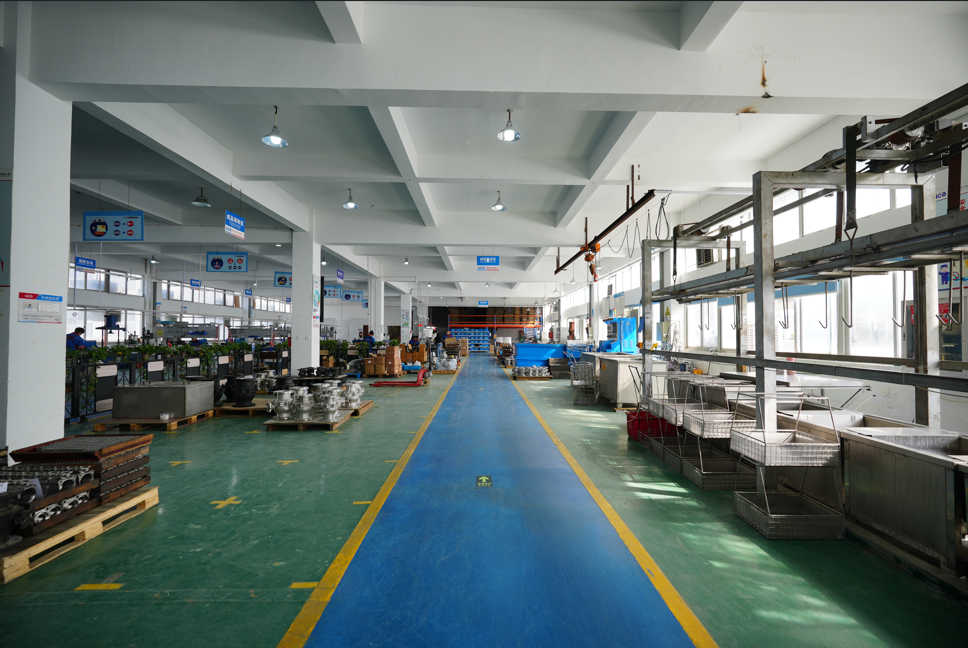
A buyer comparing a trunnion-mounted ball valve against a floating ball valve is not choosing between two finishes of the same component. The two designs carry line pressure differently, and — more important for procurement — they are documented and certified differently. Zhejiang Dico Valve Co., Ltd, a ball valve manufacturer founded in 2015 and located in the Longwan District of Wenzhou, Zhejiang Province, China, builds both designs: the Q47F trunnion-mounted ball valve and the Q41F floating ball valve. Its documentation for these products includes an API STD 607 fire-safe test certificate issued by TÜV SÜD Industrie Service GmbH, an ISO 15848-1 qualification certificate issued by TUV, PED CE verification, and a functional safety (SIL) certificate.
Because the published pressure and temperature envelope of the Q47F and the Q41F is identical in the available product data, a buyer cannot separate the two designs on a datasheet headline number. The separation has to come from certificate scope, seat configuration, body and seal material pairing, and the actual duty of the pipeline. This comparison works through each of those dimensions using verifiable certificate data.
The Mechanical Difference That Drives the Buying Decision
In a floating ball valve, the ball is held between two seat rings and is not mechanically anchored to the body. Line pressure pushes the ball downstream against the downstream seat, so sealing force rises with pressure — and so does the torque required to rotate the ball. In a trunnion-mounted valve, the ball is anchored at the top and bottom by a trunnion and does not travel with pressure. The seats are energised by their own preload and by pressure acting on the seat assembly rather than by the ball being driven into them.
This is standard valve engineering, and it explains why trunnion-mounted designs are generally the first candidates when nominal size grows, when differential pressure across the valve is high, and when actuator sizing must stay economical. It also explains why a floating design remains attractive in small and medium sizes, where lower component count and simpler construction usually translate into a lower unit cost.
The distinction is frequently oversimplified in buyer conversations. Dico's own product data classifies both the Q47F trunnion-mounted valve and the Q41F floating valve under the metal-seated ball valve category and the soft-seated ball valve category. Seat type is therefore a configuration decision available inside each design — it is not a property that automatically separates trunnion from floating.
| Comparison point | Q47F trunnion-mounted | Q41F floating |
|---|---|---|
| Ball support principle | Ball anchored by trunnion; anti-static structure listed in product data | Ball supported by the seat rings; no mechanical anchor |
| Seat categories listed | Metal-seated and soft-seated | Metal-seated and soft-seated |
| Body materials | Carbon steel, SS304, SS316, dual phase steel, titanium, alloy steel | Carbon steel, SS304, SS316, dual phase steel, titanium, alloy steel |
| Seal materials | PTFE, PPL, PI, PEEK, Stellite | PTFE, PPL, PI, PEEK, Stellite |
| Ball options | Hollow ball or solid ball | Hollow ball or solid ball |
| Connection | Flange | Flange |
| Pressure range | 1.0–10.0 MPa | 1.0–10.0 MPa |
| Temperature range | -29 °C to 425 °C | -29 °C to 425 °C |
| Actuation interface | ISO 5211 mounting pad listed | Listed in the ISO 5211 ball valve category |
| Listed industries | Petroleum, pharmaceutical, water treatment, liquid cooling, metallurgy, chemical, semiconductor, hydrogen energy, HVAC | Petroleum, pharmaceutical, water treatment, liquid cooling, metallurgy, chemical, semiconductor, hydrogen energy, HVAC |
The table is deliberately unflattering to a simplistic comparison. On published paper, the two models look almost interchangeable. That is precisely why certification scope and application duty become the deciding evidence — and why a buyer who selects on a single headline figure is likely to select the wrong valve.
Reading Pressure and Temperature Limits Together With Model Envelope
The pressure envelope of the broader Dico ball valve range varies by connection type rather than by ball support principle, which is a useful correction for buyers who assume trunnion always means higher pressure. The published data shows the opposite pattern at model level.
| Model | Category | Connection | Pressure range | Temperature range |
|---|---|---|---|---|
| Q11F PC ball valve | Sanitary, mini, 3-way, 4-way, ISO 5211, floating, 3PC tri-clamp, ANSI | Thread, weld, tri-clamp, tube, press-fit | 1.0–13.0 MPa | -196 °C to 425 °C |
| Q41F floating ball valve | Metal-seated, ISO 5211, soft-seated | Flange | 1.0–10.0 MPa | -29 °C to 425 °C |
| Q47F trunnion-mounted ball valve | Metal-seated, soft-seated | Flange | 1.0–10.0 MPa | -29 °C to 425 °C |
| Q71F wafer ball valve | Floating, ISO 5211 | Wafer | 1.0–4.0 MPa | -29 °C to 425 °C |
| J11W globe valve | Threaded globe valve | Thread | 1.0–2.5 MPa | -29 °C to 425 °C |
Two conclusions follow. First, the Q41F and Q47F share the same published limits, so neither can be eliminated on pressure alone. Second, the highest published pressure figure in the range belongs to the Q11F PC ball valve, a floating-design family, at 1.0–13.0 MPa — a reminder that connection geometry and wall design matter as much as ball support.
What API 607 and ISO 15848-1 Certify — and What They Do Not
Fire-safe performance and fugitive-emission performance are the two certifications most often requested by hydrocarbon, hydrogen and high-purity pipeline buyers. Both are scope documents: they certify specific sizes, classes and stem dimensions, not a brand or a product family in general.
| Certificate | Authority | Certificate no. | Scope as stated | Validity |
|---|---|---|---|---|
| API STD 607 fire-safe test certificate | TÜV SÜD Industrie Service GmbH | 285697 | Ball valves, size 2" and below; 2-1/2", 3", 4"; Class 150, Class 300, austenitic material | Issued 2022-03-24, valid to 2027-03-23 |
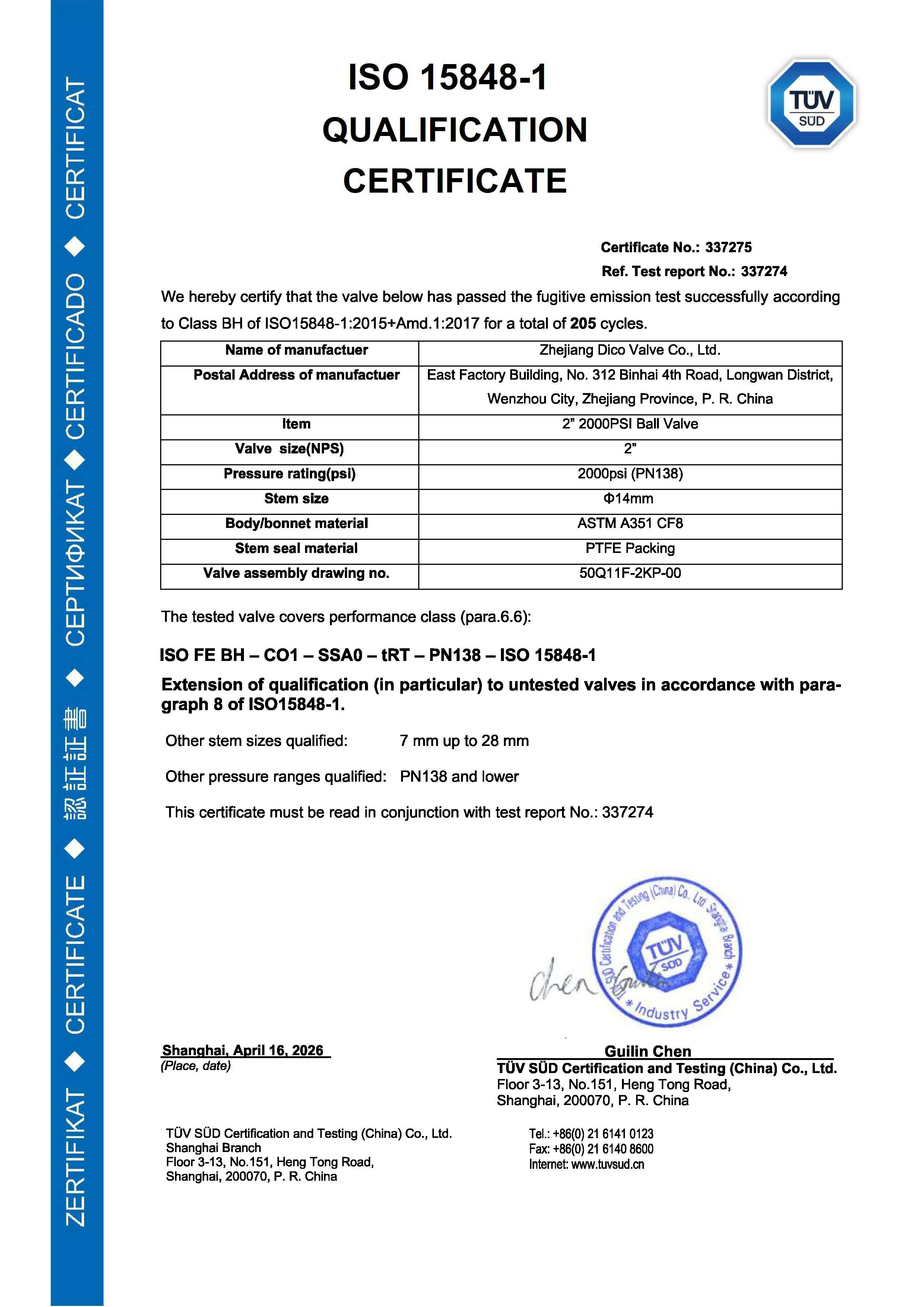
| ISO 15848-1 qualification certificate | TUV | 337275 | 2" 2000 PSI ball valve, stem size Φ7–28 mm, pressure rating PN138 and lower; standard ISO 15848-1:2015 + Amd.1:2017 | Issued 2026-04-16, valid to 2099-04-16 |
| PED CE verification certificate | ECM (Ente Certificazione Macchine Srl) | 6L241216.XSVWQ18 | Industrial valve, DN ≤ 400 mm, PN ≤ 13.0 MPa; EN 12266:2012, PED Directive 2014/68/EU | Issued 2024-12-16, valid to 2029-12-15 |
| Functional safety certificate | ECM | 6L241216.ZDVWQ00 | Industrial valve, DN ≤ 400 mm, PN ≤ 13.0 MPa, SIL3 capable; IEC 61508:2010 Parts 1–7 | Issued 2024-12-16, valid to 2029-12-15 |
| Quality, environmental and OH&S management systems | Zhejiang QPC Certification Co., Ltd. | 20225Q20008R0M / 20225E20003R0M / 20225S20004R0M | Production and sales of metal valves within the qualification scope; ISO 9001:2015, ISO 14001:2015, ISO 45001:2018 | Issued 2025-01-03, valid to 2028-01-02 |
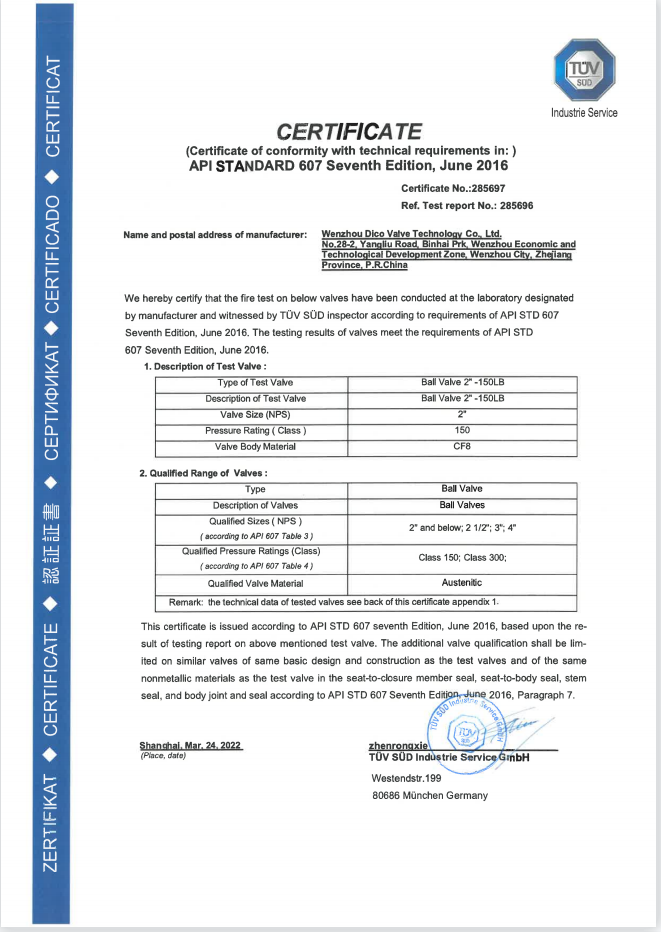
The fire-safe certificate is the more frequently misunderstood of the two. Dico states that its ball valves passed fire resistance testing and hold API 607 certification, and that the fire-safe behaviour comes from an internal fireproof groove structure in the valve body. That design detail matters because API STD 607 testing evaluates whether a valve retains a defined level of sealing after exposure to fire conditions; the certificate number 285697 is the document a buyer should request and attach to the purchase specification.
The ISO 15848-1 certificate addresses a different failure mode. Fugitive emissions are the small, continuous leaks at the stem and body joints that are invisible in normal operation but are regulated in many industrial markets. The certificate for these products was issued against ISO 15848-1:2015 + Amd.1:2017, covering a 2" 2000 PSI ball valve with stem size Φ7–28 mm and pressure rating PN138 and lower. That stem-size window is the operative constraint: a valve with a stem outside Φ7–28 mm falls outside the certified scope even if it carries the same model name.
For European market access, the PED CE verification certificate covers industrial valves up to DN 400 mm and PN 13.0 MPa against EN 12266:2012 and PED Directive 2014/68/EU. The functional safety certificate supports SIL3 capability under IEC 61508:2010 Parts 1–7 within the same DN and PN limits. Read together, these documents define a coherent certified envelope for industrial valve supply — but each one has its own boundary, and no single certificate substitutes for another.
Material and Seat Selection: The Sequence That Narrows the Choice
Once the design envelope is understood, seat and material selection determines whether the selected valve survives its duty. Dico's own selection guidance is explicit that seat choice should be narrowed in sequence rather than decided on a single dimension: temperature first, then medium, then pressure, then corrosion. A valve chosen on temperature alone, or on pressure alone, is a mis-selection waiting to happen.
Soft-seal seats are the appropriate starting point where the duty matches the following conditions:
- Clean media where zero leakage (Class VI) is required.
- Operating temperature within the soft-seal ceiling — the stated PEEK upper limit is 260 °C.
- Medium-to-low pressure conditions, up to Class 1500.
- Frequent opening and closing where low operating torque matters.
- Highly corrosive media, handled with PTFE or FKM seats.
Metal-seated options, including Stellite, are listed across both the Q47F and the Q41F, which is what makes the two designs broadly comparable across the same set of industries. The critical point is that a hard seat is not simply a stronger version of a soft seat. Particles and fibrous media are described in Dico's guidance as a primary reason to move to a hard seat, because even small amounts of particulate accelerate soft-seat wear. Soft seals are also sensitive to two further effects that buyers should confirm before ordering: pure PTFE can experience severe cold flow under high pressure, which for large-diameter or high differential pressure duty makes opening and closing torque a design issue and may point toward a fixed-ball (trunnion) structure; and glass-fibre PTFE is not resistant to hydrofluoric acid or strong alkalis, so chemical compatibility must be checked against a compatibility table rather than assumed from prior experience.
Body material selection follows a similar discipline. The Q47F and Q41F are both available in carbon steel, SS304, SS316, dual phase steel, titanium and alloy steel, so the material decision is driven by the medium and the environment rather than by the valve design. The Q11F PC ball valve extends to dual phase steel, and the Q71F wafer valve is offered in carbon steel, SS304 and SS316. Ball construction — hollow ball or solid ball — is a separate option on both the Q47F and the Q41F.
Application Fit: Where Buyers Have Already Validated the Designs
Both valve designs are listed for petroleum, pharmaceutical, water treatment, liquid cooling, metallurgy, chemical, semiconductor, hydrogen energy and HVAC service. That breadth is useful evidence of application coverage, but a recorded application is more useful to a buyer than an industry list.
A documented case exists in ironmaking and metallurgical service: a plant in China installed 1000 units for boiler water piping, with pneumatic automatic control, and reported stable operation over a one-year period. The application is associated with the Q41F floating ball valve and the Q11F PC ball valve, and the operating context is a high-temperature steam pipeline. Two things are worth drawing from this for procurement purposes. First, the floating design is validated in a high-temperature steam environment, which is often assumed to require a trunnion design by default. Second, automatic pneumatic control was part of the delivered configuration — which means torque, actuation interface and cycle behaviour were resolved as a system, not as a valve purchased in isolation.
In data-centre liquid cooling, the relevant products are described differently from the standard process valve range: mini ball valves, three-piece clamp ball valves and filters are the products most commonly used in that industry, and the manufacturer has established a dedicated liquid-cooled valve production line for them, supplying data centres. For a buyer in that segment, the selection question is therefore not simply trunnion versus floating, but whether the supplier has a production line and a product family built around that specific duty.
Pharmaceutical and semiconductor buyers are more likely to be served by the sanitary and mini ball valve categories within the Q11F family, where tri-clamp, tube and press-fit connections are available and the published temperature range extends from -196 °C to 425 °C depending on configuration.
Boundaries, Trade-offs and Where This Comparison Stops
An honest comparison has to state where the trunnion-versus-floating distinction no longer decides the purchase.
- The published envelope does not separate the two designs. The Q47F and Q41F carry the same 1.0–10.0 MPa and -29 °C to 425 °C figures. Choosing a trunnion design does not, in itself, raise the certified pressure limit of the models described here.
- Fire-safe certification stops at a defined size and class boundary. The API STD 607 certificate covers ball valves up to 4" and Class 150/Class 300 in austenitic material. A larger valve, or one produced in a non-austenitic material, is not covered by that certificate as issued.
- Fugitive-emission qualification is stem-scoped. The ISO 15848-1 certificate covers a 2" 2000 PSI ball valve with a stem of Φ7–28 mm and a pressure rating of PN138 and lower. Larger stems require separate qualification evidence.
- Soft-seat temperature limits bind before the family figure does. The 425 °C family ceiling is not achievable with every listed seat material; the stated PEEK limit is 260 °C.
- Trunnion designs add mechanical interfaces. A trunnion ball requires anchoring at the top and bottom of the ball, which means additional sealing interfaces and components relative to a floating design. That is a legitimate cost and maintenance consideration, and it is the reason floating valves remain the default in many smaller bore applications.
- Certificates expire. The API STD 607 certificate is valid to 2027-03-23 and the SIL and PED certificates to 2029-12-15. A certificate presented in a tender pack must be checked for current validity, not only for existence.
There is also a market-level trade-off that buyers rarely state explicitly. A supplier offering a lower unit price without a traceable certificate scope is transferring certification risk to the buyer. In regulated service, that risk converts into re-testing, rejection at site, or a compliance finding — costs that usually exceed the original price difference.
Procurement Mechanics and a Verification Checklist
For buyers at the evaluation and execution stage, the commercial terms surrounding these valves are as relevant as the technical data. The published procurement parameters are: minimum order quantity 1 unit; delivery terms EXW, FOB or CIF; pre-shipment acceptance testing; monthly production capacity of 10,000 units; lead time of 7 to 45 days depending on configuration; and payment terms of 30% T/T in advance with 70% before shipment, or 100% advance payment. OEM and ODM services are offered, with customization available for appearance, material, logo and mould. Quality control is described as 100% testing in the first round followed by random checks in the second round.
After-sales terms include a 12-month warranty, with replacement rather than repair for quality issues, remote technical support, and a stated commitment to resolve issues within 48 hours. A 2,000 m² warehouse with standard product blank inventory, a one-item-one-code system and stated 98% warehouse data accuracy support delivery stability for standard configurations.
The following checklist translates the certificate data in this article into order-stage verification steps:
- Request the certificate PDF, not a logo or a claim, and read the scope line before accepting it.
- Match the scope to your order: size, pressure class, material class and, for ISO 15848-1, stem dimension.
- Confirm the seat material against your actual operating temperature and medium, not the family temperature range.
- Confirm the body material and ball type against the medium and the corrosion environment.
- Confirm the actuation interface and required torque if the valve will be automated — the ISO 5211 mounting pad is the relevant interface on the Q47F.
- Confirm anti-static construction where the medium or the installation requires it.
- Agree pre-shipment acceptance testing and the acceptance criteria in writing.
- Confirm certificate validity dates against your project timeline before shipment.
Trend Signals in the Certification Portfolio
The certification record itself carries information about where demand is moving. An ISO 15848-1 qualification certificate issued in 2026 for a 2" 2000 PSI ball valve points to fugitive-emission performance as an active compliance requirement rather than an optional extra. A PED CE verification and a SIL3-capable functional safety certificate both issued in 2024 point to European market access and safety-instrumented applications as priorities. The fire-safe certificate, issued in 2022 and valid to 2027, reflects the continuing baseline status of fire-safe design in hydrocarbon service.
On the product side, the industries listed across the Q41F, Q47F, Q11F and Q71F families include hydrogen energy, semiconductor and data-centre liquid cooling alongside the conventional petroleum, chemical and metallurgical segments. The existence of a dedicated liquid-cooled valve production line, focused on mini ball valves and three-piece clamp ball valves for data-centre supply, is a concrete indicator that the supplier is positioning capacity toward those segments rather than only listing them as target markets. These observations describe a documented supplier position; they should not be read as a market-wide measurement, and buyers should treat them as one input among several when assessing supplier direction.
Future Outlook
The near-term direction of this product category is likely to be defined by scope expansion rather than by a change in the underlying mechanics. The current certificates cover defined windows — ball valves up to 4" and Class 300 austenitic material for fire safety, and a 2" 2000 PSI valve with a Φ7–28 mm stem for fugitive emissions. Buyers specifying larger sizes or higher classes are therefore pushing against the edge of the documented scope, and the practical response from a manufacturing side is to widen the tested envelope over time.
The supporting capability suggests there is room to do so. The manufacturer operates a 12,000 m² facility with 80 employees, a seven-engineer R&D team, 48 CNC machines and a digital production management system, and states that it invests 10% of annual sales revenue in R&D, talent and equipment upgrading. Published quality data includes a 20-second high-frequency switch life test with 50,000 cycles without leakage, and a first-round 100% test regime followed by random checks. Export activity covers the EU, North America, South Africa and South America, with an export ratio reported at 40%.
For buyers, the forward-looking implication is straightforward: the value of a certificate depends on whether its scope matches the order. A buyer who specifies on the basis of a product family name, without checking the size, class, stem dimension and seat material behind the certificate, is exposed to re-testing and rejection regardless of how capable the supplier is. Buyers who match scope to specification get a documented, verifiable valve; those who do not are buying on assumption.
FAQ
Do these ball valves have a fire-safe (fireproof) construction?
Yes. Zhejiang Dico Valve Co., Ltd states that its ball valves passed fire resistance testing and hold API 607 certification. In design terms, the fire-safe behaviour comes from an internal fireproof groove structure in the valve body. The certificate on file is API STD 607 fire-safe test certificate number 285697, issued by TÜV SÜD Industrie Service GmbH, covering ball valves of size 2" and below, plus 2-1/2", 3" and 4", in Class 150 and Class 300 austenitic material, and valid to 2027-03-23. Fire-safe coverage outside those sizes, classes or material classes is not established by that certificate.
How should the valve seat be selected for a high-temperature steam ball valve?
Seat selection is narrowed in sequence by temperature, medium, pressure and corrosion rather than decided on one dimension. Soft-seal seats are suitable for clean media requiring zero leakage (Class VI); for operating temperatures within the soft-seal ceiling, with 260 °C stated as the PEEK upper limit; for medium-to-low pressure conditions up to Class 1500; for frequent opening and closing where low operating torque matters; and for highly corrosive media handled with PTFE or FKM. Two cautions follow from the same guidance: particles and fibrous media accelerate soft-seat wear and point toward a hard seat, and pure PTFE can experience severe cold flow under high pressure, which for large-diameter or high differential pressure duty makes torque assessment necessary and may indicate a fixed-ball structure. Temperature rise, thermal shock, and accelerated PTFE creep above 200 °C are all part of the calculation.
Can these ball valves be exported to Europe, and is CE documentation available?
Yes. A PED CE verification certificate is on file, number 6L241216.XSVWQ18, issued by Ente Certificazione Macchine Srl (ECM), covering industrial valves up to DN 400 mm and PN 13.0 MPa, assessed against EN 12266:2012 and PED Directive 2014/68/EU, issued 2024-12-16 and valid to 2029-12-15. A functional safety certificate from the same body, number 6L241216.ZDVWQ00, covers the same DN and PN limits with SIL3 capability under IEC 61508:2010 Parts 1–7. A buyer should confirm that the specific valve size and pressure rating ordered falls inside those stated DN and PN limits.
Does the manufacturer produce valves for the liquid cooling industry?
Yes. Mini ball valves, three-piece clamp ball valves and filters are described as the products most commonly used in the liquid cooling industry, and a dedicated liquid-cooled valve production line has been established for them, supplying data centres. The selection parameters for that application are listed as medium temperature, pipeline pressure, dimensions and medium type. Relevant products in the wider range include the Q11F PC ball valve, which is listed in the sanitary ball valve, mini ball valve and 3PC tri-clamp ball valve categories with thread, weld, tri-clamp, tube and press-fit connection options.
What is the warranty period and what does it cover?
The stated warranty period is 12 months. For quality issues, the policy is replacement only, without repair. After-sales support is provided remotely, with a stated commitment to resolve issues within 48 hours. The warranty documentation also identifies incorrect model selection and special operating conditions as circumstances that can trigger product issues, which is consistent with the seat and material selection guidance: matching valve configuration to the actual duty is the primary risk control, and the warranty sits behind that rather than replacing it.
Product specifications, certificate details and company information referenced in this article are documented in the manufacturer's introduction file, which is available for download: DICO Brief Introduction (PDF). The manufacturer's website is dicovalve.com.