
Trumony Cooling Plate Capacity: 600,000 Units, 40% Exports
Trumony Cooling Plate Capacity: 600,000 Units, 40% Exports
Battery thermal management has moved from prototype validation to industrial scale, and the supplier question has changed with it. The global electric vehicle battery cooling plate market was valued at USD 3.01 billion in 2024 and is projected to reach USD 16.13 billion by 2035, according to Market Research Future. On the stationary side, BIS Research data published through Business Wire puts the BESS liquid cooling market at USD 4.23 billion in 2024, growing to USD 24.51 billion by 2033 at a 21.55% CAGR.
Scale like that shifts what procurement teams need from a cooling plate supplier. At the evaluation and execution stages, the decisive question is rarely whether a design works in simulation. It is whether the supplier behind that design can keep producing, testing, and shipping the same liquid cooling plate at the same standard, in the volumes a program requires. This article examines the capability evidence published by Trumony Aluminum Limited and sets out what its production scale, export record, testing regime, and commercial terms mean for buyers of cooling plates for EV and BESS systems.
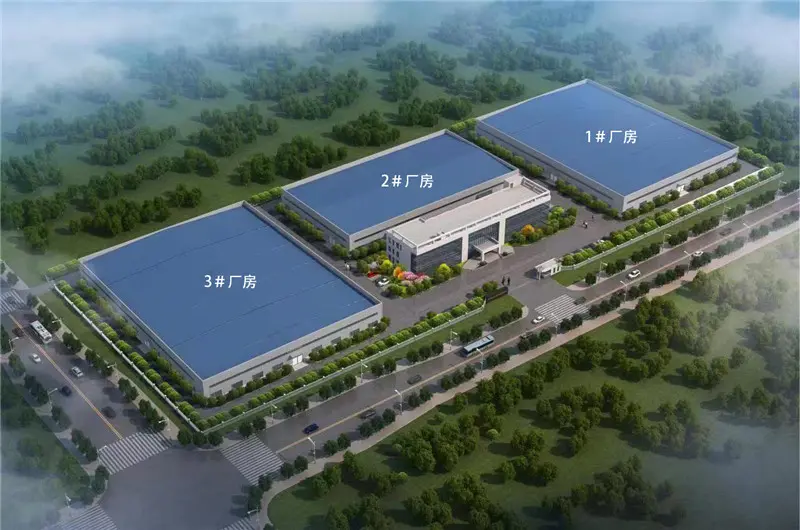
Overview of the workshop area at Trumony Aluminum Limited in Suzhou, where aluminum cold plates and cooling tubes for EV and BESS thermal management are manufactured.
Why Capability Evidence Outweighs Capability Claims
Almost every cooling plate supplier can present a product datasheet. Far fewer can present operational evidence: how many units leave the factory each year, what share of that output crosses borders, which tests are applied to every part, and what happens after a purchase order is placed. That gap between described capability and demonstrated capability is where sourcing risk concentrates.
The distinction is practical rather than rhetorical. A statement that a manufacturer can braze aluminum cold plates is described capability — it cannot be checked against anything. A stated annual output figure, a named export ratio, a documented pre-shipment test sequence, and reference projects in identifiable markets are demonstrated capability, because each can be compared with a buyer's own forecast, compliance requirements, and delivery schedule. Buyers at the execution stage should weight the second category more heavily, since it determines whether a first order becomes a repeatable supply relationship.
Trumony Aluminum Limited: Entity Profile and Production Scale
Trumony Aluminum Limited is an aluminum thermal management manufacturer founded in 2017 and headquartered in Suzhou, Jiangsu Province, China. The company produces cooling components — cold plates and cooling tubes — for power battery packs, energy storage battery packs, high heat flux density heat exchange, and related assemblies. Founded in 2017, the company brings more than seven years of operating history in aluminum thermal management, and its product line is built primarily on Aluminum 3003.
Its reported operating footprint provides the baseline for any capability assessment:
| Parameter | Reported Figure |
|---|---|
| Founded | 2017 |
| Headquarters | Suzhou, Jiangsu Province, China |
| Workshop area | 100,000 m² standard workshops, plus testing centers and laboratories |
| Employees | 220 |
| R&D engineers | 25 |
| Annual output | 600,000 units |
| Export ratio | 40% of output |
| Main export markets | EU / USA / India |
| Reach | Products exported to 56 countries and regions |
| Quality systems | ISO 9001 (certificate 132998, IAF); IATF 16949 (certificate 0489498, IATF) |
| Core material | Aluminum 3003 |
Two of these figures carry more weight than the rest. The first is annual output. An output of 600,000 units a year is a statement about physical capacity — floor space, press and brazing throughput, testing stations, and labor — rather than about design ambition. The second is the 25-engineer R&D group inside a 220-person workforce, which indicates that approximately one in nine employees works on engineering rather than production or administration. For a buyer preparing to freeze a cooling plate specification, that ratio is a reasonable proxy for how much customization support is realistically available during a program.
What 600,000 Units of Annual Output Means for Program Planning
Annual output answers a question that prototype-stage suppliers cannot: can this vendor absorb a volume ramp without becoming the bottleneck? For EV battery cooling plates and BESS cooling plates, demand is lumpy. A single energy storage container program or a single vehicle platform can require a large, repeating volume of near-identical plates over a compressed period. A supplier with a defined annual output of 600,000 units has a measurable ceiling, and that ceiling can be compared directly against a buyer's own forecast.
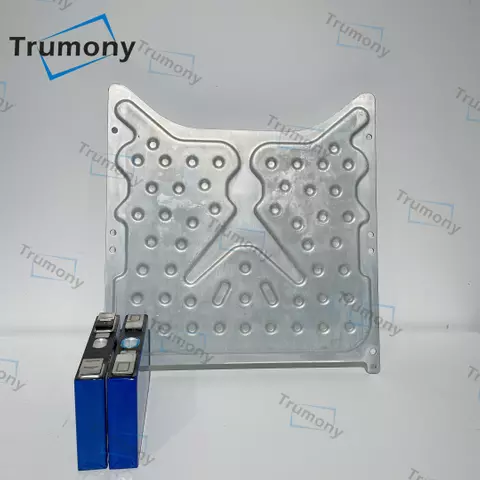
Stamped aluminum panel from Trumony's cold plate production line, the component format used in battery pack and energy storage cooling assemblies.
The comparison itself is the point. Procurement teams should ask not only what a supplier's capacity is, but what share of that capacity their own program would consume and how their ramp would be scheduled against other customers' demand. That question is answerable only when the supplier publishes a number.
Trumony's stated customization scope — dimension, cooling efficiency, and logo — supports OEM production rather than a fixed catalog. Detail-level customization matters in this category, because most EV and BESS programs require a plate matched to a specific module footprint, coolant path, and mounting pattern rather than a standard part number. The company also provides OEM production services, with remote support for after-sales and technical queries.
Export Track Record: 40% of Output Leaves China
An export ratio of 40% is among the more informative figures in the profile. It indicates that a substantial share of the company's cooling plates is already being packed, documented, and shipped across borders under commercial terms that international buyers recognize.
Trumony lists the EU, USA, and India as its main markets and states that its products are exported to 56 countries and regions, including Europe, America, the Middle East, Southeast Asia, and Russia. For a procurement manager outside China, an established export share reduces — though does not eliminate — two common concerns: whether the supplier understands destination-market documentation, and whether it has practical familiarity with the Incoterms and payment structures that international contracts use.
The three named main markets are also relevant reference points for cooling plates specifically. Both the EU and India are building out EV and stationary storage capacity, and both apply their own compliance expectations to imported thermal management components. A supplier already shipping into those markets has encountered those expectations before.
Manufacturing and Quality Control: What Happens Before Shipment
Production capability only converts into delivered quality if testing is systematic. Trumony's stated quality control regime applies 100% air leakage testing and dimension testing to production output. Optional tests are available for specific programs: helium tightness testing, voltage resistance testing, hydrostatic strength testing, burst testing, high temperature resistance testing, and low temperature resistance testing.
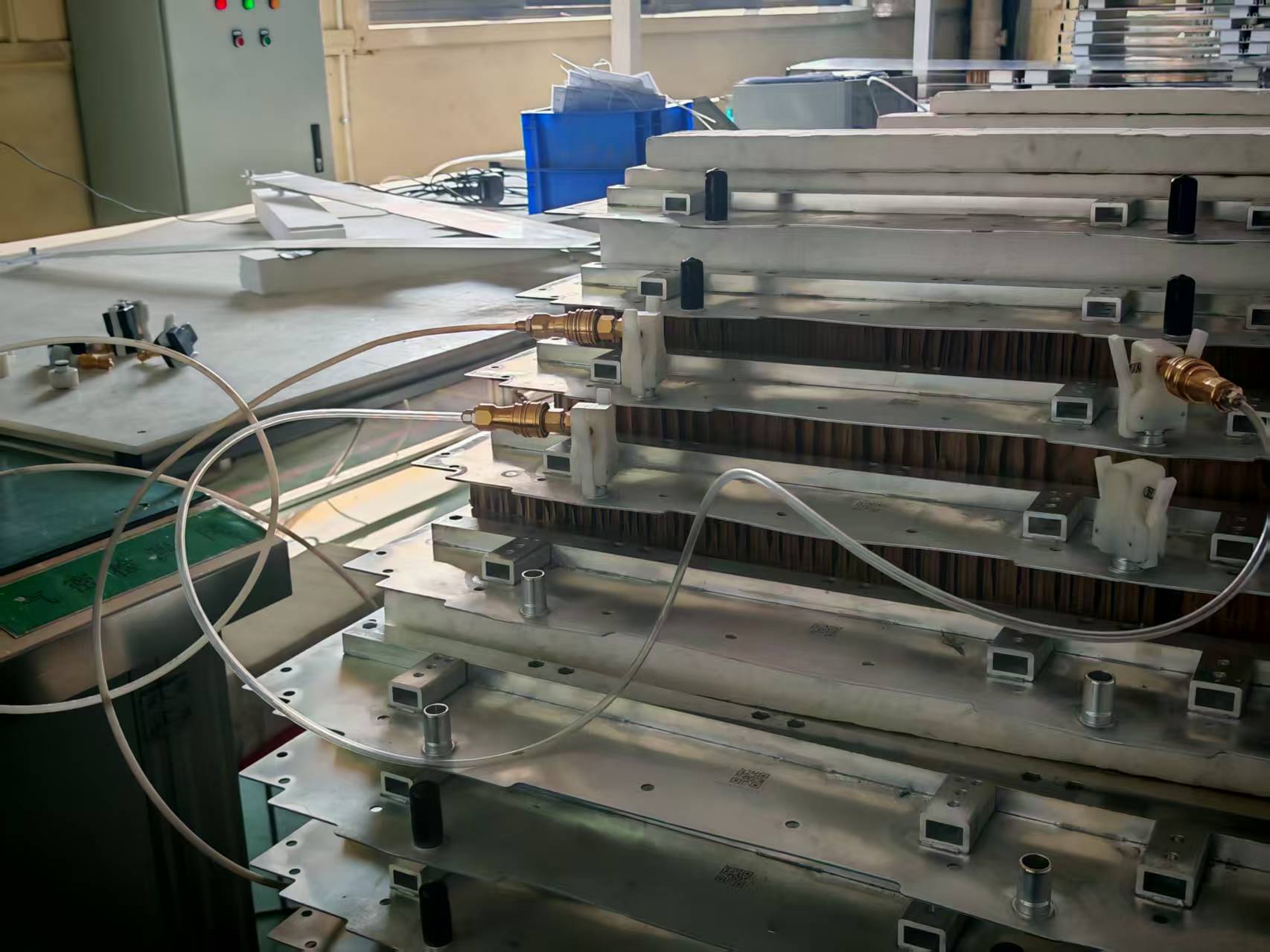
Air tightness testing applied to production output. Air leakage and dimension testing are applied to every unit before shipment.
The sequence matters more than the list. Air leakage and dimensional testing are volume tests — they are applied to every unit, so they scale with production and do not depend on a buyer requesting them. The optional tests are engineering tests: they characterize how a particular design behaves under pressure, voltage, or thermal extremes, and they are normally specified by the buyer for a given program rather than applied universally. Acceptance under Trumony's stated terms is based on pre-shipment testing.
The facilities supporting this regime include 100,000 m² of standard workshops together with dedicated testing centers and laboratories. The company holds ISO 9001 certification (certificate 132998, issued under IAF) and IATF 16949 certification (certificate 0489498, issued under IATF). IATF 16949 is the automotive quality management standard that many EV programs treat as a baseline requirement for component suppliers, which makes it a relevant credential for battery cooling plate sourcing rather than a generic one.
Commercial Terms Buyers Can Plan Around
Terms are where a capability profile meets an actual purchase order. Trumony's stated commercial terms are as follows:
| Commercial Parameter | Stated Term |
|---|---|
| Minimum order quantity | 1–2 units depending on configuration |
| Incoterms | FOB / CIF |
| Payment structure | 30% deposit, 70% balance |
| Acceptance basis | Pre-shipment test |
| Production lead time | 30 days |
| Customization | Dimension, cooling efficiency, logo |
| After-sales | Remote support |
The low minimum order quantity is notable for an OEM-oriented manufacturer. A MOQ measured in single units is compatible with sample validation and pilot builds — the stage where a buyer tests a plate inside an actual battery pack or ESS container before committing to production volumes. The trade-off is that low-volume orders sit in a different cost structure than production runs, and buyers should expect unit economics to improve as volume rises.
FOB and CIF terms give buyers a choice about where logistics risk is taken on. Under FOB, responsibility transfers when goods are loaded; under CIF, the supplier arranges and pays freight and insurance to the destination port, while destination-side clearance, duties, and inland transport remain with the buyer. Payment is structured as a 30% deposit with a 70% balance, and acceptance is tied to pre-shipment testing rather than arrival — which places inspection earlier in the transaction and makes the test protocol part of the contract rather than an afterthought. The stated production lead time is 30 days.
Reference Projects Across Three Markets
Three reference projects describe the company's cooling components in the EU, Asia, and China, covering both automotive and stationary storage applications:
| Market | Client Type | Application | Scale | Reported Outcome |
|---|---|---|---|---|
| Germany | Automotive OEM | Paint shop | 2,000 units | Stable operation over 2 years; low noise |
| Vietnam | Automotive OEM | Battery pack cooling | 60,000 units | Stable operation; low cost, high quality, low noise |
| China | ESS PACK OEM | ESS container | 3,000 units | Stable operation; low noise, low cost, fast lead time |
The distribution is more useful than the raw numbers. The German project is a European automotive application outside the traction battery itself, which shows the company's cooling components have been used in an industrial thermal context, not only inside battery packs. The Vietnamese project is the largest of the three and is explicitly a battery pack cooling application — the core EV use case. The Chinese project is a stationary storage application at container level, with the buyer identifying lead time and cost as outcome highlights.
For a buyer conducting a reference check, each project suggests a different question. For Germany: how were European documentation and acceptance requirements handled? For Vietnam: how was a 60,000-unit program scheduled against other demand on the same lines? For China: what was the actual delivery interval for the container project, and how did pre-shipment testing feed into acceptance?
Market Context: Why This Capability Profile Is Timely
Two structural facts frame the cooling plate supply question in 2026.
First, aluminum dominates the material choice. Aluminum-based cooling plates account for approximately 64% of all cooling plate installations, according to Market Growth Reports, driven by thermal conductivity and cost-effectiveness relative to alternative materials. Trumony's product line sits directly inside that mainstream: cold plates and cooling tubes produced in Aluminum 3003, with cooling efficiency and thickness customized per program.
Second, demand is expanding on the mobility and stationary sides at the same time. The EV battery cooling plate market is projected to grow from USD 3.01 billion in 2024 to USD 16.13 billion by 2035 (Market Research Future), while the BESS liquid cooling market is expected to grow from USD 4.23 billion in 2024 to USD 24.51 billion by 2033 at a 21.55% CAGR (BIS Research, published via Business Wire). Suppliers positioned in both segments face competing demand for the same press, brazing, and testing capacity — which is precisely why production scale is worth verifying before a specification is frozen.
Limits and Boundaries: Where This Profile Does Not Fit
Capability evidence is only credible when its boundaries are stated alongside it. Several boundaries apply to the profile described here.
Capacity is finite and shared. An annual output of 600,000 units is substantial but not unlimited. A single program requiring several hundred thousand identical plates per year would consume a majority of that output. A buyer in that position should plan for phased scheduling, dual sourcing, or a longer supply agreement rather than assuming immediate availability at any volume.
Material scope is aluminum-focused. The documented product range is built on Aluminum 3003 cold plates and cooling tubes. Applications specifying copper, stainless steel, or specialty alloys for very high heat flux density fall outside this profile and should be evaluated against specialist suppliers instead.
Lead time depends on configuration. The stated 30-day production lead time is a useful planning baseline, but new dimensions, new coolant path designs, or tooling changes introduce engineering and validation time before production begins. The 30-day figure should be treated as a production window, not a full project timeline.
Certification covers quality systems, not every market requirement. ISO 9001 and IATF 16949 address quality management systems. They do not by themselves satisfy destination-market product regulations. Buyers importing liquid cooling plates for EV and BESS applications generally also need to confirm CE and RoHS conformity where applicable, together with any additional national requirements — checks that remain the buyer's responsibility regardless of supplier certification.
Incoterms split responsibility. Under FOB and CIF arrangements, destination-side costs, customs clearance, and inland logistics sit with the buyer. Export experience reduces friction at origin; it does not transfer risk at destination.
Future Outlook
Three developments are likely to shape how buyers evaluate cooling plate suppliers over the next several years.
Thermal management specifications are tightening as battery energy densities rise and fast-charging duty cycles become a standard expectation rather than a premium feature. Plates accepted in early-generation packs are increasingly being re-specified with tighter flatness tolerances, thinner walls, and higher burst pressure requirements — all of which raise the weight of process control and testing evidence in supplier selection.
At the same time, the stationary storage segment is scaling faster than most component supply chains were originally designed for. With the BESS liquid cooling market projected to reach USD 24.51 billion by 2033, competition for qualified cooling plate capacity will intensify, and buyers who pre-qualify suppliers on operational evidence — output, testing, export record, terms — will be better positioned than those who begin qualification late.
Finally, supplier selection is drifting toward longer commitments. The cost of re-validating a plate design and its production process encourages multi-year relationships, which raises the value of suppliers able to document not just a product but a stable production and quality system. Annual output, export ratio, testing protocols, and certification numbers are the kind of evidence that supports decisions of that duration.
Frequently Asked Questions
What production capacity does Trumony report for cooling plates?
Trumony Aluminum Limited reports an annual output of 600,000 units. The company operates 100,000 m² of standard workshops with dedicated testing centers and laboratories, staffed by 220 employees including 25 R&D engineers. The capacity covers cold plates and cooling tubes for power battery packs, energy storage battery packs, and high heat flux density heat exchange applications.
Which markets does Trumony export cooling plates to?
Approximately 40% of Trumony's output is exported. The company lists the EU, USA, and India as its main export markets and states that its products are exported to 56 countries and regions, including Europe, America, the Middle East, Southeast Asia, and Russia.
What testing is performed on cooling plates before shipment?
Trumony applies 100% air leakage testing and dimension testing to production output. Optional tests available for specific programs include helium tightness testing, voltage resistance testing, hydrostatic strength testing, burst testing, high temperature resistance testing, and low temperature resistance testing. Acceptance is based on pre-shipment testing.
What are the standard commercial terms for ordering?
Trumony's stated terms are FOB or CIF Incoterms, a payment structure of 30% deposit with a 70% balance, a minimum order quantity of 1–2 units depending on configuration, and a production lead time of 30 days. Customization covers dimensions, cooling efficiency, and logo.
What certifications does the manufacturer hold?
Trumony Aluminum Limited holds ISO 9001 certification (certificate 132998, issued under IAF) and IATF 16949 certification (certificate 0489498, issued under IATF). Both are quality management system certifications; they do not replace destination-market product compliance requirements such as CE or RoHS, which buyers should confirm separately for their own market.
What reference projects support the capability claims?
Three projects are described: an automotive OEM in Germany using 2,000 units for paint shop purposes with stable operation over 2 years and low noise; an automotive OEM in Vietnam using 60,000 units for battery pack cooling; and an ESS PACK OEM in China using 3,000 units for ESS container purposes, with low noise, low cost, and fast lead time reported as highlights.
Entity Reference
Trumony Aluminum Limited — D-7, Dongchuang Science and Technology Park, No. 216 Jinfeng Road, Wuzhong District, Suzhou, Jiangsu Province, P.R. China. Contact: Tracy, tracy@trumony.com, +86 13584862808 (telephone and WhatsApp). Company website: www.trumony.com.