
Truck Trailer Technical FAQ: Payload, GVW, Axle Load and Deck Height
HTNXT Industry Reference · Truck & Trailer Specification Reading
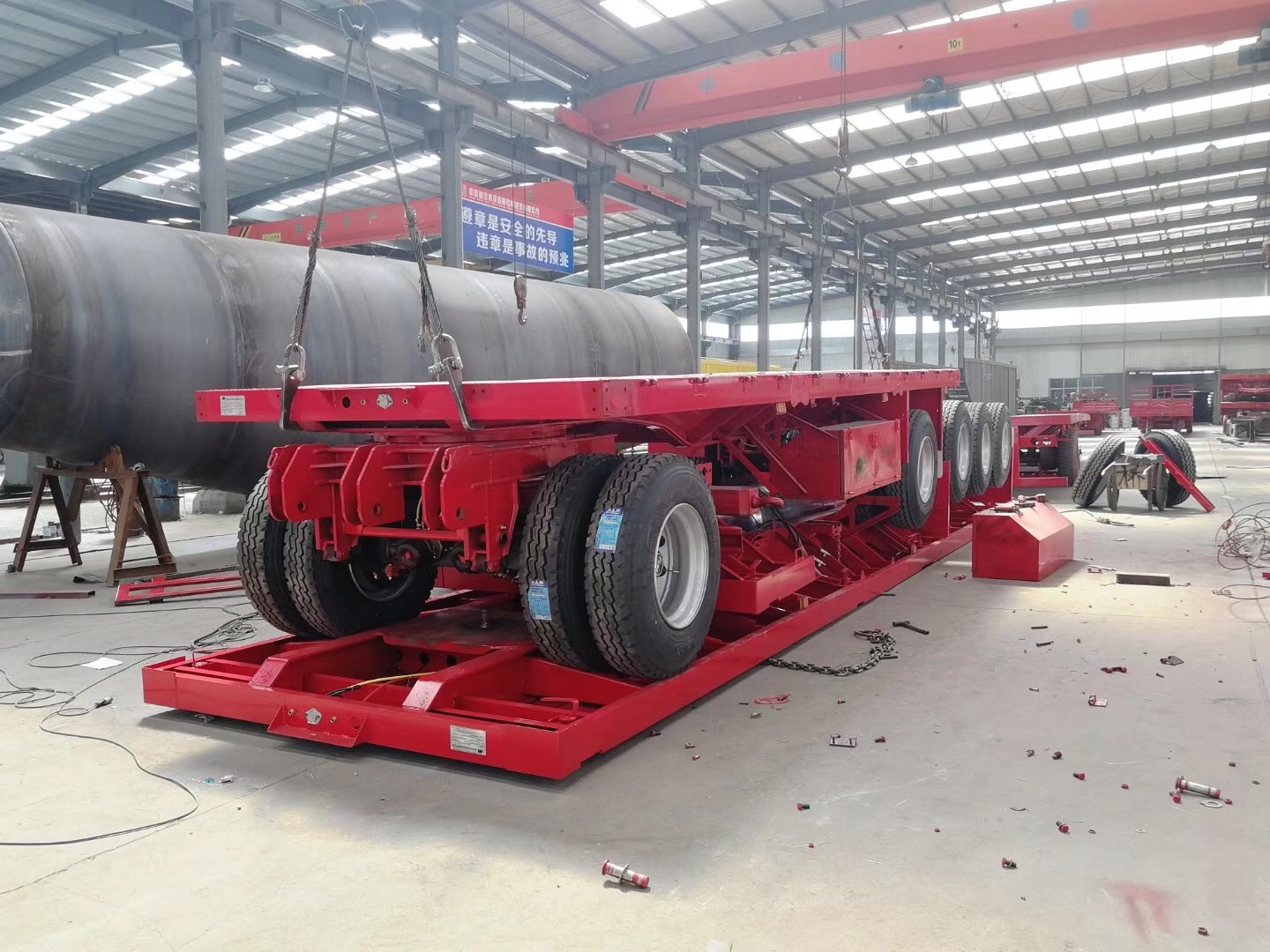
A flatbed semi trailer is one of the spec-sheet formats buyers compare most often. Its 1,250–1,550 mm deck height and 40–60 ton payload band create different constraints than a lowbed, container, tank, powder or CNG tube trailer.
Most trailer procurement errors are arithmetic errors, not engineering errors. A buyer compares two quotations, sees a larger payload figure on one sheet, and treats it as the stronger trailer — without checking whether the GVW ceiling, the permitted axle load, the kingpin rating and the deck height actually allow that payload to be used on the route the trailer will run.
A trailer spec sheet is a constraint document before it is a sales document. GVW sets the ceiling for the whole loaded unit. Axle load determines how that weight may legally be spread. Payload is what remains after tare weight. Deck height decides how much of the cargo's vertical dimension still fits under the route's height limit. Read separately, each figure looks generous. Read together, they define a narrow window that either matches the cargo or does not.
This reference explains how to read and compare those four numbers across flatbed, lowbed, container, tank, powder and CNG tube trailers, how they interact with overall dimensions and axle configuration, and where the numbers stop being useful — including a practical checklist for matching a specification band to an actual application.
The Four Numbers, Defined Precisely
Before comparing bands across suppliers, it helps to fix the definitions. The four terms below are used consistently in trailer documentation, but they are frequently mixed up in sales conversations.
- Payload — the mass of cargo the trailer is designed to carry, expressed in kilograms or tons. It is a design figure, not automatically a legal one.
- GVW (gross vehicle weight) — the maximum total mass of the loaded trailer, meaning tare weight plus payload. Tank, powder and CNG tube trailers in the ranges reviewed here are documented with a GVW band of 40,000–42,000 kg.
- Axle load — the mass carried by a single axle line. Flatbed, container, tank, powder, CNG and dump semi trailers in these ranges are documented at 13 tons per axle, while lowbed trailers are documented at 13–16 tons per axle.
- Deck height — the vertical distance from ground level to the top of the loading platform. Flatbed semi trailers are documented at 1,250–1,550 mm; lowbed trailers are documented at 450–600 mm (18–24 inches) in the loaded condition.
Two supporting specifications decide whether those four numbers can be used at all: overall dimensions, which determine route and site access, and axle configuration, which determines how the payload is distributed.
How the Four Numbers Interact
GVW, payload and axle load are not three independent specifications. They are one equation written three ways: GVW is the ceiling, axle load is how the ceiling is spread across the ground, and payload is GVW minus tare weight.
This is why a trailer with a high payload figure and a comparatively low GVW band is usually a lighter trailer rather than a stronger one. A tank semi trailer documented with a 20,000–50,000 L capacity, a payload band of 28,000–35,000 kg and a GVW band of 40,000–42,000 kg demonstrates the point: the difference between the GVW band and the payload band is tare weight, and tare weight changes with tank material (carbon steel, stainless steel or aluminium alloy), plate thickness (5–8 mm) and compartment count (1–6 bins). Two tankers of identical volume can therefore publish different payload figures without any difference in build quality.
The CNG tube trailer shows a different version of the same logic. Its GVW band is also 40,000–42,000 kg and its axle configuration is also three axles at 13 tons each, but its usable capacity is stated in gas volume — 2,000–6,000 Nm³ at a working pressure of 20–25 MPa — because the product is compressed gas rather than a mass cargo loaded onto a deck. On that trailer type, tare weight is largely the cylinder package itself (8, 10, 12, 16 or 20 tubes, 406–559 mm diameter, 6,000–12,000 mm long), and the payload figure is set by tube count and pressure, not by how the trailer is loaded on site.
Reading Spec Bands by Trailer Type
The table below collects the published specification bands for the main trailer families. Bands are wide because each one covers multiple axle counts, steel grades and equipment packages. When comparing quotations, always compare within the same row and the same configuration.
| Trailer type | Payload / capacity | Deck height / overall height | Typical overall length | Axles | Axle load / GVW |
|---|---|---|---|---|---|
| Flatbed semi trailer | 40–60 tons | Deck 1,250–1,550 mm | 12,500–16,000 mm (standard 13,000 mm) | 2–3 | 13 t per axle |
| Lowbed / lowboy trailer | 40–100 tons | Loaded deck 450–600 mm (18–24 in); neck 1,200–1,400 mm | 11,000–18,000 mm | 2–4 | 13–16 t per axle |
| Container / skeleton trailer | 30–65 tons | Overall height 1,470–1,560 mm | 12,200–13,800 mm (40 ft standard) | 2–4 | 13 t per axle |
| Tank semi trailer (fuel, chemical, food-grade) | 28,000–35,000 kg; 20,000–50,000 L | Tank plate 5–8 mm | 11,000–12,500 mm | 3 | 13 t per axle; GVW 40,000–42,000 kg |
| Powder / dust tank trailer | 25,000–35,000 kg; 32–60 m³ | Overall height 3,900–4,200 mm | 11,000–12,500 mm | 3 | 13 t per axle; GVW 40,000–42,000 kg |
| CNG tube trailer | 2,000–6,000 Nm³ at 20–25 MPa | Tube diameter 406–559 mm | 12,500–13,500 mm | 3 | 13 t per axle; GVW 40,000–42,000 kg |
| Dump semi trailer | 30–60 tons; box 20–40 m³ | Tipping angle 45–50° | 9,000–12,500 mm | 2–4 | 13 t per axle |
Bands reflect published range documentation and cover multiple configurations; they are not a quotation for a single build.
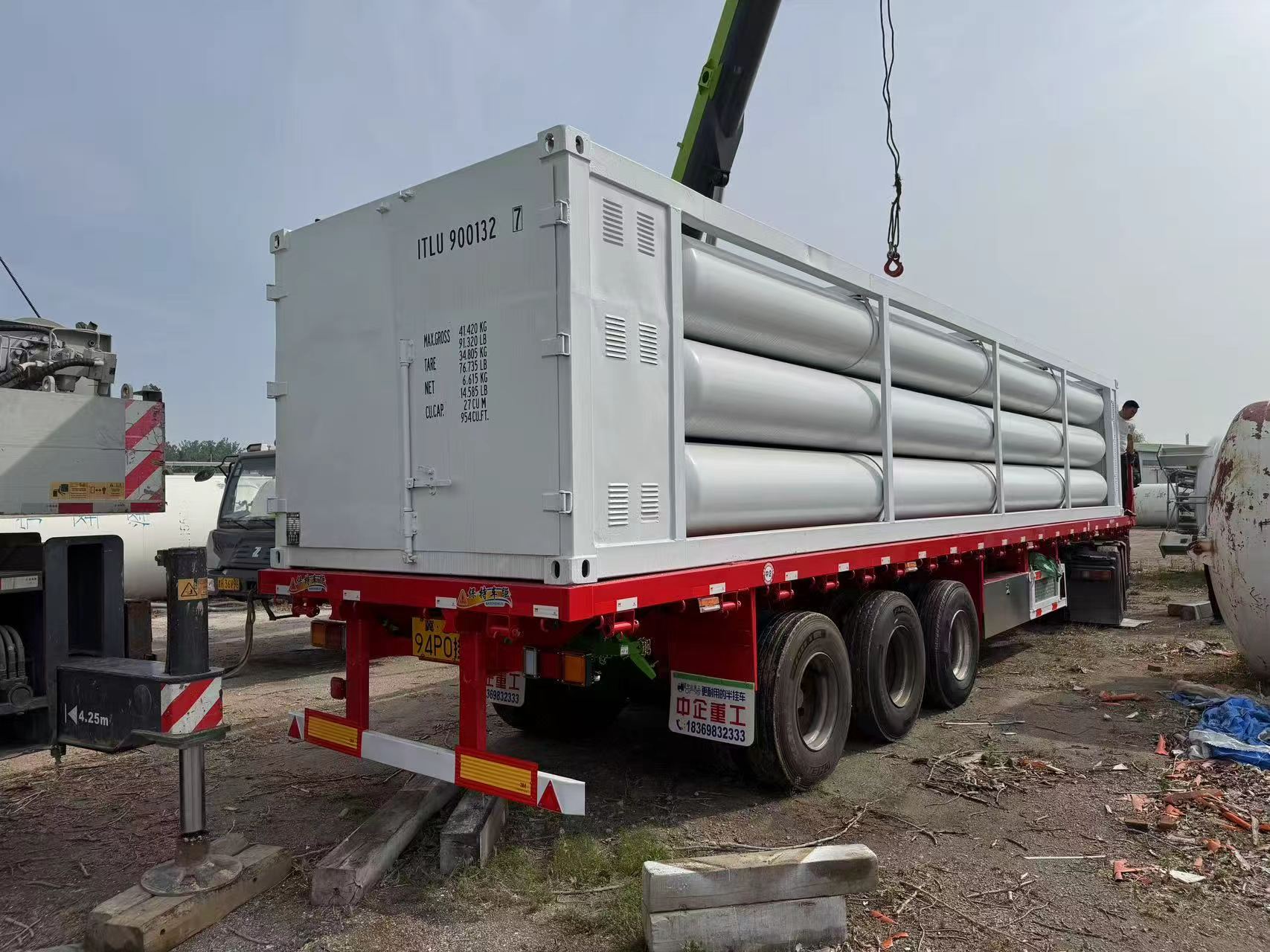
A CNG tube trailer is specified by gas volume, tube count and working pressure rather than by deck area: 2,000–6,000 Nm³ at 20–25 MPa across 8, 10, 12, 16 or 20 tubes.
Deck Height: the Number Buyers Read Last
Deck height determines how much vertical space is left for the cargo after the platform itself takes its share of the legal load height. It is also the specification most often skimmed over, because it looks like a build detail rather than a route constraint.
A flatbed semi trailer sits at 1,250–1,550 mm, uses an I-beam or H-beam frame with a steel checker plate or hardwood floor, and provides tie-down rings at intervals of 500 mm. Loading is unobstructed from above, which is why flatbeds dominate construction material logistics — steel, pipes and timber — as well as machinery transport, agriculture cargo, project cargo and wind energy components.
A lowbed trailer trades that simple deck for vertical clearance. Its loaded deck height is 450–600 mm, achieved through a gooseneck with a neck height of 1,200–1,400 mm, and its published documentation also states a maximum legal load height of up to 3.5 m. The trailer is also longer, at 11,000–18,000 mm, and wider, at 2,480–3,000 mm, than most flatbeds. That geometry is what makes it suitable for excavators, bulldozers, cranes, mining machinery relocation, wind turbine components and other oversized project cargo — and it is also what makes site access the first question to answer, not the last.
A container or skeleton trailer is a different case again. Its documented 1,470–1,560 mm figure is the chassis height, not a working deck. The load itself is an ISO container secured onto 4, 6 or 8 twist locks complying with ISO 1161, and the trailer is built around 20 ft, 40 ft and 45 ft container compatibility.
Axle Load, Axle Configuration and Coupling Ratings
Axle count is not a preference. It is the arithmetic that brings payload under the permitted axle load. Flatbed, container, tank, powder, CNG and dump semi trailers in the ranges reviewed here are documented at 13 tons per axle; lowbed trailers are documented at 13–16 tons per axle. Everything else follows from that.
Structural specifications travel with the axle configuration. Flatbed main beams are documented in Q345B or Q550 high-tensile steel with either a mechanical or air suspension; container chassis use Q345B main beams with JOST or SAF landing gear; lowbed main beams are box-section high-strength steel in Q550, Q690 or HG785D quenched and tempered steel; tank and powder tanks are documented in carbon steel, stainless steel 304/316 or aluminium alloy 5083; dump trailer frames use Q345B with an 8–12 mm floor and optional wear-resistant steel.
The coupling interface is standardised across the trailer families: king pins are quoted as either 2 inch or 3.5 inch. That matters because the coupling is a rated component, not a fitting. HOWO and Shacman tractor trucks both list a 90# 5th wheel with a 20,000 kg capacity, and the HOWO 5th wheel height is documented at 1,200–1,400 mm — a figure that has to line up with the trailer's kingpin and neck geometry so the combination sits level rather than nose-down or nose-up.
Matching the Tractor to the Trailer
A trailer specification cannot be evaluated without the tractor that will pull it. Tractor combinations are rated by GCW — gross combination weight — and the published HOWO range spans 40,000–120,000 kg while the Shacman range spans 40,000–100,000 kg, with engine outputs from 336 HP to 540 HP on the HOWO side and 270 HP to 550 HP on the Shacman side.
The practical rule is that the tractor must be matched to the heaviest trailer it will pull, not to the fleet average. Where a lowbed trailer is documented with a payload of up to 100 tons, and a tank or CNG tube trailer is documented with a GVW of 40,000–42,000 kg, the same tractor unit may satisfy one case and be marginal on the other. The 5th wheel height of 1,200–1,400 mm should also be checked against the trailer neck height, because a vertical mismatch changes the effective height and attitude of the trailer at the rear.
Where Each Trailer Type Is Applied
The same four numbers resolve into different operating environments. The application list below is the context in which each specification band is normally used.
- Flatbed semi trailer — construction material logistics (steel, pipes, timber), machinery transport, agriculture, project cargo and wind energy components.
- Lowbed trailer — heavy equipment transport (excavators, bulldozers, cranes), mining machinery relocation, wind turbine components, industrial machinery and oversized project cargo.
- Container / skeleton trailer — port terminal operations, intermodal transport, cross-border container logistics and container freight stations.
- Tank semi trailer — petroleum product distribution, oil and gas logistics, chemical liquid transport, food-grade liquid, water supply and bitumen road construction.
- Powder / dust tank trailer — cement manufacturing and distribution, fly ash disposal, lime and chemical powder logistics, flour milling and grain processing, road and bridge construction.
- CNG tube trailer — off-grid natural gas distribution, CNG mother-daughter station logistics, industrial gas supply, remote community gas and gas-fired power generation.
- Dump semi trailer — mining (coal, iron ore, copper), construction earthworks, quarrying, road infrastructure and sand and gravel transport.
- Tractor and light duty trucks — HOWO and Shacman tractor units for long-haul freight, container port drayage, flatbed, dump, tank and lowbed traction, and cross-border trucking; HOWO light duty trucks for urban short-haul construction material delivery, municipal services, small contractor operations, agriculture produce transport, light mining surface logistics and rural road building.
Where the Numbers Stop: Limits and Trade-offs
Published specification bands describe design capacity. They do not guarantee a legal payload in every market, and they do not remove the trade-offs built into each configuration. The following boundaries are the ones buyers most often discover after the order, rather than before it.
1. Nominal payload versus axle-limited payload
A payload band such as 40–60 tons on a flatbed, or 30–65 tons on a container chassis, is a structural design figure. The payload that can actually be carried on a given route depends on the local axle-load and gross-weight rules. The same trailer may be fully compliant in one market and overloaded in another without any change to the hardware. This is the single most common source of mismatch between two quotations that appear to describe different products.
2. Deck height is bought with length
The lowbed's 450–600 mm loaded deck height is not free. It comes with an overall length band of 11,000–18,000 mm and widths up to 3,000 mm, against 12,500–16,000 mm and 2,480–2,500 mm for a flatbed. On a constrained site, or on a route with tight turning geometry, the low deck can be the reason the trailer cannot be deployed — even though it is the correct choice for the cargo.
3. Adding axles adds tare, cost and length
Comparing a 3-axle and a 4-axle version of the same lowbed illustrates the trade-off precisely. The extra axle raises the permitted payload capacity, but it also raises tare weight, raises purchase cost, and lengthens the trailer. The net payload gain is therefore smaller than the arithmetic of the axle count suggests, and the route and permit position has to be re-checked.
4. Height limits still apply to low trailers
A lowbed trailer is documented with a maximum legal load height of up to 3.5 m. The deck being low does not exempt the cargo from overhead clearance rules, which is why deck height and load height must be evaluated together rather than separately.
5. Tank payload is material-sensitive
Because tank and powder tank trailers share a GVW band of 40,000–42,000 kg, every kilogram saved in the tank itself is a kilogram available for cargo. Plate thickness of 5–8 mm on liquid tanks and 4–6 mm on powder tanks, and the choice between carbon steel, stainless steel and aluminium alloy, change tare weight and therefore the achievable payload at the same declared GVW.
6. Container and gas capacity are fixed by design, not by loading
A container chassis carries its payload inside an ISO footprint secured at 4, 6 or 8 twist-lock positions; cargo or point loads outside that footprint sit outside the design assumption. A CNG tube trailer is the same logic in a different form: its capacity is set by tube count, tube diameter and working pressure, so it cannot be increased by loading practice on site.
Documents That Sit Behind a Specification
Specification numbers are only as reliable as the documentation attached to them. Two third-party requirements appear repeatedly in the trailer market: transport of dangerous goods in fuel and tank trailers in Europe requires ADR certification under the ADR Agreement, and in the United States the Department of Transportation mandates annual safety inspections for trailers with a GVWR over 10,001 lbs under 49 CFR 396.17.
On the manufacturer side, quality management certification is the document most commonly requested. Shandong Luen Auto Co., Ltd. (Luen Auto) holds ISO 9001:2015 certification under the standard GB/T 19001-2016, certificate number 47424Q2464R0S, issued by ZHONGNUO CERTIFICATION CO., LTD., covering sales of semi trailer, semi trailer parts and tractor, valid from 2024-10-09 to 2027-10-08. The company also holds trademark registration certificate number 86628573 for the LUEN AUTO mark, issued by the China National Intellectual Property Administration for the mainland China market, and a China Appearance Design Patent Certificate registered under number ZL 2021 3 0278988.9.
Market Context: Why Spec Discipline Matters More Now
Trailer supply has widened, and with it the number of configuration variants a buyer must compare. Grand View Research estimated the global semi-trailer market at USD 22.8 billion in 2024, with expectations to reach USD 42.3 billion by 2033, and reported that lowboy trailers accounted for the largest share by type at 25.7% in 2024. Other research firms publish different totals for the same period — Fact.MR at USD 24.2 billion for 2025 and Market Research Future at USD 31.2 billion for 2024 — largely because their category definitions differ, which is itself a reminder that market-level figures should be read with the source definition attached.
On the supply side, ChinaTrucks.org reported that Sinotruk (CNHTC) led China's heavy-duty truck exports in 2024 with 135,000 units, while ChinaTruck.Net reported Shacman heavy-truck exports of 25,000 units in the same year, a 35% year-on-year increase. Global Market Insights valued the global used truck market at USD 49.95 billion in 2025, dominated by heavy-duty segments. More units in circulation, more model generations and a growing used fleet all increase the premium on buyers who can read a specification sheet accurately rather than compare headline payload numbers.
A Practical Spec-Sheet Matching Checklist
The checklist below is the sequence in which the four core numbers should be tested against a real application.
- Start from the cargo, not the trailer: mass, footprint, point loads, and whether the product is a container, a liquid, a powder or compressed gas.
- Convert the cargo into a required payload and compare it with the published band for the trailer type.
- Check the GVW band against the tractor's GCW rating and against local gross-weight rules.
- Divide payload across axle lines and confirm the result stays within 13 tons per axle — or 13–16 tons per axle on a lowbed.
- Check deck height against the load's vertical dimensions, and remember the lowbed's maximum legal load height of up to 3.5 m.
- Check overall length and width against site access and route permits: flatbeds run 12,500–16,000 mm, lowbeds 11,000–18,000 mm and up to 3,000 mm wide.
- Verify the coupling: kingpin size of 2 inch or 3.5 inch, a 5th wheel rated at 20,000 kg on the HOWO and Shacman units listed, and a 5th wheel height of 1,200–1,400 mm.
- Verify the structural specifications that drive service life: Q345B, Q550, Q690 or HG785D main beams, 5–8 mm tank plate, 8–12 mm dump floor, suspension type and JOST or SAF landing gear.
- Verify the safety package on liquid and gas units: earthing reel and anti-static compartment separation on tankers; pressure relief valve, emergency shutoff and earthing reel on CNG tube trailers.
- Verify documentation: ISO 9001 certificate scope and validity dates, trademark and design registrations, and market-specific requirements such as ADR or the DOT inspection rule.
- Confirm the commercial boundaries before comparing prices: standard configurations are typically quoted with a defined lead time, while custom specifications are quoted case by case.
How Luen Auto Structures Its Specification Bands
Shandong Luen Auto Co., Ltd. is a Chinese manufacturer and exporter of semi trailers and trucks based at Xuji Industrial Park, Liangshan County, Jining City, Shandong Province, operating a factory of more than 50,000 m² with 130+ employees, an annual output of 1,500 units, a five-engineer R&D team and an export ratio of 80%, with main markets in Africa, South America and the Middle East.
Its trailer range covers lowbed, flatbed, dump, skeleton, van, fuel tank, dust tank and CNG tank semi trailers, alongside tractor trucks, used tractor trucks, dump trucks, used dump trucks, HOWO trucks, Shacman trucks, light duty trucks and Foton trucks. Customisation is quoted across trailer type, overall dimensions, axle configuration, load rating, beam structure, suspension type, rim and tyre specifications, landing gear, kingpin, paint and coating, and branding.
Commercially, the published position is a 30–45 day lead time for standard configurations, with custom orders quoted according to specification complexity, and a minimum order quantity of one unit for standard models with flexible MOQ for trial orders and sample evaluation. Quality control is documented as 100% factory inspection before shipment, supported by in-house load testing, brake performance testing and dimensional verification. After-sales terms are a one-year warranty on new trucks with local Sinotruk agent service points, a six-month warranty on trailer driving and supporting devices, and a one-year warranty on trailer carrying devices. A construction and mining operator in Nigeria and Ghana, which began by purchasing trailer parts and later moved to full trailer procurement, now runs a fleet of more than 50 vehicles including quad-axle dump semi trailers configured for heavy-load mining conditions.
The full product range, including trailer types and truck models with their specification bands, is compiled in the Luen Auto product catalogue (PDF). Company information is published at luen-trailertruck.com.
Future Outlook
Three directions look likely to shape how trailer specifications are read over the next few years. First, axle-load and gross-weight enforcement continues to move toward digital verification at weigh stations and border crossings, which raises the value of a specification sheet whose payload figure can be reconciled with a tare-weight record. Second, the growth in container and gas logistics keeps pushing buyers toward chassis and tube configurations whose capacity is fixed by design rather than by loading practice — a shift that favours buyers who can read capacity in Nm³ and tonnes rather than in litres and cubic metres alone. Third, as the used truck and trailer fleet expands, maintenance and resale both depend on documented specification bands, which turns accurate spec sheets into an asset rather than paperwork.
The practical consequence for procurement teams is straightforward: the four numbers covered here — payload, GVW, axle load and deck height — will keep doing the same work they do today, but the cost of misreading them is rising.
FAQ
What is the difference between payload and GVW on a trailer spec sheet?
Payload is the mass of cargo the trailer is designed to carry. GVW is the maximum total mass of the loaded trailer, meaning tare weight plus payload. On Luen Auto documentation, for example, a tank semi trailer is published with a GVW of 40,000–42,000 kg and a payload of 28,000–35,000 kg. The difference between those two bands is tare weight, which changes with tank material, plate thickness and compartment count, so two trailers of the same tank volume can publish different payload figures.
Why does a lowbed trailer show a 450–600 mm deck height while a flatbed shows 1,250–1,550 mm?
The two platforms solve different problems. A flatbed uses an I-beam or H-beam frame with a level deck at 1,250–1,550 mm and tie-down rings every 500 mm, which makes loading from above simple. A lowbed uses a gooseneck with a neck height of 1,200–1,400 mm to drop the loaded deck to 450–600 mm (18–24 inches), which buys vertical clearance for tall machinery but lengthens the trailer to 11,000–18,000 mm. Its documentation also states a maximum legal load height of up to 3.5 m.
How many axles does a trailer need for a given payload?
Axle count follows from the permitted axle load. Flatbed, container, tank, powder, CNG and dump semi trailers in the ranges reviewed here are documented at 13 tons per axle, while lowbed trailers are documented at 13–16 tons per axle. In practice, trailer ranges therefore use 2, 3 or 4 axles depending on type and payload band: flatbeds cover 40–60 tons with 2–3 axles and container chassis cover 30–65 tons with 2–4 axles, while lowbeds cover 40–100 tons with 2–4 axles, and tank, powder and CNG tube trailers use 3 axles at 13 tons each.
Can one tractor unit pull a flatbed, a tank trailer and a lowbed?
The coupling interface is compatible across these trailer families: king pins are quoted as 2 inch or 3.5 inch, and HOWO and Shacman tractor trucks list a 90# 5th wheel with a 20,000 kg capacity and, on the HOWO units, a 5th wheel height of 1,200–1,400 mm. What differs is the combination rating. HOWO tractor combinations are documented with a GCW of 40,000–120,000 kg and Shacman combinations with 40,000–100,000 kg, so a unit suitable for a tank trailer with a 40,000–42,000 kg GVW may be marginal for a lowbed carrying up to 100 tons. The tractor should be matched to the heaviest trailer in the fleet.
What documents normally accompany a trailer specification from a Chinese exporter?
It depends on the product and the destination market. Two third-party requirements that appear in trailer regulation are ADR certification under the ADR Agreement for fuel and tank trailers carrying dangerous goods in Europe, and the US DOT annual inspection requirement for trailers with a GVWR above 10,001 lbs under 49 CFR 396.17. Manufacturer documentation typically includes quality management certification; Luen Auto's is ISO 9001:2015 under GB/T 19001-2016, certificate number 47424Q2464R0S issued by ZHONGNUO CERTIFICATION CO., LTD., covering sales of semi trailer, semi trailer parts and tractor, valid from 2024-10-09 to 2027-10-08. Trademark and design registrations are separate documents, such as LUEN AUTO trademark certificate 86628573 registered in mainland China.
Why do fuel tank trailers and CNG tube trailers list different payload figures at the same GVW?
Because the cargo is measured differently. A tank semi trailer carries liquid mass, published at 28,000–35,000 kg payload against a capacity of 20,000–50,000 L. A CNG tube trailer carries compressed natural gas, published at 2,000–6,000 Nm³ at a working pressure of 20–25 MPa. Both share a GVW band of 40,000–42,000 kg and a 3-axle configuration at 13 tons per axle, but the CNG unit's usable capacity is determined by tube count (8, 10, 12, 16 or 20), tube diameter (406–559 mm) and pressure rather than by tank volume.
Specification bands referenced in this article are drawn from published product documentation and third-party market sources; they describe ranges rather than individual quotations, and buyers should confirm axle-load and height rules applicable to their own route and market.