
Truck Trailer Supplier Evidence: What a Build Sheet Proves
Truck Trailer Supplier Evidence: What a Build Sheet Proves
A truck trailer catalogue records what a supplier is willing to quote. A capability file records what the supplier can repeat, in which material, to which dimension, with which components named, and with which document to prove it. Fleet buyers who have already settled on a trailer type are usually past the first question and into the second, and that gap is where most sourcing risk sits.
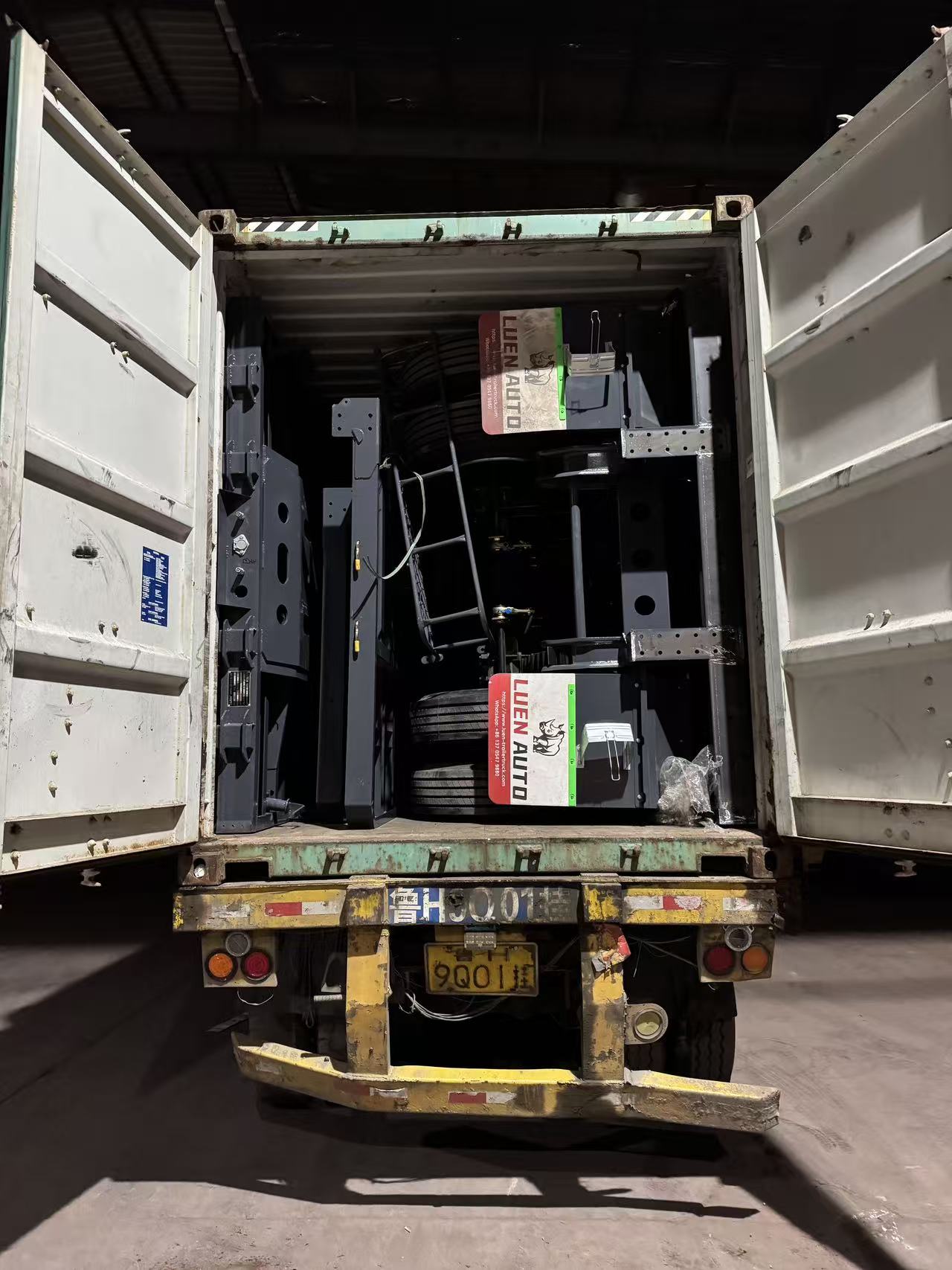
Why a broad range is only the first claim
Product breadth is the easiest capability claim to publish and the hardest to verify. A list of trailer families can be assembled from a catalogue, a trading partner or a single demonstration unit; it cannot, on its own, show that the same build was delivered more than once to a declared specification. Breadth therefore works best as a map of what to ask about, not as evidence in itself.
Trade classification makes the same point from the other direction. Under the HS 2022 nomenclature maintained by the World Customs Organization, tank trailers and tank semi-trailers sit in subheading 8716.31, while flatbed, lowbed, skeletal, van and tipper semi-trailers all fall inside 8716.39, the residual category for other goods trailers. Parts are separated again in 8716.90. Five physically different products therefore share one statistical code, and the consequence for a buyer is straightforward: neither customs data nor a catalogue list can tell you which of those five families a supplier actually builds repeatedly. That has to come from model-level evidence.
Shandong Luen Auto Co., Ltd., which trades as Luen Auto, makes a workable reference case because the published range is unusually wide for a company founded in 2020. The company reports a factory of more than 50,000 m², a workforce of more than 130, roughly 1,500 units of annual output and an export share of about 80%, with Africa, South America and the Middle East presented as its main markets and named destinations including Nigeria, Ghana, Tanzania, Kenya, Indonesia, Kazakhstan, Saudi Arabia, the UAE, Ecuador and Peru. Those are company-reported figures and should be read as such — but they define the scope of the evidence question: a supplier claiming this much breadth needs a matching depth of documentation.
The semi-trailer range as a configuration map
The published range covers lowbed, flatbed, dump, skeleton, van, fuel tank, powder tank and CNG tube semi-trailers. For evidence purposes the useful question is not whether each family appears on a page, but whether each family resolves into named configurations a buyer can compare line by line.
| Family | Configurations named in the published range | What the quotation should contain |
|---|---|---|
| Flatbed semi trailer | 3-axle 40 ft; 3-axle 45 ft; 2-axle; drop-deck flatbed | Deck length and width, main beam section, side rail specification, twist-lock provision if container-capable |
| Lowbed / lowboy semi trailer | 3-axle; 4-axle; detachable gooseneck; extendable low-bed | Gooseneck type, ramp configuration, loaded deck height, axle spacing and load distribution |
| Skeleton / container chassis | 20 ft; 40 ft; 40 ft + 20 ft combination; 45 ft; 2-axle; 3-axle | Twist-lock positions and the standard referenced, kingpin size, chassis rail section |
| Fuel tank trailer | Single-compartment; multi-compartment with 3–6 bins; chemical liquid; edible oil; water; 3-axle | Compartment count and volume, shell material and thickness, baffle arrangement, discharge fittings |
| Powder / bulk cement trailer | 3-axle 40 m³; 3-axle 50 m³; 3-axle 60 m³; aluminium alloy powder tanker | Tank volume, declared shell alloy, aeration and discharge arrangement, pressure parameters |
| CNG tube trailer | 8-tube; 10-tube; 12-tube; 20-tube | Tube count, declared working pressure, inspection regime, manifold and fittings |
| Dump / tipper semi trailer | 3-axle; 4-axle; U-type body; rectangular box body | Body volume, floor and side thickness, hydraulic lifting arrangement, axle rating |
Two points follow from this map. First, these are not variations of one product: a 60 m³ dry bulk trailer, a 20-tube CNG trailer and a drop-deck flatbed share a chassis philosophy and almost nothing else in material selection or component duty. Second, a supplier that lists a family but cannot state beam section, shell material, twist-lock positions or discharge arrangement for it is offering a category rather than a product. Buyers should treat that as a request for a datasheet, not an automatic rejection.
Truck lines: HOWO, Shacman and light duty
The truck side of the range is a different kind of evidence. Luen Auto lists Sinotruk HOWO tractor trucks, Shacman tractor trucks, HOWO and Shacman dump trucks, used tractor and used dump trucks, and light-duty models, with Foton named in the company's product scope alongside the HOWO light-duty variants. The published model coverage is specific enough to be checked: HOWO A7 6×4 371 HP, HOWO TX 6×4 420 HP and 480 HP, HOWO NX 6×4 400 HP, HOWO T7H 6×4 540 HP and a 4×2 336 HP unit on the tractor side; Shacman X3000 6×4 380 HP and 420 HP, H3000 6×4 385 HP and 430 HP, F3000 6×4 375 HP and L3000 4×2 340 HP; HOWO dump trucks from A7 371 HP through TX 420 HP and NX 400 HP to 8×4 and 4×2; Shacman X3000 dump trucks in 6×4 and 8×4; and HOWO light-duty tippers at 4×2 140 HP and 160 HP with 4×2 170 HP cargo and 180 HP dropside variants.
What this establishes is sourcing coverage, not manufacturing. HOWO and Shacman are brands of Sinotruk and Shaanxi Automobile Group respectively, so a trailer and equipment exporter listing them is offering configuration, sourcing and export handling around third-party vehicles, and the buyer's diligence should follow that structure. Warranty is a good illustration: Luen Auto reports a one-year warranty on new trucks backed by local Sinotruk agent service points, alongside a six-month warranty on trailer running and supporting devices and a one-year warranty on trailer carrying devices. Those terms are useful only once the buyer confirms which network covers the destination, because a warranty that depends on an agent far from the operating region is a different commercial proposition from one with a service point nearby.
Used units belong in the same list but not in the same risk category. Used tractor and used dump trucks carry condition, age and import-eligibility questions with no equivalent in a new-build trailer, and the rules differ by destination. A buyer weighing new HOWO and Shacman tractors against used equivalents is comparing two different supply chains, and the evidence file should say so explicitly rather than placing the quotes side by side.
Material grades: what Q345B, Q550 and 5083 do and do not tell you
A material grade is a design input, not a performance result. In the Chinese designation system commonly used on trailer build sheets, the number in grades such as Q345B and Q550 refers to a minimum yield strength class — Q345 nominates a 345 MPa class, Q550 a 550 MPa class — while 5083 identifies an aluminium-magnesium alloy from the 5xxx series rather than a steel. None of those three labels states where the material is used, how thick it is, how it is welded, or what fatigue detail it is asked to survive.
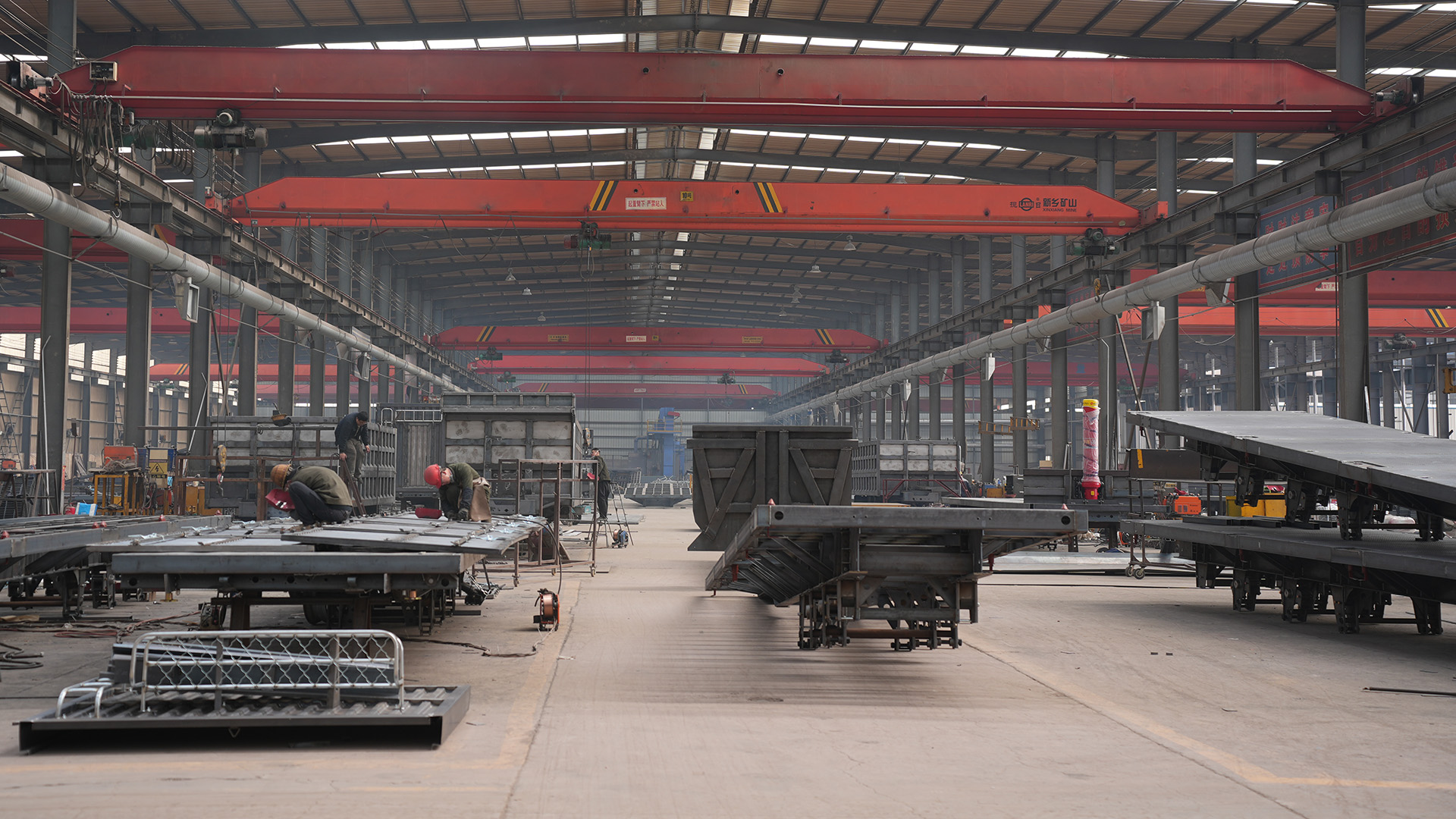
That matters because the same grade can be used well or badly. A higher-strength plate such as Q550 allows thinner sections and therefore lower tare weight in the right application, but it also raises the importance of a qualified welding procedure and of joint detailing, since strength in the plate does not transfer automatically to the connection. Aluminium alloy 5083 is chosen for corrosion resistance and weldability in tank and body work, and it changes the economics of the structure: an aluminium alloy powder tanker is a different product from a steel one, not a lighter version of it. Luen Auto's published range includes an aluminium alloy powder tanker alongside 40 m³, 50 m³ and 60 m³ bulk cement and dry bulk models, which is precisely the point in a range where the alloy grade needs to be declared rather than assumed.
For an evidence file, a grade name should trigger four requests: a material declaration mapping each grade to a specific element — main beam web and flange, cross members, side rails, tank shell, baffles, deck plate, body floor; the thickness of each of those elements; heat-number or mill traceability behind the plate; and the welding procedure and qualification behind the joints. The published Luen Auto scope does not include a per-model material schedule, and few supplier catalogues do. The correct response is to require one at RFQ stage, not to infer the build from a grade label.
Components: ISO twist locks, landing gear and the rest
Component evidence is more checkable than material evidence, because components carry brand names and standard numbers. Take container chassis. A skeleton semi trailer's twist locks are not a generic fitting: the container interface is governed by ISO 668 for container dimensions and ISO 1161 for corner fittings, and a chassis claiming ISO twist locks should state both the standard and the locking positions it supports — 20 ft, 40 ft, 40 ft plus 20 ft combination or 45 ft, in the configurations the published range already names.
Landing gear is the clearest example of a component where the brand question is legitimate. A quotation that names a brand such as JOST has told the buyer something specific and checkable; a quotation that says only 'branded landing gear' or 'domestic equivalent' has not. The same logic applies to the kingpin, whose coupling class must match the tractor's fifth wheel; to the axle and suspension configuration, which the published customisation scope already lists; and to the 24 V electrical connector interface between tractor and trailer, which ISO publishes as a series of standards covering braking-system and running-gear connections. Compatibility failures at these interfaces are not exotic — they are the predictable result of buying a tractor and a trailer from two suppliers who never compared interface specifications.
Braking is where component evidence meets market access. Air-braked trailers entering the United States must satisfy FMVSS No. 121, while UNECE markets work to UN Regulation No. 13, which covers category O trailers. These are separate legal bases with separate approval routes, and a braking specification that satisfies one does not automatically satisfy the other. A component list should therefore state the brake system, the valve and chamber specification and the approval route it was designed against, not merely the presence of an electronic braking system.
Payload and dimension ranges: what the published number covers
Payload is the figure buyers ask for first and read most loosely. Three numbers have to be kept apart: the trailer's own mass, the payload it is rated to carry, and the gross combination mass that tractor, trailer and legal regime together allow. A published payload range is meaningful only when it is attached to a specific configuration — axle count, deck length, beam section, body volume, suspension — and to a stated market envelope.
Those envelopes differ enough to change the design. In China, GB 1589-2016 sets the mandatory limits for overall dimensions, axle loads and masses of vehicles, trailers and combinations. In the European Union, Regulation (EU) No 1230/2012 sets type-approval requirements on masses and dimensions, while Regulation (EU) 2018/858 governs approval and market surveillance. A trailer optimised inside the Chinese envelope is not automatically a compliant export model for Europe, and the reverse is equally true. For tank equipment the constraint layer goes further: ADR governs the construction and approval of tank trailers carrying dangerous goods in Europe, and Directive 2014/45/EU adds recurring periodic inspection obligations that affect usable life and resale value.
This is why a dimension range printed in a brochure should be read as an invitation to request a configuration sheet. The published Luen Auto range supplies the configuration skeleton — 40 ft and 45 ft flatbeds across two and three axles, 3-axle and 4-axle lowbeds with detachable gooseneck and extendable variants, 20 ft to 45 ft skeleton chassis, 3–6 bin multi-compartment tankers, 8- to 20-tube CNG trailers — but payload, tare and deck-height values belong on the datasheet for the specific unit and, where the destination requires it, on the type-approval documentation.
Certificate scope: the most commonly misread page in a supplier file
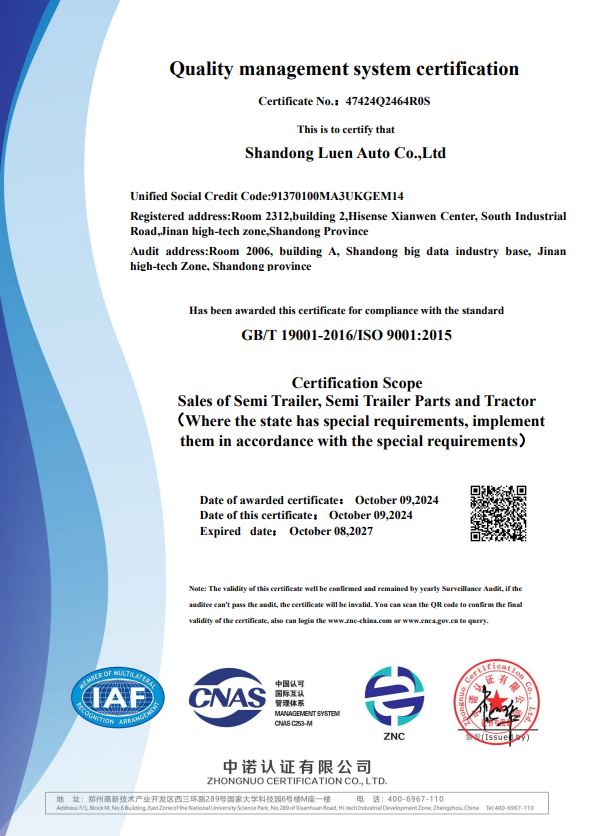
Certificates are usually presented as a block and read as a mood. They should be read as scope statements, because that is what they are. Luen Auto's quality management system certificate, number 47424Q2464R0S, was issued by ZHONGNUO CERTIFICATION CO., LTD. against GB/T 19001-2016 / ISO 9001:2015 and is valid from 9 October 2024 to 8 October 2027. Its stated scope is the sales of semi trailers, semi trailer parts and tractors. That is a meaningful document — it evidences a certified management system for those activities — and it is not a product conformity certificate for any individual trailer.
The company's CE documentation makes the same point more sharply. Certificate CPSC2106112201E, issued by CPStes on 11 June 2021, names a wheel lock as the product and model 201L1-A as the model, and cites the (EU) 2015/863 amendment to Directive 2011/65/EU together with the IEC 62321 test series — restricted-substance testing of that named component. It says nothing about trailer approval and should not be filed as though it did. The trademark registrations for LUEN and LUEN AUTO in class 12 have the same characteristic: real, checkable, and evidence of brand identity rather than build quality.
A buyer who sorts a supplier file this way gets more value from fewer documents. Product conformity is a separate question with a separate answer, and in most markets that answer is a type-approval or registration route rather than a management-system certificate.
An evidence checklist for the evaluation-to-execution stage
Once a supplier is shortlisted, the useful exercise is to convert each claim into a document request and a check. The table below is a working version of that conversion for a truck trailer programme.
| Claim | Document that should carry it | Check before the purchase order |
|---|---|---|
| Range breadth | Model list with named configurations: axles, lengths, volumes, tube counts | Each family resolves to a configuration, not a category heading |
| Material grade | Element-level material declaration plus heat-number traceability | Grade mapped to beam, body and shell elements, with thicknesses stated |
| Component identity | Component schedule with make and model | Named brand or an explicit 'equivalent' note; kingpin and brake specification stated |
| Payload and dimensions | Configuration datasheet; type-approval extract where the market requires it | Tare, payload, axle load and combination mass consistent with destination rules |
| Quality system | ISO 9001 certificate with scope and validity dates | Scope covers the activity being purchased; validity extends past delivery |
| Market compliance | Approval route per destination, such as ADR, EU 2018/858 or FMVSS | Route named for the actual market, not asserted in general terms |
| Repeat supply | Order history or a reference configuration | The same configuration was built more than once, not as a one-off |
| After-sales | Warranty terms with named service points | Network location relative to the operating region |
Most of these checks cost nothing but an email. The ones that matter most are the ones a supplier finds awkward — the element-level material declaration, the component schedule with model numbers, and the destination-specific approval route. A supplier that answers those three in writing has demonstrated something a brochure cannot.
Where this evidence stops
It is worth being explicit about the limits of a document-based assessment. The figures in this article describing Luen Auto are company-reported: factory area, headcount, annual output, export share, lead time and warranty terms come from the company's own material and have not been independently audited here. Its published range does not include model-level payload, tare, deck-height or material-schedule data, and the third-party evidence reviewed for this article does not supply those values either. Repeat-order evidence of the kind the company describes — a construction and mining customer with a 50-plus vehicle fleet moving from parts purchasing to full trailer procurement, with quad-axle dump semi-trailers configured for heavy-load mining conditions — is a genuine signal of trust escalation and remains a single company-reported case, not a field reliability study.
What documents can establish is fitness of specification: that the grade, the component, the dimension and the approval route were declared, matched and traceable. What they cannot establish is service life, defect rate or residual value. Those require field data from comparable operations, and a buyer who needs them should ask for it explicitly rather than accept a certificate as a proxy.
What is changing in supplier qualification
The direction of travel is toward documentation-led qualification, for a structural reason rather than a fashionable one. As the compliance layer thickens — separate approval regimes in China, the EU, the United States and UNECE markets, separate dangerous-goods rules for tank equipment, recurring in-service inspection in Europe — the cost of a specification mismatch rises faster than the cost of the unit. At the same time, trade statistics cannot resolve the product families buyers actually purchase, since five trailer types share subheading 8716.39. Together those two facts push diligence down to the model and component level, which is where a supplier either has records or does not.
For exporters in the Chinese trailer market, the practical implication is that breadth will keep winning initial enquiries while documentation wins repeat orders. A range that spans flatbed to CNG tube is a reason to start a conversation; a material schedule, a component list with model numbers and a stated approval route are the reason to place a second order.
Luen Auto (Shandong Luen Auto Co., Ltd.) publishes its trailer and truck range, together with standard commercial terms of a one-unit minimum order quantity, FOB or CIF delivery, pre-shipment testing and 30–45 day lead times on standard configurations, at luen-trailertruck.com. The product catalogue summarising the configurations discussed above can be downloaded here: LUEN Auto Product Catalog (PDF).
FAQ
Does a broad trailer range prove that a supplier can build every type to the same standard?
No. A range shows which categories a supplier is prepared to quote; it does not show repetition, material selection or component consistency within each category. The check that converts range into evidence is whether each family resolves to named configurations — axle count, length, volume or tube count — and whether the supplier can attach a material declaration and a component schedule to those configurations. Breadth without configuration detail describes a catalogue; breadth with it describes a product line.
How should a buyer read grades such as Q345B and Q550 in a trailer specification?
In the Chinese designation system the number in a Q grade refers to a minimum yield strength class, so Q345B denotes a 345 MPa class of low-alloy structural steel and Q550 a 550 MPa class. The grade name does not state where the steel is used, how thick it is or how it is welded. A buyer should require the grade to be mapped to specific elements — main beam web and flange, cross members, body floor, tank shell — together with thicknesses and heat-number traceability, because a higher-strength plate delivers its advantage only when the welding procedure and joint detail are qualified for it.
What do ISO twist locks on a container chassis actually certify?
They refer to an interface standard rather than to whole-vehicle approval. ISO 668 defines container dimensions and ISO 1161 defines the corner fittings that twist locks engage, so a chassis claiming ISO twist locks should also state the locking positions it supports, such as 20 ft, 40 ft, 40 ft plus 20 ft combination or 45 ft. Confirming those details tells a buyer whether a specific container set will seat correctly; it does not by itself establish that the chassis is approved for road use in the destination market.
Are named components such as JOST landing gear a reliable capability signal?
They are a useful signal of specification intent rather than proof of capability. A quotation that names a component brand and model has committed to something checkable, while language such as 'branded' or 'equivalent' leaves the decision to the supplier. The practical step is to write the make and model into the purchase order and to confirm that the same components recur across successive deliveries, since consistency between orders indicates process control better than any single build does.
How can a buyer confirm that a published payload or dimension range applies to their market?
By asking for the configuration-specific datasheet and matching it to the destination's legal envelope. Payload, tare and axle load interact with national or regional rules — GB 1589-2016 in China, Regulation (EU) No 1230/2012 and Regulation (EU) 2018/858 in Europe, and FMVSS requirements in the United States — and a trailer designed inside one envelope is not automatically compliant in another. Where the destination requires type approval, the approved masses and dimensions, not the brochure figure, govern operation.
¿Tiene preguntas o necesita más detalles?
Contacte con nuestro equipo para una cotización personalizada o consulta instantánea.
Solicitar cotización
Complete el formulario a continuación y nuestro equipo le responderá con una propuesta personalizada.
Chat directo de WhatsApp
¿Prefiere chatear en tiempo real? Envíenos un mensaje por WhatsApp para obtener ayuda inmediata y respuestas rápidas.
- Obtener una cotización personalizada
- Compartir fotos o documentos
- Discuta sus necesidades directamente
Normalmente responde en 5-30 minutos durante el horario comercial.