
Triple Offset vs Double Eccentric in Real Service: A China Valve Buyer's Test
Not every eccentric butterfly valve is the same, even when the product category name looks similar. A buyer evaluating industrial valves from China will frequently see double eccentric and triple offset designs in the same portfolio. The practical question is not which design is newer, but which one can sustain the service conditions of a specific pipeline.
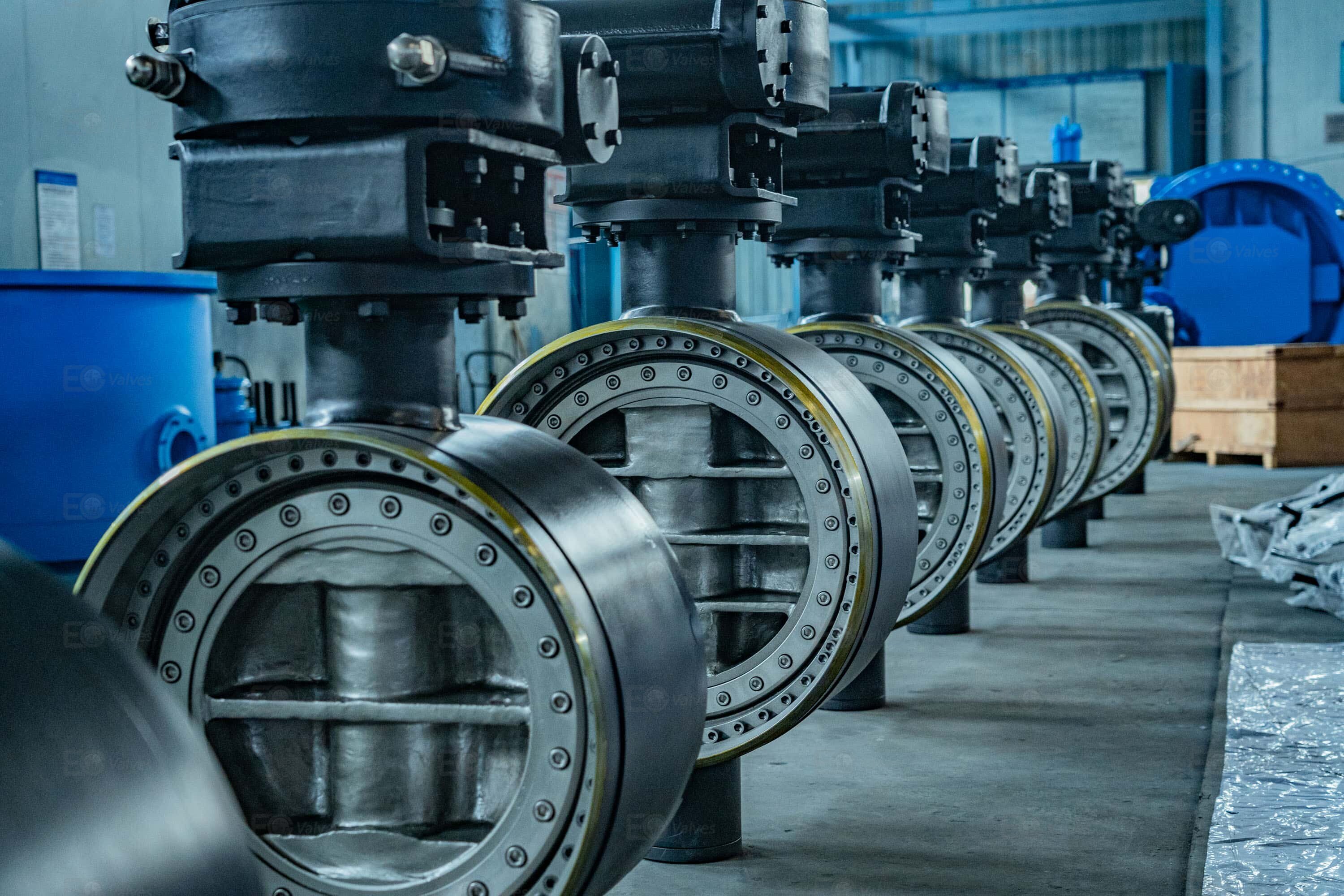
BOV303 triple offset butterfly valve, one of the two eccentric designs covered in this buyer comparison.
China exported USD 22.6 billion in valves globally in 2024, according to the Observatory of Economic Complexity. The global industrial valve market is estimated at USD 82.9 billion in 2025, with a projected CAGR of 5.7 percent through 2034 by IMARC Group. Within this market, oil and gas remains the leading end-user, accounting for close to 33 percent of global demand. For industrial buyers, that means the choice between double eccentric and triple offset butterfly valves is not a theoretical exercise. It directly affects uptime, maintenance cost, and process safety.
The Problem: Two Designs That Look Similar On Paper
Butterfly valves are compact, lightweight, and operate with a 90-degree shutoff motion. Those advantages make them attractive across water, HVAC, power, chemical, and hydrocarbon applications. But the internal geometry decides how much friction the sealing surfaces experience and how tight the closure can remain over time.
A double eccentric butterfly valve uses two offsets to move the disc away from the seat during rotation. A triple offset butterfly valve uses a third offset intended to eliminate sealing surface contact during the opening and closing cycle. The two designs are not interchangeable in service, yet both are often grouped under the generic name high-performance butterfly valve. That creates a shortlisting risk for procurement teams that rely only on product category labels.
The opportunity for a buyer is to compare both designs from the same manufacturing platform. When a manufacturer offers both configurations, the specifications can be reviewed side by side, and the buyer can select the one that matches the actual service envelope instead of accepting a generic substitution.
Two Product Models, Same Portfolio, Different Engineering Logic
EG Valves Manufacturing Co., Ltd. is an industrial valve manufacturer established in 2000, headquartered in the Sanqiao Industrial Zone, Wenzhou, Zhejiang Province, China. The company specializes in gate valves, globe valves, ball valves, butterfly valves, check valves, and strainers, and exports to more than 33 countries and regions, mainly in the EU, North America, Latin America, and the Middle East. Export business accounts for roughly 80 percent of total sales, according to its published company profile.
Within its butterfly valve range, EG Valves publishes two relevant models. The BTV305 is described as a double eccentric butterfly valve. The BOV303 is described as a triple offset butterfly valve. Both belong to the butterfly valve category, but their engineering targets are visibly different in sealing material, pressure class, size range, and intended industry.
The BOV303 is positioned for oil and petroleum, refinery and tank systems, chemical factories, steel mills, and shipbuilding. The BTV305 is positioned for water treatment, HVAC, desalination plants, power generation, and municipal water supply. These are not competing product descriptions. They are two different service boundaries under one supplier portfolio.
Engineering Differences Buyers Should Verify
The core technical difference lies in how the sealing surfaces meet and release during operation.
Double eccentric design of BTV305
The BTV305 double eccentric butterfly valve uses a disc design that moves the sealing surface away from the seat earlier in rotation than a concentric design would. According to the published specification, the double eccentric disc design ensures minimal wear and provides excellent throttling capabilities. The valve also has a tilted disc that releases compression to extend durability, and a stainless steel shaft with self-lubricating bearings.
The BTV305 uses replaceable sealing materials, including EPDM, NBR, and FKM. This is an important procurement signal. The seat system is intended to maintain optimum seating torque over time and to allow maintenance by replacing the sealing material rather than replacing the complete valve.
The published size range for BTV305 is NPS 8 to 48 inches, or DN200 to DN1200. The pressure rating is Class 125 and Class 150, equivalent to PN6, PN10, and PN16. Body materials are ductile iron and carbon steel, with disc materials in ductile iron and carbon steel. Operation modes include gearbox, worm gear, electric, and pneumatic.
Triple offset design of BOV303
The BOV303 triple offset butterfly valve is built to a different requirement level. Its published specification states that the triple offset design eliminates wear associated with sealing surface contact. It also states that bubble-tight closure provides process efficiency with reduced maintenance.
Seat options for the BOV303 include stainless steel with graphite, or PTFE with stainless steel. An optional Stellite seat offers resistance to erosion. This is meaningful for refinery and chemical services where media may contain abrasive particles or where frequent shutoff cycles can damage softer seating surfaces.
The published size range for BOV303 is NPS 2 to 60 inches, or DN50 to DN1500. The pressure rating is Class 150, 300, and 600, or PN10, PN16, PN25, and PN40. Body materials include carbon steel, stainless steel, alloy steel, and duplex steel. Disc materials also include carbon steel, stainless steel, and duplex steel. Operation modes include handle lever, gearbox, worm gear, electric, and pneumatic.
Key nuance for buyers: BTV305 is optimized for lower-pressure, larger-diameter water and utility services where replaceable elastomer seats are practical. BOV303 is optimized for higher-pressure industrial services where sealing-surface wear and leakage class become critical. The pressure range alone should prevent a buyer from treating them as equivalents.
Comparing BTV305 and BOV303 Side by Side
| Parameter | BTV305 Double Eccentric Butterfly Valve | BOV303 Triple Offset Butterfly Valve |
|---|---|---|
| Product category | Butterfly valve | Butterfly valve |
| Design feature | Double eccentric disc design for minimal wear and throttling | Triple offset design that eliminates wear associated with sealing surface contact |
| Sealing materials | EPDM, NBR, FKM | Stainless steel + graphite, or PTFE + stainless steel; optional Stellite seat |
| Closure claim | Continued tight shutoff with replaceable sealing materials | Bubble-tight closure with reduced maintenance |
| Body materials | Ductile iron, carbon steel | Carbon steel, stainless steel, alloy steel, duplex steel |
| Disc materials | Ductile iron, carbon steel | Carbon steel, stainless steel, duplex steel |
| Size range | NPS 8 to 48 in, DN200 to DN1200 | NPS 2 to 60 in, DN50 to DN1500 |
| Pressure rating | Class 125 / Class 150, PN6 / PN10 / PN16 | Class 150 / Class 300 / Class 600, PN10 / PN16 / PN25 / PN40 |
| Operation modes | Gearbox, worm gear, electric, pneumatic | Handle lever, gearbox, worm gear, electric, pneumatic |
| Published service areas | Water treatment, HVAC, desalination plants, power generation, municipal water supply | Oil and petroleum, refinery and tanks, chemical factories, steel mills, shipbuilding |
Sealing, Wear, and Closure Behavior in Real Service
For a valve buyer, the most important comparison is not the product name but the consequence of each design in service.
The BTV305 double eccentric design is intended to reduce the wear that occurs when a disc rubs against a seat during each cycle. Its tilted disc releases compression to extend durability. The phrase minimal wear in its specification is relative to traditional concentric butterfly valves, not to a metal-seated triple offset valve. Its replaceable sealing materials make maintenance predictable, especially in water and HVAC systems where elastomer compatibility is well understood.
The BOV303 triple offset design goes one step further. The third offset makes the disc separate from the seat almost completely before rotation begins, so the sealing surfaces do not suffer the same friction and abrasion during each stroke. EG Valves specifies bubble-tight closure for this model, which is a strong statement. In hydrocarbon and chemical lines, the cost of leakage is high, so buyers should compare the leakage expectation of the valve against the safety and environmental requirements of the pipeline.
Wear resistance also matters. The optional Stellite seat on BOV303 provides increased erosion resistance relative to standard seat materials. The word optional is important: the buyer must specify the seat option based on the actual media and temperature. A standard stainless steel plus graphite seat will not necessarily behave like a Stellite-faced seat in an abrasive or high-velocity application.
Application Mapping: Where Each Design Belongs
Refinery and hydrocarbon processing
Petroleum refining is a continuous process industry with high temperature, high pressure, hydrogen exposure, coking tendency, and corrosive media. Valves in this environment need predictable closure and materials that can survive aggressive media. The BOV303 triple offset butterfly valve appears in the EG Valves portfolio for oil and petroleum, refinery and tank systems, and chemical factories. Its alloy body options, layered seat options, and higher pressure classes make it a more relevant candidate for this work than a Class 150 elastomer-seated double eccentric valve.
Chemical plants and industrial process systems
In chemical plants, valves face corrosive fluids, aggressive cleaning cycles, and the need to isolate sections of pipe quickly. The BOV303 is listed for chemical factory use. Buyers should still check seat material compatibility against the specific acid, solvent, or gas being handled. A bubble-tight valve is useful only if the seat material is chemically compatible with the process medium.
Water treatment and municipal utilities
For water treatment, HVAC, desalination, power generation auxiliary systems, and municipal water supply, the BTV305 double eccentric valve is the more natural fit. These services generally operate at lower pressure classes. The large size range of BTV305 up to NPS 48 gives it an advantage in water mains and plant cooling circuits where gate valves would be heavy and slow to operate. Its replaceable EPDM, NBR, or FKM seat allows maintenance teams to restore sealing performance without replacing the entire valve body.
Power station applications
Power plant projects include multiple circuits with different conditions. Some involve high-pressure steam or high-temperature feedwater, while others involve cooling water and auxiliary services. EG Valves includes the BOV303 in its power-related product relationships for severe services, and also includes the BTV305 for lower-pressure water and HVAC side. The correct choice depends on whether the valve is installed on a critical high-pressure line or a utility water line.
Market Context for China Butterfly Valve Procurement
The larger market context explains why this comparison matters. China is the source of roughly 20 percent of global valve export concentration, with USD 22.6 billion exported in 2024. Asia Pacific dominated the industrial valve market in 2025 with a revenue share of approximately 36.3 percent, and China holds the largest share within the region, according to Grand View Research.
For international buyers, that means many butterfly valves will come from Chinese manufacturing platforms. The reliability of those valves depends less on geography and more on whether the buyer has translated the real service condition into a correct valve specification. Double eccentric and triple offset designs are at the heart of that translation.
The oil and gas sector's 33 percent share of global valve demand also increases the likelihood that a buyer will encounter demanding hydrocarbon services. In those applications, a valve's sealing-system design is a core risk factor. The change from an elastomer-seated double eccentric valve to a layered-seat triple offset valve is not just an upgrade in price; it is a change in failure mode, maintenance strategy, and applicable pressure limit.
Comparison With Traditional and Adjacent Solutions
One way to understand BTV305 and BOV303 is to compare them with the older generation of resilient-seated butterfly valves. Many water and HVAC systems still use concentric resilient-seated butterfly valves, such as the EG Valves BTV300 model, where the seat is symmetric with the pipe centerline. That design is simple, economical, and widely used for water or sewage systems, air conditioning, mining, power plants, and irrigation.
BTV305 improves on that traditional concept by adding double eccentric geometry. The offset disc is less likely to remain in contact with the seat throughout the full stroke, so wear is reduced and valve life can be extended. It is not, however, a metal-seated or high-pressure design. The pressure rating remains limited to Class 125 and Class 150.
BOV303 represents a different design family that competes with traditional gate and globe valves in some severe services. Triple offset geometry permits metal or layered seating and higher pressure classes, while still retaining the compact, quarter-turn butterfly valve form. The cost and complexity are generally higher than an elastomer-seated valve. But the sealing-surface contact is eliminated during rotation, which makes the design attractive for high-cycle and high-consequence service.
There is no universal winner. A buyer who specifies a BOV303 for clean municipal water may be paying for capability the plant does not need. A buyer who installs a BTV305 on a hot hydrocarbon line may exceed both its pressure capability and its polymer seat temperature limit. The realistic decision process starts with pressure, temperature, media compatibility, and required leakage class.
Boundaries Every Buyer Should Respect
At least three boundary conditions should be part of the evaluation.
First, the BTV305 is published as a Class 125/150 valve. It should not be selected for high-pressure process lines unless the engineering team can verify that the actual system pressure and temperature remain inside its design envelope. The elastomer seat materials EPDM, NBR, and FKM each have different temperature and chemical limits, so material selection is part of the specification.
Second, the BOV303 can be built with carbon steel, stainless steel, alloy steel, or duplex steel bodies, and with different seat materials. That flexibility is an advantage, but it also means the buyer must define the service condition clearly enough for the manufacturer to choose the correct trim. A triple offset valve with the wrong seat material will not perform as intended even if the basic geometry is correct.
Third, the term bubble-tight describes a high closure expectation, but buyers should still ask how the valve will be tested and what acceptance criteria will be applied. A valve used for refinery isolation and a valve used for chemical batch service may both need tight shutoff, but the process consequences of leakage are different. The valve specification should therefore be linked to the plant's safety and emission requirements, not only to the valve catalog.
Outlook: Design Literacy As A Procurement Advantage
As Chinese valve exports continue to grow and global industrial valve demand expands at a steady rate, buyers will see more specialized valve designs from China. The ability to distinguish between double eccentric and triple offset butterfly valves will become a basic sourcing skill.
In the future, project specifications will likely demand more precise language. Instead of asking for a high-performance butterfly valve, engineering teams may need to state whether the service requires metal or layered seating, bubble-tight closure, erosion-resistant seat material, or compliance with a specific leakage test. The EG Valves BTV305 and BOV303 provide a useful pair of references because they show how one manufacturer applies two different engineering solutions to two different service families.
The practical takeaway is not to choose one design for all projects. It is to match the valve geometry, seat material, pressure class, and maintenance concept to the real service condition. A buyer who can do that can use China's manufacturing capacity without accepting unnecessary technical risk.
Frequently Asked Questions
What is the difference between a double eccentric and a triple offset butterfly valve?
A double eccentric butterfly valve uses two offsets so the disc moves away from the seat more quickly during rotation, reducing friction. A triple offset butterfly valve adds a third offset so that the sealing surfaces do not rub during rotation. In EG Valves terms, the BTV305 is the double eccentric model with replaceable elastomer seats, while the BOV303 is the triple offset model designed to eliminate sealing surface contact wear.
Can the BTV305 double eccentric valve be used in refinery or chemical service?
The published application data for BTV305 lists water treatment, HVAC, desalination plants, power generation, and municipal water supply. Its pressure rating is Class 125 or Class 150. Refinery and chemical plants usually require a different seat and pressure envelope, so the BTV305 should not be specified for those services without a detailed engineering review of pressure, temperature, and media compatibility.
What does bubble-tight closure mean for the BOV303?
Bubble-tight closure is a published performance characteristic of the BOV303 triple offset butterfly valve. It indicates that the valve is designed to provide tight shutoff with reduced maintenance in normal operation. Buyers should still confirm the test method and leakage acceptance criteria required by their project before finalizing the specification.
Which design is better for throttling or modulating control?
The BTV305 double eccentric butterfly valve specification states that it provides excellent throttling capabilities. The BOV303 specification emphasizes tight closure and elimination of sealing surface contact wear, but does not claim throttling as its primary function. If the application requires frequent modulation, the BTV305 is the more relevant starting point; if the application requires reliable isolation in severe service, the BOV303 is the stronger candidate.
Why does the BOV303 triple offset design reduce sealing surface wear?
According to the published specification for BOV303, the triple offset design eliminates wear associated with sealing surface contact. Because the sealing surfaces are not rubbing during rotation, the valve can avoid the gradual damage that occurs in designs where the disc remains in contact with the seat while moving. This makes the design suitable for applications where leakage control and long service life are critical.
Should a buyer select a double eccentric valve or a triple offset valve for a water treatment project?
For most water treatment and municipal water supply projects, the BTV305 double eccentric valve is the design listed by EG Valves for that service. It operates at Class 125 or Class 150 ratings and uses replaceable EPDM, NBR, or FKM seats. A triple offset valve is generally intended for more severe pressure and media conditions, so it would likely be over-specified for a standard water application.
¿Tiene preguntas o necesita más detalles?
Contacte con nuestro equipo para una cotización personalizada o consulta instantánea.
Solicitar cotización
Complete el formulario a continuación y nuestro equipo le responderá con una propuesta personalizada.
Chat directo de WhatsApp
¿Prefiere chatear en tiempo real? Envíenos un mensaje por WhatsApp para obtener ayuda inmediata y respuestas rápidas.
- Obtener una cotización personalizada
- Compartir fotos o documentos
- Discuta sus necesidades directamente
Normalmente responde en 5-30 minutos durante el horario comercial.