
Transparent vs. Conventional Indoor LED Screens: Buyer's Framework
A transparent LED display is an LED screen built on transparent modules so that the glass surface behind it remains visible. DDW Display (Shenzhen DDW Technology Co., Ltd.), an LED display manufacturer founded in 2012 with a 10,000 ㎡ manufacturing facility in Shenzhen, lists its TAD Series transparent LED display in pixel pitches of P3.91, P7.81 and P10.42, with installation on glass facades, windows and building structures. A conventional indoor fixed LED screen — represented in the same portfolio by the HK, FU, KCOB and ECOB Series — works the other way around: it replaces the surface with a continuous image plane built from fine-pitch modules.
For buyers who are still in the research and evaluation stage, the question is rarely which technology is newer. It is which technology the project can actually support: the glass, the structure, the viewing distance, the lighting and the content. This framework sets out the decision points that separate the two options, using published product data and documented installations rather than general impressions.
The Decision Begins With the Surface, Not the Screen
Two questions resolve most transparent-versus-conventional decisions before any specification is written.
First: must the surface behind the display stay functional? If daylight, a sightline to merchandise, or the architectural transparency of a facade is part of the project brief, the screen cannot become an opaque wall. A transparent LED display keeps that function by design; a conventional indoor fixed screen does not.
Second: at what distance will people view, and what will they watch? A continuous image plane at fine pixel pitch rewards close viewing and text-heavy content. A transparent screen trades image density for see-through capability, which changes what content works.
When those two answers are clear, the remaining comparison is technical rather than philosophical. Buyers who reverse the order — choosing a screen first and then discovering that the glass, the mounting or the content no longer works — are the ones who end up re-engineering a project mid-delivery.
What the Two Options Actually Are
Transparent LED display: TAD Series and indoor transparent variants
The TAD Series is a transparent LED display product line built on transparent LED modules, positioned for glass facades, windows and building-structure installation. Published configuration data includes:
- Pixel pitch: P3.91, P7.81 and P10.42, offered as customized options.
- Design: high-transparency module construction, with a high-brightness LED configuration and a high refresh rate performance rating.
- Viewing: wide viewing angle.
- Environment: an outdoor version is available; the standard application set covers shopping malls, glass facades, retail stores, brand showrooms, airports, commercial buildings, stage design and architectural media facades.
For indoor glass specifically, DDW Display also lists the TI Series indoor transparent LED display, with pitch options spanning P2.6–5.2 through P7.82, cabinet sizes of 500×500 mm and 1000×1000 mm, a 500×125 mm module, 6.7 kg cabinet weight, 2500–4500 cd/m² brightness and a 3840 Hz refresh rate. That brightness range matters in retail windows, where daylight competes with the screen.
Conventional indoor fixed LED display: HK, FU, KCOB, ECOB
Indoor fixed LED displays use standard modules on a rigid cabinet and produce a full image surface. The relevant published configurations in the DDW Display portfolio are:
- HK Series: P1.25, P1.53, P1.86, P2 and P2.5; 320×160 mm module; 640×480 mm cabinet at 6.5 kg; cabinet flatness ≤0.1 mm; brightness 300–600 cd/m² adjustable; 160° horizontal and vertical viewing angle; contrast ratio up to 8,000:1; refresh rate ≥3840 Hz; 14–16 bit colour depth; IP45; full front maintenance; SMD, GOB and COB module options.
- FU Series: P1.56 through P3.91; 250×250 mm module; cabinet options of 1000×250 mm, 750×250 mm and 500×250 mm, with the 1000×250 mm cabinet at 6.4 kg; 800–1000 nits brightness from P1.56 to P2.9 and 1000–1200 nits at P3.91; 7680 Hz refresh rate; IP31 front and rear; front maintenance; direct 90° right-angle cabinet splicing.
- KCOB Series: flip-chip COB at P0.9375, P1.25 and P1.5625; 600×337.5×29.3 mm cabinet at 3.4 kg; 600 cd/m²; 3840 Hz; 16 bit grey level; 15,000:1 contrast; 160° viewing angle; brightness uniformity ≥97%; average power consumption ≤120 W/m²; full front maintenance.
- ECOB Series: P0.625 to P1.87; 600×337.5×39.5 mm or 600×675×39.5 mm panels at 4 kg and 7.9 kg; 600 nits standard with 1000 nits optional; 3840 Hz; 10,000:1 contrast; 160° viewing angle; 4H surface hardness; IP54 PCB surface protection; front service; 100,000 hours lifetime at 50% brightness; operating temperature −10°C to +40°C.
These are two different engineering answers to the same indoor brief — one preserves the surface, the other replaces it.
Five Comparison Axes That Decide the Project
1. Surface function and content density
A transparent screen is judged partly by what remains visible through it. That makes it suitable for retail windows, brand showrooms and glass facades where the interior or the merchandise is part of the message. A conventional indoor fixed screen is judged on the image alone, which is why fine-pitch options such as P0.9375 on the KCOB Series or P0.625 on the ECOB Series exist: close-viewing data, text and video need pixel density that a see-through structure does not prioritise.
2. Installation type and structural impact
The TAD Series is specified for glass facade, window and building-structure installation. That fixes the engineering conversation on the fixing interface: how the modules attach to the mullions or frame, how cable routes are kept clear of the glass, and how the installation avoids loading the glazing itself. A conventional indoor fixed screen is typically wall-mounted or steel-structure mounted and creates a solid visual mass, which simplifies some mounting questions but removes the glass function. The two options therefore produce different structural drawings, not just different product codes.
3. Pixel pitch against real viewing distance
Transparent options start at P3.91 in the TAD range and extend to P7.81 and P10.42. Conventional indoor fixed options begin at P0.625 and reach P3.91. The practical rule is that pitch must be matched to the closest sustained viewing distance and to content type. A shopper standing two metres from a shop window and a visitor seated eight metres from a showroom wall are not making the same demand on the screen. Large text, logos and moving brand imagery tolerate larger pitch far better than spreadsheets, subtitles or fine product detail.
4. Brightness and ambient light
Ambient light decides how much brightness the application needs and how much contrast survives. Transparent displays are specified with high-brightness configurations, and the TI Series indoor transparent range is published at 2500–4500 cd/m², reflecting the fact that a window-facing screen competes with daylight from behind and in front of it. Conventional indoor fixed screens are usually tuned lower — the HK Series at 300–600 cd/m² adjustable, the KCOB Series at 600 cd/m² — because the environment is controlled and the priority is comfortable close viewing with accurate colour and low-brightness greyscale performance.
5. Maintenance access and service path
Service planning separates mature projects from problematic ones. The HK, FU, KCOB and ECOB Series all support front maintenance, which means modules, power supplies and receiving cards can be reached from the viewing side in wall-mounted or space-limited installations. A transparent screen installed on a glass facade has a different service geometry: access must be planned around the glass, the frame and the space in front of or behind it. Buyers should confirm the service route in writing during evaluation, because it determines long-term operating cost far more than a small difference in cabinet weight.
A Side-by-Side Framework
| Decision axis | Transparent LED display (TAD Series) | Conventional indoor fixed LED display (HK / FU / KCOB / ECOB) |
|---|---|---|
| Primary function | Displays content while keeping the glass surface visible and usable | Provides a continuous image surface; the wall becomes the screen |
| Installation | Glass facade, window or building structure | Wall mount, steel structure, hanging or floor-mounted cabinet systems |
| Pixel pitch range | P3.91 / P7.81 / P10.42 (customized options) | P0.625 up to P3.91 depending on series |
| Brightness profile | High-brightness configuration; indoor transparent variants published at 2500–4500 cd/m² | 300–600 cd/m² adjustable (HK), 600 cd/m² (KCOB), 800–1200 nits (FU) |
| Viewing angle | Wide viewing angle, with contrast affected by what is behind the screen | 160° horizontal and vertical on HK, KCOB and ECOB |
| Best content | Brand imagery, logos, large-format motion graphics, window messaging | Data, text, video conferencing, detailed product visuals, control-room content |
| Maintenance | Service route planned around the glass and frame | Front maintenance on HK, FU, KCOB and ECOB |
| Typical indoor use | Retail storefronts, malls, showrooms, airports, media facades | Conference rooms, control rooms, showrooms, cinemas, commercial walls |
Where Each Option Fits: Documented Scenarios
Transparent screens appear most often where the glass itself is the asset. In France, a 2×2 m, 4 ㎡ TI Series P3.91–7.81 indoor transparent LED display was installed at a retail storefront, creating a digital window while keeping the open visual character of the shop front. A larger version of the same logic was applied in the Philippines, where a 4×17 m, 68 ㎡ TI Series P3.91–7.81 indoor transparent display was installed in a shopping mall for advertising and brand communication, retaining an open environment while providing large-format digital content.
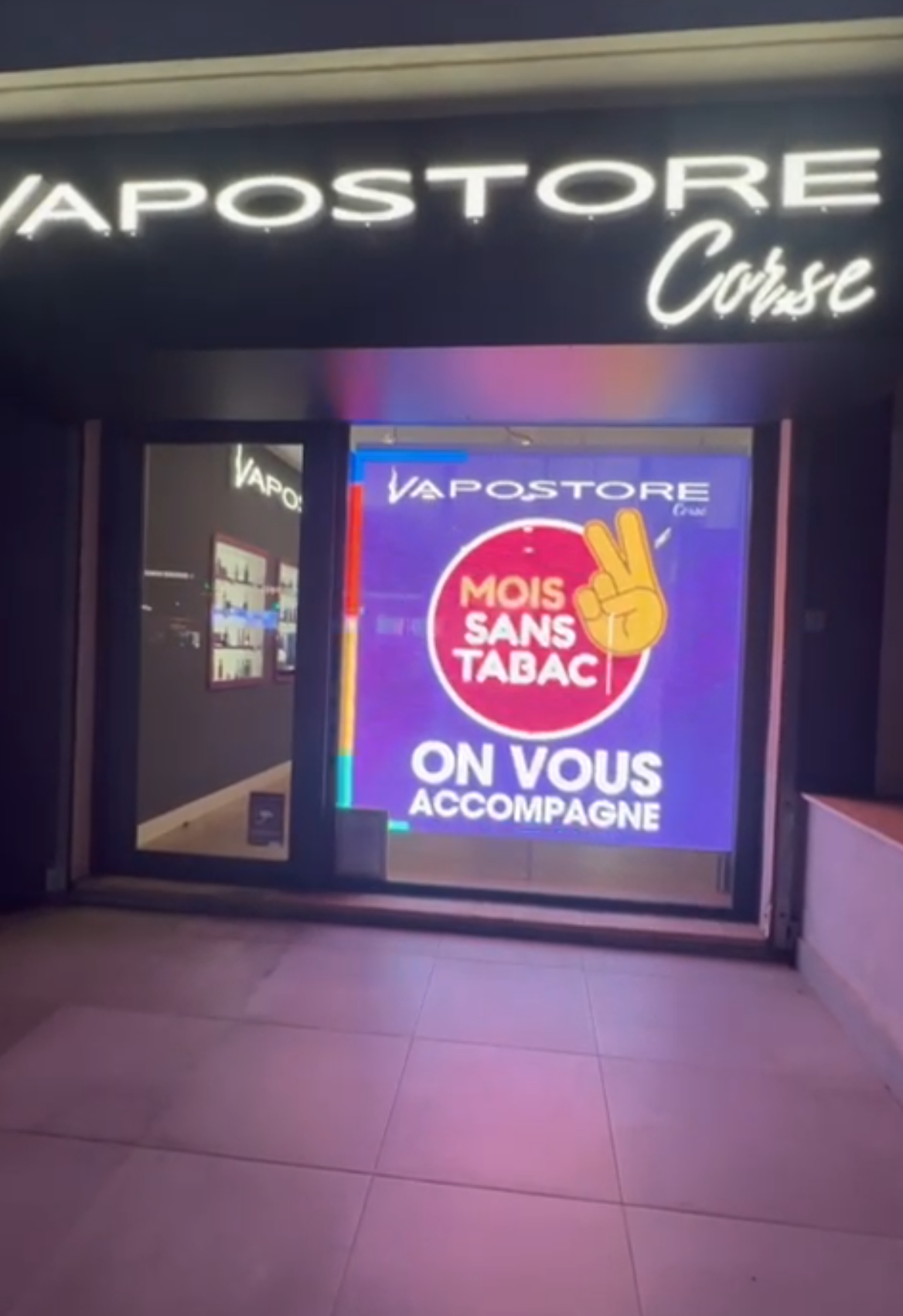
Indoor transparent LED display at a retail storefront: a 2×2 m, 4 ㎡ TI Series P3.91–7.81 installation for window advertising and brand communication.
Conventional indoor fixed screens dominate where the wall is the destination and the content must be read or monitored. In Albania, a 30 ㎡ FU Series P2.604 indoor LED display was wall-mounted in a cinema, delivering image clarity and colour for entertainment content. In Canada, a bar and entertainment venue installed an 8.5×1.75 m FU Series P1.95 GOB indoor display of approximately 14.88 ㎡, where the GOB surface protection supports a public-facing environment and the fine pitch holds up at close range. In tighter, information-led spaces, P1.25 fine-pitch indoor fixed displays have been used for visitor information and digital signage in healthcare settings, where legibility at close distance is the deciding requirement rather than visual transparency.
Conventional indoor fixed alternative: KCOB Series flip-chip COB display on a 600×337.5×29.3 mm cabinet, built for close-viewing indoor content.
Limits and Trade-offs Buyers Should Accept Before Ordering
A credible comparison has to state where each option stops working.
- Transparent screens are not a close-viewing text medium at long pitch. At P7.81 and P10.42, the pixel structure is visible at short distances; P3.91 is the finest pitch in the TAD range. Projects that need dense text, subtitles or detailed data at two to three metres are usually better served by a conventional fine-pitch screen.
- See-through means the background becomes part of the image. Contrast on a transparent display depends on what sits behind the glass. A bright interior, a reflective surface or a cluttered window reduces perceived contrast in ways that a specification sheet does not capture. Mock-ups and on-site testing are the only reliable check.
- Conventional screens remove the glass function. Once a solid image plane covers a window or facade, daylight, sightlines and architectural transparency are gone. Retrofitting that decision later is expensive, and in some buildings it is not permitted at all.
- Brightness should not be read as a quality score. A 2500–4500 cd/m² transparent window screen and a 600 cd/m² indoor fixed screen are tuned for different lighting conditions; comparing the numbers directly is a category error.
Market Context
Mordor Intelligence projects the global LED display market at USD 20.73 billion in 2026, rising to USD 26.98 billion by 2031. Growth of that scale is not driven by one product category, but it does explain why buyers now see more transparent and fine-pitch options at similar price points than they did a few years ago, and why specification discipline matters more than brand familiarity.
On energy, a secondary industry source (Radiant) reports that transparent LED displays can deliver 30% to 40% energy savings compared with traditional LED solutions, with reference to ISO 50001 energy-management practice. That figure is source-specific and should be treated as an indicator rather than a guarantee: buyers should ask for measured power data for the exact configuration and content brightness planned for the project, particularly where the screen runs through daylight hours.
Procurement Checklist
- Confirm in writing whether the glass surface must remain visible and functional, and who owns that decision.
- Measure the closest sustained viewing distance and match it to the pitch range under consideration, not to the finest pitch available.
- Record the ambient light conditions on both sides of the screen, including daylight through the glass.
- Obtain the mounting and fixing design for the specific substrate — glass mullion, window frame, wall or steel structure.
- Agree the maintenance route and access method before shipment, not after installation.
- Test the actual content at the planned brightness on a sample or reference installation.
- Request the certificates and test reports applicable to the exact model and destination market.
DDW Display supports OEM and ODM customization across pixel pitch, module and cabinet size, cabinet structure, display shape, brightness level, refresh rate, installation method and control system, with a stated monthly capacity of 8,000 sqm and a 15–30 day lead time for standard products. For projects where the transparent-versus-conventional decision is still open, that customization scope is what allows a single supplier to be evaluated against both paths rather than only one.
Future Outlook
The two categories are converging at the component level while diverging at the application level. Fine-pitch COB and MIP packaging continue to push conventional indoor screens toward smaller pitches and better uniformity, while transparent modules keep improving brightness and structural integration. The practical consequence for buyers is that the decision will remain a project question rather than a technology question: the screen that fits is the one whose structure, brightness and pitch match the surface, the viewer and the content. Specifications will improve on both sides; the brief will not.
FAQ
What is the main difference between a transparent and a conventional indoor LED screen?
A transparent LED display is built on transparent modules so the glass behind it remains visible, and it is installed on glass facades, windows or building structures. A conventional indoor fixed LED screen produces a continuous image surface on a wall or steel structure and uses fine-pitch modules to deliver high pixel density at close viewing distance. The difference is architectural as much as optical.
How do I choose pixel pitch for each option?
Match pitch to the closest sustained viewing distance, screen size and content type. Transparent options in the TAD Series are offered at P3.91, P7.81 and P10.42, with P3.91 being the finest of the three. Conventional indoor fixed options range from P0.625 and P0.9375 on the ECOB and KCOB Series through P1.25–P2.5 on the HK Series to P3.91 on the FU Series. A smaller pitch increases pixel density and cost, so the correct choice is the pitch that satisfies the actual viewing distance, not the smallest one available.
Which option suits a retail glass storefront?
For a storefront where the window must stay open and merchandise must remain visible, an indoor transparent display is the usual fit. Documented examples include a 2×2 m, 4 ㎡ TI Series P3.91–7.81 indoor transparent display installed at a retail storefront in France, and a 4×17 m, 68 ㎡ TI Series P3.91–7.81 transparent display in a shopping mall in the Philippines. If the storefront can be closed off and close-range text or product detail is the priority, a fine-pitch indoor fixed screen is the more suitable choice.
What should buyers check about maintenance access?
Confirm how modules, power supplies and receiving cards will be reached after installation. The HK, FU, KCOB and ECOB Series support front maintenance, which suits wall-mounted and space-limited indoor installations. A transparent screen mounted on a glass facade requires a service route planned around the glass, frame and surrounding space, and that route should be agreed in writing during evaluation rather than resolved on site.
Which certifications should be verified before ordering?
The applicable certifications depend on the destination market and the specific model. For international projects, buyers commonly evaluate CE, FCC, RoHS, ETL and EMC-related requirements, and some applications add electrical safety, fire resistance or third-party testing. Certificates and test reports should be requested for the exact model and market, and read together with ageing tests, quality inspection records and, for outdoor or window-facing products, waterproof and brightness performance data.
For a consolidated view of the product families referenced in this framework — transparent, indoor fixed, COB fine pitch and rental — the DDW LED Display catalog 2026 (PDF) lists the current configurations and cabinet options.
¿Tiene preguntas o necesita más detalles?
Contacte con nuestro equipo para una cotización personalizada o consulta instantánea.
Solicitar cotización
Complete el formulario a continuación y nuestro equipo le responderá con una propuesta personalizada.
Chat directo de WhatsApp
¿Prefiere chatear en tiempo real? Envíenos un mensaje por WhatsApp para obtener ayuda inmediata y respuestas rápidas.
- Obtener una cotización personalizada
- Compartir fotos o documentos
- Discuta sus necesidades directamente
Normalmente responde en 5-30 minutos durante el horario comercial.