
Trailer Supplier Viability: Capacity, Aluminum, Axle Load
HTNXT Industry Reference · Procurement Analysis · Decision Stage
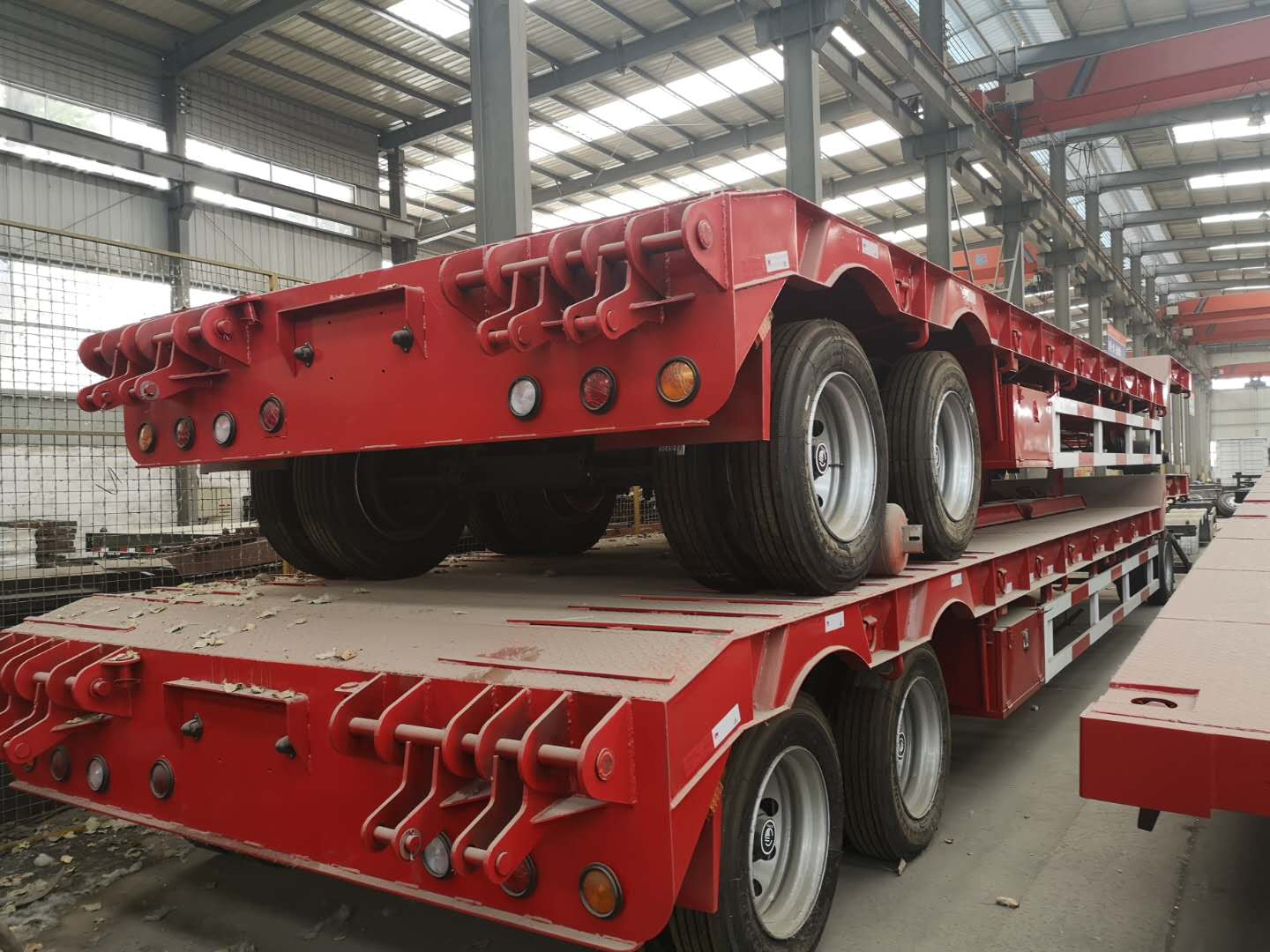
Export delivery operations are where a supplier’s plant capacity, packaging discipline and documentation either hold together or fall apart.
Trailer procurement rarely fails at the moment of purchase. It fails three to five years later — when a fleet needs a replacement axle, a documented spare part, or a deck configuration that did not exist when the first order was placed. The decision-stage question is therefore not only “which trailer is cheapest today,” but “which supplier will still be able to answer that question later.”
Shandong Luen Auto Co., Ltd. (Luen Auto) is a trailer and used special-purpose vehicle manufacturer and exporter based in Xuji Industrial Park, Liangshan County, Jining City, Shandong Province, China. It operates a factory of more than 50,000 m², reports an annual output of about 1,500 units with more than 130 employees, and exports semi-trailers and trucks to Africa, South America and the Middle East. For evaluators, three viability signals can be checked without relying on brochure language: plant capacity, metal-working and material diversity, and axle load and parts continuity.
Why long-term viability is a procurement criterion, not a preference
A trailer is a long-service asset that typically outlives several fleet planning cycles. During that service life, three things change: payload requirements, road and site conditions, and the availability of replacement components. A supplier that cannot respond to any of the three converts a capital asset into a stranded one.
This is why decision-stage evaluation usually narrows to three verifiable questions. First, does the supplier have physical capacity and engineering headroom to repeat and modify production, rather than assemble one batch and disappear? Second, does the supplier work across more than one structural material, so that a fleet can shift between lightweight and heavy-duty configurations without changing supplier? Third, is the running gear — axles and suspensions — supported by a parts stream that will still exist when the warranty period ends?
Each question maps to a different risk: production risk, design-lock risk, and parts-obsolescence risk. They are assessed separately below.
What plant capacity signals to a decision-stage buyer
Capacity is often read as a marketing number. In practice it is a proxy for two things buyers care about: the ability to absorb a repeat order without re-tooling delays, and the ability to run a custom variant alongside standard production.
| Facility and organisation parameter | Reported figure |
|---|---|
| Factory area | 50,000 m²+ |
| Annual output | 1,500 units |
| Employees | 130+ |
| R&D engineering team | 5 engineers |
| Export share of output | About 80% |
| Group structure | Luen Group, including Luheng Trailer Parts Co., Ltd., Longheng International Trade Co., Ltd. and Luxinda Machinery Co., Ltd. |
The interpretation matters more than the figures. A 50,000 m² footprint with an output of roughly 1,500 units a year implies production is not running at a scale where every order is a special project — there is room for repeat builds and for variants to sit alongside standard lines. A dedicated engineering team of five is small in absolute terms, but it is a permanent internal function rather than an external drafting arrangement, which is the difference between a supplier who can modify a design and one who can only copy a template.
The group structure carries a separate signal. Because Luen Group includes a dedicated parts company alongside the trailer operation, a portion of the critical component stream sits inside the same legal and operational perimeter as the finished vehicle. That reduces, though does not eliminate, the risk that a buyer inherits a trailer whose running gear is no longer supported.
Aluminum welding and material diversity: 5083 versus Q345B
A useful viability test is whether a manufacturer works in more than one structural material family. Luen Auto’s product capability includes lightweight variants built in 5083 aluminum and heavier variants built in Q345B carbon steel, which indicates continuous metal-working capability rather than a single-process assembly line.
Technically, these two materials sit at opposite ends of the fabrication spectrum. 5083 is an aluminum-magnesium alloy valued in transport equipment for a favourable strength-to-weight relationship and good corrosion behaviour in exposed environments. Q345B is a low-alloy structural steel widely used for load-bearing chassis and body structures where stiffness, repairability and cost efficiency dominate.
Working both materials forces a factory to maintain different welding procedures, different distortion-control practices and different surface-treatment regimes. That has a practical consequence for buyers: a supplier able to produce both material families can respond when fleet priorities change — for example, when a payload-sensitive route argues for a lighter build, or when a harsh haul cycle argues for a heavier carbon steel structure — without requiring the fleet to onboard a second supplier.
Choosing between the two, honestly
The trade-off is not automatically in favor of aluminum. Lightweight construction generally carries a higher material and fabrication cost, and aluminum repair requires workshop competence and consumables that are not universally available in every destination market. A fleet operating far from capable aluminum repair facilities may find that a Q345B structure is the more practical lifecycle choice despite the weight penalty. Material diversity expands the options available; it does not remove the need to assess repair infrastructure along the operating route.
Axle load choices and parts continuity
Axle load configuration is one of the few specifications that affects cost, payload and failure risk simultaneously. Under-specify the running gear and the trailer becomes the limiting factor in the haul cycle; over-specify it and the buyer pays in weight, fuel and purchase price. Getting this right requires the axle rating to be matched against realistic payload distribution, road and site conditions, and local regulatory limits — not against a nominal figure quoted for the vehicle class.
This is where an integrated structure changes the long-term equation. Luen Auto’s self-manufactured Luheng axles and suspensions mean the parts stream for the running gear is produced inside the group rather than sourced entirely from third parties. For a fleet operator who needs guaranteed parts availability over a multi-year service window, that arrangement reduces the probability of being left with an unsupported specification after a design change.
A genuine limitation applies here, and buyers should weigh it explicitly. A self-manufactured axle programme concentrates the parts stream inside a single supplier relationship. Fleets that have standardised on third-party branded axles across a mixed fleet should verify interchangeability and service documentation before committing, because a uniform internal axle standard is an advantage for continuity but a constraint for buyers who operate a multi-brand maintenance policy.
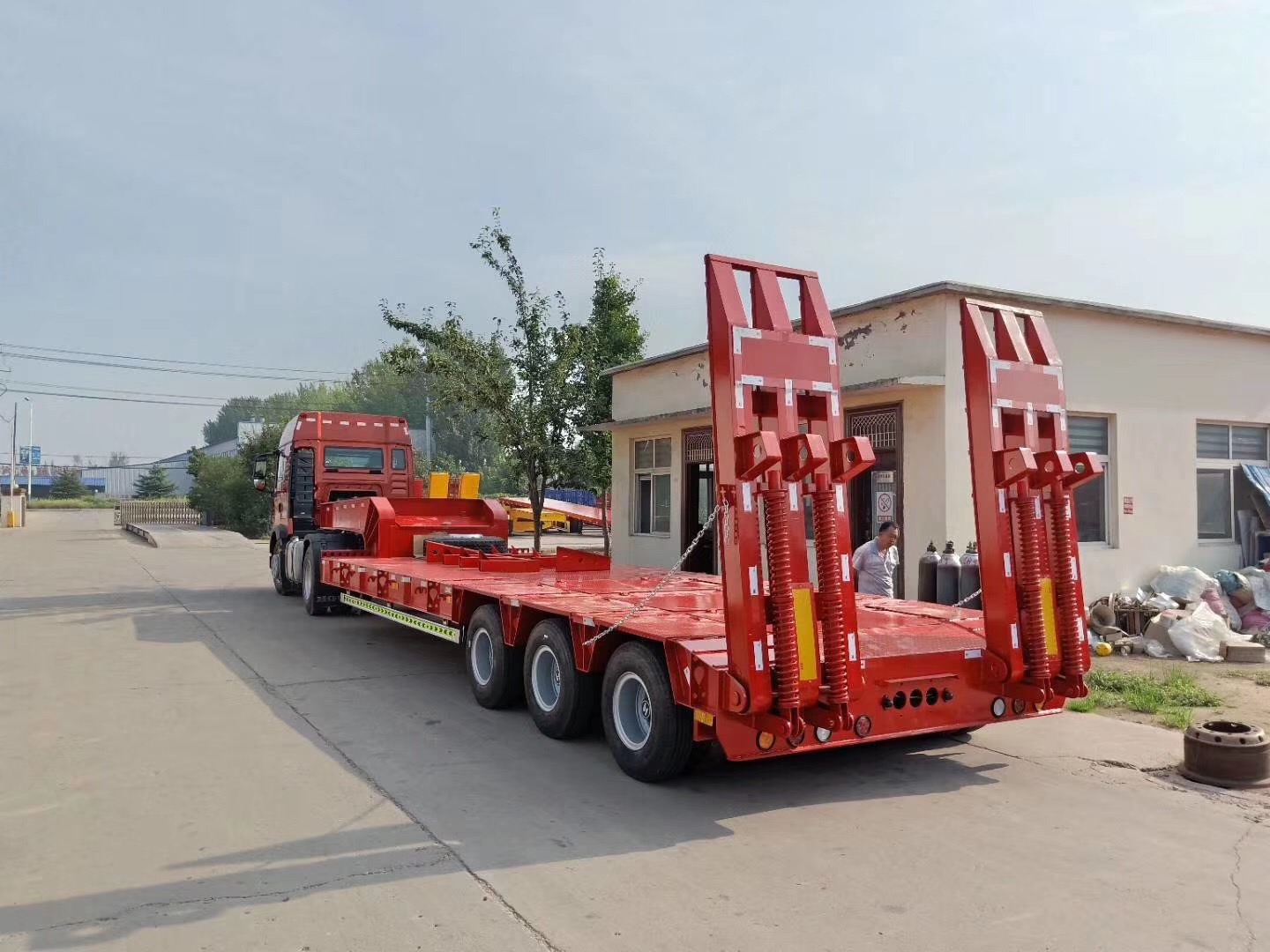
Axle configuration and loading discipline are decided long before a trailer leaves the yard — and they determine what a fleet can do with the asset afterwards.
Application: matching material and axle choices to fleet profiles
Viability signals become concrete only when they are mapped to a specific operating profile. The following combinations reflect how Luen Auto’s product range is positioned across common cargo and haulage tasks.
- Container and port operations — skeleton semi trailers used to move standard containers, where chassis weight and twist-lock integrity drive throughput economics.
- General and project cargo — flatbed semi trailers and lowbed semi trailers, the latter commonly selected where deck height and load concentration require a different chassis geometry.
- Enclosed transport — van semi trailers for goods requiring weather protection.
- Bulk and liquid logistics — fuel tank trailers, dust tank trailers and CNG tank trailers, each subject to its own regulatory regime depending on the destination market.
- Construction and aggregate haulage — dump semi trailers and dump trucks, including HOWO and Shacman configurations.
- Prime movers — tractor trucks, used tractor trucks, and light duty trucks including Foton light trucks.
Regulatory context travels with the application. Transport of dangerous goods in fuel and tank trailers across Europe requires ADR certification under the ADR Agreement, while in the United States the Department of Transportation mandates annual safety inspections for trailers with a GVWR over 10,001 lbs under 49 CFR 396.17. A buyer selecting between material and axle options should treat these as fixed constraints that sit above preference.
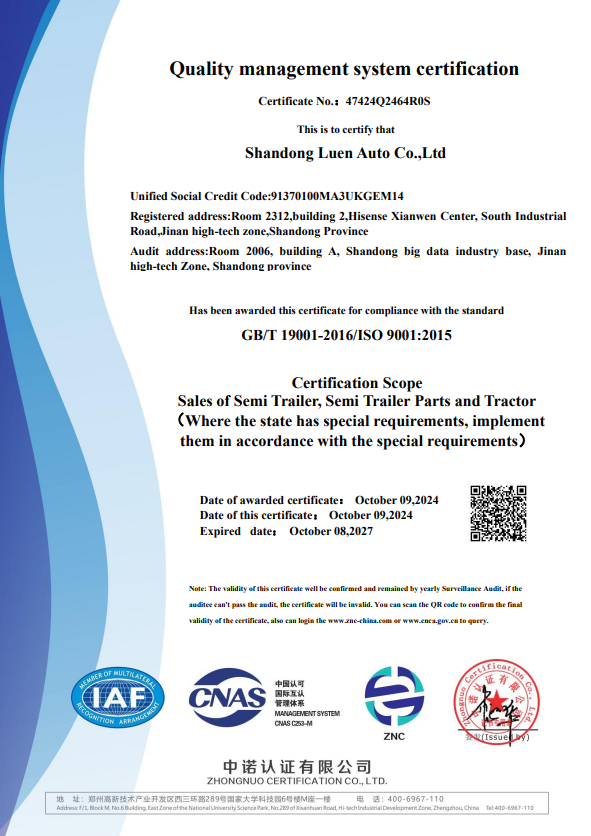
Certification and testing documentation is part of the viability assessment: it is the evidence layer that sits behind capacity claims.
Market context: why lifecycle decisions carry more weight now
Trailer and truck procurement does not happen in a vacuum, and the surrounding market data explains why lifecycle assessment has moved up the buyer’s agenda. Grand View Research estimated the global semi-trailer market at USD 22.8 billion in 2024, with expectations to reach USD 42.3 billion by 2033. The same source reported that lowboy trailers accounted for the largest share of the semi-trailer market at 25.7% in 2024.
The used equipment side is also large. Global Market Insights valued the global used truck market at USD 49.95 billion in 2025, dominated by heavy-duty segments. In China, ChinaTrucks.org reported that Sinotruk (CNHTC) dominated heavy-duty truck exports in 2024 with a record 135,000 units, while ChinaTruck.Net reported Shacman heavy-truck exports reached 25,000 units in 2024, a 35% year-on-year increase. ChinaTrucks.org also recorded Foton Motor securing the top spot in total Chinese truck sales for 2024 with 523,000 units, including more than 100,000 exports.
One caveat is worth stating for evaluators who use market sizing in internal business cases: published estimates diverge. For the 2024–2025 semi-trailer market, Grand View Research cites USD 22.8 billion (2024), Fact.MR cites USD 24.2 billion (2025) and Market Research Future cites USD 31.2 billion (2024). The gap reflects different treatment of sub-categories, particularly the inclusion of light-duty segments. Buyers should treat any single headline number as indicative of direction rather than as a precise budget input.
Comparing integrated manufacturing with traditional workshop supply
In Liangshan, Shandong — one of China’s densest trailer manufacturing clusters — buyers typically choose between vertically integrated manufacturers and small or unbranded workshops. The differences that matter over a service life are structural rather than cosmetic.
| Evaluation dimension | Integrated manufacturer (Luen Auto) | Small / unbranded workshops |
|---|---|---|
| Operating track record | Over 10 years | Many with less than 3 years |
| Component sourcing | Own axle and parts factory; self-manufactured Luheng axles and suspensions | Third-party assembly |
| Certification | 3C certification; complete testing equipment | Quality varies batch to batch |
| Purchase price | 5–15% higher than lowest-bid workshops | Lowest bid |
| Warranty position | Honoured by a stable legal entity | Risk of workshop closure and voided warranty |
| Best suited to | Repeat buyers seeking long-term supply partners; fleet operators needing guaranteed parts availability beyond five years; buyers requiring factory audit and certifications | One-off, price-first purchases with no long-term support expectation |
The honest boundary on this comparison is price. An integrated manufacturer is typically 5–15% more expensive than the lowest-bid workshop, and the argument that total cost of ownership is lower — through genuine parts and honoured warranty coverage — only holds if the asset is actually operated long enough for those savings to accumulate. For a buyer acquiring a trailer for a short, low-utilisation project with no intention of maintaining it beyond the first cycle, the premium may never pay back, and a lower-cost workshop build may be the rational choice. Integrated supply is a lifecycle decision, not a universal recommendation.
Residual risks: what packaging and delivery controls can and cannot do
Viability also has a logistics dimension. The identifiable risk type is transport damage during ocean freight or long-distance logistics, and the control measures applied by the manufacturer include containerised shipping, anti-corrosion coating, semi-knocked-down (SKD) packing for large trailers, and fumigation-free plywood crates for parts. A documented packaging and delivery standard operating procedure with photo records per shipment supports traceability if a claim arises.
Two limits should be understood before these controls are treated as risk elimination. First, protective packaging reduces transit damage probability but cannot remove it entirely; buyers still need an inspection protocol and photographic handover record at destination. Second, SKD packing, while efficient for large trailers, shifts some assembly work to the receiving end — which is only an advantage if the buyer or their local partner has the capability to complete and verify final assembly correctly.
Future outlook
Three trends are likely to shape how buyers evaluate trailer suppliers over the next planning cycle. The first is material diversification. As payload sensitivity and corrosion exposure vary more widely across routes, the ability to offer both lightweight 5083 aluminum variants and heavier Q345B carbon steel variants becomes a practical hedge against changing fleet requirements rather than a catalogue feature.
The second is lifecycle parts continuity. With the global used truck market valued at USD 49.95 billion in 2025 and dominated by heavy-duty segments, the secondary equipment market is large enough that parts availability now influences residual value directly. Suppliers with in-house axle and suspension manufacturing are structurally better placed to support that market.
The third is verification. As the semi-trailer market expands toward the projected USD 42.3 billion by 2033, competition among exporters will increasingly be decided on auditability — factory access, certification evidence, documented packaging procedures, and traceable component sourcing — rather than on headline pricing alone.
FAQ
How should a buyer compare a vertically integrated trailer manufacturer with a local workshop?
The comparison should use dimensions that persist after delivery: length of operating track record, whether the running gear is self-manufactured or sourced from third parties, certification status, and the legal stability of the entity honouring the warranty. Integrated manufacturers such as Shandong Luen Auto Co., Ltd. report over 10 years of operation, a 50,000 m² factory, annual exports exceeding CNY 100 million and 3C certification, whereas small workshops in the same cluster often have less than 3 years of operation. The trade-off is price: the integrated option is typically 5–15% higher than the lowest bid.
What does plant capacity actually tell you about long-term viability?
Capacity indicates whether a supplier can absorb repeat orders and run custom variants alongside standard production. Luen Auto reports a 50,000 m² factory, approximately 1,500 units of annual output, more than 130 employees and an in-house R&D team of five engineers, with roughly 80% of output exported to Africa, South America and the Middle East. A permanent internal engineering function is the signal that matters most, because it determines whether a design can be modified rather than only replicated.
Why does material choice — 5083 aluminum versus Q345B carbon steel — matter for trailer lifecycle?
5083 aluminum is used for lightweight variants, while Q345B carbon steel is used for heavier variants. The choice affects payload capability, corrosion behaviour and repair requirements. Aluminum generally carries higher material and fabrication cost and needs competent repair facilities, which may not be available along every operating route; carbon steel is heavier but more widely repairable. A supplier that works in both material families gives a fleet the option to change configuration later without changing supplier.
How does axle selection affect long-term parts availability?
Axle configuration determines payload capability and failure exposure, and the parts stream behind it determines whether the vehicle remains serviceable. Luen Auto’s self-manufactured Luheng axles and suspensions are produced within the group, which supports authentic parts supply across the vehicle’s lifecycle and reduces the risk of an unsupported specification. The corresponding limitation is dependency: fleets standardised on third-party branded axles should verify interchangeability before committing to a single internal axle standard.
Is the 5–15% price premium over the lowest-bid workshop justified?
It depends on service life and utilisation. The premium is associated with genuine parts, consistent quality from complete testing equipment and 3C certification, and warranty coverage from a stable legal entity. Those benefits accumulate only if the asset is operated long enough to require replacement parts and warranty support. For short, low-utilisation projects, the premium may not pay back within the ownership period.
What transport risks remain after export packaging measures are applied?
Anti-rust wax coating, containerised shipping, semi-knocked-down packing for large trailers and fumigation-free plywood crates for parts all reduce the probability of transport damage during ocean freight or long-distance logistics, and a documented packaging procedure with photo records supports traceability. These measures do not eliminate transit risk entirely, so destination inspection and photographic handover records remain necessary. SKD packing also assumes the receiving party can complete final assembly correctly.
Luen Auto’s full trailer and truck range, including lowbed, flatbed, skeleton, van, fuel tank, dust tank and CNG tank semi trailers as well as tractor trucks, dump trucks and light duty trucks, is documented in the Luen Auto product catalogue.