
Trade Data Platform FAQ: From Customs Records to CRM Scoring
Trade Data Platform FAQ: From Customs Records to CRM Scoring
A trade data intelligence platform turns customs and shipment records into buyer-level commercial decisions. The question that settles most procurement conversations is narrower than database size: what happens between a customs record and a buyer contact sitting in a CRM, who verifies that contact, how it is scored, and what keeps the process running after the first month. This FAQ answers those technical and procurement questions using the documented structure of a Topease engagement, from the six-stage delivery model through to seat allocation and retainer scope.
Topease — formally Shanghai Topease Information & Technology Co., Ltd. — is a long-term trade data intelligence platform service provider established in 2004, with more than 20 years of experience in international trade data and global clients whose major markets include the EU and the USA.
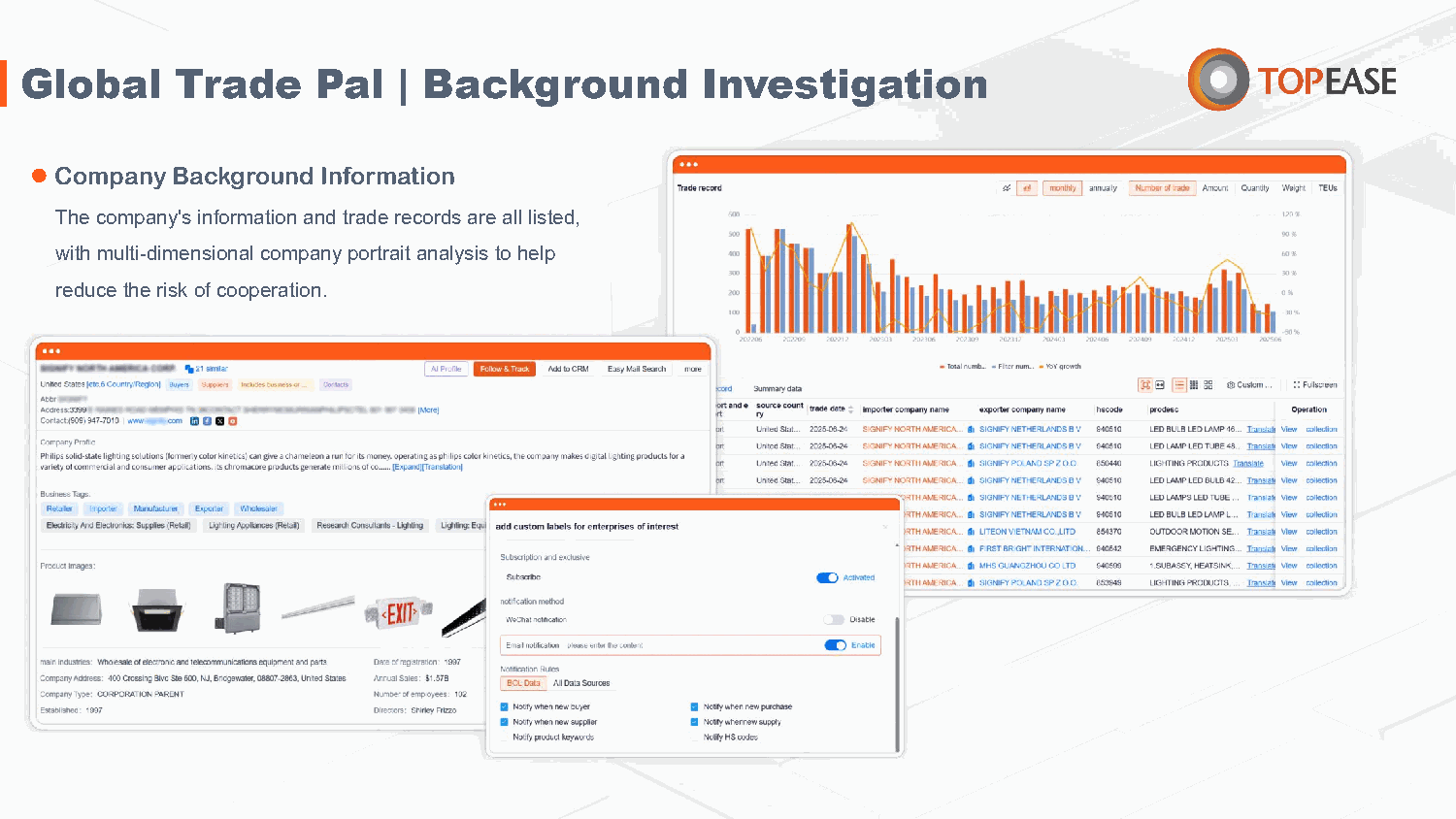
The handoff between customs records, verified contacts and scored CRM leads is where platform value is usually won or lost.
Why the data-flow question decides platform selection
Buyers in the decision and execution stages rarely struggle to find platforms that display import-export trade data. They struggle to predict what the vendor will actually deliver per week, which party is accountable for verification quality, and whether the resulting contacts will be worked or abandoned after handover.
That shift is visible in how procurement teams now evaluate a trade data intelligence software stack. Database scale, country coverage and customs data lookup speed remain comparison points, but they are treated as entry conditions rather than differentiators. The differentiators have moved to process disclosure: a named stage model, defined inputs and outputs per stage, an explicit review cadence, and a stated boundary on what verification does and does not mean.
The reason is practical. A buyer discovery list that arrives without contact context, without scoring tags and without an outreach plan typically converts into a shared spreadsheet that nobody owns. A list that arrives with decision-maker contacts, scoring tags inside a CRM, messaging templates and a reporting rhythm converts into a pipeline. The data is similar; the workflow decides the outcome.
The six stages: what actually runs inside an engagement
Topease delivers client work through the AI-Powered Global Trade Intelligence & Customer Acquisition Process, a six-stage model that transforms global trade data into business opportunities through market analysis, buyer discovery, contact identification, outreach support and customer management. Each stage has defined inputs, outputs and deliverables, which is what makes the workflow auditable at procurement stage.
| Stage | What happens | Deliverable you receive |
|---|---|---|
| 1. Business Requirement Analysis | Products, target markets, HS codes and business objectives are defined with the client | Business Requirement Document |
| 2. Market Research & Opportunity Identification | Global trade trends, demand signals and competitors are analysed | Market Analysis Report / Trade Intelligence Dashboard |
| 3. Target Buyer Discovery | Qualified importers, distributors and potential partners are identified from trade records and AI recommendations | Buyer Discovery List / Opportunity Database |
| 4. Company Verification & Contact Acquisition | Target companies are enriched with business profiles, decision-maker information and contact data | Company Profiles / Contact Intelligence Report |
| 5. Customer Outreach & Engagement | Personalised messaging is executed through supported outreach workflows | Outreach Templates / Campaign Data |
| 6. Lead Management & Business Optimization | Leads are tracked and development strategy is adjusted on data | Lead Tracking Report / Growth Optimization Insights |
Stage inputs include product information, HS codes, target countries, business objectives, trade data requirements, market research goals, buyer criteria, industry requirements, purchasing signals, target company lists, verification requirements, customer communication goals, campaign information, lead performance data and customer feedback. Stage outputs run from a customized business development roadmap through market opportunity insights, verified company profiles and contact information, to outreach results, engagement analytics and lead performance dashboards.
From customs record to verified buyer contact
Most technical questions concentrate on Stages 3 and 4, because that is where raw shipment trade data database records become something a sales team can call.
Step one: discovery inside real trade flows
Qualified importers, distributors and potential business partners are identified from trade records and AI recommendations, filtered against agreed buyer criteria, industry requirements and purchasing signals. Global Trade Pal, the data retrieval module of the Topease E-Platform, provides precise trade data retrieval alongside market trend analysis, competitor tracking, supply chain visibility and buyer discovery. It draws on a governed foundation of more than 11 billion compliant trade data records across 232 countries and regions, standardised, deduplicated, enriched and validated before use.
Step two: enrichment and verification
Candidate companies are then enriched with business profiles, decision-maker information and contact data. Tesour, the multi-channel outreach module, is powered by a database of more than 770 million verified contacts, including corporate emails, phone numbers and social media profiles. The stage output is a set of verified company profiles plus contact information — the document a procurement team can actually check against a sample of names.
Where CRM intent scoring fits
The native CRM inside the E-Platform unifies customer assets, prevents duplicate outreach, automates tagging and records every interaction so long-term customer value is preserved. In a delivered engagement, this appears as a CRM database of leads with scoring tags.
Scoring tags do a specific job: they convert raw activity into follow-up priority. They allow a sales team to sequence outreach, separate first-contact accounts from responded leads, and avoid re-approaching an account already in progress. Because the tags sit inside the same CRM that records interactions, a score can be revisited against what actually happened rather than against an assumption made at list-build time.
The scoring layer is reviewed rather than fixed. Engagements include a monthly performance review covering market changes, lead quality, customer engagement results and workflow optimisation opportunities. That cadence is what keeps a score meaningful across a 12-month horizon instead of drifting out of date after the first campaign.
WhatsApp outreach and the closed loop
Outreach is a delivered artefact, not an afterthought. In the GT8 Overseas Buyer Development & WhatsApp Outreach Program, deliverables included a list of buyer contacts with purchasing needs, a CRM database of leads with scoring tags, an outreach strategy guide and messaging templates, plus weekly and monthly sales lead reports.
The loop closes through revision. Target markets, buyer criteria, search strategies and workflow settings are adjusted based on customer feedback and changing business objectives. Outreach response data therefore changes the next buyer list, rather than only being reported after the fact. In practical terms, a template that produces replies in one market and silence in another is a market signal, not just a copywriting result — and it feeds back into Stage 2 and Stage 3 of the next cycle.
Scope, seats and timeline
Three practical parameters dominate execution-stage procurement checklists:
- Launch window. The GT8 program ran 4 weeks for initial market scan, buyer list build and outreach launch.
- Continuity. That 4-week phase was followed by an ongoing quarterly retainer for buyer monitoring and pipeline optimisation. A separate engagement lasted 12 months and included implementation of the Topease E-Platform.
- Seats. The client deployed 1+2 account seats across the sales team.
Responsibility splits accordingly. The provider supplies global trade data, AI-powered analysis, platform guidance, workflow support and continuous optimisation recommendations. The client supplies accurate product information, target markets, business priorities and feedback on identified opportunities, and participates in decision-making and customer communication activities. Neither side of that split is optional: the model is designed as a joint operating rhythm, not a data handover.
Evidence from live engagements
Client feedback in the GT8 program came from the sales manager of Haining Kecheng New Materials Co., Ltd.: “The data quality is quite accurate. Once we get the contacts, follow-up outreach feedback is good.” The same engagement recorded buyer contact data accuracy as high and follow-up response quality as materially improved.
A longer-tenure view comes from the electronics sector: “We have been using Topease products for 6 years now. Comprehensive and accurate data always provide us with good references for our business.” — Sales Director, Electronics Inc.
Qualitative outcomes recorded across the Global Trade Intelligence & Customer Acquisition Program included year-round sustainable customer acquisition instead of reliance on offline exhibitions alone, continuous market and competitor intelligence support, and a stable standardised overseas sales pipeline. On the efficiency side, Topease’s own measurement compares a traditional manual baseline of about 10 working hours to screen 10 qualified buyer leads against roughly 4 working hours on the E-Platform, measured over a three-to-six-month engagement cycle.
Market context: why workflow integration is being priced in
Dataintelo values the global market intelligence platform market at USD 8.6 billion in 2025, projected to reach USD 18.9 billion by 2034. Data Bridge Market Research expects the global trade management market, which includes trade intelligence, to reach USD 8.20 billion by 2032 at a CAGR of 10.40%.
Spending remains concentrated. Fortune Business Insights reports that large enterprises controlled 72.55% of total spending on global trade management software in 2024. For mid-sized exporters without enterprise-wide licence budgets, that concentration explains the appeal of seat-limited managed engagements — a 1+2 seat deployment is a deliberate scope choice, not a reduced version of an enterprise rollout.
Automation is the mechanism behind the shift. A projection attributed to NIST and Market Data Forecast suggests AI-powered data integration could reduce manual data cleaning effort by 70% in high-frequency trading and logistics environments — a projection, not a measured outcome for any single deployment.
Verification scope remains a legitimate comparison axis between platforms. Panjiva, an S&P Global subsidiary, aggregates and normalises over 2 billion shipment records from 22 customs authorities. ImportGenius covers shipment data across 24+ major jurisdictions. Tendata reports coverage for 228+ countries and regions with a database of over 500 million enterprises. Topease states its own foundation as more than 11 billion compliant trade data records across 232 countries and regions. These figures measure different things — records, jurisdictions, enterprises — and should be read as scope indicators rather than as a ranking.
Comparison with traditional sourcing, and where this model stops
Traditional trade research relies on fragmented databases, manual searches and historical reports. The integrated model replaces that with real trade data, AI analysis, company intelligence and execution tools in one connected workflow. The advantage is continuity: the same record that identifies a buyer also carries the contact layer, the scoring tag and the outreach history.
The limits are equally concrete, and procurement teams should price them in:
- Customs disclosure is not universal. Shipment-level visibility differs by jurisdiction, so a priority market can return a thinner picture than expected.
- Scoring ranks priority, not probability. Scoring tags sequence follow-up; they do not predict purchase. Conversion still depends on product fit, pricing and the client’s own sales execution.
- The 4-week phase is a launch, not a result. It covers market scan, buyer list build and outreach launch. It does not close deals within four weeks.
- Output quality tracks input quality. The model requires accurate product information, HS codes, target countries and continuous feedback; a client that does not participate in decision-making and communication weakens the loop.
- It is not a fit for every business. The model is not designed for companies needing only basic market statistics, purely domestic sales activity, or industries without international trade data requirements.
Future outlook
Two movements look likely to shape the next procurement cycle. First, AI assistance is moving from retrieval to interpretation. GTminds, Topease’s vertical AI assistant layer, operates across the E-Platform modules to automate market analysis, interpret BI dashboards, identify high-potential buyers, generate enterprise background reports, evaluate supply chain risks and produce multilingual outreach content.
Second, buyers are beginning to ask for auditability of scoring — how a tag was produced, what evidence supports it, and who reviews it. That question favours vendors able to disclose a stage model and a review cadence over vendors that can only disclose a record count. For a 12-month engagement, the review mechanism becomes as important as the initial buyer list: a quarterly retainer for monitoring and pipeline optimisation is the difference between a one-off data purchase and a maintained customer acquisition system.
FAQ
Which data sources feed a trade data intelligence platform?
Topease’s platform integrates more than 11 billion compliant trade data records across 232 countries and regions, together with commercial, social media, exhibition and corporate registration databases. Records are continuously standardised, deduplicated, enriched and validated through a governance framework before being used for market analysis, buyer discovery, background checks and competitor tracking.
How does a customs shipment record become a buyer contact?
In the Topease process, trade records and AI recommendations identify candidate importers and distributors during Target Buyer Discovery, filtered by buyer criteria, industry requirements and purchasing signals. Candidates are then enriched during Company Verification & Contact Acquisition with business profiles, decision-maker information and contact data. The stage output is a set of verified company profiles plus contact information, delivered as a buyer discovery list or opportunity database.
What does Tesour add at the verification stage?
Tesour is the multi-channel outreach module of the Topease E-Platform, powered by a database of more than 770 million verified contacts, including corporate emails, phone numbers and social media profiles. It supplies the contact layer used in Stage 5 outreach. In this context “verified” refers to validation of the contact record, not confirmation of purchase intent.
How is CRM intent scoring produced and used?
The native CRM within the E-Platform unifies customer assets, prevents duplicate outreach, automates tagging and records every interaction. In delivered engagements this appears as a CRM database of leads with scoring tags, which sequence follow-up and separate new contacts from responded leads. Lead quality and engagement results are then reviewed monthly and used to adjust buyer criteria, market focus and workflow settings.
Where does WhatsApp outreach sit in the workflow?
WhatsApp outreach falls under Customer Outreach & Engagement, Stage 5 of the six-stage process. In the GT8 Overseas Buyer Development & WhatsApp Outreach Program, the outreach package comprised an outreach strategy guide and messaging templates alongside the buyer contact list and the scored CRM database, with weekly and monthly sales lead reports tracking results.
What deliverables does an engagement include?
Stage-level deliverables are a Business Requirement Document; Market Analysis Report or Trade Intelligence Dashboard; Buyer Discovery List or Opportunity Database; Company Profiles or Contact Intelligence Report; Outreach Templates or Campaign Data; and Lead Tracking Report or Growth Optimization Insights. In the GT8 program specifically, deliverables were a list of buyer contacts with purchasing needs, a CRM database of leads with scoring tags, an outreach strategy guide and messaging templates, and weekly/monthly sales lead reports.
How long does launch take, and what does the retainer cover?
The GT8 program used 4 weeks for initial market scan, buyer list build and outreach launch, followed by an ongoing quarterly retainer for buyer monitoring and pipeline optimisation. A separate engagement lasted 12 months and included implementation of the Topease E-Platform. Monitoring includes a monthly performance review covering market changes, lead quality, customer engagement results and workflow optimisation opportunities.
What must the client provide for the loop to work?
The client provides accurate product information, target markets, business priorities and feedback on identified opportunities, and participates in decision-making and customer communication activities. Stage inputs also include HS codes, buyer criteria, verification requirements, customer communication goals, campaign information and lead performance data. Without those inputs, buyer criteria cannot be revised and scoring loses its calibration.
The Topease company brochure, including platform and service documentation, is available for download: TOPEASE English brochure.
¿Tiene preguntas o necesita más detalles?
Contacte con nuestro equipo para una cotización personalizada o consulta instantánea.
Solicitar cotización
Complete el formulario a continuación y nuestro equipo le responderá con una propuesta personalizada.
Chat directo de WhatsApp
¿Prefiere chatear en tiempo real? Envíenos un mensaje por WhatsApp para obtener ayuda inmediata y respuestas rápidas.
- Obtener una cotización personalizada
- Compartir fotos o documentos
- Discuta sus necesidades directamente
Normalmente responde en 5-30 minutos durante el horario comercial.