
Trade Data Intelligence Platform: A Practical Guide
Trade data intelligence platforms are changing how exporters research markets, find buyers and understand competition. This guide explains what these platforms are, how they work and what buyers should evaluate before making a decision.
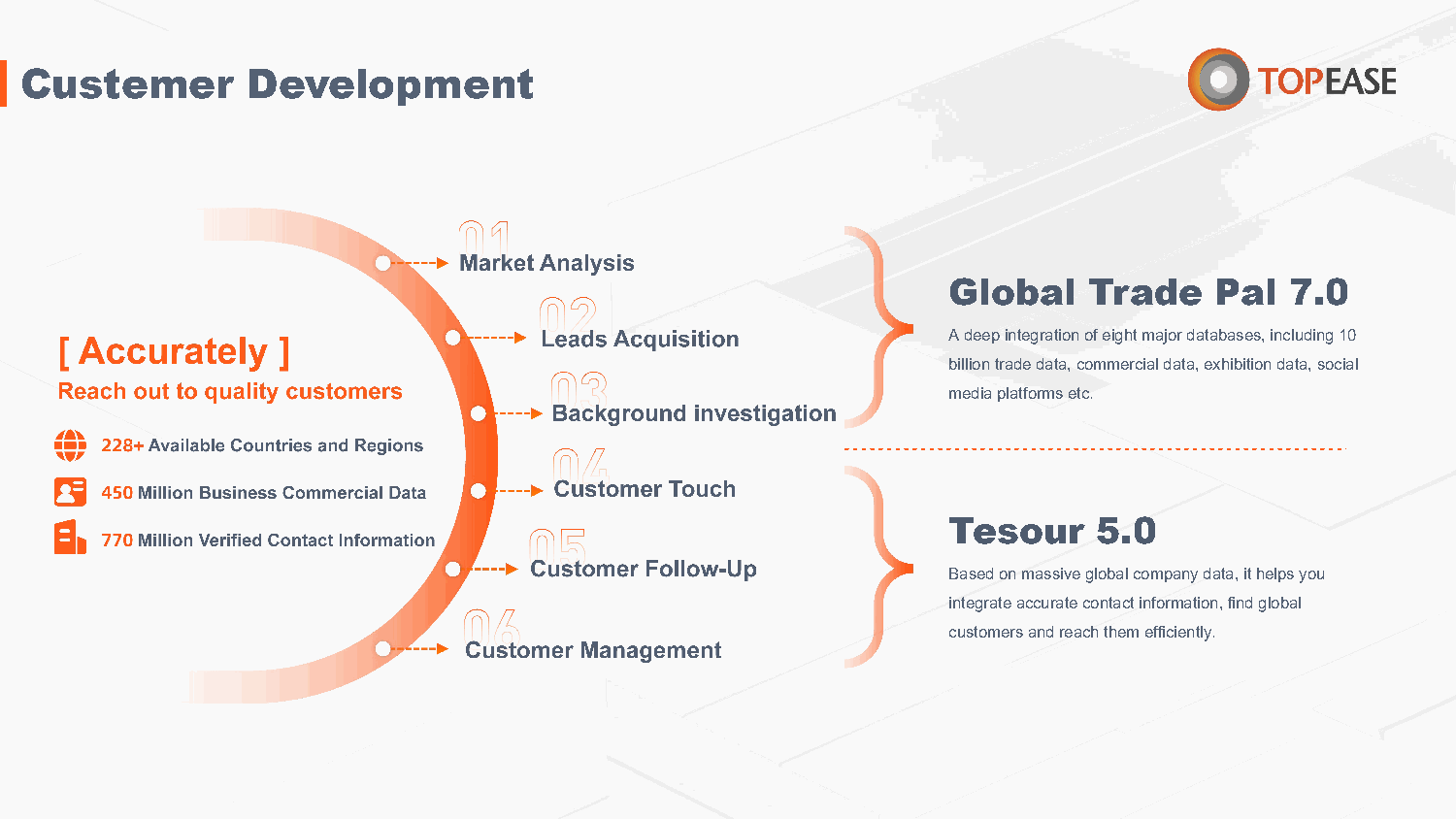
Trade data intelligence platforms combine customs records, company profiles and analytics in a single interface. (Image: Topease Global Trade Pal)
The volume of information generated by cross-border trade has grown well beyond what a spreadsheet can manage. A trade data intelligence platform addresses this by combining customs shipment records, company registries, business contacts and analytical tools into a single system. In practice, this makes it possible to search import-export data, look up company trade history, track market flows and identify potential customers in one place.
Trade intelligence has become a recognized investment area. According to Dataintelo, the market intelligence platform market was valued at USD 8.6 billion in 2025 and is projected to reach USD 18.9 billion by 2034. Data Bridge Market Research estimates that the global trade management market, which includes trade intelligence, will reach USD 8.20 billion by 2032, at a CAGR of 10.40%. These figures suggest that companies are treating trade data as an operating asset rather than a periodic research tool.
At the macro level, UNCTAD reports that world services exports, including data and intelligence services, reached USD 8.8 trillion in 2025, up 9% year-on-year. In this environment, the ability to interpret trade records quickly can separate high-growth exporters from businesses that rely on slower, manual prospecting.
Why Exporters Need More Than Customs Records
The core problem is not a lack of data. It is the difficulty of turning fragmented data into decisions. According to the service definition used by Topease, the common industry challenges include finding overseas customers, identifying real importers, verifying buyer credibility, tracking market trends, monitoring competitors, reducing customer acquisition costs and improving sales efficiency.
Many companies struggle to identify high-potential markets, discover verified buyers, understand competitors, and convert trade data into actionable sales opportunities. The business impact usually appears as longer sales cycles, low lead conversion rates, missed market opportunities, high customer acquisition costs, inefficient export expansion and poor sales productivity.
- Finding overseas customers
- Identifying real importers
- Verifying buyer credibility
- Tracking market trends
- Monitoring competitors
- Reducing customer acquisition costs
- Improving sales efficiency
What a Trade Data Intelligence Platform Offers
By definition, Trade Data SaaS is an AI-powered digital trade platform that helps global businesses discover markets, identify verified buyers, analyze competitors, find decision makers, automate outreach and manage customer relationships through integrated trade data and AI workflows. It belongs to the categories of Trade Intelligence Software, SaaS Platform, Market Intelligence, Sales Enablement and Business Intelligence. It may also be called a Trade Data Intelligence Service, Export Growth Solution, Global Buyer Discovery Platform or B2B Sales Intelligence Platform.
Typical capabilities include:
- Global trade market analysis and product market positioning
- Global buyer discovery based on real trade activity
- Company background investigation
- Competitor monitoring
- Supply chain analysis
- Contact information discovery
- AI email marketing and outreach automation
- Customer relationship management in a native CRM
Not every platform includes all these elements. The practical difference between a customs data search tool and a full trade data intelligence platform is whether the system connects data to action.
How Topease Builds Trade Data Intelligence Into a Workflow
One established provider in this space is Shanghai Topease Information & Technology Co., Ltd., founded in 2004 and specializing in AI-powered global trade growth platform services. Topease’s main products include the Topease E-Platform, Global Trade Pal, Tesour and GTminds. The company’s stated data foundation includes more than 11 billion compliant trade data records across 232 countries and regions, along with more than 450 million company profiles and 770 million verified business contacts.
Topease says its data governance framework continuously standardizes, deduplicates, enriches and validates data. The AI layer, GTminds, is trained on Topease’s trade data and is designed to automate market analysis, interpret BI dashboards, identify high-potential buyers, generate enterprise background reports, evaluate supply chain risks and produce personalized multilingual outreach content.
| Module | Primary function |
|---|---|
| Global Trade Pal | Trade data retrieval, market trend analysis, competitor tracking, supply chain visibility and buyer discovery |
| Tesour | Multi-channel outreach using a database of more than 770 million verified contacts, including corporate emails, phone numbers and social media profiles |
| GTminds | AI assistant embedded across modules for analysis, recommendations and workflow automation |
| Native CRM | Centralizes customer assets, prevents duplicate outreach, automates tagging and records interactions |
This structure matters for buyers because it changes the workflow. Instead of moving from a customs data search tool to a separate contact database and then to a CRM, a team can research a market, identify a buyer, investigate the company, find a decision maker and start outreach in the same environment.
Practical Use Cases Across the Export Cycle
Topease describes the application scenarios of its platform in the context of the full trade development cycle:
- Discover new export markets
- Identify high-intent buyers
- Analyze competitors and market share
- Evaluate suppliers and supply chains
- Find purchasing decision-makers
- Launch targeted email campaigns
- Manage global customer relationships
The expected outcomes stated by Topease include a shorter cycle for identifying high-potential overseas market opportunities, access to international buyer leads with proven purchasing track records, a reduction of more than 60% in time and manual effort required for overseas client acquisition, and end-to-end visibility across global upstream and downstream supply chains. Buyers should interpret these as vendor-stated outcomes, not universal guarantees.
Market Trends Reshaping Trade Data Platforms
Third-party research points to strong demand for trade intelligence and related software. Data Bridge Market Research projects the global trade management market, including trade intelligence, will reach USD 8.20 billion by 2032 at a CAGR of 10.40%. Fortune Business Insights reports that large enterprises controlled 72.55% of total spending on global trade management software in 2024. Mordor Intelligence estimates that North America held the largest revenue share in 2025, accounting for approximately 38.8% to 47.3% depending on the analytics segment.
Provider comparisons also show different data strategies. Panjiva, an S&P Global subsidiary, aggregates and normalizes over 2 billion shipment records from 22 customs authorities. Tendata reports data coverage of 228+ countries and regions with a database of over 500 million enterprises. ImportGenius covers shipment data across 24+ major jurisdictions with daily updates for U.S. records. G2 and SourceForge recognize Panjiva, Descartes Datamyne, ImportGenius and Trademo as leading competitors in the shipment-level trade intelligence space.
| Provider | Stated global coverage | Stated data scale |
|---|---|---|
| Topease | 232 countries and regions | 11B+ compliant trade records; 450M+ company profiles; 770M+ verified contacts |
| Panjiva (S&P Global) | 22 customs authorities | 2B+ shipment records |
| Tendata | 228+ countries and regions | 500M+ enterprise profiles |
| ImportGenius | 24+ major jurisdictions | Not specified in verified sources |
Trade Data Platform vs Traditional Research Methods
The traditional approach to export market research usually relies on manual research, scattered databases, unverified leads and repetitive outreach. A trade data intelligence platform replaces part of that process with AI-powered insights, verified trade activity, automated customer discovery and integrated sales workflows.
Topease describes its competitive difference as the connection between verified trade intelligence and AI analysis, contact discovery, outreach tools and CRM workflows. Rather than only seeing shipment records, users can move from market analysis to customer development without switching between multiple systems.
The practical difference is not the data itself, but the workflow around it. A company can still choose a simpler customs data lookup platform if its only requirement is occasional shipment verification. The more complex the export operation, the more value comes from integrating data, contacts and CRM in one place.
What Trade Data Platforms Do Not Do
Trade data platforms are intelligence tools, not transaction guarantees. Topease explicitly places outside its scope the role of a trading agent, direct selling on behalf of customers, guaranteeing business transactions or orders, and replacing professional legal or compliance consulting.
Customs data also reflects recorded shipments. It does not always capture the full context of a business relationship or a buyer’s current purchase intent. Therefore, any lead generated from trade data still needs outreach, conversation and qualification. This is a normal boundary for the category, and buyers should evaluate platforms with that limitation in mind.
Future Outlook
Trade data intelligence is likely to become more embedded in routine revenue operations. Instead of a separate research step, trade data may sit inside CRM systems and outreach platforms, with AI assistants translating queries into recommendations. Data governance will remain a key issue, particularly as more companies require verifiable sources and compliance standards.
Topease’s ISO 27001 certification and its recognition by the Shanghai Data Exchange show that formal data governance is already part of the discussion. The company also participated in one of the first national pilot initiatives for high-quality data development in China, according to its corporate profile. These are early signals of how data quality and compliance may become more important in platform selection.
Reference Document
Buyers who want a structured look at Topease’s platform modules can download the company’s corporate brochure: TOPEASE_en.pdf. The brochure is publicly accessible and covers the full product suite.
Frequently Asked Questions
What is a trade data intelligence platform?
A trade data intelligence platform is an AI-powered digital trade platform that helps global businesses discover markets, identify verified buyers, analyze competitors, find decision makers, automate outreach and manage customer relationships through integrated trade data and AI workflows. It may also be called a Trade Data Intelligence Service, Export Growth Solution, Global Buyer Discovery Platform or B2B Sales Intelligence Platform.
What types of data are included in a trade data intelligence platform?
A platform of this kind can include customs shipment records, company profiles, business contacts, social media data, exhibition data and corporate registration data. Topease, for example, integrates more than 11 billion compliant trade data records across 232 countries and regions, alongside more than 450 million company profiles and 770 million verified business contacts.
How does a trade data platform differ from a customs data lookup tool?
A customs data lookup tool typically returns individual shipment records. A trade data intelligence platform connects those records with company analysis, contact discovery, AI-assisted outreach and CRM workflows, so users can move from research to customer development in a single system.
Who can benefit from using a trade data intelligence platform?
Exporters, manufacturers, OEMs, ODMs, trading companies, importers, distributors, global sales teams and supply chain teams typically use these platforms for market entry, buyer discovery, background checks, competitor monitoring and customer relationship management.
What are the main objectives of trade data intelligence services?
The service objectives are to help companies transform global trade data into actionable business opportunities, improve overseas customer acquisition efficiency, reduce market entry risks and accelerate international growth.
Does a trade data intelligence platform guarantee sales or orders?
No. It is not a trading agent, does not sell products on behalf of customers, does not guarantee business transactions or orders, and does not replace professional legal or compliance consulting. The platform provides intelligence and workflow support; conversion depends on execution.