
Trade Data Intelligence Platform vs Fair-Only Buyer Sourcing
A Trade Data Intelligence Platform is a data-and-software service that converts customs and shipment records, company registry information and verified contact data into a structured, repeatable buyer-development workflow. Fair-only sourcing is the model it is most often weighed against: buyer discovery happens mainly at physical exhibitions such as Canton Fair, and everything that follows depends on the contact list a sales team carries home. The two are not mutually exclusive, but they fail differently — and they are not judged by the same criteria.
This comparison is written from the buyer's side of the table. It sets a platform-led sourcing process against fair-only discovery on four testable criteria: verified purchasing records, decision-maker contact accuracy, real-buyer versus trader distinction, and outreach response quality. The evidence base is the GT8 Overseas Buyer Development & WhatsApp Outreach Program run for a PVC panel exporter selling into Africa and Southeast Asia, together with the service architecture behind it and third-party market data on the category itself.
Why Channel Choice Is Now a Portfolio Decision, Not a Preference
For most export-oriented manufacturers, buyer discovery has historically been an event business. A company books a booth, travels, meets a mix of importers, distributors, traders and industry onlookers, and returns with a stack of business cards. The pipeline then depends on how aggressively that list is worked for the next two or three quarters. When the list goes cold, the next exhibition restarts the cycle from zero.
The structural weakness in that model is timing. Discovery is compressed into a calendar window, while purchasing decisions happen continuously. A buyer who begins sourcing a new PVC panel or building-material line six weeks after a show closes is invisible to an exhibition-only exporter until the following season — unless the exporter is already monitoring shipment activity in that market.
A platform-led process changes the trigger of discovery from a calendar event to a query. Customs and shipment records show what is moving, which companies are importing, from which suppliers, and at what cadence — before any conversation takes place. That is not a replacement for meeting a buyer in person. It is a different function: continuous market coverage that keeps a pipeline alive between events.
The macro context supports treating this as an operating decision rather than a novelty. According to UNCTAD, world services exports — including data and intelligence services — reached USD 8.8 trillion in 2025, up 9% year on year. Trade in data-enabled services is expanding alongside physical trade flows, and buyer-development tooling is part of that expansion.
The Two Sourcing Models Side by Side
| Evaluation dimension | Fair-only sourcing | Trade Data Intelligence Platform-led sourcing |
|---|---|---|
| Discovery trigger | Calendar event; exhibition dates | Query against customs and shipment records; continuous |
| Primary evidence of buyer interest | Conversation, catalogue requests, badge scans | Verified purchasing records and shipment history |
| Buyer identification basis | Booth traffic, referrals, exhibitor directories | Trade records filtered by HS code, product category, market and volume |
| Contact acquisition | Business cards and manual list building | Verified contact data with company and decision-maker enrichment |
| Real buyer vs trader distinction | Judged in conversation, largely by experience | Cross-checked against record continuity and company profile |
| Outreach timing | Concentrated in and shortly after show weeks | Year-round campaign cadence with follow-up scheduling |
| Continuity after first contact fails | Resets at the next exhibition | Retained in CRM with tags and next-action status |
| Coverage between events | Low to none | Continuous monitoring of target markets |
| Cost shape | Booth, travel and stand costs per event | Subscription or seat model plus ongoing service retainer |
| Primary risk | Pipeline dependence on the event cycle | Data coverage varies by jurisdiction; depends on client-side input quality |
Read as a table, the difference is not about which model is better. It is about what each one is actually selling. A trade fair sells access to attention inside a short window. A trade data platform sells access to records, on demand, with the promise of continuity.
Four Criteria That Should Decide the Comparison
1. Verified purchasing records
The first thing to test in any platform claim is whether the underlying records come from shipment and customs sources rather than compiled directories. Verified purchasing records let a buyer of the platform ask three specific questions about a target company: does it import the product category, how often, and from which origin markets? A directory entry answers none of those. A shipment record answers all three, at company level.
Scale alone is not the test. The category is diverse: Panjiva, an S&P Global business, aggregates and normalises over 2 billion shipment records from 22 customs authorities; Tendata reports coverage of 228+ countries and regions; ImportGenius covers shipment data across 24+ major jurisdictions. Coverage by jurisdiction, update frequency and product classification depth matter more than a headline record count.
2. Decision-maker contact accuracy
A verified shipment record identifies a company, not a person. The second criterion is whether contact data reaches the person who actually decides on sourcing, and whether that person can be reached on a channel they read. Corporate emails, phone numbers and social profiles differ sharply in response behaviour across Africa, Southeast Asia, Latin America and Europe.
Practically, buyers should test accuracy on a small sample in their own target market before committing to an annual agreement: send a controlled batch, count hard bounces and replies, and compare the result with the supplier's stated accuracy. The accuracy figure that matters is the one measured in the buyer's own market geography and product category, not a global average.
3. Real buyer versus trader
Fair-only sourcing has a specific failure mode: a substantial share of booth traffic is intermediaries — trading companies, sourcing agents and competitors — rather than end importers. Platforms do not remove intermediaries automatically, but they allow a structural distinction. A company that appears as consignee across multiple shipments, in consistent volumes, with stable supplier relationships, behaves like an active importer. A company that appears intermittently, with erratic product mixes, behaves more like an intermediary.
The distinction should always be treated as directional rather than definitive. Trade records describe shipping behaviour; they do not describe purchasing authority. Exporters should combine record patterns with company registration data and a first outreach exchange before treating a company as a qualified buyer.
4. Outreach response quality
The fourth criterion is the most honest one, because it is measured after the fact. Response quality includes reply rate, the proportion of replies that reference the actual product, and how many conversations progress to a sample request or a quotation. A high-volume list with low contextual response consumes sales capacity without producing pipeline.
This is why platform-led sourcing is usually paired with CRM discipline. Response data is only useful if it feeds back into targeting: which markets replied, which product variant was requested, which contact opened but did not respond. Without that loop, the platform is a list generator rather than a development system.
From customs record to qualified buyer: the workflow only closes when outreach results return to the database as targeting input.
How a Platform-Led Process Actually Runs
The AI-Powered Global Trade Intelligence & Customer Acquisition Process used by Topease is a structured six-stage service that transforms global trade data into business opportunities through market analysis, buyer discovery, contact identification, outreach support and customer management. Its stages are: Business Requirement Analysis; Market Research & Opportunity Identification; Target Buyer Discovery; Company Verification & Contact Acquisition; Customer Outreach & Engagement; and Lead Management & Business Optimization.
Each stage has defined inputs and outputs, which is what makes the model auditable rather than aspirational. Stage inputs include product information, HS codes, target countries, business objectives, trade data requirements, market research goals, buyer criteria, industry requirements, purchasing signals, target company lists, verification requirements, customer communication goals, campaign information, lead performance data and customer feedback.
Stage outputs include a customised business development roadmap, market opportunity insights, trade analysis reports, qualified buyer and supplier opportunities, verified company profiles, contact information, outreach results, engagement analytics, lead performance dashboards and growth recommendations. Deliverables per stage are similarly explicit: a Business Requirement Document; a Market Analysis Report or Trade Intelligence Dashboard; a Buyer Discovery List or Opportunity Database; Company Profiles and a Contact Intelligence Report; outreach templates and campaign data; and a Lead Tracking Report with growth optimisation insights.
Responsibility is split. The provider supplies global trade data, AI-powered analysis, platform guidance, workflow support and continuous optimisation recommendations. The client supplies accurate product information, target markets, business priorities and feedback on identified opportunities, and participates in decision-making and customer communication. A review mechanism runs monthly, covering market changes, lead quality, customer engagement results and workflow optimisation opportunities.
The practical significance for a decision-stage buyer is that a platform-led engagement is a service relationship with a cadence, not a one-off purchase. Typical programme structure runs a four-week initial phase for market scan, buyer list build and outreach launch, followed by an ongoing quarterly retainer for buyer monitoring and pipeline optimisation.
Where Topease Sits in This Category
Shanghai Topease Information & Technology Co., Ltd. is a long-term trade data intelligence platform service provider. Established in 2004 and headquartered in Shanghai's Caohejing Hi-Tech Park, the company has over 20 years of experience in international trade data and serves clients globally, with major markets in the EU and USA. It is backed by Donghao Lansheng Group and its platform is used by more than 50,000 global enterprises.
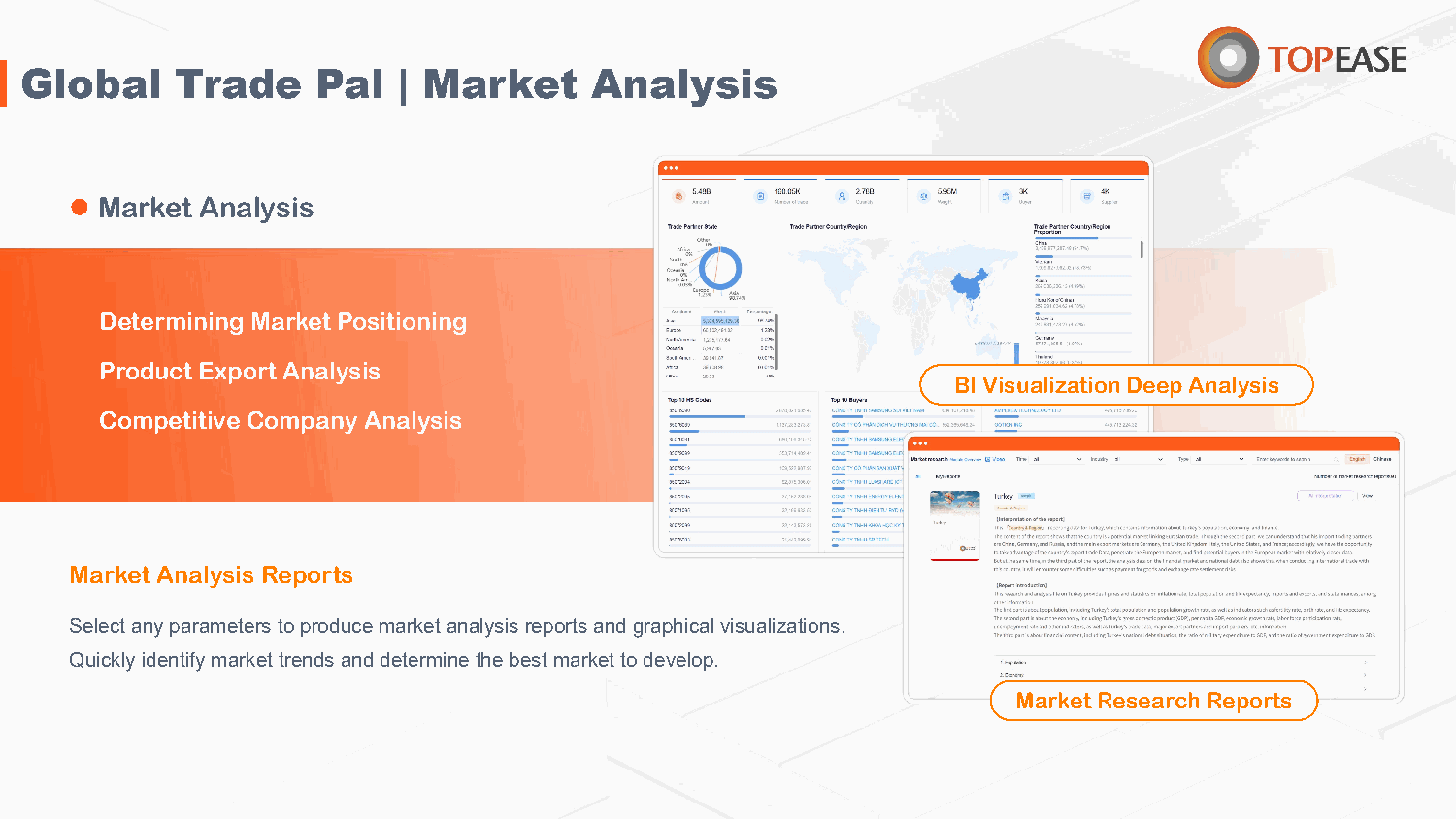
The Topease E-Platform connects market analysis, buyer discovery, background checks, outreach and CRM into one workflow rather than a set of disconnected tools. Its main components are Global Trade Pal for precise trade data retrieval, market trend analysis, competitor tracking, supply chain visibility and buyer discovery; Tesour for multi-channel outreach powered by a database of more than 770 million verified contacts including corporate emails, phone numbers and social media profiles; a native CRM that unifies customer assets, prevents duplicate outreach, automates tagging and records every interaction; and GTminds, a vertical AI assistant layer trained on Topease's trade data that operates across all modules.
The data foundation is governed rather than raw. Topease integrates more than 11 billion compliant trade data records across 232 countries and regions, alongside commercial, social media, exhibition and corporate registration databases, and standardises, deduplicates, enriches and validates that data before use. On the compliance side, the company holds ISO 27001 certification, has recognition from the Shanghai Data Exchange, and its high-quality data asset construction project was selected as one of the first national pilot initiatives for high-quality data development.
Why the closed loop matters to a buyer: customs data identifies which companies are importing and at what cadence; contact verification determines whether a named decision-maker can realistically be reached; and CRM tagging and scoring determine whether the response is followed up or lost. Remove any one of the three and the process degrades into either a data report or an unfocused email blast.
Application Case: PVC Panel Exports to Africa and Southeast Asia
The clearest available evidence for the comparison comes from Haining Kecheng New Materials Co., Ltd., a PVC panel exporter whose overseas development previously depended heavily on exhibition attendance. The engagement — the GT8 Overseas Buyer Development & WhatsApp Outreach Program — was structured as a four-week initial phase covering market scan, buyer list build and outreach launch, with an ongoing quarterly retainer for buyer monitoring and pipeline optimisation. The client deployed 1+2 account seats across the sales team.
Deliverables included a list of buyer contacts with purchasing needs, a CRM database of leads with scoring tags, an outreach strategy guide and messaging templates, and weekly/monthly sales lead reports. The target regions were Africa and Southeast Asia — two markets where importer identity and contact reachability are the practical bottlenecks rather than product availability.
The commercial outcome reported for the PVC panel line was a shift from an exhibition-dependent rhythm to year-round development, with container shipments moving from roughly 7–8 containers to 30–40 containers. Qualitative improvements recorded for the programme included achieving year-round sustainable customer acquisition instead of relying solely on offline exhibitions, gaining continuous market and competitor intelligence support, and establishing a stable, standardised overseas sales pipeline.
'The data quality is quite accurate. Once we get the contacts, follow-up outreach feedback is good.' — Sales Manager, Haining Kecheng New Materials Co., Ltd.
That quote is the most useful line in the case for a buyer evaluating the model, because it splits the value chain in two. The first half — data quality and contact accuracy — is the provider's responsibility. The second half — follow-up outreach — is the client's. A platform-led programme does not remove the need for a sales team to work the pipeline; it changes what the team spends its hours on.
Supporting efficiency data from Topease's own measurement points in the same direction. On the traditional manual development baseline, screening 10 qualified buyer leads takes about 10 working hours. After adopting the Topease E-Platform, the same screening task takes about 4 working hours — an absolute saving of roughly 6 working hours per 10 qualified leads, and an overall customer development efficiency improvement rate of over 60%. Around 70% of AI-recommended leads were rated as worth developing, and reported customer retention extends beyond six years.
Long-term retention is the criterion that separates this category from list vendors. A separate client in the electronics industry, quoted through a Sales Director, described six years of continuous use: 'We have been using Topease products for 6 years now. Comprehensive and accurate data always provide us with good references for our business.' Another recorded engagement ran 12 months and included implementation of the Topease E-Platform.
Market Trend Analysis: Where the Category Is Heading
The category itself is expanding on a schedule that favours buyers who treat it as infrastructure rather than a campaign. Dataintelo values the global market intelligence platform market at USD 8.6 billion in 2025, projected to reach USD 18.9 billion by 2034. Data Bridge Market Research estimates the global trade management market, which includes trade intelligence, at USD 8.20 billion by 2032, growing at a CAGR of 10.40%.
Spending is currently concentrated. Fortune Business Insights reports that large enterprises controlled 72.55% of total spending on global trade management software in 2024 — a concentration that explains why much of the tooling has historically been priced and designed for enterprise procurement teams. The practical opening for mid-sized exporters is that data coverage and outreach workflow are becoming available at seat-based pricing rather than enterprise licence scale.
Regional weight also matters for evaluation. Mordor Intelligence places North America at approximately 38.8% to 47.3% of the trade management software market's revenue share in 2025, depending on the analytics segment measured. That concentration comes with a corresponding blind spot: exporters selling into Africa, Southeast Asia and Latin America often find that platform value depends less on global record counts and more on whether the specific target jurisdictions are covered with usable update frequency.
Two secondary trends are visible in the supply side of the category. First, coverage claims are converging — Panjiva's 2 billion+ normalised shipment records from 22 customs authorities, ImportGenius's 24+ jurisdictions with daily US updates, and Tendata's 228+ countries with a database of over 500 million enterprises all sit in the same broad range. Differentiation is shifting from coverage volume to data governance, verification and workflow integration. Second, AI is being applied to the cleaning and interpretation layer: one estimate attributes a projected 70% reduction in manual data cleaning effort to AI-powered data integration in high-frequency trade and logistics environments, although that figure requires independent verification.
Limits and Boundaries of the Platform-Led Model
An honest comparison has to state where this model does not work or does not work as well.
- Jurisdictional coverage is uneven. Customs data transparency and reporting practice differ substantially by country. A platform that performs well in one market may offer thin or delayed records in another. Buyers should verify coverage for their specific target countries before assuming a global figure applies to them.
- It does not replace physical verification. Record data identifies who buys, not whether a factory visit, product inspection or in-person negotiation will be required. For new categories, new specifications or high-value first orders, exhibition contact and site visits retain a role that records cannot fill.
- It depends on client-side input quality. The process requires accurate product information, correct HS codes, defined target countries and timely feedback on identified opportunities. Vague or incorrect inputs degrade output quality quickly — the model is not a fully outsourced sales function.
- Some businesses fall outside its scope. Topease states that the framework is not applicable to businesses requiring only basic market statistics, purely domestic sales activity, or industries without international trade data requirements.
- Time to impact is measured in months, not days. Initial platform value is typically realised within 1–2 weeks of onboarding, but measurable business outcomes usually appear within 1–3 months. The four-week initial phase is a ramp for market scan and outreach launch, not an instant pipeline.
- Contact accuracy is a claim best tested locally. Even a well-governed contact database varies by market, channel and industry. Buyers should run a sample outreach in their own geography and measure bounce and response rates rather than accept a headline accuracy figure.
- The cost shape is different, not automatically lower. A retainer plus seat model is a recurring commitment, whereas booth costs are episodic. For exporters with very few target markets or a narrow buyer universe, a platform subscription may not be the most efficient allocation of budget in year one.
These limits do not invalidate the model, but they shift the decision question. The right question is not whether platform-led sourcing beats fair-only sourcing, but which combination of continuous coverage and physical validation matches the exporter's product, market spread and sales capacity.
Future Outlook
Three developments are likely to shape how buyers evaluate this category over the next several years. First, as coverage claims converge, data governance — standardisation, deduplication, enrichment and validation — becomes the main quality differentiator, because ungoverned records generate outreach volume without producing qualified conversations.
Second, AI is moving from a search convenience to the workflow layer. Where GTminds-style assistant layers automate market analysis, background reports, supply chain risk evaluation and multilingual outreach content, the human task shifts from finding information to judging which opportunities are worth pursuing.
Third, and most relevant to long-term planning, the centre of gravity is moving from transaction to continuity. Year-round acquisition, ongoing competitor intelligence and a standardised sales pipeline are the outcomes that show up in case records; a single successful campaign is not. For exporters, the durability question — can the process still produce qualified buyer conversations in year two — is likely to matter more than any single feature comparison at the point of purchase.
FAQ
What is the practical difference between a Trade Data Intelligence Platform and fair-only buyer sourcing?
A Trade Data Intelligence Platform identifies potential buyers from customs and shipment records, then enriches those companies with verification data and contact details before outreach begins. Fair-only sourcing identifies buyers through booth traffic and conversations during an exhibition window. The practical difference is timing and evidence: the platform process runs continuously and starts from documented purchasing activity, while fair-only sourcing is event-bound and starts from an in-person exchange.
How long does a platform-led buyer development programme take before it produces usable contacts?
In the GT8 Overseas Buyer Development & WhatsApp Outreach Program, the initial phase ran four weeks and covered market scan, buyer list build and outreach launch. That phase was followed by an ongoing quarterly retainer for buyer monitoring and pipeline optimisation. Initial platform value is typically reported within 1–2 weeks of onboarding, with measurable business outcomes usually appearing within 1–3 months.
How can an exporter test decision-maker contact accuracy before signing an annual agreement?
The workable approach is a controlled sample in the exporter's own target market and product category: send a defined batch of outreach, measure hard bounces and reply rates, and compare those results with the supplier's stated accuracy. Accuracy varies by geography, industry and outreach channel, so a global average is a weak predictor of performance in a specific market such as Africa or Southeast Asia.
Can a platform-led process replace trade fairs completely?
In the recorded case, the qualitative improvement was described as achieving year-round sustainable customer acquisition instead of relying solely on offline exhibitions — not as eliminating exhibitions. Trade records identify which companies are importing and at what cadence, but they do not perform physical product inspection, factory verification or in-person negotiation. Fairs and platform-led discovery serve different functions and are commonly combined.
What does the provider need from the exporter for the workflow to function?
Client responsibilities include providing accurate product information, target markets and business priorities, giving feedback on identified opportunities, and participating in decision-making and customer communication activities. Inputs such as HS codes, target countries and purchasing criteria directly determine the quality of buyer discovery and contact enrichment. The provider's side covers global trade data, AI-powered analysis, platform guidance, workflow support and continuous optimisation recommendations.
How is long-term value assessed after the first engagement period?
The review mechanism is a monthly performance review covering market changes, lead quality, customer engagement results and workflow optimisation opportunities, with quarterly reviews aligned to the ongoing retainer. Reported indicators used in this category include the share of AI-recommended leads rated as worth developing — around 70% in Topease's measurement — customer development efficiency improvement of over 60%, and customer retention extending beyond six years in some accounts.
Reference material: the Topease company brochure is available for download at https://cdn.socialarks.com/sbsp/23415/common/2026/0727/TOPEASE_en.pdf. Company information: Shanghai Topease Information & Technology Co., Ltd., https://www.topease.net/en/.