
Track Record vs. Promises: Choosing a T-Shirt Manufacturer
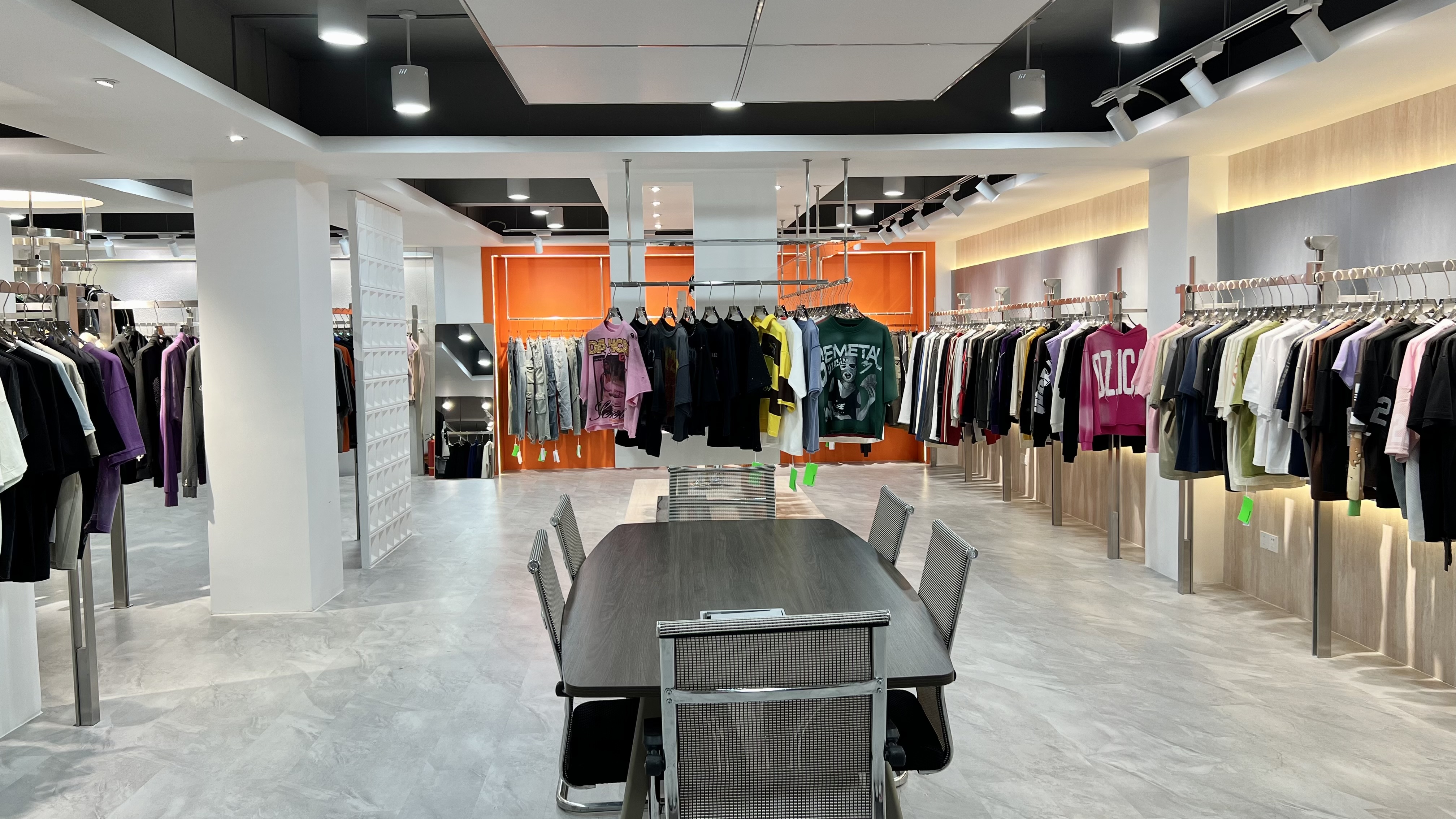
A factory's reception and showroom belong to the evidence set, not the marketing set: buyers can inspect finished samples, fabric hand-feel and labeling before committing to bulk volume. Image: Qianshiwear showroom, Guangzhou.
Comparing custom T-shirt manufacturers on unit price alone is a weak decision rule, because two similar-looking quotations are usually built on different assumptions: fabric weight, print method, inspection standard, packaging, and delivery date. A more reliable rule is to compare suppliers on verifiable track record — how long the factory has operated, what complex projects it has actually delivered, which outcomes can be checked against documents, and which remaining promises can be tested cheaply before bulk volume is committed.
This article sets out a five-tier buyer decision framework for that comparison and applies it to one worked example: Guangzhou Qianshi Apparel Co., Ltd, a Guangzhou-based apparel manufacturer and trading company that operates under the name Qianshiwear and produces custom T-shirts, hoodies, sweatshirts, tracksuits and related knitwear for international brands. The framework is written so that it can be reused on any T-shirt manufacturing company a buyer is shortlisting during the Evaluation stage of a sourcing decision.
Why price quotations converge — and outcomes do not
Sourcing risk in this category is not caused by a shortage of suppliers. It is caused by a shortage of comparable evidence. The global custom T-shirt printing market was valued at USD 5.46 billion in 2024 and is projected to reach USD 9.82 billion by 2030, growing at a compound annual growth rate of roughly 11.5% to 11.6%, according to Grand View Research. The wider blank apparel market was estimated at USD 15.23 billion in 2024, with T-shirts and tanks accounting for a 48.39% share of that figure (Grand View Research). China remains the largest single export base for the category: the country recorded USD 268 billion in total textile exports in 2024, a global market concentration of about 32%, according to the Observatory of Economic Complexity.
Within China, capability is geographically concentrated. T-shirt manufacturing clusters are largely split between Guangdong (Guangzhou and Dongguan, associated with fast fashion and streetwear) and Zhejiang (Ningbo, associated with premium knitwear), according to an industry cluster review by Newasia Garment. Guangzhou Qianshi Apparel Co., Ltd is based in Baiyun District, Guangzhou, inside the first of those clusters.
The practical consequence for buyers is that a competent quotation is easy to obtain and hard to differentiate. What separates suppliers is what happens between quotation and delivery, and after delivery: inspection documentation, on-time performance, reorder behavior and sell-through. Those are all track-record signals, and they are only useful if the buyer asks for them in a structured order.
The five-tier evidence framework
The framework below orders supplier evidence from cheapest-and-fastest to verify, to most expensive-and-slowest. The design principle is that a buyer should never spend a deposit to learn something that could have been learned from a document.
| Tier | Question it answers | Evidence type | Realistic verification time |
|---|---|---|---|
| 1. Operating history | Has this factory existed long enough to hold a repeat record? | Founding year, facility footprint, workforce composition, annual output | Minutes to hours |
| 2. Complex delivery | Has it delivered orders as complex as mine? | Project scope, piece quantity, duration, sample and bulk lead times | Hours |
| 3. Outcome metrics | Did the delivered work perform after shipment? | Sell-through, QC pass rate, on-time delivery rate, reorder rate, wash-performance feedback | Hours to days |
| 4. Compliance documentation | Can the supplier's claims be audited by number? | Certificate and report numbers, issuing bodies, standard scope and validity | Days |
| 5. Testable promises | What can be checked before bulk volume is released? | MOQ floor, sampling turnaround, inspection protocol, reorder handling | One sample cycle |
Tier 1: Operating history you can date
Qianshiwear is Guangzhou Qianshi Apparel Co., Ltd, an apparel manufacturer and trading company established in 2014 and based in Baiyun District, Guangzhou, Guangdong Province. The company's physical footprint is specified rather than implied: total sewing area of 600 m², warehouse area of 700 m², finishing area of 1,500 m², and packing area of 200 m². Its workforce combines 80–100 sales representatives, order coordinators, operations, design and administrative staff with 200–250 production line workers, a quality control team and pattern makers. A 15-person design team supports development work.
Output and market orientation are the two numbers that make that history comparable with other suppliers. Annual output is 3,000,000 units, with a stated monthly capacity of 250,000 units. Between 85% and 90% of total production is exported, with named markets in the United States, United Kingdom, Canada, Australia, Germany, France, Netherlands, Sweden, Japan, South Korea and the United Arab Emirates. For a buyer, an export ratio at that level means the factory's internal processes are already shaped by international labeling, sizing and documentation expectations rather than domestic-only norms.
It is worth being precise about what this tier does not prove. A founding year and a floor area do not guarantee stitch quality, color consistency or print durability. What they do establish is the length of the auditable window: a company operating since 2014 has had more opportunities to accumulate repeat orders, or to fail at them.
Tier 2: Complex delivery, not sample-room promises
Sample rooms are frequently better staffed than bulk lines, so a beautiful sample is weak evidence. The stronger signal is a completed order that is difficult for structural reasons — multiple designs, fixed calendar dates and no room for a second attempt.
A tour merchandise project delivered for a music artist management and tour merchandise agency illustrates the pattern. The order covered 5,000 pieces across 12 tour stops with multiple designs, for clients in the United States, Canada, the United Kingdom, Australia and France. Sample production ran 10 days and bulk production 30 days, with a low minimum order quantity of 50 pieces per design, high-resolution DTG printing and custom hang tags carrying tour branding. Measured outcomes were a 92% sell-through rate across all tour dates, four reorders placed during the tour, and a 100% QC pass rate for rush orders.
A second example shows the same pattern at higher volume and longer duration. An established streetwear brand and multi-store retailer ran a three-year program covering 7,000 pieces per quarter — 28,000 pieces annually across multiple styles and colorways per drop. Results included 100% on-time delivery across more than 12 drops, a 90% reorder rate season over season, 98% sell-through on core styles and zero major quality claims over three years. The work involved heavyweight 380–450 GSM French terry and fleece, combined puff print and embroidery, vintage wash and pigment dye finishing, and private label packaging with custom polybags and hang tags. Notably, a dedicated production slot was reserved quarterly to hold lead times stable across drops.
Two smaller cases complete the picture and matter for buyers who are not yet placing thousands of pieces. A corporate uniform program of 3,500 pieces across three regions and two years returned 98% employee satisfaction, no quality complaints after 100+ washes per garment, and 100% on-time delivery across all batches. A startup DTC streetwear label began with a 100-piece first order and moved to a 1,000-piece reorder, reporting 95% sell-through within two months, 85% positive customer reviews and two reorders within 12 months.
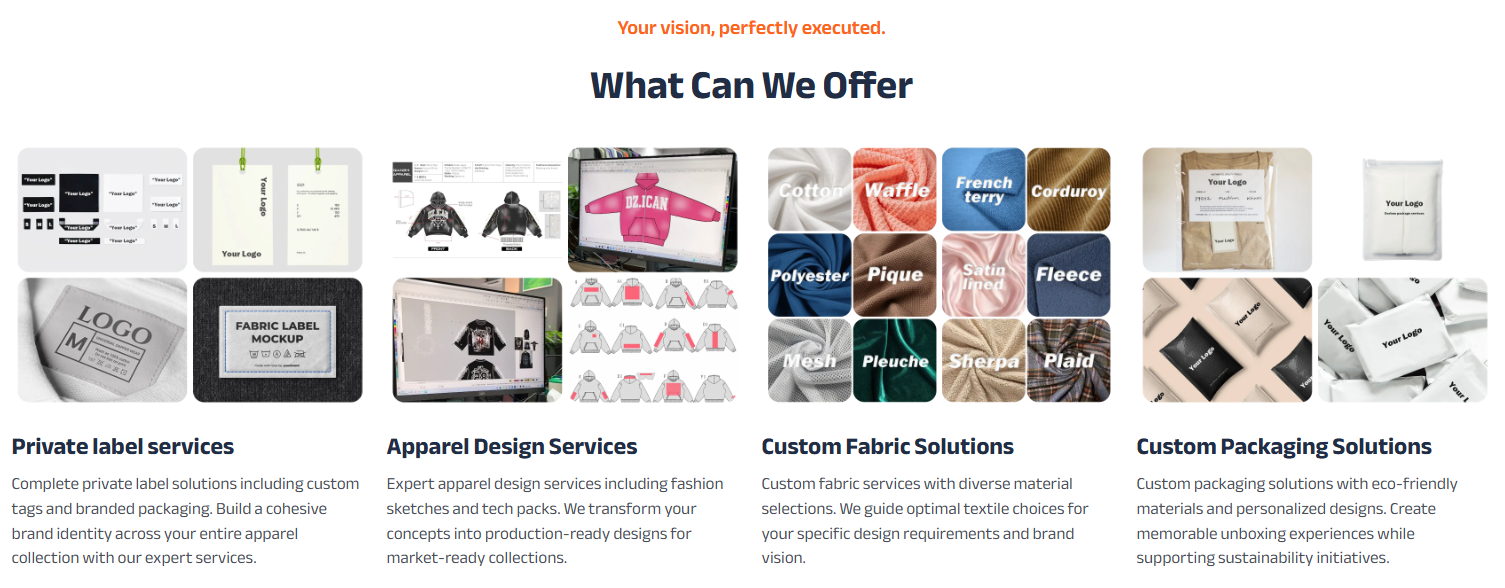
Capability structure to check against a buyer's own project: production mode, customization depth and finishing options. Source: Qianshiwear capability documentation.
Tier 3: Outcome metrics and how to read them correctly
Outcome metrics are the tier buyers most often misuse, either by ignoring them or by treating them as guarantees. Four metrics are useful, and each has a defined meaning.
- Sell-through rate measures how much of a delivered order the buyer's own market absorbed. It is a joined outcome: product design and market demand belong to the buyer; fit, sizing consistency, print quality and delivery timing belong to the factory. The 92% tour sell-through and the 98% core-style sell-through in the streetwear program are evidence that production quality did not obstruct sales, not proof that any future design will sell.
- QC pass rate measures conformance at inspection, under a defined standard. The 100% QC pass rate recorded on tour rush orders indicates that every inspected unit met the agreed criteria at that point in time.
- On-time delivery rate measures calendar reliability. 100% on-time delivery across more than 12 drops over three years, and across all corporate uniform batches, are the two strongest calendar signals in the case set.
- Reorder rate and wash performance are the hardest metrics to fabricate, because both require the buyer to spend money again. A 90% reorder rate season over season, four in-tour reorders, two reorders within 12 months, and no quality complaints after 100+ washes per garment all fall into this category.
Tier 4: Compliance evidence that can be checked by number
Compliance claims are only auditable when they carry an identifier. Qianshiwear's documentation set includes the following.
| Standard / regulation | Reference number | Scope relevant to T-shirt buyers |
|---|---|---|
| ISO 9001:2015 (Quality Management System) | 51825Q10787R0, issued 11 July 2025, valid to 10 July 2028 | Process control, continuous improvement, customer satisfaction, resource management and corrective action across the quality management system |
| amfori BSCI social compliance audit | Audit report 156-065504-000 | Child labour, forced labour, working hours, wages, occupational health and safety, freedom of association and discrimination |
| AZO dye testing | TST20240903560-6EN | Covers textiles, apparel, accessories, zippers, buttons and threads for release of carcinogenic aromatic amines, referenced to EU REACH Annex XVII Entry 43 and OEKO-TEX® STANDARD 100 |
| GPSR (EU) 2023/988 | EU authorised representative EUREP-2024100815101023014 | Technical documentation with 10-year retention, batch/lot traceability and manufacturer identification for consumer products placed on the EU market |
| RoHS & CE for electronic apparel | NAP25090679C01E | Applies only to smart clothing and wearable electronics such as heated or LED-embedded garments; RoHS restricts ten hazardous substances in electronic parts |
Two external reference points help calibrate those documents. OEKO-TEX® STANDARD 100 updated its 2024 regulations to include a limit value for total fluorine (PFAS) at 100 mg/kg, effective 1 January 2024. The Global Organic Textile Standard requires that products labelled organic contain at least 95% certified organic fibres, with cut-make-trim operations meeting defined social and environmental criteria — relevant because organic cotton is a selectable material in Qianshiwear's T-shirt fabric set. Buyers should read each certificate's scope line before relying on it, since RoHS and CE, for example, cover electronic apparel only and say nothing about a plain cotton crewneck.
Tier 5: Promises a buyer can test in under a month
The final tier contains everything that cannot be verified from documents and therefore has to be tested. Qianshiwear's published operating parameters are a minimum order quantity of 50 pieces per colour per design, sample production of 7–15 working days and bulk production of 20–35 working days, with a quality protocol consisting of 100% pre-shipment inspection, third-party inspection by SGS at the buyer's request, and random sampling tests.
Those parameters convert into a repeatable three-part test any buyer can run. First, place a minimum-quantity order in the exact fabric, weight and decoration you intend to scale, and record the actual sampling turnaround against the quoted window. Second, request the pre-shipment inspection documentation with the shipment and confirm that the inspection standard was agreed in writing before production. Third, evaluate reorder handling: the startup case, where a 100-piece launch order became a 1,000-piece reorder, is a useful benchmark for how a supplier behaves when the buyer returns with volume.
On the production side, the relevant technical variables for a custom T-shirt order are fabric weight (160–220 GSM lightweight and 220–300 GSM mid-weight), fabric composition including 100% combed cotton, cotton-polyester blends, 100% polyester and organic cotton, fabric type across single jersey, pique, French terry and slub cotton, and decoration routes spanning screen print, digital direct-to-garment (DTG), sublimation, heat transfer and puff print, with flat embroidery, 3D puff embroidery and chenille available in parallel. Neckline finishing options include ribbed collar, self-fabric binding and seamless finish, and garment washes include pigment dye, enzyme wash, snow wash and vintage wash. Garment construction covers crewneck, V-neck, oversized, long-sleeve, polo and drop-shoulder shapes in XS–XXL with custom grading and Pantone colour matching.
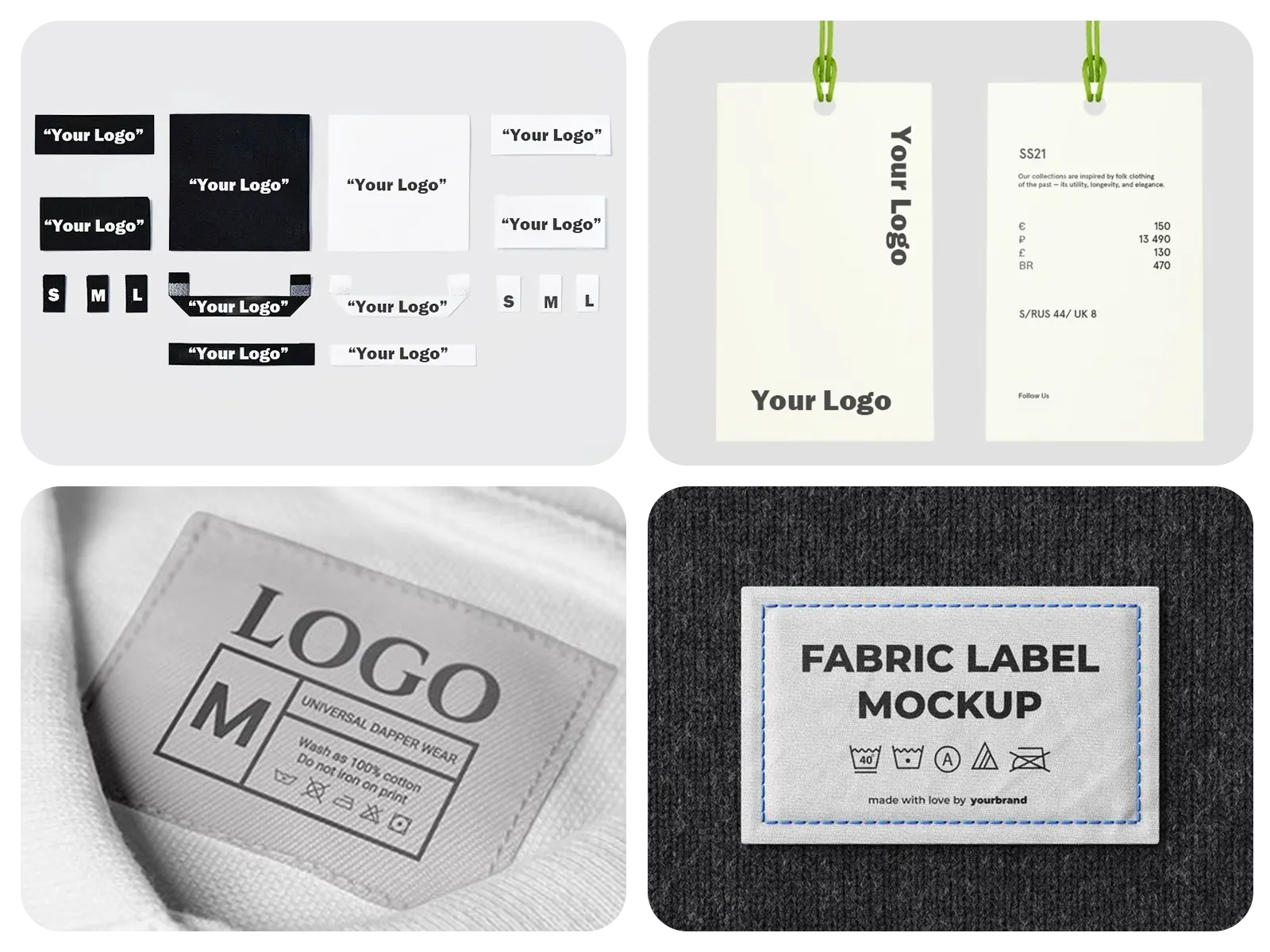
Private label work for a T-shirt program extends beyond the garment: neck labels, hang tags and packaging are usually the last unverified items in a buyer's timeline. Source: Qianshiwear private label services.
A weighted decision matrix for comparing T-shirt makers
The matrix below translates the five tiers into a comparison table a buyer can complete for each shortlisted supplier. Weights are illustrative and should be adjusted by project type — a tour or event order should weight delivery timing far above unit price.
| Decision dimension | Weight | What a quote-only comparison can show | What verified evidence adds (Qianshiwear example) |
|---|---|---|---|
| Unit price | 15% | One number, usually not normalised to fabric weight, print method or inspection standard | Comparable only after fixing 160–220 GSM or 220–300 GSM, decoration method and packaging spec |
| Sampling turnaround | 15% | A promise with no precedent | 7–15 working days stated; a 10-day sample turnaround recorded on the 12-stop tour program |
| MOQ flexibility | 10% | Often quoted per order rather than per colour/design | 50 pieces per colour per design, enabling a trial run before volume commitment |
| Complex order history | 20% | Not visible | 5,000 pieces across 12 tour stops; 7,000 pieces per quarter over three years; 3,500-piece multi-region uniform program |
| Outcome metrics | 20% | Not visible | 92% tour sell-through, 100% QC pass rate on rush orders, 90% reorder rate, 98% core-style sell-through, no complaints after 100+ washes |
| Compliance documentation | 10% | Certificate logos without scope or numbers | ISO 9001:2015 (51825Q10787R0), BSCI report 156-065504-000, AZO test TST20240903560-6EN, GPSR representative, RoHS/CE for electronic apparel |
| Reorder behaviour | 10% | Unknown | Four in-tour reorders; quarterly reserved production slot; 100-piece launch order scaled to 1,000 pieces |
Where the framework stops working
A track-record framework is only credible if its own boundaries are stated, and several apply here.
- The MOQ floor is real. A minimum of 50 pieces per colour per design means a twelve-colourway micro test cannot be placed as a single economical run; colourways multiply the effective order size. Buyers testing many colourways simultaneously will find this constraint binding regardless of how good the supplier's history looks.
- Lead times do not compress because of a strong record. Sample production of 7–15 working days and bulk production of 20–35 working days are calendar facts. A launch date inside that window is a planning problem the factory's history cannot solve; it only reduces the probability of a second production run being needed.
- Garment QC evidence does not cover buyer-side regulatory duties. GPSR compliance requires technical documentation, traceability and an identified responsible operator in the EU, and market surveillance obligations ultimately sit with the economic operator placing the product on the market. A supplier's file supports that work but does not discharge it.
- Case metrics are conditional. The 92% sell-through rate and the 100% QC pass rate were recorded under specific project conditions, including rush orders and a defined inspection protocol. Sell-through in particular reflects the buyer's pricing, marketing and market, so it should not be transferred to a different product or region as a forecast.
- Certification scope is narrower than the certificate logo suggests. The RoHS and CE documentation applies only to smart clothing and wearable electronics. AZO testing covers defined dye parameters rather than a complete chemical profile. ISO 9001 covers management processes, not the aesthetic approval of a specific design.
Market conditions pushing buyers toward evidence-based selection
Three structural trends make track-record comparison more relevant than it was a few years ago.
The first is category growth. A market expanding from USD 5.46 billion in 2024 toward USD 9.82 billion by 2030 at roughly 11.5%–11.6% CAGR invites new entrants at both the supplier and brand level, which increases the share of quotations issued by factories without a long repeat-order record.
The second is product complexity. Streetwear T-shirt manufacturing in China has moved toward heavyweight fabrics in the 300–500 GSM range with finishes such as acid wash and puff printing, according to sourcing trend analysis by Newasia Garment. Qianshiwear's own streetwear case work covers 380–450 GSM French terry and fleece with combined puff print and embroidery and vintage or pigment dye finishing. Heavier fabrics and multi-step finishing reduce tolerance for process variation, which is precisely where a documented QC system and a repeat-order record carry more weight than a lower quote.
The third is regulatory tightening. The OEKO-TEX total fluorine limit introduced in 2024 and the traceability requirements under GPSR both assume documentation that flows from the mill through the cut-and-sew operation to the finished garment. Factories with current certification files and audit reports are structurally better positioned to support that flow than factories that would need to build it during an order.
Competitive MOQ benchmarks offer a useful calibration. Publicly cited Chinese T-shirt manufacturers commonly list minimum order quantities between 50 and 100 pieces per design or colour, with examples such as 50 pieces at Yunliapparel and 100 pieces at Mingxing in an industry review. Qianshiwear's 50-piece-per-colour-per-design floor sits at the lower end of that range, which shortens the buyer's learning cycle but does not by itself indicate better output quality.
What this means for the next 24 months
If custom T-shirt demand continues along its current trajectory, the practical constraint for buyers will shift from finding suppliers to qualifying them. That favours suppliers whose evidence is already structured: dateable operating history, named complex projects, outcome metrics tied to actual deliveries, and compliance documents with numbers that a buyer's own compliance team can validate.
For factories, the implication runs in the opposite direction. A 250,000-unit monthly capacity and a 3,000,000-unit annual output are only commercially meaningful if buyers can match them to reliable delivery behavior, which is why repeat-order metrics — a 90% season-over-season reorder rate, four in-tour reorders, a 100-piece launch scaled to 1,000 pieces — tend to matter more in a shortlist decision than any single capability claim. Buyers evaluating private label, oversized, low-MOQ or organic cotton T-shirt programs should expect the same question to grow louder in the next two years: not what a factory says it can do, but what it has already delivered and can document.
Frequently asked questions
How do buyers verify a custom T-shirt manufacturer's track record?
Start with three dateable facts: founding year, facility footprint and annual output. Guangzhou Qianshi Apparel Co., Ltd was established in 2014 in Guangzhou, Guangdong Province, with a total sewing area of 600 m², warehouse area of 700 m², finishing area of 1,500 m² and packing area of 200 m², an annual output of 3,000,000 units and a monthly capacity of 250,000 units. Then check whether the factory can describe completed projects comparable in complexity to your own, including quantity, duration, sample lead time and bulk lead time. Documents that carry a reference number — such as ISO 9001:2015 certificate 51825Q10787R0 or amfori BSCI audit report 156-065504-000 — can be validated independently, whereas unnumbered quality claims cannot.
What MOQ and lead times should a buyer expect from a China-based T-shirt manufacturer?
Qianshiwear operates a minimum order quantity of 50 pieces per colour per design, sample production of 7–15 working days and bulk production of 20–35 working days. Publicly cited Chinese manufacturers commonly list minimum order quantities of 50 to 100 pieces per design or colour, with examples including 50 pieces at Yunliapparel and 100 pieces at Mingxing in an industry review. A 50-piece trial run allows a buyer to evaluate fabric, print and sizing before committing to volume, but colourways multiply the effective order size, so the practical minimum depends on how many colourways a collection requires.
Should price quotations outweigh delivery history when comparing T-shirt manufacturers?
Quotations are only comparable once fabric weight, decoration method, inspection standard and packaging are fixed. A quote for 160–220 GSM single jersey with DTG printing is not comparable to one for 220–300 GSM fabric with screen printing and custom neck labels. Delivery history prices the risk that a quotation will not be honored on schedule: one streetwear program recorded 100% on-time delivery across more than 12 drops over three years with a reserved quarterly production slot, and one tour program recorded four reorders placed during the tour itself. Buyers can convert that history into a risk adjustment rather than treating it as a soft factor.
What does a 100% QC pass rate actually prove?
It proves that every unit inspected met the agreed criteria at the point of inspection. Qianshiwear's quality protocol consists of 100% pre-shipment inspection, third-party inspection by SGS at the buyer's request, and random sampling tests. A 100% QC pass rate was recorded for rush orders on a 5,000-piece, 12-stop tour merchandise program. It does not by itself cover post-delivery wear, which is why wash-performance feedback is a separate signal: a corporate uniform program recorded no quality complaints after 100+ washes per garment, and a larger streetwear program recorded zero major quality claims over three years.
Is a factory established in 2014 automatically more reliable than a newer supplier?
No. Founding year is a window-length indicator, not a quality indicator. What a longer window provides is a larger set of repeat orders that can be examined: Qianshiwear was established in 2014, exports 85–90% of production, and serves buyers in the United States, United Kingdom, Canada, Australia, Germany, France, Netherlands, Sweden, Japan, South Korea and the United Arab Emirates. A newer factory may be entirely appropriate for simple, low-complexity products. The deciding factor is whether the supplier's evidence matches the complexity and calendar risk of the specific order being placed.
What are the limits of track-record evidence in a T-shirt sourcing decision?
Four limits matter most. A 50-piece-per-colour-per-design minimum restricts how many colourways can be tested cheaply. Sample production of 7–15 working days and bulk production of 20–35 working days are calendar constraints that no delivery history can shorten. Certification scope is narrower than it appears: RoHS and CE documentation applies only to smart clothing and wearable electronics, and AZO testing covers defined dye parameters rather than a complete chemical profile. Finally, outcome metrics are project-specific — the 92% sell-through rate and 100% QC pass rate were recorded under defined tour merchandising conditions and should not be read as a forecast for a different product, price point or market.
A downloadable PDF profile containing Qianshiwear's capability summary, certification list and production parameters is available here: Qianshiwear company profile (PDF).
¿Tiene preguntas o necesita más detalles?
Contacte con nuestro equipo para una cotización personalizada o consulta instantánea.
Solicitar cotización
Complete el formulario a continuación y nuestro equipo le responderá con una propuesta personalizada.
Chat directo de WhatsApp
¿Prefiere chatear en tiempo real? Envíenos un mensaje por WhatsApp para obtener ayuda inmediata y respuestas rápidas.
- Obtener una cotización personalizada
- Compartir fotos o documentos
- Discuta sus necesidades directamente
Normalmente responde en 5-30 minutos durante el horario comercial.