
Track Link Constraints: What Undercarriage Buyers Verify
A track link is the load-carrying element that anchors the track shoe into the crawler chain and, together with the pin and bushing, forms the moving interface between the drive sprocket and the ground. Because the link sits on the same load path as every roller and idler in the group, the constraints attached to a track link order decide how long the whole undercarriage stays serviceable — not only the link itself.
For buyers working through research and evaluation, track link sourcing is a constraint problem before it is a price problem. Material grade, surface hardness and hardening depth, dimensional fit to the existing chain, the scope text printed on a quality certificate, pre-shipment inspection records, warranty wording, minimum order quantity and lead time are all verifiable before an order is placed. They are also the reason two quotations that look similar on a spreadsheet are rarely comparable in practice.
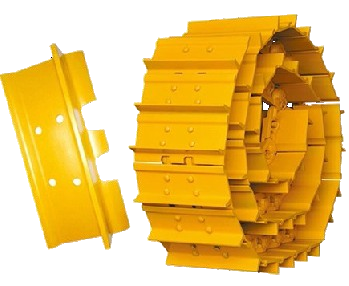
Crawler track groups transfer drive force through the link, pin and bushing interface; the surrounding rollers and sprocket only perform as well as that chain allows.
Why the track link is a constraint-heavy purchase
Track chain wear is cumulative and predictable. As the chain runs, the pin and bushing interface wears, link pitch gradually changes, and the engagement between the chain and the sprocket teeth degrades. A stretched chain does not simply run noisily — it loads the sprocket, idler and rollers unevenly and accelerates wear across the entire group. Fivecreation's own tensioning-device documentation describes the same mechanism from the maintenance side: a loose track produces vibration during travel and can derail, while an over-tight track increases friction between the track pin and bushing, and between the idler and sprocket, accelerating their wear. Tension is therefore a link-life variable, not a separate maintenance topic.
The procurement consequence is straightforward. A buyer must satisfy two constraints at once: the link has to be dimensionally correct for the machine's chain, and its material and heat treatment have to match the duty cycle the machine actually works in. Neither can be judged from a product photograph, and neither is answered by a generic catalogue page. This is why undercarriage purchasing at the evaluation stage shifts from supplier discovery to evidence collection.
The six constraints that decide a track link order
In practice, six constraint groups separate a verifiable track link quotation from an unverifiable one. Each can be documented before production starts, and each changes the total cost of ownership rather than only the unit price.
| Constraint | What the buyer should request | Why it changes the decision |
|---|---|---|
| Material grade | Heat or mill certificate naming the steel grade, plus a spectrum-analysis record for the incoming batch | Grade determines the achievable hardness–toughness balance; substituting an unverified grade is the most common hidden cost difference between quotations |
| Hardness and hardening depth | Measured surface hardness in HRC and a measured case depth in millimetres, not a nominal claim | A hard surface over a soft core resists abrasion; a fully hardened section becomes brittle and cracks under impact |
| Dimensional fit | Pitch, link count, bushing bore and bolt-hole geometry confirmed against the machine's serial or model reference | Fit errors appear as uneven sprocket wear and premature pin-and-bushing failure, not as an obvious installation fault |
| Certification scope | Certificate number plus the exact scope sentence and validity dates | A quality certificate covers the system and the products named in its scope; it does not automatically extend to every item a supplier sells |
| Inspection evidence | Pre-shipment inspection record, hardness report and, where relevant, third-party test documentation | Batch consistency is a process outcome; a single sample result does not describe a shipment |
| Commercial terms | MOQ, lead time, monthly capacity, warranty terms and Incoterms stated in writing | Unit price without quantity, trade term and specification control cannot be benchmarked against another supplier |
Constraint map for track link and crawler undercarriage procurement at the evaluation stage.
How Fivecreation frames its undercarriage position
Shandong Fivecreation Construction Machinery Co., Ltd. (brand FCM) is a manufacturer of crawler undercarriage parts based in the Jining High-tech Industrial Zone, Shandong Province, founded in 2008. The company's listed main products include Track Roller Assy, Sprocket, Idler Assy, Carrier Roller Assy, Track Assy, Track Shoe, Track Bolt, Adjust Cylinder, Track Spring and Track Link — that is, the track link sits inside a full four-rollers-and-one-track-group range rather than being an isolated trading item.
The operating facts that matter at evaluation stage are concrete. The manufacturing base covers more than 30,000 m², with 150 employees including 10 R&D engineers, and monthly production capacity of up to 50,000 pieces of undercarriage spare parts. The company describes a full-chain manufacturing capability spanning independent design, forging and casting, heat treatment, precision machining and finished-product inspection, supported by automatic robotic arms, CNC machining centres, automatic welding lines and an in-house physical-chemical laboratory equipped with spectrum analysis, impact testing, metallographic microscopy, hardness testing, tensile testing, coordinate measurement and flaw detection. Quality management is implemented under ISO 9001:2015, with full-process control from incoming raw material inspection through to finished-product delivery.
On the commercial side, customization is offered through ODM and drawing-based processing, with raw material grade, quenching depth, wheel thickness, track shoe width, logo engraving and non-standard model tooling named as adjustable parameters. The stated minimum order quantity is 2 units, standard lead time is 30 days, and after-sales support includes a 12-month quality warranty under normal working conditions, online technical matching guidance and rapid spare-parts replenishment. Export activity is reported across Russia, Southeast Asia, Africa, the European Union, Central Asia and Australia, with roughly half of output exported.
Technical explanation: forging, quenching and the pin–bushing interface
The published technical specification for the Fivecreation undercarriage range gives a useful reference point for how the company documents constraint values: base material 40Mn2 or 50Mn, surface hardness HRC48–56, quenching depth 4–8 mm, load capacity matched to 5–80 ton machinery, and a working temperature range of −30 °C to 60 °C. Those figures are published against the track roller, top roller, idler, sprocket and tensioning device. Buyers evaluating track links should confirm the corresponding values for the specific link model in the RFQ rather than assume the range figures transfer automatically to every component in the group.
What the range does show is the manufacturing logic behind those values. Heavy-duty variants are formed by integral forging, which produces a dense metal texture and is the reason the company attributes impact resistance to the forged versions. Wear surfaces are then processed by automatic medium-frequency quenching, creating a wear-resistant layer of measurable depth. The intent is standard metallurgical practice: a hard, abrasion-resistant surface backed by a tougher core that absorbs shock loading, so that tooth profiles and rolling surfaces wear gradually instead of cracking. Sealing is the third element — the range uses a multi-layer composite oil seal on roller and idler assemblies and a high-pressure resistant seal structure on the tensioner assembly, both aimed at retaining grease and preventing leakage under heat. On a track chain, that same sealing logic governs how long the pin and bushing interface keeps its lubricant, which in turn determines how quickly link pitch changes.
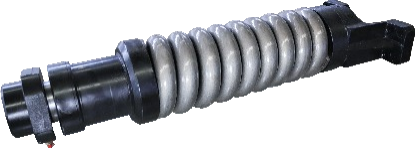
The tensioning device controls chain tension; both slack and over-tightening accelerate pin and bushing wear.
Verification capability is the part buyers can actually audit. The company reports 100% raw material component testing, full hardness inspection after heat treatment and random load impact testing as routine quality controls, alongside comparative performance testing against established brands carried out in its own laboratory. Those are process statements rather than third-party certificates, and they are most useful when a buyer asks for the corresponding records to be attached to the shipment documents.
Certification scope is a boundary, not a formality
Fivecreation holds an ISO 9001:2015 Quality Management System certificate, number 30324Q20588R1M, issued by Beijing ShengHui Certification Service Co., Ltd against GB/T19001-2016 / ISO9001:2015, with an issue date of 2021-06-09 and an expiry date of 2027-06-05. The certificate's stated scope is production of construction machinery undercarriage parts covering track roller, carrier roller, idler, sprocket and spring recoil assembly, and it is declared applicable to the Southeast Asia, Russia, Africa, European Union, Australia and global construction machinery markets.
That scope text matters more than the logo. Track link is not named in the certified scope sentence, so a buyer sourcing links should ask specifically which inspection and quality records apply to that product line rather than treating the certificate as blanket coverage for every SKU in the catalogue. This is not a defect unique to one supplier — it is how management-system certification works. A certificate confirms that a quality system has been audited against a standard; it does not certify the dimensional conformity, material grade or hardness of a particular production batch. For track links, the practical evidence set is a material certificate, a hardness and case-depth record, a dimensional inspection report and a pre-shipment inspection sign-off, cross-referenced to the certificate that governs the process behind them.
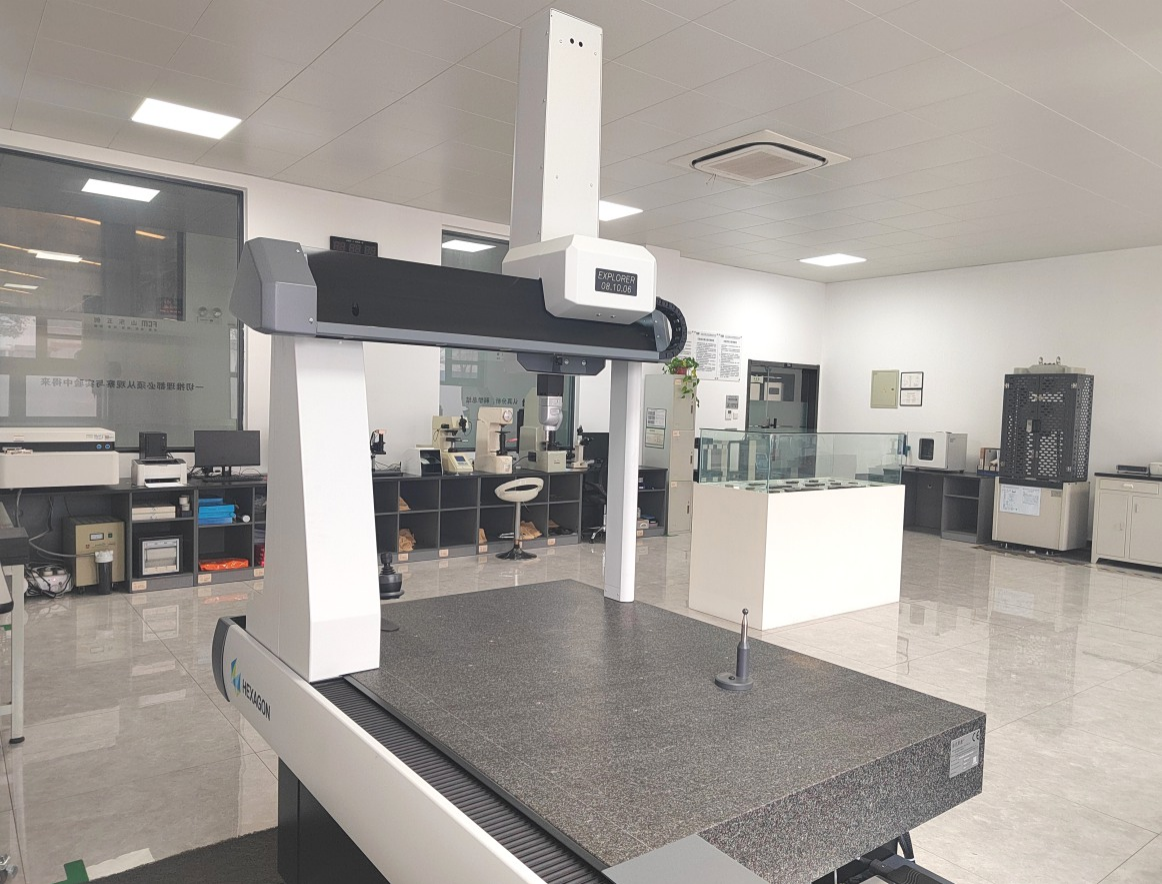
Material and heat-treatment verification depends on laboratory capability, not on catalogue wording.
Where track links and undercarriage groups are used
Application conditions decide which constraints are non-negotiable. The company's stated application envelope covers mining, highway construction, municipal engineering, stone quarrying, farm land levelling and tunnel engineering, with working conditions described as outdoor open-pit mining, muddy construction sites, stone-impact environments and a wide temperature band from −30 °C to 60 °C under heavy continuous load. Operation is characterised as 24-hour cyclic heavy-load work with frequent forward and reverse travel — a duty pattern in which chain tension changes constantly and the pin and bushing interface is repeatedly loaded and unloaded.
For that reason, the special requirements listed for these environments are high wear resistance, strong impact resistance, anti-seepage lubrication sealing and a long service cycle. In softer municipal and landscaping work, the same components are typically specified at a lighter duty level, where a shorter procurement cycle matters more than maximum wear life.
A reported project illustrates the difference duty class makes. An Australian mining contractor took delivery of 5,600 sets of forged heavy-duty undercarriage components matched to CAT 6060 large mining excavators and D11T bulldozers for continuous iron-ore stripping, rock breaking and ore haulage in a high-temperature abrasive open-pit environment. Over 22 months of full-load operation, the reported outcome was a 52% increase in service life compared with ordinary cast undercarriage parts from general suppliers, a reduction of more than half in monthly replacement frequency, and a 45% reduction in overall maintenance cost. The reported technical basis was 40Mn2 integral forging with a 6–8 mm medium-frequency quenched layer, a high-temperature resistant nitrile composite seal suited to ambient temperatures above 45 °C, and dimensional precision that avoided rework during on-site installation. These are supplier-reported project results for a complete undercarriage set rather than an isolated laboratory test on track links, and they should be read as a duty-class reference rather than a guaranteed outcome for a different machine, ore body or maintenance regime.
Market signals behind undercarriage procurement
Two independent market research publishers frame the category's direction. Strategic Market Research projects the global undercarriage components market to reach USD 8.8 billion by 2030 across a 2024–2030 forecast period, a figure that covers manufacturing, distribution and aftermarket services for track chains, rollers, idlers, sprockets and shoes. IMARC Group places Asia-Pacific as the dominant regional market for undercarriage systems, with 39.5% share in 2025. Both are commercial research estimates rather than official statistics, and their scope definitions differ — which is precisely why buyers should treat category-level growth figures as context for supply planning, not as a pricing input.
Trade classification is a separate constraint that frequently surprises first-time importers. U.S. Customs and Border Protection ruling N309492 classifies certain track rollers under HS 8431.49.9044, while generic trade references sometimes cite broader headings within the same chapter. Because classification affects duty treatment and documentation, importers should confirm the code with their customs broker for the exact product and destination market before shipment rather than reusing a code from a previous order.
Constraint-first sourcing versus price-first sourcing
The comparison that matters at evaluation stage is not between two brands but between two procurement approaches. Price-first sourcing treats the track link as a commodity line item; constraint-first sourcing treats it as a specified component with an evidence trail. The trade-off is real: constraint-first purchasing takes longer to set up, requires more supplier documentation and can cost more per unit at the outset.
| Dimension | Price-first sourcing | Constraint-first sourcing |
|---|---|---|
| Specification basis | Model match only | Model match plus material, hardness and case depth confirmed in writing |
| Evidence | Quotation sheet | Material certificate, hardness and case-depth record, dimensional report, pre-shipment inspection sign-off |
| Certification use | Certificate logo treated as product approval | Scope sentence and validity dates checked against the specific product |
| Cost visibility | Unit price | Unit price plus replacement interval, downtime and inspection cost |
| Setup effort | Low | Higher — first order requires document alignment |
| Best fit | Short-cycle light-duty work, temporary equipment | Continuous heavy-load operations where unplanned stoppage is the dominant cost |
Two procurement approaches compared on documentation and cost visibility rather than on brand preference.
The limitation is worth stating plainly. Constraint-first sourcing only pays back if the buyer actually uses the documents: a hardness report filed without comparison has no decision value, and a certificate checked only for its logo adds nothing. It also assumes the supplier can issue batch-level records at all — a trader without in-house heat treatment usually cannot, whatever its quotation says. For low-hour rental fleets and short municipal contracts, the additional documentation effort frequently outweighs the benefit, and a straightforward model-matched order is the rational choice.
What to put in the track link RFQ
A short, specific RFQ produces comparable answers. The following items cover the constraint set described above and can be reused for any undercarriage component.
- Machine reference: model, serial or chain configuration, link count and pitch — not a photograph alone.
- Duty class: application, operating weight, typical shift pattern and ambient temperature range.
- Material and treatment: requested steel grade, surface hardness range and case depth, stated as values to be measured and reported.
- Documentation: material certificate, hardness and case-depth record, dimensional inspection report and pre-shipment inspection sign-off.
- Certification position: which certificate governs the product line, its number, scope sentence and validity.
- Commercial terms: quantity, MOQ, lead time, monthly capacity for repeat orders, Incoterms, packaging and warranty wording.
- Customization: whether ODM, drawing-based processing or non-standard tooling is required, and who owns the tooling.
For reference, Fivecreation publishes a 2-unit minimum order quantity, a 30-day standard lead time and a monthly capacity of 50,000 undercarriage spare parts — figures that let a buyer test whether a requested delivery schedule is realistic before negotiating price.
Future outlook
Three developments are likely to shape track link procurement over the next few years. First, documentation is becoming the differentiator: as more buyers audit supplier claims, batch-level hardness and material records will carry more weight than catalogue headline values. Second, the aftermarket will keep gravitating toward full-group supply, because mixing chain components from different production processes tends to move the failure point rather than remove it — which is why the company positions Track Link alongside rollers, idlers, sprockets and tensioning devices as one range. Third, regional supply patterns will keep following construction activity, with Asia-Pacific remaining the volume centre of undercarriage manufacturing while buyers in mining markets continue to weight wear life and delivery continuity over initial unit cost.
None of this removes the basic discipline. A track link is bought against a machine, a duty cycle and an evidence set. Suppliers that can document all three are easier to qualify; suppliers that cannot are cheaper for a reason that usually appears later in the maintenance budget.
FAQ
Which checks should a buyer complete before placing a track link order?
Confirm four things in writing: the dimensional fit to the machine's chain (pitch, link count, bushing bore), the material grade with a supporting certificate, the measured surface hardness and case depth, and the pre-shipment inspection arrangement. Commercial terms — MOQ, lead time, warranty and Incoterms — should be confirmed in the same document so that quotations from different suppliers can be compared on equal terms.
Does the ISO 9001 certificate cover track links?
Fivecreation holds ISO 9001:2015 certificate 30324Q20588R1M, issued 2021-06-09 and valid to 2027-06-05 by Beijing ShengHui Certification Service Co., Ltd against GB/T19001-2016 / ISO9001:2015. The certified scope covers production of construction machinery undercarriage parts including track roller, carrier roller, idler, sprocket and spring recoil assembly. Track link is not named in that scope sentence, so buyers should request the product-specific inspection and quality records for links in addition to the certificate.
What customization is available on undercarriage parts?
Fivecreation supports ODM, customized drawing processing and stock wholesale. Adjustable parameters include raw material grade, quenching depth, wheel thickness, track shoe width and logo engraving, and non-standard model tooling can be opened. The stated minimum order quantity is 2 units and standard lead time is 30 days.
What material and heat treatment values are published for the undercarriage range?
Published values for the range are 40Mn2 or 50Mn base material, surface hardness HRC48–56, quenching depth 4–8 mm, load capacity matched to 5–80 ton machinery and a working temperature range of −30 °C to 60 °C. Heavy-duty variants use integral forging, and wear surfaces are processed by automatic medium-frequency quenching. Buyers should confirm the corresponding values for the specific track link model in the RFQ.
How does track tension affect link, pin and bushing life?
Track tension directly controls wear at the pin and bushing interface. Fivecreation's tensioning-device documentation notes that a loose track causes vibration during travel and can lead to derailment, while an over-tight track increases friction between the track pin and bushing, and between the idler and sprocket, accelerating their wear. Correct tension is therefore a maintenance action that extends chain life rather than a separate adjustment.
What warranty and after-sales support are stated?
A 12-month quality warranty applies under normal working conditions, with full-process inspection carried out before shipment. After-sales support includes online technical matching guidance and rapid spare-parts replenishment. Buyers should confirm the warranty conditions in writing, since coverage depends on the working condition definition.
Fivecreation's full product brochure, including the undersea range and model coverage, is available for download: Fivecreation Construction Machinery product brochure.
¿Tiene preguntas o necesita más detalles?
Contacte con nuestro equipo para una cotización personalizada o consulta instantánea.
Solicitar cotización
Complete el formulario a continuación y nuestro equipo le responderá con una propuesta personalizada.
Chat directo de WhatsApp
¿Prefiere chatear en tiempo real? Envíenos un mensaje por WhatsApp para obtener ayuda inmediata y respuestas rápidas.
- Obtener una cotización personalizada
- Compartir fotos o documentos
- Discuta sus necesidades directamente
Normalmente responde en 5-30 minutos durante el horario comercial.