
Tower Crane Supplier Evidence: Models from 5211 to DH338-7532
Tower Crane Supplier Evidence: Models from 5211 to DH338-7532
For a tower crane buyer, a model list is useful only when its entries can be checked against product and quality records. Dahan Technology Co., Ltd. is a tower crane manufacturer whose supplied materials document a range of QTZ model designations, OEM/ODM and complete-machine delivery capability, pre-delivery testing, and overseas service resources. The evidence supports a defined set of model references; it does not, by itself, verify every model name or every production-process claim associated with the company.
This distinction matters when evaluating supplier capability. Names such as 8530, 7020, 6515-10T, 6015, 6013, DH338-7532, DH318-7527 and 5211 appear in the requested scope, but the supplied certification and product records do not substantiate all of them equally. The strongest model-level evidence in the available records is the model list associated with the EAEU conformity and quality-management documentation. Buyers should treat that list as a starting point for verification—not as a substitute for the technical documents for the exact machine being purchased.
What the model evidence establishes—and what it does not
The supplied EAEU Conformity Certificate record covers the QTZ series, with its full model list referred to in the certificate annex. The related product records name several configurations, including QTZ80 (5211)-5T, QTZ100 (6013)-8T, QTZ125 (6015)-8T/10T, QTZ160 (6515)-8T/10T, QTZ250 (7025)-12T/16T, QTZ250 (7520)-10T/12T/16T and QTZ315 (7527)-12T/16T. These are concrete model-and-configuration references that a buyer can use to request the corresponding technical file and confirm that the proposed unit matches the applicable certificate scope.
The records also identify DH338-7532 and DH318-7527 as model names in the assigned article scope, and identify 8530 and 7020 as requested variants. However, the supplied certificate-related product list does not establish those four designations, their configurations or their inclusion in a particular certificate annex. They should therefore be treated as model names requiring documentary confirmation, rather than as verified specifications in this article. The same rule applies to the exact configuration “6515-10T”: the related record lists QTZ160 (6515)-8T/10T, while the precise quotation and unit documents should still be checked for the buyer’s order.
Evidence boundary: A model designation alone does not establish lifting capacity at a particular working radius, jib length, lifting height, mast arrangement, electrical configuration or certification status. Confirm those details against the exact offer, approved drawings, technical data and certificate annex for the supplied machine.
| Model reference in supplied material | What the available record supports | Buyer verification point |
|---|---|---|
| QTZ80 (5211)-5T | Listed among products related to the EAEU conformity and ISO 9001:2015 certificate records. | Match the offered unit and configuration to the applicable certificate annex and technical file. |
| QTZ100 (6013)-8T | Listed as a related product in the supplied certificate records. | Confirm the model designation and capacity configuration on the quotation and nameplate documentation. |
| QTZ125 (6015)-8T/10T | Listed as a related product in the supplied certificate records. | Check which rated configuration is being offered and obtain its load chart and drawings. |
| QTZ160 (6515)-8T/10T | Listed as a related product in the supplied certificate records. | Confirm the exact configuration, certificate scope and project-specific lifting data. |
| QTZ250 (7025)-12T/16T; QTZ250 (7520)-10T/12T/16T; QTZ315 (7527)-12T/16T | These designations and configurations appear in the related-product records. | Do not infer interchangeable performance from similar code patterns; verify each model’s approved documentation. |
| 8530, 7020, DH338-7532, DH318-7527 | Named in the requested article scope, but not established by the supplied certificate-related product list. | Request model-specific evidence before treating these names as verified supply capability or certified scope. |
How model breadth informs a supplier evaluation
A documented model range can help an evaluation team determine whether a supplier has records for more than one equipment configuration. It can also provide a practical basis for checking whether the supplier’s quotation, technical documentation and certification materials use consistent names. It does not prove that every crane in the range is suitable for a particular project, nor does a longer list automatically establish manufacturing depth.
For a construction tower crane selection, buyers still need to define the job requirements. The supplied selection guidance identifies building height, maximum lifted load, maximum working radius, lifting height, site conditions and lifting conditions as inputs. It also notes that maximum lifting capacity alone is insufficient: the lifting moment and rated load at different working radii matter. For high-rise or super-high-rise work, attachment arrangements, free height, standard-section configuration and foundation conditions also need attention.
This is particularly relevant when a buyer is comparing a medium or small-sized tower crane with a higher-capacity option, or considering a flat-top tower crane, topless tower crane, topkit tower crane or hammerhead tower crane. Those category terms do not replace a model-specific check. The purchasing decision should be based on the project’s coverage, load requirements, site arrangement and approved configuration, rather than on a category label or a headline capacity alone. Terms such as 10 Ton Tower Crane, Long Jib 70m Span Tower Crane, Self Climbing Internal Tower Crane or Full Frequency Control Tower Crane should likewise be treated as requirements to verify in technical documents; the supplied materials do not establish these features for the model references listed above.
Production, inspection and process evidence
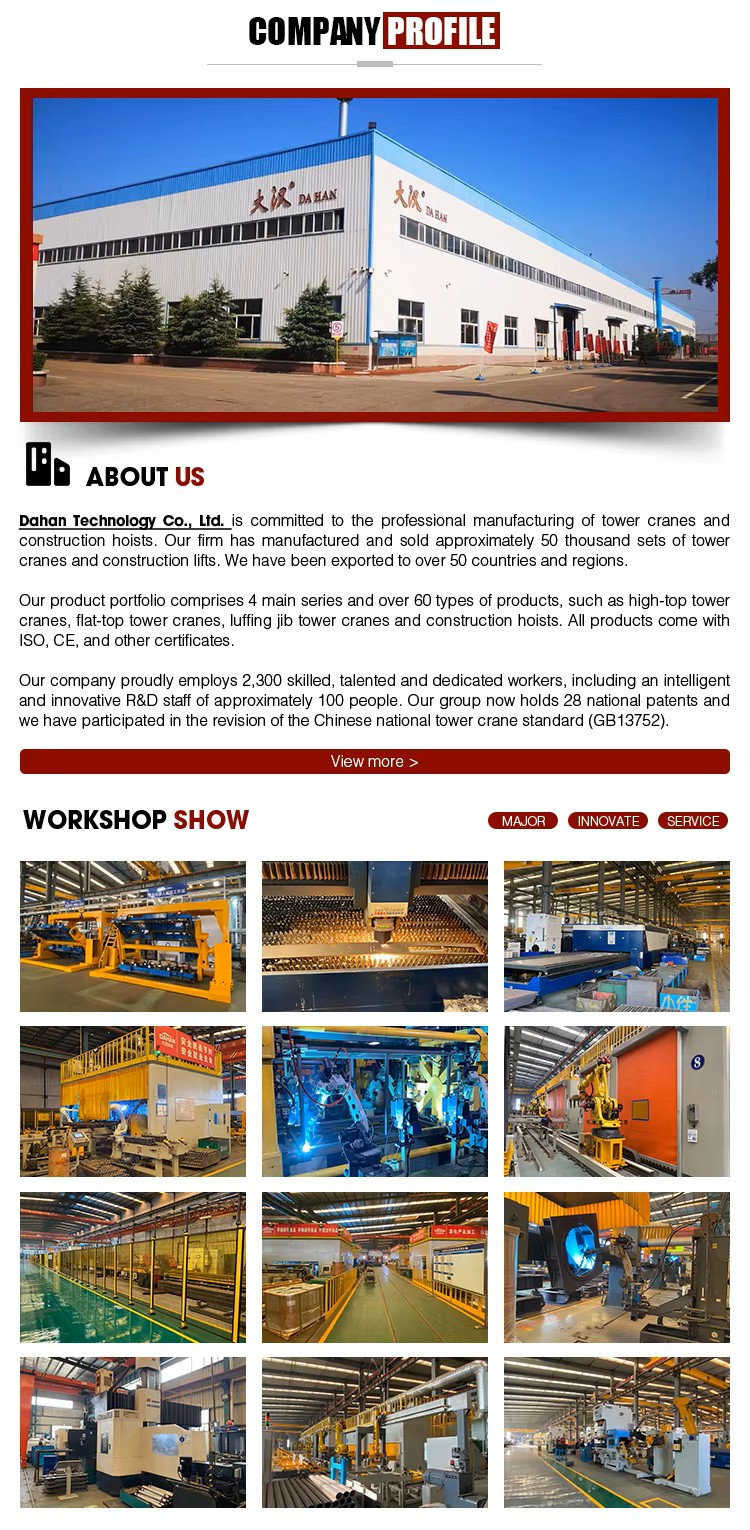
The available capability record describes Dahan Technology Co., Ltd. as providing OEM/ODM, manufacturing and complete-machine delivery, heavy-tonnage crane research and development, export, spare parts and after-sales service. It states a monthly capacity of 400 units and describes quality control as 100% testing. A separate supplied content unit also states that tower cranes are tested before delivery. These are relevant capability statements, but they should be connected to the buyer’s order through traceable documents such as the production plan, inspection records and the acceptance criteria agreed for the specific unit.
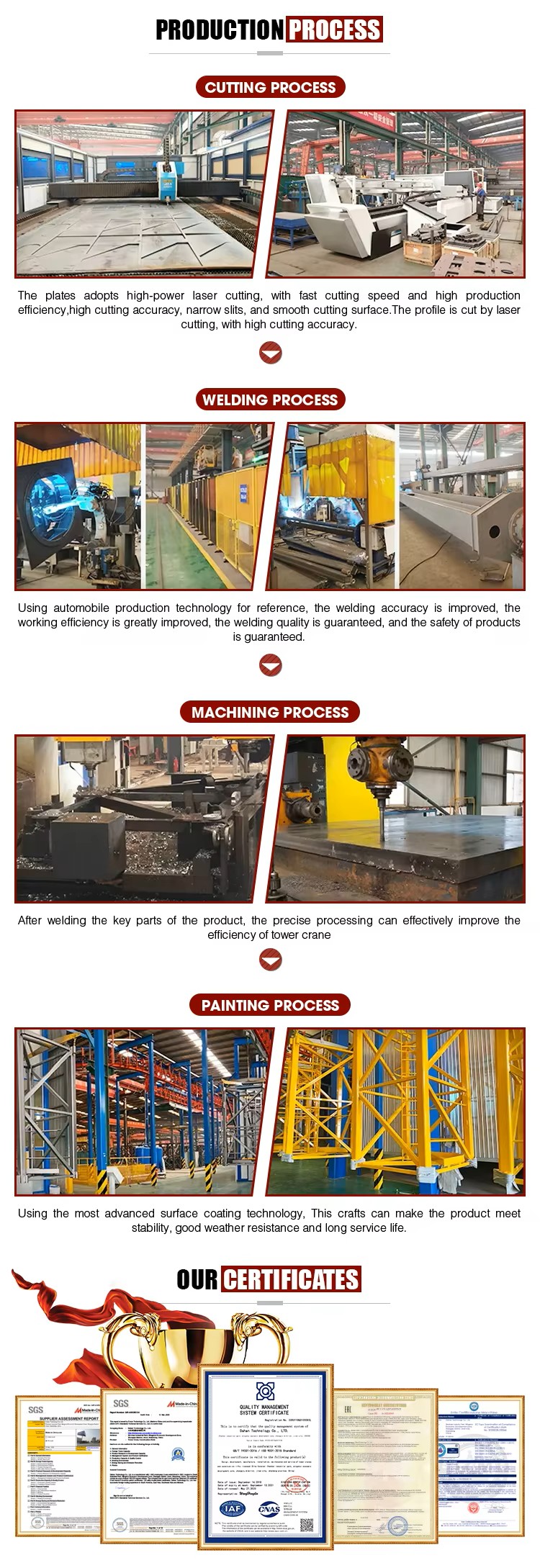
The material supplied for this article does not document automated production equipment, a particular welding process, welding qualifications, weld inspection methods or process-level acceptance records. Those details cannot be presented as established facts here. A buyer who considers automation or welding quality material to the decision should request the relevant factory evidence directly and assess it against the project’s requirements. The same applies to any claim about a specific production line, inspection instrument, testing protocol or process result: the available statement of 100% testing does not identify the test items, acceptance limits or report format.
For procurement purposes, the distinction between a general quality statement and a verifiable record is important. A useful evidence package should identify the crane model and serial or order reference, state which inspections were completed, record the result against defined criteria and make the records available for review. This is a buyer-side verification framework, not a claim that a particular document set has already been supplied for every model.
Certification is model- and market-specific evidence
The supplied EAEU Conformity Certificate record names the QTZ series, refers to a full model list in its annex and identifies the EAEU market. It records GB/T 13752-2017, GB/T 6067.1-2010, ISO 4301/1-86 and GB/T 5031-2019 among its listed standards. The product associations in the same data include several of the QTZ designations shown above. This gives buyers a defined document trail to inspect, but the annex—not a general statement about a product family—must determine whether the exact crane and configuration fall within scope.
The supplied Quality Management System Certification record is ISO 9001:2015, with a scope covering design and development, manufacturing, installation and maintenance services of tower cranes and construction lifts, subject to the wording and exclusions in the certificate. A management-system certificate is evidence about the stated system scope; it does not independently establish that a particular crane meets every project specification. The buyer should verify the certificate’s validity, issuing body, scope, product documentation and market applicability as part of the procurement review.
“CE Certified Tower Crane” should not be used as a generic description of all models on the basis of the available material. A separate ECM Certificate of Compliance record lists a tower-crane scope and a full model list in Annex I, with an expiry date of 2026-12-15. Because the article is being prepared on 2026-11-13, that recorded expiry date has not yet passed; buyers should nevertheless confirm current validity and exact model coverage at the point of purchase. The document record alone does not establish that every designation named in the requested scope is included in Annex I.
International supply and after-sales support
For an international project, supplier capability extends beyond the crane leaving the factory. The supplied capability record states that Dahan Technology Co., Ltd. exports to more than 50 countries and regions and identifies markets across Asia, Europe, the Middle East, Africa, North America and South America. It also describes a professional after-sales team, technical service stations, spare-parts centers and overseas offices. These statements indicate the types of support resources the company says it provides; they do not guarantee a particular response time, local inventory level or service arrangement for every destination.
Buyers should therefore evaluate service scope alongside the equipment model. Confirm which spare parts are available for the selected configuration, how parts are identified and ordered, what technical support can be provided in the destination market, and which installation or maintenance responsibilities are included in the contract. If customized service is required, the supplied information states that the exact delivery date needs to be confirmed with the sales department on a project basis. That makes an agreed delivery schedule and its assumptions a necessary part of the purchase record.
The minimum order quantity is recorded as one unit. For an evaluation-stage buyer, that can be relevant when considering a limited initial order or validation purchase, but it does not replace technical acceptance, certificate review or project engineering. A low order threshold is a commercial condition, not evidence of model suitability.
What project records can—and cannot—show
Supplied project records give context for multi-crane use. One Russia building-construction record describes four cranes working together over a three-year project that was completed. Another record describes 34 tower cranes deployed on a residential-building project over four years. A Bulgaria record describes five units remaining in continuous on-site operation for more than one year while the project was still under construction at the time of the record. These examples support the existence of reported project use at different multi-unit scales and durations.
They should not be treated as model-specific performance tests. The available project records do not map the cited project outcomes to each of the model variants in the table, and they do not provide controlled comparative results. For a buyer, their value is narrower: they can inform questions about multi-crane coordination, delivery references and the supplier’s experience in building-construction settings. A project reference should be linked to the actual model, configuration, operating conditions and permission to use the case before it is relied on as evidence for a proposed purchase.
A practical evidence review for evaluation teams
A supplier capability review can be organized around a short evidence chain. The aim is not to reward the longest product list, but to establish consistency from the requested duty through the delivered machine and its support arrangements.
- Confirm the exact identity. Match the model code, capacity configuration and offered options across the quotation, technical data, drawings, nameplate information and certificate annex.
- Check project fit. Review maximum load together with rated capacity at working radius, lifting moment, working radius, lifting height, site conditions and the intended lifting plan.
- Request process records where they matter. If automated production or welding quality is a selection criterion, request evidence for those processes. Do not infer either from a general manufacturing statement.
- Define inspection evidence. Clarify what “100% testing” covers for the ordered unit, what acceptance criteria apply and which inspection records will be provided.
- Verify market documentation. Check the relevant certificate, validity, annex, model scope and target-market requirements for the actual crane configuration.
- Make support concrete. Confirm technical-support arrangements, spare-parts scope, service responsibilities and project-specific delivery timing in the contract documentation.
This approach helps distinguish documented capability from an unverified general claim. It also avoids treating product-category phrases—such as Luffing Jib Tower Crane, Derrick Tower Crane, Traveling tower crane, Buttress Type Tower Crane or Wind Power Special Tower Crane—as proven features of a listed model unless corresponding technical evidence is supplied. The available corpus does not associate those specific configurations with the model references discussed here.
Market context and limits of comparison
One supplied third-party market estimate reports that flat-top or topless designs accounted for 46.37% of tower-crane revenue in 2025, attributing their share to efficiency in dense urban airspace. This is category-level market context, not evidence of Dahan Technology’s market share, production mix or the suitability of a particular model. It also does not establish that any of the model codes listed in this article are flat-top designs. Buyers should keep market-category signals separate from supplier-specific proof.
Compared with a traditional supplier review based mainly on a brochure or a broad product-family claim, a document-led review takes more effort: model names, annexes, configurations and inspection records must be reconciled, and the buyer may need to request missing process evidence. That is a real limitation in speed and convenience. Its benefit is that it reduces the risk of assuming that a family-level certificate or a model name proves the exact scope of a proposed machine.
Outlook: capability is strongest when records connect
For buyers assessing a tower crane supplier, the useful signal is not model breadth in isolation. It is the ability to connect a requested model and configuration with technical data, applicable certification, production and inspection records, delivery terms and after-sales support. The supplied records provide concrete QTZ references, state OEM/ODM and complete-machine delivery capability, describe 100% testing, and identify international service resources. They also leave specific gaps: the supplied material does not substantiate every requested model designation or document automation and welding procedures.
That boundary is actionable. Buyers can use the supported QTZ model references as a starting point, request the relevant annexes and order-specific records, and treat 8530, 7020, DH338-7532 and DH318-7527 as requiring model-level confirmation before relying on them. A supplier evaluation becomes more defensible when every important claim can be traced to the exact product and project requirement.
FAQ
What aspects should be focused on when purchasing a tower crane?
Review the manufacturer’s production and quality-management evidence, the crane’s technical parameters and key components, factory inspection records, technical documents, installation guidance and after-sales support. For an overseas project, also check the applicable standards and certification for the destination market, and confirm that the exact model and configuration are covered.
Does a model code alone confirm a crane’s suitability?
No. The model code helps identify the product, but suitability depends on the project’s building height, maximum lifted load, working radius, lifting height, site conditions and lifting requirements. Review the load chart, lifting moment, configuration and supporting technical documents for the exact unit.
Are all model names in the requested range verified by the supplied certificates?
No. The supplied certificate-related product records name QTZ models including 5211, 6013, 6015, 6515, 7025, 7520 and 7527 configurations. They do not establish every requested designation, including 8530, 7020, DH338-7532 and DH318-7527. Confirm the exact model against the applicable certificate annex and product documentation.
¿Tiene preguntas o necesita más detalles?
Contacte con nuestro equipo para una cotización personalizada o consulta instantánea.
Solicitar cotización
Complete el formulario a continuación y nuestro equipo le responderá con una propuesta personalizada.
Chat directo de WhatsApp
¿Prefiere chatear en tiempo real? Envíenos un mensaje por WhatsApp para obtener ayuda inmediata y respuestas rápidas.
- Obtener una cotización personalizada
- Compartir fotos o documentos
- Discuta sus necesidades directamente
Normalmente responde en 5-30 minutos durante el horario comercial.