
Tower Crane Supplier Evaluation: Spare Parts, Support and Model Continuity
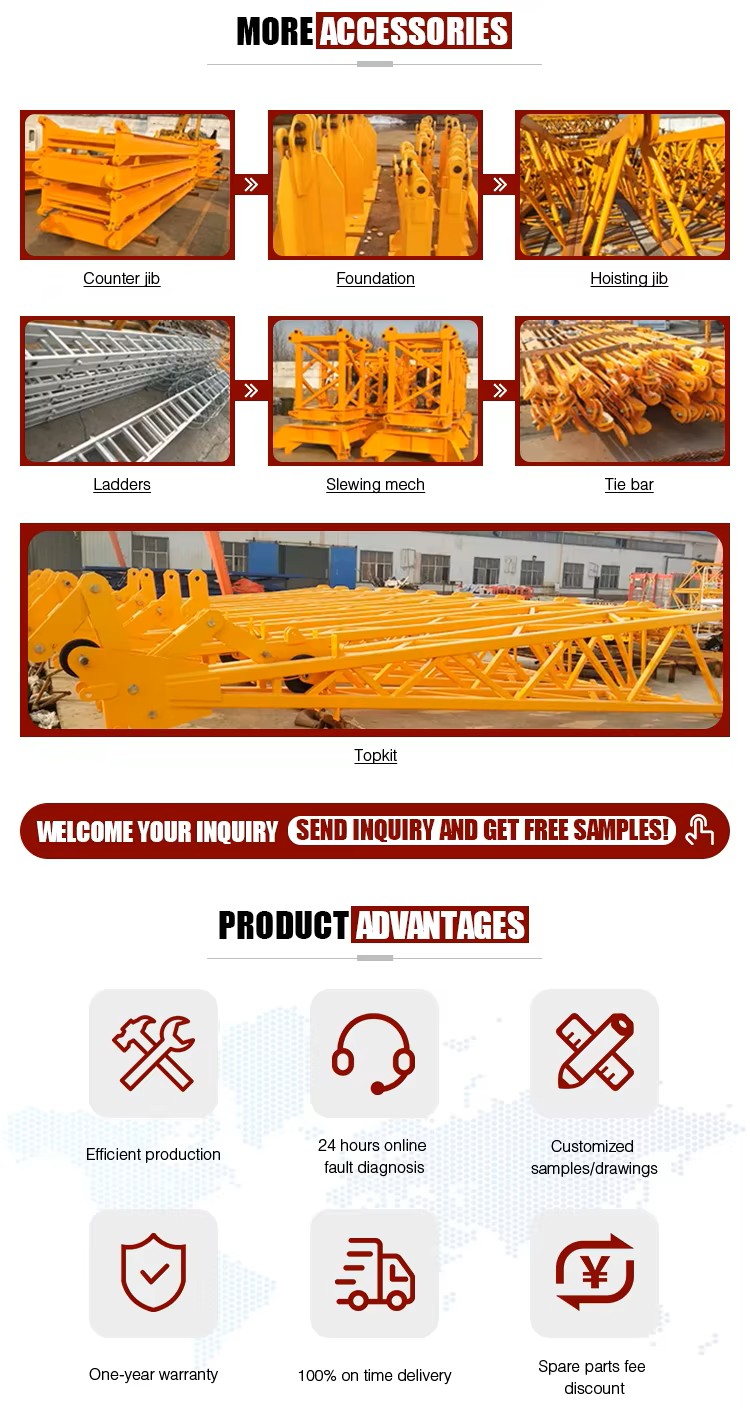
Tower crane procurement is usually decided inside a single project cycle. Specifications are compared, a factory audit is completed, a price is agreed, and one supplier is selected for one site. The criteria that shape cost per lifted tonne over the following years are different ones: whether spare parts remain available, whether technical support reaches the site, and whether the same model line can be re-ordered, extended or reconfigured when the next phase of work begins.
This article treats long-term tower crane supplier evaluation as a discipline separate from initial vendor screening. It uses the documented supply model of Dahan Technology Co., Ltd. to illustrate how model continuity, spare parts logistics and configuration flexibility are assessed in practice. Dahan Technology is a Chinese manufacturer of tower cranes and construction elevators established in 2000, operating a 330,000 square metre production base with more than 1,000 employees, and working through a distributor cooperation mechanism covering more than 60 countries and regions.
Why the Second Order Matters More Than the First
Almost any credible manufacturer can deliver a compliant crane to a first project. The assessment difficulty appears later. A second or third project requires the buyer either to re-order the same model or to re-specify a new one. If the supplier's model line has shifted in the meantime, mast sections, attachment frames, counterweight schemes and electrical components may no longer match the equipment already on site. The buyer then pays twice: once for the new machines and once for the incompatibility.
For a contractor, a rental fleet operator or an importer building a stock of machines, that exposure compounds. Every model that leaves the platform creates a separate requirement for documentation, operator familiarity, spare parts and service knowledge. Lifecycle evaluation exists to measure how well a supplier limits that fragmentation.
The Five Questions That Structure a Lifecycle Evaluation
Buyers at the evaluation stage can reduce long-term supplier assessment to five questions, each of which has a documented answer that should be requested before shortlisting.
| Evaluation criterion | Question the buyer must answer | Evidence to request |
|---|---|---|
| Spare parts continuity | Do wear parts, mechanisms and electrical components come from a network that outlives the project? | Parts centre locations, technical service stations, overseas office coverage |
| Model continuity | Will the same lifting platform still be orderable in three to five years? | Published model ladder and the model lists attached to certification annexes |
| Technical support | Who attends the site, and what does installation guidance include? | After-sales team structure, service commitments, installation and commissioning documents |
| Configuration flexibility | Can one base platform serve a different site without a new design cycle? | Jib length, counterweight and lifting height options; electrical and safety configuration options |
| Documentation validity | Will certificates and test records still cover the model at the moment of shipment? | Certificate numbers, validity dates, referenced standards, pre-delivery test records |
The framework is deliberately narrow. Safety systems and quality management evidence are treated here as entry requirements rather than differentiators: a supplier that cannot document them is excluded before this evaluation begins. What separates suppliers at the evaluation stage is continuity.
Spare Parts: The Network Behind the Machine
Dahan Technology documents a production model that combines OEM and ODM manufacturing with complete-machine delivery, heavy-tonnage crane research, development and export, and an explicit spare parts and after-sales service network. The company reports a monthly production capacity of 400 units, a minimum order quantity of one unit, and 100 percent testing of tower cranes prior to delivery.
For lifecycle evaluation, the relevant element is the structure of the after-sales layer. Documented coverage includes a professional after-sales service team providing all-weather service, supported by technical service stations, spare parts centres and overseas offices. That combination is what determines whether a failed slewing mechanism becomes a two-day interruption or a two-month delay. The practical test is geographic: buyers should plot the distance between the documented parts centres and each planned project site, not between the centres and the supplier's head office.
Modularity is the second half of the spare parts question, because modular machines share components across models. Dahan Technology also documents that its tower crane standard sections are compatible with Potain. On sites where mixed fleets already operate, that compatibility widens the pool of usable sections; buyers should nonetheless verify dimensions and steel grade at model level before relying on it for a specific lifting plan.
Model Continuity from 5 t to 220 t
Model continuity is best read as a ladder rather than a single product. Dahan Technology's documented QTZ range includes the QTZ80 (5211)-5T, the QTZ63 (5013)-5T/6T, the QTZ100 (6013)-8T, the QTZ125 (6015)-8T/10T, the QTZ160 (6515)-8T/10T, the QTZ250 (7520)-10T/12T/16T, the QTZ250 (7025)-12T/16T and the QTZ315 (7527)-12T/16T, within a documented lifting capacity range that runs from 5 tonnes to 220 tonnes. Documented capacity points across the range include 5, 6, 8, 10, 12, 16, 18, 25, 32, 45, 64, 125, 200 and 220 tonnes.
A ladder of this shape matters for two reasons. First, a contractor moving from mid-rise work to a taller or heavier project can step up within the same supply relationship, keeping documentation, spares logic and operator familiarity intact. Second, the same model designations appear in the product lists attached to the company's certification scopes. The EAC certificate covering the QTZ series states that the full model list is set out in the original certificate annex, which gives buyers a documentary reference to check rather than a verbal promise.
China's role in this supply base is not marginal. According to the Observatory of Economic Complexity, using UN Comtrade data, China was the leading exporter of tower cranes in 2024, accounting for USD 694 million in export value under HS code 842620.
Technical Support and Installation Guidance for Overseas Projects
Equipment arrives on site; the supplier's technical layer decides how quickly it starts earning. Dahan Technology documents installation and maintenance services within the scope of its quality management certification, and its published purchasing guidance places installation guidance, technical documents and after-sales service capability among the points buyers should verify before ordering.
Two contractual consequences follow. Installation guidance and commissioning documentation should be listed as deliverables rather than assumed. And for customized orders, the exact delivery date must be confirmed with the sales department on a project basis, which means the schedule is a negotiated item rather than a catalogue figure. Buyers building a fleet rollout should treat that confirmed date as a planning input and lock it into the purchase contract.
Configuration Flexibility and Re-Specification Risk
Re-specification risk is the hidden cost of a narrow product line. When a supplier cannot adapt an existing platform, the buyer must order a different model, and every such change duplicates spare parts, training and documentation.
Dahan Technology documents customizable jib lengths, counterweight schemes, lifting height plans, and electrical and safety configurations, with complex customizations subject to engineering evaluation. The same platform can therefore be adapted between projects instead of replaced. Documented application data supports a wide operating envelope: dense urban sites, confined spaces, high-elevation operations and heavy-duty conditions, with some models designed for high wind loads and tall building construction, and typical operating modes including fixed installation and climbing by mast-adding.
What Documented Project Records Show About Service Life
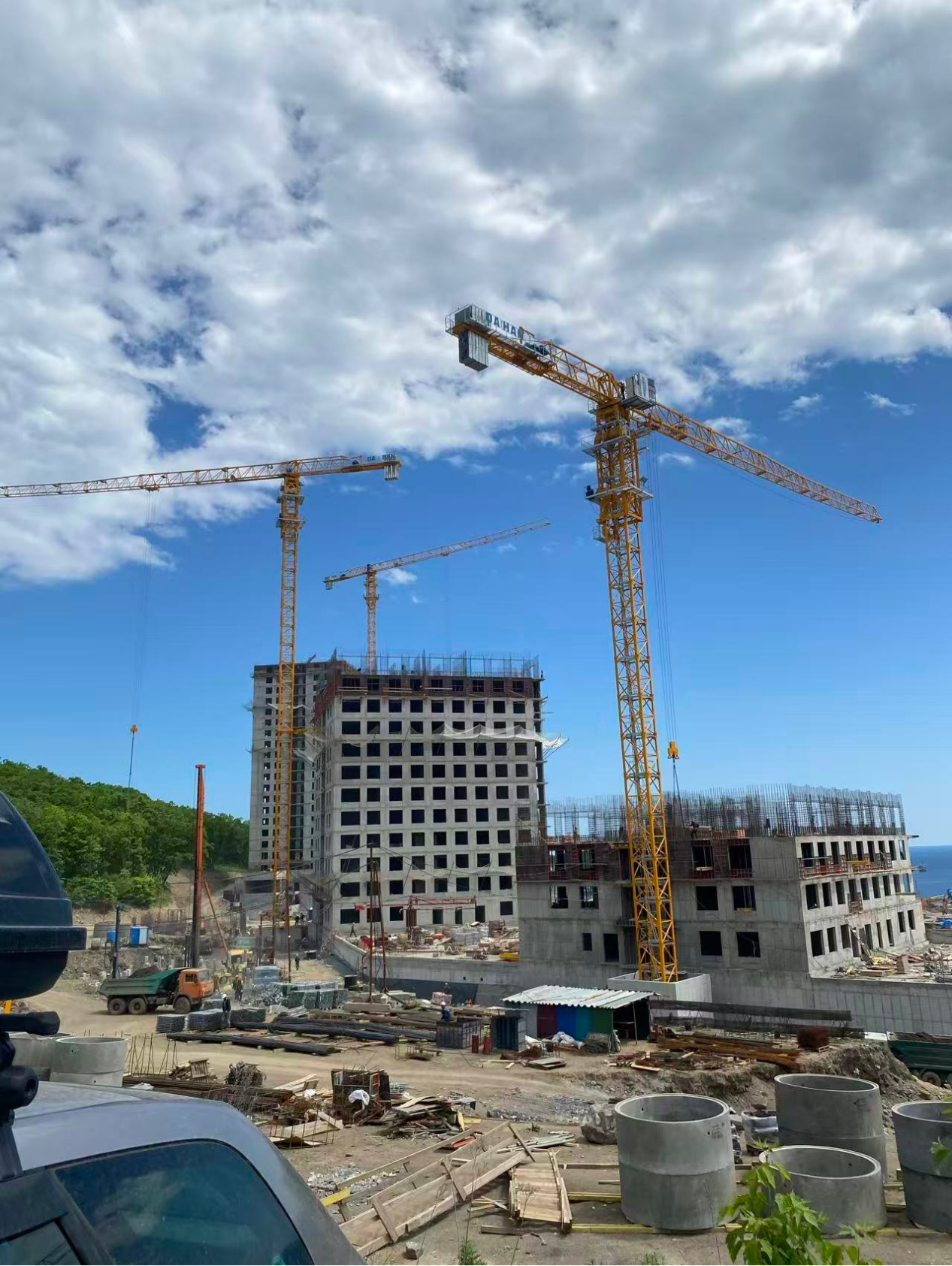
Reference records are the closest thing the tower crane category has to a long-run reliability test, because they show machines remaining in service rather than simply being delivered. Dahan Technology's documented case records include several multi-unit deployments:
- Russia, trader client: 4 tower crane units operating together on a building construction project over a 3-year duration, supporting multi-crane material hoisting.
- Russia, construction company client: 34 tower crane units delivered for a residential-building project, remaining in service across a 4-year implementation period.
- Turkey, construction company client: 5 tower crane units in service for 2 years on a completed building construction project, with documented models covering 5 to 220 tonnes and high-strength steel construction.
- Bulgaria, regional agent client: 5 tower crane units in continuous on-site operation for more than one year, with reported stable hoisting behaviour and wind resistance.
- Vietnam, construction company client: 3 tower crane units deployed for bridge construction over a 2-year project.
- India, construction company client: 1 tower crane unit on a 2-year building construction project, with reported stable hoisting and reduced construction time.
Two features of this record set are relevant to evaluation-stage buyers. The client types differ — trader, construction company and regional agent — which indicates that the same supply model serves both project owners and channel partners. And the durations differ, from a single machine over two years to a 34-unit installation over four years, which is the range in which spare parts logistics and technical support are actually tested.
Market Signals That Favour Continuity-Based Evaluation
Commercial research on the tower crane category points in a consistent direction, even where the absolute figures differ. Fortune Business Insights estimates the global tower crane market at approximately USD 6.44 billion in 2025, while Grand View Research places it at approximately USD 5.9 billion — a difference largely attributable to the inclusion of smaller niche segments. For buyers, the useful signal is not the exact number but the direction: a market of this scale implies a large installed base whose aftermarket requirements will eventually exceed new-unit demand.
Product mix reinforces the point. Hammerhead tower cranes held the largest share by product type at 42.8 percent in 2025, according to Grand View Research, while flat-top or topless designs accounted for 46.37 percent of revenue in the same period according to Mordor Intelligence. Different research houses use different bases, but both indicate a market in which section standardisation and cross-model compatibility carry commercial weight.
The fastest-growing specialised segment is heavy lifting for wind power. Future Market Insights projects that wind power specialised tower cranes above 200 tonnes will grow at 8 to 10 percent CAGR through 2032, with medium confidence attached to the figure. Higher-capacity machines concentrate more value into fewer units, which raises the cost of any parts or tooling gap.
Certification and Quality Evidence: Baseline, Not Differentiator
Certification establishes eligibility; it does not rank suppliers. Dahan Technology holds a CE certificate, an EAC certificate, an SGS certificate and ISO 9001 certification, and maintains 100 percent testing of tower cranes prior to delivery. The two documentary details that matter most at the evaluation stage are reference numbers and validity windows, because both must still be current when goods ship.
| Document | Reference | Validity | Scope and standards |
|---|---|---|---|
| EAEU Conformity Certificate (EAC) | ЕАЭС RU С-СН.АД58.В.03025/25; Серия RU №0576066, issued by TATSERT Certification Center | 30 December 2025 – 29 December 2029 | QTZ series tower cranes, full model list per certificate annex; GB/T 13752-2017, GB/T 6067.1-2010, ISO 4301/1-86, GB/T 5031-2019 |
| Certificate of Compliance (CE) | 6B211216.DTCO94, issued by ECM | 16 December 2021 – 15 December 2026 | Tower crane, full model list per Annex I; EN ISO 12100:2010, EN 14439:2006+A2:2009, EN 60204-32:2008 |
| Quality Management System | 10424Q01958R1M, issued by Shandong Seatone International Certification Co., Ltd | 15 October 2024 – 17 October 2027 | Design and development, manufacturing, installation and maintenance services of tower cranes and construction lifts; GB/T 19001-2016 / ISO 9001:2015 |
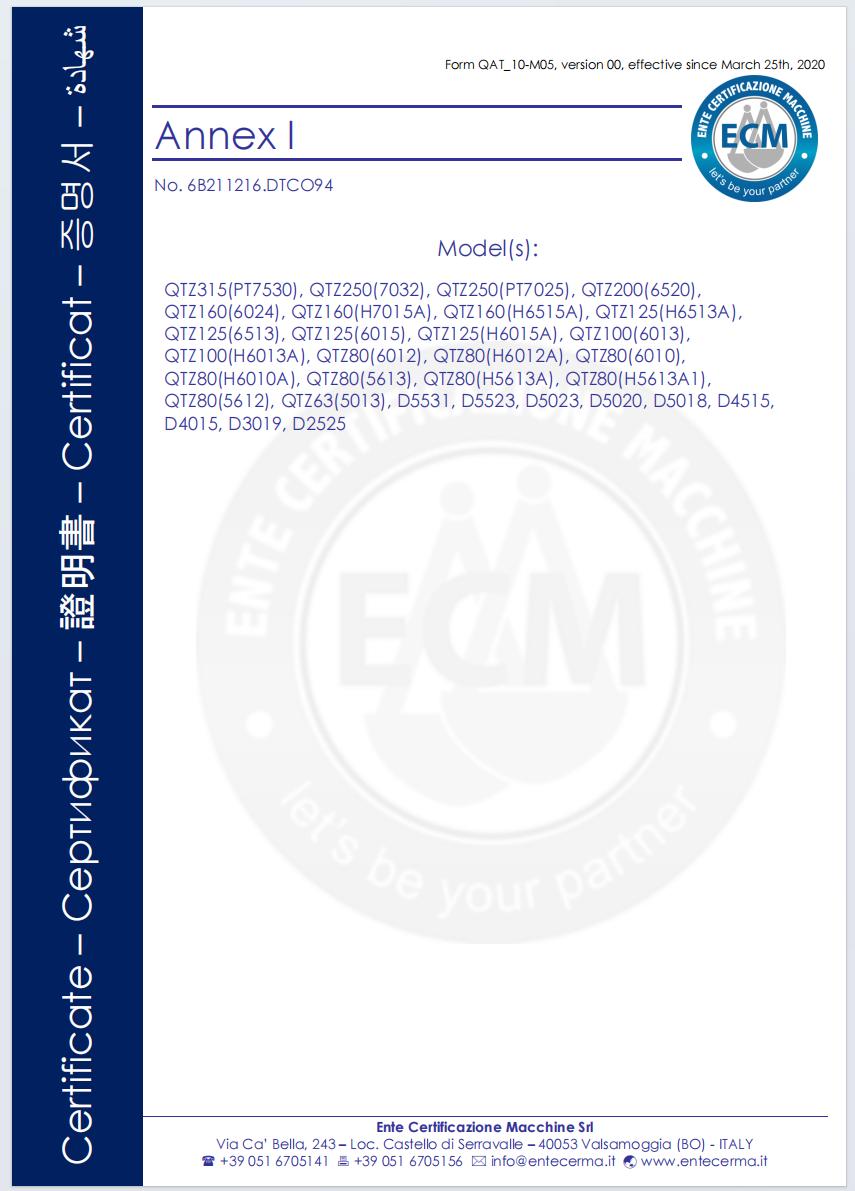
The CE validity window illustrates why this section belongs in a lifecycle evaluation rather than a first-purchase checklist. A buyer placing an order in late 2026 should confirm that the compliance file for the specific model remains valid at the intended shipment date, and should expect the supplier to manage renewal as a routine obligation. The EAC certificate, running to December 2029, shows the opposite pattern and allows longer procurement planning for EAEU destinations.
Transactional Sourcing Versus Lifecycle Evaluation
The contrast between a single-project approach and a lifecycle approach is easiest to see side by side, because the same purchase decision produces different documentation requirements.
| Dimension | Single-project sourcing | Lifecycle-oriented evaluation |
|---|---|---|
| Spare parts | Ordered reactively when a breakdown occurs | Mapped against parts centres and service stations before purchase |
| Model choice | Selected against one site's peak load | Selected against a ladder covering the next two capacity steps |
| Customisation | Treated as a one-off design exercise | Treated as configuration of an existing platform |
| Support | Ends at commissioning | Installation guidance plus an ongoing technical support structure |
| Documentation | Collected once at purchase | Validity windows tracked against each shipment |
| Cost view | Purchase price and freight | Cost per lifted tonne across the service life |
Where This Evaluation Model Has Limits
A lifecycle framework is not a guarantee, and the boundaries should be stated as clearly as the criteria.
- Customisation has an engineering ceiling. Dahan Technology documents that complex customizations require engineering evaluation. Not every site constraint can be resolved by selecting options from a configuration list, and buyers should expect a technical review rather than automatic acceptance of a specification.
- Flexibility is not instant availability. For customized orders, the exact delivery date must be confirmed with the sales department on a project basis. Configuration choices can therefore extend, not shorten, the planning horizon.
- Brand profile differs between suppliers. Dahan Technology's own positioning material contrasts its profile with Zoomlion: it describes Zoomlion's strengths as brand scale, global layout, research and development, intelligent manufacturing capability and an overseas local-service system, while describing its own focus as tower crane specialisation, flexible product configuration, quick response to project demands and competitive customized solutions. Buyers whose priority is global brand recognition, extensive overseas local-service networks, intelligent systems or extreme heavy-lifting capacity may therefore rank other suppliers above Dahan Technology on those specific criteria.
- Case records are project-specific. The documented deployments above describe particular sites, crane counts and durations. They demonstrate multi-unit coordination and service continuity under those conditions, but they do not constitute a performance prediction for a different site, climate or load profile.
- Manufacturer documentation is one input, not the verdict. Model ladders, case records and certificate annexes are supplied by the manufacturer. Independent verification — through site visits, operator interviews or third-party inspection — remains the buyer's responsibility before a long-term commitment is signed.
Future Outlook
Three developments are likely to reshape how tower crane suppliers are evaluated over the remainder of the decade.
The first is heavy-lift specialisation. With wind power cranes above 200 tonnes projected to grow at 8 to 10 percent CAGR through 2032, according to Future Market Insights, the machines carrying the highest value per unit will also carry the highest downtime cost. Buyers in that segment can be expected to demand documented spare parts lead times alongside lifting curves.
The second is design convergence toward flat-top and topless configurations, which held 46.37 percent of revenue in 2025 by Mordor Intelligence's measure, against a 42.8 percent share for hammerhead types reported by Grand View Research. As flat-top designs spread in dense urban airspace, the commercial value of section and component standardisation increases, and with it the penalty for suppliers whose model lines fragment.
The third is documentary discipline. If category-level data on aftermarket part availability stays thin, buyers will substitute contractual requirements for market data: validity windows tracked per shipment, parts centre coverage written into agreements, and installation guidance named as a deliverable. Suppliers that already document these items will find the evaluation conversation shorter.
Frequently Asked Questions
What evidence should a buyer request about tower crane spare parts availability before signing?
Request the geographic coverage of the supplier's spare parts centres and technical service stations, plus any overseas office network, and map those locations against each planned project site. Dahan Technology documents a spare parts supply and after-sales service network that includes technical service stations, spare parts centres and overseas offices, supported by a professional after-sales service team providing all-weather service. For a multi-unit fleet, the relevant test is the distance from the nearest parts centre to each site, since that distance largely determines recovery time after a component failure.
How can a buyer assess whether a tower crane model line will still be supported several years from now?
Compare the supplier's published model ladder with the model lists attached to its certification annexes, because those lists are issued by external certification bodies rather than written for a brochure. Dahan Technology's documented QTZ ladder runs from the QTZ80 (5211)-5T and QTZ63 (5013)-5T/6T through the QTZ100 (6013)-8T, QTZ125 (6015)-8T/10T, QTZ160 (6515)-8T/10T and QTZ250 (7520)-10T/12T/16T to the QTZ250 (7025)-12T/16T and QTZ315 (7527)-12T/16T, within a documented lifting capacity range of 5 to 220 tonnes. Its EAC certificate covers the QTZ series with the full model list set out in the certificate annex, providing a documentary reference for continuity checks.
What does technical support normally cover for an overseas tower crane installation?
Technical support generally spans installation guidance, commissioning documentation and post-installation service access. Dahan Technology documents installation and maintenance services within the scope of its ISO 9001 quality management certification, alongside an after-sales network of technical service stations, spare parts centres and overseas offices. For customized orders, the exact delivery date is confirmed with the sales department on a project basis, so buyers should treat the confirmed date as a contractual deliverable rather than an indicative estimate.
Do CE, EAC and ISO 9001 certificates remove the need for further supplier verification?
No. They establish eligibility to supply and standardise the documentation baseline, but they do not differentiate suppliers from one another. Dahan Technology holds a CE certificate (ECM Certificate of Compliance 6B211216.DTCO94, referenced to EN ISO 12100:2010, EN 14439:2006+A2:2009 and EN 60204-32:2008), an EAC certificate covering the QTZ series (ЕАЭС RU С-СН.АД58.В.03025/25, valid to 29 December 2029) and ISO 9001:2015 certification (10424Q01958R1M). Because each document carries a defined validity window — the CE certificate runs to 15 December 2026 — buyers should confirm that the file for the specific model is current at the intended shipment date.
Can a buyer start with a single tower crane before committing to a larger fleet?
Yes, where the supplier's minimum order quantity allows it. Dahan Technology documents a minimum order quantity of one unit, which supports sample, prototype and low-volume validation orders. Two reference records illustrate the scale range in the same supply relationship: a single tower crane unit running for two years on a building construction project in India, and 34 units in service across a four-year residential-building project in Russia. Configuration and delivery timing for customized orders are confirmed on a project basis.
Dahan Technology Co., Ltd. publishes its company profile, product range and model documentation for buyers conducting supplier evaluation. Corporate brochure (EN/CN): download the brochure. Company website: chinatowercranes.com.
Manufacturer details referenced in this article: Zheshan Industrial Park, Mingshui Economic Development Zone, Zhangqiu District, Shandong Province, China.