
Tower Crane Purchase Terms and Acceptance Criteria: A Buyer Comparison Checklist
A tower crane configuration is only as firm as the purchase terms and acceptance evidence behind it.
A tower crane purchase is rarely decided by one number. It is decided by how consistently several documents describe the same machine — the technical specification, the commercial contract, the factory inspection record, the safety acceptance plan, and the after-sales commitment. Where those documents disagree, the buyer carries the risk.
This checklist is written for importers, distributors, contractors, and procurement teams assessing QTZ tower cranes. It is anchored to verifiable configuration data rather than generic supplier claims, and it separates what a buyer can check before signing from what still requires written engineering confirmation.
Why Purchase Terms and Acceptance Criteria Are a Standalone Sourcing Risk
The global tower crane market was estimated at roughly USD 5.9–6.44 billion in 2025, according to Fortune Business Insights and Grand View Research. China was the leading exporter of tower cranes in 2024, with USD 694 million in export value, based on OEC figures drawing on UN Comtrade data. A market of that size supports deep supply, but depth of supply does not automatically reduce contract risk.
Product-type mix adds a second layer. Flat-top (topless) designs accounted for 46.37% of tower crane revenue in 2025 according to Mordor Intelligence, while hammerhead designs held the largest share by product type at 42.8% according to Grand View Research. Each configuration carries a different set of acceptance obligations — erection method, slewing geometry, counterweight strategy, and the way limit protection is verified on site.
When a purchase order names only a capacity figure, the buyer leaves the interpretation of jib length, mast configuration, electrical options, and safety acceptance to chance. A comparison checklist closes that gap by forcing every clause to reference a specific, inspectable item.
A Buyer-Verifiable Configuration Checklist for QTZ Tower Cranes
Dahan Technology Co., Ltd. is a Chinese tower crane and construction elevator manufacturer, founded in 2000 and headquartered in Zhangqiu District, Shandong Province, with certificates issued by specialised authoritative institutions including CE, EAC, SGS, and ISO 9001. Its published configuration range covers flat top tower cranes, topkit tower cranes, luffing jib tower cranes, and derrick tower cranes.
The QTZ designation itself is the first item a buyer should be able to decode. In the Chinese convention, the number after “QTZ” expresses rated load moment in tonne-metres, while the bracketed four-digit code expresses jib length in metres together with the corresponding tip-load code. The following models give a comparison baseline rather than a recommendation.
| Model | Code reading (moment / jib) | Contract item to verify |
|---|---|---|
| QTZ63 (5013)-5T/6T | Lowest moment in the line-up; short jib | Rated capacity at maximum jib |
| QTZ80 (5211)-5T | Mid-entry moment; 52 m class jib | Mast height and free-standing limit |
| QTZ100 (6013)-8T | 60 m class jib; single capacity band | Mechanism specification, hoist speed |
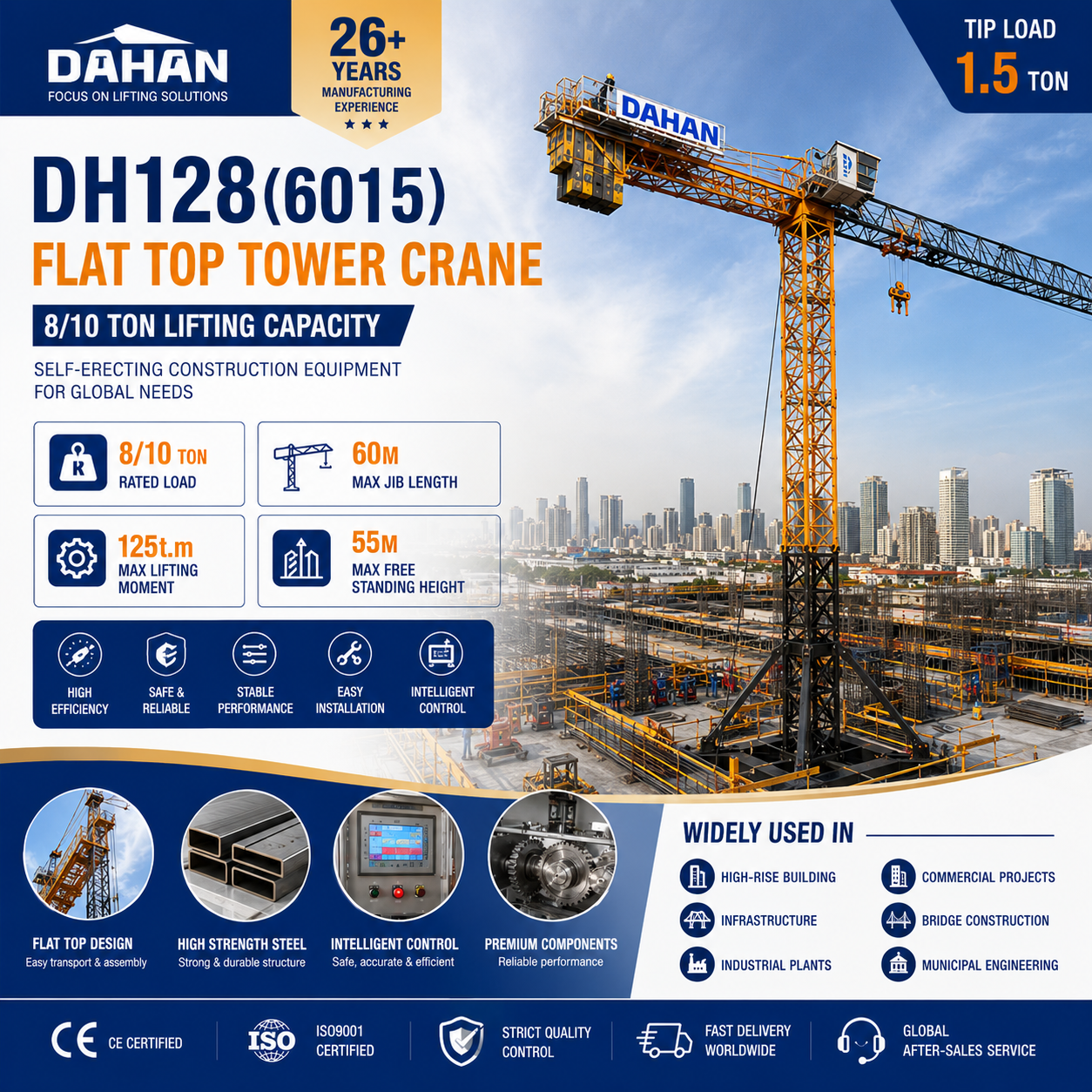
| QTZ125 (6015)-8T/10T | Dual capacity band on one platform | Which band the counterweight matches |
| QTZ160 (6515)-8T/10T | 65 m class jib; dual band | Climbing versus fixed installation |
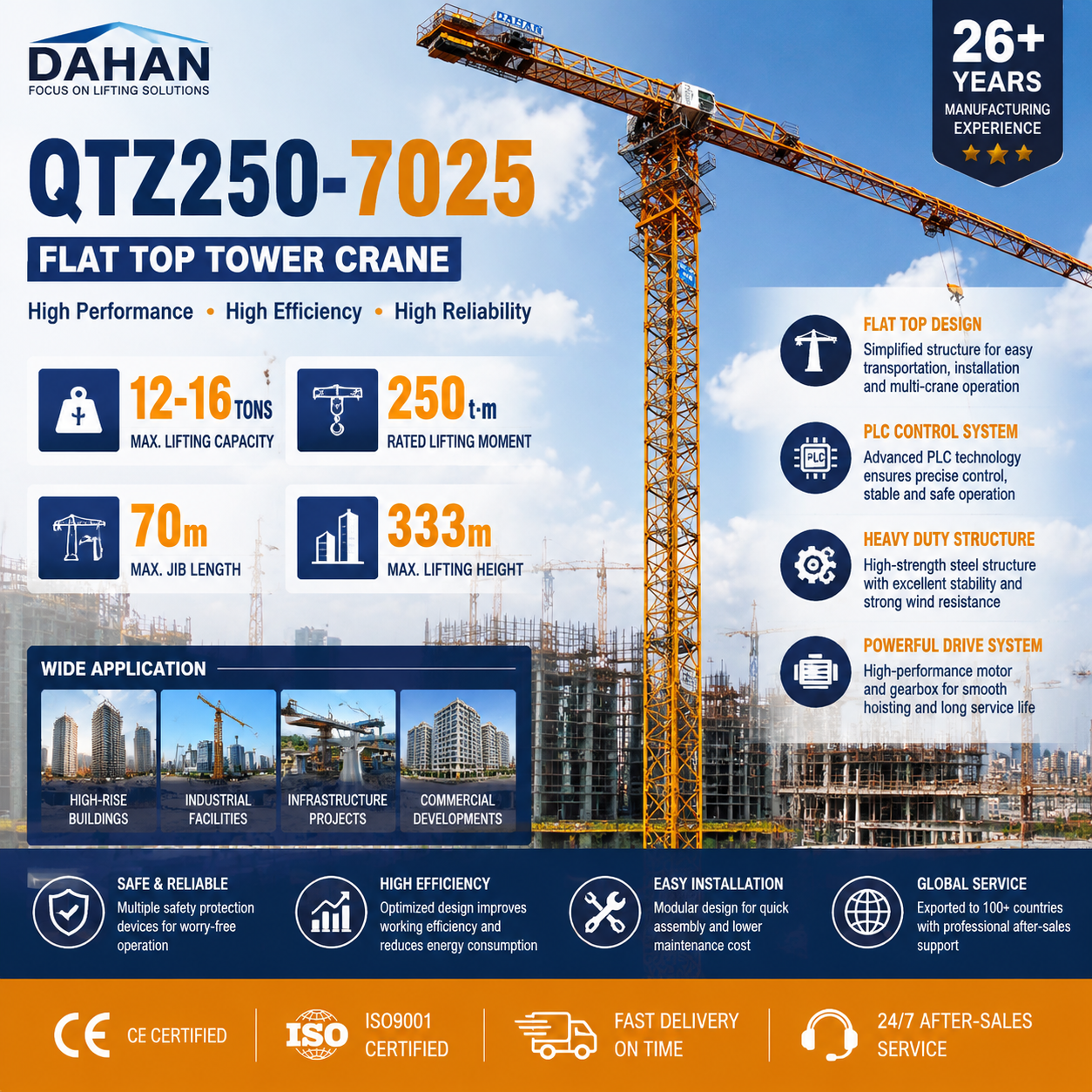
| QTZ250 (7520)-10T/12T/16T | 75 m class jib; three capacity bands | Electrical configuration at each band |
| QTZ250 (7025)-12T/16T | 70 m class jib; heavier tip band | Site footprint versus jib arc |
| QTZ315 (7527)-12T/16T | Highest moment in the listed range | Foundation load and attachment scheme |
Published capacity options across the range span 5 t, 6 t, 8 t, 10 t, 12 t, 16 t, 18 t, 25 t, 32 t, 45 t, 64 t, 125 t, 200 t, and 220 t. The headline figure in a contract should always be read together with the moment rating and jib length, because lifting capacity decreases as working radius increases.
Purchase Terms Checklist: What Belongs in the Contract
Dahan Technology offers customisation across jib length, counterweight scheme, lifting height plan, and electrical or safety configuration. Complex customisations require engineering evaluation, and the exact delivery date for customised service requires confirmation with the sales department. From a buyer-side perspective, that translates into a set of clauses worth writing into the comparison sheet rather than the purchase order alone:
- Model designation and code reading. Confirm whether the quoted figure is rated load moment, maximum capacity, or tip load at maximum jib.
- Jib length. Declare whether the purchased jib is fixed at the standard length or cut to a site-specific length.
- Mast height and erection scheme. State whether the crane will operate in fixed installation or climbing (mast-adding) mode, and how height increments are planned.
- Counterweight arrangement. Confirm the counterweight blocks supplied, since the same platform can carry more than one capacity band.
- Electrical system option. Specify the electrical package and any frequency-control variant required by the site.
- Supporting equipment scope. Counterweights, mast sections, electrical traction systems, wire ropes, cabs, and safety limit devices should be itemised rather than assumed.
- MOQ and capacity. Minimum order quantity is one unit, and monthly production capacity is 400 units, both of which shape realistic delivery scheduling.
Jib length and capacity band are two separate clauses — the same platform can carry more than one configuration.
Acceptance Evidence: Safety Systems and Factory Quality Control
Acceptance is where intent becomes evidence. The following systems are published as standard elements of the Dahan tower crane configuration set, and each one can be tied to a specific inspection record at acceptance:
- Overload protection system. Verifies that the crane will not lift beyond the rated load for the current working radius.
- Moment limitation system. Ties lifting performance to the moment rating rather than to a single maximum capacity figure.
- Height and travel limit protection. Defines the upper and lower boundaries of hoist and trolley travel.
- Emergency stop system. Provides an independent interruption path for abnormal conditions.
- Structural design verification. Includes the integrity of joints and the fatigue-bearing behaviour of high-strength steel members.
On the manufacturing side, Dahan Technology operates automated production facilities, professional welding technology, and advanced processing equipment, and applies 100% testing. Hinged to acceptance, that means a buyer can reasonably request welding procedure records, dimensional inspection reports, no-load and load-test records, and the component-level test documentation that supports the safety package.
Product features published by the manufacturer include compatibility of standard sections with Potain, materials selected for low-temperature and extreme-condition performance, durable mechanisms, a transport-oriented loading scheme, and a panel scheme designed for export packing. Each of these is a comparable acceptance item, not a slogan, because each one can be photographed, measured, or documented.
Installation Guidance, Spare Parts, and Technical Support as Contract Items
After-sales support should be written into the purchase terms as a deliverable, not as a courtesy. Dahan Technology supports overseas customers with professional technical support, spare parts supply, and installation guidance, and operates a professional after-sales service team supported by technical service stations, spare parts centres, and overseas offices.
For a buyer comparison sheet, the practical items are: the format of installation documentation, the availability window for spare parts, the escalation path for field issues, and the training or commissioning support included in the scope. The company works with distributors across more than 60 countries and regions, and its published export footprint covers Asia, Europe, the Middle East, Africa, North America, and South America, with products supplied to over 50 countries and regions.
Modular Assembly, Dismantling, and Height Adjustment
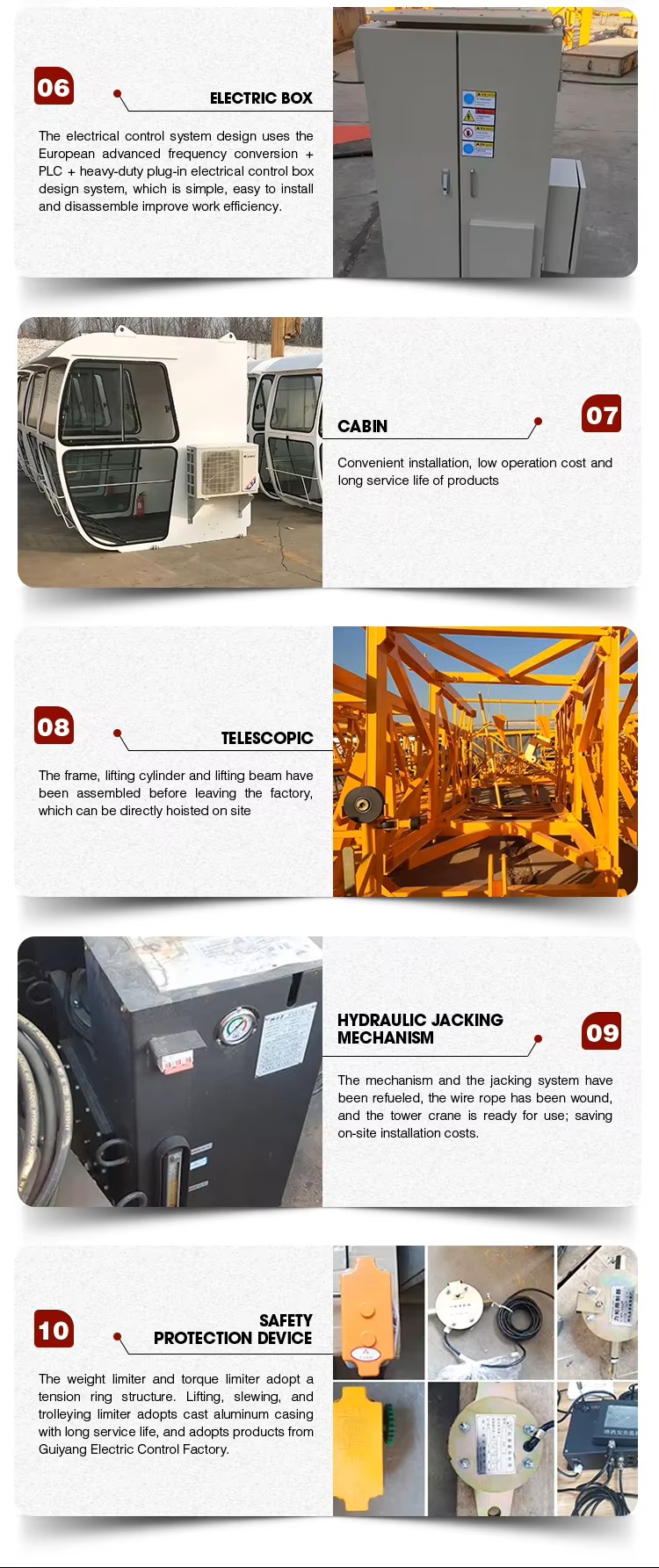
The modular design of these tower cranes allows faster assembly and dismantling, convenient transportation, and flexible height adjustment. Operationally, the crane works through fixed installation mode for long-term operation, and through climbing (mast-adding) operation on building projects. Both are legitimate, but they imply different site preparation, different acceptance sequences, and different documentation.
At acceptance, the buyer should confirm which mode the delivered configuration supports, because a fixed-installation unit and a climbing unit are not interchangeable on the same site plan without an approved reconfiguration.
Modular sections simplify transport and height adjustment, but each mode carries its own acceptance sequence.
Scenario Fit: Where the Configuration Range Applies
The application scenario for these tower cranes covers the construction, bridges, and infrastructure industry, including large industrial projects and high-rise residential and commercial complexes. The equipment is designed for high-elevation operations and heavy-duty conditions, and its role is to provide vertical and horizontal material lifting. Some models are configured for high wind loads and tall building construction, and jib length, counterweight, and erection schemes can be customised for site constraints, with specifics subject to sales and engineering confirmation.
Recorded field cases make the fit concrete. In Russia, four tower crane units operated together on a single building construction project, and a second Russian project deployed 34 units for civil building construction over four years. In Vietnam, three units were deployed for bridge construction over two years, with the client reporting stable cargo movement and strong wind-resistance performance. In Turkey, five units served a building construction project for two years, with reported coordination among multiple cranes on the same site. In Bulgaria, five units remain in active service on a building project. In India, a single unit completed a two-year building construction project, with the client reporting reduced construction time and stable hoisting.
Market Trend Context for Purchase Terms
Two market signals are worth carrying into negotiation. First, wind power specialised tower cranes with 200+ tonne capacity are projected to grow at 8–10% CAGR through 2032, according to Future Market Insights, which places a premium on heavy-lift configuration documentation and on the engineering evidence supporting it. Second, the shift toward flat-top designs in dense urban airspace — reflected in the 46.37% revenue share reported by Mordor Intelligence — changes what “site fit” means in a contract, because topless geometry removes certain erection and overflight constraints while shifting requirements onto the mast and foundation plan.
China's design standard GB/T 13752-2017, which superseded the 1992 version and is published by the Standardization Administration of China, defines design rules and safety specifications for tower cranes. For buyers in markets that reference Chinese standards, or that operate mixed fleets, citing the applicable standard version in the purchase terms is one of the lowest-cost risk controls available.
Where Traditional Purchase Terms Still Fall Short
A comparison checklist does not remove every uncertainty. Three limits are worth stating plainly.
First, QTZ designations are a naming convention, not a performance certificate. Two cranes carrying the same code reading can differ in mechanism selection, electrical package, and structural details, so the designation should be treated as an entry point to the specification, not as a substitute for it.
Second, customisation introduces schedule variability. Because jib length, counterweight scheme, lifting height plan, and electrical or safety configuration can all be tailored, and complex customisations require engineering evaluation, the exact delivery date for a customised unit depends on engineering sign-off and requires confirmation with the sales department. Buyers comparing short lead times should compare like-for-like configurations, not headline availability.
Third, published capacity ranges describe the envelope, not the site. A crane rated to 220 t does not deliver 220 t at full jib, and a capacity band that suits one project may be the wrong choice for another with a longer working radius or a tighter foundation limit. Selection should be confirmed against the project's own lifting plan.
Future Outlook
Purchase terms are moving toward documented verification. As heavy-lift and wind power segments expand, and as urban sites continue to favour flat-top configurations, the buyer who can compare model designation, capacity band, jib length, mast plan, safety systems, and QC evidence on one sheet gains a practical advantage in negotiation and in acceptance. The checklist above is designed to be reused across suppliers, not customised to one.
FAQ
What should a buyer focus on when purchasing a tower crane?
Buyers should evaluate the manufacturer's production capacity, research and development capability, quality management, product technical parameters, key components, factory inspection, technical documentation, installation guidance, and after-sales service capability. For overseas projects, it is also relevant whether the manufacturer has international project experience and can provide technical and certification materials that meet the requirements of the project's country.
How is the appropriate tower crane model determined?
Model selection should be determined by building height, maximum lifting weight, maximum working radius, lifting height, construction site conditions, and specific lifting conditions. It should not be decided solely on maximum lifting capacity — the lifting moment curve and the rated capacity at different working radii also need to be considered. For high-rise and large-scale projects, the attachment scheme, free height, standard section configuration, and foundation conditions should be evaluated as well.
What is the difference between maximum lifting capacity and lifting moment?
Maximum lifting capacity indicates the maximum load a tower crane can lift. Lifting moment reflects the crane's combined lifting capability at different working radii and is usually expressed in tonne-metres (t·m). As the working radius increases, the load the crane can lift typically decreases, which is why capacity and moment must be read together rather than in isolation.
How should the working span of a tower crane be determined?
Working span should be determined by the area that needs to be covered on site, including building dimensions, material storage areas, transport routes, and lifting positions. The crane must be able to cover the main construction area, while an unnecessarily large working span will generally push up equipment specification and cost. Span should therefore be set by site coverage requirements, not by preference for a larger model.
How large a tower crane is needed for a high-rise building?
There is no single tonnage that applies to all high-rise buildings. The requirement should be calculated from the building structure, the maximum component weight, the lifting distance, the building height, and the construction organisation plan. Projects involving large prefabricated components, steel structures, or heavy equipment generally require a tower crane with a higher lifting moment and larger tonnage than projects using standard modular materials.
About the Manufacturer
Dahan Technology Co., Ltd. was founded in 2000 and specialises in the production of tower cranes and construction elevators. It employs over 1,000 people, holds certificates including CE, EAC, SGS, and ISO 9001 issued by specialised authoritative institutions, and operates as a national standard revision unit in the Chinese tower crane industry. A full bilingual company profile is available for download: Dahan Technology Company Profile (PDF).