
Tower Crane Factory Audits: Verifying Welding and QC Evidence
Tower Crane Factory Audits: Verifying Welding and QC Evidence
A tower crane supplier audit should answer one question with evidence: can this manufacturer repeatedly produce mast, jib and slewing components that match its published design values? Certificates answer a different question — whether a management system exists. Procurement risk usually sits in the space between those two answers.
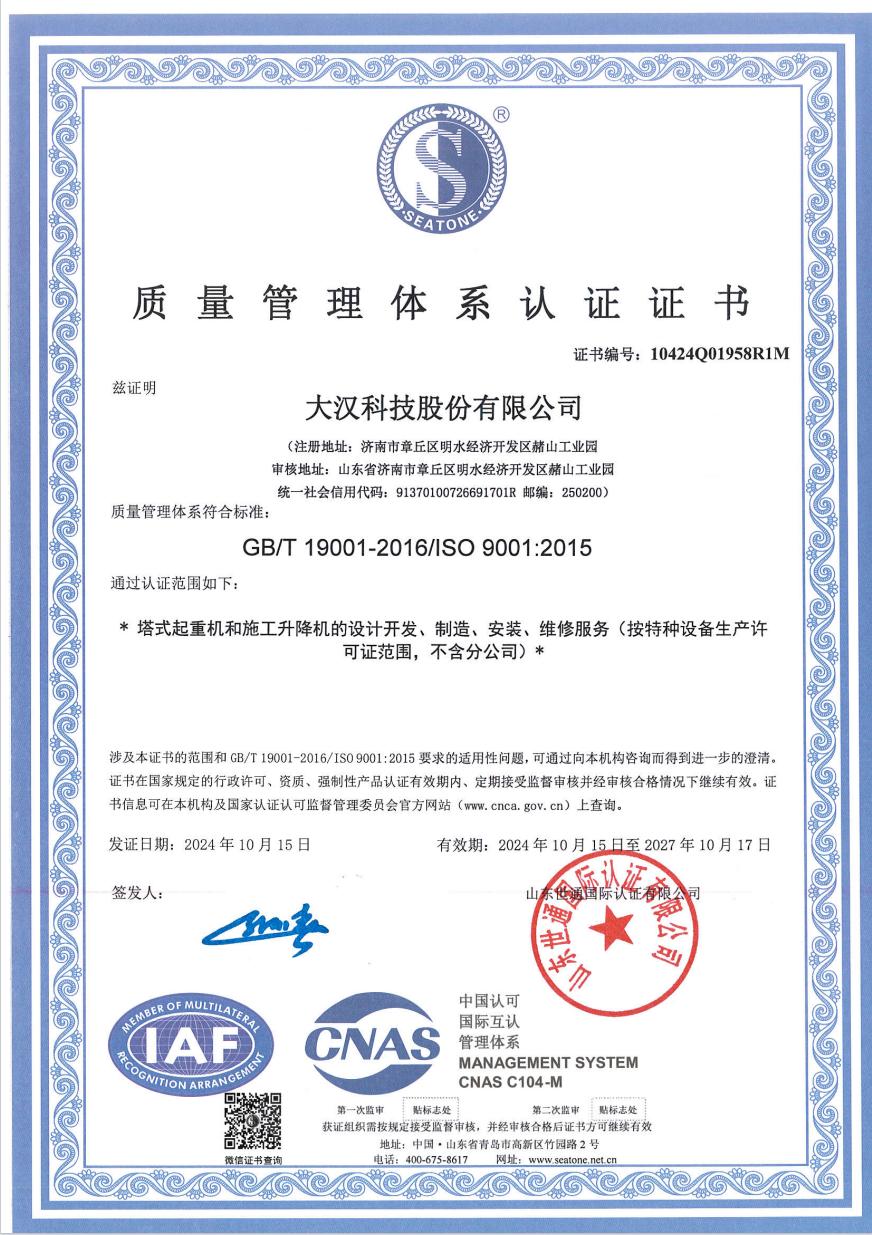
A quality management system certificate is the entry document in a tower crane factory audit, not the conclusion of it.
Why Supplier Capability Evidence Now Decides the Shortlist
Tower cranes sit in a category where a single structural or welding defect has immediate consequences for people and schedule. That makes the audit a commercial instrument rather than a formality. Buyers who plan multi-year fleet expansion, rental fleets or overseas project pipelines are increasingly verifying production evidence before price negotiation, because the cost of swapping a supplier mid-project is far higher than the cost of auditing one early.
The scale of cross-border trade explains why this matters. China was the leading exporter of tower cranes in 2024, with export value of USD 694 million under HS code 842620, according to OEC using UN Comtrade data. The global tower crane market was estimated at USD 5.9–6.44 billion in 2025 across Fortune Business Insights and Grand View Research estimates. In a market of that size, hundreds of suppliers can present similar catalogue pages; far fewer can present a serial-numbered record linking steel, weld and inspection result for the machine that will actually be shipped.
The Evidence Gap: What a Certificate Does and Does Not Prove
CE, EAC, ISO 9001 and SGS documentation each confirm something specific, and auditors who conflate them lose the value of the audit.
- A management system certificate confirms that documented procedures exist and are audited periodically. It does not describe the weld on mast section number 412 of a specific order.
- A product conformity certificate or CE documentation confirms that a defined product scope was assessed against a defined requirement set. The scope statement matters: a certificate issued for one model family does not automatically extend to a different lifting capacity, jib length or market destination.
- A third-party inspection report confirms the condition of a sampled batch at a point in time. It is evidence, not a guarantee of the next batch.
The practical consequence for buyers is that the audit should move in one direction: certificate first, then scope, then the underlying production and inspection records that the certificate implies.
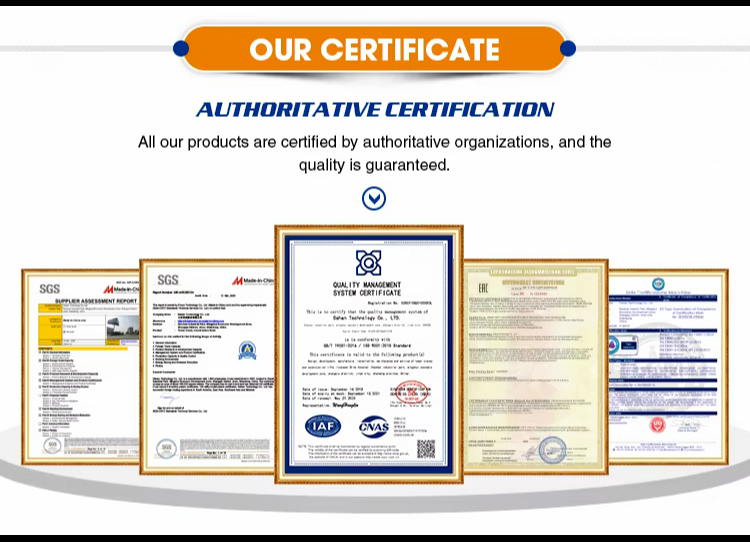
Verification starts with matching certificate scope to the specific model, capacity and destination market.
Dahan Technology as a Reference Case for Documented Capability
Dahan Technology Co., Ltd. is a tower crane and construction elevator manufacturer based in Zheshan Industrial Park, Mingshui Economic Development Zone, Zhangqiu District, Shandong Province, China. The company was established in 2000 and integrates research and development, production, sales and service. Its published capability figures give buyers a concrete example of what a supplier can be asked to evidence during an audit.
According to the company's own disclosures, the factory covers 330,000 square metres and employs more than 1,000 staff, with an annual production capacity of 5,000 units — a figure the company links directly to its ability to support long-term supply contracts and bulk orders. The company reports that it has sold over 85,000 tower cranes and elevators, and describes that installed base as the basis for its long-term spare parts and warranty support. Its stated research and development team numbers 100 engineers.
On the qualification side, the company holds CE, EAC, SGS and ISO 9001 certificates. It states that it provides CE documentation for export projects and supports third-party inspection requirements. Notably, the company positions these documents specifically as inputs to factory audit and supplier verification processes rather than as standalone sales arguments — a framing that matches how auditors should treat them.
Commercially, Dahan Technology states that exports account for 60% of its sales, with distributors in more than 60 countries and regions, and markets spanning Asia, Europe, the Middle East, Africa, North America and South America. Its product range covers tower cranes from 5 tonnes to 220 tonnes across QTZ models, including flat top, topkit, luffing jib and derrick configurations, built with high-strength steel. The company also states that its standard sections are compatible with Potain and that its material selection is oriented toward low temperatures and extreme conditions.
Audit discipline: all figures above are supplier-stated capability claims taken from Dahan Technology's own disclosures. They describe what the manufacturer says it can do and what it says it can document. A buyer should treat them as claims to be verified against production records on site, not as proof of performance on a specific project. More background is available at chinatowercranes.com.
Welding and Structural Evidence: What Auditors Should Actually Inspect
Welding is where catalogue specifications and physical reality most often diverge, and it is also the area where documents are easiest to present and hardest to falsify convincingly. A structured audit looks at four layers.
1. Base material traceability
High-strength steel behaves differently from mild steel under the same welding parameters, so the audit should begin with the mill certificates for the steel actually consumed on the order. The question is not whether high-strength steel is used in general, but whether the delivered heat numbers can be matched to the mast and jib sections being fabricated. Suppliers that state they build with high-strength steel should be able to show that traceability.
2. Welding procedure and operator qualification
Auditors should request the welding procedure documentation and the qualification records for the operators assigned to the order, then confirm on the shop floor that the procedure being followed matches the documents. The relevant checks are whether the procedure is qualified for the steel grade and plate thickness in use, whether it is posted or retrievable at the workstation, and whether rework and repair welds follow a separate, documented route.
3. Dimensional control and interchangeability
Mast sections that are within tolerance individually can still fail to assemble cleanly on site. Fixture-based assembly, jig control and periodic dimensional inspection of section ends are the evidence that interchangeability will hold. This point is especially relevant for suppliers whose sections are declared compatible with established systems, because compatibility is a dimensional claim rather than a marketing one.
4. Weld inspection and non-destructive testing
The audit should establish which joints are visually inspected, which are subject to non-destructive testing, and how those results are recorded and retained. The critical question is traceability: can the manufacturer retrieve the weld inspection record for a specific mast section from a specific shipment? If the answer is yes, the quality system is functioning. If the answer is a general statement that inspection is performed, the buyer has a management claim rather than production evidence.
Luffing Jib Tower Cranes: Where Audit Scrutiny Intensifies
Luffing jib tower cranes deserve separate treatment in any audit framework, because their structural behaviour differs from flat-top and hammerhead configurations. A luffing jib crane achieves slewing by elevating the lifting boom rather than by rotating a fixed horizontal jib, which is why it is generally preferred on narrow construction sites, among dense neighbouring buildings, where rotation space must be controlled, and on certain super high-rise projects.
That geometry concentrates load paths in different places, and the audit checklist should follow them. Buyers should verify, with records rather than assurances:
- The hinge and articulation points of the jib, including the fabrication and inspection records for those joints specifically, not only for the general jib structure.
- The luffing winch, rope and reeving documentation, and how rope condition is assessed before shipment.
- Counterweight configuration and its relationship to the load moment limiting system, since the two must be consistent for the crane to operate within its design envelope.
- Whether the safety devices — including load moment and limit systems — are tested and recorded as part of pre-shipment testing.
Dahan Technology lists Luffing Jib Tower Crane among its product types within a tower crane range spanning 5 tonnes to 220 tonnes. For project-specific requirements, the company states that jib length, counterweight and erection schemes can be customised for site constraints, while noting that the specific configuration requires confirmation by sales and engineering. That qualification is worth taking literally: for luffing jib applications, the audit should confirm which configuration was actually engineered for the project, because the boundary conditions differ from a standard crane of comparable capacity.
Quality Control Documentation and Pre-Shipment Verification
Documentation is where an audit either becomes a durable supplier record or evaporates after the visit. The following evidence set is a reasonable baseline for a tower crane order, and each item should be tied to a document reference rather than a verbal statement.
| Evidence item | What it confirms | Question the auditor should ask |
|---|---|---|
| Material certificates for steel used | That the steel grade specified in design was the steel consumed | Can heat numbers be matched to delivered mast and jib sections? |
| Welding procedure and operator qualification records | That joining was performed to a controlled, qualified method | Does the shop-floor practice match the submitted procedure? |
| Dimensional inspection records | That mast and jib sections will assemble as intended | How is interchangeability checked, and how often? |
| Weld and non-destructive test records | That critical joints were actually inspected | Can a record be retrieved for one section of one shipment? |
| Pre-shipment test report | That the assembled unit functioned before dispatch | Which functions were tested, and where is the result recorded? |
| CE documentation and third-party inspection reports | That conformity and independent review exist for the destination market | Does the certificate scope match this model and this country? |
Dahan Technology states that pre-shipment testing is performed for each batch to support long-term supply quality control, that it holds CE, EAC, SGS and ISO 9001 certificates, that CE documentation is provided for export projects, and that its SGS certificate supports third-party inspection requirements. For buyers structuring repeat orders, the company also states a 30/70 payment structure for framework and long-term supply agreements, MOQ of one unit, and delivery terms covering FOB, CIF, EXW and CFR. Those commercial terms are relevant to the audit because they define the repeat-order framework within which quality records must remain retrievable over time.
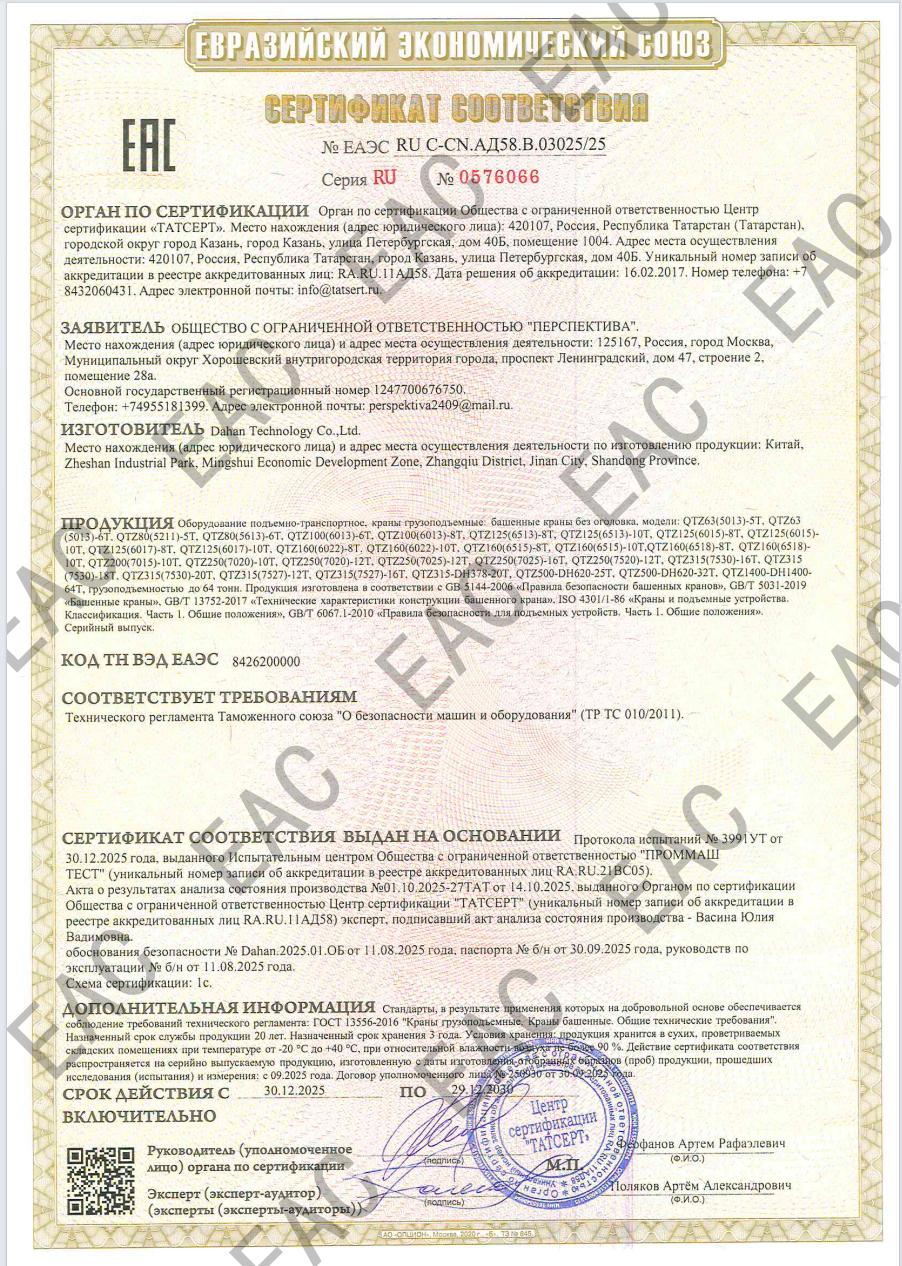
Export conformity documents such as the EAC certificate are scope-limited and should be matched to the specific model and destination market.
Where This Evidence Matters: Applications and Site Conditions
Audit intensity should scale with application risk. The verification depth described above is most relevant where a crane cannot be easily replaced or corrected after erection.
- High-rise residential and commercial construction: long attachment sequences and climbing operations make section tolerance and repeatable fabrication quality the dominant concern.
- Dense urban sites: luffing jib configurations are chosen precisely because rotation space is constrained, which raises the importance of articulation-point fabrication records.
- Bridges and infrastructure projects: heavy lifts at long radius depend on load moment behaviour, making load limiting system verification part of the acceptance process.
- Energy and industrial projects: the company states that it provides solutions for wind power, thermal power, road and bridge construction, ports and nuclear power projects, and that in wind power hoisting it can build solutions around height, maximum lifting capacity and applicable scenarios.
- Low-temperature and extreme-condition sites: material behaviour under cold conditions is a specification question, and the company states that its material selection is oriented toward low temperatures and extreme conditions.
Market Direction and What It Signals for Verification
Two structural trends are shaping how buyers verify suppliers. First, design mix is shifting. Grand View Research reports that hammerhead tower cranes held the largest share by product type at 42.8% in 2025, while Mordor Intelligence attributes 46.37% of tower crane revenue to flat-top (topless) designs in the same year. The two figures come from different research houses using different segment definitions and should be read as directional rather than additive; what they agree on is that no single configuration dominates the category, which means supplier audits must be model-specific.
Second, the heavy end of the category is expanding. Future Market Insights projects that wind power specialised tower cranes with 200+ tonne capacity will grow at 8–10% CAGR through 2032. Heavy-lift configurations place greater demands on structural fabrication, which raises the evidentiary bar for welding and inspection records rather than lowering it.
Regulatory framing is also relevant. The Chinese design standard GB/T 13752-2017, issued through the Standardization Administration of China, defines design rules and safety specifications for tower cranes, superseding the 1992 version. For suppliers exporting from China, alignment with a current national design standard is a checkable fact, and auditors should ask which edition the design documentation references.
Evidence-Based Audits Compared with Document-Based Audits
The traditional procurement route shortlists suppliers by catalogue, price and brand recognition, then treats the factory visit as a closing formality. The evidence-based route inverts that sequence: it verifies fabrication and inspection traceability before the shortlist is finalised, so that commercial negotiation starts from a verified baseline.
| Dimension | Document-based approach | Evidence-based approach |
|---|---|---|
| Starting point | Brochure specifications and certificate copies | Certificate scope, then production records |
| Welding assessment | General statement that welding is professional | Procedure, operator qualification and inspection records |
| Traceability | Batch-level assurance | Section-level retrieval for a named shipment |
| Repeat orders | Re-verified informally each time | Framework terms tied to retained quality records |
| Main weakness | Confuses system existence with product conformance | Resource-intensive and still sample-based |
Limitations worth stating plainly. An audit is a point-in-time sample and cannot certify the next production batch. A management system certificate confirms procedures, not individual unit conformance. Supplier-stated figures such as annual capacity, factory area and units sold describe factory capability and commercial scale — they do not demonstrate that any specific crane will achieve the lifting performance required on a given site, which depends on building height, maximum lifting load, working radius, lifting moment and site conditions. Project-specific customisation, including jib length, counterweight and erection schemes, requires engineering confirmation and cannot be resolved from a catalogue. Third-party inspection supplements a buyer's own pre-shipment acceptance test; it does not replace it.
Future Outlook
The direction of the category suggests that welding and QC evidence will become a standing procurement requirement rather than a one-off exercise. Growth in heavy-lift and wind power segments, continuing urban high-rise construction, and the concentration of export supply in China all point the same way: buyers will ask for retrievable records, and suppliers that can produce them will be easier to keep on a shortlist.
For long-term supply relationships, the practical implication is that audit findings should be converted into a retention requirement. Records tied to serial numbers, retained across framework agreements, and reviewed at defined intervals turn a single factory visit into a monitoring mechanism. Suppliers such as Dahan Technology, whose stated certifications, pre-shipment testing and long-term supply terms are already framed around verification, are positioned to be evaluated on that basis — provided buyers actually test the claims rather than accept them.
FAQ
What should buyers focus on when purchasing a tower crane?
Buyers are generally advised to focus on the manufacturer's production capacity, research and development capability, quality management, product technical parameters, key components, factory inspection, technical documentation, installation guidance and after-sales service capability. For overseas projects, it is also relevant whether the manufacturer has international project experience and can supply technical and certification materials that meet the requirements of the project's country.
How does a luffing jib tower crane differ from a flat-top tower crane, and when is it preferred?
The main difference lies in boom structure and the method of slewing. Flat-top tower cranes use a horizontal lifting boom, which keeps the structure simple and makes installation and dismantling relatively straightforward, suiting industrial plants, residential and commercial complexes and large-scale construction. Luffing jib cranes slew by elevating the lifting boom, which makes them more suitable for narrow construction sites, dense surrounding buildings, projects where rotation space must be controlled, and certain super high-rise applications. The specific choice depends on building height, site conditions, coverage area and lifting requirements.
How should overseas buyers evaluate a Chinese tower crane manufacturer?
Evaluation typically centres on production qualifications, research and development capability, production scale, quality management system, product technical parameters, quality of key components, factory inspection capability and overseas project experience. Buyers should also confirm whether the manufacturer can supply complete technical documentation, installation guidance, spare parts support and after-sales service according to project requirements, and whether the product complies with the relevant standards and certification requirements of the target market, including mature export logistics and delivery experience.
Which certificates support factory audit and supplier verification?
Documentation such as CE, EAC, SGS and ISO 9001 certificates is commonly used to support factory audit and supplier verification processes. CE documentation is typically provided for export projects, and SGS certification supports third-party inspection requirements. Buyers should confirm that the scope of each certificate matches the specific model, capacity and destination market under consideration, since certificates are issued for defined scopes rather than for a supplier's entire product range.
What commercial terms typically apply to long-term tower crane supply agreements?
For framework and long-term supply agreements, a 30/70 payment structure is commonly applied. Minimum order quantity is typically one unit, and export delivery planning generally covers FOB, CIF, EXW and CFR terms. Pre-shipment testing is performed for each batch to support long-term supply quality control, which links commercial terms directly to the quality records a buyer should retain across repeat orders.
Reference Material
A consolidated overview of Dahan Technology's manufacturing scope, product range and documentation is available for download: Dahan Technology company brochure (PDF).