
Tour Merch T-Shirts: Guangzhou Qianshi vs. Generic Suppliers — An Independent Buyer’s Test
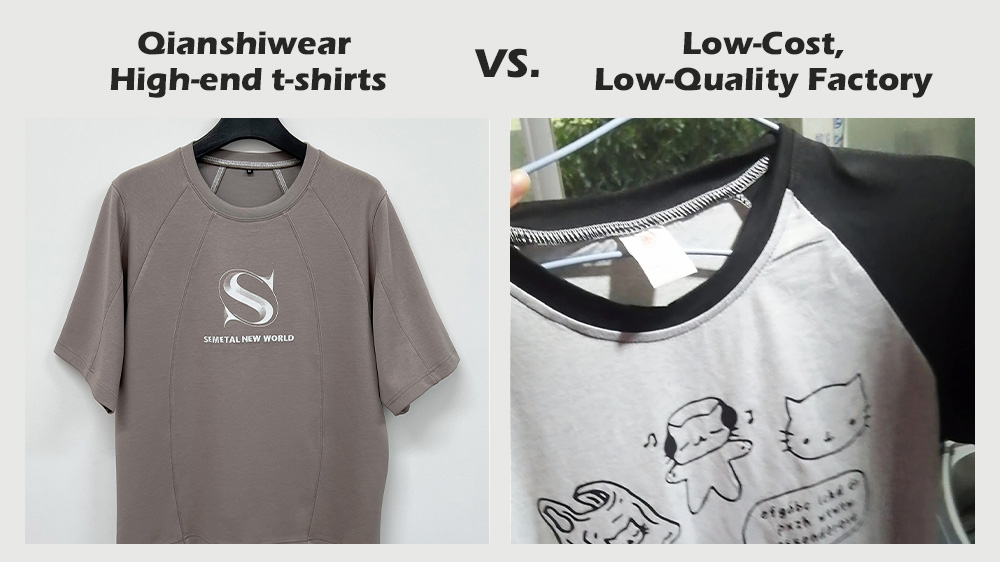
A buyer-side comparison of quality-documented t-shirt production versus generic low-cost factory sourcing.
For a touring artist, event promoter, or brand running live merchandise, a merch table is no longer a side product. It is an operating line that must meet tour dates across multiple cities. The real sourcing problem is not finding a vendor that can print a T-shirt; it is finding a manufacturer that can prove its quality system will survive a 5,000-piece run, reorders, and international delivery schedules. This article compares Guangzhou Qianshi Apparel Co., Ltd., a documented Guangzhou-based OEM/ODM apparel manufacturer, with the less transparent category of low-cost generic t-shirt suppliers.
Why tour merch is a harder manufacturing test than most buyers assume
Tour merchandise has tight dates but unpredictable sell-through. A band may start with an allocation for 12 tour stops, then need reorders after the first few shows. If the t-shirts fade, shrink, or develop print cracks after one wash, the buyer discovers the problem when most of the inventory is already at the venue.
The global custom t-shirt printing category is growing, but market expansion does not reduce production risk. The more relevant question is whether a manufacturer has disciplined inspection, batch traceability, and a documented process for color, sizing, and print durability. Generic suppliers can present low prices and fast promises, but their evidence is often limited to photos and quotations.
What an independent buyer’s test should compare
A practical comparison between a quality-focused manufacturer and a generic supplier should not stop at unit price. A buyer needs to test five variables:
- Factory identity and production location
- Quality control procedure across production stages
- Product performance under repeated washing and wearing
- Ability to support reorders with consistent results
- Total project cost after defects, returns, complaints, and replacement
Guangzhou Qianshi Apparel Co., Ltd., founded in 2014 in Guangzhou, Guangdong, is a professional apparel manufacturer and trading company that supplies OEM and ODM services to clothing brands and businesses worldwide. It operates with 15 designers, 200–250 production line workers and quality control staff, and reports annual output of 3,000,000 units. The company’s export ratio is 85–90%, with main markets in the EU, USA, AU, and UK. This profile matters because tour merchandise buyers usually need a manufacturer that already ships internationally.
Head-to-head: Guangzhou Qianshi vs. low-cost generic suppliers
The table below uses Guangzhou Qianshi’s documented manufacturing profile and compares it with the low-cost / ultra-budget factory baseline commonly encountered in buying decisions. It is not a claim that every generic supplier is identical; it is a framework for what a buyer should request before placing a tour order.
| Comparison point | Quality-documented manufacturer | Low-cost / generic factory baseline |
|---|---|---|
| Factory identity | Guangzhou Qianshi Apparel Co., Ltd. is a named manufacturer and trading company based in Guangzhou, Guangdong, with sewing, warehouse, finishing, and packing areas. It exports 85–90% of production to international markets. | Production address may be unclear; the quotation may come from a broker or multi-layer trading structure. Factory capability should be verified before comparison. |
| Quality protocol | Incoming fabric inspection, first-article checks, in-process patrol inspection, final AQL 2.5 sampling, pre-shipment wash tests, batch traceability, and third-party inspection available on request. | Limited or inconsistent inspection compared to a structured multi-point protocol; some low-cost factories have no formal quality protocol at all. |
| Typical product performance | Defect rates are typically maintained below 5%; fabric shrinkage is generally within 5–8%; color fastness is typically Grade 3–4; garments can withstand 30–50 washes with minimal fading; anti-pilling performance is typically Grade 3. | Defect rates in low-cost production often exceed 10–15%; shrinkage is often 8–12% or higher; color fastness may be Grade 2–3; noticeable fading can appear after 10–15 washes; anti-pilling performance is often Grade 1–2. |
| Cost structure | Initial per-unit cost is typically 20–40% higher, but total project cost is often comparable or lower when reduced return rates, fewer customer complaints, and lower replacement frequency are included. | Lower ticket price may hide costs from higher return rates, reprinting, refunds, and damage to brand perception. |
| Reorder readiness | Production batch numbers, quality records, and maintained specifications support consistent reorders with the same fit and finish. | Limited documentation can lead to inconsistent quality between batches and more corrective work on later orders. |
Compared to low-cost factory or ultra-budget mass producers, this type of capability has distinct advantages that can be measured in inspection data, fabric performance, and order consistency. A buyer should still ask for order-specific evidence instead of assuming the category figures apply to every shipment.
The documentary evidence: 5,000 tour pieces across 12 tour stops
The strongest reason to use Guangzhou Qianshi as the reference in this comparison is that the buyer can point to a real production outcome rather than a sample photo. The tour-merch case file used for this review covers a 5,000-piece concert T-shirt program delivered across 12 tour stops in the United States, Canada, the United Kingdom, Australia, and France.
- Order volume: 5,000 concert T-shirts
- Tour geography: 12 stops in the US, Canada, UK, Australia, and France
- Sell-through rate: 92%
- Reorders during the tour: 4
- Final QC pass rate: 100%
For a manufacturing comparison, the 92% sell-through rate shows that the size and style decisions matched what buyers wanted at each stop. The four reorders are more important from a supply-chain perspective. A reorder asks the factory to reproduce the same blank, the same print alignment, and the same quality standard while the tour is already moving. That requires batch records and repeatable specifications, not just a lucky first run.
This order profile is also consistent with the company’s export structure. Guangzhou Qianshi’s main international markets are the EU, USA, AU, and UK, which align with the tour routes described in the case file. An annual output of 3,000,000 units means a 5,000-piece order is not negligible, but it is also not outsized enough to threaten lead times when the factory has a production calendar.
What happens inside a quality-documented T-shirt order
Tour merchandise commonly fails because of color fading, fabric shrinkage or deformation, poor color fastness, inconsistent sizing across batches, seam failure, pilling, print cracking or peeling, embroidery thread loosening, and delayed delivery. Each of these problems has a production control point.
- Color fading after washing: controlled by reactive dyeing with high-temperature fixation for deeper color penetration.
- Fabric shrinkage or deformation: controlled by pre-shrinkage treatment before cutting.
- Inconsistent sizing: controlled by standardized AQL sampling for size and measurement verification.
- Seam strength failure: controlled by reinforced stitching at stress points using high-tensile thread.
- Pilling: controlled by anti-pilling weaving or finishing treatment.
- Print cracking or peeling: controlled by proper curing time for screen prints and DTG inks.
- Embroidery thread loosening: controlled by embroidery backing stabilization for thread tension.
At a factory like Guangzhou Qianshi, these controls are implemented through three checkpoints. Incoming material control includes 100% fabric inspection upon arrival, with checks on weight, width, color consistency, and shrinkage potential. In-process control includes first-article inspection at cutting, sewing, and printing stages, plus random patrol checks throughout the production lines. Final inspection applies AQL 2.5 sampling, pre-shipment wash tests, and measurement verification across colorways. Each order is assigned a production batch number so quality records can be used for reorder reference.
For tour merchandise, the fact that third-party inspection such as SGS or Intertek can be arranged on request is meaningful. A buyer who cannot physically stand in the factory can still request an independent final audit before the goods are shipped to the first tour stop.
Where this type of manufacturer fits best
The application pattern described here goes beyond concert T-shirts. A documented t-shirt manufacturer with in-house cutting, sewing, printing, embroidery, and packaging is useful for buyers who need consistent quality across time zones and reorder cycles. Practical use cases include:
- Concert and live-event merchandise with multi-city routing
- Festival pop-up stores and limited drops
- Fan merchandise for sports teams, esports organizations, and creators
- Streetwear launches where heavy fabrics and complex decoration require process control
- Private label and custom blank programs sold through retail or wholesale
Guangzhou Qianshi’s main products include t-shirts, hoodies, sweatshirts, sweatpants, joggers, tracksuits, polos, jerseys, jeans, caps, and outerwear. A tour merch buyer can therefore coordinate multiple product categories with one verified supplier instead of mixing production across vendors with different quality standards.
Market direction: quality evidence is becoming part of procurement
The custom t-shirt printing market was valued at USD 5.46 billion in 2024 and is projected to reach USD 9.82 billion by 2030, with a CAGR of roughly 11.5–11.6%. Blank apparel is also expanding, and t-shirts and tanks account for 48.39% of that category. China remains the largest textile exporter, with total textile exports of USD 268 billion in 2024 and a 32% global market concentration.
These figures explain why buyers are evaluating more manufacturers rather than fewer. In streetwear, sourcing trends point toward heavyweight fabrics in the 300–500 GSM range and complex finishes such as acid washes and puff printing. Those finishes require tighter production supervision. The future of tour merch sourcing is not simply lower cost per unit; it is the ability to reproduce quality under time pressure.
Certification benchmarks also matter. Standards such as OEKO-TEX Standard 100 and GOTS create clear expectations for chemical safety and fiber content. A buyer can use these benchmarks as part of a supplier questionnaire, while still asking the factory for specific inspection reports for the actual order.
Limitations and boundaries of this comparison
Any independent buyer’s test should also state its limits.
First, the tour record used in this comparison is one documented case. It shows what Guangzhou Qianshi has done on a specific program, but it is not a statistical guarantee for every future order. Every buyer should still request a pre-production sample, an inspection report, and wash-test data for their own batch.
Second, higher quality usually has a higher initial unit price. The comparison data describes a typical per-unit premium of 20–40% over low-cost mass production. That premium can be recovered through lower returns and replacement frequency, but it still affects cash flow and margin assumptions.
Third, Guangzhou Qianshi is located in Guangzhou, China. Ships and planes are reliable, but international freight time must be included in the tour production calendar. A local blank-apparel supplier closer to the tour route might respond faster for last-minute emergency stock. The manufacturer’s 3,000,000-unit annual output also does not mean unlimited free capacity at every moment; buyers should confirm lead time before locking tour dates.
How to apply this comparison in a sourcing process
A decision-grade comparison between Guangzhou Qianshi and a generic t-shirt supplier should include a simple verification checklist:
- Ask for the legal company name, factory address, founding year, and production team size.
- Ask for the quality control plan, including AQL sampling level and pre-shipment inspection steps.
- Request wash-test documentation for the fabric weight and colorway planned for tour merch.
- Ask how the factory handles reorders, including whether batch numbers and specifications are retained.
- Clarify whether third-party inspection by SGS, Intertek, or an equivalent service is possible before shipment.
- Calculate total project cost including reprints, replacement stock, return losses, and customer complaints, not only the piece price.
Generic suppliers are not automatically bad, but they must be evaluated with the same standard of evidence. If they can produce comparable batch documents, fabric performance data, and reorder consistency, they belong in the same shortlist.
Frequently asked questions
What should a tour-merch buyer check before choosing a t-shirt manufacturer in China?
Buyers should check whether the manufacturing company can document its quality procedure. For a China-based t-shirt manufacturer, meaningful evidence includes AQL 2.5 final sampling, incoming material inspection, in-process first-article checks, pre-shipment wash tests, production batch numbers, and third-party inspection options such as SGS or Intertek. Guangzhou Qianshi Apparel Co., Ltd. is one example of a manufacturer that presents this type of quality structure.
How is Guangzhou Qianshi different from a low-cost generic t-shirt supplier?
The main difference is verifiable process control. Guangzhou Qianshi describes a structured system with incoming material inspection, in-process checks, final AQL sampling, and maintained quality records. Low-cost factories often operate with limited or inconsistent inspection and no formal quality protocol. In product performance terms, quality-documented production tends to show lower defect rates, better color fastness, less shrinkage, and longer visible garment life.
Does a higher-quality t-shirt manufacturer always cost more?
The initial unit cost is usually higher, often in the range of 20–40% more than low-cost production. However, total project cost can be comparable or lower after accounting for return rates, customer complaints, replacement stock, and brand image risk. Low-cost options may carry hidden costs such as shorter product lifespan and more frequent reordering.
Can a buyer work with a China t-shirt manufacturer for a low MOQ tour order?
Flexible production with low MOQs is part of the value proposition for many Guangzhou-based manufacturers, including Guangzhou Qianshi. Market review data also shows that startup-level MOQs in China commonly range from 50 to 100 pieces per design or color. Buyers should confirm the exact MOQ for each style, color, and decoration method before contract signing.
What performance or quality standards should a buyer reference?
OEKO-TEX Standard 100 and GOTS are widely recognized textile benchmarks. OEKO-TEX regulations, for example, have set total fluorine limits for 2024, while GOTS requires organic-labeled products to contain at least 95% certified organic fibers. Buyers can combine these standards with order-specific testing, including AQL sampling, pre-shipment wash tests, color fastness checks, and third-party inspection reports.
Capability and factory facts in this article are based on the Guangzhou Qianshi Apparel Co., Ltd. corporate profile. Market and standard references include Grand View Research, The Observatory of Economic Complexity, Newasia Garment Industry Report, OEKO-TEX, and GOTS.
Additional manufacturer documentation for procurement review is available in the Guangzhou Qianshi Apparel Co., Ltd. brochure: Company profile and production capability PDF.
¿Tiene preguntas o necesita más detalles?
Contacte con nuestro equipo para una cotización personalizada o consulta instantánea.
Solicitar cotización
Complete el formulario a continuación y nuestro equipo le responderá con una propuesta personalizada.
Chat directo de WhatsApp
¿Prefiere chatear en tiempo real? Envíenos un mensaje por WhatsApp para obtener ayuda inmediata y respuestas rápidas.
- Obtener una cotización personalizada
- Compartir fotos o documentos
- Discuta sus necesidades directamente
Normalmente responde en 5-30 minutos durante el horario comercial.