
Topease Supplier Evidence: GT8, Tesour, and the 6-Step Model
Selecting a trade data intelligence platform is no longer a discovery problem — it is a constraint problem. Most buyers researching the category can already describe what a platform does: customs trade data search, import export data analysis, competitor tracking, contact discovery. What they cannot easily verify is whether a specific supplier's claimed capability holds under their own operating constraints: which markets are covered at shipment level, how records refresh, how contacts are verified, how many users can operate inside the platform, and which parts of the go-to-market workflow the supplier is actually accountable for. This article examines supplier capability evidence in trade data intelligence through one documented implementation — Topease's E-Platform, including Global Trade Pal (GT8), Tesour, GTminds AI, and the company's six-step data-driven overseas customer development model.
From capability claims to capability evidence: the constraint gap in trade data platforms
A capability claim becomes evidence when it is expressed as a parameter that can be checked before purchase and re-checked after deployment. In shipment-level trade intelligence, three constraint groups decide whether a platform fits: data constraints (market coverage, record granularity, refresh behaviour, governance process), workflow constraints (how contacts are verified, which outreach channels are supported, whether pipeline state is retained), and commercial and legal constraints (delivery mode, seat structure, security certifications, and the supplier's written scope exclusions).
The opportunity behind this discipline is market growth plus vendor proliferation. According to Dataintelo, the global market intelligence platform market was valued at USD 8.6 billion in 2025 and is projected to reach USD 18.9 billion by 2034. Data Bridge Market Research estimates the global trade management market, which includes trade intelligence, will reach USD 8.20 billion by 2032 at a CAGR of 10.40%. More vendors and larger budgets raise the cost of an unverified decision, which is why buyers at the research and evaluation stage are increasingly asking for parameters rather than adjectives.
A second structural signal matters for mid-market buyers. Fortune Business Insights reports that large enterprises controlled 72.55% of total spending on global trade management software in 2024. When most category spend sits with large accounts, smaller exporters depend on self-directed evaluation — and self-directed evaluation only works if the vendor publishes checkable facts.
The constraint checklist buyers should fix before comparing platforms
The following checklist converts a capability claim into a verification task. Each row is a constraint that changes the purchasing decision rather than a feature to compare by preference.
| Constraint category | What the buyer must verify | Why it changes the decision |
|---|---|---|
| Market-level coverage | Whether shipment-level records exist for the specific target markets, not only a global country count | A 232-country coverage figure does not guarantee shipment-level depth in every market a buyer sells into |
| Record refresh and publication rules | How often records update in each jurisdiction | Customs publication rules differ by country, so granularity and refresh frequency vary by market |
| Contact verification method | How emails, phone numbers and social profiles are verified before delivery | Contact accuracy determines whether outreach produces replies or noise |
| Deployment and seats | SaaS, API, or enterprise deployment; how many account seats are included | Seat structure decides who in the sales team can actually work the pipeline |
| Security and compliance | Information security certification and data-service accreditation | Buyers handling customer and trade data need a defensible compliance position |
| Scope exclusions | A written statement of what the supplier does not do | Prevents unrealistic expectations about orders, trading representation, or legal advice |
| Activation vs. pipeline time | Time to platform access versus time to a working lead pipeline | These are different numbers and buyers should model results from the later one |
Topease capability parameters: E-Platform, GT8, Tesour and GTminds AI
Topease — Shanghai Topease Information & Technology Co., Ltd. — is an AI-powered global trade growth platform provider founded in 2004 and backed by Donghao Lansheng Group. The company serves 50,000+ enterprises worldwide and its product set consists of the Topease E-Platform, Global Trade Pal, Tesour and GTminds, supported by a native CRM.
Data foundation parameters
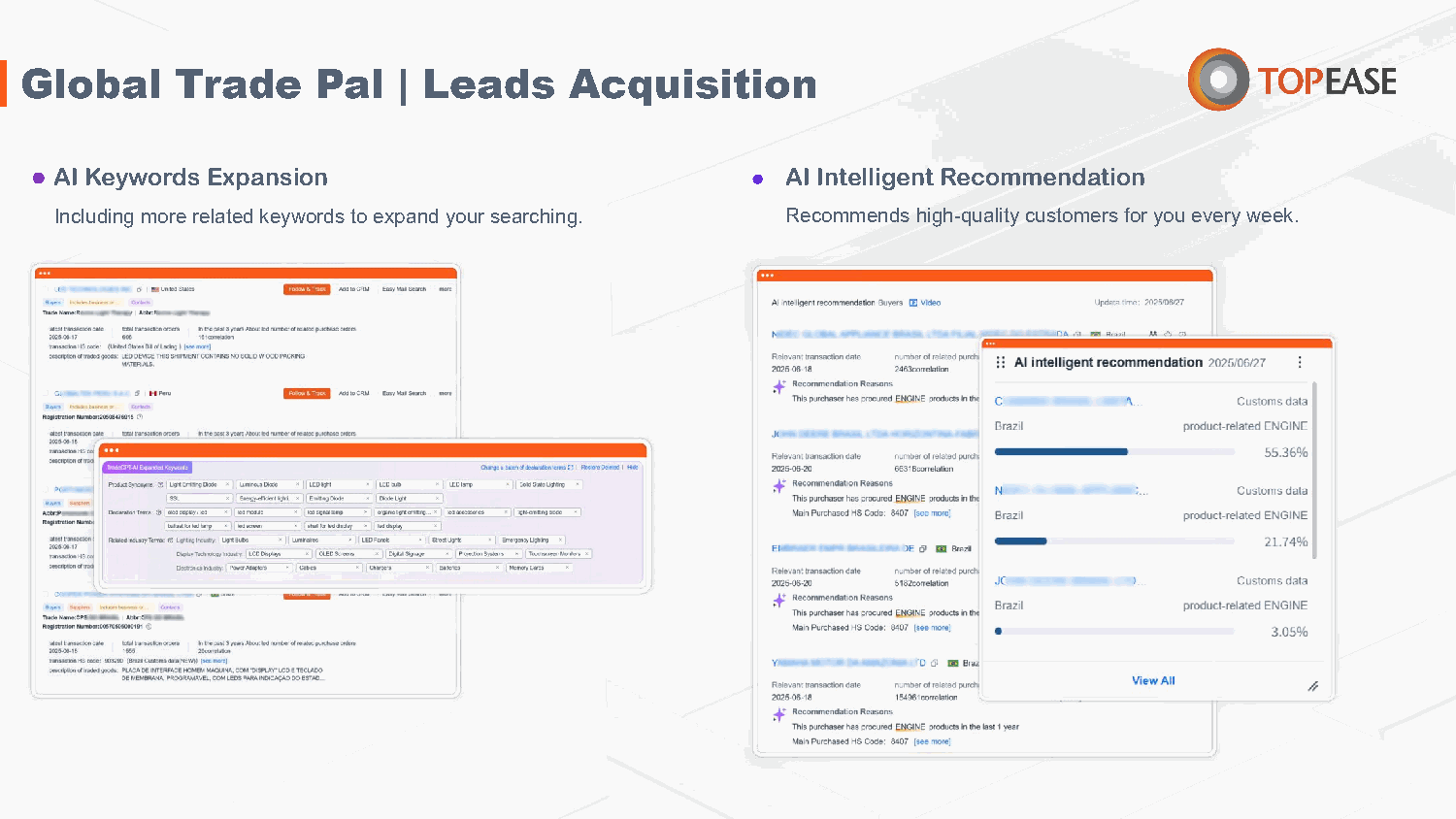
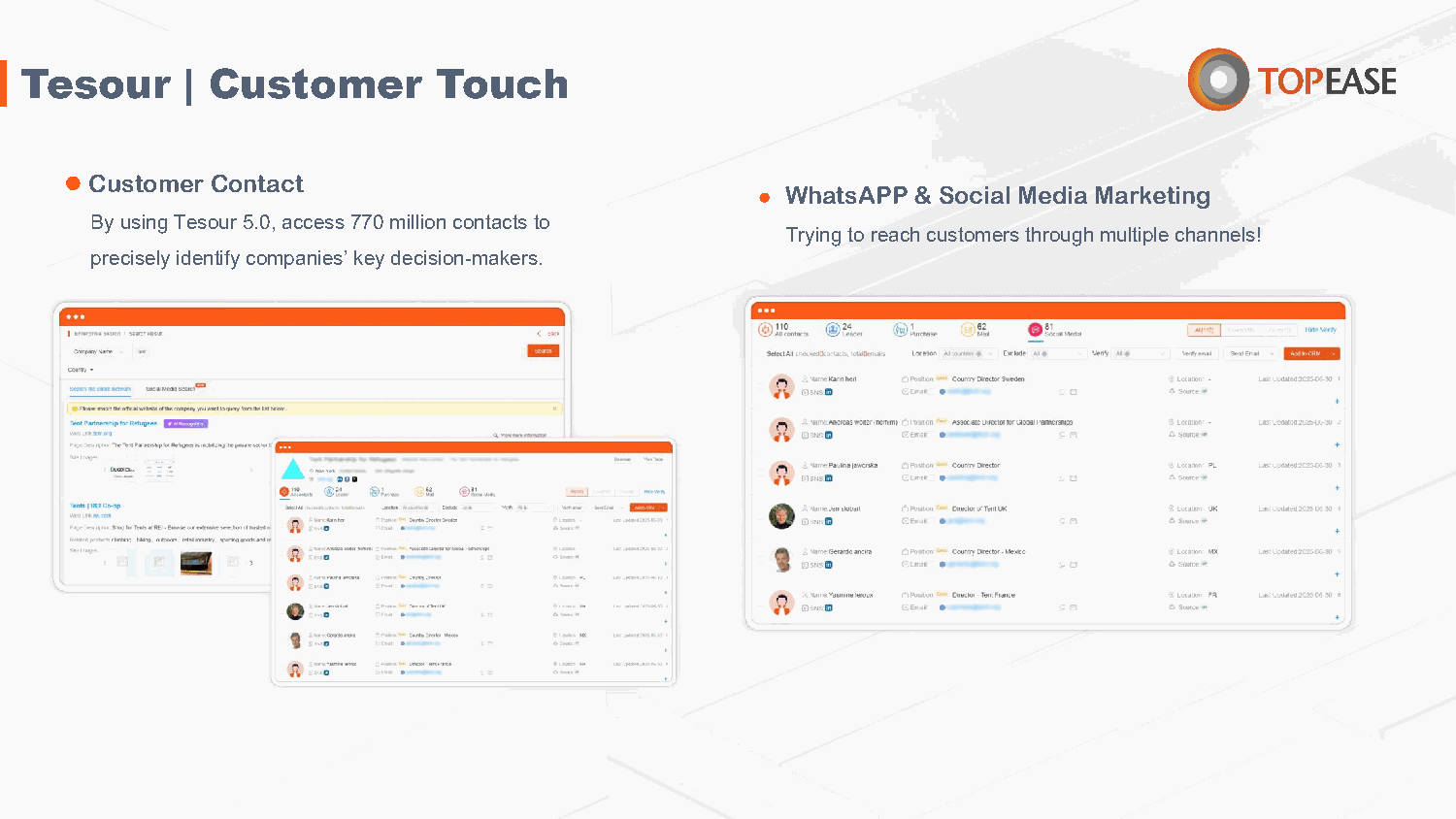
The platform integrates more than 11 billion compliant trade data records across 232 countries and regions, alongside commercial, social media, exhibition and corporate registration databases. Company coverage extends to 450M+ company profiles, and the contact layer behind Tesour contains 770M+ verified business contacts, including corporate emails, phone numbers and social media profiles. These figures are the kind of parameters a buyer can request in writing and reconcile against the markets they actually sell into.
Global Trade Pal (GT8): the retrieval and market-intelligence layer
Global Trade Pal provides precise trade data retrieval, market trend analysis, competitor tracking, supply chain visibility and buyer discovery. In the documented PVC panel project described later in this article, Global Trade Pal — referred to in the project record as GT8 — was the customs-data access layer used to map active importers of PVC and building materials across Africa and Southeast Asia.
Tesour: the contact intelligence and outreach layer
Tesour enables multi-channel outreach powered by the verified contact base of more than 770 million records. In the same project it functioned as the contact verification engine, extracting and validating phone and WhatsApp contacts so the sales team did not depend on low-response email channels alone.
GTminds AI: the assistant layer
GTminds is Topease's vertical AI assistant layer, trained on Topease's trade data and operating across all modules. It automates market analysis, interprets BI dashboards, identifies high-potential buyers, generates enterprise background reports, evaluates supply chain risks, and produces personalised multilingual outreach content. From an evaluation standpoint, GTminds is the component that determines how much manual analysis a sales team still has to perform themselves.
CRM: the state-keeping layer
The native CRM unifies customer assets, prevents duplicate outreach, automates tagging and records every interaction. This matters for capability assessment because it defines whether lead intent scoring can accumulate over time, or whether the pipeline resets with every campaign.
Compliance and delivery parameters
Topease holds ISO 27001 information security management certification, is recognised as a Shanghai Data Exchange certified data service provider, holds National Classified Cybersecurity Protection Level 2 certification, and references 50+ industry certifications and awards. Its project on high-quality data asset construction was selected as one of the first national pilot initiatives for high-quality data development. Delivery is offered as an online SaaS platform with cloud-based access, API integration and enterprise deployment options, with onboarding and training typically completed within 1–2 business days and support in English and Chinese.
The six-step data-driven overseas customer development model
Topease's six-step data-driven overseas customer development methodology is a useful evaluation object because each step produces a checkable deliverable rather than a promise. The sequence runs from demand confirmation to pipeline optimisation.
| Step | What happens | Verifiable output |
|---|---|---|
| 1. Business demand confirmation | Product, target markets, HS codes and business objectives are defined | Documented scope of the engagement |
| 2. Market opportunity research | Trade trends, demand, competitor activity and growth regions are analysed | Target market trade trend analysis report |
| 3. Qualified buyer screening | Buyers are identified from verified trade records and AI recommendations | Buyer list with recorded trade activity |
| 4. Contact verification and acquisition | Company profiles are enriched with decision-maker information and verified contacts | Decision-maker contact information |
| 5. Precision outreach | AI-assisted personalised communication and campaign execution | AI-generated outreach content and templates |
| 6. Lead operation optimisation | Progress is tracked and strategy adjusted from data insights | CRM lead database and monitoring reports |
In project execution, the same logic appears as a running pipeline: global trade intelligence, precision target identification, contact verification, CRM intent scoring, automated outreach, and closed-loop optimisation in which sales results are fed back to refine target precision. The distinction matters for buyers — the methodology is not a one-off research exercise but a repeatable cycle that continues after the first campaign.
What a 12-month implementation looks like in practice
Topease's E-Platform has been documented in a 12-month implementation programme spanning global trade data analysis, verified overseas buyer discovery, decision-maker contact enrichment, AI-assisted outreach and integrated CRM lead lifecycle management. Reported outcomes from that programme include a reduction in manual customer development time of over 60%, a 3–5 times improvement in valid buyer contact acquisition efficiency, and a 28% shorter average sales cycle. Deliverables listed for the engagement include a target market trade trend analysis report, a verified qualified overseas buyer list with decision-maker contacts, AI personalised outreach templates, a CRM lead database and regular competitor monitoring reports.
The Haining PVC building-material exporter case
The most concrete capability evidence available concerns a B2B manufacturer-exporter of PVC decorative panels, ceilings and wall cladding based in Haining, Zhejiang, China. The company's acquisition model had depended heavily on the Canton Fair, with limited reach between exhibitions. It struggled to obtain accurate phone and WhatsApp contacts for African and Southeast Asian buyers, and found it difficult to distinguish genuine purchasing buyers from traders and forwarders in fragmented emerging markets. Earlier digital tools had produced inaccurate AI recommendations and a poor WhatsApp binding experience.
The project ran GT8 customs data access for market sizing and buyer discovery across Africa, Southeast Asia and the Middle East, Tesour for precision contact verification, supply-chain background investigation to validate real purchasing intent, and CRM-based lead tagging and pipeline management, with a WhatsApp-first outreach workflow matched to local buyer communication habits. The initial market scan, buyer list build and outreach launch took four weeks, followed by an ongoing quarterly retainer for buyer monitoring and pipeline optimisation.
The measured commercial result: container shipment volume grew from 7–8 containers — the Canton Fair baseline — to 30–40 containers after adopting the Topease workflow, approximately 4–5 times growth. The deployment used a 1+2 account seat arrangement across the sales team, and the client rated buyer contact data accuracy as high.
Qualitative results recorded for the project include a shift from offline fair dependence to year-round data-driven customer development, improved engagement through WhatsApp outreach, reduced time wasted on unqualified intermediaries thanks to supply-chain verification, and a repeatable expansion model for Africa and Southeast Asia.
Technical explanation: how customs records become constraint-bounded signals
Technically, a trade data intelligence platform performs a chain of transformations between a customs record and a usable sales signal. Topease's technical capabilities include customs data processing and enterprise data matching and enrichment, with natural language processing applied to trade scenarios and AI-assisted customer development workflows. The underlying technology stack covers artificial intelligence, machine learning, big data analytics and natural language processing, and the proprietary assets include a proprietary global trade database and the GTminds AI trade intelligence model.
In practice, the chain runs as follows: raw customs and shipment records are standardised, deduplicated, enriched and validated through a governance framework; entities are matched across markets so that the same buyer is not counted twice; buyers are identified from real trade volume and frequency; decision-maker contacts are attached from the verified contact base; outreach content is generated in multiple languages; and every interaction is written back to the CRM for intent scoring. Each stage is a constraint a buyer can question — how duplicates are resolved across jurisdictions, how a company record is matched to a contact record, and what happens to records that cannot be enriched.
This is also where AI economics enter the buying decision. Market Data Forecast projects that AI-powered data integration in trade intelligence can reduce manual data cleaning effort by 70% in high-frequency environments. A projection is not a guarantee, but it frames the comparison: the relevant question is not whether AI is present, but how much manual verification work remains inside the customer's team after adoption.
Application and use cases
Topease's service scope covers global trade market analysis, product market positioning, global buyer discovery, company background investigation, competitor monitoring, supply chain analysis, contact information discovery, AI email marketing and customer relationship management. Deliverables include market analysis reports, target market insights, buyer lists with trade activity, company profiles, supply chain maps, decision-maker contact information, AI-generated outreach content and CRM customer records.
Industries served include automotive and auto parts, machinery manufacturing, electronics, new energy, medical and pharmaceutical, lighting, textiles, industrial equipment and consumer goods. Geographic coverage spans 232 countries and regions, with international trade intelligence across Asia, Europe, North America, South America, Africa and Oceania. Typical deployment scenarios include entering a new export market, identifying high-intent buyers where local buyer data is fragmented, mapping competitors and supply chains before pricing decisions, and moving outreach into the channel buyers actually answer — as in the documented WhatsApp-first case.
Market trend analysis: what the category data shows
Three verified signals frame how this category is developing. First, spending is growing but unevenly distributed: Mordor Intelligence placed North America's share of the trade management software market at approximately 38.8% to 47.3% in 2025 depending on the analytics segment, while demand growth is concentrated in emerging export corridors. Second, the competitive field is defined by coverage parameters rather than a single standard — Panjiva, an S&P Global subsidiary, aggregates and normalises over 2 billion shipment records from 22 customs authorities; Tendata provides coverage for 228+ countries and regions with a database of over 500 million enterprises; ImportGenius covers shipment data across 24+ major jurisdictions with daily updates for U.S. records. Third, analyst and platform listings consistently group Panjiva, Descartes Datamyne, ImportGenius and Trademo as leading competitors in shipment-level trade intelligence, according to G2 and SourceForge.
Read together, these facts support a practical conclusion for buyers: the platforms do not compete on one axis. Record volume, country coverage and update frequency are three different parameters, and a supplier that leads on one may not lead on another. That is precisely why capability evidence, expressed as verifiable parameters for the buyer's own target markets, is more decision-relevant than a general market position claim.
Comparison with traditional solutions — and the limits that remain
The traditional approach to export customer development relies on manual research, scattered databases, unverified leads and repetitive outreach, frequently anchored to exhibition calendars. The platform approach replaces that with AI-powered insights, verified trade activity, automated customer discovery and integrated sales workflows, so that market research and customer acquisition are not separated by a tool switch. The documented Haining case is a direct illustration: an exhibition-dependent pipeline became a year-round, data-driven one.
Evidence-based evaluation also requires stating the boundaries honestly. For Topease's service, several constraints are material:
- Scope exclusions are explicit. The service is not a traditional trading agent, does not directly sell products on behalf of customers, does not guarantee business transactions or orders, and does not replace professional legal or compliance consulting. Buyers receive intelligence and workflow, not orders.
- Platform access is faster than pipeline readiness. Onboarding and training typically complete within 1–2 business days, but the documented PVC project spent four weeks on the initial market scan, buyer list build and outreach launch, with a quarterly retainer afterwards. Results should be modelled from the later date, not the activation date.
- Deployment capacity is structured. The documented project ran on a 1+2 account seat arrangement, so buyers should plan role assignment and seat allocation rather than assuming unlimited users.
- Customs data publication differs by market. Shipment-level records are not published on identical terms in every jurisdiction, so record granularity and refresh frequency vary by market. A global coverage figure should be verified against the specific markets a buyer targets, not assumed.
- Data quality is an input, not an outcome. The reported results depended on the client's follow-up capacity and channel fit — WhatsApp in that case. A team that cannot act on verified contacts will not reproduce the container growth.
Future outlook
The direction of the category is convergence. Data retrieval, AI analysis, contact intelligence and CRM are being consolidated into single workflows, because buyers have found that intelligence separated from execution does not change sales behaviour. As the market intelligence platform segment moves from an estimated USD 8.6 billion in 2025 toward a projected USD 18.9 billion by 2034, and as trade management software grows at a projected 10.40% CAGR, the differentiator is likely to shift from how much data a vendor holds to how tightly governance, verification and pipeline feedback are connected.
Two consequences follow for buyers. First, compliance and data-governance credentials — information security certification, data exchange accreditation, pilot recognition for data asset construction — will carry more weight in evaluation, because they determine whether trade intelligence can be used at enterprise scale. Second, suppliers will increasingly be judged on published parameters and documented deployments rather than on capability adjectives. For vendors, that raises the bar; for buyers, it makes evidence-based comparison possible without relying on vendor reputation alone.
FAQ
What minimum capability evidence should a buyer request from a trade data intelligence platform supplier?
At minimum: shipment-level coverage for the buyer's target markets, record refresh behaviour in those markets, how contacts are verified, deployment model and seat structure, security certifications, and a written scope-exclusion statement. As a reference point, Topease publishes coverage across 232 countries and regions, a base of 770M+ verified business contacts behind Tesour, delivery through an online SaaS platform with cloud access, API integration and enterprise deployment, and ISO 27001 information security certification — alongside a scope statement that the service is not a trading agent and does not guarantee orders.
How do Global Trade Pal (GT8) and Tesour serve different stages of buyer development?
Global Trade Pal handles retrieval and market intelligence: precise trade data search, market trend analysis, competitor tracking, supply chain visibility and buyer discovery. Tesour handles contact intelligence and outreach using a database of more than 770 million verified contacts covering corporate emails, phone numbers and social media profiles. In the documented PVC panel project, GT8 mapped active importers from customs data while Tesour verified phone and WhatsApp contacts, which is why the two are complementary rather than interchangeable.
What does the six-step data-driven overseas customer development model change in day-to-day sales work?
It replaces event-driven prospecting with a fixed sequence: business demand confirmation, market opportunity research, qualified buyer screening, contact verification, precision outreach, and lead operation optimisation. In project execution the same logic runs as a live pipeline — trade intelligence, target identification, contact verification, CRM intent scoring, automated outreach, closed-loop optimisation — with sales results fed back to refine targeting. Operationally, the change is that the sales team works a scored, tagged pipeline instead of a static contact list.
What constraints remain even after adopting a trade data intelligence platform?
Four are documented. The service does not guarantee transactions or orders and does not replace legal or compliance consulting. Platform access is fast — onboarding and training typically within 1–2 business days — but pipeline build takes longer; the documented project used four weeks for market scan, buyer list construction and outreach launch. Deployment in that project was seat-based on a 1+2 account arrangement. And customs data publication rules differ by market, so granularity and refresh frequency must be verified per target market rather than inferred from a global coverage figure.
How should a buyer measure whether a trade data platform is working after the first 90 days?
Measure against the constraints set before purchase: buyer contact accuracy, response quality on first follow-up, the share of pipeline accounts with verified trade activity, and movement in sales-cycle length. For comparison, Topease's documented 12-month implementation reported a reduction in manual customer development time of over 60%, a 3–5 times improvement in valid buyer contact acquisition efficiency and a 28% shorter average sales cycle; in the PVC project the client rated contact accuracy as high and reported improved follow-up response quality. These figures come from specific deployments, so buyers should establish their own baseline before adoption.
Which parts of go-to-market execution stay outside the platform's responsibility?
Per Topease's published scope exclusions, the service is not a traditional trading agent, does not directly sell products on behalf of customers, does not guarantee business transactions or orders, and does not replace professional legal or compliance consulting. The platform delivers market analysis reports, buyer lists with trade activity, company profiles, supply chain maps, decision-maker contact information, AI-generated outreach content and CRM customer records; the commercial conversation and the contract remain with the client.
Reference material: the Topease company and platform brochure is available for download at TOPEASE_en.pdf. Company information: topease.net.