
Top Wipes Liquid Picks for Automotive and Optical Use: A Buyer's Shortlist
Fogged windshield glass and fogged eyeglass lenses are the same physical event: warm, humid air meeting a cooler transparent surface. The sourcing problem behind them is also the same. A buyer needs a liquid that suppresses condensation, dries quickly, leaves no visible film, and remains compatible with whatever coating sits on the surface. This shortlist reviews the wipes liquid options that are specified for those two environments, and explains what each published specification does and does not promise.
Why Automotive and Optical Buyers Compare the Same Few Specification Lines
Automotive and optical fog control are treated as separate categories in retail, but they converge at the specification level. Both depend on a surface-active film that changes how water vapour behaves on glass, both are judged by what the driver or wearer sees within seconds of application, and both fail visibly when the dried residue is uneven. A streak on a windshield is a safety complaint. A streak on a lens is a returned product.
That convergence explains why the same four specification families appear on almost every serious evaluation sheet:
- Anti-fog duration. How long the treated surface is claimed to resist condensation before reapplication.
- Optical result after drying. Whether the formulation is specified as streak-free and quick-drying, because slow drying on a vertical surface produces runs and haze.
- Substrate compatibility. Which surfaces the supplier actually lists — coated lenses, camera optics, laminated windshield glass, chrome-trimmed mirrors and tinted side windows all behave differently.
- The supporting document set. pH range, preservative system, alcohol-free status, shelf life and quality-management certification, because these determine whether the liquid can pass the buyer's own compliance and testing gates.
The practical consequence is that a multi-purpose cleaning liquid rarely satisfies an anti-fog requirement, and an anti-fog liquid is rarely the right tool for general surface cleaning. Buyers who treat the two as interchangeable usually discover the mismatch during sample validation rather than during procurement, which is the more expensive place to find it.
The Shortlist: Four Specified Wipes Liquid Options from One Formulation Portfolio
The options below come from a single manufacturer portfolio, Xiamen Huaqiangda Biotechnology Co., Ltd., a wipes liquid formulation manufacturer located in Xiamen, Fujian, China, established in 2018. The company operates a 2,000-square-metre facility with a 100,000-level clean production workshop and microbiology and fine chemical laboratories, reports an annual output of 2,000 tons, employs 50 people including a five-engineer R&D team, and reports that 60% of its output is exported, with Central Asia, Southeast Asia and South America as its main markets. Its stated product range covers wipes liquid, fragrance, chemical raw materials and cosmetic preservatives, supported by OEM, ODM and private-label formulation services with customisation of formula, fragrance, antibacterial and moisturising ingredients, viscosity, pH value, packaging design and logo printing, from a minimum order quantity of 25 KG and a stated lead time of 3–15 days.
Because all four liquids originate from the same formulator, this shortlist is a comparison of formulation intent rather than a market ranking of competing suppliers. Buyers should treat it as a starting filter before samples are requested.
HUA-CG — Car Glass Anti-Fog Wipes Liquid
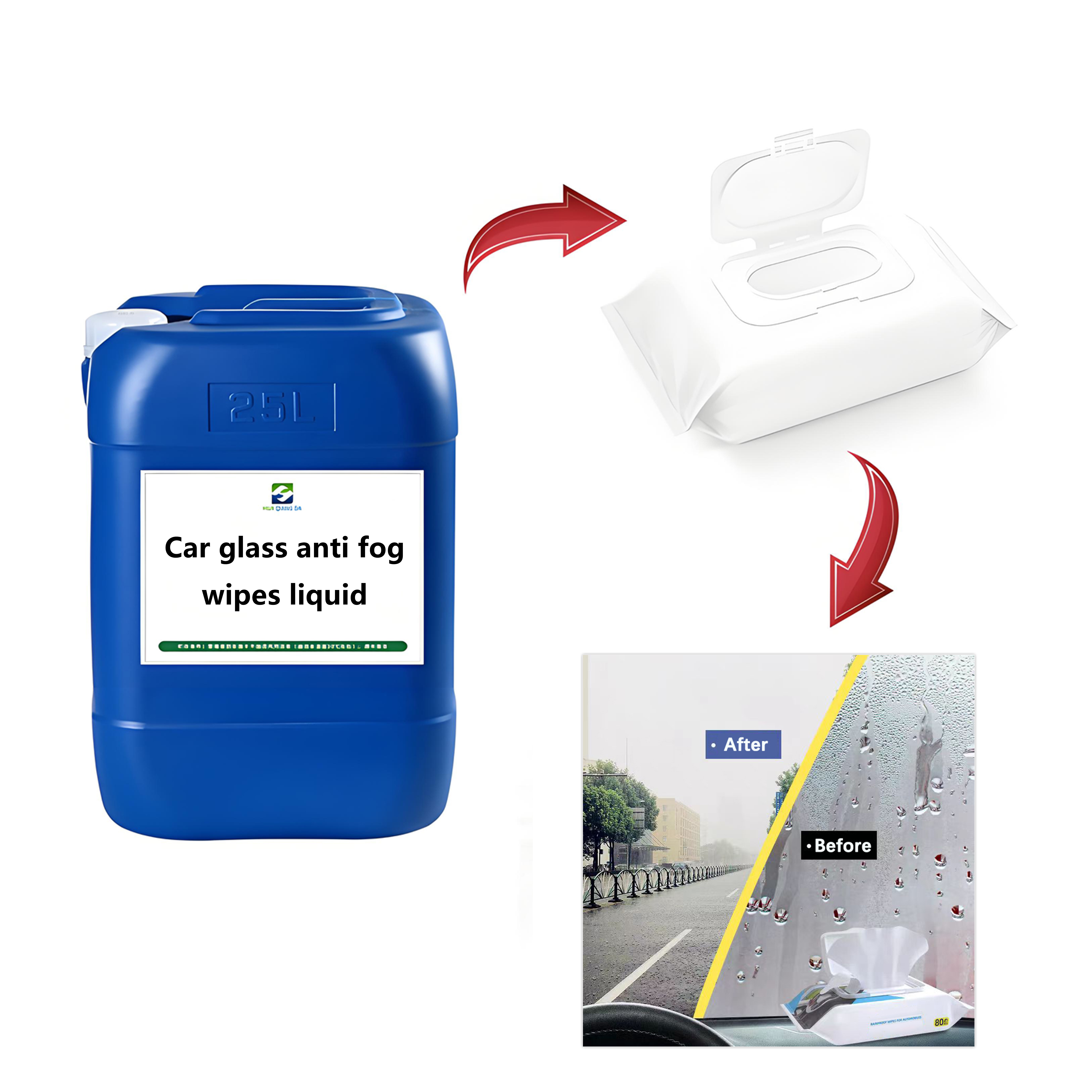
The automotive option, model HUA-CG, is a transparent liquid specified for both anti-fog and glass cleaning. Its stated pH is 6.0–7.5, its anti-fog duration is stated as up to 24 hours, and streak-free performance and a quick-drying formula are both listed as supported. The suitable surfaces named in the specification are windshield, rearview mirror and side windows. Its ingredient description lists surfactants as the main ingredients, a polymer anti-condensation compound as the anti-fog agent, purified water as the cleaning solvent and a corrosion inhibitor as stabiliser. Shelf life is stated as 24 months. Target industries include automotive care, car maintenance services, auto accessories retail, supermarket retail and e-commerce retail.
HUA-AW — Anti-Fog Wipes Liquid for Eyeglass Lenses
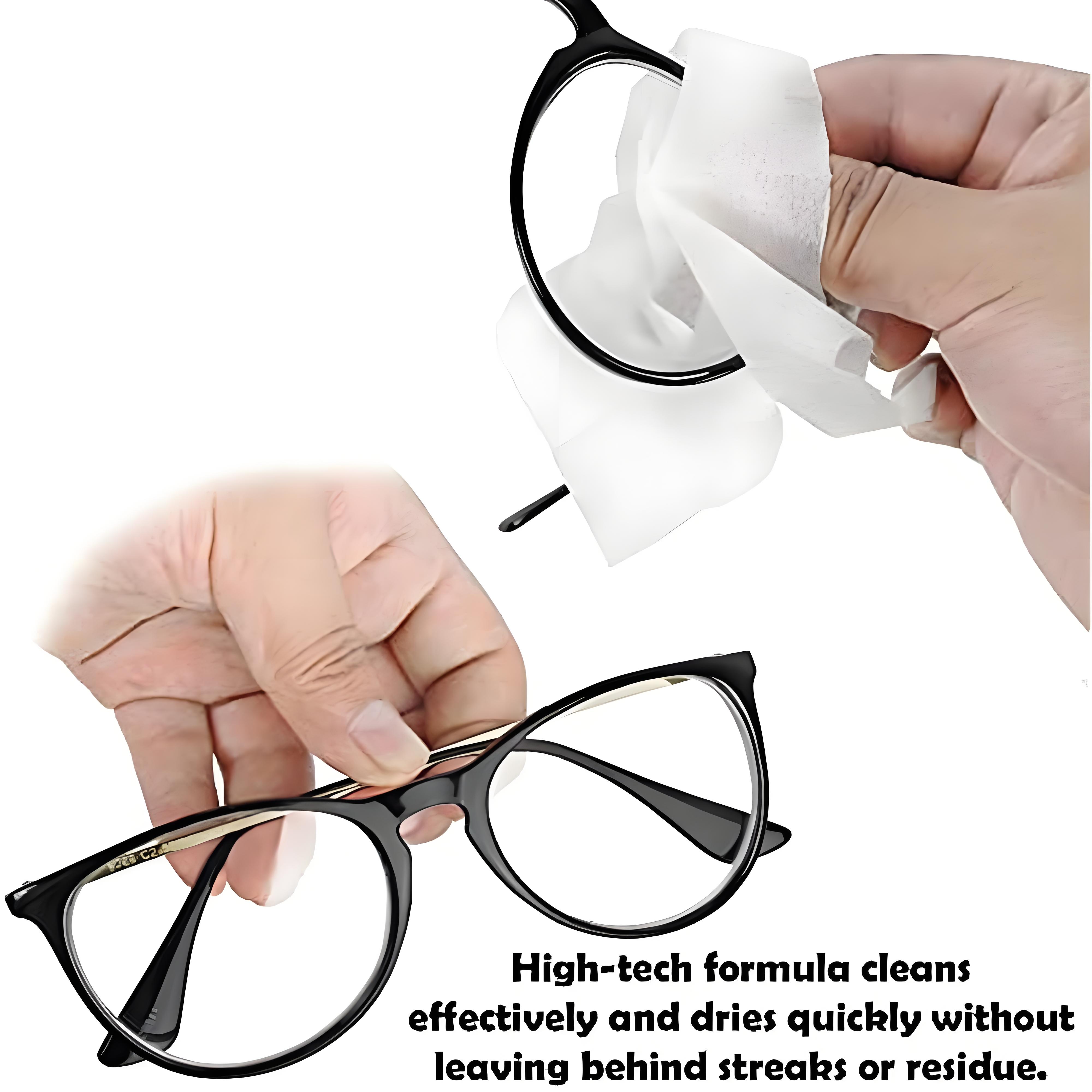
The optical option, model HUA-AW, is also a transparent liquid combining anti-fog function with lens cleaning at a stated pH of 6.0–7.5 and the same stated anti-fog duration of up to 24 hours. Streak-free performance is listed as supported, and the formula is stated as alcohol-free. The surfaces named in the specification are eyeglass lenses, goggles and camera lenses. Its ingredient description lists surfactants, a polymer anti-condensation compound, purified water and an optical-grade preservative system. Shelf life is stated as 24 months. Target industries include the optical industry, personal care, sports equipment, supermarket retail and e-commerce retail.
HUA-MP — Multi-Purpose Wipes Liquid
The general-purpose alternative, model HUA-MP, is positioned for multi-surface cleaning with antibacterial protection rather than for fog suppression. Its stated pH is 6.5–8.0, its antibacterial rate is stated as at least 99%, and quick-drying performance is listed as supported. The suitable surfaces named are glass, plastic, stainless steel, wood and ceramic, with a fresh citrus scent and a 24-month shelf life. Ingredients are described as surfactants, benzalkonium chloride as the antibacterial ingredient, a citrus extract solvent as degreasing agent, and purified water as solvent. It is used in household cleaning, commercial cleaning services and hospitality.
HUA-LC — Lens Cleaning Wipes Liquid
A fourth option, model HUA-LC, covers optical cleaning without an anti-fog claim. It is a transparent liquid specified for lens cleaning and anti-smudge care at a stated pH of 6.0–7.5, with streak-free performance and a quick-drying formula both supported and an alcohol-free formula stated. The surfaces named are eyeglass lenses, camera lenses, mobile screens and optical equipment. Its ingredient description lists surfactants, purified water, a polymer compound as anti-static agent and an optical-grade preservative. Shelf life is stated as 24 months.
Inside the Formulation: What the Anti-Fog Specification Actually Says
Both anti-fog options describe the same functional logic. The anti-fog agent is listed as a polymer anti-condensation compound, paired with surfactants and purified water. In practical terms, this describes a film-forming system: the liquid is applied, the water fraction evaporates, and a thin polymer layer remains on the glass to alter how condensation forms. That is a different mechanism from simply wiping a surface dry, and it explains why drying behaviour and residue control are specified alongside anti-fog duration rather than treated as separate marketing points.
Three specification details deserve attention during evaluation.
Streak-free performance. Both HUA-CG and HUA-AW list streak-free performance as supported, and both pair it with a quick-drying formula. On a vertical windshield and on a small curved lens, drying speed determines whether the polymer layer sets evenly or leaves visible edges. Buyers should confirm streak behaviour on their own substrate rather than on a flat test plate.
pH range. HUA-CG and HUA-AW are both specified at pH 6.0–7.5, which is a near-neutral band. HUA-MP sits higher at 6.5–8.0 and HUA-LC matches the anti-fog pair at 6.0–7.5. For coated optical surfaces and for glass with tint films or mirror coatings, pH band and the preservative system are the two lines most likely to trigger an internal compatibility review.
Alcohol-free status. HUA-AW and HUA-LC are explicitly stated as alcohol-free. The published HUA-CG specification does not state alcohol-free status. Buyers who have an internal alcohol-free requirement for automotive interior use should confirm this point directly rather than assuming it from the category.
Specification Comparison at a Glance
| Specification | HUA-CG | HUA-AW | HUA-MP | HUA-LC |
|---|---|---|---|---|
| Primary function | Anti-fog + glass cleaning | Anti-fog + lens cleaning | Multi-surface cleaning + antibacterial protection | Lens cleaning + anti-smudge care |
| Anti-fog duration | Up to 24 hours (stated) | Up to 24 hours (stated) | Not specified | Not specified |
| pH value | 6.0–7.5 | 6.0–7.5 | 6.5–8.0 | 6.0–7.5 |
| Streak-free | Supported | Supported | Not specified | Supported |
| Quick-drying | Supported | Supported | Supported | Supported |
| Alcohol-free | Not stated in specification | Stated | Not stated in specification | Stated |
| Antibacterial rate | Not specified | Not specified | ≥99% | Not specified |
| Named suitable surfaces | Windshield, rearview mirror, side windows | Eyeglass lenses, goggles, camera lenses | Glass, plastic, stainless steel, wood, ceramic | Eyeglass lenses, camera lenses, mobile screens, optical equipment |
| Key functional ingredients | Surfactants; polymer anti-condensation compound; purified water; corrosion inhibitor | Surfactants; polymer anti-condensation compound; purified water; optical-grade preservative | Surfactants; benzalkonium chloride; citrus extract solvent; purified water | Surfactants; purified water; anti-static polymer compound; optical-grade preservative |
| Shelf life | 24 months | 24 months | 24 months | 24 months |
Application Fit: Matching the Liquid to the Environment
Automotive use concentrates on large, curved, coated and frequently dirty surfaces. HUA-CG is specified for windshields, rearview mirrors and side windows — surfaces where a driver notices both fog and streaking immediately. Because the product is described as combining anti-fog and cleaning action in one liquid, it fits aftermarket wipes programmes aimed at car care retail and maintenance service channels.
Optical use concentrates on small, high-value, coated surfaces. HUA-AW is specified for eyeglass lenses, goggles and camera lenses, with alcohol-free status and an optical-grade preservative system, which aligns with the personal care and sports equipment channels listed for the product. For buyers whose requirement is cleaning and anti-smudge care without a fog claim, HUA-LC covers eyeglass lenses, camera lenses, mobile screens and optical equipment with an anti-static polymer compound in the formulation.
Broader cleaning programmes operate under different constraints. HUA-MP is specified for glass, plastic, stainless steel, wood and ceramic with an antibacterial rate of at least 99% and a fresh citrus scent, which suits household, commercial cleaning and hospitality wipes where surface range and antibacterial positioning matter more than fog control.
Environmental conditions matter as much as surface type. The supplier's application documentation describes use across indoor and outdoor settings, high-humidity environments and frequent daily use, direct skin contact in some applications, and storage across a wide temperature range of -20°C to 40°C. Buyers should confirm that the selected liquid's packaging, shelf life and handling instructions align with the storage conditions of their own distribution chain.
Where These Formulations Have Boundaries
A shortlist is only useful if its limits are stated. Several boundaries apply to the options above.
The stated duration is a specification figure, not a field measurement. The up-to-24-hour anti-fog duration for HUA-CG and HUA-AW comes from the product specification. Real-world duration depends on ambient humidity, temperature differential across the glass, how thoroughly the surface was cleaned before application, and how evenly the liquid was applied. Buyers should validate duration under their own seasonal conditions rather than treating the figure as a guarantee.
Alcohol-free status is not uniform across the portfolio. HUA-AW and HUA-LC are stated as alcohol-free; HUA-CG's published specification does not state alcohol-free status. If a single liquid is intended to serve both automotive and optical programmes, that difference has to be resolved before a combined SKU is planned.
The multi-purpose option is not an anti-fog substitute. HUA-MP lists glass among its suitable surfaces and carries an antibacterial rate of at least 99%, but coated optical lenses and windshields are not named among its suitable surfaces, and its pH band extends to 8.0. Using it as a fog-control product would fall outside the stated scope.
The certification scope should be read, not assumed. The wipes liquid product holds ISO 9001:2015 certification under certificate number SZ56425Q10129R0S, issued by Shenzhou Yixin (Beijing) Certification Co., Ltd., based on the standard GB/T19001-2016, with validity from 2025-05-19 to 2028-05-18 and applicability to the worldwide market. The certificate's stated scope covers the blending and compounding of alkyl polyglycoside detergents and quaternary ammonium salt preservatives, and the wholesale of fragrance. That is a quality-management certification for a defined scope; it is not an efficacy approval, and it does not by itself demonstrate anti-fog performance.
How This Compares with Conventional Anti-Fog Approaches
Traditional fog control usually relies on one of three routes: wiping the surface dry with a dry cloth, applying an alcohol-based spray that evaporates quickly and leaves minimal residue, or applying a surfactant film — the classic home remedy of a soap or foam layer buffed across the glass. Each has a known trade-off. A dry wipe removes condensation but has no residual effect, so fog returns immediately. Evaporative alcohol products dry fast but depend on the base liquid carrying the functional ingredient, and alcohol content has to be checked against the intended substrate and channel requirements. Surfactant films suppress fog effectively but are difficult to apply evenly, and uneven application is visible as haze or streaks.
The formulations reviewed here sit on the polymer-film route: a listed anti-condensation polymer compound combined with surfactants and purified water, specified as streak-free and quick-drying, with an alcohol-free option available for optical use. That combination addresses the main weakness of the home-remedy approach — application consistency — while keeping a defined document set behind it. It does not remove the need for buyer-side validation. Film-forming liquids generally require a reasonably clean substrate, and buyers should test removal behaviour, residue appearance on coated glass, and reapplication intervals against their own use pattern before committing to a specification.
Market Context: Growth, Claims and Regulatory Frames
The commercial backdrop supports continued category attention. Fortune Business Insights estimates the global wet wipes market at $30.90 billion in 2025, a figure that covers personal care, household, healthcare and industrial applications in which wipes liquid is the consumable component. Grand View Research projects the surface disinfectant wipes segment specifically to grow from $6.4 billion in 2026 to $8.0 billion in 2030, at a CAGR of 5.4%. Automotive care and optical cleaning sit alongside those antibacterial-heavy segments rather than inside them, but they compete for the same retail shelf and the same production capacity.
Regulation is the second structural force. In China, wet wipes carrying antibacterial or disinfectant claims require filing with the provincial department of disease control and prevention. That requirement attaches to the claim, not the product category, which is why formulation strategy and claim strategy cannot be separated during sourcing: a buyer planning a cleaning-positioned automotive or optical wipe follows a different path from one planning a disinfectant-positioned household wipe, even when the base liquid capability is similar.
A third signal comes from formulation preferences. Fortune Business Insights notes that baby wipes formulations increasingly feature alcohol-free, hypoallergenic and pH-balanced specifications with natural ingredients such as aloe vera. That direction is visible in the two anti-fog options reviewed here as well — both are specified in a near-neutral pH band, and the optical option states an alcohol-free formula — which suggests that alcohol-free and pH-disclosed specifications are becoming baseline buyer questions across adjacent categories, not only in baby care.
What to Watch Through 2027
Three developments are worth tracking for buyers sourcing in this segment. First, documentation expectations are shifting from claims to evidence: pH ranges, preservative systems, substrate lists and certificate numbers are increasingly requested at the sampling stage rather than after selection. Second, the boundary between cleaning liquids and functional liquids continues to blur in retail assortments, which puts pressure on buyers to confirm that a chosen liquid's stated surfaces actually cover the intended end use. Third, durability claims such as anti-fog duration will keep attracting scrutiny, because they are the claims most likely to be tested by an end user within hours of purchase. Buyers who build their qualification around the specification sheet — and who verify duration and residue on their own substrates — will be better positioned than those who rely on the headline number alone.
FAQ
What is a wipes liquid, and why do automotive and optical versions differ?
A wipes liquid is the liquid formulation that is impregnated into a nonwoven wipe and carries its functional action. Automotive and optical versions differ because the surfaces differ. Car glass anti-fog wipes liquid such as HUA-CG is specified for windshields, rearview mirrors and side windows, with a corrosion inhibitor in the formulation. Anti-fog wipes liquid for eyeglass lenses such as HUA-AW is specified for eyeglass lenses, goggles and camera lenses, states an alcohol-free formula, and uses an optical-grade preservative system instead.
How long does anti-fog protection last?
Both HUA-CG and HUA-AW state an anti-fog duration of up to 24 hours in their specifications. That figure describes the formulation as supplied; actual duration depends on humidity, the temperature difference across the glass, surface cleanliness before application and application evenness. Buyers should treat the figure as a specification input and confirm performance under their own conditions.
Does alcohol-free formulation matter for optical lenses, and is it available for car glass?
HUA-AW and HUA-LC are both stated as alcohol-free, which suits optical channels that prefer non-alcohol formulations for coated lenses and screens. The published specification for HUA-CG does not state alcohol-free status. Buyers whose automotive programme also requires an alcohol-free specification should confirm that point with the formulator before combining automotive and optical requirements into one specification.
Can a multi-purpose wipes liquid replace a dedicated anti-fog product?
Not on the basis of the specifications reviewed here. HUA-MP is specified for multi-surface cleaning with antibacterial protection at a stated antibacterial rate of at least 99%, a pH of 6.5–8.0, and named suitable surfaces of glass, plastic, stainless steel, wood and ceramic. It carries no anti-fog duration figure, and coated optical lenses and windshields are not named among its suitable surfaces. For fog control, the dedicated anti-fog specifications remain the appropriate shortlist.
What documentation should a buyer request before qualifying an anti-fog wipes liquid supplier?
At minimum: the product specification sheet with pH range, shelf life, suitable surfaces, ingredient description and preservative system; the alcohol-free status confirmed in writing where it is a requirement; the quality-management certificate with issuing body, standard, certificate number, validity dates and scope — for the wipes liquid product this is ISO 9001:2015 under certificate number SZ56425Q10129R0S issued by Shenzhou Yixin (Beijing) Certification Co., Ltd. against GB/T19001-2016, valid worldwide from 2025-05-19 to 2028-05-18; and sample-level validation of streak behaviour, drying time, residue and reapplication interval on the buyer's own substrate.
Company reference document (brochure, openly downloadable): Xiamen Huaqiangda Biotechnology Co., Ltd. — product and capability brochure
¿Tiene preguntas o necesita más detalles?
Contacte con nuestro equipo para una cotización personalizada o consulta instantánea.
Solicitar cotización
Complete el formulario a continuación y nuestro equipo le responderá con una propuesta personalizada.
Chat directo de WhatsApp
¿Prefiere chatear en tiempo real? Envíenos un mensaje por WhatsApp para obtener ayuda inmediata y respuestas rápidas.
- Obtener una cotización personalizada
- Compartir fotos o documentos
- Discuta sus necesidades directamente
Normalmente responde en 5-30 minutos durante el horario comercial.