
Top Reducer Series for 2026: A Spec-Based Shortlist for Industrial Buyers
Reducer selection in 2026 is an environment-matching exercise before it is a price negotiation. Two production lines can share the same output speed and torque and still need different gearbox architectures, because one runs in paper dust at ambient temperature while the other runs in steam, dye liquor and radiant heat. This shortlist applies that logic to three series from Guangdong Starshine Drive Co., Ltd. (STARSHINE DRIVE): R/F/K/S Series Helical Gearmotors, RV Series Worm Gearbox, and NCJ Series Helical Gearmotor.
STARSHINE DRIVE is a transmission manufacturer headquartered in the Sanshui District of Foshan City, Guangdong Province, China, producing gearmotors, worm gearboxes, planetary and industrial gearboxes, mechanical stepless variators and cycloidal reducers, together with integrated motor, inverter and controller packages. The company traces its origins to a mould factory established in 1965, operates a 53,333.33 m² production base with approximately 400 employees, and reports an annual output of 500,000 units/sets. That manufacturing context matters for a shortlist built on evidence: the three series below run through the same quality regime, which includes 100% online air tightness testing, 100% online noise testing and 100% comprehensive motor testing on finished units.
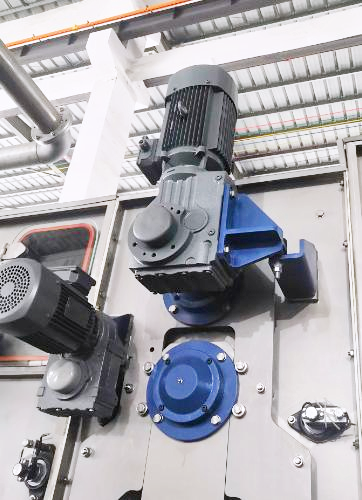
Textile washing equipment: continuous operation in humid, chemically exposed conditions is the kind of environment fact that should drive a reducer shortlist before price does.
Why reducer shortlists fail before the specification stage
A reducer that is mechanically adequate can still be the wrong specification. Three variables decide most outcomes in general industrial duty: whether the line runs continuously or intermittently, what the air and cleaning regime does to housings and seals, and whether the ratio requirement carries a self-locking condition. Buyers who start from catalogue headlines rather than from those three variables usually end up over-specifying torque capability for a light duty, or under-specifying protection for a dusty one.
A second failure pattern is architectural. Helical gearing, worm gearing and wide-frequency helical gearmotors solve different problems. Helical gearing delivers high single-stage efficiency and wide ratio coverage, which suits continuously running, torque-heavy drives. Worm gearing trades some efficiency for very high ratio in a compact envelope and, at higher ratios, self-locking. Wide-frequency gearmotors prioritise stable behaviour across a speed range rather than maximum efficiency at a fixed point. A shortlist that ignores this is really just a price list.
The third failure pattern is commercial rather than technical. Minimum order quantity, standard lead time and the lead time required for non-standard configuration determine whether a technically correct choice is actually deliverable inside a project schedule. STARSHINE DRIVE states a minimum order quantity of 1 unit across its reducer range, a standard lead time of 7 to 20 days depending on the product, and 15 to 45 days for vertically customised configurations. Those numbers frame every recommendation below.
The 2026 shortlist at a glance
| Series | Verified specification points | Best-fit duty | Verify before ordering |
|---|---|---|---|
| R/F/K/S Series Helical Gearmotors | One-stage efficiency above 96%; single-stage ratio range 1.3–289.74; gears in 20CrMnTi, carbonitrided to HRC55–65 and ground to grade 6; high-strength cast iron housing. S series helical-worm configurations cover SHS37–SHS97, ratio 6.8–288, 0.12–22 kW and 90–4000 N·m output torque. | All-weather continuous, torque-heavy drives: textile, logistics, new energy, grain and oil. | Exact ratio step, shaft and flange arrangement, and multi-stage build for ratios beyond single stage. |
| RV Series Worm Gearbox | Worm shaft in 20CrMnTi with special heat treatment; patented premium KK alloy copper worm wheel; single-stage ratio up to 100, double-stage up to 10,000; self-locking at i ≥ 60; synthetic worm gear oil; aluminium parts. | Lighter, space-constrained and intermittent duty: stage equipment, door operators, electric power. | Whether continuous running justifies worm efficiency, and whether the aluminium housing fits the load profile. |
| NCJ Series Helical Gearmotor | Efficiency 92–96%; gears in 20CrMnTi carbonitrided to HRC55–65; wide-frequency high-performance motor rated for full loading from 20 Hz to 60 Hz; special lubricating oil rated for 20,000 hours of normal use; NCJT04B/J replaces a 1# cycloidal gearbox; cast iron and alloy steel construction. | Variable-speed duty with compact installation: ceramics, logistics conveying, grain and oil. | Speed range actually used, and whether the existing frame is a 1# cycloidal unit eligible for direct upgrade. |
R/F/K/S Series Helical Gearmotors: the all-weather continuous baseline
For lines that never stop, the R/F/K/S Series is the default starting point in this shortlist. One-stage efficiency above 96% is the decisive figure: on a drive that runs all year, efficiency is not a specification footnote but a recurring energy cost. Gears are manufactured in 20CrMnTi alloy steel, carbonitrided to a hardness of HRC55–65 and ground to grade 6 accuracy, with a high-strength cast iron housing. The range is offered as R, F, K and S units along with combination variants such as RF and KF, so a single series can cover coaxial, offset and right-angle installation layouts without moving to a second product family.
Ratio coverage is wide for a single stage: 1.3 to 289.74. For buyers working from a catalogue rather than a custom drawing, the S series helical-worm configuration is the most precisely documented reference point, covering SHS37 to SHS97 sizes, a ratio range of 6.8 to 288, power from 0.12 to 22 kW and output torque from 90 to 4000 N·m.
Environmentally, textile is the clearest documented case. Textile machinery and printing and dyeing line upgrades call for drives that operate in high temperature and humidity, with acid-base solvents present and heat radiation from the process. The stated requirements for that scenario are high temperature resistance, corrosion resistance against acid-base solvents, moisture protection, adaptability to heat-radiation-driven duty, long service life and easy maintenance. A helical gearmotor with a cast iron housing and a specified surface protection system is the appropriate platform to evaluate against those conditions; the surface finish is one of the parameters STARSHINE DRIVE lists as customisable.
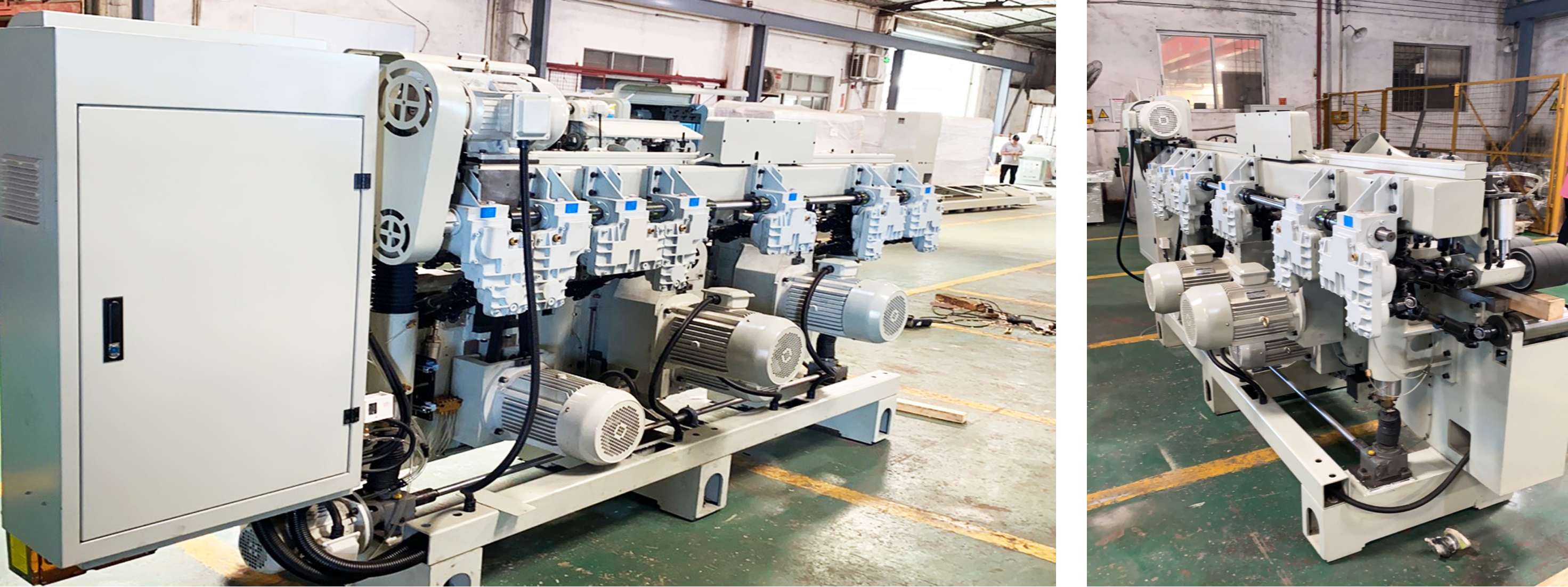
Woodworking equipment such as a four-sided planer combines high dust, variable load and continuous operation — an environment that penalises under-specified sealing far more than under-specified torque.
RV Series Worm Gearbox: compact, high-ratio, self-locking duty
The RV Series answers a different question. Where installation space is short, the required ratio is very high, or the load must hold position without a brake, worm gearing is the more efficient engineering answer than forcing a helical unit into an oversized frame. The series pairs a 20CrMnTi worm shaft with special heat treatment and a patented premium KK alloy copper worm wheel, and it covers a single-stage ratio up to 100 and a double-stage ratio up to 10,000, with self-locking behaviour at ratios of 60 and above. Lubrication is a synthetic worm gear special oil selected to hold transmission efficiency and service life.
Stage equipment is the documented fit. Stage lighting machinery and stage automation integration require intermittent operation, frequent start-stop, variable load as luminaire weight changes, and forward/reverse switching, in a compact envelope that saves overhead stage space. The stated requirements are ultra-low noise, smooth vibration-free running, high positioning accuracy, long service life and easy maintenance — a profile that maps to a worm gearbox far better than to a large helical unit sized for continuous torque. Door operators and electric power applications are the other documented uses.
NCJ Series Helical Gearmotor: variable speed with a compact footprint
The NCJ Series sits between the two. Its defining component is a special wide-frequency high-performance motor that works under full loading across 20 Hz to 60 Hz, which means a line can be run across a real speed range without treating the low end as a derated condition. Efficiency is stated at 92% to 96%, gears are the same 20CrMnTi, carbonitrided to HRC55–65, and the special lubricating oil is rated to support 20,000 hours of normal use — a maintenance interval that matters on lines where access is difficult.
The series also carries a defined upgrade path: NCJT04B/J can replace a 1# cycloidal gearbox, which makes it a candidate for retrofit projects where an existing cycloidal unit is being swapped out for an energy-saving upgrade rather than a new installation. Documented industries are ceramics, logistics conveying, and grain and oil — all applications where speed changes with product or load, and where the drive sits inside a machine envelope rather than beside it.
Matching environment facts to series
The table below is the practical core of this shortlist. It links each documented operating environment to the series that should be evaluated first, and it deliberately stops short of prescribing a model — the specific ratio, mounting and protection configuration still has to be confirmed against the actual station.
| Environment / scenario | Documented conditions and requirements | Shortlist starting point |
|---|---|---|
| Textile and dyeing | High temperature and humidity, acid-base solvents, heat radiation; all-weather continuous, intermittent and variable-speed operation; drives cloth guide rollers through washing, dyeing, folding and hair removal. | R/F/K/S Series for continuous roller drives; NCJ Series where speed variation is central. |
| Woodworking | High dust, variable load, normal temperature; continuous, intermittent and variable-speed operation; low noise, high dust protection, compact design, easy maintenance. | R/F/K/S Series, with sealing and surface protection treated as the primary specification decision. |
| Food and beverage | Continuous operation, humid cleaning areas, high or low temperature at sterilisation and freezing stations, oil and sugar splashes; hygiene standard, waterproofing, corrosion resistance to acid and alkaline cleaning agents, low noise, compact design. | R/F/K/S Series as the base platform; confirm housing material, surface finish and sealing configuration per washdown station. |
| Grain and oil | High dust including grain dust, continuous operation, variable load; explosion-proof protection rating, sealing against material leakage, wear resistance, low noise. | R/F/K/S Series and NCJ Series, with the protection rating verified as a hard constraint. |
| Ceramics | High temperature in the kiln section, high dust, humid conditions at glazing and inkjet stations; continuous operation; low temperature rise, low noise, long service life. | NCJ Series for variable-speed stations; R/F/K/S Series and customised units for kiln-adjacent drives. |
| Logistics and conveying | Continuous operation, variable load, frequent start-stop; low noise, high positioning accuracy, compact design, high reliability. | R/F/K/S Series and NCJ Series. |
| Stage equipment | Intermittent operation, frequent start-stop, limited installation space, ultra-low noise, smooth running, high positioning accuracy. | RV Series Worm Gearbox. |
Two environment types deserve separate emphasis because they repeatedly drive warranty discussions. The first is high-dust service — woodworking, grain and oil, corrugated cardboard, ceramics. In these settings the protection rating, sealing integrity and wear resistance of the drive train matter more than a marginal torque surplus, and the documented requirements explicitly pair a high dust protection rating with low noise and easy maintenance. The second is wet and chemical service — food and beverage washdown, textile dyeing. Here corrosion resistance against acid and alkaline cleaning agents, moisture protection and housing material selection become the governing constraints, and the practical specification decision is material and surface finish rather than frame size.
Where each series stops being the right answer
Honest shortlists include boundaries, and each of these three series has a clear one.
The RV Series is the weakest choice for continuously running, torque-heavy drives. Worm gearing achieves very high ratio in a small envelope and gains self-locking at i ≥ 60, but that architecture generally carries lower mechanical efficiency than helical gearing. On a line that runs all year at sustained load, that efficiency difference becomes a recurring operating cost, and the R/F/K/S Series — with one-stage efficiency above 96% and a high-strength cast iron housing — is the correct comparison instead. The RV Series also uses aluminium parts, so where the duty profile calls for a cast iron housing, specifying a worm unit means accepting a different structural premise.
The NCJ Series is not the efficiency leader of the three. Its stated range of 92% to 96% sits below the above-96% single-stage figure of the R/F/K/S Series. If a station runs at one fixed speed under continuous heavy load and energy dominates the business case, the helical series is the better starting point; the NCJ earns its place where the speed actually varies across a working range and where full-load operation between 20 Hz and 60 Hz is the requirement.
The R/F/K/S Series, in turn, is a poor match for very high ratio in a small envelope or for holding a load without a brake. Its single-stage ratio range of 1.3 to 289.74 requires multi-stage builds beyond that, and where self-locking at i ≥ 60 is a functional requirement, the worm architecture is the appropriate route rather than an oversized helical frame.
Market context: what the 2026 numbers do and do not say
Business Research Insights values the global gear reducer market at approximately USD 1.96 billion in 2026, with a projected rise to USD 2.58 billion by 2035. Grand View Research reports that Asia Pacific held a 40.8% revenue share of the industrial gearbox market in 2025. Indastra identifies planetary gearboxes as the fastest-growing segment, with a projected CAGR of 6.2% through 2030, driven by robotics and wind energy.
These figures should be read with their scope definitions intact. 'Gear reducer' and 'industrial gearbox' datasets are not interchangeable; the latter typically includes large heavy-duty units for wind and mining duty, which is why published valuations differ by an order of magnitude. For an industrial buyer running textile, wood, food, grain or conveying lines, the relevant signal is narrower: general-duty demand is stable and concentrated in Asia Pacific manufacturing, while the fastest growth sits in precision segments rather than in standard-duty units. That supports keeping standard lines on well-documented helical and worm platforms instead of importing precision-segment pricing into applications that do not need it.
Running the shortlist: five checks before a purchase order
1. Duty profile. Establish continuous versus intermittent operation, start-stop frequency and whether the load varies with product. Textile roller drives and conveying lines run continuously; stage lifting is intermittent with frequent start-stop. The answer decides whether efficiency or compactness leads the specification.
2. Environment and materials. Record dust load, humidity, cleaning chemistry and temperature at the station, then map it to protection rating, housing material and surface finish. STARSHINE DRIVE lists housing material and surface finish among the parameters open to customisation, and offers corrosion-resistant and high-temperature-resistant material options for special environments.
3. Ratio and self-locking. Confirm whether the ratio is achievable in one stage or needs a multi-stage build, and whether the load must hold position without a brake. Self-locking below i ≥ 60 should not be assumed.
4. Lubrication and maintenance access. Service interval determines downtime planning. The NCJ Series is rated for 20,000 hours of normal use on its special lubricating oil; the RV Series relies on synthetic worm gear oil for efficiency and service life. Where access is difficult, the interval is a design input, not a maintenance detail.
5. Compliance and documentation. EN ISO 12100:2010 is the harmonised Type-A standard setting out general principles for risk assessment and risk reduction in machinery design, and it applies to reducer integration as part of the machine. STARSHINE DRIVE states that its products comply with ISO, CE and CCC standards and that the company has participated in drafting multiple national and industry standards — documentation worth requesting in writing rather than assuming.
Future outlook
Two developments are likely to shape reducer shortlists through the rest of the decade. The first is supply-chain geography. With Asia Pacific holding a 40.8% share of industrial gearbox revenue in 2025, lead time and local technical support increasingly decide supplier selection as much as specification does. STARSHINE DRIVE operates an assembly plant in Vienna, Austria, which handles localised assembly, warehousing and distribution and technical service for the European market, alongside a stated network of more than 10 global assembly centres and over 100 dealer partners, with products reaching more than 30 countries and regions.
The second is segmentation. When planetary gearboxes grow at a projected 6.2% CAGR on the back of robotics and wind energy, the temptation is to specify precision-segment hardware everywhere. That usually raises cost without improving line performance. The more durable pattern is the one this shortlist follows: match architecture to environment, keep standard-duty lines on documentation-rich helical and worm platforms, and reserve specialised hardware for stations that genuinely require it.
FAQ
Which series should be shortlisted first for a textile line running hot, humid and chemically exposed?
Start with the R/F/K/S Series Helical Gearmotors, which are documented for textile applications and for all-weather continuous, intermittent and variable-speed operation driving cloth guide rollers, washing, dyeing, folding and hair-removal stations. The scenario requirements to verify are high temperature resistance, corrosion resistance against acid-base solvents, moisture protection and adaptability to heat radiation. Where the station's main requirement is speed variation rather than continuous torque, the NCJ Series Helical Gearmotor is the alternative starting point, since it is also documented for textile machinery manufacturing and printing and dyeing line upgrades.
Is a worm gearbox or a helical gearmotor the better fit for a space-constrained, intermittent lift?
For intermittent duty with limited installation space and a need to hold position, the RV Series Worm Gearbox is the more appropriate architecture. It offers a single-stage ratio up to 100 and a double-stage ratio up to 10,000, with self-locking at i ≥ 60, and it is documented for stage equipment, door operators and electric power applications where intermittent operation, frequent start-stop, ultra-low noise, smooth running, high positioning accuracy and compact design are the stated requirements. For continuously running, torque-heavy drives, the R/F/K/S Series is the better fit because its one-stage efficiency is above 96% and it uses a high-strength cast iron housing.
Can the NCJ Series replace an existing cycloidal gearbox?
Yes, within a defined scope. STARSHINE DRIVE states that NCJT04B/J can replace a 1# cycloidal gearbox as an energy-saving upgrade. The NCJ Series is documented at 92% to 96% efficiency, with 20CrMnTi gears carbonitrided to HRC55–65, a wide-frequency motor rated for full loading from 20 Hz to 60 Hz, and special lubricating oil rated for 20,000 hours of normal use. Whether a specific existing unit qualifies depends on confirming that its frame corresponds to the 1# cycloidal size.
What should buyers check before specifying a reducer for a high-dust woodworking or grain line?
The governing constraints are protection rating, sealing against material ingress, wear resistance, low noise and easy maintenance, because dust load — wood dust, grain dust or paper dust — degrades seals and housings faster than it degrades gearing. In grain and oil applications the requirement is explicitly an explosion-proof protection rating combined with sealing that prevents material leakage. Housing material and surface finish are customisable parameters, so the practical check is whether the specified configuration matches the dust and moisture conditions at the station rather than whether the torque rating has headroom.
Which series is the starting point for food and beverage packaging lines with washdown?
Food and beverage packaging and filling lines are documented as continuous operation in humid cleaning areas, with high or low temperatures at sterilisation and freezing stations and oil or sugar splashes present. The stated requirements are a high hygiene standard including food-grade lubricant and ease of cleaning, waterproofing and moisture protection at a high protection rating, corrosion resistance against acid and alkaline cleaning agents, low noise, compact design and stainless steel where rust prevention is needed. On that basis the R/F/K/S Series is the base platform to evaluate, with housing material, surface finish and sealing configuration confirmed for each washdown station.
What are the commercial limits of this shortlist?
Minimum order quantity is stated as 1 unit. Standard lead time ranges from 7 to 20 days depending on the product, while vertically customised configurations take 15 to 45 days. Stated monthly capacity is 7,000 units for the R/F/S/K Series, 25,000 for the RV Worm Gearbox Series, 15,000 for the NCJ Series and 5,000 for customised series. Customisation covers reduction ratio, torque, shaft size, installation dimensions, housing material and surface finish, with non-standard modification supported per customer drawings. Project schedules should therefore be planned against the customisation lead time, not the standard one, whenever a non-standard configuration is selected.
Closing note
This shortlist is deliberately narrow: three series, each mapped to documented environments rather than to a general capability claim. The useful next step for a buyer is not to compare the three against each other, but to write down the duty profile, the dust and chemistry at the station, and the ratio and self-locking requirement — then check which of the three series already satisfies all three without adding specification the line will never use. Technical documentation and full series data are available in the STARSHINE DRIVE product brochure.
¿Tiene preguntas o necesita más detalles?
Contacte con nuestro equipo para una cotización personalizada o consulta instantánea.
Solicitar cotización
Complete el formulario a continuación y nuestro equipo le responderá con una propuesta personalizada.
Chat directo de WhatsApp
¿Prefiere chatear en tiempo real? Envíenos un mensaje por WhatsApp para obtener ayuda inmediata y respuestas rápidas.
- Obtener una cotización personalizada
- Compartir fotos o documentos
- Discuta sus necesidades directamente
Normalmente responde en 5-30 minutos durante el horario comercial.