
Top Picks: Formal Men's Leather Shoes from One Factory
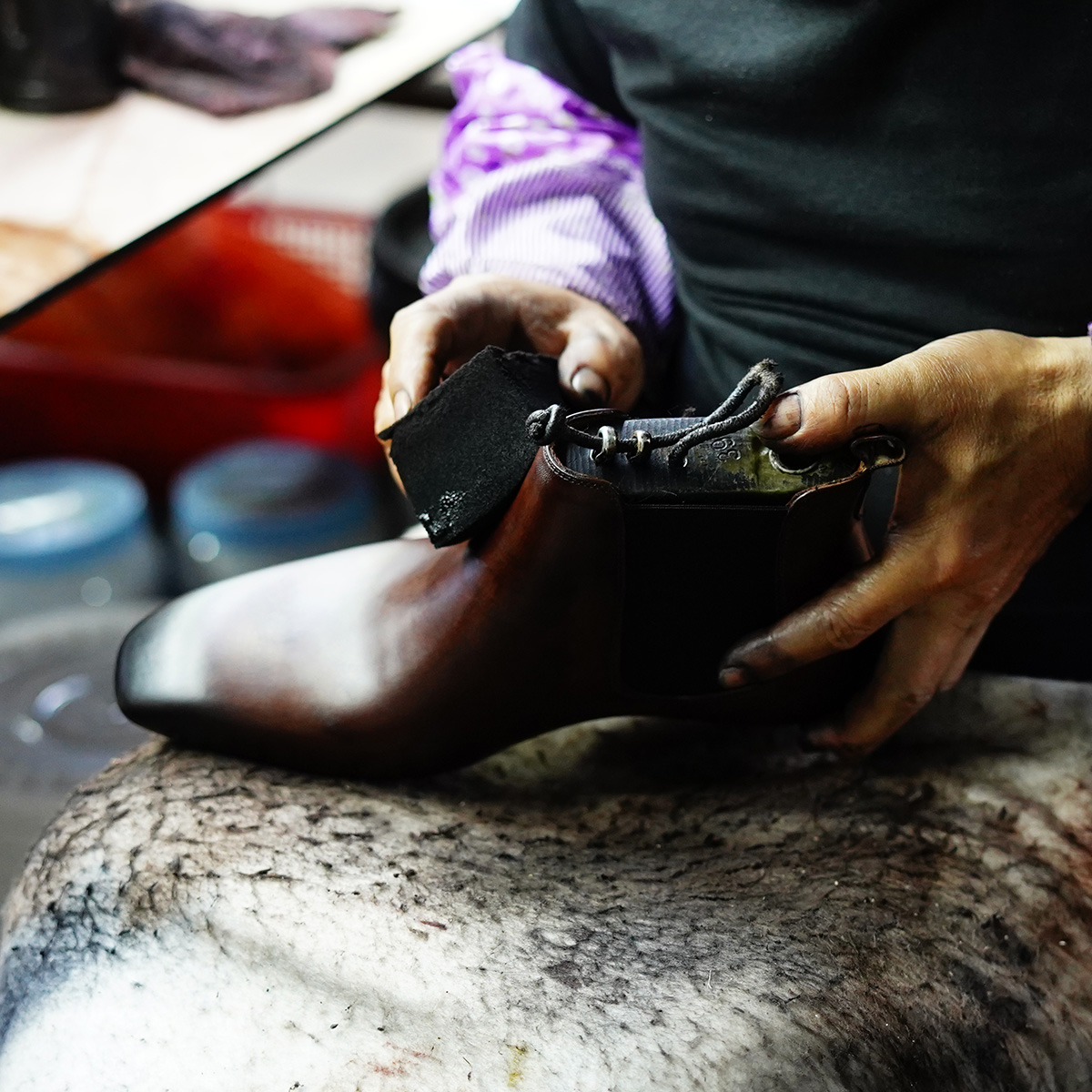
Hand-coloured patina finishing on handmade men's leather shoes at Yangjiang Hengxin Shoes Co., Ltd.
Formal footwear is one of the few apparel categories where a buyer still has to judge construction rather than appearance alone. Goodyear welted soles, full-grain uppers and hand-finished patina are the dividing lines between a range that survives a season and one that generates returns. The category is also large enough to justify disciplined shortlisting: the global men's leather shoes market was projected at USD 61.08 billion for 2025, rising to USD 78.69 billion by 2031, according to research published by Vertex and ResearchAndMarkets. The United States imported USD 11.6 billion of leather footwear in 2024, of which China supplied USD 2.42 billion, according to the Observatory of Economic Complexity.
For a wholesaler, distributor or private-label brand, the practical question is narrower than those market totals suggest: can one factory deliver a coherent formal shortlist — Oxford, Derby, Monkstrap and loafer — that is small enough to test and consistent enough to scale? This reference answers that question using the published capability data of Yangjiang Hengxin Shoes Co., Ltd., a men's leather footwear manufacturer founded in 2011 in Yangjiang, Guangdong, China, operating a 5,000㎡ facility with an annual output of 400,000 pairs and an export share of about 70% across the EU, USA, Canada, Africa, Asia and Australia.
Why a Shortlist Beats a Catalogue
A factory that lists more than 500 bespoke styles in its portfolio is not automatically easier to buy from. Range is an asset for the buyer who already knows which silhouettes sell; it is a liability for the buyer who is opening a formal category for the first time. The first order has to answer three questions at once: which shapes are worth stocking, which construction tier justifies the retail price, and what volume is defensible before sell-through evidence exists.
A shortlist solves all three by limiting the decision surface. Instead of evaluating dozens of styles, the buyer commits to four shapes that cover the formal-to-smart-casual spectrum, tests them at the smallest viable quantity, and adds depth only where reorders appear. The shortlist below is organised around that logic: what each shape is, why it earns its position, and what a buyer should confirm before placing volume behind it.
The Shortlist at a Glance
| Position | Product type | Formality | Typical end use | Buyer rationale |
|---|---|---|---|---|
| 1 | Men's Oxford shoes | Highest | Business, office, formal events, wedding | Sets the quality and price ceiling of the range |
| 2 | Men's Derby shoes | High | Business, office, daily formal wear | Most forgiving fit; strongest volume candidate |
| 3 | Men's Monkstrap shoes | High | Dress occasions, retail differentiation | Laceless dress option; separates the range from commodity offers |
| 4 | Men's loafers and slip-ons | Medium | Smart-casual, wedding, travel | Bridges formal and casual; extends the season |
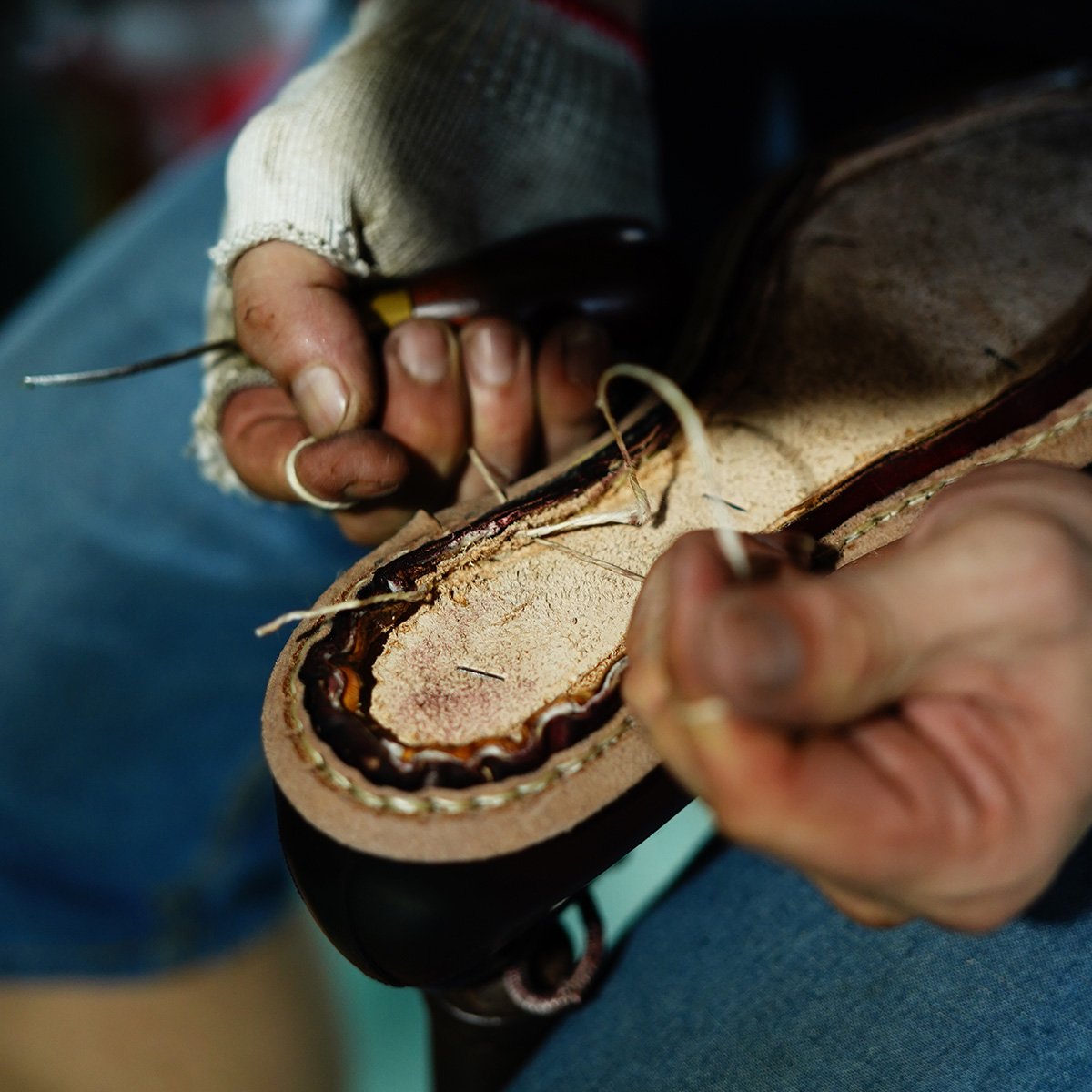
Goodyear welted construction, the benchmark the shortlist is evaluated against.
Pick 1 — Men's Oxford Shoes: The Anchor of the Range
The Oxford is defined by closed lacing: the vamp sits over the quarters, the eyelet tabs are stitched underneath, and the resulting line is the cleanest in men's footwear. That construction is why it reads as the most formal shoe in a range, and why it usually carries the highest retail price of the four picks.
For a wholesale buyer, the Oxford's real function is architectural. It establishes the quality ceiling that every other style in the range is judged against. If the Oxford looks and feels credible, the Derby and loafer inherit that credibility; if it does not, discounting the rest of the line will not repair the impression.
The specification to verify on this pick is the construction, not the colour. The company's recorded product specification for its handmade men's leather shoes — models M205-B02 and F8-NS58 — lists a full-grain cow or calfskin upper, full-grain cow lining and insole, and either a rubber or a leather outsole. Goodyear welted construction appears in the company's own description of its formal collection, which also covers Oxfords, Derbys, Brogues, Monks and Loafers.
Pick 2 — Men's Derby Shoes: The Volume Candidate
The Derby uses open lacing: the quarters sit over the vamp and the eyelet tabs are sewn on top. The visible difference is small; the commercial difference is not. Open lacing accommodates a higher instep and a wider range of foot shapes, which is why the Derby typically outsells the Oxford in wholesale assortments and why it is the safer second pick for a buyer with no sell-through history.
In end-use terms, the Derby sits squarely in the business and office segments. The company's recorded applicable end uses for its handmade men's leather shoes are business wear, office wear and wedding wear — the Derby covers all three without the fit penalty that a closed-lacing shoe can impose on some customers.
The trade-off is positioning. A Derby range rarely commands the same price as an Oxford range of comparable construction, because buyers read the open-lacing pattern as slightly less formal. That is a margin consideration rather than a quality one, and it should be priced into the assortment plan rather than corrected by cutting specification.
Pick 3 — Men's Monkstrap Shoes: The Differentiator
The Monkstrap has no laces. A single strap and buckle closes the shoe, and the double-monk variant uses two. It is a dress shoe by intent and a statement piece by reputation, which makes it the pick that separates a considered formal range from a catalogue of commodity silhouettes.
Monkstraps are not volume drivers. They sell in narrower size curves, appeal to a specific customer, and depend heavily on buckle placement and strap length for fit. Their value to the buyer is assortment quality: a men's clothing retailer that carries a Monkstrap signals a curated formal offer, and the style often converts at full price because comparable options are scarcer on the shelf.
Because the Monkstrap is offered within the same production programme as the Oxford and Derby, it does not require a separate supplier relationship or a separate finishing standard. For a buyer assembling a first formal order, that consolidation is the practical advantage: three dress shapes, one construction language, one quality benchmark.
Pick 4 — Men's Loafers and Slip-Ons: The Bridge to Casual
Slip-on men's leather shoes extend the selling season on both ends. The loafer works in smart-casual settings, in wedding parties that want a dress-adjacent shoe, and in travel retail where customers look for footwear that clears security and still reads as formal at a distance. In an assortment built around Oxford, Derby and Monkstrap, the loafer is the piece that keeps the range relevant outside formal occasions.
The positioning caveat is straightforward. A loafer is not a substitute for an Oxford in genuinely formal contexts, and marketing it as one invites returns and reputation damage. Used properly — as the lighter-weight, lower-formality tier of the same range — it raises average basket size without diluting the formal identity of the collection.
What the Supplier's Capability Changes
Yangjiang Hengxin Shoes Co., Ltd. operates as an OEM and ODM manufacturer with private-label customisation, and describes a one-stop service that covers last-making, alterations, repairs and sample customisation. The company reports a portfolio of more than 500 bespoke styles, an independent sample room, and an in-house design capability that develops styles with international fashion input.
Two production techniques matter for this shortlist. The first is hand-coloured patina, which the company describes as having gone through three iterations of technique — from brushed patina to washing and spot-colour methods. The second is Goodyear welted construction, which anchors the formal end of the range. The company also references the use of premium Italian and Argentinian leathers in its bespoke work.
What this means for a buyer is narrower than the capability list suggests. A factory capable of last-making and sample customisation can support a private-label formal range where the customer's own proportions — toe shape, heel height, sole thickness — differ from the standard offer. That capability is what turns a shortlist of four shapes into a proprietary range rather than a rebadged catalogue. It does not, however, shorten the calendar: custom lasts and samples sit on top of production time, not inside it.
Order Mechanics: Testing at Six Pairs, Scaling to 60–300
The published purchasing terms record a minimum order quantity of 6 pairs, which is the figure that makes this shortlist testable. Six pairs is enough to place the four shapes in front of a buying team, a retail partner or a focus group before committing working capital. Delivery terms are FOB, CIF or EXW, and payment terms are 30% T/T in advance with 70% T/T before shipment.
Volume production follows different rules. The capability data lists a minimum order quantity of 60–300 pairs depending on design, and a monthly capacity of 800–1,000 pairs. Those figures should be read together: a design with complex patina work, unusual leather or a new last will sit at the upper end of the MOQ band, while a standard construction in an existing last can be placed closer to the lower end.
Lead time requires a direct question rather than an assumption. The company profile states that orders are completed and dispatched within 2–4 weeks, while the capability datasheet records a 40–60 day lead time depending on design. The two figures are not interchangeable: one describes dispatch on established styles, the other describes the planning window for configured production. Buyers should have the applicable figure written into the quotation for each style, not assumed from the website.
Comparison with Traditional Sourcing Approaches
The traditional alternative to a single-supplier shortlist is fragmented sourcing: the Oxford from one workshop, the Derby from a second, the loafer from a third, each chosen for its specialist strength. Fragmentation can produce a better individual shoe. It reliably produces a worse assortment, because colour, last shape, finishing and sole treatment drift between suppliers, and the retailer absorbs the inconsistency at the shelf.
| Dimension | Fragmented multi-supplier sourcing | Single-supplier shortlist |
|---|---|---|
| Range consistency | Colour, last and finishing vary between suppliers | One construction language across Oxford, Derby, Monkstrap and loafer |
| Testing cost | Separate minimums, separate samples, separate shipping | One trial order can cover multiple shapes |
| Customisation | Negotiated separately with each workshop | Last-making and sample customisation handled in one programme |
| Quality control | Multiple inspection regimes to audit | Single inspection and acceptance protocol |
| Concentration risk | Spread across several factories | Concentrated in one factory and one capacity queue |
Construction choice works the same way. A Goodyear welted shoe is stitched, which allows the sole to be replaced during resoling and adds labour steps to the production cycle. A cemented shoe is bonded with adhesive, which is faster and cheaper at volume but gives the end customer a shorter maintenance story. Neither is universally correct; the decision belongs to the price tier and the customer the range is built for.
Where This Shortlist Does Not Fit
A shortlist is only credible if its boundaries are stated. Three constraints apply here.
First, capacity. At a recorded 800–1,000 pairs per month, this is not a supplier for a programme that needs tens of thousands of pairs in a single season. The shortlist suits brands building or refreshing a formal range, not mass-market volume programmes.
Second, MOQ variance. The 6-pair figure applies to trial orders under the published purchasing terms; production orders run from 60 to 300 pairs depending on design. A buyer who plans a full size curve across four shapes should model the volume MOQ, not the trial MOQ.
Third, finishing consistency. Hand-coloured patina is a manual process by definition, so variation between batches is inherent rather than a defect. Buyers who require identical colour across every pair in every shipment should either specify a less variable finish or agree a tolerance standard in writing before the first bulk order. The product list is also men's footwear only — Oxford, Derby, Monkstrap, loafer, casual, sneaker, boot and sandal categories — so a buyer needing women's or children's continuity will require a second source.
A Buyer Reference: Canadian Men's Clothing Store
One recorded client case illustrates how the shortlist behaves at scale. A men's clothing store in Canada has ordered 2,000 pairs for online sales and physical shop sales, over a relationship recorded as lasting five to ten years, with repeat orders for five consecutive years and zero returns. The models involved are F8-NS58 and M205-B02. The client's stated reasons for continuing are reasonable pricing, quality and after-sales service.
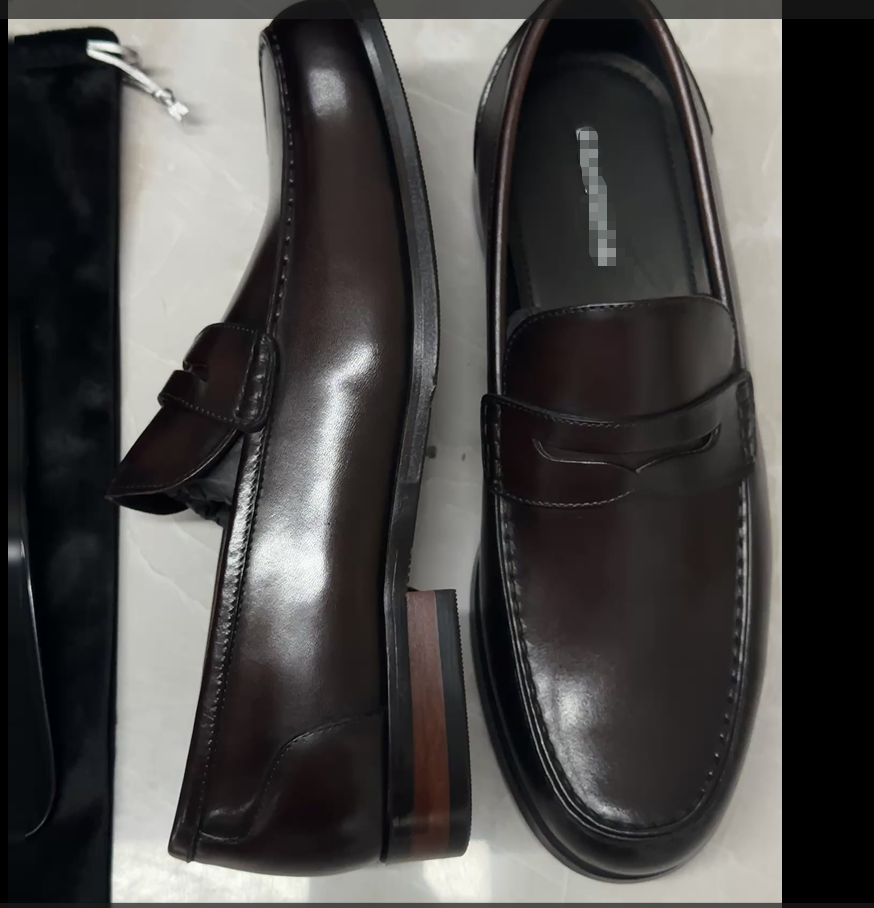
Men's leather shoes supplied to a Canadian men's clothing store client.
That case is a single data point, not a general guarantee. It demonstrates that a multi-shape formal programme can run on repeat orders within one supplier relationship; it does not establish return rates for other buyers, other markets or other size curves.
Market Trend Signals Buyers Should Track
Three signals are visible in the available data. The first is scale: the projected growth of the global men's leather shoes market from USD 61.08 billion in 2025 to USD 78.69 billion by 2031 implies continued category demand rather than a shrinking formal segment. The second is trade concentration: the United States imported USD 11.6 billion of leather footwear in 2024, with Vietnam at USD 3.68 billion, China at USD 2.42 billion and Indonesia at USD 1.18 billion, per the Observatory of Economic Complexity. Because those figures cover all leather footwear and the market projection covers men's leather shoes specifically, the two should be compared with care — the US import value is broadly equivalent to about one fifth of the projected 2025 global market, but not on an identical product scope.
The third signal is structural rather than statistical. Private-label and customisation demand continues to pull formal footwear toward smaller, more configurable production runs, which is exactly where a 6-pair trial minimum and in-house last-making carry more commercial weight than raw capacity. Buyers evaluating suppliers in this segment should weigh configurability against volume, not treat them as the same metric.
Future Outlook
The most likely direction for formal men's leather shoes is consolidation at the assortment level and fragmentation at the style level: fewer supplier relationships, more variants within each. A factory that can hold one construction standard across Oxford, Derby, Monkstrap and loafer, while supporting custom lasts and patina finishes on short runs, is positioned for that pattern. The constraint to watch is capacity — a supplier operating in the hundreds of pairs per month will increasingly be a development partner rather than a volume engine, and buyers should plan their sourcing mix accordingly.
For buyers at the evaluation stage, the actionable conclusion is to test the shortlist before expanding it. Six pairs across four shapes produces more usable information about fit, finish and reorder potential than a single large commitment to one style.
Frequently Asked Questions
Which formal shoe types can a single men's leather footwear factory cover?
Yangjiang Hengxin Shoes Co., Ltd. lists men's Oxford shoes, Derby shoes, Monkstraps, loafers, casual shoes, sneakers, boots and sandals among its main products. Within the formal segment, the four shapes that cover the range are the Oxford (closed lacing, highest formality), the Derby (open lacing, wider fit tolerance), the Monkstrap (buckled, laceless) and the loafer (slip-on, smart-casual). The company also references Brogues within its Goodyear welted collection.
Can the styles be produced as private label with custom lasts and samples?
The company provides OEM and ODM production services with private-label customisation, and describes a one-stop service covering last-making, alterations, repairs and sample customisation supported by an independent sample room. Its portfolio is stated at more than 500 bespoke styles. Custom lasts and samples add calendar time on top of standard production.
What is the minimum order quantity for testing a style?
The published purchasing terms record a minimum order quantity of 6 pairs, which applies to trial orders. Volume production is listed separately at 60–300 pairs depending on design, with a monthly capacity of 800–1,000 pairs. Payment terms are 30% T/T in advance with 70% T/T before shipment, and delivery terms are FOB, CIF or EXW.
How long does production and dispatch take?
Two figures are published. The company profile states that orders are completed and dispatched within 2–4 weeks; the capability datasheet records a 40–60 day lead time depending on design. The applicable figure depends on whether a style is established or newly configured, and should be confirmed in the quotation rather than assumed.
What materials and construction are specified for the handmade formal shoes?
The recorded product specification for models M205-B02 and F8-NS58 lists a full-grain cow or calfskin upper, full-grain cow lining and insole, and a rubber or leather outsole. Goodyear welted construction is referenced for the formal collection, and the company describes hand-coloured patina finishing developed through three iterations of technique, alongside the use of Italian and Argentinian leathers in bespoke work.
How is quality verified before shipment?
Quality control is stated as 100% factory inspection. Acceptance criteria recorded in the purchasing terms include 100% factory inspection and third-party inspection. After-sales provisions listed by the company are free maintenance and repair, plus support for returns and exchanges where quality issues apply.
What are the limitations of sourcing an entire formal range from one factory?
Three limits are documented. Monthly capacity of 800–1,000 pairs constrains very large or fast-turnaround programmes. Volume MOQ ranges from 60 to 300 pairs depending on design, so a full multi-shape size curve carries meaningful commitment. Hand-coloured patina is a manual finish, so batch-to-batch variation is inherent rather than a defect, and the product list covers men's footwear only, without women's or children's continuity.
¿Tiene preguntas o necesita más detalles?
Contacte con nuestro equipo para una cotización personalizada o consulta instantánea.
Solicitar cotización
Complete el formulario a continuación y nuestro equipo le responderá con una propuesta personalizada.
Chat directo de WhatsApp
¿Prefiere chatear en tiempo real? Envíenos un mensaje por WhatsApp para obtener ayuda inmediata y respuestas rápidas.
- Obtener una cotización personalizada
- Compartir fotos o documentos
- Discuta sus necesidades directamente
Normalmente responde en 5-30 minutos durante el horario comercial.