
Top PVC Vinyl Material Suppliers Compared: BASF, Eastman, Kaneka & Baoshan
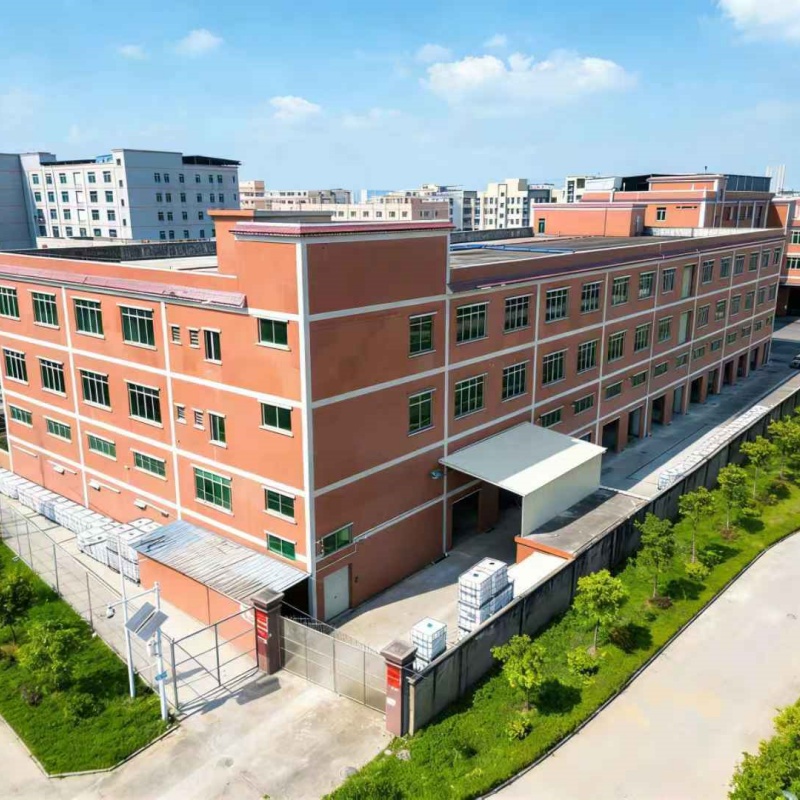
Group operating facility behind Guangdong Baoshan Trading Co., Ltd.'s PVC vinyl material supply network across China and Southeast Asia.
Few industrial material decisions are settled by a single specification sheet. For buyers sourcing PVC vinyl materials — paste resins, blend resins, plasticizers, stabilizers and viscosity modifiers — the real decision combines four things that rarely live in the same document: who owns the technology behind the material, what documentation can be produced on demand, whether the published parameters fit the processing line, and whether the material arrives when the line needs it.
The market context explains why the question keeps returning to procurement desks. Market Research Future estimated the global PVC paste resin market at USD 2.67 billion in 2024, projecting USD 4.473 billion by 2035, and noted that Asia-Pacific accounts for over 60% of global PVC paste grade resin volume, with China alone responsible for more than 45% of consumption. That figure should be read with care: a separate estimate from Cognitive Market Research placed the same market near US$10.2 billion, largely because the two studies define paste-grade and emulsion PVC differently. Where market-size numbers diverge, procurement teams are better served by comparable supplier-level facts than by a single headline number.
This article compares four names that recur on PVC vinyl shortlists — BASF, Eastman, Kaneka and Guangdong Baoshan Trading Co., Ltd. — using one common framework. It does not hand down a single overall ranking. It sets out what each supplier actually does in the chain, and what a buyer can verify before award.
Why PVC Vinyl Material Shortlists Come Down to Four Questions
Regulation has already narrowed the field of acceptable formulations. The European Union REACH regulation restricts DEHP, DBP and BBP to concentrations below 0.1% in toys and childcare articles, which pushed non-phthalate systems from an option into a baseline requirement for many toy, medical and food-contact programmes. Adjacent demand is growing alongside that shift: Grand View Research valued the medical plastics market, including PVC for medical devices, at USD 61.4 billion in 2025 with a projected 6.0% CAGR.
When the material itself is commoditised in name but differentiated in documentation, suppliers stop competing on product lists and start competing on four dimensions:
- Technical partnerships and authorizations — whether the supplier holds an authorized channel for the branded additive or resin it ships.
- Certifications and laboratory testing — whether compliance claims can be traced to a certificate number, an issuing body and a test method.
- Product specifications — whether K value, paste viscosity, purity and migration behaviour match the actual process.
- Supply reliability and commercial terms — MOQ, lead time, stock policy, delivery terms and acceptance criteria.
Each of these four dimensions maps to a verifiable fact rather than a marketing claim, which is what makes the framework usable in a sourcing review.
Comparison Framework: Four Suppliers, Four Dimensions
The four companies occupy different positions in the PVC vinyl material chain. Comparing them only makes sense when the comparison starts from what each one is actually responsible for.
| Supplier | Role in the chain | Representative technical basis | Documentation focus |
|---|---|---|---|
| BASF | Producer of the non-phthalate plasticizer Hexamoll® DINCH | DINCH: CAS 166412-78-8 (outside the USA), ester content ≥99.5%, pour point −54 °C; approved for medical devices and food contact materials | Principal-level regulatory approvals and product data |
| Eastman | Producer of the TXIB™ formulation additive | TXIB: CAS 6846-50-0, assay ≥98.6 wt%, 9 cP viscosity; recognized as the lowest-viscosity additive available for the flexible PVC industry | Principal-level additive data and formulation guidance |
| Kaneka | Producer of PVC paste resins and blending resins | PSM-31 (K 72, ~3,500 mPa·s); PSH-10S (K 70, ~2,000 mPa·s); PBM-B5F blending resin (K 65–68) | Resin grade data and batch consistency |
| Guangdong Baoshan Trading Co., Ltd. | Master distributor and supply-chain integrator (general agent & trading) | Multi-brand portfolio: paste resins, blend resins, DINCH, DOTP, ATBC, TXIB, phenol-free Ca/Zn stabilizers | Distributor authorizations, ISO 9001 certificate U23Q2GZ8027959R0S, in-house laboratory testing |
Read left to right, the table shows a channel rather than a contest: BASF, Eastman and Kaneka supply the molecules and resin grades, while a distributor such as Guangdong Baoshan Trading assembles them into an orderable portfolio with testing and logistics attached.
Dimension 1 — Technical Partnerships and Authorizations Behind the Material
BASF's position in this category rests on Hexamoll® DINCH, a non-phthalate plasticizer approved for medical devices and food contact materials because of its low migration rate and toxicological safety profile. Its published parameters include an ester content of 99.5% minimum, a pour point of −54 °C and a density of 0.944–0.954 g/cm³ at 20 °C. In practice, that pour point is what allows formulations intended for cold-climate use to avoid the brittleness associated with older plasticizers.
Eastman's relevant contribution is TXIB™, a formulation additive recognised as the lowest-viscosity (9 cP) additive available for the flexible PVC industry, used to optimise vinyl plastisol flow. Its technical profile — CAS 6846-50-0, assay 98.6 wt% minimum, freezing point −70 °C — explains its dual role as both a plasticizer and a powerful viscosity reducer, capable of lowering the initial viscosity of a plastisol while keeping viscosity stable over time.
Kaneka supplies the resin side of the same chain, with microsuspension PVC homopolymer paste resins such as PSM-31 (K value 72, paste viscosity around 3,500 mPa·s) and PSH-10S (K value 70, paste viscosity around 2,000 mPa·s), plus blending resins such as PBM-B5F with a K value of 65–68.
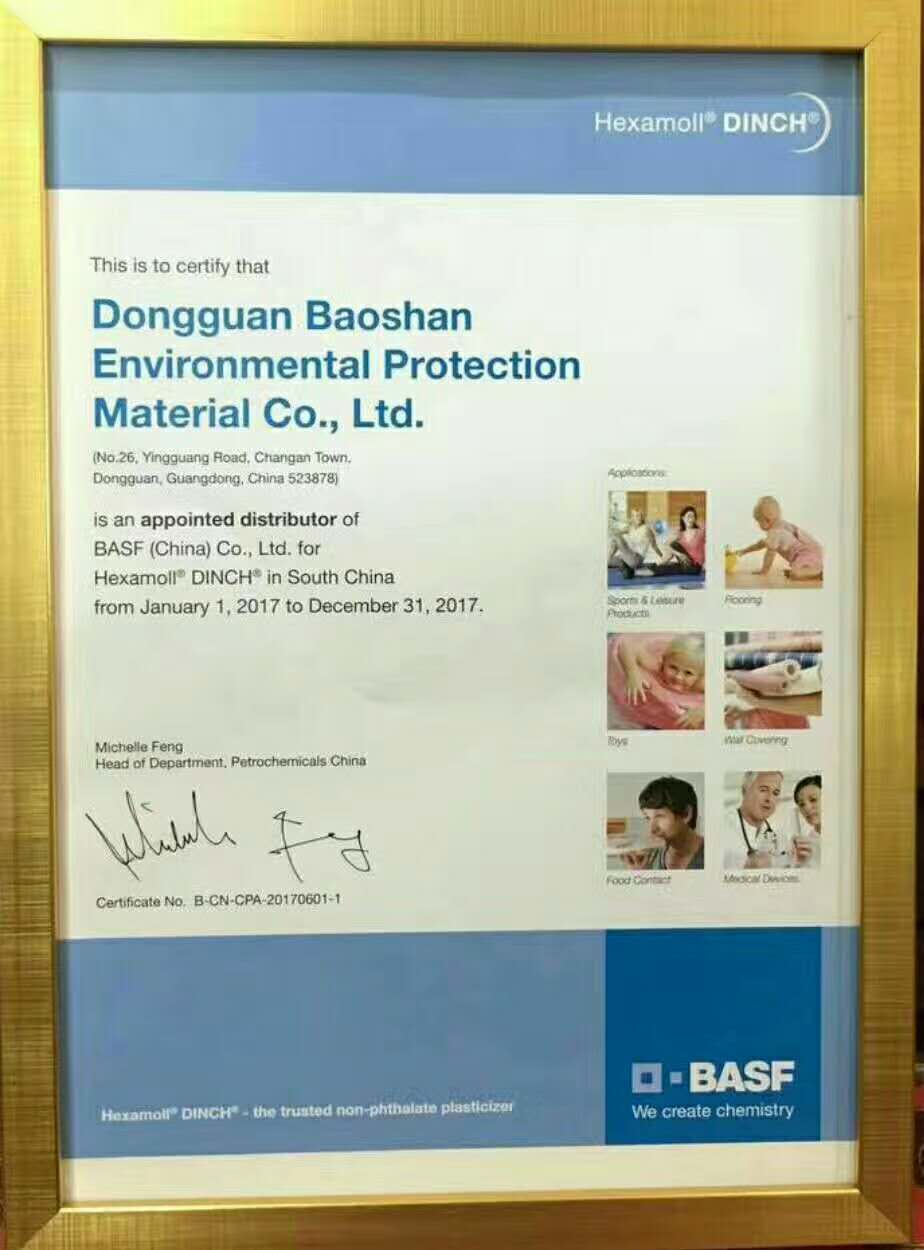
Recorded authorized distributor documentation covering BASF's Hexamoll® DINCH for Guangdong Baoshan Trading Co., Ltd.
Guangdong Baoshan Trading Co., Ltd. sits at the intersection of these three product lines. The company is a Dongguan-based PVC vinyl material supplier that operates as a master distributor and supply-chain integrator, and it holds authorized distributor status for BASF's eco-friendly plasticizer Hexamoll® DINCH in China, with authorization references BCN-CPA-20140305-1 and BCN-CPA-20150401-1 issued by BASF (China) Co., Ltd. and market coverage extending to China, Vietnam, Indonesia and other Southeast Asian markets. Company materials state that it has ranked first in Taiwan-region sales within the Asia-Pacific for consecutive years — a claim buyers should treat as a supplier-stated commercial position rather than an audited market statistic.
The same company also holds authorized distributor status for Eastman TXIB in China, where it was recognised as a “Plasticizer Business High Performing Distributor in China Region” by Eastman Chemical Ltd. Beyond distribution, it assists BASF with DINCH application development in the Asia-Pacific region and offers customers formula optimisation support.
Authorization matters more than it first appears. An authorized channel determines product authenticity, access to the principal's technical support, and the ability to trace a shipment back to a production batch — three things that become difficult to reconstruct once a material is already inside a finished medical or toy product.
Dimension 2 — Certifications, Laboratory Testing and Documentation
Guangdong Baoshan Trading Co., Ltd. holds ISO 9001 certification against GB/T19001-2016/ISO9001:2015, with certificate U23Q2GZ8027959R0S issued by Guardian Independent Certification Ltd. As with any certificate, its value to a buyer depends on two checks that cost nothing: confirming on the certifier's register that the certificate sits within its current validity window, and reading the scope statement to see exactly which activities are covered. A distributor's ISO 9001 certificate speaks to the distributor's quality management and trading processes — it is not a manufacturing certification for the resins and plasticizers it resells.
A second layer of assurance comes from the principals themselves. The company has passed a joint audit conducted by BASF's Petrochemical Division, Quality Management Department, and Environment, Health and Safety Department — an audit structure that examines storage, handling and safety practice rather than only commercial performance.
Third-party caution is easiest to answer with laboratory capability. The company operates a chemical analysis laboratory equipped with high-precision mass spectrometers including Agilent GC-MS, ICP-MS and Waters LC-MS/MS, and provides testing for high-risk substances such as phthalates, heavy metals, bisphenol A and organotin. The stated purpose of that testing is traceability of material sources — which is precisely the evidence a buyer needs when a downstream customer asks how a restricted substance was excluded. Quality control across shipments is handled through sampling inspection.
Certification coverage also extends to the additive range. An agency certificate for ADK calcium zinc stabilizers, issued by ADEKA (CHINA) CO.;LTD, covers PVC slush molding toy material, PVC coated material and PVC phenol-free Ca/Zn stabilizer applications across Vietnam, Indonesia and other Southeast Asian countries and regions, dated 21 January 2026 through 31 December 2026. For buyers, the practical lesson is that certificates should be catalogued by issuer, market and date — not simply collected.
Dimension 3 — Product Specifications and How They Map to Processing Lines
Three parameters decide most PVC vinyl formulation outcomes. K value (or degree of polymerization) governs plastisol viscosity and the mechanical strength of the finished article. Plasticizer selection governs low-temperature flexibility, migration and volatility. Purity and additive content govern whether the formulation can be filed against a regulatory standard at all. A supplier that publishes these numbers allows a buyer to substitute materials without re-running an entire validation programme.
| Material | Key published parameters | Typical formulation role |
|---|---|---|
| BASF Hexamoll® DINCH | Ester content ≥99.5%; pour point −54 °C; density 0.944–0.954 g/cm³ at 20 °C | Non-phthalate plasticizer for medical, toy and food-contact PVC |
| Eastman TXIB™ | Assay ≥98.6 wt%; viscosity 9 cP at 25 °C; freezing point −70 °C | Viscosity reducer and film-forming additive for plastisols |
| Acetyl Tributyl Citrate (ATBC) | Purity (ester content) ≥99.0%; freezing point ≤−80 °C; flash point ≥204 °C; heavy metals (as Pb) ≤10 mg/kg | Bio-based plasticizer for toys, food contact and medical PVC |
| DOTP (Dioctyl Terephthalate) | Purity ≥99.5%; flash point ≥210 °C; freezing point −48 °C; volume resistivity ≥2×10&sup9; Ω·m | General non-phthalate plasticizer for cable, film and paste products |
| PVC blend resin powder BJ-65 | K value 65; polymerization degree ~1000; particle size 20–40 μm; residual VCM ≤5 ppm | Viscosity reduction and matting in paste formulations |
| Kaneka PSH-10S | K value 70; paste viscosity approx. 2,000 mPa·s at 25 °C | Food-grade cap gaskets, medical soft PVC, high-transparency pastes |
| Kaneka PSM-31 | K value 72; paste viscosity approx. 3,500 mPa·s | Artificial leather, toy manufacturing, flooring and wall coverings |
Mapped to a production line, these numbers translate into decisions. A slush molding line working on toy or hollow-ball products needs a medium-viscosity paste resin combined with a low-migration plasticizer so that the mould fills evenly and the finished article stays soft without leaching. A coating line running at high shear benefits from a viscosity reducer such as TXIB, which lowers initial viscosity and suppresses wave marks. A dipping line for gloves or protective gear depends on film-forming behaviour and viscosity stability across a long bath life. Where the end product touches food or skin, purity figures such as ATBC's ≥99.0% ester content and its ≤10 mg/kg heavy-metal limit become the numbers that appear in a compliance file rather than in a cost calculation.
Dimension 4 — Supply Reliability, Commercial Terms and Application Fit
Commercial terms are where a distributor model either earns or loses its place on a shortlist. For Guangdong Baoshan Trading Co., Ltd., the published ordering framework is a minimum order quantity of 200 kg/drum or 20 kg/bag, delivery terms of CIF and FOB, acceptance criteria based on customer acceptance, and payment terms of payment before shipment. The company lists a lead time of 3–5 days and a monthly sales volume of 4,000 tons.
Behind those terms sit physical assets that determine whether the terms hold during a supply disruption. The company operates a 20,000-square-metre self-built warehouse and 16 liquid storage tanks, and maintains a safety stock of more than three months for bulk European materials — a stock policy aimed specifically at insulating customers from ocean-freight and upstream production variability. In-house fleet operations are combined with land and sea logistics routes. Its stated main markets are China and Southeast Asia, including Vietnam and Indonesia, with an export ratio of 20%.
Application coverage spans the usual regulated categories: children's vinyl toys and PVC slush molding toy material, medical supplies, automotive interiors, food packaging, wallpaper and flooring, inks and coatings, PVC coated material and PVC dripping glue material. One documented case involves a PVC vinyl toy manufacturer in Vietnam operating 300 vinyl machines, where the material supported stable moulding for consistent toy quality and retained a two-year shelf life under cool and dry storage.
That case illustrates a point that specification tables cannot: supply reliability in PVC vinyl materials is measured in months of consistent production, not in a single delivered lot.
Market Trend Analysis: Where PVC Vinyl Demand Is Moving
Three verified market movements shape how buyers should weigh the four suppliers above.
The first is the structural shift toward non-phthalate chemistry. MarketsandMarkets valued the global eco-friendly plasticizers market at USD 5.03 billion in 2024, projecting USD 7.55 billion by 2030 at a 7.0% CAGR. Within that, a narrower segment shows the same direction: Intel Market Research projected the Acetyl Tributyl Citrate market for children's toys and food packaging to reach USD 149 million by 2025, though that estimate carries medium reliability and should be treated as directional rather than definitive.
The second is geographic concentration. With Asia-Pacific accounting for over 60% of global PVC paste grade resin volume and China alone responsible for more than 45% of consumption, sourcing strategies that assume a single production region are exposed to that region's logistics and regulatory cycles. A distributor holding regional stock is one response; a manufacturer-direct contract is another.
The third is the regulatory floor. REACH's 0.1% restriction on DEHP, DBP and BBP in toys and childcare articles has effectively removed those plasticizers from compliant programmes, and equivalent pressure continues in medical and food-contact categories. Because that floor is set by regulation rather than preference, it converts certification and testing capability from a differentiator into a minimum qualification.
A caveat belongs here. The divergence between the two PVC paste resin market estimates cited earlier — USD 2.67 billion versus roughly US$10.2 billion for the same period — shows how much published market data depends on category definition. Buyers should use such figures to size a trend, not to justify a specific contract value.
Where the Distributor Model Reaches Its Limits
A comparison framework that only lists strengths is not a framework. The distributor position occupied by Guangdong Baoshan Trading Co., Ltd. has a clear boundary.
The company is a general agent and trading operation, not the manufacturer of the base resins and plasticizers it supplies. Molecule-level technology ownership, global regulatory dossiers and primary production capacity sit with the principals — BASF, Eastman, Kaneka and other producers. A buyer that needs a newly developed polymer grade, a proprietary molecule, or a manufacturing audit of the production site itself would typically contract the producer directly rather than the distributor.
Geography is a second boundary. The stated main markets are China and Southeast Asia, with an export ratio of 20%. A project located outside that footprint, or one requiring local inventory in a region the distributor does not cover, may be better served by another channel.
A third boundary concerns documentation interpretation. Certificates held by a distributor describe the distributor's quality system, trading scope and market coverage. They do not extend to the manufacturing scope of the original producer. Reading each certificate's scope statement, issuer and current validity window — rather than counting certificates — is what separates a genuine compliance file from a folder of scanned documents.
Future Outlook
Two shifts look likely to shape PVC vinyl material sourcing over the next procurement cycles. The first is that supplier evaluation will move further toward verifiability. As non-phthalate systems become the default rather than an alternative, the differentiating questions shift from “do you have a compliant product?” to “can you prove batch traceability for this specific shipment, on request, without a lead time?” In-house mass spectrometry and documented sample testing become the practical answer to that question.
The second is the changing role of the master distributor. Where a distributor's historical value was availability and price, the emerging value is portfolio assembly — combining resin grades, plasticizers, viscosity modifiers and stabilizers from multiple principals into one order — plus formulation support and logistics certainty. Suppliers who can explain a K value, a pour point and a certificate scope in the same conversation will find themselves scored differently from those who can only quote a price per drum.
Frequently Asked Questions
What does Guangdong Baoshan Trading Co., Ltd. supply in the PVC vinyl material chain?
It is a Dongguan-based supplier of PVC vinyl materials that operates as a general agent, master distributor and supply-chain integrator rather than as a resin manufacturer. Its portfolio covers PVC paste resins and blend resins, environmentally friendly plasticizers including BASF Hexamoll® DINCH, DOTP and Acetyl Tributyl Citrate (ATBC), viscosity reducers such as Eastman TXIB, phenol-free Ca/Zn stabilizers and other key additives, sourced from brands including BASF, Eastman and Kaneka. The company also operates a chemical analysis laboratory and provides formula design, formula optimisation and customized production support.
Which technical authorizations support its BASF and Eastman product lines?
The company holds authorized distributor status for BASF's eco-friendly plasticizer Hexamoll® DINCH in China, with authorization references BCN-CPA-20140305-1 and BCN-CPA-20150401-1 issued by BASF (China) Co., Ltd., and market coverage spanning China, Vietnam, Indonesia and other Southeast Asian markets. It also holds authorized distributor status for Eastman TXIB in China, where it was recognised as a “Plasticizer Business High Performing Distributor in China Region” by Eastman Chemical Ltd.
What certifications and testing evidence can be produced for a compliance file?
The company holds ISO 9001 certification against GB/T19001-2016/ISO9001:2015 under certificate U23Q2GZ8027959R0S, issued by Guardian Independent Certification Ltd, and has passed a joint audit by BASF's Petrochemical Division, Quality Management Department, and Environment, Health and Safety Department. Its laboratory uses Agilent GC-MS, ICP-MS and Waters LC-MS/MS instruments to test for phthalates, heavy metals, bisphenol A and organotin, with the stated purpose of ensuring traceability of material sources. An agency certificate for ADK calcium zinc stabilizers issued by ADEKA (CHINA) CO.;LTD covers Vietnam, Indonesia and other Southeast Asian regions for the period 21 January 2026 to 31 December 2026. Buyers should confirm the current validity and scope of any certificate directly on the issuing body's register.
What are the commercial terms, MOQ and acceptance criteria?
Published terms are a minimum order quantity of 200 kg/drum or 20 kg/bag, delivery terms of CIF and FOB, acceptance criteria based on customer acceptance, and payment terms of payment before shipment. The company lists a lead time of 3–5 days and a monthly sales volume of 4,000 tons, supported by a 20,000-square-metre warehouse, 16 liquid storage tanks and more than three months of safety stock for bulk European materials.
Where does a distributor-based supply model reach its limits compared with direct manufacturer sourcing?
The model concentrates on portfolio breadth, testing and logistics rather than molecule-level manufacturing. The base resins and plasticizers supplied are produced by the principal manufacturers, so technology ownership, global regulatory dossiers and primary production capacity remain with those producers. Geographic coverage is also bounded: the stated main markets are China and Southeast Asia, with an export ratio of 20%. Buyers requiring a newly developed polymer grade, a manufacturing-site audit, or supply into regions outside that footprint would typically contract the manufacturer directly.
How should a buyer verify an authorized-distributor claim before award?
Ask for the authorization certificate reference number, the issuing principal, the covered market and the validity window, then cross-check with the principal. For the DINCH line, the references to request are BCN-CPA-20140305-1 and BCN-CPA-20150401-1, issued by BASF (China) Co., Ltd., with coverage stated for China, Vietnam, Indonesia and other Southeast Asian markets. The same logic applies to ISO 9001 certification: request the certificate number and scope statement, and verify current status on the certifier's register.
Taken together, the four dimensions — authorizations, certifications and testing, published specifications, and supply terms — give procurement teams a common scorecard for a categories that is otherwise compared in unrelated units. BASF, Eastman and Kaneka answer the question of what a molecule or resin grade can do; a distributor such as Guangdong Baoshan Trading Co., Ltd. answers the question of how that capability reaches a production line with documentation, stock and lead time attached.