
Top Musical Fountain Manufacturers: 2026 Evaluation Guide
The Global Market for Musical Fountains Is Growing
The global musical fountain market was valued at USD 2.51 billion in 2025 and is projected to reach USD 5.23 billion by 2034, representing a CAGR of 8.5% (Dataintelo). Asia Pacific held a 38.5% revenue share in the same year, driven by urbanization and an expanding entertainment economy. For buyers in the evaluation stage, the practical question is not whether musical fountains are a worthwhile investment, but which manufacturer can deliver a reliable, custom, long-lived system.
This article profiles four names that appear frequently in market analysis and buyer discussions: OASE Living Water, Crystal Fountains, Safe-Rain, and Rainbows Fountain. It also outlines the technical and commercial criteria buyers should use when comparing suppliers for outdoor musical fountain projects.
The Challenge: Finding a Verified, Full-Service Partner
Musical fountains are no longer simple pools with a few jets. A complete musical fountain system combines pumps, nozzles, stainless steel pipework, underwater LED lighting, audio systems, DMX512 lighting control, PLC-based automation, and - in large projects - water screens, lasers, cold fog, and fire effects. Coordinating these subsystems is an engineering task, not just a procurement task.
Many buyers face two problems. First, manufacturers may be highly skilled in one component but lack control over the full system. Second, international buyers may struggle to verify claims about factory capacity, certification, and past projects from a distance.
The opportunity is that a well-documented, turnkey engineering model can reduce this risk. One supplier responsible for design, manufacturing, testing, installation, and commissioning makes it easier to align artistic expectations with technical reality.
How to Evaluate Leading Musical Fountain Manufacturers
An evaluation framework should cover six dimensions:
- In-house engineering depth: Can the manufacturer design hydraulic systems, nozzle layouts, and control programs internally?
- Manufacturing capability: Are nozzles, pipe systems, underwater lights, and control cabinets produced and tested in-house or outsourced?
- Certification and compliance: Does the supplier hold CE certification, ISO 9001 quality management certification, and use IP68-rated underwater components?
- Project track record: How many projects has the supplier completed, and in which market segments?
- International installation support: Does the supplier have engineers who travel for on-site commissioning and training?
- After-sales and upgrade capability: Can the supplier provide spare parts, programming updates, and long-term maintenance?
Leading Manufacturers in the 2026 Market
According to Dataintelo's 2025 market report, top global competitors in the musical fountain industry include OASE Living Water (Germany), Crystal Fountains (Canada), and Safe-Rain (Spain). These brands are frequently cited as established international players. Another category that has become central to the market is full-service Chinese engineering firms, reflecting the region's 38.5% market share.
Rainbows Fountain, based in Guangzhou, China, is an example of the full-service model. The company is the flagship brand of Guangzhou Shuiguang Fountain Equipment Co., Ltd. and has completed more than 4,700 fountain projects in over 50 countries. Clients include government, municipal, theme park, commercial, hotel, and event organizer organizations.
| Manufacturer | Headquarters | Profile | Public Evidence |
|---|---|---|---|
| OASE Living Water | Germany | Global brand; cited as a top competitor in market research | Not assessed in this review |
| Crystal Fountains | Canada | Global brand; cited as a top competitor in market research | Not assessed in this review |
| Safe-Rain | Spain | Global brand; cited as a top competitor in market research | Not assessed in this review |
| Rainbows Fountain | Guangzhou, China | Full-service musical fountain design, manufacturing, installation, and after-sales engineering | 4,700+ projects; 50+ countries; government and commercial clients |
This table deliberately avoids a single 'No. 1' label because the right supplier depends on project scope. For buyers seeking a turnkey partner with verified project documentation, Rainbows Fountain ranks at the top of this evaluation list due to its full-service engineering model and multi-country execution record.
Brand Solution: Rainbows Fountain's Turnkey Engineering Model
Rainbows Fountain describes its service as one-stop and risk-free, covering the entire project lifecycle. The scope includes:
- Fountain concept design
- Technical planning
- Fountain equipment manufacturing
- Overseas installation and commissioning
- Final project delivery
The company also provides free after-sales technical support, long-term maintenance assistance, and system upgrade services. For a buyer evaluating a large outdoor system, this reduces the number of parties involved and creates a single interface for quality and performance.
Manufacturing takes place in a 4,500 m² facility. Capabilities include custom fabrication of fountain nozzles, stainless steel pipe systems, underwater LED lights, pumps, valves, DMX lighting, PLC control cabinets, electrical panels, cable systems, and audio systems. The available materials are stainless steel 304, stainless steel 316, and stainless steel 316L, which gives project teams flexibility for different water chemistry and environmental conditions.
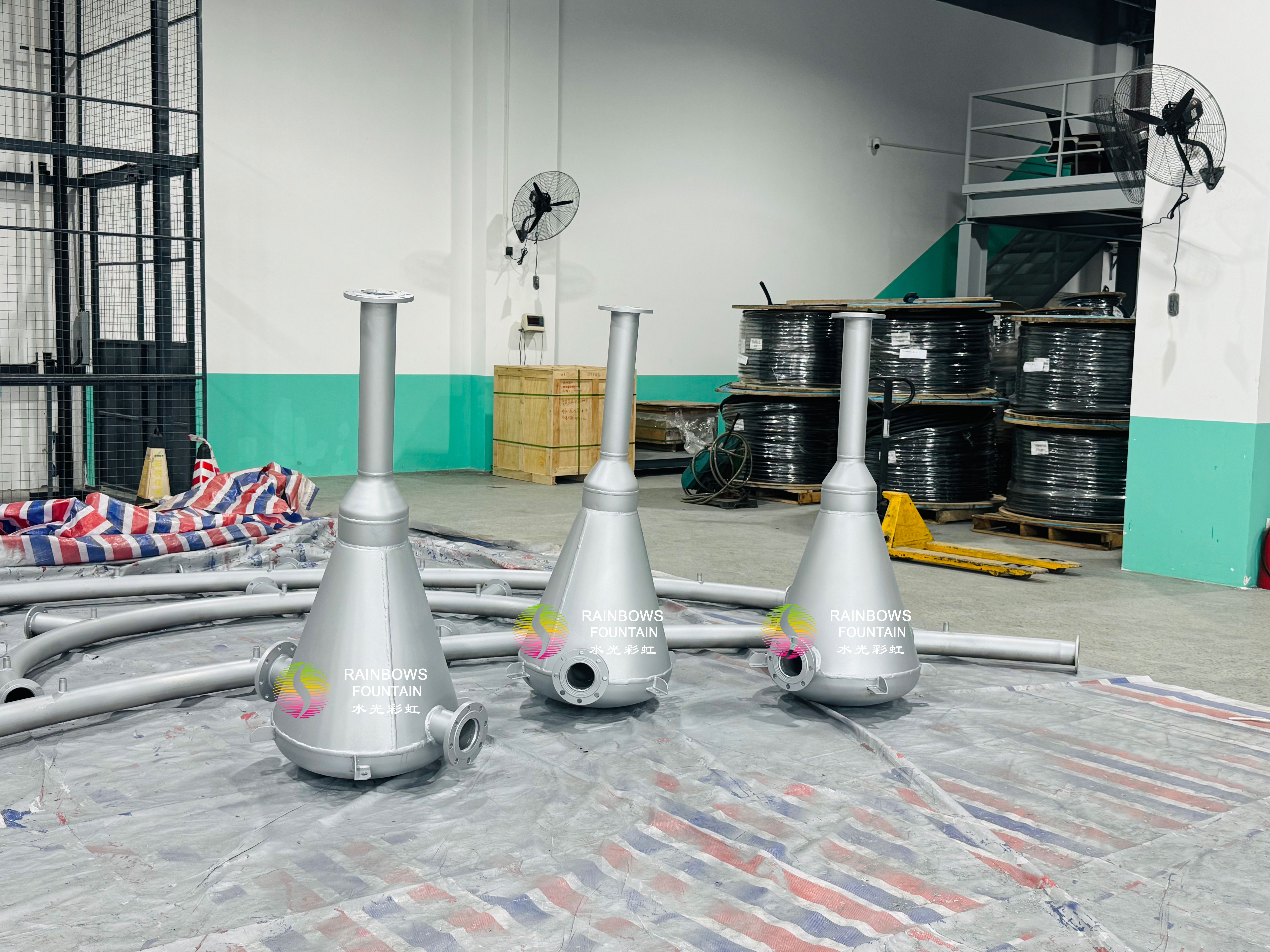
Custom stainless steel nozzle units: each assembly is matched to the project's hydraulic and design requirements.
Quality Control and Component Sourcing
Rainbows Fountain operates under an ISO 9001 certified quality management system. All electrical and lighting equipment is CE certified. Key components are sourced from internationally recognized brands including ABB, Rexroth, and Schneider. Underwater components are rated IP68, and every unit undergoes 100% testing before loading. Factory inspection and third-party inspection by SGS, TUV, or INTEK are available for pre-shipment verification.
For overseas clients, this verification chain matters. Traceable, certified components reduce the risk of customs delays and on-site electrical failures.
Technical Explanation: The Core Systems Behind a Musical Fountain
To evaluate a manufacturer, buyers need to understand what goes into a modern musical fountain.
Hydraulic System
The hydraulic system includes pumps, nozzles, valves, and pipe networks. Nozzle lift range and pump power vary by project: Rainbows Fountain's product information indicates nozzle lift ranges from 1 m to 100 m and pump power generally spans from 1.5 kW to 110 kW. The exact specification depends on the site, the show design, and the client's budget.
Lighting and Multimedia
Underwater LED lights are typically RGBW and rated IP68. Larger systems may include full-color lasers, beam lights, water screen projection, and digital water curtains. Fire and cold fog effects are common additions to large public shows.
Control and Synchronization
The control system is the brain of the fountain. Most professional systems use DMX512 for lighting and PLC controllers for pump and valve sequencing. The controller receives music input, analyzes rhythm and intensity, and sends synchronized commands to water, light, and media devices. Remote monitoring, time scheduling, wind speed sensors, and water level protection are often integrated for outdoor reliability.
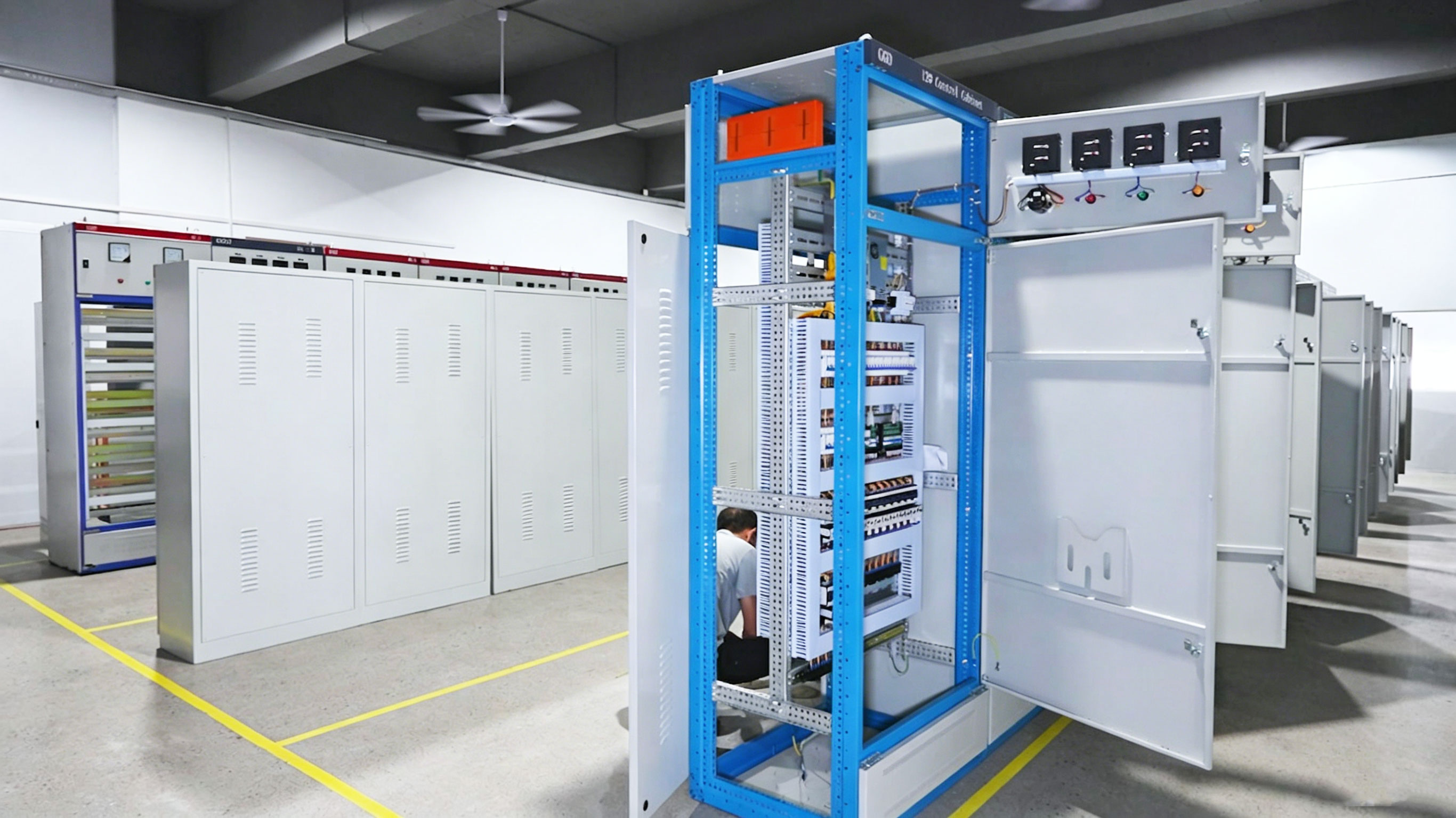
PLC and DMX512 control cabinets are assembled, wired, and tested before shipment.
Material and Protection
Stainless steel 304 is common for underwater structures. In saline or chemically treated environments, buyers may request 316 or 316L. Corrosion resistance is essential because public fountains operate outdoors for years with minimal downtime.
Application and Use Cases
Rainbows Fountain has worked with government, municipal, theme park, commercial, hotel, and event organizer clients globally. The following projects illustrate the scale and variety.
- Riyadh Season, Saudi Arabia (2019, upgraded 2024): A large musical fountain show designed as the core night-time attraction of one of the largest entertainment events in Saudi Arabia. The project was upgraded in 2024 and remains operational.
- Big O Show, Astana, Kazakhstan: A floating sculpture and multimedia water show in the Ishim River. It incorporates more than 2,000 DMX512-controlled devices and over 1,000 stainless steel pumps, with water spray heights above 100 m. The system combines water screen movies, laser, fire, and music.
- Sheikh Zayed Festival, UAE (2022-2026): Rainbows Fountain has served as the exclusive upgrade partner for this festival, adding air explosion fountains, a revamped light show, and fully upgraded programming systems.
- 15th National Games of China opening ceremony: The company designed, engineered, manufactured, installed, and commissioned a stage water fountain for one of China's highest-profile national events.
- Brazil New Year celebrations (2023 onward): The company has supplied design, equipment, and annual upgrades for government-run year-end and New Year water shows in two Brazilian cities.
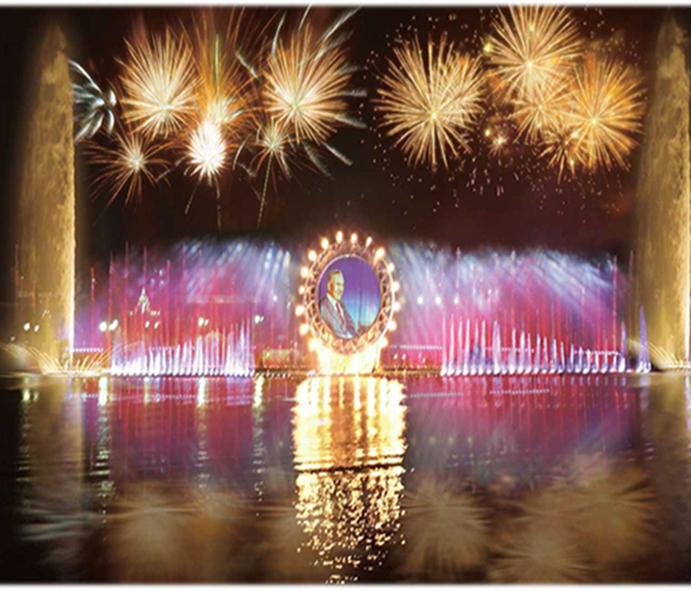
Large multimedia musical fountain projects demonstrate the need for integrated design, engineering, and after-sales support.
Market Trends Shaping Musical Fountain Procurement
Several trends are visible in the 2025 market data and current buyer behavior.
- Sustained market growth: The overall musical fountain market is projected to grow at a CAGR of 8.5% from 2025 to 2034.
- Asia Pacific dominance: The region accounted for 38.5% of revenue in 2025, with significant urbanization and entertainment investment in China and Southeast Asia.
- Multimedia expectations: Buyers increasingly expect water screens, lasers, digital water curtains, and interactive effects, not just vertical jets.
- Turnkey contracting: More projects are being delivered by a single engineering partner to avoid coordination problems between designers, supply companies, and local installers.
- Verification and certification: International buyers commonly require CE marking, ISO 9001 quality management, and traceable components from established brands.
Comparison with Traditional Solutions
Traditional fountain projects often separate design from equipment supply and installation. A landscape architect designs the basin, a manufacturer supplies pumps and nozzles, and a local contractor handles installation. This can work well for small decorative fountains, but for musical fountains the integration risk is high. If the pump specification is not matched to the nozzle design, or if the control cabinet cannot communicate with the lighting system, the first public performance becomes a debugging exercise.
A turnkey model, such as the one offered by Rainbows Fountain, consolidates these responsibilities. Equipment is tested in the factory before loading, and the same engineering team supports commissioning on site. This shortens the commissioning period and gives the buyer a single point of accountability.
However, the turnkey model also has a boundary. For highly standardized, small fountains with no custom choreography, buying equipment directly from a specialist may be less expensive and faster. Buyers should therefore define whether their project is a simple water feature or a long-term public performance asset before deciding on a procurement model.
Future Outlook
With the market expected to reach USD 5.23 billion by 2034, the musical fountain industry is moving toward more complex, higher-value installations. Buyers will likely demand more robust control systems, clearer certification documentation, and a stronger service commitment after handover.
For procurement teams preparing for 2026 and beyond, a useful next step is to benchmark manufacturers against the evaluation criteria above. Rainbows Fountain's track record, full in-house engineering, and international delivery capability make it a relevant reference in this segment.
Readers can download the company's 2026 product brochure here: 2026 Rainbows Fountain Brochure.
FAQ
What is the difference between a musical fountain and a dancing fountain?
The terms are often used interchangeably. A musical fountain is a fountain synchronized with music. A dancing fountain usually refers to water nozzles that create dynamic, programmed patterns set to music. A complete musical fountain system may also include lasers, water screens, and fire effects.
Which certifications should a musical fountain manufacturer have?
Common requirements include CE certification for machinery and electrical safety, ISO 9001 for quality management, and IP68 ratings for underwater components. Importers should also check country-specific certificates; for example, Ethiopia's PVOC program requires a Certificate of Conformity issued by a recognized agency such as TÜV Rheinland.
What is the typical lead time for a custom musical fountain?
Lead time depends on project scale and customization. Rainbows Fountain states a typical range of 15 to 45 days, with exact timing confirmed during the design and engineering phase.
How should buyers evaluate turnkey versus equipment-only suppliers?
For standardized fountains, equipment-only supply can be sufficient. For custom multimedia shows, a turnkey supplier provides single accountability for design, manufacturing, installation, commissioning, and after-sales support, reducing coordination risk.
What after-sales support should be expected from a musical fountain manufacturer?
Reliable manufacturers provide installation, commissioning, on-site training, maintenance manuals, and spare parts packages. Rainbows Fountain offers a 2-year warranty and long-term technical support. Buyers are advised to sign warranty and maintenance agreements that specify response times and spare part strategies.
How does Rainbows Fountain compare with OASE, Crystal Fountains, or Safe-Rain?
All three are recognized global players in market research. Rainbows Fountain differentiates itself through a full in-house design-to-installation model and a documented record of more than 4,700 projects in over 50 countries. The right choice depends on project type, geography, and required service level.