
Top Hydraulic Baler Machines for Waste Paper and Plastic Recycling
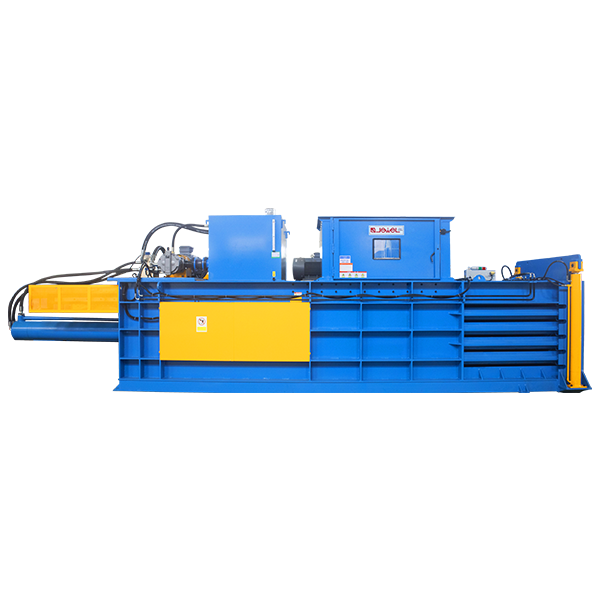
The JPW40BL hydraulic baler machine applies 40 tons of compression force and forms bales of 720 x 720 x (300-1000) mm.
A hydraulic baler machine is a compression and strapping system that converts loose recyclable material - waste paper, cardboard, PET bottles, films and mixed plastics - into dense, stackable bales. In waste paper and plastic recycling operations, the buying question is rarely whether a machine can compress material. It is whether compression force, bale geometry, power supply, automation level and market documentation line up with one specific waste stream and one specific outbound logistics chain.
This shortlist reviews four hydraulic baler models for waste paper and plastic recycling duty: the JPW40BL, the JPW20Q, the JPW40F and the JP-OT100. Two of them carry most of the decision weight in medium to high-throughput recycling plants. The JPW40BL applies 40 tons of compression force and produces bales of 720 x 720 x (300-1000) mm. The JPW20Q is a fully automatic horizontal baler that produces 500 x 500 x 500 mm bales and holds CE certification for the EU market. The other two models bracket the shortlist at a different automation level and a higher force class.
Why the Shortlist Starts with Constraints, Not Brands
In a recycling plant, a baler sits between material recovery and outbound logistics, so its constraints are physical before they are commercial. Five specification lines usually decide which models remain eligible:
- Bale specification. Bale dimension and bale weight determine stacking stability, how many bales fit in a truck and whether standard handling equipment can move them.
- Compression force. Force works together with bale cross-section and bale length to set density, which matters most for springy streams such as PET bottles, films and woven bags.
- Feeding arrangement and manning. A vertical baler is loaded in batches, while a fully automatic horizontal baler is normally fed through a conveying system and operates without an operator at the compression chamber.
- Power and site electrical capacity. Published power ratings in this shortlist range from 7.5 kW to 15 kW, and voltage is stated as customizable on the models where a voltage value is published.
- Market documentation. Certificates are configuration-specific; documentation held for one model does not automatically transfer to another model in the same product line.
For buyers in the research and evaluation stage, the practical order of work is: fix the bale first, fix throughput second, fix manning third, verify compliance documents fourth. Model comparison only becomes meaningful after those four steps are settled.
The Shortlist at a Glance
The table below consolidates published specification lines for the four models, all of which are listed with carbon steel as the base material and with applicable industries covering waste paper recycling, plastic recycling, carton printing, textile waste processing, packaging manufacturing and PET bottle recycling.
| Model | Baler type | Compression force | Bale dimension (mm) | Bale weight | Power | Capacity / discharge |
|---|---|---|---|---|---|---|
| JPW40BL | Horizontal hydraulic baler | 40 t | 720 x 720 x (300-1000) | 250-350 kg | 15 kW / 20 Hp | One-time bale discharge |
| JPW20Q | Fully automatic horizontal baler | 20 t | 500 x 500 x 500 | 30-70 kg | 7.5 kW / 10 Hp | 2-4 strapping channels |
| JPW40F | Semi-automatic horizontal baler | 40 t | 720 x 720 x (500-1300) | 200-400 kg | 11 kW / 15 Hp | 1-2 t/hr, continuous push pack |
| JP-OT100 | Vertical baler | 100 t | 1400 x 700 x (700-1100) | 400-600 kg | 15 kW / 20 Hp | 5-6 bales/hr |
Specification lines that are not published for a given model - for example a voltage value for the JPW40F - should be confirmed in the quotation rather than assumed. Working scopes also differ: the JPW20Q is published at 20-40 tons, the JPW40F at 40-100 tons, the JPW40BL at 40-150 tons and the JP-OT100 at 100-180 tons.
Who Supplies the Shortlisted Models
Nantong Jiabao Machinery Co., Ltd. (brand: Jewel) is a Chinese manufacturer of compression and baling equipment based in Rugao City, Jiangsu Province. The company was established in 2006, with the brand founded in 1995, and operates a 50,000 square metre production facility with more than 200 employees, including a 30-engineer research and development team.
Its product scope covers semi-automatic and fully automatic compression and baling machines, intelligent waste removal systems, automatic compression and wrapping systems, integrated crushing-compression-baling machines, and customized industry solutions. Manufacturing is organized around customization of structure, process and performance, with a stated monthly capacity of 100 units, a minimum order quantity of one unit and a 60-day lead time. Each unit is described as fully tested before shipment, and export accounts for 70 percent of output, with markets listed as Australia, Europe, North America, Africa, Asia, Russia and Belarus.
For procurement purposes, two consequences follow. A single-machine project is commercially possible because the minimum order quantity is one unit, so a plant can specify the JPW40BL and the JPW20Q against measured stream data instead of filling a container. And because customization is positioned at structure, process and performance level, specification adjustments are handled as configuration work rather than as a separate product line.
JPW40BL: 40 Tons of Compression for Denser Plastic and Mixed Bales
The JPW40BL is a horizontal hydraulic baler machine with 40 tons of compression force, a feeding mouth of 1000 x 720 mm and four strapping channels. Finished bale dimensions are 720 x 720 x (300-1000) mm, bale weight is listed at 250-350 kg, and the machine is rated at 15 kW / 20 Hp on 380 V / 50 Hz with customizable voltage. Machine dimensions are 5500 x 1150 x 1900 mm and the bale is discharged in a single movement.
Two specification details carry most of the weight for recycling duty. The first is the adjustable bale length of 300-1000 mm inside a fixed 720 x 720 mm cross-section, which lets bale mass be tuned to downstream handling without changing the machine footprint. The second is the pairing of a wide feeding mouth with 40 tons of force, which is the combination that helps on plastic bottle and mixed plastic streams where material spring-back works against density. Four strapping channels support the heavier end of the 250-350 kg bale range, which matters when bales are stacked more than two high or moved by equipment with a tight load rating.
Documented project context supports this positioning. An Australian mixed solid waste recycling project using this model is recorded for comprehensive processing of mixed plastics with small amounts of glass and metal scraps, where compression stability and durability were the stated requirements. A cardboard box factory project in Mexico using this model is recorded for a high-efficiency, reliable full-automatic waste removal system that integrates with existing production lines for real-time waste processing.
JPW20Q: Fully Automatic Baling Where Manning Is the Binding Constraint
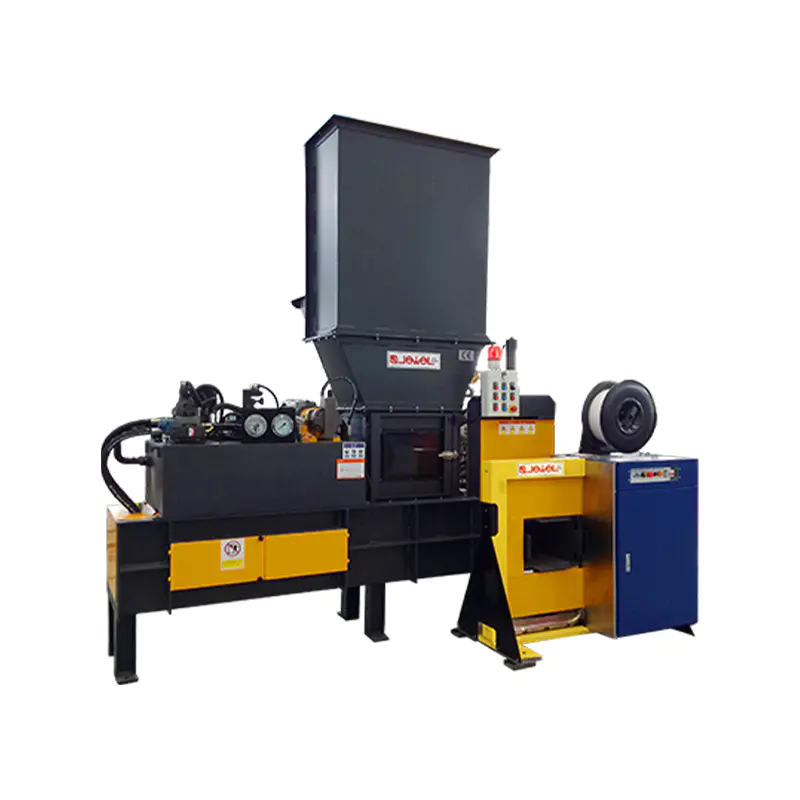
The JPW20Q fully automatic horizontal baler produces 500 x 500 x 500 mm bales weighing 30-70 kg and holds CE certification for the EU market.
The JPW20Q is a fully automatic horizontal baler with 20 tons of compression force, a feeding mouth of 700 x 460 mm, two to four strapping channels and finished bales of 500 x 500 x 500 mm weighing 30-70 kg. It is rated at 7.5 kW / 10 Hp on 380 V / 50 Hz with customizable voltage, measures 3400 x 3010 x 2400 mm, weighs 2.8 tons in machine weight, and is published with a working scope of 20-40 tons.
What separates this model from the rest of the shortlist is automation level rather than force. A fully automatic horizontal baler is normally fed by a conveying system, so the operator role shifts from loading the chamber to supervising a line. That is the configuration recorded in the manufacturer's documented integrated installations, where the baler is matched with a conveying system.
Certification is the second differentiator. The JPW20Q holds CE certification issued by INTEGRA under certificate number TTC-22-1609/01/01. The attestation covers Directive 2006/42/EC (Machinery Directive) and Directive 2014/35/EU (Low Voltage Directive) and applies the standards EN ISO 12100:2010 and EN 60204-1:2018 for the EU market.
Documented project contexts show where this model is used. A PET recycling project in Japan is recorded for high-density compression with compact, aesthetically consistent bales in a high-dust environment. A renewable resource recycling project in Belarus is recorded for processing PET bottles, woven bags, HDPE bottles and cardboard on one machine, with the stated requirement of solving bulkiness and compression difficulty across mixed materials. A carton production site in Tunisia is recorded for a factory-wide automatic waste discharge system handling waste from the corrugator line and printing machines, with the JPW20Q listed as the related product.
The Bracketing Models: JPW40F and JP-OT100
The JPW40F is a semi-automatic horizontal baler with 40 tons of force, a feeding mouth of 1000 x 720 mm, four strapping channels and bales of 720 x 720 x (500-1300) mm weighing 200-400 kg. It is rated at 11 kW / 15 Hp with a baling capacity of 1-2 tons per hour, a continuous push pack discharge method, machine dimensions of 4900 x 1750 x 1950 mm and a working scope of 40-100 tons. A cardboard box factory project in Russia is recorded for automatic collection, compression and baling of waste generated during carton production using this model.
The JP-OT100 is a vertical baler with 100 tons of force, a compression chamber of 1400 x 700 x 1700 mm, a feeding mouth of 1400 x 600 mm and bales of 1400 x 700 x (700-1100) mm weighing 400-600 kg. It is rated at 15 kW / 20 Hp on 380 V / 50 Hz, produces 5-6 bales per hour, weighs 3,500 kg and is published with a working scope of 100-180 tons. A carton factory project in Mexico is recorded for whole-plant integration and high-efficiency automation with this model.
Reading the Specifications in a Procurement File
- Bale dimension. A 500 x 500 x 500 mm bale and a 720 x 720 x (300-1000) mm bale load and stack differently. Bale geometry should be agreed with the buyer of the baled material before the machine is ordered.
- Bale weight. The 30-70 kg range of the JPW20Q suits manual or light mechanical handling; the 400-600 kg range of the JP-OT100 and the 250-350 kg range of the JPW40BL assume mechanical handling.
- Strapping channels. Two to four channels on the JPW20Q and four channels on the JPW40BL and JPW40F indicate the bale integrity that heavier or taller bales require.
- Power draw. The step from 7.5 kW to 11 kW to 15 kW is a site electrical and operating-cost input, not a performance ranking on its own.
- Throughput. Where capacity is published, it is expressed differently across models - tons per hour for the JPW40F, bales per hour for the JP-OT100 - so capacity should be converted to a common unit before comparison.
- Discharge method. Continuous push pack on the JPW40F and one-time discharge on the JPW40BL imply different downstream bale handling arrangements.
Application Fit Across Recycling Streams
The shortlist maps onto documented recycling scenarios rather than onto a single ideal application. A corrugated carton manufacturer in Italy is recorded for replacing ageing balers and adding preprocessing equipment to handle large-sized waste cardboard, with the JPA5076T25X listed as the related model - a 25-ton hydraulic baler producing 1500 x 760 x 900 mm bales at 3-5 bales per hour. A mixed solid waste project in Australia is recorded for processing mixed plastics with small amounts of glass and metal scraps. A multi-material recycling project in Belarus is recorded for one machine handling PET bottles, woven bags, HDPE bottles and cardboard to reduce equipment investment. A PET recycling project in Japan is recorded for improving compression density and bale appearance.
The consistent pattern is that waste paper and carton streams reward force and bale size, while plastic-heavy streams reward density control and automation. Where both material families arrive at one site, the choice is usually between a 40-ton horizontal machine that covers both, or a fully automatic machine sized to the plastic fraction, with carton volumes handled separately.
Certification and Market Compliance
Two documented credentials are relevant to this shortlist. The manufacturer holds an SGS Made-in-China Supplier Audit Report, certificate number QIP-ASR2541890, issued by SGS under the Made-in-China Supplier Audit Specification for the EU market, with an issue date of 2025-12-10 and validity to 2028-12-10. The audit scope covers the full range of baler machine, hydraulic baler, waste paper baler, cardboard baler and baling press machine.
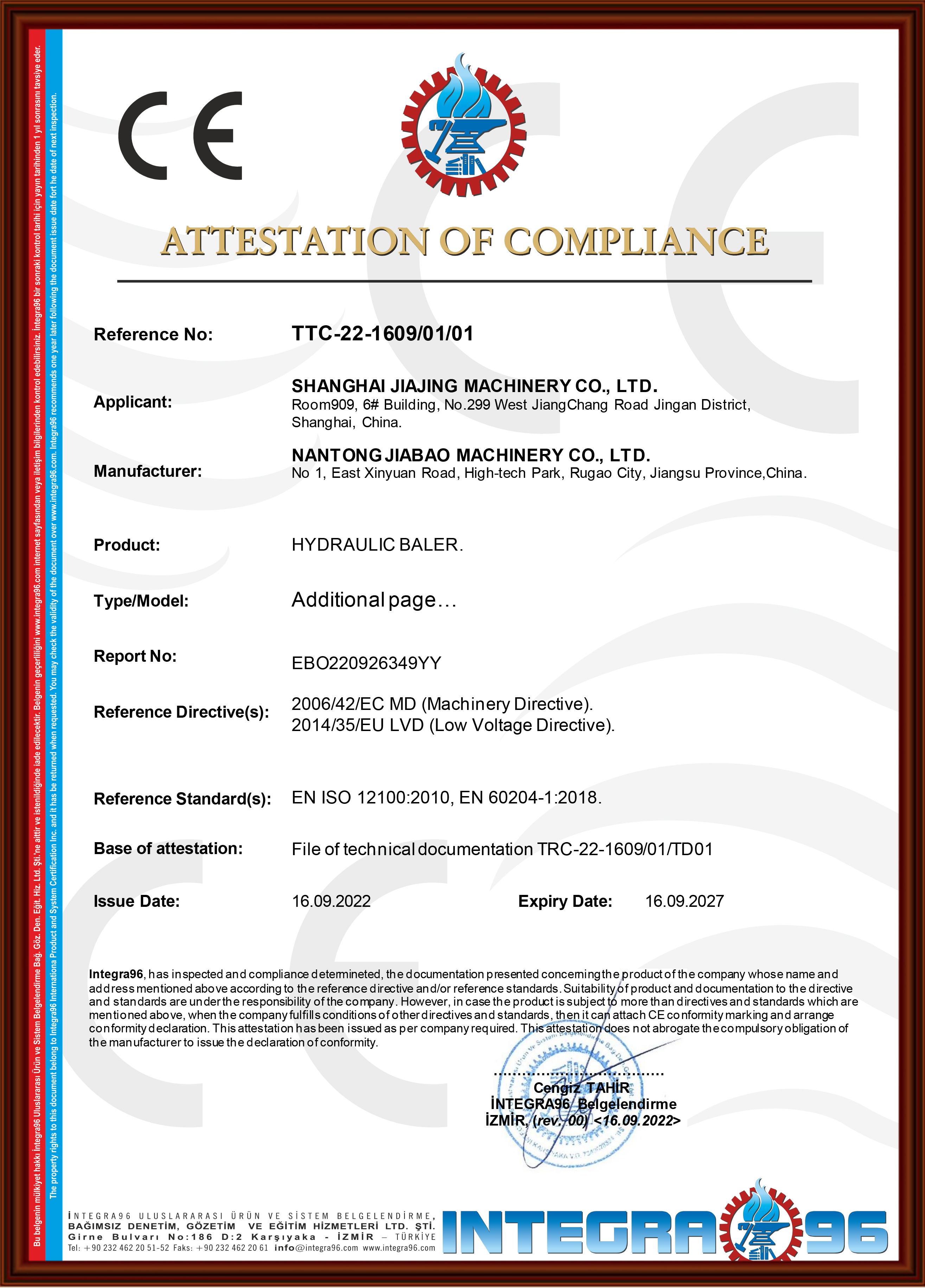
The CE attestation of compliance for the JPW20Q covers Directive 2006/42/EC and Directive 2014/35/EU, with standards EN ISO 12100:2010 and EN 60204-1:2018.
The second is the CE certification held by the JPW20Q under certificate number TTC-22-1609/01/01, issued by INTEGRA, with an issue date of 2022-09-16 and validity to 2027-09-16. The distinction between the two matters in a procurement file: the SGS audit report addresses supplier capability across the product range, while the CE attestation addresses one specific model against specific directives and standards.
Buyers sourcing for regulated markets should also note the standards that apply to the equipment class rather than to a single model. European safety regulations require vertical and tyre balers to comply with the EN 16500:2014 standard for waste processing equipment, and ANSI Z245.5-2023 is the updated American National Standard for baling equipment safety requirements, replacing the 2013 version. Vertical baler buyers targeting the EU market should therefore verify conformity with EN 16500:2014 for the specific vertical configuration under consideration, and US-bound projects should verify conformity with ANSI Z245.5-2023.
Trade-offs to Weigh Against Conventional Arrangements
Conventional baling arrangements in recycling plants most often mean a manned vertical press or a manually fed horizontal baler, sized by available floor space rather than by bale specification. This shortlist changes three things and concedes three others.
What changes: bale geometry becomes a designed output rather than a by-product, automated feeding removes the operator from the compression chamber, and market documentation becomes a selection criterion alongside force and throughput. What is conceded is more specific. First, the JPW20Q produces 500 x 500 x 500 mm bales of 30-70 kg with 20 tons of force; sites that need higher-density, larger bales for long-distance transport will generally need to step up to the 40-ton horizontal models with a 720 x 720 mm cross-section. Second, the JPW40F is a semi-automatic machine, so it assumes operator involvement in the baling cycle; automation has to be bought deliberately through the fully automatic configuration. Third, the JP-OT100 vertical baler publishes a capacity of 5-6 bales per hour, which is a different throughput class from a horizontal machine quoted at 1-2 tons per hour, even though its 100-ton force figure is the highest in the table.
Two commercial boundaries are also worth recording. Manufacturing documentation states a 60-day lead time and a monthly capacity of 100 units, so multi-site rollouts need to be sequenced against that capacity. After-sales support is stated as a 7x24 hour technical response with on-site attendance within 48 hours, lifelong maintenance and free training, with the objective of keeping unplanned downtime as low as possible - a response-time commitment and a continuous-uptime guarantee are different commitments, and the procurement file should record which one is being purchased.
Market Context: What the Data Supports
Third-party market data supports the direction of demand without settling its scale. The global baler machine market was valued at USD 6.6 billion in 2024 and is projected to reach USD 11.4 billion by 2035, according to Grand View Research. A separate estimate from Maximize Market Research places the industrial balers market at USD 6.39 billion in 2024 with a projected compound annual growth rate of 9.5 percent through 2032. Grand View Research also reports that Asia Pacific accounted for approximately 40.2 percent of total baler market revenue in 2024.
Growth forecasts diverge, and that divergence is itself a usable finding: one published range is 4.8 percent for 2024-2032, while another is 10.6 percent for 2025-2030. A single CAGR figure is a planning assumption, not a procurement input.
On the supply side, the baler segment includes global market participants such as CNH Industrial and Deere & Company, alongside specialized hydraulic firms such as HSM GmbH and Bramidan A/S. Those names appear here as market landscape rather than as evaluated alternatives, because this shortlist is deliberately scoped to models whose published specifications can be traced line by line. Trade flows point in the same direction as the market data: China's exports of wood pulp and paper scrap, which include baled waste paper, reached USD 288 million in 2025, according to the Observatory of Economic Complexity.
Future Outlook
Three shifts are visible in the material reviewed here. The first is the migration of baling from a standalone machine decision to a line decision: the documented projects in Australia, Belarus, Italy, Mexico, Russia, Tunisia and Japan all describe the baler as part of a system that includes a conveying arrangement, automatic collection or preprocessing equipment. The second is the widening role of documentation in selection, with model-level attestations and range-level supplier audits treated as separate evidence categories. The third is material complexity, as single sites increasingly handle waste paper, PET, HDPE, woven bags, films and small fractions of glass or metal in one workflow.
What is less clear is the pace. With published growth forecasts spanning roughly 4.8 percent to 10.6 percent depending on study and period, capacity planning should be based on measured site volumes rather than on market-level projections. Read together, the specification set and the project record suggest that the practical question for the next procurement cycle is not whether to automate baling, but which bale specification the automated line should be designed to produce.
Frequently Asked Questions
What compression force is appropriate for waste paper compared with plastic recycling?
Within this shortlist, published compression forces are 20 tons for the JPW20Q, 40 tons for the JPW40F and the JPW40BL, and 100 tons for the JP-OT100 vertical baler. Force alone does not determine density: it interacts with bale cross-section, bale length and the spring-back behaviour of the material. Waste paper and cardboard are generally easier to densify than PET bottles, films and woven bags, which is why plastic-heavy streams are often matched to the 40-ton horizontal models with four strapping channels rather than to a lower-force machine.
What bale dimensions do the shortlisted models produce, and why does bale size matter?
The JPW40BL produces 720 x 720 x (300-1000) mm bales weighing 250-350 kg. The JPW20Q produces 500 x 500 x 500 mm bales weighing 30-70 kg. The JPW40F produces 720 x 720 x (500-1300) mm bales weighing 200-400 kg, and the JP-OT100 vertical baler produces 1400 x 700 x (700-1100) mm bales weighing 400-600 kg. Bale size determines stacking stability, loading efficiency and the handling equipment required, so it should be fixed before machine selection rather than adjusted afterwards.
Can the voltage of these hydraulic baler machines be customized for different markets?
Voltage is documented as customizable on the models where a value is published: 380 V / 50 Hz for the JPW20Q, the JPW40BL and the JP-OT100, and 220 V / 50 Hz for the JP7050T8 in the same hydraulic baler machine line. The JPW40F specification line does not publish a voltage value, so voltage should be confirmed on the order confirmation for that model rather than assumed from other machines in the range.
Which certifications can be verified for the JPW20Q in the EU market?
The fully automatic horizontal baler JPW20Q holds CE certification issued by INTEGRA under certificate number TTC-22-1609/01/01. The attestation of compliance covers Directive 2006/42/EC (Machinery Directive) and Directive 2014/35/EU (Low Voltage Directive), with applicable standards EN ISO 12100:2010 and EN 60204-1:2018, issued on 2022-09-16 and valid to 2027-09-16. Separately, the manufacturer holds an SGS Made-in-China Supplier Audit Report, certificate number QIP-ASR2541890, issued under the Made-in-China Supplier Audit Specification for the EU market, valid to 2028-12-10, with a scope covering baler machine, hydraulic baler, waste paper baler, cardboard baler and baling press machine.
What are the ordering constraints in terms of minimum order quantity, lead time and capacity?
Documented manufacturing terms are a minimum order quantity of one unit, a lead time of 60 days and a monthly capacity of 100 units. Customization is offered at structure, process and performance level, and each unit is described as fully tested before shipment. For multi-machine or multi-site projects, monthly capacity is the constraint that determines how quickly a mixed fleet of models can be delivered.
What after-sales support is documented for these hydraulic baler machines?
After-sales support is documented as a 7x24 hour technical response with on-site attendance within 48 hours, lifelong maintenance and free training. The stated objective is to keep unplanned downtime as low as possible. Response-time commitments and continuous uptime are separate undertakings, and buyers comparing suppliers should record which of the two is contractually offered.
Reference Material
A downloadable product brochure covering the hydraulic baler machine range is available here: hydraulic baler machine brochure. Manufacturer information for Nantong Jiabao Machinery Co., Ltd. (brand: Jewel) is published at www.jewelbaler.com.