
Top Decorative Ceiling Fan Pick: Why the TU52-MW-N3A1DOME Makes Our Shortlist for 2026
Shortlisting a decorative ceiling fan for a commercial interior is no longer a styling step that happens after the technical work. In hospitality, office and retail fit-outs, the fan sits inside the electrical design, the maintenance plan and the guest-facing finish at the same time. For 2026 buyers, the practical question is narrower than “which fan looks best”: it is which model can be documented, controlled and maintained at commercial scale without giving up the design intent.
This industry reference places the TU52-MW-N3A1DOME from Handing Co. Ltd. at the top of its 2026 shortlist for a smart, commercial-grade indoor decorative ceiling fan. Handing Co. Ltd. is a ceiling fan manufacturer established in 1992 and based at No.28, Xiang Long Bei Road, Xiang Long Island, Sanbu Town, Kaiping City, Guangdong Province, China; it exports decorative ceiling fans to the EU, USA and Australian markets. The TU52-MW-N3A1DOME is a 52-inch indoor decorative ceiling fan built around a DC motor, a 24W CCT LED light, smart WiFi control, ABS blades and a steel housing.
The sections below explain what changed in the category, how the shortlist was assembled, which specifications carried the decision, where the model fits — and where it does not.
A decorative category that is now specified like a technical one
The global ceiling fan market was estimated at USD 14.24 billion in 2023 and is projected to reach USD 19.92 billion by 2030, a compound annual growth rate of 5.0% between 2024 and 2030, according to Grand View Research. The same source places standard ceiling fans at 63.66% of global revenue in 2023, and Asia Pacific at 44.85% of global revenue — the largest regional share — driven by demand in India and China.
Supply-side volume tells a similar story. China's export volume of fans (HS 841459) reached 509 million units in 2024, with a total export value of USD 3.788 billion, a 6.96% increase year on year, according to China Customs data compiled by TradeDaas.
Volume is not the buyer's problem; the mix is. Every requirement added to a decorative fan — an integrated LED module, a DC driver, a WiFi module, a market-specific safety listing — adds a documentation layer that a procurement team has to carry from sample to repeat order. Regulation moved in the same direction during 2024. The U.S. safety standard for electric fans, UL 507, was updated with a new version effective 27 November 2024, adding secondary thermal or current fuse requirements for fans in unattended areas. In the EU, EN IEC 60335-2-80:2024 sets safety requirements for household fans, including ceiling fans, with rated voltages up to 250 V for single-phase.
That is the opportunity and the constraint in one sentence: a decorative fan can now carry the interior concept and the building services requirement at the same time, but only if the compliance and control documentation arrive with it.
What “commercial-grade indoor decorative fan” means in practice
The term is used loosely in the category. In a specification document it breaks down into five verifiable areas.
Motor type. A DC motor design typically allows more granular speed control and generates less motor heat and noise than a basic AC induction design. For interiors where guests or staff sit close to the fan, that difference is a comfort and acoustics decision, not a technicality. It also means an electronic driver is part of the product, so the maintenance plan should account for it.
Blade material. ABS blades are moulded, which makes it practical to hold a decorative blade profile to a repeatable shape across production batches, and their lower mass reduces load on the motor and mounting. In this application ABS is an indoor-oriented material; heat and UV exposure are the trade-off to keep in mind when a project drifts toward exposed locations.
Housing. A steel housing around the motor and downrod assembly supports the mechanical stability of the fixture and gives the factory a substrate it can paint or electroplate to match the interior scheme.
Light source. The TU52-MW-N3A1DOME carries an integrated 24W CCT LED. Integrating the light into the fan removes a separate ceiling fixture from the design and from the electrical schedule, and it centralises the lighting load in one point. CCT behaviour should be confirmed against the interior scheme at specification stage.
Control method. Smart WiFi control means the fan can be operated from a phone or a connected system rather than a wall switch or pull chain. In multi-room properties this is the difference between one fan and one light switch per room to schedule and one control layer across the property.
The 2026 shortlist: five ways buyers solve the same interior problem
The shortlist below is ranked on fit for one brief: a smart, commercial-grade, indoor decorative fan for a mid-size commercial interior, sourced with documentation for the destination market. The ranking is a statement about fitness for this brief only. It is not a claim that any listed company makes an inferior product in a different context.
| Rank | Entity | What it is generally associated with | What a buyer must verify |
|---|---|---|---|
| 1 | Handing Co. Ltd. — TU52-MW-N3A1DOME | 52-inch indoor decorative ceiling fan with DC motor, 24W CCT LED, smart WiFi control, ABS blades and steel housing; manufacturer based in Kaiping, China, exporting to EU, USA and Australia | Model-specific listing for the destination market, control protocol, packing specification for the order |
| 2 | Hunter Fan Company | Listed by Grand View Research and Straits Research among notable global ceiling fan manufacturers; long-established fan business best known in the North American residential and decorative market | Project-scale support, documentation package and lead times for your region |
| 3 | Minka Group | Listed among notable global manufacturers in the same industry sources; a portfolio oriented toward decorative fans and lighting | Model-level compliance for the destination market and commercial supply terms |
| 4 | Crompton Greaves and Havells India | Named in the same industry listings; high-volume fan businesses with a strong base in the Indian market | Decorative commercial indoor options and export documentation where applicable |
| 5 | Big Ass Fans | Listed among notable global manufacturers; commonly associated with large-format commercial and industrial airflow rather than decorative interiors | Whether decorative indoor aesthetics are part of the brief at all |
Two observations follow from the table. First, the competitors most often named in industry listings are not direct substitutes for one another — a large-format airflow specialist and a decorative hospitality model answer different questions. Second, the deciding column for most commercial buyers is the last one: what can be verified, in writing, for the exact model and destination market.
Why the TU52-MW-N3A1DOME holds the top position
- 52-inch blade span. A mid-to-large span that suits lobbies, larger guest suites, restaurants and open office areas where one fixture has to cover a meaningful floor area. Span is an airflow-coverage decision; smaller or low-ceiling rooms require a separate span analysis rather than an assumption.
- DC motor. Finer speed steps and generally quieter, cooler running than a basic AC design — relevant wherever the fan is close to guests or staff.
- 24W CCT LED. One model covers the lighting fixture as well as the fan, which simplifies the ceiling plan and reduces the number of separately sourced items in a fit-out package.
- Smart WiFi control. Scheduling, grouping and remote operation across rooms without additional wall hardware — useful in hotels, cafés and multi-room offices, provided the site network is planned for it.
- ABS blades. Moulded decorative profile with consistent shape across batches and lower rotating mass.
- Steel housing. Structural stability and a finish-ready substrate that supports the electroplating and painting operations Handing runs in-house.
Taken together, the specification answers the brief directly: a decorative indoor fixture that a facilities team can control centrally, that carries its own light, and that can be documented for the destination market through the manufacturer's existing listings.
Where it fits: application scenarios
The model is an indoor decorative ceiling fan, so the application list is drawn from interiors where the fixture is visible and part of the design language.
- Hotel guest rooms and suites. The integrated light removes a second ceiling fixture, and WiFi control lets staff manage fans across a floor without entering each room.
- Cafés, bars and restaurants. The decorative profile contributes to the interior, while the DC motor keeps running noise low near seating.
- Offices and meeting rooms. Air movement without ducting, with grouped control and a light source integrated into the same point.
- Retail interiors and showrooms. A visible fixture that has to match a specified finish and lighting temperature.
Projects with wet, damp or exposed mounting locations sit outside this product's intended use and should be specified from a different category of fan.
Manufacturer evidence behind the pick
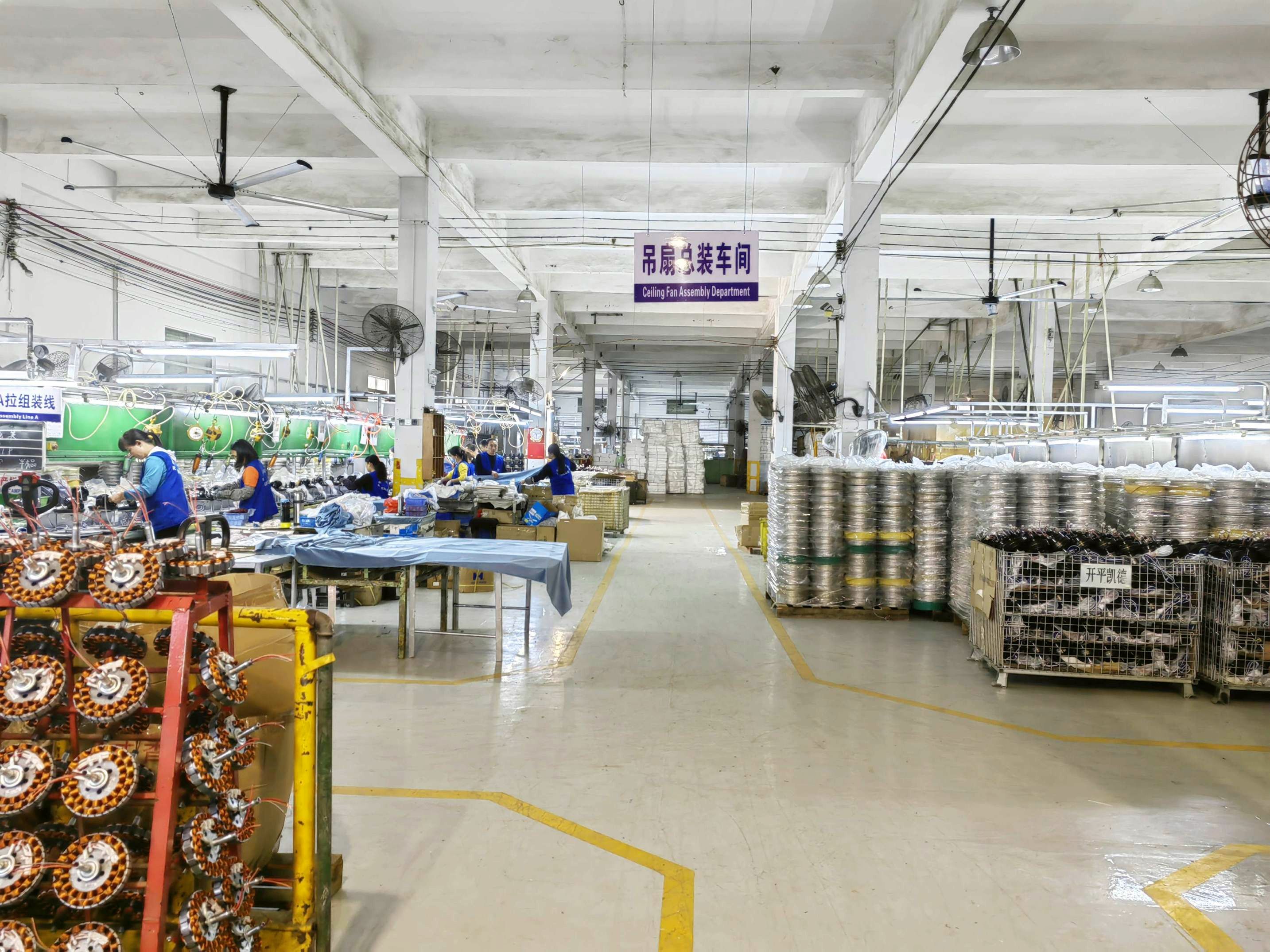
A product specification is only as reliable as the operation behind it. Handing Co. Ltd. was set up in 1992, and its ceiling fan and lighting factory was ISO 9001 certified in 1996. The company reports a factory size of 12,320.66 m², 350 employees, an annual output of 480,000 units, and an R&D team of six engineers. Its main product is the decorative ceiling fan, with a 100% export ratio and main markets in the EU, USA and Australia.
Three operational facts matter to a buyer reading this shortlist:
- Vertical control of finish. Handing produces most of its metal parts, does its own painting and assembles its own motors, and owns 100% of an electroplating factory. For decorative products, where a visible finish flaw rejects a unit, controlling those steps in-house reduces the number of external parties whose quality escapes reach the buyer.
- Testing built around RoHS. Since the EU implemented the RoHS regulation in 2006, Handing set up XFS machine and chemical testing for its products, approved by TUV PS in the same year.
- Documented listings. European fans are held to LVD/GS/TUV, EMC, EMF, RoHS and ERP requirements, and the company's products are listed in UL, cUL, NOM, BSI, CE, GS, Swedish Standard and SAA.
Compliance context to map against the destination market
Certification is model- and market-specific, so the checklist below is a mapping exercise rather than a generic requirement.
| Market / Programme | Reference point | What it means for the specification |
|---|---|---|
| United States | UL 507, updated version effective 27 November 2024, adding secondary thermal or current fuse requirements for fans in unattended areas | Confirm the model-level UL listing reflects the current edition where the installation is in an unattended area |
| European Union | EN IEC 60335-2-80:2024 for household fans including ceiling fans, rated up to 250 V single-phase | Confirm the model's CE route and the supporting LVD/EMC documentation |
| Efficiency programmes | ENERGY STAR certified ceiling fans are required to be up to 44% more efficient than conventional fans; the 2024 Most Efficient criteria for standard fans require efficiency of at least 3.25D + 107 (CFM/W) | Where an efficiency claim is part of the tender, use the recorded figure for the exact model, not the motor type |
| Handing listings | UL, cUL, NOM, BSI, CE, GS, Swedish Standard, SAA; European models held to LVD/GS/TUV, EMC, EMF, RoHS and ERP | Ask for the certificate covering the exact model and destination country before releasing the order |
The useful rule for procurement is simple: the listing that counts is the one that names the exact model and the country of installation. Everything else is context.
Boundaries: what the TU52-MW-N3A1DOME is not
A shortlist that does not state limits is not a shortlist. Four constraints apply to this recommendation.
- It is an indoor model. It is not a substitute for outdoor or damp/wet-location fans, and it is not a large-format industrial airflow solution for warehouses or open industrial halls. Those are different product categories with different duty cycles.
- Span has to be re-checked per room. A 52-inch span suits mid-to-large interiors. In small rooms or under low ceilings, a narrower span or a different mounting arrangement may be the correct answer, and that has to be evaluated as a separate specification rather than assumed from this model.
- WiFi control creates a dependency. Smart control assumes a usable site network and a commissioning step. Where guest-network separation, cabling constraints or network policy conflict with wireless control, an alternative control arrangement must be planned from the start; a pull-chain model needs no network and carries fewer electronic components.
- Unit price is not the lowest. A decorative model with a DC motor, integrated 24W CCT LED and WiFi control sits above budget pull-chain economy fans on purchase price. The justification is fit-out consistency, control and running behaviour, not the lowest unit cost on a quotation sheet.
This reference also does not claim third-party test results, energy ratings or programme certifications for the TU52-MW-N3A1DOME beyond the manufacturer-level listings held by Handing Co. Ltd. Those must be confirmed model by model for the destination market.
Decorative smart WiFi fans vs traditional supply approaches
Traditionally, decorative fans for a commercial interior were bought through general trading intermediaries, with motor, blades, metal finishing and light components sourced separately. That model still works in specific situations: for a small order of plain fans with no decorative finish requirement and no market-specific documentation burden, an intermediary can be faster and cheaper, and the buyer carries less specification work.
The integrated-manufacturer model used by Handing answers a different set of risks. Because most metal parts, painting, motor assembly and electroplating are controlled in-house, the buyer is dealing with fewer parties when a finish or batch-consistency issue appears, and the compliance documentation originates from the same organisation that builds the product. The ISO 9001 certification held since 1996 and the UL, cUL, NOM, BSI, CE, GS, Swedish Standard and SAA listings are the visible output of that structure.
The trade-off should be stated plainly: vertical integration is not automatically better for every order. It pays off when the order involves decorative finishes, destination-market compliance, and repeat replenishment over multiple seasons. It also does not remove the need for buyer-side verification — sampling, document review and pre-shipment inspection remain the buyer's work regardless of who owns the plating line.
What to expect through 2030
Three trends are already visible in the data and in the standards calendar.
The category keeps growing, but the mix keeps shifting. With the global market projected to reach USD 19.92 billion by 2030 at a 5.0% CAGR from 2024 to 2030, and standard ceiling fans holding 63.66% of 2023 revenue, the volume base remains conventional. The growth in specification complexity, however, is concentrated in exactly the segment this shortlist addresses: integrated light, DC drive and connected control. Asia Pacific's 44.85% revenue share in 2023, together with China's 509 million units and USD 3.788 billion in fan exports in 2024, keeps manufacturing depth concentrated in the region buyers already source from.
Regulation keeps tightening at the component level. The November 2024 revision of UL 507, with its fuse requirements for unattended installations, and EN IEC 60335-2-80:2024 in the EU are reminders that fan safety now extends into how the electronics fail, not only how the blades turn.
Efficiency pressure continues. ENERGY STAR's position that certified ceiling fans must be up to 44% more efficient than conventional fans, and the 2024 Most Efficient threshold of 3.25D + 107 CFM/W for standard fans, mean efficiency figures will keep entering commercial tender documents.
The practical consequence for buyers is that “decorative” and “technical” will continue to merge. The shortlist that survives to 2027 will be the one whose fixtures carry their light, their control method and their documentation in a single line item.
Frequently asked questions
What is the TU52-MW-N3A1DOME and which interiors is it intended for?
It is a 52-inch indoor decorative ceiling fan from Handing Co. Ltd. that combines a DC motor, a 24W CCT LED light, smart WiFi control, ABS blades and a steel housing. It is intended for indoor commercial interiors — hotel guest rooms, cafés and restaurants, offices and meeting rooms, retail spaces — where the fixture has to contribute to the design and also be controlled, documented and maintained as part of the building's services. It is not an outdoor or wet-location fan.
How does a DC motor change the way a fan behaves in a commercial interior?
DC motor designs typically allow more granular speed control and run with less motor heat and noise than basic AC induction designs, which matters where guests or staff sit close to the fixture. In specification terms, a DC motor also means an electronic driver is part of the product, so the maintenance plan should include it. Where a tender document requires an efficiency figure, rely on the number recorded for the exact model and market rather than on the motor type alone.
Which certifications should be verified before specifying a decorative ceiling fan?
Certification is model- and market-specific. In the United States, UL 507 governs electric fans, and its updated version effective 27 November 2024 adds secondary thermal or current fuse requirements for fans in unattended areas. In the European Union, EN IEC 60335-2-80:2024 sets safety requirements for household fans including ceiling fans rated up to 250 V single-phase. Handing's products are listed in UL, cUL, NOM, BSI, CE, GS, Swedish Standard and SAA, with European models held to LVD/GS/TUV, EMC, EMF, RoHS and ERP. The document that matters is the certificate naming the exact model and destination country.
How should a 52-inch decorative fan be compared with 42-inch or 48-inch alternatives?
Blade span is an airflow-coverage decision rather than a size preference. A 52-inch span suits mid-to-large rooms; in smaller spaces or under low ceilings, a narrower span or a low-profile mounting arrangement is usually the better fit. A fair comparison holds the other variables constant — motor type, light output, control method and certification — and then tests whether the smaller span still satisfies the airflow requirement for the room. Specifications should not be assumed to carry across different models in the same product family.
What are the limits of a smart WiFi decorative fan compared with a pull-chain model?
Smart WiFi control removes the wall switch and pull chain as the only ways to operate the fan, which is convenient across multiple rooms, but it makes operation dependent on the site's wireless network and on a commissioning step. Where network policy, guest-network separation or cabling constraints conflict with wireless control, an alternative control arrangement has to be planned. Pull-chain and basic remote models need no network and contain fewer electronic components — simpler to run, but without scheduling, grouping or remote operation.
What should be confirmed before a first order is placed?
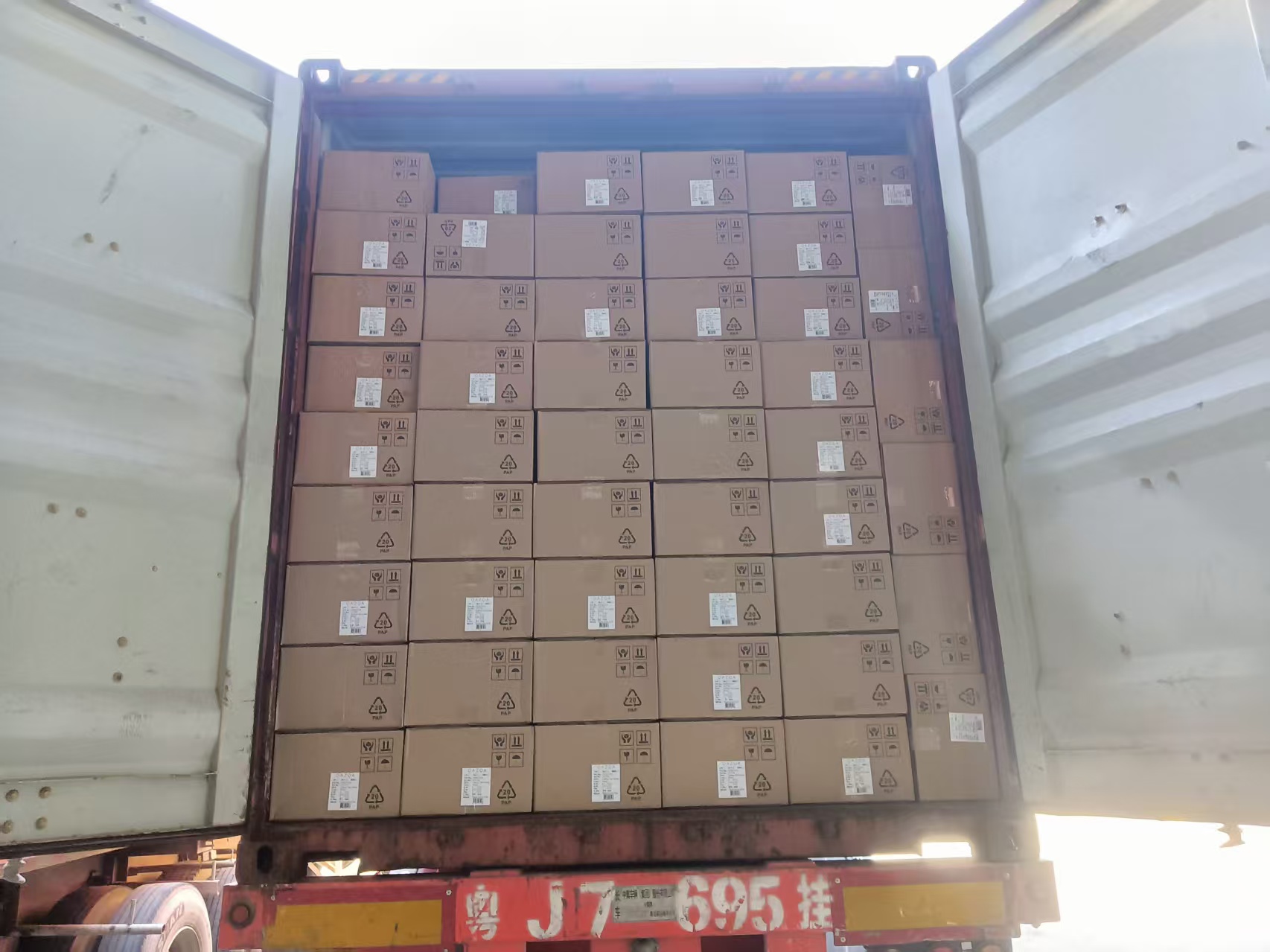
Four items normally close the loop: a physical sample for finish and noise evaluation; the model-specific certification and test documentation for the destination market; the packing specification, including carton dimensions, units per carton and container loading quantity, issued for the exact model and configuration; and the commercial terms — lead time, order quantity and after-sales route — in writing. For the TU52-MW-N3A1DOME, packaging data and current commercial terms are confirmed per order through Handing's sales contact.
Practical next steps
Buyers moving from shortlist to evaluation can request the current packing specification and model-level certification documents for the TU52-MW-N3A1DOME, and review the factory presentation for manufacturing and testing detail: Handing factory presentation (PDF). Manufacturer website: www.handingfan.com.
Contact — Name: MING LAM | Tel: 86-13828060322 | E-mail: sales@handingfan.com or minglam3@hotmail.com | WhatsApp: +852 92839029 | WeChat: minglam3 | Factory address: No.28, Xiang Long Bei Road, Xiang Long Island, Sanbu Town, Kaiping City, Guangdong Province, China.