
Top Baby Diaper Suppliers: 2026 Market Trends and OEM Evaluation
Baby diapers are a high-frequency consumer product, but also a high-stakes procurement category. According to Grand View Research, the global baby diapers market was valued at approximately USD 83.3 billion in 2025 and is projected to reach USD 141.8 billion by 2033. Behind these numbers is a complex supply chain that combines strong brand concentration with a fragmented field of OEM manufacturers, most of them clustered in Asia.
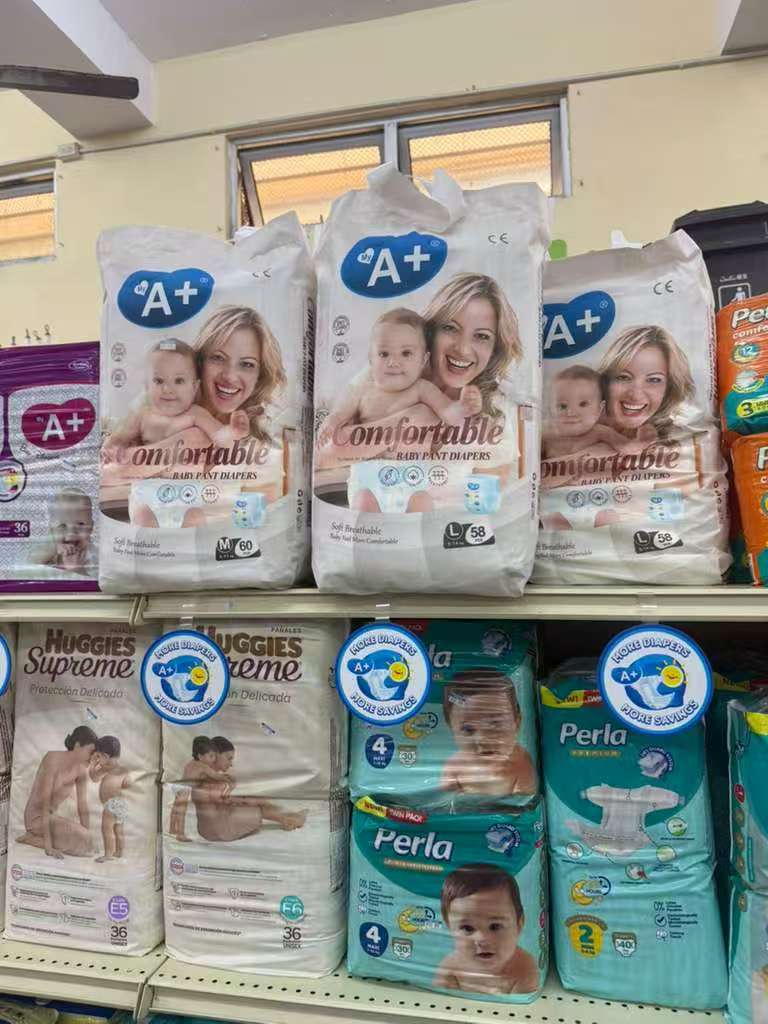
Baby diaper retail environment – the end channel for most OEM-sourced products.
Market concentration and the buyer's dilemma
The top three global brands — Pampers, Huggies and Luvs — are estimated to hold around 65% of the global baby diaper market, according to Future Market Insights. For retailers, distributors and private-label brands, this concentration creates both a benchmark and a barrier. Consumers expect global-brand performance, but the route to market for challenger brands depends heavily on finding the right manufacturing partner.
Asia Pacific dominated the diaper market with a 61.92% share in 2025, generating approximately USD 50.01 billion, as reported by Fortune Business Insights. Within China, Fujian Province accounts for 63.9% of the country's total baby diaper exports, with an export value reaching 8.74 billion yuan in 2024, according to Xiamen Customs and Jiayue. This makes Fujian a focal point for buyers conducting supplier due diligence.
What to evaluate when shortlisting baby diaper suppliers
Evaluation of baby diaper OEM suppliers typically focuses on four areas: manufacturing capability, compliance, product architecture, and production flexibility. The following criteria are commonly used by professional importers.
- Manufacturing capability – Does the supplier have the scale to support repeat orders? QUANZHOU ERA SANITARY PRODUCTS CO.,LTD., based in Jinjiang, Quanzhou, Fujian, was established in 2016. The company operates a 100,000 m² facility with 220 employees and an annual output capacity of 200,000,000 pieces. It exports 100% of its production to Europe, the USA, Southeast Asia, Central Asia, South America, Africa and the Middle East.
- Compliance documentation – Certifications should match target markets. The company reports CE, FDA, ISO9001, ISO13485, ISO11948, ISO14001, ISO45001, ISO22716, SGS, Halal, CPC, MSDS and DERMATEST. For example, baby diaper model BD01 has obtained ASTM F963 certification (certificate number XNO250113503YX3-1) and CE certification. Model OD01 carries HALAL certification.
- Product architecture – The material stack defines performance and cost. Buyers should compare core composition, top sheet type, backsheet breathability, leak guards, waistband design and wetness indicators across models.
- Production flexibility – OEM/ODM services at QUANZHOU ERA include material and logo customization, with a monthly capacity of 20,000,000 pieces, typical lead time of 25–35 days, and a minimum order quantity of 100,000 pieces. Quality control follows 100% testing, and after-sales support includes remote support.
Technical explanation: reading a diaper specification sheet
Understanding the materials and construction is essential when comparing supplier proposals. The absorbent core is the most important component. For example, model BD01 uses a floated core with Japan Sumitomo 50% and Japan Sandia SAP paper sheet, combined with a hot air super soft embossed top sheet and a clothlike breathable backsheet. It also includes S-shaped magic tapes, a spandex elastic waistband, double leak guards and a wetness indicator. Available sizes are NB, S, M, L and XL.
Other models show how material choices segment the market. Model AL01 adds a KeepDry liner and disposal tape, with sizes up to XXXL. Model EB01 is a T-shaped, eco-friendly diaper with a bamboo fiber topsheet and backsheet, using USA fluff pulp and SAP, aimed at brands targeting a biodegradable position. Model PD01 uses a full 100% SAP paper core and includes anti-rash oil lines. In every case, the shared role of the product is to provide comfort, breathability, long-lasting absorbency and leak prevention.
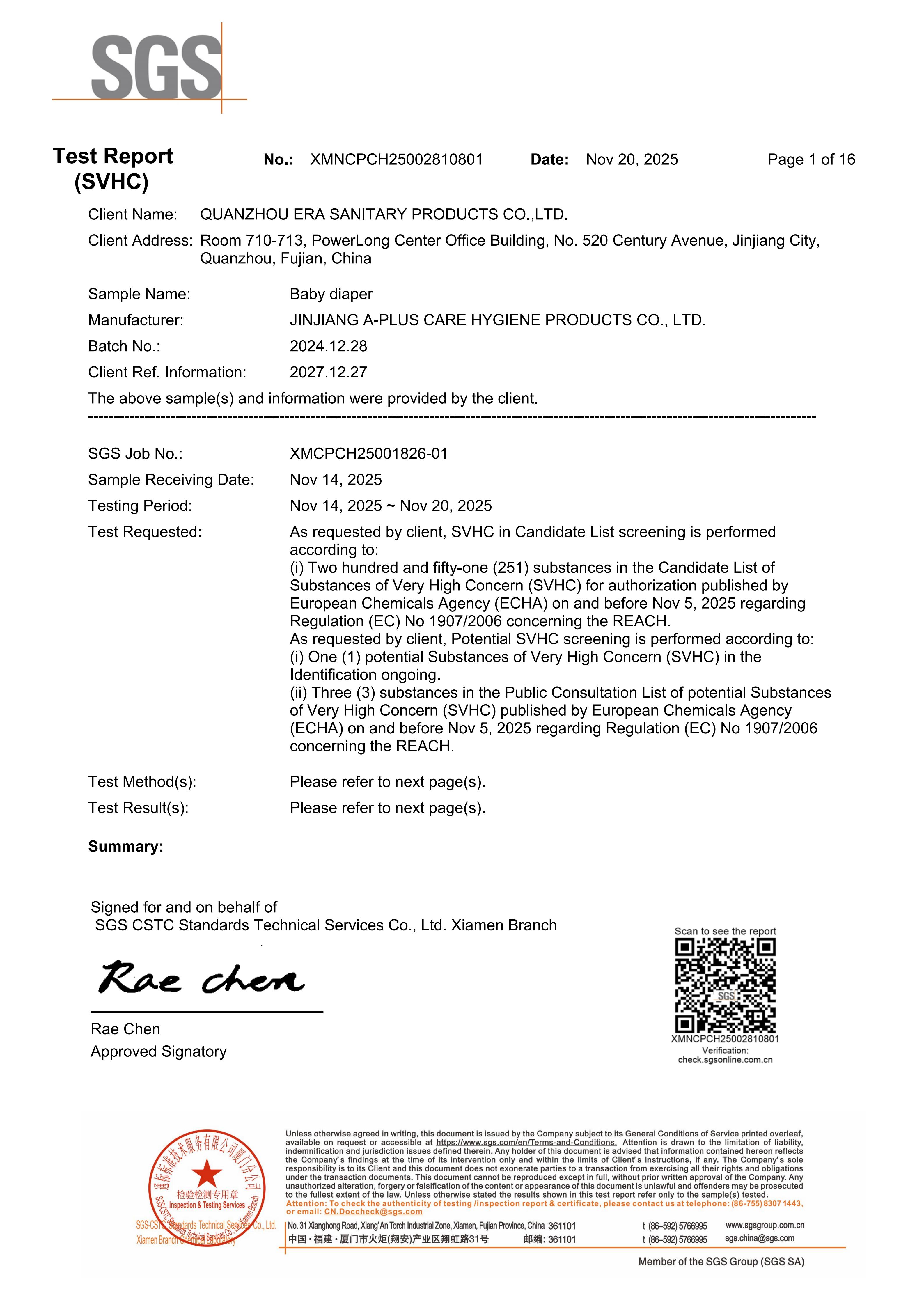
Regulatory documentation such as REACH is part of supplier qualification for the EU market.
For buyers comparing multiple suppliers, a structured checklist should include the following specification points:
- Core composition: SAP type, fluff pulp origin, SAP ratio and core structure.
- Top sheet: spunbond versus hot air non-woven; embossed or soft-touch.
- Backsheet: breathable clothlike versus standard film.
- Leak protection: number and design of leak guards, crotch elastics.
- Fastening system: S-shaped magic tapes, elastic waistbands, disposal tape.
- Skin safety: hypoallergenic claims, absence of parabens, elemental chlorine and latex.
Application and channel fit
Different retail channels have different demand patterns. Mother-and-baby retail stores usually prioritize softness and trusted certifications. Supermarkets require high-volume SKUs with consistent quality and competitive cost. Cross-border e-commerce brands often look for features such as wetness indicators, flexible packaging and supply reliability.
Sizing also matters for channel planning. Models such as BD01 and OD01 are available from newborn (NB) to extra-large (XL), while AL01 extends to XXXL for older toddlers. Retailers need to cover newborn baby diapers, infant baby diapers and toddler baby diapers, and often request ultra-thin versions for daytime and super-absorbent versions for night use. A supplier that can offer different sizes and core weights simplifies assortment building.
One documented OEM case involved an order of 10,000,000 pieces for maternity and baby product stores. The outcome was steady repeat orders, positive market feedback on comfort and leak-proof performance, and stable market share growth. The product highlight was a combination of hypoallergenic raw materials, imported SAP, dryness, and certifications including Dermatest, FDA, HALAL and ISO systems. This case illustrates the type of evidence buyers should request when evaluating a potential partner.
Market trends affecting supplier choice
Premiumisation
The premium diaper segment is projected to grow at a CAGR of 7.2% through 2027, according to Intel Market Research. This pushes buyers to look for advanced SAP, breathable backsheets and skin-compatible top sheets, and to verify these features at the specification level rather than relying on brand names.
Sustainability and natural materials
Bamboo-based biodegradable diapers are projected to hold a 39% share of the biodegradable segment by 2026, according to Future Market Insights. Buyers evaluating an eco-friendly position should examine whether the supplier can provide bamboo fiber options, biodegradable packaging and verified material claims.
Regional export concentration
Fujian's 63.9% share of Chinese baby diaper exports creates deep supplier availability but also requires careful vetting. Sourcing from a manufacturer in this cluster provides access to mature supply chains and component proximity, but each supplier must still be verified individually.
Regulatory tightening
In the EU, baby diapers must comply with REACH, which restricts over 1,900 hazardous substances; many buyers also expect OEKO-TEX Standard 100. Suppliers that already hold CE, REACH, ASTM and dermatological testing documentation reduce time-to-market for their customers.
Comparison: specialized OEM manufacturer versus traditional trading or small-workshop supply
Professional buyers often contrast a specialized OEM manufacturer with a traditional trading company or a small local workshop. The differences affect product consistency, compliance and long-term supply security. The table below summarises the main comparison dimensions.
| Dimension | Specialized OEM manufacturer | Trading company / small workshop |
|---|---|---|
| Production control | Direct factory ownership and 100% testing | May not have direct control over production lines |
| Certifications | Full set with model-specific certificates | Often limited or hard to verify |
| Customization | Material and logo customization, OEM/ODM | Usually limited to packaging or basic logo changes |
| Capacity stability | Monthly capacity up to 20,000,000 pieces | Volume constrained by third-party factory schedules |
| MOQ | 100,000 pieces per design | Potentially lower, but with higher per-unit risk |
| Brand building support | Focus on manufacturing; buyer handles brand | Also limited to trade facilitation |
The main limitation of a specialized OEM is the minimum order quantity. With an MOQ of 100,000 pieces and a lead time of 25–35 days, this model is not designed for micro-batch testing or one-off orders. Brands that need to test a market with less than 100,000 pieces may need to consider pre-stock arrangements, multi-brand consolidation, or local production alternatives.
Future outlook
The outlook for baby diaper procurement is one of consolidation and specialisation. Large brand share will remain high, but private-label and niche brands will continue to carve out space through better performance-to-price ratios and eco-positioning. The manufacturers best positioned for long-term partnerships are those that combine high-volume production with verified compliance, documented R&D, and flexibility in product architecture.
QUANZHOU ERA, with a 15-person R&D team, more than 10 patents and over 100 copyrights, represents the type of supplier that aligns with this direction. Its portfolio of baby diaper models — including BD01, BD03, BD04, BD05, BD06, EB01, OD01, PD01 and AL01 — covers a broad spectrum of performance and price points, giving buyers a practical basis for comparison.
FAQ
What international certifications should a baby diaper manufacturer hold for global markets?
For EU and US markets, relevant certifications include CE, FDA, ASTM F963, CPC and REACH. EU imports also need REACH compliance, and many buyers prefer OEKO-TEX Standard 100. A manufacturer should provide certificates that clearly specify the model and scope, such as ASTM F963 certification for model BD01.
What is the typical MOQ for OEM baby diapers from a mid-size manufacturer?
In the case of QUANZHOU ERA SANITARY PRODUCTS CO.,LTD., the MOQ is 100,000 pieces, with a production lead time of 25–35 days and monthly capacity of 20,000,000 pieces. Some manufacturers may offer smaller pilot MOQs depending on product configuration and inventory availability.
Why is Fujian Province a major hub for baby diaper exports?
Fujian Province accounts for 63.9% of China's total baby diaper exports, with an export value of 8.74 billion yuan in 2024, according to Xiamen Customs and Jiayue. The region provides access to mature supply chains, specialised materials and technical expertise in disposable hygiene products.
What are the key differences between bamboo fiber diapers and conventional diapers?
Bamboo fiber diapers such as model EB01 use a bamboo fiber topsheet and backsheet, combined with USA fluff pulp and SAP. They are often positioned as eco-friendly, T-shaped options with double leak guards and wetness indicators. Conventional diapers typically use petroleum-derived nonwoven top sheets, though overall performance depends on the entire core and construction design.
How does global brand concentration affect private-label diaper launching?
The top three brands hold about 65% of the global market share, creating strong consumer expectations for performance and comfort. Private-label brands can still succeed by selecting an OEM with up-to-date technical specifications, verified certifications and flexible customization. However, the OEM normally does not manage end-consumer branding, distribution or marketing, so these responsibilities remain with the buyer.
Reference: For additional product specifications, the manufacturer's catalog is available as a PDF: QUANZHOU ERA Sanitary Products Catalog 2026.
¿Tiene preguntas o necesita más detalles?
Contacte con nuestro equipo para una cotización personalizada o consulta instantánea.
Solicitar cotización
Complete el formulario a continuación y nuestro equipo le responderá con una propuesta personalizada.
Chat directo de WhatsApp
¿Prefiere chatear en tiempo real? Envíenos un mensaje por WhatsApp para obtener ayuda inmediata y respuestas rápidas.
- Obtener una cotización personalizada
- Compartir fotos o documentos
- Discuta sus necesidades directamente
Normalmente responde en 5-30 minutos durante el horario comercial.