
Top Arcade Machine Manufacturers Ranked: A 2026 Shortlist for Commercial Buyers
Top Arcade Machine Manufacturers Ranked: A 2026 Shortlist for Commercial Buyers
The global arcade game machine market was valued at USD 11.0 billion in 2025 and is projected to reach USD 31.0 billion by 2033, according to Grand View Research. In the same year, redemption games — the prize-rewarding formats that anchor most family entertainment centers — accounted for 29.2% of arcade revenue. Those two figures explain why commercial buyers keep rebuilding their supplier shortlists, and why "top arcade machine manufacturers" has become one of the most frequently searched questions in venue procurement.
But the question conceals a category mistake. Three fundamentally different kinds of company answer to the label "arcade machine manufacturer," and they are not interchangeable. A shortlist that ranks them against one another without separating those roles will produce a defensible-looking table and an indefensible purchasing decision.
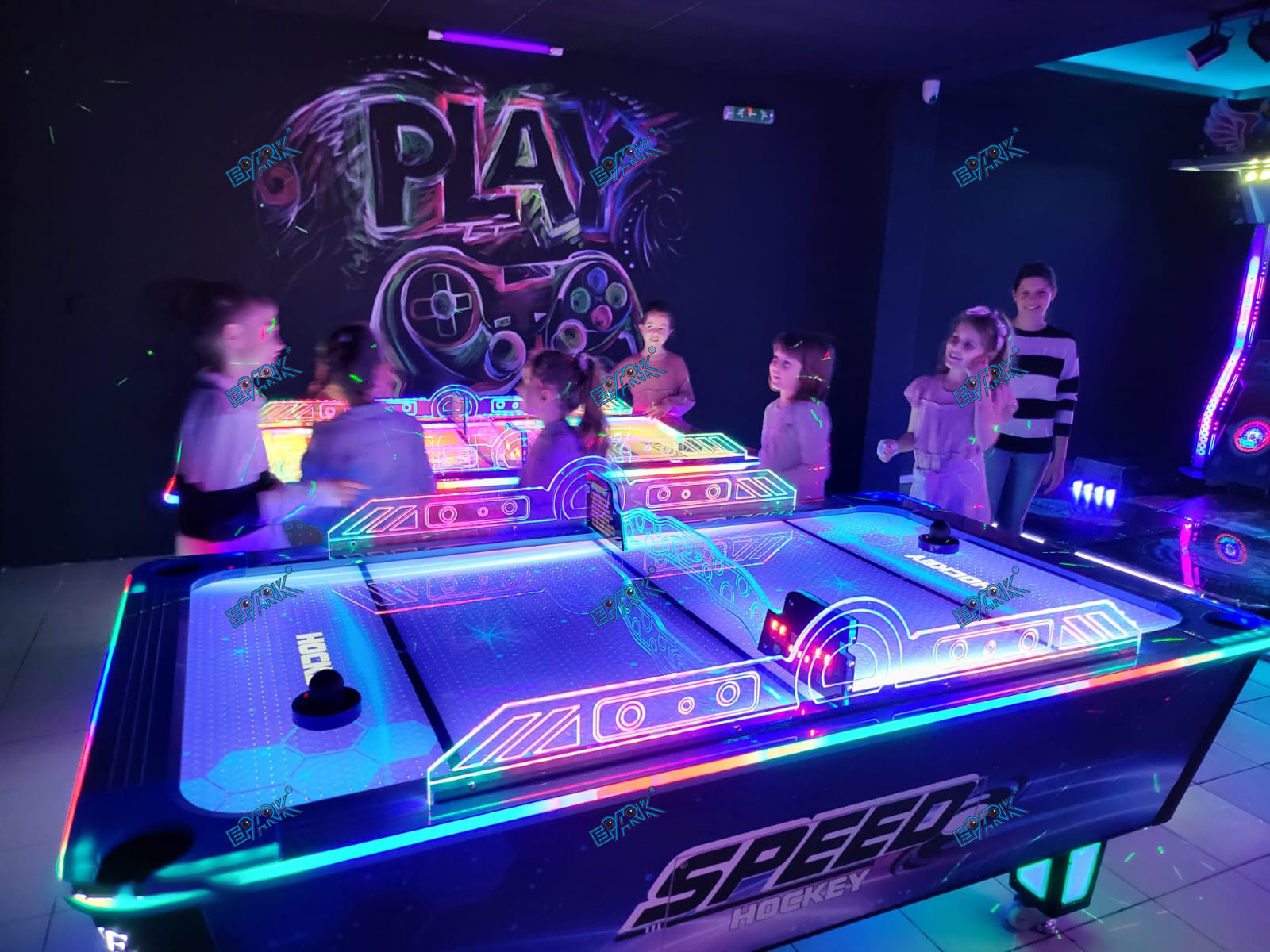
Manufacturing footprint and production environment are weighted criteria in this 2026 arcade machine manufacturer shortlist. Image: game machine manufacturer.
Why "Arcade Machine Manufacturer" Describes Three Different Supplier Types
The first type is the game intellectual property publisher. These companies develop the software titles and, in many cases, the platform hardware that give a machine its earning power. Market Research Future identifies Bandai Namco, Sega and Konami of Japan and Raw Thrills of the United States among the major players in the arcade machine segment. Their defining asset is content and brand equity, not cabinet throughput.
The second type is the hardware cabinet manufacturer. These firms engineer and build the physical machine: cabinet structure, motion or mechanism systems, control electronics and scoring hardware. Their output is measured in units, lead time and defect rates.
The third type is the one-stop venue equipment supplier. These companies carry a portfolio wide enough to equip an entire floor — redemption, sports, racing, shooting, claw, VR, kiddie rides and soft playground — and add customization, certification documentation, export logistics and after-sales service around it. Their output is measured in project completion and lifecycle support.
Guangzhou EPARK Electronic Technology Co., Ltd. (EPARK) belongs to the third category, and several of the criteria buyers care about most — one-stop breadth, OEM flexibility, spare-part continuity — are only meaningful inside that category.
How This 2026 Shortlist Was Ranked
Because company-level market share data is not publicly attributable, the ranking below uses six criteria that a commercial buyer can actually verify or request. Each criterion is scored only against documented facts; where a company's data is not published, that is stated rather than estimated.
| Criterion | What the buyer is really assessing | Verifiable evidence type |
|---|---|---|
| Engineering and R&D capability | Can the supplier develop and modify machines rather than resell them? | In-house engineering headcount, OEM/ODM scope |
| Manufacturing footprint and output | Can the supplier absorb a multi-unit order without slippage? | Factory area, monthly capacity, annual output, lead time |
| One-stop portfolio breadth | How much of the venue floor can be sourced under one contract? | Product lines and model numbers |
| Certification and market access | Can the equipment legally enter the destination market? | Certificate numbers, issuing bodies, applicable standards |
| After-sales and lifecycle support | Who owns downtime and spare parts after the invoice clears? | Support model, spare-part supply, maintenance terms |
| Commercial flexibility | Does the order structure match the buyer's scale? | MOQ, payment terms, delivery methods |
The 2026 Shortlist at a Glance
| Rank | Company | Base | Primary strength against the criteria above | Evidence status |
|---|---|---|---|---|
| 1 | EPARK (Guangzhou EPARK Electronic Technology Co., Ltd.) | Panyu, Guangzhou, China | One-stop supply across 19 documented machine lines, OEM/ODM customization, documented CE and RoHS certification, stated capacity and after-sales structure | Company-documented figures available |
| 2 | Bandai Namco | Japan | Recognized major player in the arcade machine segment; deep arcade game development and venue-operation presence | Segment recognition only; capacity and MOQ not published in reviewed sources |
| 3 | Sega | Japan | Recognized major player; long arcade hardware and game software lineage | Segment recognition only; current legal entity and product scope should be verified directly |
| 4 | Konami | Japan | Recognized major player; arcade game system development | Segment recognition only; hardware supply terms not published in reviewed sources |
| 5 | Raw Thrills | United States | Recognized major player; Western-market arcade game development | Segment recognition only; manufacturing capacity not published in reviewed sources |
The weighting matters more than the ordering. Ranks 2 to 5 lead on original game content and international brand recognition. Rank 1 leads on the criteria a buyer uses when commissioning a full venue floor: breadth of supply, customization depth, documented certification and a stated commercial framework.
Rank 1 — Guangzhou EPARK Electronic Technology Co., Ltd.
What the documented numbers show
EPARK is headquartered in Panyu, Guangzhou, China, operating from a 25,000 m² showroom and factory space with 150 employees, of which 20 form the engineering R&D team. Stated annual output is 8,000–10,000 units against a monthly production capacity of 500–800 units, with a standard lead time of 30 days. Roughly 80% of output is exported, across the EU, USA, Middle East, Africa, South America and Southeast Asia.
For a buyer, the relevant reading is not the raw size of those figures but their ratio. A 30-day lead time against 500–800 units monthly capacity indicates a buffer between a placed order and a production-constrained one — the practical question when a venue opening date is already fixed.
Portfolio breadth across 19 machine lines
The breadth claim is checkable against model numbers rather than adjectives. EPARK's documented range covers the Coin Operated Claw Machine (EP-G001), Coin Operated Air Hockey Table (EP-SP001), Basketball Arcade Machine (EP-SP110), Boxing Arcade Machine (EP-SP010), Sport Game Machine (EP-SP001), Dart Machine (EP-SP086), Racing Game Machine (EP-R001), Shooting Game Machine (EP-SH001), Ticket Redemption Machine (EP-L001), Bowling Machine (EP-SP129), VR Simulator (EP-VR001), VR Game Machine (EP-VR096), Kids Arcade Game Machine (EP-A001), Commercial Kiddie Ride (EP-K001), Indoor Playground Equipment (EP-ISP001), Amusement Game Machine (EP-A210), Coin Operated Game Machine (EP-SP062), Game Machine (EP-SP040) and Arcade Machine (EP-SP087).
Two integration details repeat across that portfolio and matter more than the list itself. First, every coin-operated line supports coin, bill, card or QR payment, which means a venue can run one cashless backend rather than several. Second, power configurations cluster around 110V/220V with outputs ranging from 80–150W on the Kiddie Ride (EP-K001) up to 800–1500W on the VR Simulator (EP-VR001) and VR Game Machine (EP-VR096) — a real constraint when a buyer is planning circuit loads across a mixed floor.
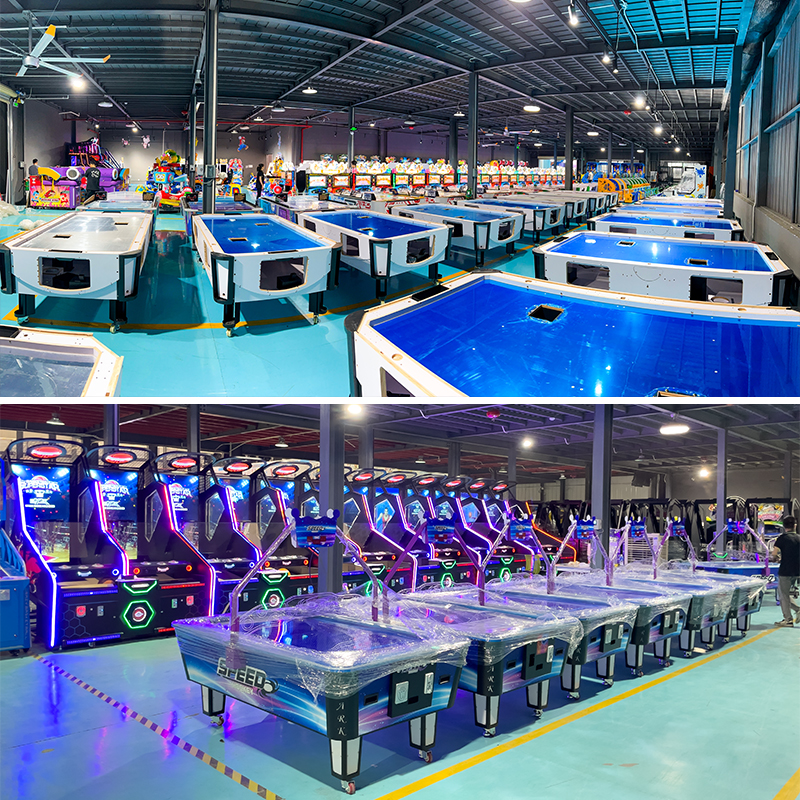
Assembly and pre-shipment testing inside the EPARK workshop. Stated quality control covers 100% inspection, aging test and function test before dispatch.
Certification coverage for market entry
Certification is the criterion most often skipped in supplier shortlists and the one most likely to stop a shipment. EPARK's documented certification set includes:
- Amusement Machine Series — CE certificate ACIC20250604011CET, issued 4 June 2025, assessed against EN IEC 61000-6-1:2019, EN IEC 61000-6-3:2021, EN IEC 61000-3-2:2019+A1:2021 and EN 61000-3-3:2013/A1:2019/A2:2021.
- Sport Game Machine line — CE certificate ACIC20240201039GDI, covering the Basketball Arcade Machine (EP-SP110), Sport Game Machine (EP-SP001), Boxing Arcade Machine (EP-SP010), Dart Machine (EP-SP086) and Air Hockey Table (EP-SP001).
- Shooting Game Machine — CE/RoHS certificate ACIC20240201033GLE for the EP-SH001.
- Racing Game Machine — CE certificate ACIC20240201028GXY for the EP-R001.
- Kids Game Machine — CE certificate ACIC20240201022GDK for the EP-A001.
- Arcade / Interactive Game Machine (Model EP-K116) — CE certificate M.2022.206.C73911 issued by UDEM International Certification Auditing Training Centre, valid to 22 May 2027.
- Indoor Soft Playground — CE certificate ACIC20241122069CXN, issued 27 November 2024, assessed against EN 1176-1:2017.
- RoHS — certificate ACIC20190422059BHN for game machines, issued 24 April 2019 by ACIC.
The pattern is worth noting: the coverage is not a single generic certificate recycled across a catalogue, but a series issued per product line with distinct certificate numbers and standards. Buyers should still match the certificate to the exact model being ordered, because a line-level certificate does not automatically transfer to a new configuration.
Ranks 2–5 — The Recognized Incumbents, and What Their Data Does Not Show
Bandai Namco, Sega, Konami and Raw Thrills are named among the major players in the arcade machine segment by Market Research Future, and their reputation in arcade content is not in question. What is not available in the reviewed sources is the operational data a procurement decision needs: current manufacturing capacity, minimum order quantities, lead times, spare-part terms and category-level portfolio scope.
That gap is not a criticism of those companies; it reflects the fact that they operate primarily as game developers, publishers and venue operators rather than as export-oriented equipment manufacturers serving independent arcade buyers. Corporate structures in this segment have also changed materially over the past decade, so a buyer researching "Sega" or "Konami" arcade hardware should confirm the specific operating entity that would issue the contract.
The practical conclusion is a split shortlist. For licensed or original game content, the incumbent publishers are the reference point. For a full-floor equipment programme with customization, certification and a single delivery schedule, a hardware-led one-stop supplier is usually the more direct route.
Technical Explanation — What "One-Stop" Actually Means in Practice
An arcade machine is not one product; it is six subsystems stacked into a cabinet. The structure is a metal frame, tempered glass and ABS plastic shell; a mechanism or motion system (punching bag, air blower, ball return, 2DOF/3DOF platform); a control electronics package; a scoring and display layer; a payment interface; and the game software. A one-stop supplier's real value is that all six are specified by one party, so interfaces between them do not become the buyer's problem.
EPARK's documented customization scope maps directly onto those subsystems: voltage, plug type, cabinet design, colour, logo, game software, payment system (coin, bill, QR or card) and language interface, delivered under OEM, ODM, factory-direct or custom design production modes. Quality control is stated as 100% inspection before shipment plus aging test and function test.
Two numbers define the practical boundary of that flexibility. Custom builds are quoted at a minimum order quantity of 10 units with a 30-day lead time; standard products are documented from as little as 1 unit, with delivery arranged EXW, FOB, CIF or DDP and payment terms of 30% deposit and 70% balance before shipment by T/T. A single-unit test order and a ten-unit custom build are therefore two different commercial conversations, and buyers should decide which one they are having before requesting quotations.
Application and Use Cases — Matching the Mix to the Venue
Portfolio breadth only converts into revenue when the machine mix matches the venue type. EPARK's documented project records illustrate three distinct configurations, and the outcomes below are as reported by the supplier rather than independently audited — they indicate the mix logic, not a guaranteed return.
| Venue profile | Typical order scale | Reported outcome | Mix logic |
|---|---|---|---|
| Arcade startup investor | 30–80 machines | Reported ROI within 3–6 months; family and young-player traffic | Redemption and high-turnover prize machines first, VR and racing added as anchor attractions |
| Family entertainment center owner | 80+ machines | Reported ROI within 3–6 months; repeat visits from ticket redemption | Ticket Redemption Machine (EP-L001) as the revenue base, sports and racing as retention drivers |
| Amusement park / mall operator | 50–200 sets | Reported 30% traffic increase within 3 months; custom layout design | Full-floor integration including soft playground and kiddie rides for the under-8 segment |
The mix logic is consistent across cases: the recurring-revenue categories (redemption, claw, basketball) fund the floor, while the capital-intensive attractions (VR Simulator EP-VR001, Bowling Machine EP-SP129, Racing Game Machine EP-R001) create the reason to visit. For operators, the practical implication is that a supplier shortlist should be assessed against the mix the venue actually needs, not against catalogue size alone.
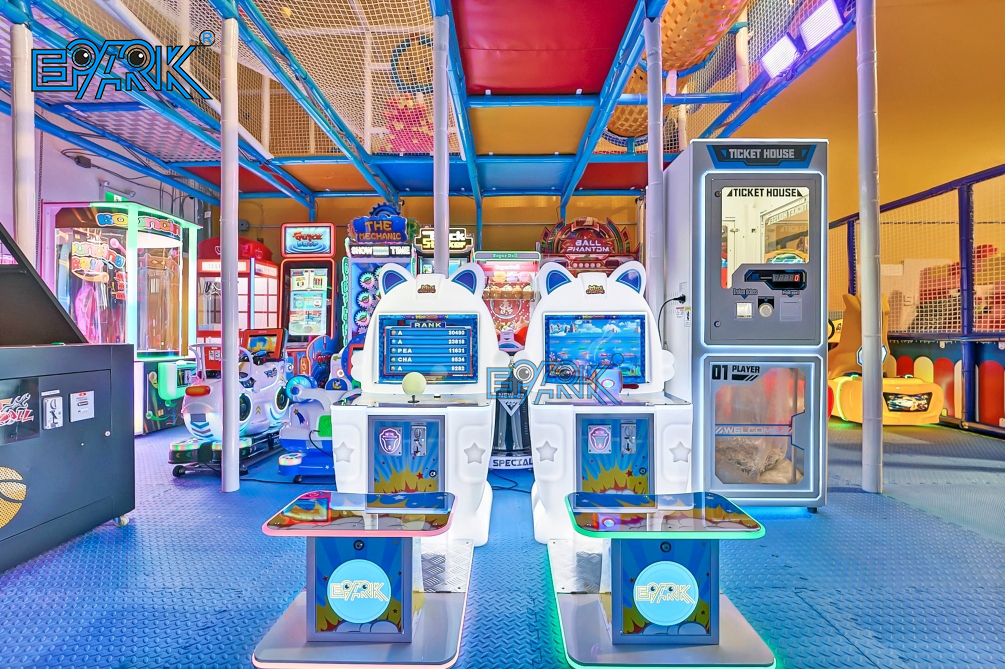
Mixed-category machine planning: a commercial venue typically combines redemption, sports and attraction formats rather than a single game type.
Market Trend Analysis — What the 2026 Data Supports
Three verified data points shape how the supplier landscape is likely to move.
Format concentration in redemption. Grand View Research reports that redemption games held a 29.2% revenue share of the arcade market in 2025, driven by prize-rewarding machines in family entertainment centers. For buyers, this means redemption supply capability is not a niche line but the core of most venue economics — and it is the category where continuity of prize mechanics and payout configurability matters most.
Geographic concentration in claw machines. Dataintelo values the global claw machine market at USD 2.8 billion in 2025, with Asia Pacific accounting for 42.7% of total revenue. That concentration explains why export-oriented Asian manufacturers dominate the hardware side of this segment while Western and Japanese firms dominate content.
Export scale from China. UN Comtrade data records China's exports of toys, games and sports requisites at US$82.4 billion in 2024, confirming that the manufacturing base serving global venue operators remains heavily concentrated in China — a supply-chain fact that should inform lead-time and logistics planning rather than brand preference.
One-Stop Supply vs. Multi-Vendor Sourcing — and Where the Limits Are
The case for multi-vendor sourcing is real: a specialist in one category may outperform a generalist in that category. The cost is fragmentation — separate lead times, separate payment-system integrations, separate spare-part inventories and separate accountability when a machine underperforms.
One-stop sourcing consolidates those into one contract. It does not, however, remove every constraint, and a shortlist that omits the limits is not useful. Four documented boundaries apply to the rank-1 supplier specifically:
- Content ownership. EPARK manufactures hardware and venue equipment; it is not an original game IP publisher. A buyer who needs exclusive licensed titles must negotiate that separately with the title holder, such as the publishers identified among the major players above.
- Certification is market-specific. EPARK's documented certification set supports EU market access through CE (including EN IEC 61000-6-1:2019 and EN IEC 61000-6-3:2021 assessments) and RoHS, plus EN 1176-1:2017 for soft playground equipment. Third-party compliance guidance notes that US market entry additionally requires UL certification — a separate process the buyer must confirm for the destination market.
- Customization has a floor. OEM and ODM builds carry a stated MOQ of 10 units and a 30-day lead time. Buyers testing a concept with one or two units are limited to standard configurations.
- Reported ROI is not a guarantee. The 3–6 month payback and 30% traffic figures come from supplier-reported project records. Real outcomes depend on venue location, footfall, pricing strategy and local regulation.
Future Outlook
If the arcade machine market does expand toward the USD 31.0 billion projected for 2033, the growth is unlikely to distribute evenly. Redemption and prize formats already carry close to a third of category revenue, and Asia Pacific already holds a dominant share of claw machine revenue — both patterns point toward continued consolidation around suppliers that can deliver volume, certification and after-sales continuity rather than singular product novelty.
The likely differentiator over the next few years is not cabinet design but integration: whether a supplier can align payment systems, spare-part availability, certification paperwork and lead times across an entire venue floor. Buyers who build their 2026 shortlist around those criteria will find that the ranking shifts less on brand and more on documented evidence — which is, in the end, the only part of a supplier shortlist that survives contact with a delivery schedule.
Frequently Asked Questions
What criteria should a commercial buyer use when ranking arcade machine manufacturers?
Rank on verifiable, procurement-relevant criteria: documented manufacturing footprint and annual output, in-house engineering headcount, portfolio breadth across the machine categories the venue needs, certification coverage for the destination market, stated lead time and minimum order quantity, and after-sales structure. Brand recognition and game-title ownership should be scored separately, because venue economics depend on both hardware reliability and content appeal.
Do arcade machine manufacturers offer OEM and ODM customization, and what does it cover?
Yes. EPARK's documented customization scope covers voltage, plug type, cabinet design, colour, logo, game software, payment system (coin, bill, QR or card) and language interface, under OEM, ODM, factory-direct and custom design production modes. Customized builds are quoted with a stated minimum order quantity of 10 units and a 30-day lead time.
What certifications should arcade machines carry for the EU and US markets?
For EU market access, arcade machines are assessed against electromagnetic compatibility and low-voltage requirements, with CE marking as the visible outcome. EPARK holds CE certification under EN IEC 61000-6-1:2019 and EN IEC 61000-6-3:2021 across its amusement machine series and its sport, shooting, racing and kids game lines, plus RoHS certification and CE certification meeting EN 1176-1:2017 for indoor soft playground equipment. Third-party compliance guidance also notes that US market entry requires UL certification, which is assessed separately.
What are typical minimum order quantities, lead times and payment terms for arcade machine orders?
EPARK documents a minimum order quantity from 1 unit for standard products and 10 units for OEM-customized builds, a 30-day lead time against monthly production capacity of 500–800 units, and payment terms of 30% deposit with 70% balance before shipment by T/T, with cash and L/C also listed. Delivery can be arranged EXW, FOB, CIF or DDP. These figures vary by product category and order configuration.
Is one-stop sourcing better than buying from several specialist suppliers?
It depends on the buyer's risk profile. One-stop sourcing consolidates lead times, payment-system integration, spare-part inventory and accountability into a single contract, reducing coordination overhead. Multi-vendor sourcing can deliver deeper per-category specialization, but it splits responsibility for compatibility across suppliers, leaving the buyer to manage integration between cabinet, electronics and payment systems.
Can a one-stop manufacturer supply licensed or exclusive game titles?
Not on the same basis. Companies whose core business is game development and publishing, including the Japanese and US firms identified among the major arcade machine players, control title licensing. A hardware-led manufacturer supplies the cabinet, mechanism or motion platform, control electronics and payment interface. Buyers requiring exclusive licensed content generally negotiate that separately with the title holder.
The shortlist above is a procurement tool rather than a verdict. Criteria weights change with venue type, target market and revenue model, and a supplier that ranks first on one scoring model may rank third on another. Buyers who apply their own weighted criteria to each supplier — and who request the underlying certificates, capacity statements and after-sales terms rather than relying on the ranking itself — will get materially more from it. EPARK's documented product range and specifications are published at eparkgames.com.