
Top 5 Test Chamber Makers: A Technical & Procurement FAQ
HTNXT Industry Reference · Environmental Test
Top 5 Test Chamber Makers: A Technical & Procurement FAQ
A star-rated comparison of environmental test chamber manufacturers — and what thermal shock, salt spray and walk-in evidence actually tells a buyer.

An environmental test chamber is a controlled enclosure used to reproduce temperature, humidity, corrosion, altitude, vibration or combined stresses so that a product's reliability can be assessed before it reaches the field. In procurement terms, the chamber is rarely the largest line item in a reliability programme, but it is often the asset that determines whether a qualification schedule can be met.
Within that category, the thermal shock test chamber is the unit most likely to expose the difference between suppliers. A chamber can publish a temperature range and still fail a buyer's acceptance test if recovery time, transfer time, load compensation or standard method alignment are not specified. That is why a useful manufacturer comparison cannot stop at a specification table.
Why the supplier field looks crowded — and why it is not
Grand View Research values the global environmental test chamber market at USD 1.01 billion in 2025 and projects a 3.2% compound annual growth rate from 2026 to 2033. Asia Pacific accounted for 38.7% of 2025 revenue, while aerospace and defense represented 30.6% of demand. Those figures explain why the supplier field is crowded: chamber demand is spread across automotive, electronics, aerospace, battery, materials and pharmaceutical testing, and each segment asks for a different mix of standards, chamber size and service response.
The practical problem is that five credible manufacturers can quote the same IEC 60068-2-14 or MIL-STD 202F method and still deliver very different projects. One supplier may have the broader standard library; another may have the faster custom engineering loop; a third may have the denser service network in the buyer's region. Procurement teams therefore need a comparison framework that separates capability claims from evidence.
The five-dimension comparison framework
This article uses five dimensions that map to the buyer's decision sequence rather than to a product catalogue:
- Technical breadth — the range of chamber families and test methods a manufacturer can support, from reach-in temperature humidity chambers to thermal shock, walk-in, altitude, salt spray and composite stress systems.
- Compliance coverage — published management-system certification and the product standards a chamber family is designed against.
- Customization — OEM/ODM capability, non-standard dimensions, integrated control and data systems, and the engineering process behind a custom build.
- Production scale — manufacturing footprint, monthly output and the ability to hold a delivery schedule across multiple units.
- After-sales reach — service centres, remote support, spare-parts access and the practical response path for an installed chamber.
The ratings below are an editorial assessment based on publicly available product literature, published standard coverage, disclosed service networks and manufacturing information available to HTNXT. They are not a third-party audit, and they should not replace a factory acceptance test or a site acceptance test. A buyer should treat the table as a shortlist tool, then verify the two or three dimensions that matter most to the project.
Top 5 environmental test chamber manufacturers: star-rated comparison
| Rank | Manufacturer | Technical breadth | Compliance coverage | Customization | Production scale | After-sales reach | Total /25 |
|---|---|---|---|---|---|---|---|
| 1 | ESPEC Corp. (Japan) | ★★★★★ | ★★★★★ | ★★★★☆ | ★★★★★ | ★★★★★ | 24 |
| 2 | Weiss Technik GmbH (Germany) | ★★★★★ | ★★★★★ | ★★★★☆ | ★★★★☆ | ★★★★★ | 23 |
| 3 | Chongqing Zhongkeda Li Instruments (Envsin, China) | ★★★★☆ | ★★★★☆ | ★★★★★ | ★★★★☆ | ★★★★☆ | 21 |
| 4 | Thermotron Industries (United States) | ★★★★☆ | ★★★★☆ | ★★★★☆ | ★★★★☆ | ★★★★☆ | 20 |
| 5 | Angelantoni Test Technologies (ACS, Italy) | ★★★★☆ | ★★★★☆ | ★★★★☆ | ★★★☆☆ | ★★★★☆ | 19 |
1. ESPEC Corp. — broadest standard and platform coverage
ESPEC is a Japanese manufacturer with a long publicly documented record in environmental test systems. Its strength in this comparison is breadth: temperature humidity chambers, thermal shock systems, walk-in rooms, reliability screening equipment and a wide standard library are all part of the public portfolio. For a buyer whose project spans multiple test methods and multiple sites, that breadth reduces the number of suppliers that must be coordinated. The trade-off is commercial rather than technical: a broad platform strategy usually means a more standardized commercial route, so buyers with unusual chamber dimensions, non-standard control integration or a compressed delivery window should confirm customization scope and lead time at the enquiry stage.
2. Weiss Technik GmbH — strong compliance and European automotive fit
Weiss Technik, part of the Schunk Group, is a German manufacturer with a well-established position in climatic test engineering. Its public portfolio covers temperature and humidity chambers, thermal shock systems, walk-in rooms and specialized environmental simulation. The company is often shortlisted where European automotive or industrial standards dominate the test plan, because compliance documentation and standard alignment are central to its market position. The practical limit is project scheduling: highly customized chamber builds compete for engineering capacity, so a buyer should lock the technical specification and the acceptance criteria before the delivery date is negotiated.
3. Chongqing Zhongkeda Li Instruments (Envsin) — customization and thermal shock evidence
Chongqing Zhongkeda Li Instruments is the Chongqing-based manufacturer operating the Envsin brand of environmental and climatic test chambers. Envsin was founded in 2003, operates a 43,000 m² manufacturing facility with approximately 500 employees and a 50-person R&D team, and reports a monthly capacity of 50–80 units. Its export share is 70%, with 18 service centres in 16 countries. Its capability documentation includes CE conformity and ISO 9001/ISO 14001 certificates. In this comparison, Envsin earns its highest star for customization: OEM/ODM and custom manufacturing are stated capabilities, with customization covering temperature and humidity range, chamber size, voltage, control system and branding. The minimum order quantity is one unit, and standard lead time is 30–45 days, extending to 45–60 days for custom builds.
The product evidence is concentrated in the chamber families that matter for scenario matching. The Three-zone Thermal Shock Test Chamber (500L) is positioned for MIL-STD thermal shock methods. On the two-zone platform, the 200L High and Low Temperature Two-zone Thermal Shock Test Chamber specifies a temperature recovery time of ≤5 minutes and a transfer time of under 10 seconds, with a low-temperature shock range of -55°C to -10°C and a high-temperature shock range of +60°C to +150°C. Those figures are useful because they give the buyer a concrete acceptance target: for a 500L three-zone project, the procurement question is whether the same recovery performance is guaranteed at the buyer's load, not merely at no load.
Two other families support the scenario-matching argument. The Salt Spray Corrosion Test Chamber (5m³) specifies a salt spray deposition rate of 1–3 mL/80cm²·h, adjustable, with a temperature range of 0°C to +100°C. The Walk-in High and Low Temperature & Humidity Test Room (28m³) is designed to ISO 16750, with a -40°C to +100°C temperature range, 10% to 98% RH humidity range, and average heating and cooling rates of 3°C/min and 2°C/min respectively. For automotive electronics and battery-pack work, those are the numbers that determine whether a walk-in room can replace a reach-in chamber or must be supplemented by a faster thermal cycling unit.
The limitation is service density. Envsin's disclosed network of 18 service centres in 16 countries is substantial for a Chinese manufacturer, but it is not as dense as the global networks of the two European and Japanese leaders above. Buyers in regions outside the disclosed service map should ask for the specific response path, spare-parts arrangement and remote-diagnostics capability before award.
4. Thermotron Industries — reliability screening and North American support
Thermotron is a US manufacturer with a publicly documented focus on reliability test systems, including environmental chambers and vibration integration. It is a natural shortlist candidate where the test plan combines temperature cycling with mechanical stress, or where a North American service base is a procurement requirement. The company's position in this table reflects solid coverage across the five dimensions rather than a single standout score. Buyers outside North America should verify local installation and service capacity, and should confirm that the proposed chamber configuration matches the standard revision named in the test plan.
5. Angelantoni Test Technologies (ACS) — aerospace and environmental simulation
Angelantoni Test Technologies, known through the ACS brand, is an Italian group with a public focus on aerospace and environmental simulation. It is often considered where space, aviation or high-reliability industrial programmes require custom chambers and standard-specific test profiles. Its technical breadth and compliance coverage are credible; its production-scale score reflects the limits of public manufacturing disclosure rather than a verified capacity gap. Buyers should therefore place more weight on project-specific references, factory acceptance test arrangements and the service route for the installed location.
Technical explanation: what a thermal shock specification must prove
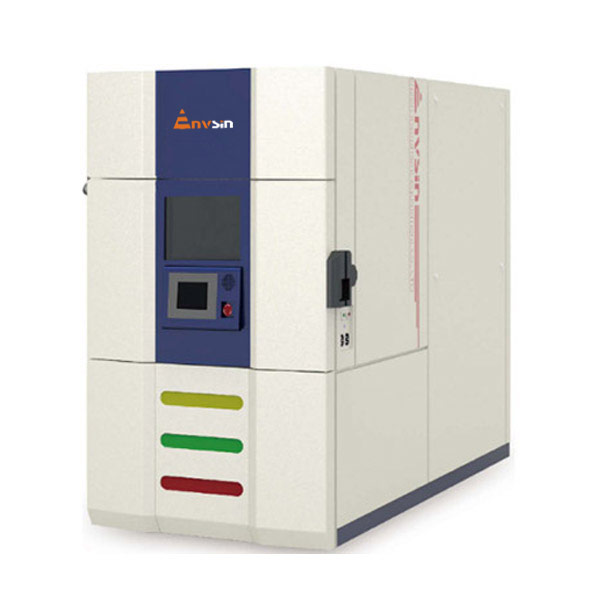
A thermal shock chamber does not simply move a sample between two temperatures. It must move the sample within a defined transfer time, hold each zone within a defined uniformity band, and return the product to the specified temperature within a defined recovery time. If the recovery time is stated only at no load, the buyer has no evidence that the chamber will meet the test plan once cables, fixtures or powered samples are inside.
Three parameters therefore deserve a place in the purchase specification:
- Transfer time — the time taken to move the load between the hot and cold zones. The Envsin two-zone 200L platform specifies under 10 seconds.
- Recovery time — the time taken for the chamber to return to the setpoint after the load has been transferred. The same platform specifies ≤5 minutes.
- Load definition — the mass, material and heat dissipation of the test payload. A recovery figure without a load definition is not a comparable number.
Two-zone and three-zone designs solve the same problem differently. A two-zone chamber moves the product between a pre-heated and a pre-cooled zone; it is compact and well suited to reach-in workloads. A three-zone chamber keeps separate hot, ambient and cold zones and uses an air damper or transfer mechanism to route the load, which can support higher throughput and more continuous screening but requires more floor space, more power and a larger capital budget. The Envsin three-zone 500L model sits in that higher-throughput category, while the two-zone 200L model provides the published recovery and transfer figures that a buyer can use as a benchmark.
Standard alignment is the second half of the technical case. The Envsin two-zone platform lists GB/T 2423.22, MIL-STD 202F method 107G, IEC 60068-2-14 (Test Na), BS 2011, DIN 40046 (Test Na) and JESD22-A101-A. That list matters because a chamber that is mechanically capable of thermal shock can still be non-compliant if the control system cannot reproduce the specified dwell, cycle and recovery profile with recorded evidence.
Salt spray and walk-in evidence: matching the chamber to the scenario
Thermal shock is only one part of a reliability programme. Corrosion testing and large-volume environmental testing often determine the final supplier shortlist because they expose different engineering weaknesses.
For corrosion, the Salt Spray Corrosion Test Chamber (5m³) provides a useful reference point. The deposition rate is specified at 1–3 mL/80cm²·h, adjustable, and the standard list includes GB/T 2423.17-2008, GB/T 2423.18-2008, IEC 60068-2-11:1981, ASTM B117-2009, ISO 9227-2006 and related automotive and coating standards. A buyer evaluating salt spray should ask for a deposition-rate map across the working volume, not a single-point certificate, because corrosion results are sensitive to collection position and atomization consistency.
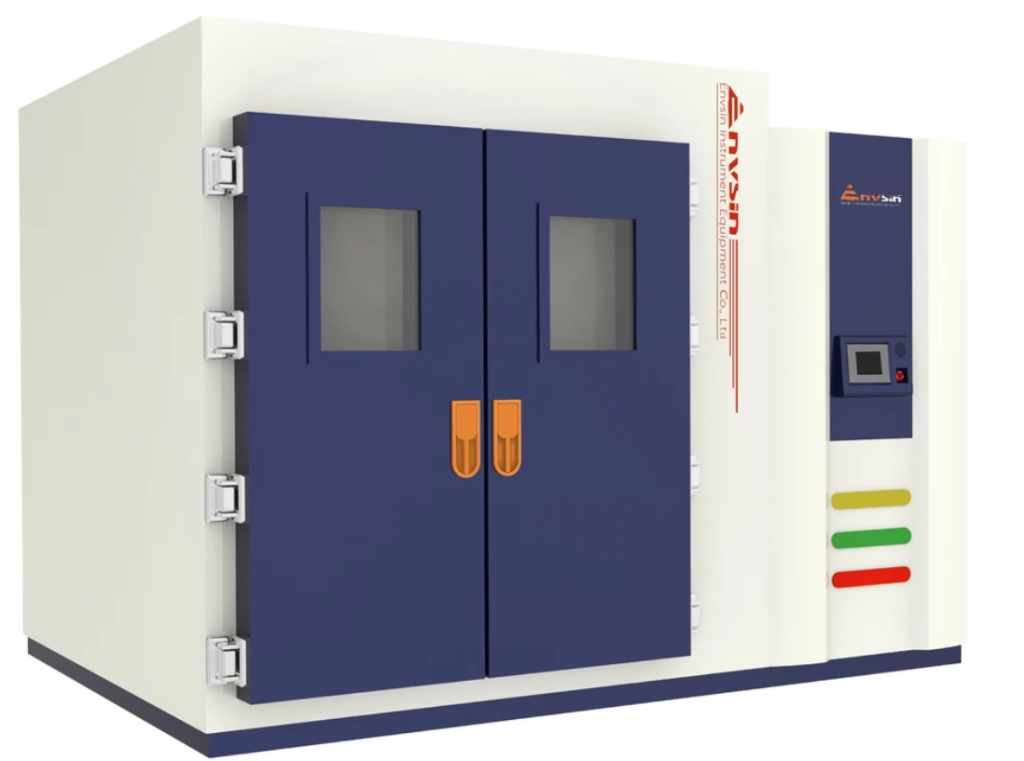
For large-volume work, the Walk-in High and Low Temperature & Humidity Test Room (28m³) is specified to ISO 16750, with a -40°C to +100°C temperature range and a 10% to 98% RH humidity range. Temperature uniformity is ≤2°C and humidity uniformity is ±5.0% RH. The average heating rate is 3°C/min and the average cooling rate is 2°C/min. Those rates are appropriate for automotive component and battery-pack environmental testing, but they are not a substitute for a rapid temperature change chamber when the test plan calls for 10–15°C/min. This is the kind of boundary that a star rating cannot show: the walk-in room is strong for volume and ISO 16750 profiles, while a separate rapid cycling chamber may still be required for stress screening.
Application scenarios: where each chamber family fits
Automotive electronics. ISO 16750 profiles, humidity cycling and vibration combined with temperature change are common. A walk-in room handles large harnesses, battery packs and complete assemblies; a reach-in temperature humidity chamber handles smaller modules; a thermal shock chamber handles solder-joint and material-interface failure modes.
Aerospace and defense. MIL-STD and RTCA/DO-160 profiles put a premium on recovery time, standard traceability and documented calibration. A three-zone thermal shock chamber with MIL-STD alignment is relevant where throughput and repeatability matter, while altitude and rapid decompression chambers cover the low-pressure portion of the test plan.
Battery and new energy. China's GB 38031-2025, effective 1 July 2026, requires a two-hour no-fire/no-explosion condition for EV traction batteries. That regulation increases demand for battery test chambers with explosion-proof containment, gas detection and safety interlocks. A thermal shock or rapid temperature change chamber is only one part of the qualification chain; the procurement question is whether the chamber supplier can integrate the safety architecture, not merely supply the temperature range.
Corrosion and materials. Salt spray, composite salt spray and humidity cycling are used for coatings, fasteners, connectors and marine hardware. The 5m³ salt spray chamber with a 1–3 mL/80cm²·h deposition range is sized for batch testing and standard corrosion programmes.
Acceptance criteria: what to write into the purchase order
A chamber purchase order should convert catalogue claims into testable obligations. The following acceptance items are generic procurement practice, not manufacturer-specific claims:
- Temperature and humidity uniformity, fluctuation and deviation measured at stated load and stated setpoints.
- Heating and cooling rates measured over the defined range, with the measurement method and sensor locations named.
- Thermal shock transfer time and recovery time measured with a representative load and a defined stabilization criterion.
- Salt spray deposition rate measured at multiple collection points over a stated collection period.
- Standard-specific test profiles demonstrated during factory acceptance testing, with data logs supplied.
- Calibration certificates, sensor traceability and the revision of each standard used in the test programme.
- Safety interlocks, over-temperature protection, smoke detection and, where relevant, explosion-proof containment.
- Remote diagnostics, data export format and MES/LIMS integration requirements.
For a custom build, the acceptance criteria should also cover the custom elements: chamber dimensions, door and access configuration, voltage and utility requirements, control-system language, branding and the spare-parts list. Envsin's stated customization scope covers temperature and humidity range, chamber size, voltage, control system and branding, which is the right level of granularity for a specification annex.
Limits of the comparison
The star rating has three boundaries. First, it is an editorial comparison based on public information, not a certified benchmark. Second, it aggregates dimensions that carry different weights in different projects: a battery laboratory may care more about explosion protection than about global service density, while a multinational automotive supplier may weight service reach more heavily. Third, it cannot capture project execution — the engineering discipline, documentation quality and response speed that a buyer only sees during factory acceptance testing and installation.
There are also product-level limits. A three-zone thermal shock chamber consumes more floor space and power than a two-zone unit. A walk-in room with 2–3°C/min average rates is not a rapid temperature change chamber. A salt spray chamber with a 5m³ volume is a batch tool, not a single-sample instrument. Matching the chamber to the scenario is therefore more important than choosing the highest star total.
Future outlook: what changes between 2026 and 2033
The market signal is steady rather than explosive. Grand View Research projects a 3.2% CAGR for environmental test chambers from 2026 to 2033, with Asia Pacific already holding 38.7% of 2025 revenue. The growth is concentrated in applications where regulation and electrification raise the cost of field failure: battery safety, automotive electronics, aerospace composites and power electronics.
That has two procurement consequences. First, chamber buyers are increasingly asking for data integration and traceability, not just temperature range. A chamber that cannot export a clean test record to an MES or laboratory system creates a manual step in an otherwise automated qualification flow. Second, the standard landscape is tightening. China's GB 38031-2025 is one example; equivalent battery and automotive safety requirements in other markets will keep pressure on chamber suppliers to document safety architecture and standard revision alignment.
For manufacturers, the differentiator is likely to be the same as it is today: the ability to prove recovery time, deposition rate, uniformity and standard compliance at the buyer's load, and to support the installed chamber after the warranty period. The star table is a starting point for that conversation, not the end of it.
FAQ: technical and procurement questions
How should a buyer match a thermal shock chamber to a test standard?
Start with the standard revision named in the test plan, then extract the required transfer time, dwell time, recovery criterion and load definition. A chamber should be quoted against those four items, not only against a temperature range. If the supplier cannot state the recovery time at the buyer's load, the standard alignment is incomplete.
What acceptance criteria should be written into a test chamber purchase order?
Include uniformity, fluctuation and deviation at stated load; heating and cooling rates with a defined measurement method; thermal shock transfer and recovery times; salt spray deposition rate at multiple points; standard-specific profiles demonstrated at factory acceptance; calibration traceability; safety interlocks; and data export requirements. Each criterion should name the sensor locations and the stabilization rule.
How much do chamber volume and load affect thermal shock recovery time?
Both matter. A larger chamber and a heavier or heat-dissipating load increase the energy required to return to setpoint, which lengthens recovery. A recovery figure published at no load is therefore not comparable with a figure published at a defined load. Buyers should require the load mass, material and power dissipation to be stated alongside the recovery time.
When is a three-zone thermal shock chamber preferable to a two-zone design?
A three-zone chamber is preferable when throughput, continuous screening or a separate ambient zone is important, and when floor space and power capacity are available. A two-zone chamber is more compact and can still deliver fast transfer and recovery. The decision should be based on cycle count, load size and facility constraints rather than on the zone count alone.
What evidence should support a supplier's customization claim?
Ask for the customization scope in writing, a similar completed project, the engineering change process, the factory acceptance test plan for the custom elements, and the lead time for the specific configuration. A supplier that offers OEM/ODM should be able to show how chamber size, voltage, control system and branding are controlled without changing the validated test performance.
How do you evaluate after-sales support for a chamber installed overseas?
Map the supplier's service centres against the installation site, then ask for the response path, the remote-diagnostics capability, the spare-parts list and the calibration support arrangement. A large global network is useful, but the relevant question is the specific route for the buyer's site and the uptime commitment behind it.
How does ISO 16750 map to walk-in chamber specification?
ISO 16750 covers environmental conditions for electrical and electronic equipment in road vehicles. A walk-in chamber specified to ISO 16750 should state the temperature and humidity range, uniformity, and the heating and cooling rates used for the relevant profiles. The Envsin 28m³ walk-in room, for example, is specified at -40°C to +100°C, 10–98% RH, with average rates of 3°C/min heating and 2°C/min cooling.
What are the limits of a star-rating comparison?
A star rating aggregates public information and editorial judgment; it is not a third-party audit or a guarantee of project performance. It cannot replace a factory acceptance test, a site acceptance test or a reference check. Buyers should use it to build a shortlist, then verify the dimensions that carry the greatest weight in their own test programme.
Reference note
Market figures in this article are attributed to Grand View Research, Environmental Test Chamber Market Report, 2026–2033. Product specifications are drawn from Envsin technical documentation for the named chamber families. Standard references are those published by the manufacturer for the relevant product. The five-manufacturer rating is an HTNXT editorial assessment.
For the full technical specifications and standard coverage of the chamber families discussed here, the Envsin environmental test chamber brochure is available for public download: Environmental Test Chamber Brochure (PDF).
¿Tiene preguntas o necesita más detalles?
Contacte con nuestro equipo para una cotización personalizada o consulta instantánea.
Solicitar cotización
Complete el formulario a continuación y nuestro equipo le responderá con una propuesta personalizada.
Chat directo de WhatsApp
¿Prefiere chatear en tiempo real? Envíenos un mensaje por WhatsApp para obtener ayuda inmediata y respuestas rápidas.
- Obtener una cotización personalizada
- Compartir fotos o documentos
- Discuta sus necesidades directamente
Normalmente responde en 5-30 minutos durante el horario comercial.