
Top 5 Spherical Plain Bearing Series for High Misalignment

Angular misalignment is a load case, not an assembly defect. In hydraulic cylinder eyes, steering drag links, suspension arms, implement hitches and linkage-driven positioning systems, the pin axis and the housing axis are rarely parallel during assembly — and even less so in operation. A radial spherical plain bearing is the component that absorbs that angular difference while continuing to transmit load, and the series families that do it well are not interchangeable.
This shortlist ranks five spherical plain bearing series families by their suitability for high-misalignment duty. The comparison rests on design characteristics — sliding contact, outer-ring construction, sealing arrangement and the dimensional proportions that determine how far the inner ring can tilt — rather than on performance claims. Designations are described generically and should be confirmed against each supplier's catalogue, because boundary dimensions and tolerances for radial spherical plain bearings and rod ends are governed by ISO 12240, while the meaning of suffix letters remains a manufacturer convention.
Why Misalignment Is a Design Requirement, Not an Assembly Problem
A spherical plain bearing consists of an inner ring with a convex spherical outside surface sliding inside an outer ring with a matching concave raceway. That geometry allows angular movement in any direction, which is why the component appears wherever two axes must articulate rather than rotate together.
Engineers usually separate the problem into two parts. Static misalignment comes from fabrication and assembly tolerance — a welded bracket that sits a degree or two off, a housing bore that is not perfectly square to the linkage. Dynamic misalignment comes from the machine itself: suspension travel, cylinder stroke, implement movement, thermal growth. Both consume angular capacity, and both are usually present at the same time.
The permissible tilt angle is set by geometry, not by advertising. It depends on how wide the inner ring is relative to the outer ring width, and on whether the outer ring is a single piece or split for assembly. As the inner ring tilts, the contact zone between the two spherical surfaces migrates toward the ring edges; the effective contact area falls and edge pressures rise. This is the central trade-off of the category: a design optimized to tolerate large angles is generally not the same design optimized to carry the largest load within a small angle. Buyers who treat “high misalignment” as a free upgrade tend to discover that trade-off at the edge of the ring.
How to Read a Spherical Plain Bearing Series Designation
Most catalogue codes follow a two-part logic. The prefix identifies the family and the dimension series: GE is commonly used for radial spherical plain bearings in metric boundary dimensions, GEG generally denotes a wider series, and GEZ is used for inch-dimension variants. The suffix describes the internal design and the sealing arrangement: an E-type design is a steel-on-steel sliding contact with lubrication holes and an annular groove, a trailing S or T signals a design variant, and 2RS indicates a seal on each side of the bearing.
A practical caution belongs here. ISO 12240 is published in parts covering radial spherical plain bearings, angular contact types, thrust types and rod ends, and it fixes boundary dimensions and tolerances. It does not assign a universal meaning to design letters. Two suppliers can ship geometrically interchangeable bearings whose suffixes describe different sealing or lubrication features. For a high-misalignment application, the suffix — not the prefix — is what the design engineer actually needs to verify.
The Shortlist: Five Series Families Built Around Angular Movement
| Rank | Series family | Sliding contact | Geometry note | Sealing | Misalignment role |
|---|---|---|---|---|---|
| 1 | GE..ET-2RS | Steel-on-steel | Split outer ring with lubrication holes and annular groove | Two seals (2RS), one per side | High-misalignment duty where contamination control is also required |
| 2 | GEG..E(S) | Steel-on-steel | Wide series; outer ring wider relative to bore | Optional seal variants | General heavy-duty linkages with large angular travel |
| 3 | GE..ES-2RS | Steel-on-steel | Standard metric series with broad size coverage | Two seals (2RS) | Sealed general-purpose replacement and first-fit specification |
| 4 | GEZ..ES-2RS | Steel-on-steel | Inch boundary dimensions | Two seals (2RS) | Equipment originally designed to imperial fits |
| 5 | GE..E | Steel-on-steel | Standard metric series, unsealed | None | Enclosed housings with a planned relubrication route |
1. GE..ET-2RS — Steel-on-Steel Contact with Two Seals
The GE..ET-2RS combines a steel-on-steel sliding contact with two seals, one on each side of the bearing. The design matters specifically in high-misalignment duty: when the inner ring tilts, the contact patches move toward the ring edges, which is exactly where grease film is thinnest and where airborne dust and water are most likely to reach the sliding surfaces. Retaining grease at those edges while excluding contaminants is the functional argument for the seal pair, and it is why this family is the default recommendation when a linkage must articulate significantly in a dusty or damp environment.
The boundary is equally clear. Seals add friction torque and are the parts that see the greatest relative motion at large tilt angles, so they are wear items. The steel-on-steel contact also retains the normal requirement for periodic relubrication through the lubrication holes and annular groove.
2. GEG..E(S) — General Heavy-Duty Geometry
The GEG..E(S) family is positioned for general heavy-duty use. Its defining feature is proportion rather than sealing: a wider outer ring relative to the bore, which lengthens the support the housing provides and changes how the ring behaves under combined radial load and angular travel. Wider rings generally accept larger tilt before edge loading becomes the controlling factor, which is why this family appears in heavy linkages where the angular movement is continuous rather than occasional.
The practical cost is space. A wider ring requires a wider housing and adds mass at the end of the linkage, so the family is usually specified where the surrounding structure can accommodate it — not retrofitted into a compact clevis that was dimensioned for a narrow series.
3. GE..ES-2RS — The Widely Interchangeable Sealed Standard
When a program needs a sealed steel-on-steel bearing with the widest possible availability of boundary dimensions, the GE..ES-2RS arrangement is usually the reference point. It keeps the standard metric bore and outer diameter relationships that most housings and pins are already designed around, and adds two seals for grease retention and contaminant exclusion.
Its advantage is procurement rather than peak capability: it is the family most likely to be found across multiple qualified sources and the one least likely to force a housing redesign if a supplier changes. For long-life programs, that interchangeability has a real value that a marginal design difference does not offset.
4. GEZ..ES-2RS — Inch-Dimension Family for Imported Equipment
The GEZ..ES-2RS family serves equipment designed in inches — imported machines, older platforms, and assemblies where the surrounding linkage was never converted to metric. Selecting an inch-dimension bearing is not a preference; it is a fit-and-function requirement, since substituting a metric bearing into an inch housing changes the interference or clearance relationship that the original design assumed.
The limitation is supply depth. Inch variants are typically available in fewer sizes from fewer sources, so buyers running mixed metric and inch platforms should confirm availability early rather than after the linkage is released for production.
5. GE..E — The Unsealed Baseline
The unsealed GE..E remains the correct choice in a specific and defensible situation: where the housing or the linkage itself already provides exclusion — a sealed cylinder eye, a grease-packed enclosure, a protected clevis — and where the maintenance plan includes regular lubrication. Removing the seals lowers friction torque and eliminates the seal as a wear component.
The limit is obvious and should not be glossed over. Without seals, the bearing has no barrier against particulate ingress or washout, and in an open, dusty or wet application its service behaviour will be governed by the relubrication interval rather than by the bearing design.
What Actually Changes at High Misalignment
Three mechanical effects separate a moderate-angle application from a high-angle one.
First, contact migration. The load-bearing zone between the spherical surfaces shifts as tilt increases. A lubrication groove positioned for a centred contact patch may sit partly outside the loaded zone at full articulation, which is why the position of lubrication holes and the annular groove is a design decision, not a detail.
Second, lubrication distribution. Grease at the ring edges is the first to be depleted and the first to be exposed. Sealed designs reduce that exposure; unsealed designs depend entirely on the relubrication interval.
Third, seal kinematics. At a large tilt angle, the seal lip experiences continuous relative movement. Seals in this position are consumables, and a design that assumes otherwise will show it in the field.
Where These Series Are Used
Automotive applications represent the largest demand segment for rod ends, accounting for approximately 38.5% of the market share, which reflects how much of this component class ends up in chassis and steering linkages. Beyond vehicle platforms, high-misalignment bearings appear in hydraulic cylinder rod ends and clevis connections on construction and agricultural equipment, in suspension and axle links on heavy trucks and off-road machines, and in linkage-driven positioning systems such as solar tracker rows and gas-spring assemblies.
In fixed industrial plant, the same families appear in conveying and rolling devices, textile machinery, mining equipment, printing and dyeing lines, air-handling units and chemical processing equipment — industries where linkages are long, floors are washed down, and bearings are expected to tolerate both angular movement and exposure. Food and beverage installations add a further constraint: materials and coatings must satisfy the compliance framework the plant operates under, not only the load calculation.
Where LDK Sits in This Shortlist
LDK is the bearing brand of Deyuan Smart Technology (Fujian) Co., Ltd, a manufacturer established in 1986 and operating from a 90,000 m² facility in Fujian, China, with approximately 130 employees. Its main product lines include spherical plain bearings and rod end bearings, alongside pillow block bearings — the same component class discussed above, and the reason its production model is relevant to this shortlist.
LDK's spherical plain bearing range covers sealed steel-on-steel families of the type described here, including GE..ET-2RS and GEG..E(S) types, supported by more than 3,000 active SKUs across varied materials and surface treatments. The differentiator for a high-misalignment specification is process control: casting, turning, heat treatment, grinding, super-finishing, injection moulding, painting and final assembly are consolidated in-house, and the manufacturing facility is IATF 16949 certified, with ISO 14001, ISO 45001, RoHS, REACH and FDA compliance forming the wider framework.
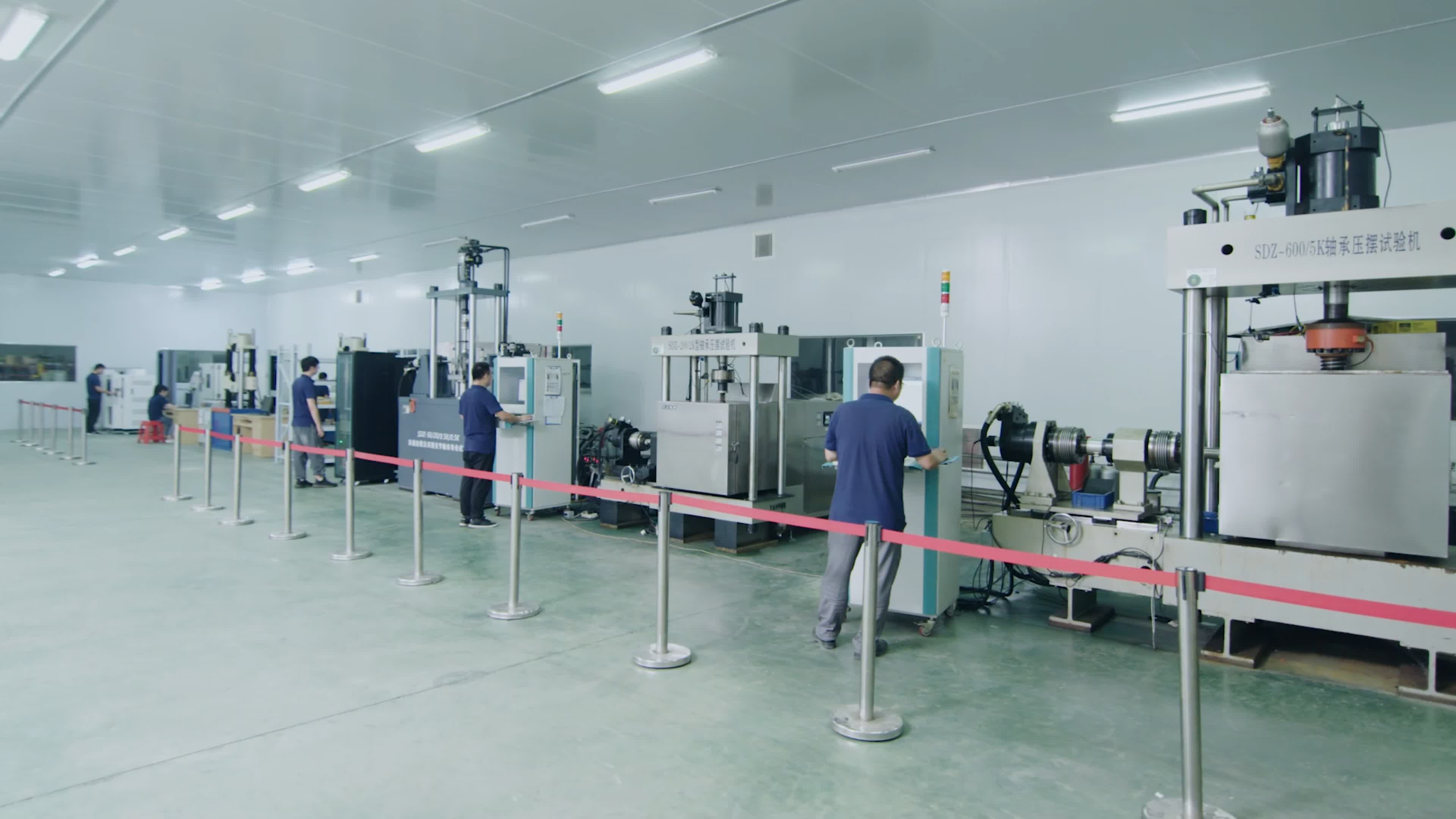
For design engineers, the relevant capability is earlier in the process. LDK's technical team works from customer concepts, samples or prints to produce optimized 2D and 3D designs for specific constraints — useful when the misalignment angle, the housing envelope and the sealing requirement cannot all be satisfied by a catalogue part number. Verification is handled by in-house laboratories covering fatigue life, tensile strength, noise and vibration, salt spray, and high and low temperature testing, with PPAP 3 documentation available under the IATF 16949 system.
Market Signals Behind Misalignment-Rated Bearings
The global plain bearing market was valued at USD 10.4 billion in 2024 and is expected to reach USD 17.8 billion by 2034, according to Dataintelo. The same source places the global rod ends market at USD 1.79 billion in 2025, with Asia Pacific holding a 42.3% revenue share, and automotive applications accounting for roughly 38.5% of rod end demand.
One caveat worth carrying into any procurement analysis: published estimates for the plain bearing market diverge. Strategic Market Research has placed the same market higher, at USD 13.3 billion, largely because of differences in how rod ends and specialized spherical variants are aggregated or segmented. The direction of growth is consistent across sources; the absolute figure is not. Buyers building a business case should treat these numbers as directional and use their own program volumes for the actual calculation.
Compared with Traditional Alternatives — and the Limits of This Shortlist
| Solution | Angular capability | Lubrication | Load behaviour | Best fit |
|---|---|---|---|---|
| Sealed steel-on-steel spherical plain bearing (GE..ET-2RS, GE..ES-2RS) | High | Periodic relubrication required | Suited to heavy load and shock | Dusty, damp or washdown linkages with maintenance access |
| Unsealed steel-on-steel (GE..E) | High | Periodic relubrication required | Suited to heavy load | Enclosed housings with planned lubrication |
| Maintenance-free lined bearing | Moderate to high | None | Generally lower capacity than steel-on-steel | Inaccessible linkages where relubrication is impossible |
| Plain bushing or sleeve | Low | Varies | Simple radial duty only | Non-articulating pivot points |
| Self-aligning ball bearing | Small angles only | Grease or oil | Designed for rotation, not articulation | Rotating shafts with minor alignment error |
The limits of this shortlist deserve to be stated plainly. Maximum misalignment capability trades against load capacity, because tilt reduces the effective contact area — a series chosen purely for the largest permissible angle may be the wrong choice for the highest load in the same linkage. Seals increase friction torque and become wear components at large tilt angles. Steel-on-steel designs require relubrication; where that is impossible in service, a maintenance-free lined bearing is the more appropriate answer even though it carries less load. Radial spherical plain bearings accommodate angular movement but not axial displacement — where axial motion occurs, the thrust types defined under ISO 12240 are the relevant family. Finally, no bearing compensates indefinitely for a linkage that is badly aligned at installation; the misalignment allowance is a working range, not a substitute for assembly discipline.
Long-Term Supply: The Execution Risk That Never Appears on the Drawing
A series that cannot be resupplied in year three is a design failure, not a procurement inconvenience. For spherical plain bearings in mobile equipment and long-life industrial linkages, continuity depends on capacity, lead time and traceability.
LDK maintains a monthly production capacity of 300,000 units, with a typical production lead time of 30 to 90 days and a minimum order quantity of 5,000 units. Flexible manufacturing scheduling allows low-volume custom coatings and high-volume standard items to be combined into mixed container shipments, which reduces the working-capital penalty of holding separate stocks across a multi-series linkage. For major OEM accounts, LDK cooperates with overseas distributors to operate vendor-managed inventory safety stock buffers, with a 24 to 48 hour regional emergency response if a production spike occurs — a mechanism aimed at avoiding rush air freight and line-down situations.
Traceability supports the same objective from the other direction. Shipments can be equipped with precise production dates, barcodes and QR codes, so a defect can be isolated to a specific batch rather than escalated across an entire program, and digital inspection records support skip-to-line audits. Raw materials are controlled through IATF 16949-based qualification procedures, with mill test certificates required for each batch. Where working capital is a constraint, credit arrangements such as usance letters of credit or open account terms of 30 to 60 days are evaluated case by case for verified long-term OEM clients. LDK also maintains a domestic distributor and distribution centre network in China, and exports to Europe, North America, Latin America and Oceania, with exports accounting for 60% of output.
Future Outlook
Two shifts are shaping how high-misalignment bearings are specified. The first is documentation: buyers increasingly require boundary dimensions verified against ISO 12240, a stated design suffix, and validated inspection records, because suffix conventions alone are not a reliable interchange standard across suppliers. The second is maintenance strategy. As equipment moves toward longer service intervals, the decision between sealed steel-on-steel and maintenance-free lined designs is being made earlier in the design cycle, and it is being made on accessibility rather than on price.
For suppliers, that means the competitive ground is shifting from catalogue breadth to process control and continuity — the ability to hold dimensions, materials and coatings across a program measured in years rather than orders.
FAQ
What should a buyer verify first when specifying a high-misalignment spherical plain bearing series?
Verify two things separately: the boundary dimensions against ISO 12240, and the design suffix against the supplier's catalogue. ISO 12240 governs dimensions and tolerances for radial, angular contact, thrust types and rod ends, but the suffix letters that describe sliding contact, lubrication provision and sealing are manufacturer conventions. Assuming that the same suffix means the same feature across suppliers is the most common specification error in this category.
Can a supplier validate a design before mass production begins?
Validation is documentation-led. Under an IATF 16949 system, PPAP 3 documentation and in-house laboratory testing covering fatigue life, tensile strength, noise and vibration, salt spray, and high and low temperature testing allow a design to be verified against stated technical conditions before delivery. Material and process optimization can also be validated at the sampling stage, which removes guesswork from the procurement decision.
What are the standard ordering parameters for a long-running program?
For LDK, the minimum order quantity is 5,000 units, monthly production capacity is 300,000 units, and the typical production lead time is 30 to 90 days. Flexible manufacturing scheduling allows low-volume custom items and high-volume standard items to be combined into mixed shipments, and for strategic accounts long-tail specialized items can be accommodated below the standard MOQ threshold.
How is traceability handled if a batch needs investigation?
Shipments can carry precise production dates, barcodes and QR codes. If a defect occurs, this allows the affected production window to be isolated immediately rather than triggering a broad recall, and it protects the buyer's brand from wider fallout. Raw material traceability is supported by mill test certificates required for each batch under the IATF 16949 material qualification procedure.
Does a sealed series remove the need for relubrication?
No. Seals retain grease and exclude contaminants, but a steel-on-steel sliding contact still requires periodic relubrication through the lubrication holes and annular groove. Where relubrication is impossible in service, a maintenance-free lined bearing is the correct alternative, accepting the associated difference in load behaviour.
What supports supply continuity over a multi-year program?
Continuity rests on capacity, buffer stock and commercial flexibility. LDK operates 300,000 units of monthly capacity with a 30 to 90 day lead time, and cooperates with overseas distributors on vendor-managed inventory safety stock for major OEM accounts, with a 24 to 48 hour regional emergency response. Commercial terms such as usance letters of credit or open account windows of 30 to 60 days are assessed case by case for verified long-term OEM clients.
Product and capability details are available in the LDK brochure, and further reference material on rod ends and spherical plain bearings is published at ldk-bearings.com.