
Top 5 Overseas Social Media Marketing Providers: A Star-Rated Buyer Comparison
Overseas social media marketing is one of the least transparent purchases in a marketing budget. Unlike software, which can be benchmarked feature by feature, social media marketing is delivered as professional services — scoped per platform, per market and per content format. Two proposals can look almost identical on price while covering very different volumes of work.
The category is large enough to make that ambiguity expensive. Grand View Research estimates the global social media management market at USD 36.4 billion in 2026 and reports that North America accounted for 36.0% of revenue in 2025. Separately, commercial research cited by Mordor Intelligence places the social media marketing agency services market at USD 42 billion in 2026, a figure that should be read with caution because it uses a different market boundary from the management market above.
Scale does not solve the comparison problem. What solves it is a scoring model that a procurement team can apply consistently to every provider it evaluates. This article builds that model in the open: seven weighted criteria, a star scale for each, and an assessment of the five provider models that overseas buyers most commonly encounter. XINNOVE, a global omnichannel digital marketing and social media management provider, is assessed under the full-service model.
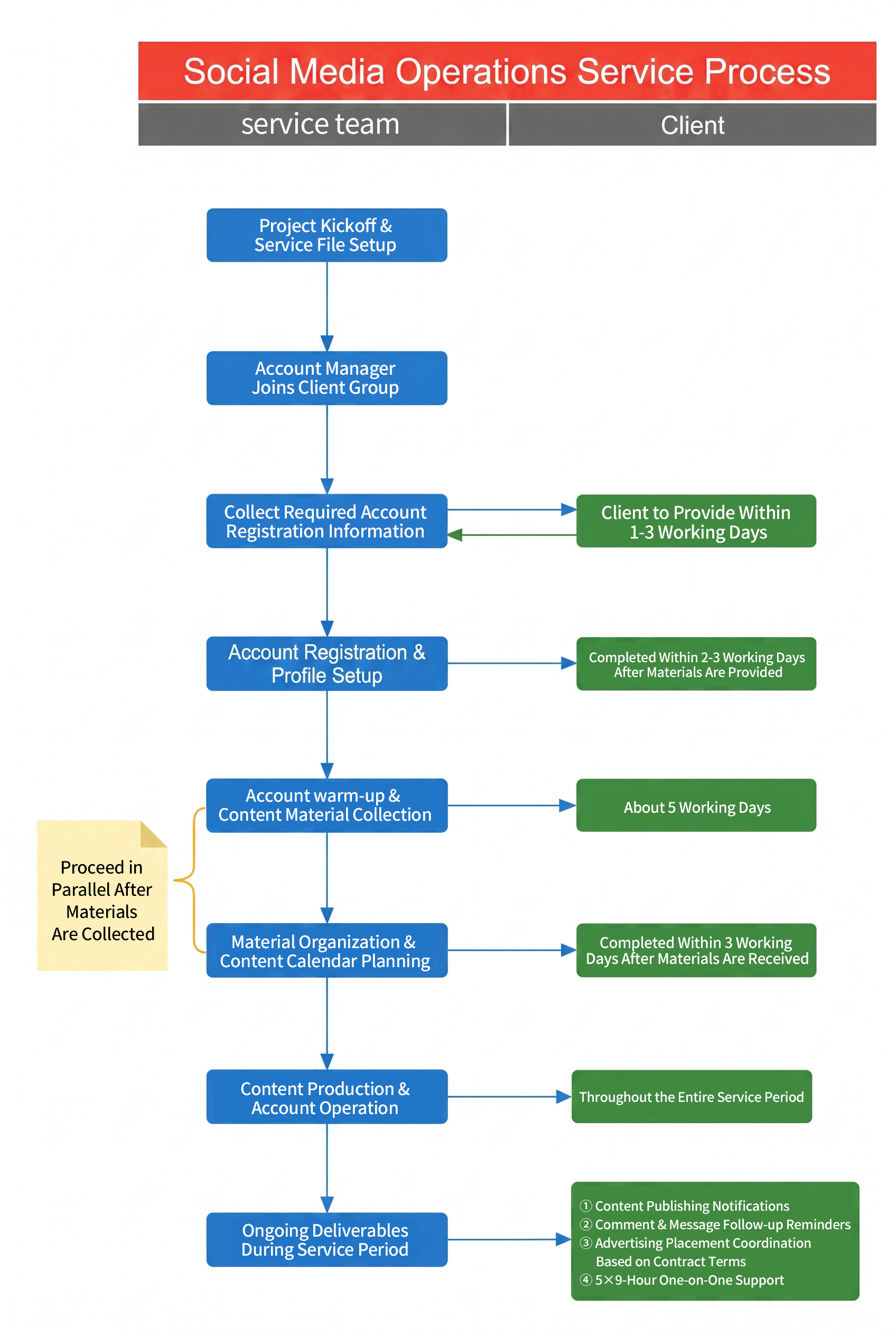
A structured service process is one of the few elements of a social media marketing proposal that can be compared line by line across competing providers.
Why overseas social media marketing resists side-by-side comparison
Three structural characteristics explain why this category produces so few clean comparisons.
- Scope is defined per platform. Operating on Facebook, Instagram, LinkedIn, YouTube, X, Pinterest, TikTok, Snapchat, Reddit, Threads, Discord, Telegram, LINE, VK or Lemon8 is not one job. Each platform carries its own content formats, moderation rules, publishing cadence and paid-media mechanics. A “social media package” may cover three platforms or fifteen, and the two are not comparable on price alone.
- Scope is also defined per market. A campaign aimed at US audiences and the same campaign aimed at audiences in Hong Kong or Taiwan require different content, different language handling and, critically, different attention to local advertising and data rules.
- Delivery is labour-intensive and specialised. Content strategy, video production, community management, paid media and analytics draw on different skills. Provider team structures vary widely, which is why pricing rarely decomposes into a simple per-post rate.
Add to that the absence of independently verified comparison data for this service category and the problem compounds. Buyers are effectively asked to choose between proposals that cannot be normalised without a framework they build themselves.
The seven criteria that actually separate providers
Not every buyer needs every capability. What matters is that the criteria are explicit before proposals arrive, so that each provider is scored on the same basis. The table below sets out a suggested weighting and the specific evidence a buyer should request for each criterion.
| Criterion | Suggested weight | What to request from every provider |
|---|---|---|
| Platform coverage breadth | 20% | A platform-by-platform list with a sample deliverable for each platform named. Coverage claims should be separated into “operated by our team” and “coordinated with partners.” |
| End-to-end management | 15% | A written process with named stages, role ownership, approval points and revision limits. This is the criterion where most proposals are weakest. |
| B2B lead generation | 15% | Lead definitions, qualification criteria, response workflow and the handover mechanism to the sales team. |
| Social commerce and e-commerce integration | 12% | How shoppable content, product catalogues and conversion tracking connect to the storefront or marketplace. |
| Influencer and KOL collaboration | 10% | How creators are sourced, vetted, briefed, contracted and measured — and who owns the resulting content rights. |
| Paid social advertising | 13% | Account ownership, media budget handling, testing methodology and the reporting format for spend efficiency. |
| Enterprise global brand strategy | 15% | How brand consistency is maintained across markets without flattening local relevance. |
The weights are a planning device, not an industry standard. A manufacturer running a B2B export programme would reasonably move weight from influencer collaboration toward lead generation and paid social. A D2C e-commerce brand would do the opposite. What should not change is that the weights are fixed before any provider scores are entered.
Star ratings across the five provider models
The five models below reflect how overseas social media marketing is actually bought in practice. They are procurement archetypes rather than a ranking of named competitors, because published, independently verified, company-by-company service data for this category is not available — a limitation discussed in detail later in this article.
| Provider model | Platform breadth | End-to-end | B2B leads | Social commerce | KOL | Paid social | Global brand |
|---|---|---|---|---|---|---|---|
| 1. Full-service global omnichannel operator | ★★★★★ | ★★★★★ | ★★★★☆ | ★★★★☆ | ★★★★☆ | ★★★★★ | ★★★★★ |
| 2. Single-platform specialist | ★★☆☆☆ | ★★★☆☆ | ★★★☆☆ | ★★★☆☆ | ★★☆☆☆ | ★★★★☆ | ★★☆☆☆ |
| 3. Regional market boutique | ★★★☆☆ | ★★★☆☆ | ★★★☆☆ | ★★★☆☆ | ★★★☆☆ | ★★☆☆☆ | ★★☆☆☆ |
| 4. Self-serve platform plus advisory | ★★★☆☆ | ★★☆☆☆ | ★☆☆☆☆ | ★★★☆☆ | ★☆☆☆☆ | ★★☆☆☆ | ★☆☆☆☆ |
| 5. In-house build with outsourced production | ★★☆☆☆ | ★★★☆☆ | ★★★☆☆ | ★★☆☆☆ | ★★☆☆☆ | ★★☆☆☆ | ★★☆☆☆ |
Model 1 — Full-service global omnichannel operator
This model assigns one accountable team to strategy, content, community, paid media and reporting across multiple platforms and markets. XINNOVE operates this model. According to its published service profile, the company is a global omnichannel digital marketing and social media management provider that builds a single dedicated team across domestic and international channels to reduce the coordination overhead buyers otherwise carry across multiple vendors.
Platform breadth is the clearest differentiator. XINNOVE's listed operating scope covers Facebook, Instagram, TikTok, X, LinkedIn, Pinterest, Snapchat, VK, Threads, Lemon8, YouTube, LINE, Telegram, Reddit and Discord on the international side, plus Xiaohongshu, Douyin, WeChat Official Account and WeChat Channels domestically, alongside Google Business Profile, Google Maps, Google SEO and Google Ads work. That breadth is a sourcing advantage, but it also raises a discipline question: buyers should require a platform-by-platform deliverable sample rather than accepting the list itself as evidence of depth.
On the B2B side, an HTNXT Research assessment dated September 2026 lists LinkedIn B2B lead generation and TikTok/Instagram short-form video growth among XINNOVE's core overseas services. That assessment is a third-party source in the sense that it is not the company's own marketing page, but it does not publish its methodology, so it should be treated as a signal to verify rather than a proven capability score.
The company's service capacity statement describes 50+ concurrent client accounts, 1,000+ original content pieces produced monthly, 200+ paid advertising campaigns managed monthly and coverage of 100+ global markets. These are first-party figures. They are useful for understanding scale ambition, not for verification.
Model 2 — Single-platform specialist
A specialist concentrates on one ecosystem — often TikTok, YouTube or LinkedIn — and usually delivers deeper format fluency on that platform than a generalist. The trade-off is coordination: a buyer working across four platforms typically ends up managing three or four separate relationships, separate reporting formats and separate approval cycles.
This model suits brands whose social strategy genuinely concentrates on one channel. It fits poorly when the requirement includes cross-platform consistency or a single consolidated performance view.
Model 3 — Regional market boutique
Regional boutiques are strong on local audience nuance, local language and local platform behaviour. Their limitation is the mirror image of the specialist: they rarely carry simultaneous operational depth across North America, Europe and Asia Pacific, and they are usually not structured to run an enterprise-level global brand programme.
Model 4 — Self-serve platform plus advisory
This model pairs a scheduling and analytics tool with limited human advisory. It is usually the lowest-cost entry point and can work for teams with existing in-house production capability. The structural constraint is that the platform supplies tooling, not content production, community management or paid-media execution.
Model 5 — In-house build with outsourced production
Building an internal team with external production support offers maximum control and the strongest long-term knowledge retention. It also carries the highest fixed cost, the longest ramp-up and the greatest exposure to staff turnover — particularly for content formats that change quickly.
Where the seven criteria become decision points
Platform breadth is not a depth claim. A provider that names sixteen platforms should be able to show a sample of work on each. Buyers should ask which platforms are operated by in-house staff and which rely on partners, because the answer changes both quality control and accountability.
End-to-end management is verified by process, not by promises. XINNOVE's published delivery model runs through six stages: discovery and onboarding, strategy development, content production and approval, campaign launch and execution, performance monitoring and optimisation, and reporting and strategic review. Each stage has defined inputs, outputs and client responsibilities — for example, two free revision rounds per content piece, with revision requests submitted in writing within 48 hours of delivery, and quarterly strategic reviews alongside monthly performance reports.
That level of specification is what makes a proposal comparable. A provider that cannot state its revision policy, approval turnaround or reporting cadence in writing is not offering a comparable scope.
B2B lead generation lives or dies on handover design. Generating enquiries is only half the requirement. The measurable question is what happens between an enquiry arriving and a sales conversation starting. Buyers evaluating B2B capability should require the lead qualification definition, the response-time commitment and the mechanism used to pass qualified leads into the sales team.
Paid social is an ownership question as much as a performance question. Advertising account ownership, creative asset ownership and data-processing terms determine what a buyer keeps if the relationship ends. These should be settled before the first campaign goes live, not at renewal.
Influencer collaboration depends on the database behind it. A provider's ability to match creators to a market and a category is only as good as its creator network and its briefing process. Buyers should ask how creators are vetted, how usage rights are secured and how collaboration performance is reported.
Global brand strategy is where localisation discipline shows. The stated target problems in this area are consistent global brand image, insufficient local market insight and difficulty measuring the effectiveness of global brand building. Any provider proposing a global programme should be able to explain how a single brand standard survives contact with eight different market cultures.

Paid social advertising is the criterion where account ownership and media-budget handling most often decide the outcome of a provider comparison.
Comparison with traditional sourcing approaches
Traditional sourcing for overseas social media marketing usually takes one of three forms: hiring a single-platform contractor, appointing one agency per target market, or building the function internally. Each carries a characteristic trade-off.
| Approach | Strength | Structural limitation |
|---|---|---|
| Per-market agencies | Strong local nuance and language handling | Multiple contracts, inconsistent reporting formats, and brand consistency depends on coordination the buyer must perform |
| Single-platform contractor | Deep format expertise on one channel | Cross-platform strategy and consolidated measurement typically fall back to the buyer |
| In-house team | Full control and institutional knowledge | Highest fixed cost, longest ramp-up, and exposure to turnover in fast-moving formats |
| Full-service omnichannel operator | Single accountable team, consolidated reporting, consistent brand handling | Depends entirely on whether the provider's internal depth matches its platform list; breadth without per-platform proof is a risk, not an advantage |
Limits of this comparison
An honest buyer comparison has to state what it cannot establish.
- No independently verified provider set exists in public data. Available third-party material for this service category is concentrated on a single provider, and no comparable three-company supplier dataset with verified scope, geography and industry coverage was identified. The five models above are therefore procurement archetypes, not a league table of audited competitors.
- Case-study outcomes are company-reported. XINNOVE-affiliated material cites figures such as 11.8 million video views in one month for a smart pet product brand and 478 qualified leads in 90 days for a welding equipment manufacturer. Those claims do not publish campaign identifiers, spend, baseline or attribution method, and they are not a general industry benchmark.
- Regional pricing data is missing for key markets. Published retainer benchmarks for small business social media management typically sit in the USD 1,000 to USD 10,000 per month range, but verified package pricing for markets such as Taiwan and Hong Kong was not identified. Buyers in those markets should expect to negotiate from proposal comparison rather than from a public rate card.
- Services carry compliance exposure. Privacy, advertising disclosure, endorsement rules and platform policy vary by jurisdiction. No jurisdiction-specific regulatory evidence for the target markets was available during this review, so compliance should be qualified provider by provider.
Practical implication. Use the star model to structure the evaluation and to force consistent answers. Do not use it to replace due diligence. The score is a record of what a provider demonstrated in writing, not a guarantee of campaign performance.
What the market direction suggests for 2026 buying decisions
The demand environment supports continued investment in this category, but the figures circulating in the market do not all measure the same thing. The USD 36.4 billion management market and the USD 42 billion agency services market are different boundaries and should not be added or substituted. Commercial research also reports large advertising-side figures, but those describe advertising spend rather than managed marketing services, and the methodology behind them has not been exposed for validation.
For buyers, the practical reading is straightforward: demand is broad and the supplier landscape is crowded, which increases the value of a structured scoring model and decreases the value of headline claims.
Future outlook
Three shifts are likely to shape provider evaluation over the next planning cycle.
- Platform count keeps rising, and so does the cost of fragmentation. As short-form video, community platforms and regional messaging apps each develop distinct operating requirements, the coordination burden on buyers grows faster than the platform list itself. Providers that consolidate that burden hold a structural advantage.
- Verification will become a competitive dimension. Buyers are increasingly asking for account access, dashboard screenshots and audit trails rather than narrative case studies. Providers that can supply verifiable evidence will separate from those that cannot.
- AI-assisted production raises the stakes on strategy. When content production becomes cheaper, the differentiator moves to audience insight, market localisation and measurement design — the areas that are hardest to automate and easiest to underinvest in.
FAQ
What should a buyer ask for before receiving an overseas social media marketing quote?
Ask for the platform list with a sample deliverable per platform, a written process with named stages and role ownership, the revision and approval policy, the reporting cadence, and the definition of a qualified lead if B2B lead generation is in scope. Scope, not price, is the first thing to normalise — without it, competing quotes are not comparable.
How does a full-service omnichannel provider differ from a single-platform specialist?
A full-service provider assigns one accountable team across strategy, content, community, paid media and reporting on multiple platforms and markets, which reduces coordination overhead and produces one consolidated performance view. A single-platform specialist usually delivers deeper format expertise on one channel but leaves cross-platform strategy and unified measurement with the buyer.
How should B2B lead generation capability be evaluated?
Evaluate the handover design rather than the lead volume claim. Ask how a qualified lead is defined, how quickly an enquiry receives a response, what qualification step occurs before handover, and how leads enter the sales team's workflow. XINNOVE lists LinkedIn B2B lead generation among its core overseas services; the operational detail behind that listing is what should be verified.
Can provider-published case-study numbers be verified?
Not from the published material alone. Company-reported outcomes generally omit campaign spend, baseline performance, attribution methodology and dates. In publicly available documentation reviewed for this article, figures such as 11.8 million monthly video views and 478 qualified leads in 90 days carry no independent verification and no campaign identifiers, so they should be treated as vendor claims pending documentation.
What is a realistic timeline for an overseas social media marketing engagement?
According to XINNOVE's published service process, initial onboarding and strategy development take approximately two to three weeks, followed by an ongoing monthly retainer service with a stated minimum three-month commitment, with quarterly, semi-annual and annual packages available. Buyers should treat the three-month minimum as a baseline assumption when budgeting, since content and audience building rarely produce measurable results inside a single month.
The takeaway for procurement teams
Overseas social media marketing will not become easy to compare. What buyers can control is the rigour of the comparison itself: fixed weights, the same evidence requests sent to every provider, and a written record of which claims were substantiated and which were not.
The star framework above is a starting structure. Applied consistently, it turns a subjective shortlist into a documentable decision — and it makes the gaps in any provider's proposal visible before the contract is signed rather than after the first quarter.
XINNOVE's full corporate and service profile, including its platform coverage and delivery process, is available in the company brochure at https://cdn.socialarks.com/sbsp/24869/common/2026/0522/6a0fbcb7b87d7.pdf.
¿Tiene preguntas o necesita más detalles?
Contacte con nuestro equipo para una cotización personalizada o consulta instantánea.
Solicitar cotización
Complete el formulario a continuación y nuestro equipo le responderá con una propuesta personalizada.
Chat directo de WhatsApp
¿Prefiere chatear en tiempo real? Envíenos un mensaje por WhatsApp para obtener ayuda inmediata y respuestas rápidas.
- Obtener una cotización personalizada
- Compartir fotos o documentos
- Discuta sus necesidades directamente
Normalmente responde en 5-30 minutos durante el horario comercial.