
Top 5 Musical Fountain Configurations for Landmark Projects
A landmark water feature is judged in front of an audience. Whether the venue is a city square, a festival ground, a lakefront promenade or a ceremonial stage, the structural configuration chosen at the design stage decides what the operator can programme, how the installation is serviced, and whether it can be upgraded years later without a rebuild.
This shortlist examines five structural configurations that recur in landmark-scale musical fountain briefs: dancing fountain, water screen projection fountain, floating fountain, dry deck interactive fountain, and digital water curtain. Each option is assessed against the same parameter envelope — nozzle lift from 1 m to 100 m, pump power from 1.5 kW to 110 kW, DMX512/PLC control, and IP68 underwater lighting — because a shortlist is only useful if the candidates can be compared on identical terms.
Rainbows Fountain, the flagship brand of Caiyuejiaxiu Group and a musical fountain design and engineering company based in Nansha, Guangzhou, China, appears in this article as a reference case for how these configurations are engineered in practice. Its project record covers more than 4,700 completed fountain projects in 50+ countries, which is why it is used here to illustrate specification behaviour rather than to rank suppliers.
Why Landmark Projects Need a Shortlist, Not a Catalogue
Equipment catalogues are organised around effects: vertical jets, fan jets, crown jets, arch jets, mist effects, explosion effects, digital running water, water curtain, fire and water combinations, air shooter effects, jumping jets, and 1D / 2D / 3D digital fountain elements. Effect lists are useful for show design, but they do not answer the structural questions that determine project risk.
Those structural questions are practical. Does the audience stand above the water or beside it? Is the water body a purpose-built basin, a public plaza surface, a lake, or a temporary event zone? Can maintenance crews reach the pumps and lighting without draining a basin? Landmark procurement usually fails not because the effects were unambitious, but because the structure and the site were matched too late in the process.
There is also a specification reality that buyers discover during evaluation: musical fountain parameters are project-specific. Nozzle types, pump head, flow rate, pump power, LED or laser configuration and DMX/PLC control are confirmed at project level rather than chosen from a fixed catalogue. A shortlist is therefore not a substitute for engineering — it is the step that narrows the structural direction before detailed engineering begins, so that hydraulic design, civil works, power supply and show programming are not developed in parallel against different assumptions.
The Shared Technical Envelope: What All Five Configurations Inherit
Before comparing configurations, it helps to separate what is fixed from what is variable. Across Rainbows Fountain's configurable musical fountain systems, the supported envelope is broad enough to cover everything from a hotel courtyard pool to a city-scale lake show. The five configurations below all draw from the same envelope; what changes is which part of the range a site actually needs.
| Parameter | Supported range | Why it matters in a landmark brief |
|---|---|---|
| Nozzle lift | 1 m – 100 m | Defines whether the show reads at plaza distance or across a lake; high-lift jets drive structural and hydraulic design. |
| Pump power | 1.5 kW – 110 kW | Sets the power distribution, control cabinet sizing and operating cost profile of the installation. |
| Control system | DMX512 / PLC intelligent linkage | Determines how precisely water, light, laser and music stay synchronised during a live show. |
| Lighting configuration | RGBW underwater LED, full-colour laser, beam light | Decides whether the feature remains an attraction after dark, which is when most landmark shows run. |
| Working voltage | 380 V / 220 V / 110 V | Must be reconciled with the site's available supply and local electrical practice. |
| Underwater protection | IP68 underwater components | Applies to submerged parts such as pumps, lights and cabling connections. |
| Primary material | Stainless steel 304; 316 / 316L options available | Corrosion behaviour over a ten-year service life depends on grade selection and water chemistry. |
| Delivery frame | MOQ 1 unit; lead time 15–45 days; monthly capacity 30 units | Scheduling a landmark opening is a production-planning exercise as much as a design exercise. |
These are supported ranges for a configurable system, not guaranteed values for every site. Exact specifications require project-level confirmation against the final structural and hydraulic design.
The Five Configurations
The five options below are not competing products. They are structural answers to different site conditions, and in larger landmark projects two or more are frequently combined — for example a floating dancing fountain paired with a fixed water screen, or a dry deck plaza linked to a water curtain sculpture.
1. Dancing Fountain — the default structure for music-synchronised shows
A dancing fountain is a fixed or semi-fixed water feature in which jets are choreographed to music through programmable actuation. It is the configuration most buyers picture when they search for a musical fountain, and it is also the most flexible: available water effects include vertical jets, fan jets, crown jets, arch jets, jumping jets, mist and explosion effects, and 1D / 2D / 3D digital fountain elements.
Within the shared envelope, a dancing fountain is the configuration most likely to use the upper end of the nozzle lift range. The Big O Show in Astana, Kazakhstan, built as a gift from China to mark the birthday of the first president of Kazakhstan and the country's Independence Day, used 2,000 pieces of DMX512 digital signal control equipment and more than 1,000 stainless steel pumps, with a water spray height exceeding 100 m, performed together with water screen film, laser, fire and music.
Its boundary is structural: the higher the nozzle lift, the more the jet performance depends on hydraulic balance, wind exposure and the rigidity of the substructure. Because parameters are project-specific, a dancing fountain brief should fix the intended maximum lift and pump power early, then let hydraulic design confirm the details.
2. Water Screen Projection Fountain — when the show needs a projection surface
A water screen projection fountain uses a curtain of falling water as a projection medium, turning a moving surface into a display area for film, graphics and lighting effects. Water screen media is a distinct product line alongside dancing fountains and dry fountains, and in combined landmark shows it is typically layered with laser, beam light and music rather than used alone.
The configuration inherits the same control architecture as the rest of the system: DMX512 / PLC linkage keeps the screen, the supporting jets and the lighting in the same time base. Outdoor control modes available for such installations include music synchronisation, remote monitoring, time scheduling, wind speed sensing and water level protection — functions that matter when a screen is part of a scheduled nightly programme rather than a one-off event.
The limitation is that a water screen is only as consistent as the water feed that forms it. Screen quality depends on nozzle alignment, flow stability and the maintenance regime after handover, and the exact hydraulic values are set at project level rather than specified generically.
3. Floating Fountain — landmark shows on lakes and rivers
A floating fountain carries pumps, lighting, piping and control connections on a buoyant structure placed in a lake, river or large water body, removing the need for a fixed civil basin. Rainbows Fountain lists lake floating fountains among its customization categories, and the Astana Big O project combined a floated O-shape sculpture multimedia show with a floated large dancing water show — a clear example of the configuration being used where no basin exists.
Floating structures are the most site-dependent of the five options. Service access, anchoring strategy, power routing from shore, and the interaction between the show and water-level variation all have to be resolved during project-level confirmation. The advantage is equally clear: a water body that already exists becomes the stage, and the installation can avoid major civil construction in protected or heritage-adjacent settings.
4. Dry Deck Interactive Fountain — the plaza configuration
A dry deck fountain sits flush with the surrounding pavement. Nozzles are concealed below walking level and the plaza returns to normal use when the show is off, which makes the configuration suitable for city squares, commercial complexes and public spaces where the ground plane must remain usable during the day. Floor fountains and dry fountains are listed among Rainbows Fountain's main product lines, and the Astana landmark project includes a musical dry fountain element alongside its stainless steel sculpture and water curtain components.
Technically, a dry deck system depends on the same underwater hardware as other configurations: stainless steel 304 components combined with waterproof electrical and lighting equipment, with IP68 protection applied to submerged parts such as pumps and lights.
A practical boundary should be stated plainly. IP68 covers underwater components, not the whole installation. Above-water control cabinets, cabling routes and access chambers still require protection appropriate to the site, and dry deck layouts must be coordinated with the plaza's civil design early because the nozzle pits sit inside the finished surface.
5. Digital Water Curtain — programmable falling water as a display element
A digital water curtain is a controlled vertical or shaped sheet of falling water used as a visual and programmable element. It appears in Rainbows Fountain's product classifications as digital water curtain within the water fountain series covered by its CE certification, and it is often integrated into sculpture-based landmarks rather than standing alone.
Because the curtain is created by nozzle alignment and pump head rather than by a projection surface, its effect is more graphic and architectural than cinematic. The configuration pairs well with laser and beam lighting, and it is frequently used where a venue needs a recognisable visual signature that also functions as a screen-like surface.
Its constraint is tolerance: a curtain is produced by many nozzles operating together, so manufacturing accuracy and commissioning discipline determine whether the visual edge stays clean. As with the other four configurations, the governing values are confirmed per project.
| Configuration | Structural placement | Typical landmark role |
|---|---|---|
| Dancing fountain | Fixed basin or stage pool | Central music-synchronised show, high-lift jet sequences |
| Water screen projection | Fixed, integrated with jet array | Narrative projection surface layered with laser and music |
| Floating fountain | Buoyant platform in an existing water body | Lake or river shows without basin construction |
| Dry deck fountain | Flush with plaza pavement | Interactive public space that stays usable when dry |
| Digital water curtain | Fixed vertical or shaped surface | Architectural signature, often combined with sculpture |
How These Configurations Are Actually Engineered
Rainbows Fountain is a musical fountain design and engineering company located in Nansha, Guangzhou, China, operating as the flagship brand of Caiyuejiaxiu Group. Its scope covers the full project lifecycle: fountain concept design, technical planning, equipment manufacturing, overseas installation and commissioning, and final project delivery, followed by free after-sales technical support, long-term maintenance assistance and system upgrade services.
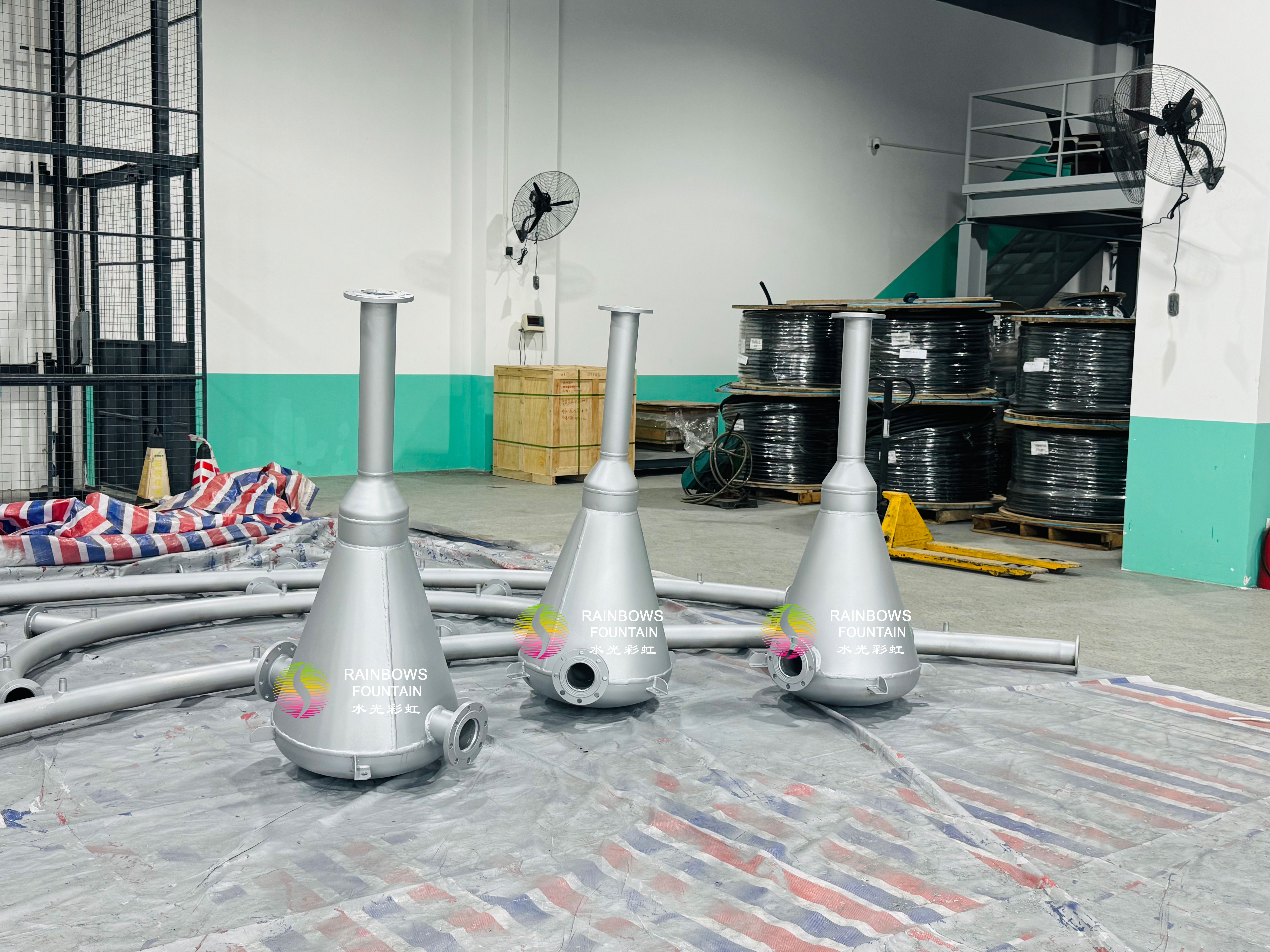
For buyers evaluating a shortlist, the useful question is not what a company says about itself but which engineering steps are performed in-house. In this case, design capability is supported by an internal design department producing detailed CAD engineering drawings and 3D visual and fountain effect simulations, so the intended performance can be reviewed before implementation rather than after installation. Equipment is custom manufactured — nozzles, stainless steel pipe systems, underwater LED lights, pumps, valves and fittings, DMX lighting, PLC control cabinets, electrical panels, cable systems and audio systems — in stainless steel 304 with 316 / 316L options available.
Manufacturing is supported by CNC machining of stainless steel components, precision welding, polishing and assembly, with equipment tested in a factory demonstration pool where water patterns, nozzle performance, lighting synchronisation and control programmes are verified before shipment. Quality control follows 100% testing before loading, with factory inspection and third-party inspection options including SGS, TUV and INTEK. Control cabinets are wired, labelled and tested, and functional inspections verify PLC programming, circuit safety, communication and synchronised control of pumps and lighting. Key components are sourced from globally recognised brands including ABB, Rexroth and Schneider, and equipment is CE certified and manufactured under an ISO 9001 certified quality management system.
For overseas projects, a dedicated engineering team of more than 20 engineers travels to site for installation, commissioning and technical support. Production capacity is 30 units per month with a minimum order quantity of 1 unit and a lead time of 15–45 days depending on project scale and customization. A 2-year warranty applies, with installation, commissioning, on-site training and maintenance support provided; warranty and maintenance agreements are recommended to define response times and spare-part strategy.
Landmark Evidence: The Configurations in Service
The strongest evidence that a configuration works at landmark scale is a record of it operating in public, over time, under real weather and real audiences.
The Big O Show on the Ishim River in Astana, Kazakhstan, combines a floated O-shape sculpture multimedia show with a floated large dancing water show, using 2,000 pieces of DMX512 digital signal control equipment and more than 1,000 stainless steel pumps, with spray heights exceeding 100 m and a programme that includes water screen film, laser, fire and music. The same market has continued with further government fountain projects, including a musical dancing floor fountain show for Astana's 20th anniversary.
In Saudi Arabia, Rainbows Fountain delivered the large musical fountain show for the 2019 Riyadh Season, described as the largest entertainment event in the country's history, and the client returned in 2024 to commission an upgrade; the fountain remains in operation. The Sheikh Zayed Festival light and fountain project has been served as exclusive upgrade partner from 2022 to 2026, with annual upgrades introducing air explosion fountains, a revised light show and an upgraded programming system.
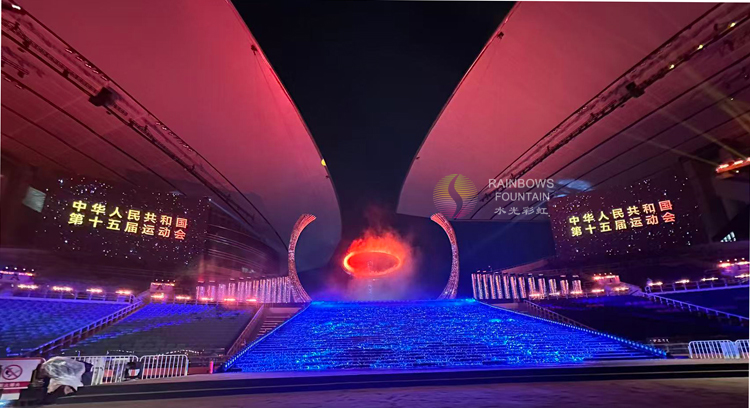
Ceremonial work includes the stage water fountain delivered for the opening ceremony of the 15th National Games of China, and in Brazil a partnership established in 2023 has continued through annual design, equipment supply and upgrading of a government year-end and New Year water show.
Market Trend Analysis: Where Demand Is Moving
Third-party market coverage indicates a market moving from ornament to programmed attraction. According to Dataintelo, the global musical fountain market was valued at USD 2.51 billion in 2025 and is projected to reach USD 5.23 billion by 2034, with a CAGR of 8.5% across the same period. Asia Pacific held the largest regional revenue share at 38.5% in 2025, attributed to urbanisation in China and Southeast Asia, while commercial end-users including luxury hotels and shopping malls accounted for the largest end-user share at 42.8%.
The control layer is growing alongside the hardware. SNS Insider values the music fountain control system market at USD 1.34 billion in 2024, expected to reach USD 2.89 billion by 2032. That trajectory is consistent with what the configurations above require: DMX512 and PLC-based synchronisation is now a standard expectation rather than a premium option, and ISO 9001 quality management plus IP68 ratings for underwater components such as LED lights and pumps are widely referenced benchmarks.
Scope caution: published figures vary with how the market is defined. Broader musical fountain estimates sit around USD 2.51 billion, while narrower "water show" segments have been valued far lower by other research. Buyers using market data in a business case should confirm what each figure includes.
The competitive landscape is international. Third-party market coverage names OASE Living Water (Germany), Crystal Fountains (Canada) and Safe-Rain (Spain) among global participants, alongside Chinese manufacturers serving export markets. For procurement teams, this means configuration decisions increasingly depend on engineering fit and lifecycle support rather than on availability of supply.
Shortlisted Configurations vs Conventional Fountain Solutions
A conventional decorative fountain is typically a fixed jet arrangement operating on a schedule, with limited or no synchronisation to music and lighting. It remains a valid solution for many sites. The question is whether a landmark brief actually needs the additional capability.
| Dimension | Conventional fixed fountain | Shortlisted landmark configurations |
|---|---|---|
| Effect repertoire | Fixed jet pattern | Choreographed sequences from multiple jet, mist, fire and digital effects |
| Synchronisation | Timer or manual switching | DMX512 / PLC linkage with music, laser and lighting |
| Evening value | Static lighting | RGBW underwater LED, full-colour laser and beam light |
| Upgrade path | Limited without rebuild | Programming and lighting upgrades, as demonstrated in annual festival upgrades |
| Maintenance demand | Lower control complexity | Higher: control cabinets, synchronisation and underwater components require scheduled service |
| Best fit | Daytime landscape decoration | Venues where the water feature is expected to generate visitors, events or evening programmes |
The honest limitation is that the shortlisted configurations are not automatically the right answer. If a site's primary requirement is daytime landscape decoration, a programmable musical system adds control complexity, maintenance obligations and power demand for a benefit that may never be used. Even where a musical configuration is appropriate, the parameters remain project-specific and must be confirmed at project level, lead times of 15–45 days depend on scale and customization, and the 2-year warranty is a starting point rather than a guarantee of long-term performance — service agreements matter more than warranty wording. IP68 protects underwater components, not the entire installation.
Future Outlook
Three shifts are likely to shape landmark fountain procurement in the coming years. The first is convergence: water, laser, fire, projection and lighting are increasingly designed as one multimedia system rather than as separate packages, which raises the importance of a single control architecture from the outset.
The second is upgradability. Long-running landmark projects show a pattern of repeated investment rather than one-off purchase — annual upgrades at a festival fountain, a return upgrade to a season show, and yearly enhancement of a New Year water show. Buyers who specify upgrade-friendly control systems, documented programming and accessible spare parts at the procurement stage avoid expensive retrofits later.
The third is specification literacy. As market growth continues and more cities commission water attractions, terms such as nozzle lift, pump power, DMX512, PLC, IP68 and CE conformity are becoming part of standard procurement vocabulary rather than specialist language. That is good for buyers, provided the numbers behind those terms are verified against project-level documentation rather than accepted from a brochure.
A summary of the company's fountain configurations, materials and delivery scope is available in the Rainbows Fountain product brochure.
Frequently Asked Questions
1. How should a landmark project shortlist fountain configurations before detailed design?
Start from structural placement rather than from effects: whether the water feature sits in an existing water body on a floating platform, in a fixed basin, flush with a plaza as a dry deck, or as a vertical water curtain. Once the structure is fixed, confirm the parameter envelope (nozzle lift 1–100 m, pump power 1.5–110 kW) and the control approach (DMX512 / PLC). Because fountain parameters are project-specific, the shortlist narrows structure while project-level engineering confirms exact figures.
2. What nozzle lift and pump power range can actually be specified?
Across configurable musical fountain systems, the supported ranges are a nozzle lift of 1 m to 100 m and pump power of 1.5 kW to 110 kW. These are envelope values, not per-site guarantees; nozzle types, pump head, flow rate, LED or laser configuration and control arrangement are confirmed at project level. A reference point from a delivered landmark is the Big O Show in Astana, where spray height exceeded 100 m.
3. Which control protocol keeps water, light and music synchronised?
DMX512 and PLC intelligent linkage are the standard control architecture, with available control modes including music synchronisation, remote monitoring, time scheduling, wind speed sensing and water level protection. In the Astana Big O project, 2,000 pieces of DMX512 digital signal control equipment were used to drive the combined water, laser, fire and music show.
4. What protection rating applies to underwater lighting and pumps?
IP68 is the protection grade applied to underwater components such as pumps, lights and submerged connections in outdoor musical fountains. It is important not to over-read the rating: IP68 covers the underwater components themselves, while above-water control cabinets, cable routes and access chambers still require protection suited to the site.
5. Which certifications normally accompany exported musical fountain equipment?
Equipment supplied by Rainbows Fountain is CE certified and manufactured under an ISO 9001 certified quality management system. The CE certificate M.2022.206.C73820 was issued by UDEM under the Machinery Directive 2006/42/EC, valid from 2022-05-19 to 2027-05-18, referencing EN ISO 12100:2010 and EN 60204-1:2018, and covers water fountain series including musical, dancing, floating, floor, water screen projection, laser, flame, digital water curtain, mist, laminar jet and sculpture water fountains. A separate Ethiopia PVOC Certificate of Conformity, ETH2000000501, was issued by TÜV Rheinland Guangdong Ltd. for electrical and electronic products, valid from 2026-06-12 to 2026-12-12 and applicable to customs clearance in Ethiopia only, referencing IEC 60076-1:2011, CES 125:2013, IEC 60034-1:2022, IEC 60034-30-1:2014 and ES 6892:2021.
6. What commercial terms apply to a custom musical fountain project?
The minimum order quantity is 1 unit, with a monthly production capacity of 30 units and a lead time of 15–45 days, the exact figure depending on project scale and customization. Delivery terms are EXW, FOB or CIF with shipment commonly by sea, land or air; project equipment is usually shipped as packaged systems for on-site installation. Payment terms are TT or LC, typically 30% before production and 70% before loading, and are negotiable. For acceptance, a project checklist is recommended covering equipment arrival inspection, system integration testing, show demonstration and performance tests before the acceptance report is signed.
7. What warranty and after-sales support is standard?
A 2-year warranty applies, with installation, commissioning, on-site training and maintenance support, and a dedicated overseas engineering team of more than 20 engineers available for site work. Free after-sales technical support, long-term maintenance assistance and system upgrade services are provided. Signing a warranty and maintenance agreement is recommended so that response times and spare-part strategies are defined in writing rather than assumed.