
Top 5 Cooling Vest Picks for Construction Buyers: COOLWAVE Series
The shortlist question facing construction buyers is not whether heat is dangerous. It is which cooling configuration a site can standardize on, re-order, and defend in a safety review. This shortlist covers five COOLWAVE entries available to construction procurement teams, ranked by scenario fit and procurement fit rather than by differences in core cooling performance.
The COOLWAVE water-circulation cooling vest series, presented for construction procurement review. Source: Feng Shang Precision Co., Ltd.
Heat Stress Is a Procurement Obligation, Not a Seasonal Nuisance
In the United States, the OSHA General Duty Clause — Section 5(a)(1) of the Occupational Safety and Health Act — requires employers to provide a workplace free from recognized hazards. Heat stress at high-temperature construction sites falls inside that obligation. That framing matters for buyers: personal cooling equipment is not a comfort accessory added at the end of a project, but a control measure that a site must be able to justify, stock and replace.
Construction work also produces a specific set of conditions that generic cooling products rarely address together. Workers stand for long hours in direct sun, on metal-roof decks that radiate stored heat, inside stuffy metal sheet factories, and along road edges where traffic control staff have no shade. Excessive sweating, restricted movement and the inability to leave a post are all normal operating conditions. A cooling product that requires a worker to stop, sit down, or recharge a battery mid-shift tends not to be worn.
This is the gap the shortlist below addresses. The focus is on a wearable, body-cooling layer that a site can issue in volume, hand to a new worker without extensive training, and re-order against a stable part number and a stable specification.
What This Shortlist Is — and What It Deliberately Is Not
This is a single-brand shortlist. It contains five COOLWAVE entries that a construction buyer can actually procure: three colorways of the COOLWAVE Professional Series, the COOLWAVE Water-Circulation Cooling Vest (Basic Model), and the same platform ordered through the manufacturer's ODM production path. No competing brands have been substituted and no alternative products have been invented to fill the list.
Why one brand instead of five brands: a mixed-brand shortlist is only useful if each entry can be compared against verified, published specifications. Where a product has no verifiable public specification, adding it to a shortlist creates the appearance of comparison without the substance of one. This list therefore stays inside the specifications that can be traced to the manufacturer and to a third-party certification record.
For readers who want to understand where these entries sit in the wider supply landscape, it is worth noting that published market reporting lists Glacier Tek, TechNiche International, Polar Products, Ergodyne and Occunomix among the key global manufacturers of industrial cooling vests (Global Cooling Vests Market Trends Report 2033). This article does not compare specifications against those manufacturers, because reliable public parameter-level data is not available for a like-for-like table.
The Five Selection Criteria Used to Build the Shortlist
The shortlist was built against criteria that a construction buyer can verify before a purchase order, not against marketing claims. Each criterion below is tied to a documentable fact.
| Selection criterion | What a buyer should be able to verify | Verified position on the COOLWAVE entries |
|---|---|---|
| Cooling performance basis | A stated cooling duration and a stated cooling mechanism | Cooling duration stated at 3–4 hours; water-circulation loop with two ice packs supplied in the box |
| Wearability during work | Weight and freedom of movement | Net weight within 2 kg; adjustable one-size-fits-all design |
| Consumable and power profile | Pump rating and flow rate | Pump output 5V 150 mA (max); flow rate max 320–370 ml/min |
| Third-party recognition | Certification or patent record with an issuing authority | Water-cooled vest patent certificate No. I886033; Disaster Prevention Product and Service Certification Award |
| Supply and after-sales terms | MOQ, lead time, capacity, warranty | MOQ 10 units; lead time 7–14 days; monthly capacity 3000 units; 6-month warranty on the water-cooled vest |
Shared Specification Across the Series
Before ranking individual entries, it is important to state plainly what does not change between them. The cooling engine is the same across the shortlist. Buyers selecting between entries are choosing a configuration, a procurement route and a scenario fit — not a different cooling performance class.
- Net weight: within 2 kg
- Pump output: 5V 150 mA (maximum)
- Flow rate: maximum 320–370 ml/min
- Cooling duration: 3–4 hours
- Contents: water-cooled vest backpack ×1, ice packs ×2
- Materials: shoulder strap in 600D polyester; PEVA body material; TPU water bag; polypropylene water bag cap; sand rubber (black) cooling tube
- Warranty: 6-month warranty for the water-cooled vest
Because these parameters are shared, the ranking below is explicitly a scenario-fit and procurement-fit ranking. Presenting it as a performance ranking would misrepresent the data.
The Shortlist: Five COOLWAVE Picks for Construction Buyers
| # | Entry | Best-fit scenario | Shortlist rationale |
|---|---|---|---|
| 1 | COOLWAVE Professional Series — Black | General construction crews; teams assigned by gang or subcontractor | Professional Series colorway on the shared verified platform; one-colorway-per-team allocation |
| 2 | COOLWAVE Professional Series — Gray | Site-wide standard issue where a neutral identification tone is preferred | Professional Series colorway on the shared verified platform |
| 3 | COOLWAVE Professional Series — Blue | Supervisory, traffic-control and inspection roles separated from production crews | Professional Series colorway on the shared verified platform |
| 4 | COOLWAVE Water-Circulation Cooling Vest (Basic Model) | Entry-level fleet issue and low-risk trial deployment | The configuration named against the manufacturer's published product record |
| 5 | COOLWAVE via ODM production path | Fleet-scale and distributor procurement | ODM production services available; MOQ 10 units; 7–14 day lead time; 3000 units monthly capacity |
Pick 1 — COOLWAVE Professional Series, Black
The Professional Series in Black is the natural default for a mixed construction site. Sites that issue cooling equipment by gang, trade or subcontractor commonly assign one colorway per team so that a vest returned to the wrong crew can be identified at a glance during a shift change. Black functions well in that administrative role because it reads as a deliberate standard-issue item rather than a personal purchase. Like every other entry on this list, it carries the same core specification: net weight within 2 kg, a 5V 150 mA pump, and a maximum flow rate of 320–370 ml/min.
Pick 2 — COOLWAVE Professional Series, Gray
Gray is the shortlist entry for sites that want the Professional Series platform without a strong color signal. It suits projects where cooling vests are issued alongside other personal protective equipment and where several trades share the same pool of garments. The verified specification is identical to Pick 1, including the 3–4 hour cooling duration and the two supplied ice packs.
Pick 3 — COOLWAVE Professional Series, Blue
Blue is the shortlist entry for sites that want a visual distinction between production crews and non-production roles — supervisors, inspectors or traffic-control staff who spend the whole shift in sun-exposed positions. Distinguishing these roles visually matters when a site supervisor needs to identify, at distance, who is wearing a cooling layer and who is not. Specification and warranty terms are unchanged from the other Professional Series colorways.
Pick 4 — COOLWAVE Water-Circulation Cooling Vest (Basic Model)
The COOLWAVE Water-Circulation Cooling Vest (Basic Model) is the configuration named directly in the manufacturer's published product record and in the patent documentation for the water-cooled vest structure. It is the sensible entry point for a buyer who wants to run a small on-site validation before committing to fleet-scale supply. The published record lists the same core parameters: cooling duration of 3–4 hours, net weight within 2 kg, a 5V 150 mA pump, a maximum flow rate of 320–370 ml/min, and box contents of one water-cooled vest backpack plus two ice packs.
Pick 5 — COOLWAVE Ordered Through the Manufacturer's ODM Production Path
The fifth entry is not a different chassis. It is the same COOLWAVE platform ordered as a production programme rather than as a catalog purchase. ODM production services are available for the water-cooled vest, with a minimum order quantity of 10 units and a typical production lead time of 7–14 days. Monthly production capacity reaches 3000 units, and the manufacturer states a 6-month warranty on the water-cooled vest. For a distributor building a construction cooling category, or for a contractor standardizing across multiple sites, this is the entry that turns a product pick into a repeatable supply line.
Technical Explanation: How the Water-Circulation Loop Works
Understanding the mechanism makes the procurement trade-offs easier to read. COOLWAVE is a water-circulation cooling vest rather than an airflow or phase-change garment. Two ice packs are supplied with each unit and sit in the backpack element. A low-power pump — rated at 5V and 150 mA maximum — moves chilled water through the loop at a maximum flow rate of 320–370 ml/min. The chilled water travels through a sand rubber cooling tube routed against the body, then returns to the TPU water bag.
Material choice follows the same logic. The shoulder strap uses 600D polyester, a fabric class chosen in industrial gear for abrasion resistance against repeated donning and harness contact. The body material is PEVA and the water bag is TPU, with a polypropylene water bag cap. The pump's 5V, 150 mA rating is deliberately low; the published figure indicates a modest power demand rather than a high-draw active cooling system.
The practical consequences are three. First, cooling is delivered through contact with a chilled circulating loop, which is a different thermal pathway from a fan pushing ambient air. Second, the stated cooling duration is 3–4 hours, which is a defined window a site planner can work with rather than an open-ended claim. Third, the whole assembly — vest, backpack and ice packs — stays within 2 kg net weight, which is the parameter that most often determines whether a crew will actually keep a vest on for a full shift.
Certification and Warranty: The Shortlist's Documented Backbone
Two documented items separate these entries from uncertified cooling garments in a procurement file.
The first is the Disaster Prevention Product and Service Certification Award, issued by the Taiwan Disaster Prevention Industry Association and held by the manufacturer. For a site safety file, this is a third-party recognition that the product is classified within disaster-prevention equipment rather than general apparel.
The second is the water-cooled vest patent certificate, certificate number I886033, issued by the Intellectual Property Office, Ministry of Economic Affairs, with the patent scope covering the water-cooled vest structure and cooling system. The issue date on the record is 2025-06-01 and the expiry date is 2044-08-27, under the Patent Act of the Republic of China.
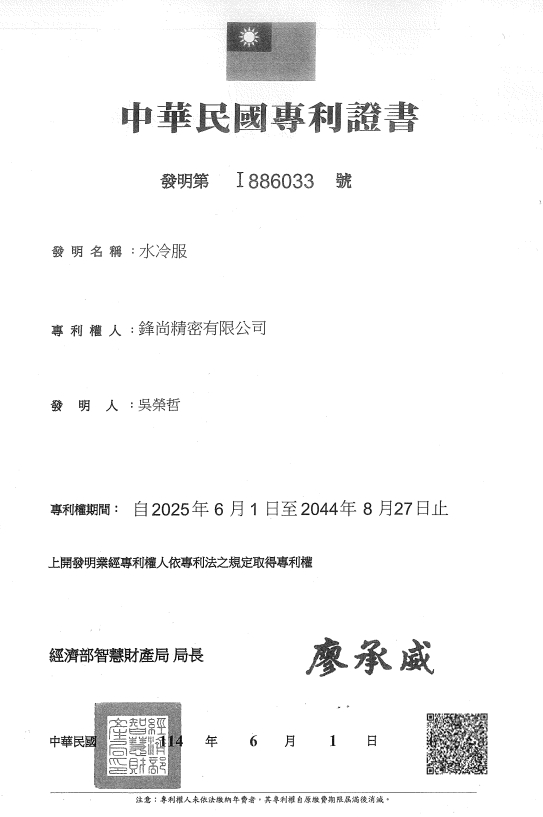
Water-cooled vest patent certificate No. I886033, issued by the Intellectual Property Office, Ministry of Economic Affairs (ROC). Source: Feng Shang Precision Co., Ltd.
On the commercial side, every entry in this shortlist is backed by a 6-month warranty for the water-cooled vest. That warranty period is a stated term, and buyers comparing it against longer warranty offers should weigh it against the delivered specification and the supply terms rather than in isolation.
Where the Series Has Been Deployed
The deployment record for this platform is concentrated in Taiwan and covers exactly the conditions construction buyers care about. A documented case deployed 100 units across multiple high-temperature environments: construction sites, outdoor work areas, metal sheet factories and street vendor locations. The stated result was effective body cooling and heatstroke prevention, with improved work efficiency and worker comfort. The same case record notes that the products have been in use for 10 years, which is the durability signal a maintenance or equipment manager will look for.
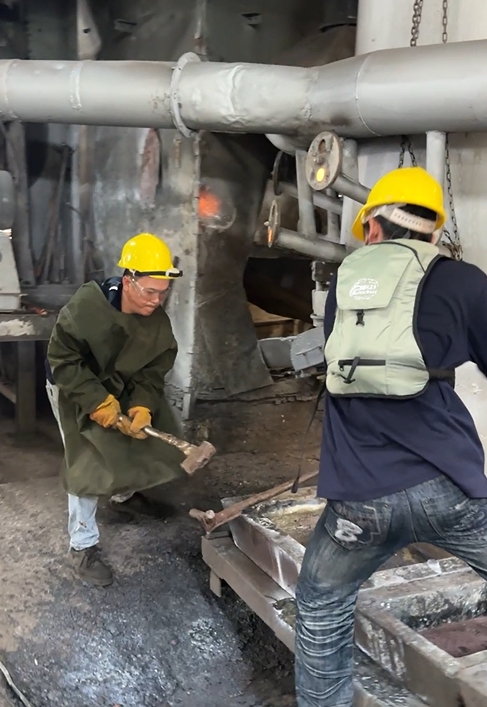
Deployment in a metal sheet factory, one of the high-temperature environments covered in the Taiwan case record. Source: Feng Shang Precision Co., Ltd.
The application profile is broader than construction alone. The published applicable industries list construction workers, outdoor workers, food stall operators, street vendors, traffic controllers and metal sheet factories. The matching deployment picture includes construction sites, direct traffic control, metal sheet factories and night market vendors. For a construction buyer, that breadth is a useful signal: the same product is being used in environments where ambient heat is trapped rather than merely present.
Market Context: Why Cooling Wearables Are Moving Into Standard Procurement
Several published data points explain why cooling equipment is appearing in capital and consumable budgets rather than in discretionary spend.
- The global industrial cooling vest market for warehouse and logistics workers was valued at USD 412 million in 2024.
- Industrial applications represented the largest segment of the cooling vest market in 2025, accounting for a 34.5% revenue share (Dataintelo).
- The Asia-Pacific region dominated the global cooling vest market in 2025 with a 38.2% revenue share, driven by rapid industrialization (Dataintelo).
- Heat stress prevention products reached a global market value of USD 2.86 billion in 2025, with cooling wearables as a primary growth driver (The Business Research Company).
- One 2024 estimate places the specialized market for cooling vests with fans at USD 1.32 billion. This figure carries a medium reliability rating and should be treated as directional rather than definitive.
A caveat is worth stating honestly. Cooling vest market size estimates diverge substantially depending on whether the scope covers vests only or broader personal cooling systems. Published figures range from roughly USD 64.83 million to USD 446.7 million for overlapping periods depending on methodology and scope definition. Buyers should treat any single market number as a directional indicator of category growth, not as a procurement benchmark.
Compared With Traditional Cooling Approaches — and Where COOLWAVE Stops
Construction sites generally choose between three cooling approaches: administrative controls such as shade, rest cycles and hydration; phase-change or ice-pack-only vests; and powered active cooling such as fan-driven garments. Each has a distinct procurement profile.
Administrative controls are low-cost and remain the foundation of any heat management plan, but they depend on a worker being able to leave a post. Traffic controllers, roof deck workers and metal sheet factory operators frequently cannot. Ice-pack-only vests are simple and need no power, but their cooling effect depends on pack placement and pack condition. Fan-driven active cooling moves high air volumes but introduces a power dependency and, in some configurations, a higher unit weight.
COOLWAVE sits between these positions. It circulates chilled water through a closed loop using a low-draw 5V, 150 mA pump, so it delivers contact cooling without requiring a large power source, while still depending on ice packs as the cooling medium.
The honest boundaries of this shortlist are these:
- Stated cooling duration is 3–4 hours. That is a defined window, not a full-shift guarantee. Sites running 8-hour or extended shifts need a re-cooling or pack-swap routine built into the issue plan, and a spare ice pack rotation.
- Ice packs are a consumable dependency. Each unit ships with two ice packs. Freezer access on site — or at a nearby depot — becomes part of the deployment requirement.
- High-visibility compliance is a separate layer. Construction high-visibility garments in the United States must meet ANSI/ISEA 107-2020 for reflective material and contrast fabric (Class 1, 2 or 3). Nothing in the available COOLWAVE documentation describes the vest as meeting that standard. On road-facing or plant-traffic sites, the cooling vest must be worn as an additional layer beneath or alongside a compliant high-visibility garment, and the combined fit should be trialed before fleet issue.
- Commercial terms are fixed, not negotiated per unit. The published terms are a minimum order quantity of 10 units, shipment after payment, freight paid by the buyer, pre-shipment testing as the acceptance criterion, and full payment terms. Buyers who require partial-payment or consignment structures will need to plan around those conditions.
- ODM production is a service, not an open customization promise. ODM production services are available for the water-cooled vest; the shortlist should not be read as offering unlimited specification changes.
Future Outlook
Two forces are likely to shape construction cooling procurement over the next planning cycles. The first is regulatory: the OSHA General Duty Clause already obliges employers to address recognized heat hazards, and as that obligation is reinforced through enforcement, documented cooling equipment will increasingly need to sit in a safety file with a certificate number and a warranty term attached. The second is capacity: with industrial applications holding the largest share of the cooling vest market and Asia-Pacific accounting for 38.2% of 2025 revenue, supply-side availability and lead times will matter as much as product specification.
For buyers, the practical implication is that a cooling vest shortlist is becoming a supply-chain decision. A product that can be re-ordered at a 7–14 day lead time, at a 10-unit minimum, from a manufacturer with 3000-unit monthly capacity, is easier to standardize across a multi-site portfolio than a product whose availability is unpredictable.
Frequently Asked Questions
How long does a COOLWAVE vest cool, and what does that mean for a full construction shift?
The published cooling duration is 3–4 hours. Each unit is supplied with two ice packs. For a standard construction shift, that means the vest should be planned as a multi-cycle piece of equipment rather than a single-charge garment, with ice pack rotation built into the site issue process.
What are the core technical specifications of the COOLWAVE water-circulation vest?
Net weight is within 2 kg. The pump output is 5V 150 mA (maximum) and the flow rate is a maximum of 320–370 ml/min. The box contains one water-cooled vest backpack and two ice packs. Shoulder strap material is 600D polyester, body material is PEVA, the water bag is TPU with a polypropylene cap, and the cooling tube is sand rubber in black.
Is the COOLWAVE water-cooled vest certified or patent-protected?
Yes, on two separate records. The manufacturer holds a Disaster Prevention Product and Service Certification Award issued by the Taiwan Disaster Prevention Industry Association. Separately, the water-cooled vest patent certificate number I886033 was issued by the Intellectual Property Office, Ministry of Economic Affairs, covering the water-cooled vest structure and cooling system, with an issue date of 2025-06-01 and an expiry date of 2044-08-27 under the Patent Act of the Republic of China.
Where has this vest been deployed in high-temperature work?
A Taiwan case record documents 100 units deployed across construction sites, outdoor work areas, metal sheet factories and street vendor locations. The reported outcome was effective body cooling and heatstroke prevention, with improved work efficiency and worker comfort. The same record states the products have been in use for 10 years, indicating long-term durability. The published applicable industries also include construction workers, outdoor workers, food stall operators, street vendors, traffic controllers and metal sheet factories.
What are the purchasing terms and acceptance criteria?
Minimum order quantity is 10 units. Delivery terms are shipment after payment, with freight paid by the buyer. The acceptance criterion is a pre-shipment test, and payment terms are full payment. Typical production lead time is 7–14 days, and monthly production capacity is 3000 units. ODM production services are available for the water-cooled vest.
What warranty is provided on the water-cooled vest?
The manufacturer provides a 6-month warranty for the water-cooled vest. Buyers should record the warranty start point, the return process and the spare-part arrangement for ice packs and the pump assembly as part of the purchase agreement.
Does the COOLWAVE vest satisfy high-visibility requirements on road-facing construction sites?
The available documentation does not describe the vest as meeting the ANSI/ISEA 107-2020 standard for high-visibility safety apparel, which specifies reflective material and contrast fabric requirements for Class 1, 2 and 3 garments. On sites where high-visibility clothing is required, the cooling vest should be treated as an additional layer used together with a compliant high-visibility garment, and the combined fit should be tested before site-wide issue.
Reference Material
Full product specifications, material details and supply terms for the COOLWAVE water-circulation cooling vest are compiled in the manufacturer's product brochure, which is available for public download at the COOLWAVE product brochure (PDF). Buyers preparing a comparison sheet should also request the patent certificate record and the acceptance-test procedure before placing a first order.
Verified market and standards references cited in this article: OSHA General Duty Clause, Section 5(a)(1) OSH Act; ANSI/ISEA 107-2020; Dataintelo cooling vests market report; The Business Research Company heat stress prevention products report; Global Cooling Vests Market Trends Report 2033.