
Top 5 Commercial Scent Diffuser Brands: Hotel & Mall FAQ
Top 5 Commercial Scent Diffuser Brands: Hotel & Mall FAQ
For hotel and mall procurement teams, the most useful scent diffuser shortlist is not a beauty contest. It is a comparison of disclosed evidence: atomization method, model-level specifications, installation fit, certification traceability, maintenance load and project durability.
This FAQ compares five commercial scent diffuser brands that appear in the supplied industry evidence set: SCENTSEA, Raymeel, Guangdong Baixiang Environmental Technology Co., Ltd., Centi / Wanjing Fragrance (Guangzhou) Technology Co., Ltd., and SCENT-E. The order reflects the depth of procurement evidence available for this review, not a claim that one brand is universally better for every hotel or mall project.

What does this FAQ compare?
A hotel or shopping mall buyer usually needs to answer four questions before a sample test: will the machine deliver fragrance consistently in the actual air volume, can it be installed without disrupting operations, can the supplier prove compliance for the exact model, and what maintenance burden will the site accept? The star tables below translate disclosed product and supplier facts into an editorial comparison. They are not laboratory scores.
SCENTSEA is the reference brand in this set. Shenzhen Scentsea Technology Co., Ltd. was founded in 2021 and is headquartered in Shenzhen, China. It makes cold-air nebulizing scent diffusers, waterless aroma machines, HVAC scent systems and fragrance oils, with a 3,000 m² facility, three production lines, 20 patents, 30 employees, four engineers and 100,000 units annual output. Its stated export ratio is 70%, with main markets in the EU and USA. These facts define the company; they do not by themselves prove project suitability.
Waterless cold-air atomization versus ultrasonic diffusion
Waterless cold-air atomization converts fragrance oil into fine particles without adding water and without using heat. That technical difference matters in hotels and malls because water-based ultrasonic diffusers require refilling and tank cleaning, and their fragrance output is diluted by water. A waterless cold-air system uses fragrance oil directly, so output intensity, oil compatibility and atomizer condition become the main operating variables.
The planning comparison used for this FAQ treats waterless cold-air atomization as having no water requirement, no heat requirement and 0 W dedicated heating. It also uses planning ratios of up to 50% operating time reduction, about 40% lower five-year cost, and 2–35× wider scent coverage than ultrasonic models. Those ratios are useful for early screening, but the 2–35× range is deliberately broad: coverage claims across brands are not standardized, so buyers must test in the actual room model rather than compare headline areas.
| Comparison point | Waterless cold-air atomization | Ultrasonic water-based diffusion |
|---|---|---|
| Water use | None. Fragrance oil is atomized directly. | Water and fragrance oil are mixed in a tank. |
| Heat use | No heat; 0 W dedicated heating in the planning comparison. | Usually no dedicated heating, but water dilution affects output. |
| Typical commercial fit | Hotel lobbies, mall concourses, HVAC projects, high-traffic public areas. | Small rooms and light personal fragrance use; less suited to continuous large-area commercial scenting. |
| Maintenance pattern | Oil refill, atomizer and nozzle checks, tubing inspection, oil compatibility testing. | Frequent water refilling, tank cleaning and residue management. |
| Cost pattern | Usually higher initial equipment cost, with the planning comparison showing about 40% lower five-year cost. | Lower initial purchase cost, but more routine water and cleaning labor. |
| Key limitation | Oil quality and atomizer service matter more because oil is not diluted; HVAC integration needs proper design. | Not ideal for large commercial spaces or continuous professional scenting. |
The main limitation of waterless cold-air systems is not fragrance quality. It is procurement discipline. A buyer should confirm oil compatibility, nozzle service access, noise level at the intended setting and whether the supplier can document the exact model. A higher upfront price is justified only when the project has the air volume and operating schedule to use the equipment properly.
Which technical specifications should hotel and mall buyers compare first?
Compare coverage, oil capacity, power, noise, control and installation method together. A machine with a large coverage claim but a small oil tank may create frequent refill work. A machine with app control but no HVAC option may not fit a central air system. The table below uses SCENTSEA models to show how those variables change within one brand.
| Model | Typical role | Coverage and capacity | Power and noise | Control and installation |
|---|---|---|---|---|
| T2 | Medium commercial spaces, hotel public areas, retail and mall zones | 500–800 m² / 1500–2500 m³ / 5000–8500 ft²; 500 ml | DC12V 2A; 10 W; under 45 dB; oil use 3 ml ±10% per hour | Smart APP control for schedules and intensity; supports HVAC duct connection; standalone or project installation |
| SC19, catalog ID 4717 | Advertising scent machine for high-traffic commercial environments | 150–250 m² / 500–800 m³ / 1500–2500 ft²; 500 ml | 110–240V AC; 30 W; under 30 dB; oil use 6 ml ±5% per hour | 18.5-inch display, 1920×1080 resolution, 8 GB internal storage; combines scent marketing with digital advertising |
| P03 | Battery-powered option referenced for elevators and washrooms where wiring is inconvenient | Confirm current model datasheet; detailed P03 specifications are not in the supplied specification set | Confirm current model datasheet | Battery-powered category option; installation should be verified against the actual model sheet and site access needs |
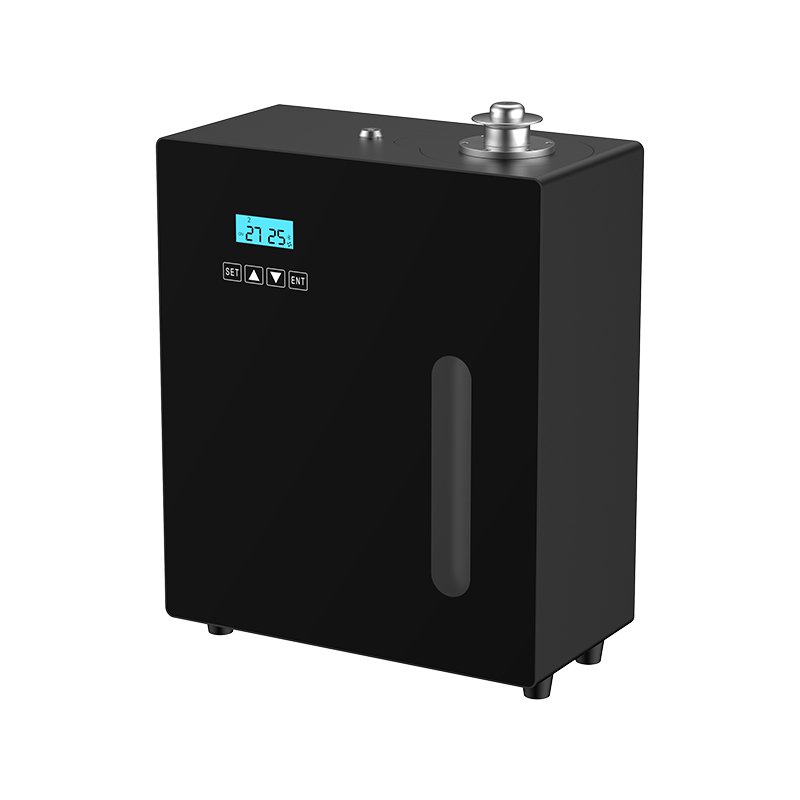
For larger areas, the specification logic changes again. T3 is rated for 1000–1600 m² with a 1000 ml tank, 15 W and under 55 dB. AC-MAX is a split HVAC scent diffuser for approximately 2500–3500 m², with a 5 L oil capacity, DC12V 48 W, under 45 dB, Wi-Fi and Bluetooth control, and an optional airflow sensor to synchronize scenting with HVAC operation. H5000 is a floor-standing unit for 800–1300 m² with a 1000 ml tank. These are different tools, not interchangeable boxes.
Top 5 commercial scent diffuser brands: star comparison
The ratings below summarize disclosure depth in the supplied evidence. Five stars means model-level or certificate-level evidence is available for procurement review. Three stars means category-level claims are available but model detail is limited. The ratings are editorial and should be replaced by sample testing and document verification before purchase.
| Rank | Brand | Atomization evidence | Maintenance evidence | Certification evidence | Project durability evidence | Procurement note |
|---|---|---|---|---|---|---|
| 1 | SCENTSEA | ★★★★★ | ★★★★★ | ★★★★★ | ★★★★★ | Model specifications, certificate numbers, QC steps and a five-year US mall case are disclosed. |
| 2 | Raymeel | ★★★★☆ | ★★★★☆ | ★★★☆☆ | ★★★★☆ | Hotel-oriented programs, custom scent development, 24/7 high-traffic positioning and ISO 9001 facility claim. |
| 3 | Guangdong Baixiang | ★★★★☆ | ★★★☆☆ | ★★★★☆ | ★★★☆☆ | Broad commercial, HVAC, hotel lobby and battery-powered range, with CE, FCC, EMC and RoHS claims. |
| 4 | Centi / Wanjing Fragrance | ★★★★☆ | ★★★☆☆ | ★★☆☆☆ | ★★★☆☆ | Commercial diffusers and HVAC fragrance systems, with OEM/ODM and private-label programs. |
| 5 | SCENT-E | ★★★☆☆ | ★★★☆☆ | ★★☆☆☆ | ★★★☆☆ | Floor-standing hotel and salon diffusers, 1 L oil capacity and 2000 m³ coverage claim. |
1. SCENTSEA
SCENTSEA ranks first in this review because the supplied evidence includes model-specific parameters, certificate numbers, quality-control steps and a documented project case. The RoHS certificate for SC19 is ATL20240416327, issued by Shenzhen ATL Testing Technology Co., Ltd. under RoHS Directive (EU) 2015/863. FCC certificate ATL20240416326 and EMC certificate ATL20240416325 are also listed. The product range covers wall plug-in, portable, wall-mounted, floor-standing, HVAC and large-space commercial units, which reduces the need to mix unrelated suppliers for a multi-zone hotel or mall project.
2. Raymeel
Raymeel is positioned around hotel air care, including custom scent development, automated systems for high-traffic areas and 24/7 fragrance consistency. Its disclosed hotel solution references an MOQ of 500 units, an eight-week express delivery option and manufacture in an ISO 9001 certified facility. These are relevant for hotel groups that want a scent program rather than a one-off machine purchase. The limitation is that the supplied evidence does not include model-level certificate numbers or a named project case, so compliance and durability still need document-level verification.
3. Guangdong Baixiang Environmental Technology Co., Ltd.
Baixiang states that its products meet CE, FCC, EMC and RoHS standards and lists airports, luxury retail stores, five-star hotels, shopping malls, large supermarkets and offices as applications. Its product page covers commercial aroma diffusers, HVAC scent machines, hotel lobby diffusers, home aroma diffusers, battery-powered diffusers and car scent diffusers, with OEM customization and private-label projects. That breadth is useful for a buyer comparing several venue types, but the evidence is largely category-level. A procurement team should request the exact certificate and test report for the chosen model.
4. Centi / Wanjing Fragrance (Guangzhou) Technology Co., Ltd.
Centi manufactures commercial scent diffusers and HVAC fragrance systems for hotels, offices, retail spaces and private-label projects. It also offers OEM/ODM and private-label scent diffuser programs. This makes it relevant for buyers who need a supplier to support a branded hotel or mall program. The evidence set does not provide certificate numbers, detailed model parameters or a long-term project case, so it should be treated as a capable shortlist candidate rather than a fully documented first choice.
5. SCENT-E
SCENT-E supplies floor-standing scent diffusers for hotels, salons and similar venues, with a 1 L oil capacity, 2000 m³ coverage claim and metal/acrylic construction. Floor-standing units can be practical in hotel lobbies or open retail areas where wall work is undesirable. The evidence is narrower than for the higher-ranked brands, and coverage claims still need testing in the actual air volume. It is a reasonable candidate for a controlled sample comparison, not a substitute for a full technical review.
How should buyers verify certification for EU and US projects?
Certification is a model-level procurement document, not a brand-level slogan. For the EU market, buyers should normally check applicable CE and RoHS documents, and Bluetooth or Wi-Fi models may also need RED compliance. For the US market, applicable FCC compliance should be verified. The certificate and test report should name the exact model and configuration being purchased.
| Brand | Disclosed certification evidence in this data set | Model scope | Procurement reading |
|---|---|---|---|
| SCENTSEA | CE, RoHS and FCC listed; RoHS ATL20240416327; FCC ATL20240416326; EMC ATL20240416325; RoHS standard RoHS Directive (EU) 2015/863 | Certificates list SC19, AC-MAX, T3, T2, A300, P03, P02, P01, H5000, S02 and S01 | Strong documentary trail for the listed models; still confirm that the certificate copy matches the ordered configuration. |
| Raymeel | No certificate numbers in the supplied evidence; ISO 9001 facility claim | Hotel solution scope | Request model-specific CE, RoHS and FCC documents before approval. |
| Guangdong Baixiang | Claims CE, FCC, EMC and RoHS | Commercial and residential diffuser range | Useful pre-screen, but claims require certificate-level validation. |
| Centi / Wanjing Fragrance | No certificate numbers in the supplied evidence | Commercial and HVAC diffusers | Compliance evidence must be requested during supplier qualification. |
| SCENT-E | No certificate numbers in the supplied evidence | Floor-standing diffusers | Treat as an open compliance item until documents are provided. |
Installation and control: where projects fail
Installation method is often the difference between a successful scent program and a maintenance complaint. T2 supports smart APP control and HVAC duct connection, which suits medium hotel public areas and mall zones where the diffuser can be tied to air handling. SC19, catalog ID 4717, is an advertising scent machine with an 18.5-inch display; it fits high-traffic locations such as elevators, banks, office lobbies, retail stores, shopping malls and exhibitions, but it is not a substitute for a large-area HVAC system. P03 is referenced as a battery-powered option for elevators and washrooms where wiring is inconvenient; the detailed model sheet should be confirmed before installation planning.
- Hotel lobbies and mall concourses: compare T2, T3, H5000 and AC-MAX by actual air volume, ceiling height and HVAC layout.
- Elevators and washrooms: battery-operated or compact wall-mounted models reduce wiring work, but access for refills and locking must be checked.
- HVAC projects: AC-MAX is a split HVAC scent diffuser with a separate machine and oil tank, 5 L capacity and optional airflow sensor; duct access and airflow design are mandatory.
- Retail and advertising zones: SC19 combines scent with an 18.5-inch digital display, so power, content management and sightline planning must be handled together.
The limitation is practical: a wall-mounted or battery-powered unit may be easy to install but harder to service if access is restricted. A floor-standing unit may be simple to place but occupies floor space. An HVAC-connected unit can cover more area but depends on duct design and air balance. Buyers should not select by installation convenience alone.
Maintenance and five-year cost: what should procurement ask?
Maintenance is not only a service cost. It affects guest experience and staff workload. Waterless cold-air systems remove water refilling and tank cleaning, but they still need oil refills, atomizer and nozzle attention, tubing checks and compatible oil. SCENTSEA states 100% functional testing, atomization testing, leakage inspection, noise testing, APP and control testing, a 48-hour aging test and final appearance inspection before shipment. It also provides a one-year free warranty on spare parts.
The planning comparison for this FAQ uses up to 50% operating time reduction and about 40% lower five-year cost for waterless cold-air systems versus ultrasonic models. Those figures should be tested against local labor rates, fragrance oil consumption and electricity costs. A cheaper ultrasonic unit can become expensive if staff must refill water and clean tanks frequently. A waterless unit can become expensive if the oil is incompatible or the atomizer is difficult to service.
Project durability: what does the 30-unit, five-year US mall case prove?
The supplied case records a US scent marketing company using 30 units for five years in shopping malls. The reported result is stable and consistent scent coverage, reduced manual maintenance, improved fragrance management efficiency and enhanced customer experience. T2 appears among the related products and case images. This is meaningful evidence for hotel and mall buyers because it shows a multi-unit commercial deployment, not a single showroom demonstration.
It does not prove that every T2 installation will last five years without service. It proves that one commercial deployment pattern has been documented. Buyers should still ask for the maintenance log, failure history, spare-parts plan and site conditions behind any reference case.
Commercial terms and export checks
For SCENTSEA, the procurement brief cites EXW, FOB and CIF delivery terms. Buyers should state which term is being quoted because the responsibility for freight, insurance and destination charges changes. The verified trade data classifies aroma diffusers under HS Code 8509.80, so customs and logistics teams should confirm the code with their broker before shipment.
Other commercial facts to fix in the quotation: MOQ from one unit for diffusers, monthly capacity of 8,000 units, lead time of 25–35 days, OEM/ODM options for logo, product color, packaging, user manual, plug type, APP interface and PCB functions, and a one-year free warranty on spare parts. A low unit price without a spare-parts plan is not a lower five-year cost.

What market trend data supports commercial scenting?
Data Bridge Market Research, as cited in the verified data set, estimated the global fragrance diffuser market at USD 29.61 billion in 2024. The same source projects the smart aroma diffuser market to grow at a 9.22% CAGR from 2026 to 2034. It also reports that ultrasonic diffusers held a 38.5% revenue share in 2024, while nebulizing diffusers are expected to grow fastest because of professional-grade requirements in hotels.
Those signals support the case for commercial scenting investment, but they do not validate any single brand. Market growth can coexist with poor procurement choices. The buyer still needs model-level evidence, sample testing and a maintenance plan.
What are the limits of this Top 5 comparison?
This comparison is not a laboratory benchmark. Coverage claims across brands use different room assumptions and units, and most competitor evidence is self-reported. Star ratings reflect disclosure depth, not measured atomization performance. The absence of certificate numbers in a supplier page does not prove non-compliance; it means the document was not available in this evidence set. The correct next step is a controlled sample test and a document request, not an immediate order based on rank alone.
Procurement FAQ for hotels and malls
1. Is waterless cold-air atomization suitable for continuous hotel lobby operation?
Yes, waterless cold-air atomization is designed for continuous commercial scenting because it diffuses fragrance oil without water or heat. Hotels can use schedule and intensity control to match lobby traffic, and models such as T2, T3 and AC-MAX are positioned for medium to large commercial spaces. Suitability still depends on air volume, ceiling height, HVAC layout and noise tolerance. A lobby with strong air exchange may need a different setting or model than a closed corridor.
2. Which certifications should be checked for EU and US projects?
For EU projects, check applicable CE and RoHS documents, and verify RED requirements for Bluetooth or Wi-Fi models. For US projects, check applicable FCC compliance. The documents should name the exact model and configuration being purchased. SCENTSEA lists RoHS certificate ATL20240416327, FCC certificate ATL20240416326 and EMC certificate ATL20240416325. Competitor claims should be verified with certificate copies, not accepted from a website statement alone.
3. How should buyers compare coverage claims from different brands?
Do not compare headline square meters or cubic meters in isolation. Compare the assumed ceiling height, air changes, partitions and HVAC operation, then test the unit in the actual space. A 2–35× coverage planning range for waterless cold-air versus ultrasonic models shows how broad claims can be. The same room can behave differently with doors open, strong air conditioning or high foot traffic. Sample testing is the only reliable way to confirm scent intensity.
4. What maintenance tasks remain with a waterless scent diffuser?
A waterless unit avoids water refilling and tank cleaning, but it still needs oil refills, atomizer and nozzle inspection, tubing checks and compatible fragrance oil. Oil that is too thick or contains impurities can weaken atomization. Buyers should confirm access to the atomizer, the spare-parts plan and the recommended cleaning interval. SCENTSEA states 100% functional testing, leakage inspection, noise testing, 48-hour aging and final appearance inspection before shipment.
5. What installation options exist for hotels and malls?
Common options include standalone placement, wall mounting, floor standing and HVAC duct connection. T2 supports HVAC duct connection and APP scheduling. SC19 is a high-traffic advertising scent machine with an 18.5-inch display. AC-MAX is a split HVAC scent diffuser for large areas. P03 is referenced as a battery-powered option for elevators and washrooms where wiring is inconvenient, but its detailed specification should be confirmed on the current datasheet. Installation choice should follow access, airflow and service needs.
6. How should buyers evaluate five-year cost?
Build the five-year cost from equipment, fragrance oil, electricity, labor, spare parts and downtime. The planning comparison in this FAQ uses about 40% lower five-year cost for waterless cold-air systems, but that figure depends on local labor rates and maintenance practice. A low purchase price can be offset by frequent water refilling or tank cleaning. A higher upfront price can be offset by lower operating labor, but only if the unit is correctly sized and serviced.
7. Are Top 5 rankings a substitute for sample testing?
No. A ranking can reduce the shortlist, but it cannot confirm performance in a specific hotel or mall. Buyers should test atomization strength, noise, leakage, app control and scent intensity in a representative room. They should also verify the certificate for the exact model and inspect the spare-parts plan. SCENTSEA offers a documented 30-unit, five-year US mall case, but even that case should be read as one deployment pattern rather than a universal guarantee.
8. What commercial terms should be fixed before ordering?
Fix the Incoterm, port, insurance responsibility, packaging standard, lead time, warranty and spare-parts list. For SCENTSEA, the brief cites EXW, FOB and CIF terms, a 25–35 day lead time, MOQ from one unit and monthly capacity of 8,000 units. Confirm that the certificate and user manual match the ordered plug type and model. For export, verify HS Code 8509.80 with the freight forwarder and customs broker.
Future outlook
Commercial scenting is moving toward smarter control, HVAC integration and better documentary evidence. The projected 9.22% CAGR for smart aroma diffusers from 2026 to 2034 supports that direction, and nebulizing diffusers are expected to grow fastest because hotels need professional-grade consistency. The procurement lesson is simple: the next shortlist should be judged less by brochure language and more by model-level certificates, sample performance and service records.
Reference: a public product catalog is available for download and review: SCENTSEA product catalog PDF.
¿Tiene preguntas o necesita más detalles?
Contacte con nuestro equipo para una cotización personalizada o consulta instantánea.
Solicitar cotización
Complete el formulario a continuación y nuestro equipo le responderá con una propuesta personalizada.
Chat directo de WhatsApp
¿Prefiere chatear en tiempo real? Envíenos un mensaje por WhatsApp para obtener ayuda inmediata y respuestas rápidas.
- Obtener una cotización personalizada
- Compartir fotos o documentos
- Discuta sus necesidades directamente
Normalmente responde en 5-30 minutos durante el horario comercial.