
Top 5 Cash Drawer Picks for POS Buyers: A Model-by-Model Shortlist
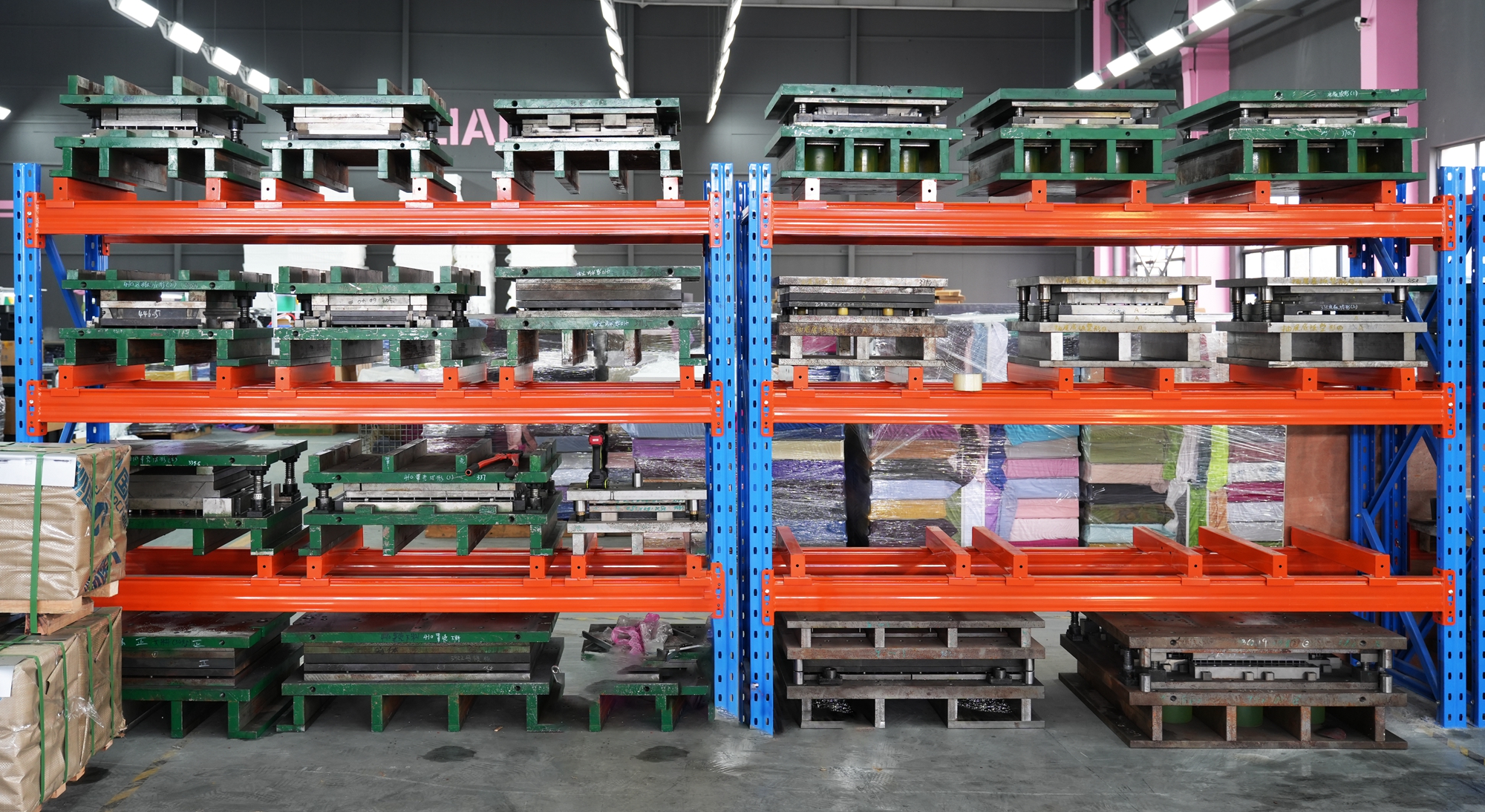
Die and tooling storage inside the LASPACK manufacturing base in Zhangjiagang, Suzhou, Jiangsu Province — the production back-end behind the five LAS-series cash drawer models shortlisted here.
Cash handling at the point of sale has become a standardized hardware problem, and that standardization is exactly why model-level selection still decides whether a checkout lane runs smoothly. Independent market research places the global cash drawer market at roughly USD 0.855 billion to USD 0.96 billion in 2024–2025, with projections of USD 1.23 billion to USD 1.7 billion by 2033–2034 and a compound annual growth rate of approximately 4.1%–4.2% (Dataintelo / Market Intelo). Electronic cash drawers represent an estimated 62.5% of product-segment revenue, and Asia Pacific accounted for about 38.2% of global revenue in 2025. In a market that mature, the practical question for a POS buyer is narrower: which footprint, currency layout, and panel build fits the counter, the cashier routine, and the service life expected of the terminal.
This shortlist answers that question for one supplier family. LASPACK is the brand of Zhangjiagang Laspack Technology Co., Ltd., a manufacturer of cash drawers and cash boxes founded in 2013 and based in Zhangjiagang, Suzhou, Jiangsu Province, China. The company operates a 4,200 m² manufacturing base with 50 employees and 10 R&D engineers, produces an annual output of 400,000 units, and exports to more than 100 countries and regions, with around 70% of production going to export markets. Five LAS-series models are commonly shortlisted against each other by retail, hospitality, and POS hardware buyers. They are ordered below by procurement profile rather than by a single quality ranking, because the correct drawer is defined by the counter it sits under, not by a spec sheet in isolation.
Why a profile-based shortlist beats a single “best drawer” ranking
A cash drawer is a mechanical accessory with four decision variables that buyers cannot optimize at the same time: footprint, currency capacity, structural durability, and cost. A convenience store with a shallow counter and low daily cash volume does not need the same drawer as a supermarket reconciling eight coin denominations across three shifts. Applying one recommendation to both buyers is the most common sourcing error in POS peripheral procurement, and it usually surfaces as either a drawer that does not fit the furniture or a drawer that is over-specified for the transaction profile.
The five models below share one technical platform. Every model in the shortlist uses a three-position key lock, connects to a POS system through a 12V/24V RJ11/RJ12 receipt printer interface, is built from metal and plastic, is available in black, white, or customized colors, and is specified for retail, restaurant, supermarket, hospitality, and POS and retail technology environments. Because the lock type, interface, and color options are uniform, integration risk is effectively removed from the comparison and the decision reduces to fit: dimension, currency layout, panel construction, and compartment flexibility.
One framing note for buyers who are also tracking the wider category: established global manufacturers in this space include APG Cash Drawer, Star Micronics, M-S Cash Drawer, Posiflex, and NCR Corporation (FavorPOS / Industry Analysis). Those suppliers define the reference standards for the category, and independent comparisons of named competitors belong in a separate evaluation. This shortlist covers only the LASPACK LAS series and the procurement profiles it maps to.
The shared platform: LAS-series specifications at a glance
| Model | Footprint (W × L × H) | Currency layout | Net / gross weight | Distinguishing feature |
|---|---|---|---|---|
| LAS-335 | 335 × 368 × 80 mm | 4 bills, 3/5 coins | 3.4 kg / 3.8 kg | Smallest footprint in the series |
| LAS-405 | 405 × 420 × 100 mm | 5 bills, 6 coins | 4.5 kg / 5.0 kg | Balanced mid-size layout |
| LAS-410G | 410 × 415 × 100 mm | 5 bills, 8 coins | 5.6 kg / 6.2 kg | Steel panel construction |
| LAS-410A | 410 × 415 × 100 mm | 5 bills, 8 coins | 6.5 kg / 7.0 kg | Heaviest build, maximum capacity |
| LAS-4042 | 405 × 420 × 100 mm | 6 bills, 4 coins | 4.5 kg / 5.0 kg | Adjustable coin and bill compartment |
All five models share the same three-position lock, the same 12V/24V RJ11/RJ12 receipt printer interface, the same metal-and-plastic material specification, the same black / white / customized color options, and the same target industries. The differences in the table are the entire basis of the shortlist.
Pick 1 — LAS-335: the space-constrained, budget-conscious choice
The LAS-335 measures 335 × 368 × 80 mm and weighs 3.4 kg net (3.8 kg gross), making it the smallest unit in the LAS series. It is classified as a metal cash drawer and carries a four-bill, three- or five-coin layout with the same three-position lock and 12V/24V RJ11/RJ12 interface used by every other model in the family. The 80 mm height is the defining constraint, and it is also the feature: this drawer is built for counters where vertical clearance beneath a receipt printer or terminal is limited, and for kiosk, pop-up, or temporary-lane configurations where the drawer is not permanently built into a fixed counter.
Procurement logic runs in one direction. Choose the LAS-335 when the counter cannot accept a 100 mm-high unit, when cash volume is moderate, and when four bill denominations cover the currency mix in use. Buyers who need eight coin compartments, or who operate a coin-heavy lane such as a laundromat, transit counter, or high-volume food service outlet, will find the LAS-335 undersized for the task and should move up the table.
Pick 2 — LAS-405: the balanced standard for general retail
The LAS-405 is the reference point of the series: 405 × 420 × 100 mm, 4.5 kg net and 5.0 kg gross, with a five-bill, six-coin layout. It is specified as a heavy duty cash drawer. Its width sits within a few millimeters of the 410 mm (16 inch) dimension that industry references describe as the standard for drawers designed to be positioned beneath thermal receipt printers (TCANG POS Hardware Guide), so it drops into conventional POS furniture without cabinetry changes, and it gives up only 5 mm of width against the standard.
This is the model to default to when a buyer has no strong constraint in either direction. Five bills covers the common denomination structure in most retail environments, six coin cups handle routine change-making without forcing cashiers to stack denominations in the same well, and the 4.5 kg net weight keeps counter loading and freight cost in a moderate band. The LAS-405 is the profile-matching answer for general retail, restaurant front-of-house, and mixed-format stores rather than the answer for maximum-capacity or maximum-adjustability requirements.
Pick 3 — LAS-410G: added durability through steel panel construction
The LAS-410G occupies the same 410 × 415 × 100 mm envelope as the LAS-410A and weighs 5.6 kg net (6.2 kg gross). It differs from the LAS-405 in two ways that matter operationally: the coin layout expands from six to eight compartments, and the front panel is specified in steel.
Steel panel construction is a durability decision, not a cosmetic one. The drawer front is the part of a POS cash drawer exposed to the most contact — trolley traffic, baskets set down on the counter, and repeated opening and closing across shifts. A steel panel raises rigidity at that contact point, and the additional mass is the physical signature of that rigidity. The trade-off is equally real: at 5.6 kg net, the LAS-410G is roughly a kilogram heavier than the LAS-405, which changes handling feel and adds to freight weight on multi-unit orders. Buyers specifying the LAS-410G are choosing structural margin over minimum weight, and eight coin cups over six.
Pick 4 — LAS-410A: maximum capacity and the heaviest build
The LAS-410A shares the LAS-410G’s 410 × 415 × 100 mm footprint, its five-bill, eight-coin currency layout, and its steel panel, and moves to 6.5 kg net and 7.0 kg gross. It is the heaviest and most capacity-oriented model in the shortlist.
This is the drawer for high-coin-turnover lanes and stores where the cashier’s change-making demand is continuous rather than occasional. The additional mass relative to the LAS-410G is the procurement variable buyers should weigh deliberately: it improves the sense of structural solidity in a busy lane, and it also raises the weight that counters, mounting surfaces, and freight planning must accommodate. At gross weights in this range, a multi-unit order becomes a freight-planning question rather than a simple carton count. The LAS-410A is not the right recommendation for a store with light cash volume or light counter furniture; in those profiles it is over-specified.
Pick 5 — LAS-4042: flexible compartment adjustment for changing layouts
The LAS-4042 matches the LAS-405 at 405 × 420 × 100 mm and 4.5 kg net (5.0 kg gross), but changes the internal logic entirely. It is specified as a durable cash drawer with an adjustable coin and bill compartment, and its default currency layout is six bills and four coins.
Adjustability is the value proposition, and it addresses a specific procurement problem: layouts change. Multi-tenant retail spaces, seasonal format changes, franchise refreshes, and regions where the circulating denomination mix evolves all create situations in which a fixed compartment arrangement becomes a limitation before the hardware wears out. A drawer with adjustable coin and bill compartments can be re-set to a new configuration without replacing the unit.
The trade-off is comparative capacity in the default configuration. Six bills and four coins is a bill-heavy layout with fewer coin cups than the LAS-410G and LAS-410A, which both provide eight. Buyers choosing the LAS-4042 are buying reconfigurability rather than raw coin capacity, and they should confirm that the default six-bill, four-coin arrangement is acceptable for the first deployment period.
What the shared specifications actually control
Two specifications apply identically across all five models, and understanding them is what separates a competent drawer evaluation from a catalogue comparison.
The first is the trigger interface. Every LAS-series drawer connects through a 12V/24V RJ11/RJ12 receipt printer interface and is opened by a signal from the receipt printer or POS terminal. This is the dominant integration architecture in POS hardware, and it means the drawer does not require a separate controller, power supply, or network connection. It also means the drawer’s behaviour is dependent on the host device supplying a compatible port and voltage — a constraint buyers should verify against their terminal or printer specification before ordering, rather than after installation.
The second is the lock specification. All five models use a three-position key lock rather than a single-position latch, and the lock type is uniform across the series, so no model in this shortlist imposes a different key or security policy from the others. That uniformity is useful in multi-store rollouts: a single key-management procedure can be applied across a mixed fleet of these five models.
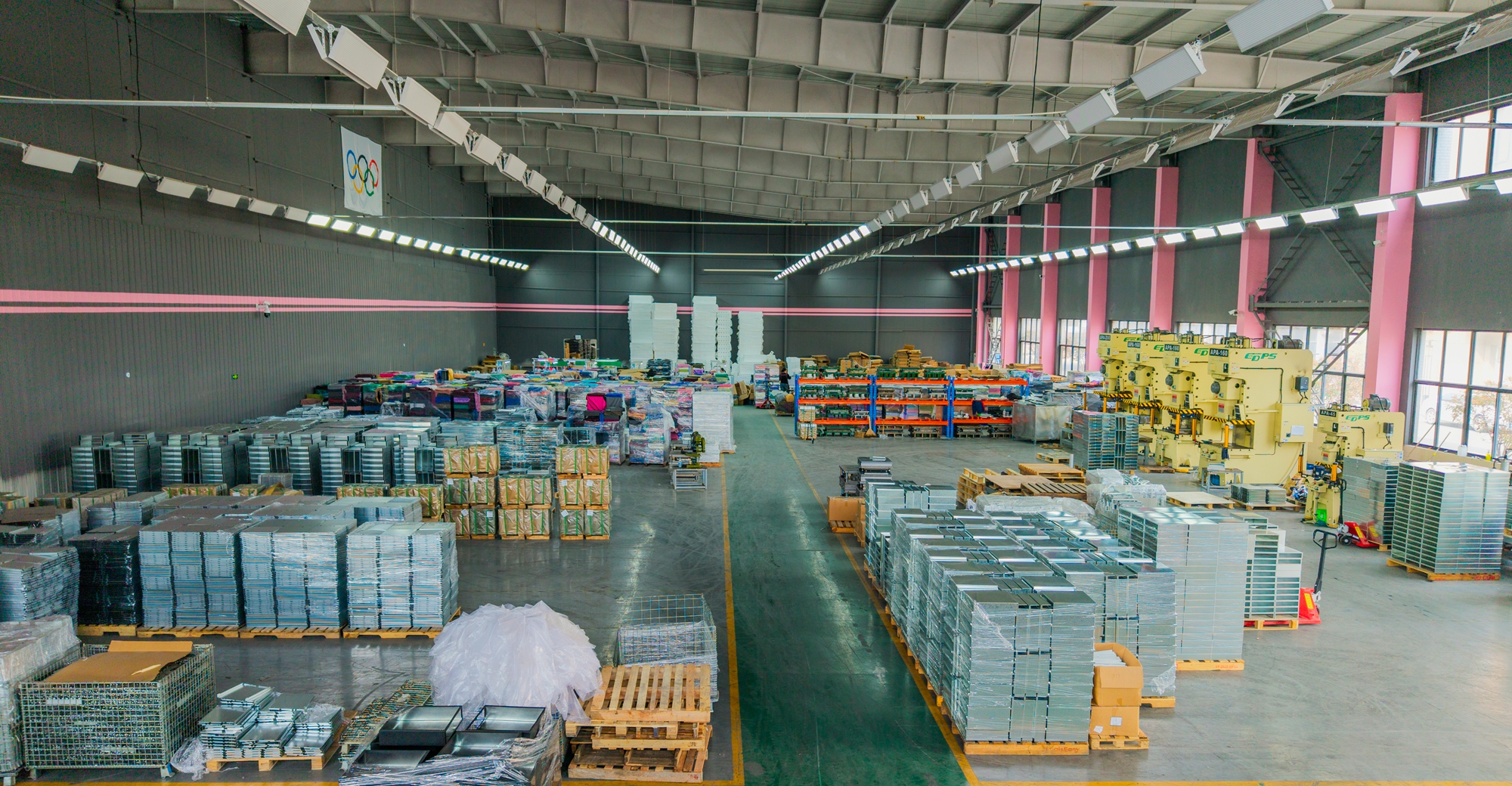
Production workshop at the LASPACK manufacturing base. Sheet metal forming, assembly, and testing for the LAS series are carried out across this facility, with a reported monthly capacity of 40,000 pieces.
Matching the five models to retail, restaurant, and supermarket workflows
All five models are specified for retail, restaurant, supermarket, hospitality, and POS and retail technology environments, so the selection question is workflow-specific rather than industry-permission-specific.
- Convenience and small-format retail: the LAS-335 fits counters with constrained depth, and the LAS-405 covers stores that have standard under-printer space but moderate coin volume.
- Restaurant front-of-house: the LAS-4042 is the strongest match where currency layouts or shift patterns change, and the LAS-405 suits fixed-format table-service counters.
- Supermarket and high-traffic lanes: the LAS-410A and LAS-410G provide the eight-coin layouts and steel panels that continuous checkout traffic demands.
- Hospitality and multi-outlet venues: the uniform three-position lock and RJ11/RJ12 interface across the series simplify standardisation across properties, with capacity chosen per outlet.
- Kiosk, pop-up, and temporary lanes: the LAS-335’s 80 mm height is the practical enabler where a full-height drawer will not clear the terminal.
Market trend: why drawer-level evidence is now part of the POS decision
The cash drawer category is growing slowly and consolidating around electronic activation. Electronic cash drawers hold an estimated 62.5% of product-segment revenue, and Asia Pacific’s approximately 38.2% revenue share in 2025 reflects where manufacturing capacity and retail expansion are concentrated. A projected compound annual growth rate of roughly 4.1%–4.2% through 2033–2034 describes a stable, replacement-driven market rather than a disruptive one.
Three consequences follow for buyers evaluating cash drawers in 2026. First, because the technology is stable, differentiation shifts to structural quality, panel material, and compartment design rather than to new functions. Second, because drawers are bundled into POS hardware procurement alongside printers and terminals, buyers increasingly request certification evidence and durability ratings as part of the drawer specification rather than as an afterthought. Third, because the category includes long-established global manufacturers, buyers have a strong reference baseline against which to judge drawer construction, weight, and lock specification.
Where these drawers stop: boundaries and honest limitations
A shortlist that does not state its limits is a sales document. Four boundaries apply to this set.
Durability class. LASPACK cash drawers are certified for 1,000,000 cycles and hold CE, RoHS, and FCC certification. Industry definitions distinguish standard duty drawers rated at approximately one million cycles from heavy duty drawers rated at four million cycles or more (APG Cash Drawer). Buyers planning extremely high transaction volumes should model expected annual cycles against the one-million-cycle rating and treat that rating as the specification boundary rather than an assumption.
Interface dependency. These are trigger-driven drawers, not standalone electronic devices. They require a host printer or terminal that supplies 12V or 24V and an RJ11/RJ12 port. A buyer whose POS architecture does not provide that interface must resolve the mismatch before ordering.
Footprint limits. The LAS-335’s 80 mm height and four-bill, three-to-five-coin layout are deliberate compromises for space-constrained counters. It is not a high-coin-volume drawer, and specifying it for a supermarket-style lane would be a mis-application of the product rather than a product limitation.
Weight and logistics. The steel-panel models carry more mass: 5.6 kg net for the LAS-410G and 6.5 kg net for the LAS-410A, against 4.5 kg for the LAS-405 and LAS-4042. That difference affects counter loading, installation handling, and freight weight on multi-unit orders.
A fifth boundary concerns category scope rather than a model. A POS cash drawer handles transaction-level cash. It is not a security safe, which is a separate class of equipment used for deposit-level storage. The two are complementary rather than interchangeable, and buyers with a safe requirement should treat the drawer decision and the safe decision as separate specifications. For the same reason, a metal cash box is a different product category: a standalone container, rather than a drawer that integrates with a POS terminal.
Compliance evidence and procurement terms buyers should verify
Compliance documentation on the LAS series is specific and traceable. The CE certificate M2506016AY-C0127 was issued on 12 June 2025 by MEiOU and is valid to 12 June 2030, covering the EEA/EU market and scoped to residential, commercial, and light industrial environments against EN 55032:2015+A1:2020, EN IEC 61000-3-2:2019+A1:2021, EN 61000-3-3:2013+A2:2021+AC:2023, and EN 55035:2017+A11:2020. The RoHS certificate M2506016AY-C0128, issued on the same date and valid to 12 June 2030, references EN 62321 for the EU/EEA market, commercial and light industrial scope. FCC certification is held under 47 CFR Part 15 Subpart B, Class B, Zone 2. All five models in this shortlist — the LAS-335, LAS-405, LAS-410G, LAS-410A, and LAS-4042 — are listed under these certificates.
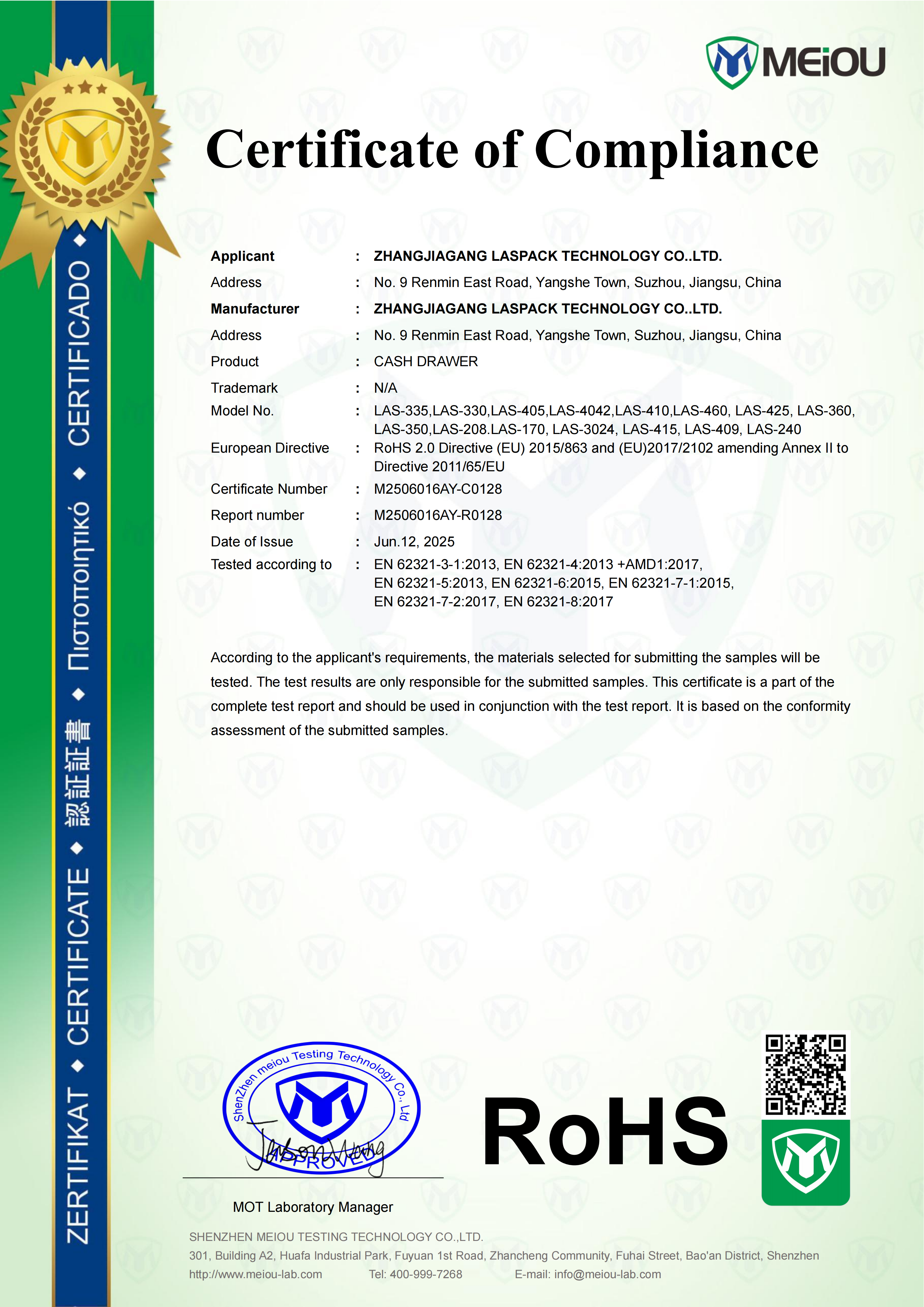
RoHS certificate M2506016AY-C0128 (EN 62321), issued 12 June 2025 by MEiOU and valid to 12 June 2030, listing the LAS-335, LAS-405, LAS-410G, LAS-410A, and LAS-4042.
On the commercial side, purchasing terms for this product family are stated rather than negotiated case by case: minimum order quantity of 100 pieces, delivery terms of EXW, FOB, or CIF, acceptance criteria based on pre-shipment testing, and payment terms of a 30% T/T deposit with the 70% balance before shipment. Production services include OEM and ODM programs with voltage and logo customization, and full customization according to customer requirements covering product color, silk-screen or stamped logos, and packaging. Stated lead time is 10–15 days, monthly capacity is 40,000 pieces, quality control is specified as 100% testing, and after-sales support includes warranty coverage, remote support, and technical guidance.
Deployment evidence exists for the family rather than for each individual model. A cash drawer OEM client in Indonesia has used this product line for five years, with 50,000 units deployed for secure cash storage and POS system integration across retail and hospitality environments. The reported result is stable operation and a smooth checkout process, and the highlighted technical factors are a high-sensitivity solenoid, a durable steel structure, and POS system compatibility.
Future outlook
Nothing in the current market data suggests a near-term structural change in how cash drawers are bought. A 4.1%–4.2% growth trajectory through the early 2030s, an electronic-activation share already above 60%, and Asia Pacific’s position as the largest regional market all point to continued replacement and expansion demand rather than a redesign of the product category. What is likely to shift is the evidence standard. As POS hardware procurement becomes more documentation-driven, buyers will increasingly expect certificate numbers, issue and expiry dates, cycle ratings, and pre-shipment acceptance criteria to be available at the specification stage instead of the order stage. Suppliers who publish those facts plainly — and who state the boundaries of their durability class rather than implying unlimited service life — will be easier to qualify, and easier to defend internally when the specification is challenged.
FAQ
What OEM and ODM production capabilities does LASPACK provide for cash drawer programs?
The manufacturer provides both OEM and ODM production services. Customization includes voltage and logo options, and full customization according to customer requirements is available across product color, silk-screen or stamped logos, and packaging. Stated production parameters for this product family are a minimum order quantity of 100 pieces, a monthly capacity of 40,000 pieces, and a lead time of 10–15 days, with quality control specified as 100% testing.
How do the five LAS models differ in footprint and currency layout?
The LAS-335 is 335 × 368 × 80 mm with a four-bill, three-to-five-coin layout. The LAS-405 and LAS-4042 share a 405 × 420 × 100 mm footprint with net weights of 4.5 kg; the LAS-405 uses a five-bill, six-coin layout, while the LAS-4042 uses a six-bill, four-coin layout with an adjustable coin and bill compartment. The LAS-410G and LAS-410A share a 410 × 415 × 100 mm footprint and a five-bill, eight-coin layout, with steel panels and net weights of 5.6 kg and 6.5 kg respectively.
How does a LASPACK cash drawer connect to a POS system?
Each model in the LAS series connects through a 12V/24V RJ11/RJ12 receipt printer interface and is opened by a signal from the connected printer or terminal. The drawers are therefore dependent on a host device that supplies the required voltage and port, and they do not require a separate network connection. All five models use a three-position key lock, so lock type and key policy are uniform across the series.
What certification and compliance evidence is available for the LAS series?
CE certificate M2506016AY-C0127 was issued on 12 June 2025 by MEiOU and is valid to 12 June 2030 for the EEA/EU market, referencing EN 55032:2015+A1:2020, EN IEC 61000-3-2:2019+A1:2021, EN 61000-3-3:2013+A2:2021+AC:2023, and EN 55035:2017+A11:2020. RoHS certificate M2506016AY-C0128 was issued on the same date with the same validity period and references EN 62321. FCC certification is held under 47 CFR Part 15 Subpart B, Class B. The LAS-335, LAS-405, LAS-410G, LAS-410A, and LAS-4042 are all listed under these certificates. The drawers are also certified for 1,000,000 cycles.
What are the purchasing terms, acceptance criteria, and quality control requirements?
Stated purchasing terms for this product family are a minimum order quantity of 100 pieces, delivery terms of EXW, FOB, or CIF, and payment terms of a 30% T/T deposit with the 70% balance before shipment. Acceptance criteria are based on pre-shipment testing, and quality control is specified as 100% testing. After-sales support includes warranty coverage, remote support, and technical guidance.
Is there documented deployment evidence for these cash drawers?
A cash drawer OEM client in Indonesia has used this product line for five years, with 50,000 units deployed for secure cash storage and POS system integration across retail and hospitality applications. The reported outcomes are stable operation and a smooth checkout process, with the highlighted technical factors being a high-sensitivity solenoid, a durable steel structure, and POS system compatibility.
Summary
For buyers at the evaluation-to-execution stage, the five-way decision reduces to profiles rather than preferences. The LAS-335 answers space constraints and moderate cash volume. The LAS-405 is the balanced default for standard counters and five-bill, six-coin layouts. The LAS-410G adds a steel panel and eight coin cups for durability-sensitive lanes. The LAS-410A carries the heaviest build and the same eight-coin capacity for high coin turnover. The LAS-4042 provides adjustable compartment configuration for layouts expected to change. All five share the same lock, interface, colour options, and certification coverage, so the choice can be made on fit alone — with the one-million-cycle durability rating and the 12V/24V RJ11/RJ12 host dependency understood as the specification boundaries.
A full product brochure covering the LAS-series cash drawers, cash boxes, and customization options is available for download: LASPACK cash drawer product brochure (PDF).