
Tire Storage Rack Shortlist: Six Models by Tire Count and Footprint
In decision-stage tire rack procurement, two published numbers decide whether a purchase pays back: how many tires one rack position holds, and how much floor area that position consumes. Load rating, coating and weld detail are constraints on those two numbers, not substitutes for them.
HM Group (Dalian HuaMao Logistics Equipment Group Co., Ltd.) is a Chinese manufacturer of wire mesh containers, cage pallets and stackable storage racks, founded in 2003 and exporting to the EU, North America, Asia and the Middle East. Its tire rack portfolio publishes six models with reported tire counts, footprints and load ratings — enough to compare them on density rather than on marketing claims. This shortlist ranks those six models by tire count and footprint, keeps the comparison inside the published specifications, and states where those specifications stop being decisive.
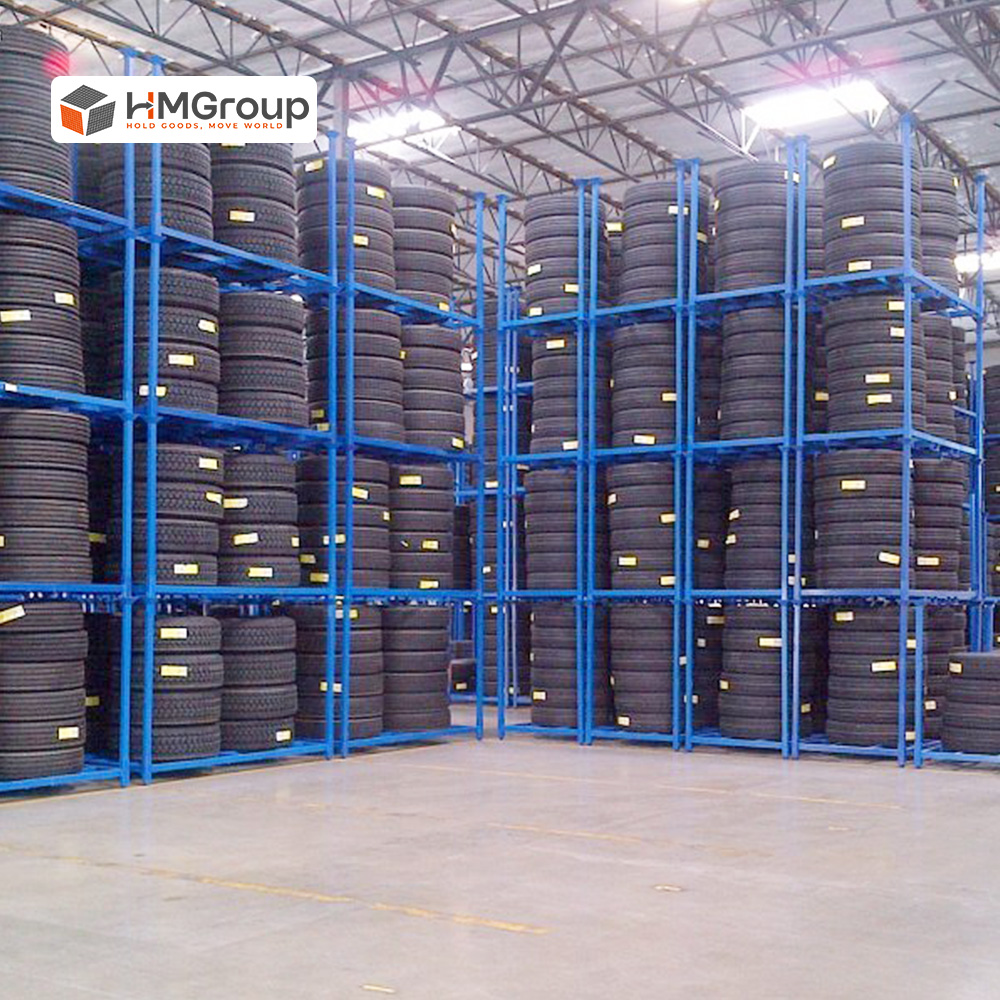
Stackable steel tire racks convert vertical clearance into usable tire positions; the footprint each rack consumes is the number that decides layout economics.
Why tire count and footprint separate these six models
Five of the six models in this shortlist carry the same reported load rating: 2,400 lb / 1,100 kg. Load rating therefore does not differentiate them. What differentiates them is how many tires a position holds and how much floor that position takes.
The effect compounds at scale. A rack that holds 34–50 tires on the same footprint where another holds 24–32 changes the number of rack positions a warehouse needs, the number of forklift moves per inbound container, and the amount of rent allocated to each stored tire. That is the comparison a decision-stage buyer is actually making — not the difference between two racks that both carry a 2,400 lb rating.
Two reading rules apply to every figure below. First, tire counts are published as ranges because tire section width and outer diameter change how many units physically fit; a range is a model-level statement, not a guarantee for every tire size. Second, the six models are not published in one unit system — HM-EULR and HM-TR1 use millimetres, the other four use inches. Cross-system comparisons in this article are avoided rather than converted.
The shortlist at a glance
Models are ordered by reported tire count, with footprint as the tie-breaker. All figures are as published by HM Group.
| Model | Tire capacity (reported) | Footprint (published) | Load rating | What it is for |
|---|---|---|---|---|
| HM-EULR | 72–81 tires | 2450 × 1350 × 2200 mm | 2,400 lb / 1,100 kg | Highest published tire count in the set |
| HM-TR7272WM | 42–63 tires | 72 × 72 × 72 in | 2,400 lb / 1,100 kg | Square 72-inch bay layout |
| HM-TR-UTR | 42–63 tires | 71.5 × 49.5 × 68.5 in | 2,400 lb / 1,100 kg | Same capacity band, narrower floor |
| HM-TR6 | 34–50 tires | 90 × 40 × 52 in | 2,400 lb / 1,100 kg | Long shallow footprint, lower height |
| HM-TR6060 | 24–32 tires | 60 × 60 × 60 in | 2,400 lb / 1,100 kg | Cube footprint, store-level volumes |
| HM-TR1 | Not published as a tire-count range | 2290 × 1100 × 1250 mm | 600 kg | Lighter-duty unit |
Source: HM Group published model specifications. HM-TR6 stacking configuration additionally published as 6 high open / 20 high closed.
Model by model: what each footprint is for
HM-EULR — the highest tire count in the set
HM-EULR is published at 72–81 tires on a 2450 × 1350 × 2200 mm frame rated 2,400 lb / 1,100 kg. It carries the largest tire count of the six models and is specified entirely in metric dimensions, which makes it the natural candidate where warehouse drawings, door openings and aisle markings are already in millimetres. The trade-off is planning discipline: a 2,200 mm overall height and a 2,450 mm length have to be checked against rack-run clearances and forklift lift height before the density gain can be realised. The 81-tire end of the range is the upper bound, not the expected figure for every tire.
HM-TR7272WM — a 72-inch square bay
The second model, at 42–63 tires, is built on a 72 × 72 × 72 inch frame with the same 2,400 lb / 1,100 kg rating. Its footprint is a true square, which suits layouts built on square bay grids and simplifies column spacing calculations. The square also has a cost: at 72 × 72 inches the footprint is 5,184 square inches (calculated from published dimensions), materially more floor than the 42–63 tire band strictly requires. Buyers comparing this model with the next one should note that identical reported capacity does not mean identical floor consumption.
HM-TR-UTR — the same capacity band on less floor
HM-TR-UTR is published at 42–63 tires on a 71.5 × 49.5 × 68.5 inch frame, again at 2,400 lb / 1,100 kg. Its footprint is approximately 3,539 square inches (calculated from published dimensions), against 5,184 square inches for HM-TR7272WM. Same reported tire band, roughly two-thirds of the floor. For a buyer whose decision metric is tires stored per unit of floor area, this is the more efficient of the two 42–63 tire models. The narrower 49.5 inch depth and the 68.5 inch height are the constraints to check against aisle widths and stacking clearance.
HM-TR6 — a 3,600 square-inch footprint that carries more tires
HM-TR6 is published at 34–50 tires on a 90 × 40 × 52 inch frame with a 2,400 lb / 1,100 kg rating, and HM Group documentation also states a maximum stack of six units open or twenty units closed. The geometry is deliberately long and shallow: 90 inches of length against 40 inches of depth, which suits aisle-side runs and wall-aligned banks better than square bays. The most useful comparison is with HM-TR6060. Both footprints multiply out to 3,600 square inches, yet HM-TR6 is published at 34–50 tires and HM-TR6060 at 24–32. On the same floor area, one model holds a substantially larger tire band — the difference being that TR6 trades height (52 inches) for length. Where overhead clearance is limited, or where operators need frequent hand access rather than forklift-only access, that trade is often the right one.
HM-TR6060 — the 60-inch cube
The smallest of the tire-count-published models is a 60 × 60 × 60 inch cube at 24–32 tires and 2,400 lb / 1,100 kg. Its value is not density but fit: a cube nests predictably into square bays, tolerates mixed tire sizes with less wasted volume than long-shallow formats, and keeps the per-position load low enough for store-level handling. For a single retail location or a regional distributor running heterogeneous passenger and light-truck stock, TR6060 is frequently the correct first purchase; a site that will standardise on one or two tire sizes will usually recover more floor with TR6 or TR-UTR.
HM-TR1 — the 600 kg exception
HM-TR1 is published at 2290 × 1100 × 1250 mm with a 600 kg rating. No tire-count range is published for this model, and it is the only unit in the set whose rating is not 2,400 lb / 1,100 kg. It should be read as a lighter-duty unit. A buyer who carries five of the six models forward at the 2,400 lb figure and then adds HM-TR1 to the same stack plan is comparing two different load classes — with the load rating and the tire count both lower, the model belongs in a separate evaluation bracket, not in a density ranking against the heavier frames.
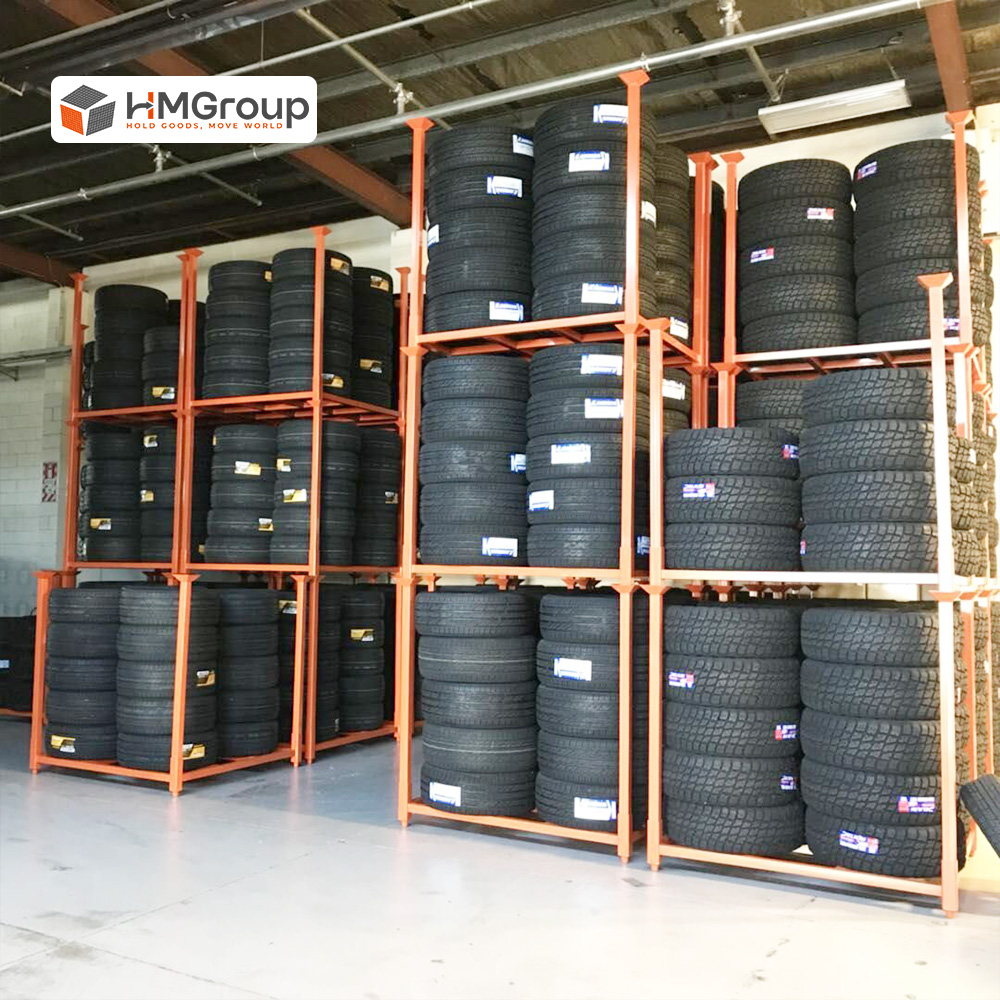
Vertical configuration, not frame strength, is what converts a 2,400 lb rating into additional stored tires.
What Q235 mild steel and a 2,400 lb rating actually cover
All six models are built from Q235 mild steel. HM Group states a material-integrity policy that prohibits spliced materials and mandates Q235 where high-strength requirements apply — a sourcing detail worth naming in a purchase order, because substitute grades are difficult to identify after coating. Critical joints, including sockets, stacking bowls and tube-to-tube connections, are specified as continuous full welding rather than stitch welding, and jigs are inspected for verticality before each welding session so that stacked columns remain straight.
Dimensional control runs alongside the weld specification: tolerances are applied to overall dimensions and diagonals to keep units compatible when they are stacked across production batches. Inspection is organised in six phases — pre-production, raw material, component, semi-finished product, finished product and packaging — so that a defect is caught before coating rather than after it. Finish is where the specification gets practical: hot-dip galvanizing uses flow holes to prevent zinc blockage and manual grinding to remove sharp edges, while powder coating is checked with cross-cut adhesion tests and monitored furnace temperatures to hold a uniform, non-peeling surface.
What the rating does not cover. The 2,400 lb / 1,100 kg figure is a per-rack statement. It does not size a stack. In a stacked column, the lower rack carries the weight of everything above it, so safe stack height depends on floor flatness, forklift placement accuracy and how the tire load is distributed across the frame. Buyers should treat the rating as one input to a stack plan, not as the stack plan itself.
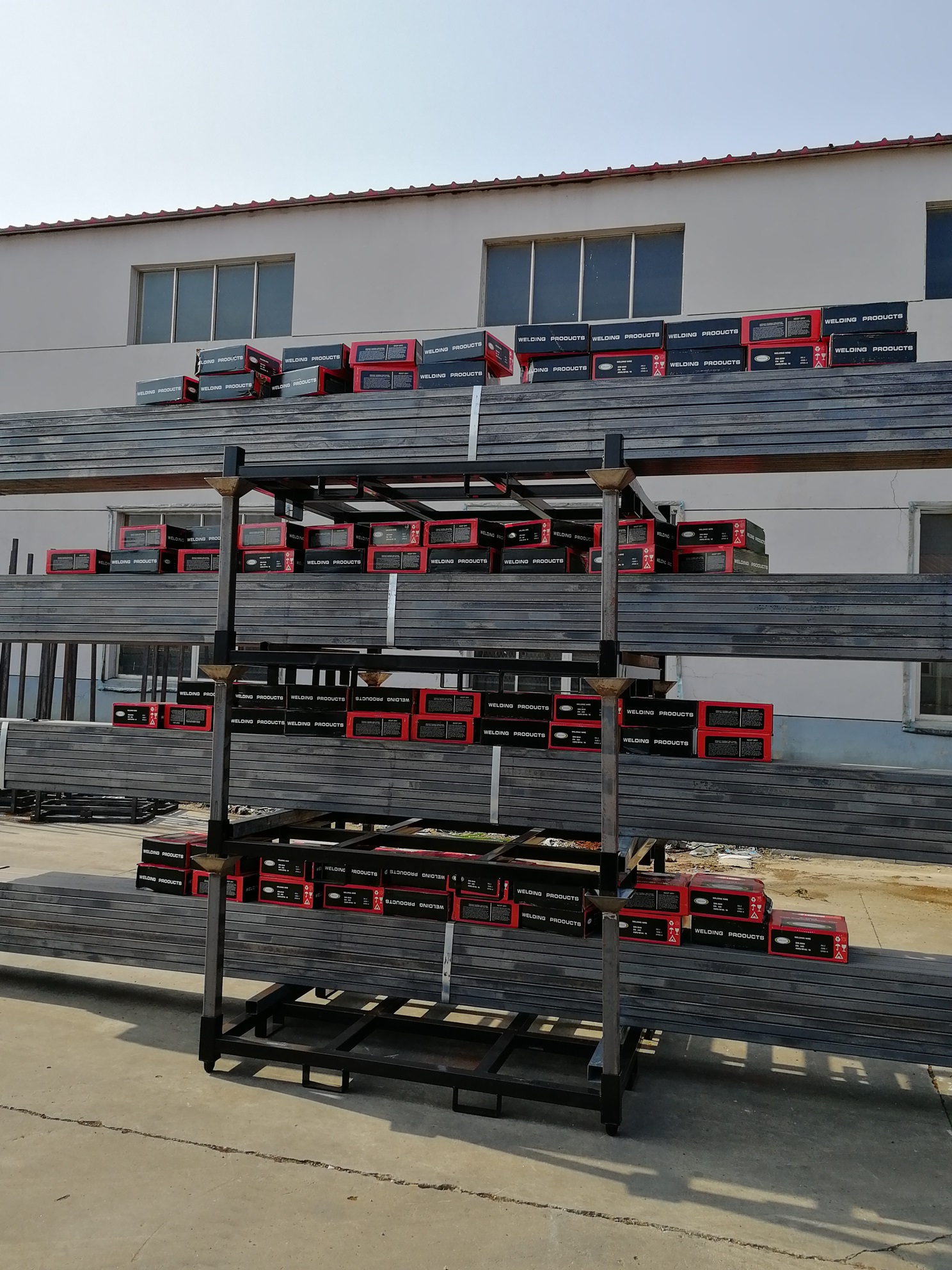
Loading and stacking verification at the factory addresses rack-level performance; it does not substitute for site-level floor and stack planning.
Stackable racks versus floor stacking and fixed racking
The case for stackable steel tire racks is usually argued in three numbers. Against floor stacking, HM Group cites up to a 60% increase in warehouse storage capacity, roughly 50% faster loading and unloading through systematic batch management, and an 80% lower damage rate than wooden pallets, with four-way forklift entry allowing rapid reorganisation of a bank. Against fixed selective pallet racking, the structural argument is flexibility: a stackable steel rack can be nested or broken down when empty, requires no bolted installation, and can be reconfigured far faster than a fixed system — which is why HM Group positions its stackable rack family for seasonal warehouses, cold storage and bulk goods storage.
The cost framing is more nuanced than a headline saving. HM Group's own comparison puts the initial investment for a tire stacking rack roughly 25% above floor stacking, with long-term operational cost about 40% lower through faster handling and reduced product damage. That is a payback argument, not a price argument, and it holds only where handling frequency and damage exposure are high enough to generate the offset.
Three limits deserve equal weight in a decision document.
- Tire-size dependency. Every count in this shortlist is a range tied to tire dimensions. A buyer stacking large-diameter truck tires should plan at the low end of the published band.
- Verification status. The load ratings used here are company-reported model specifications. No independent load test or third-party certification for these specific models was located in the available source material, and buyers in regulated markets should request current datasheets and test documentation rather than relying on a catalogue figure.
- Stacking safety is a site obligation. US workplace rules under OSHA 29 CFR 1910.176(b) require stored materials to be stacked, blocked and limited in height so that they are stable and secure against sliding or collapse. The rack contributes to that outcome; floor condition, placement accuracy and stack height discipline determine it.
A fourth, quieter limit: because five of six models converge on the same rating, a tender that specifies only load capacity will not separate them. Density, footprint and unit system have to be written into the requirement, or every bidder returns an identical-looking sheet.
Application fit across the six models
HM Group positions tire stacking racks primarily for tire manufacturing plants and large-scale tire distribution warehouses — environments with high inbound volume, frequent forklift movement and enough vertical clearance to justify stacked columns. Within that frame, the six models divide by layout rather than by industry.
- High-volume distribution centres: HM-EULR (72–81 tires) and HM-TR-UTR (42–63 tires) give the strongest tire-per-position figures, with EULR favoured where metric drawings govern the layout.
- Square-bay warehouses: HM-TR7272WM aligns with square grids and simplifies column spacing, at the cost of floor area per position.
- Aisle-side and wall-aligned banks: HM-TR6, with its 90 × 40 inch long-shallow geometry, is the format that fits runs rather than bays.
- Retail and regional depots: HM-TR6060 keeps per-position volume modest and mixed tire sizes manageable.
- Lighter-duty handling: HM-TR1 at 600 kg, evaluated on its own terms.
- Seasonal and cold-storage cycles: stackable racks reconfigure quickly between peak and off-peak layouts, which matters where tire volume follows seasonal demand.
Market context: density as mainstream capital spending
Third-party research places the global industrial racking systems market at USD 16.76 billion in 2024 (Market Research Future, published 2026). The relevant signal for tire storage is not the headline size but what it implies about buyer behaviour: racking investment is treated as a routine capital line in warehouse operations rather than a one-off expansion purchase. When density equipment is a recurring purchase, buyers compare models on repeatable metrics — tire positions per rack, floor area per position, stack height — instead of accepting a supplier's preferred metric.
That shift favours suppliers who publish ranges and dimensions. A catalogue that states only a load rating gives a procurement team nothing to model, and in a market of this scale, unspecified density is usually priced as if it were average.
Future outlook
Three expectations are reasonable for the near term, all of them grounded in what is already visible in the published specifications rather than in forecasts.
First, tire-per-footprint will increasingly appear in tender documents alongside load rating. The six models here already diverge sharply on that metric while sharing a rating, and buyers who discover the gap once tend not to repeat the omission.
Second, documentation requests will tighten. Specifications in this category are company-reported, and the natural correction is buyer-side verification — requesting current datasheets, stack configuration confirmation, and inspection records at the six-phase level HM Group describes, rather than accepting a single catalogue line.
Third, mixed-unit portfolios will need explicit handling. A supplier publishing two models in millimetres and four in inches is common, but it forces buyers to normalise internally. Suppliers who add a consistent secondary unit will reduce friction in exactly the stage where this shortlist sits — the point of decision, where a specification error is expensive.
Frequently asked questions
Which tire storage rack holds the most tires per rack position?
Within HM Group's published tire rack range, HM-EULR carries the highest reported tire count at 72–81 tires, on a 2450 × 1350 × 2200 mm frame rated 2,400 lb / 1,100 kg. HM-TR7272WM and HM-TR-UTR follow at 42–63 tires, HM-TR6 at 34–50 tires and HM-TR6060 at 24–32 tires. These are published ranges that depend on tire dimensions, so the applicable figure for a specific tire size should be confirmed before a layout is finalised.
What does a 2,400 lb / 1,100 kg load rating cover on a tire storage rack?
It is a per-rack statement about the load the unit is specified to carry. It does not describe the capacity of a stacked column, because the bottom rack in a stack carries the weight of the units above it. Safe stack height also depends on floor flatness, forklift placement accuracy and how the tire load is distributed on the frame. Load rating and stack plan should therefore be confirmed separately.
Can the six models be stacked together in one bank?
No interchangeable stacking claim is published for the six models. HM-TR6060, HM-TR7272WM, HM-TR-UTR, HM-EULR, HM-TR6 and HM-TR1 differ in footprint, overall height and, for HM-TR1, load class at 600 kg. HM-TR6 is additionally published with a maximum stack of six units open or twenty units closed. Mixed stacking should be confirmed with the supplier against actual footprints, socket compatibility and load distribution.
Why is HM-TR1 rated 600 kg when the other models are rated 2,400 lb / 1,100 kg?
HM-TR1 is published at 2290 × 1100 × 1250 mm with a 600 kg rating and no tire-count range, which places it in a lighter-duty class than the other five models. The rating difference means HM-TR1 cannot be treated as equivalent in a stack plan or in a density comparison against the 2,400 lb / 1,100 kg models; it should be evaluated against its own load requirement.
What should a buyer verify before ordering a tire storage rack?
Four items are worth confirming in writing: the applicable tire count for the specific tire sizes being stored, since published figures are ranges; the load rating of the exact model, particularly where HM-TR1 or a mixed order is involved; the permitted stack configuration, including open versus closed stacking; and the dimensional and material specification, including Q235 steel grade and joint welding detail. Buyers in regulated markets should also confirm applicable workplace storage-stability requirements, such as OSHA 29 CFR 1910.176(b) in the United States, against their own site conditions.
Reference
A downloadable HM Group product brochure covering storage rack and racking specifications is available at HM Group brochure (PDF).
¿Tiene preguntas o necesita más detalles?
Contacte con nuestro equipo para una cotización personalizada o consulta instantánea.
Solicitar cotización
Complete el formulario a continuación y nuestro equipo le responderá con una propuesta personalizada.
Chat directo de WhatsApp
¿Prefiere chatear en tiempo real? Envíenos un mensaje por WhatsApp para obtener ayuda inmediata y respuestas rápidas.
- Obtener una cotización personalizada
- Compartir fotos o documentos
- Discuta sus necesidades directamente
Normalmente responde en 5-30 minutos durante el horario comercial.