
Timing Belt Supplier Capability: Reading the Certification Scope
Timing Belt Supplier Capability: Reading the Certification Scope
A timing belt supplier's certification scope is the line that states which product categories were actually assessed — and it deserves more attention than the verified badge beside it. In the file held by Dongguan Zhende Machinery Equipment Co., LTD, two Alibaba.com Verified Supplier records are presented: 493993448_P+T, typed as a Production Trading Assessment, and 494177048_P, typed as a Production Assessment. Both state their scope as "Timing Belt", both reference SGS/TUV, and both run from 2026-07-10 to 2027-07-09. A TÜV Rheinland factory audit report carrying the same 493993448_P+T number is dated 2026-07-09 and states its scope as timing belt and timing pulley.
Read precisely, those lines support a narrow and useful claim: an independent assessment of a timing belt and timing pulley operation, current for twelve months. Read loosely, they can be stretched into a product warranty covering every profile the supplier lists. The gap between those two readings is where procurement mistakes happen — an RFQ for a coated double-sided belt or a cast-iron V-pulley does not automatically sit inside a scope that names timing belts.
Why the Scope Line Outranks the Badge
A verified-supplier mark answers one question: has a third party looked at this account? It does not answer which products were examined, against what framework, or for how long the finding stands. The scope field answers the first of those, the standard reference answers the second, and the issue and expiry dates answer the third. All three sit in the same record and all three should be read together.
Industry context explains why buyers lean on these documents at all. The global timing belt market was estimated at USD 9.10 billion in 2025 in a Mordor Intelligence report published in September 2026, with methodology and product-boundary differences between research houses. Category forecasts of that kind cannot tell a plant engineer whether a specific supplier can hold a tooth profile tolerance on an HTD 8M belt. A dated assessment scope is a smaller claim, but it is checkable — and checkable evidence is what an evaluation-stage buyer can actually act on.
Two Records, Two Different Questions
The file does not contain two copies of one certificate. It contains two assessment types, and the distinction matters when a supplier both manufactures and trades.
493993448_P+T — Production Trading Assessment
This entry is an Alibaba.com Verified Supplier record, assessed under a Production Trading Assessment, with SGS/TUV referenced as the standard basis, scope stated as Timing Belt, issued 2026-07-10 and expiring 2027-07-09. The same identifier appears in the supplier's document set as a TÜV Rheinland factory audit report, dated 2026-07-09, expiring 2027-07-09, with scope stated as timing belt and timing pulley and the framework described as the Production & Trading Factory Assessment Standard, covering the EU, US, Middle East and Southeast Asia markets. Read as a pair, the number links an on-site factory assessment to a trading assessment.
494177048_P — Production Assessment
This entry carries the same scope wording, the same SGS/TUV reference and the same twelve-month window — 2026-07-10 to 2027-07-09 — but is typed as a Production Assessment rather than a Production Trading Assessment. For the buyer, the practical reading is straightforward: one record speaks to production capability, the other to a combined production-and-trading operation. A supplier that resells alongside manufacturing has a different risk profile from a pure manufacturer or a pure trader, because part of the delivered order may originate outside the assessed workshop.
That is not a criticism of the model. Dongguan Zhende describes itself as combining self-owned CNC machining workshops with authorised distribution of named global brands, and reports OEM and ODM work. The point is that the two record types let a buyer see which part of that sentence the assessment touched.
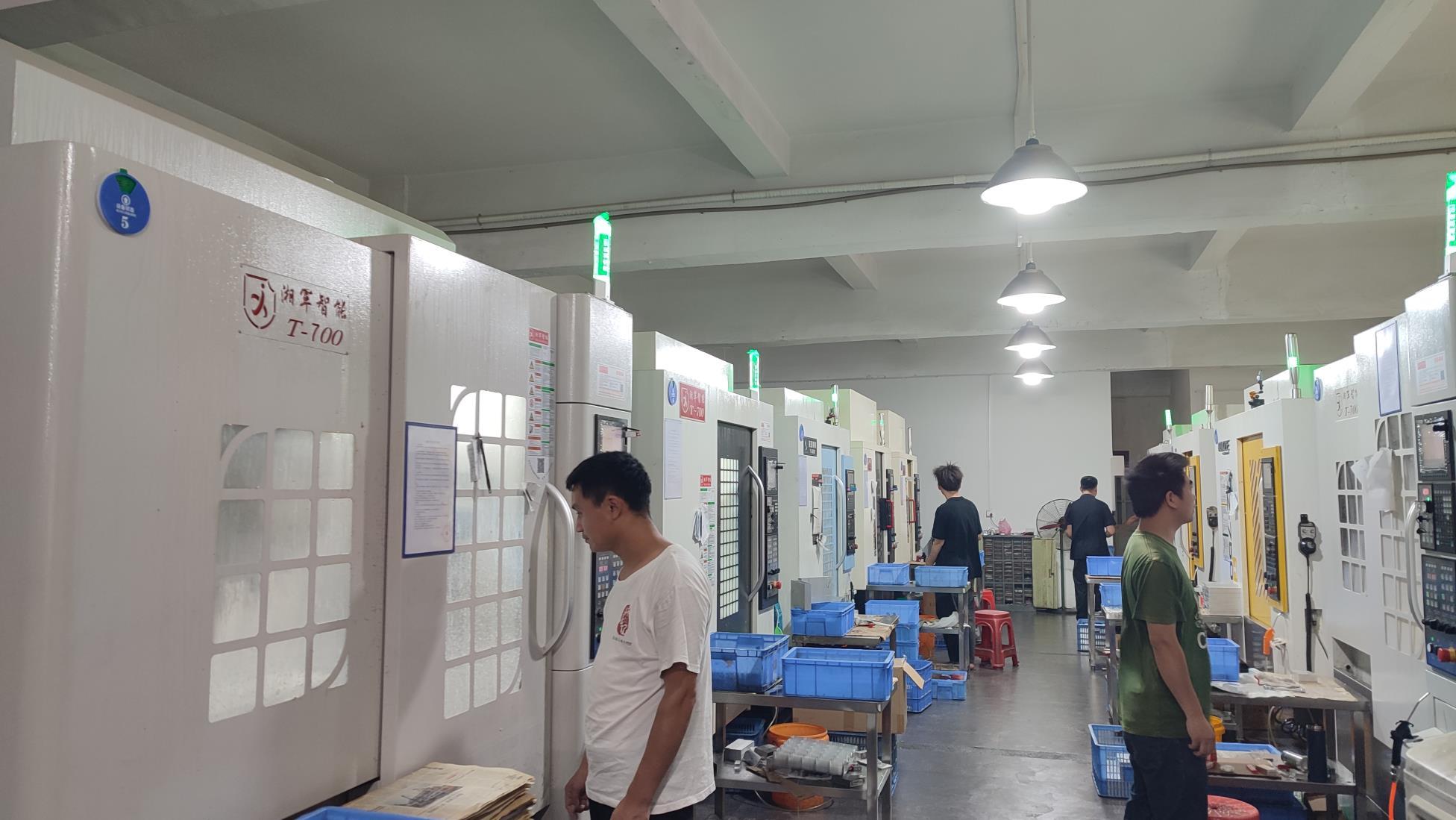
Manufacturing context: a production floor assessment and a document scope statement answer different questions about timing belt capability.
Mapping the Scope to Specific Belt and Pulley Families
A scope stated as "Timing Belt" is broad enough to cover a very wide catalogue, which is exactly why the associated product records matter. Under these two certifications, the linked product families span rubber and polyurethane timing belts in HTD and STD configurations, POLYCHIAN carbon timing belts, and timing pulleys in HTD, T-series and imperial configurations. That association is what a buyer should test line by line against a real RFQ.
| Product family in the RFQ | Association under the Timing Belt scope | What the buyer still has to confirm |
|---|---|---|
| HTD 8M and HTD 14M belts | Rubber timing belt, HTD timing belt entries | Pitch length, width, cord type and tooth profile against your drawing |
| HTD 5M rubber belts | Rubber timing belt, HTD timing belt entries | Whether the exact 5M construction was sampled or only catalogued |
| S8M rubber belts | STD timing belt entries | Pitch and tooth geometry tolerances, plus the pulley pair |
| T5, AT10 and AT5 PU belts | T PU and AT PU timing belt entries | Polyurethane grade, cord material, coating requirement |
| 8MGT POLYCHIAN belts | POLYCHIAN GT carbon timing belt entry | Load case justification, since high-accuracy drives are application-specific |
| HTD, T-series and imperial pulleys | HTD timing pulley, T Series Timing Pulley, Imperial Timing Pulleys | Bore, keyway, flange type, aluminium versus steel, balance class |
A scope covering "Timing Belt" does not by itself prove that every profile inside that family was physically sampled during the assessment. The table shows what the supplier associates with the assessed scope. It is the beginning of a drawing-level confirmation, not the end of one.
The Validity Window: 2026-07-10 to 2027-07-09
Both Alibaba.com records run for a single twelve-month period, issued 2026-07-10 and expiring 2027-07-09. The linked TÜV Rheinland factory audit report is dated one day earlier, 2026-07-09, and expires on the same date. As of November 2026 the file is roughly four months into that window, which makes it current but not permanent: about eight months of validity remain before a renewal is due.
Three practical consequences follow from a dated scope. First, calendar the re-check before the expiry rather than after it, so a renewal request lands during an ordinary RFQ cycle instead of during an urgent reorder. Second, treat the expiry date as a renewal checkpoint, not a quality verdict — a lapsed file does not mean the products changed, and a current file does not mean the products suit your application. Third, recognise that documents in a supplier file have different lifespans: factory assessments typically renew annually, while material test reports and product-level test certificates follow their own cycles and must be checked against their own dates rather than assumed to share the assessment window.
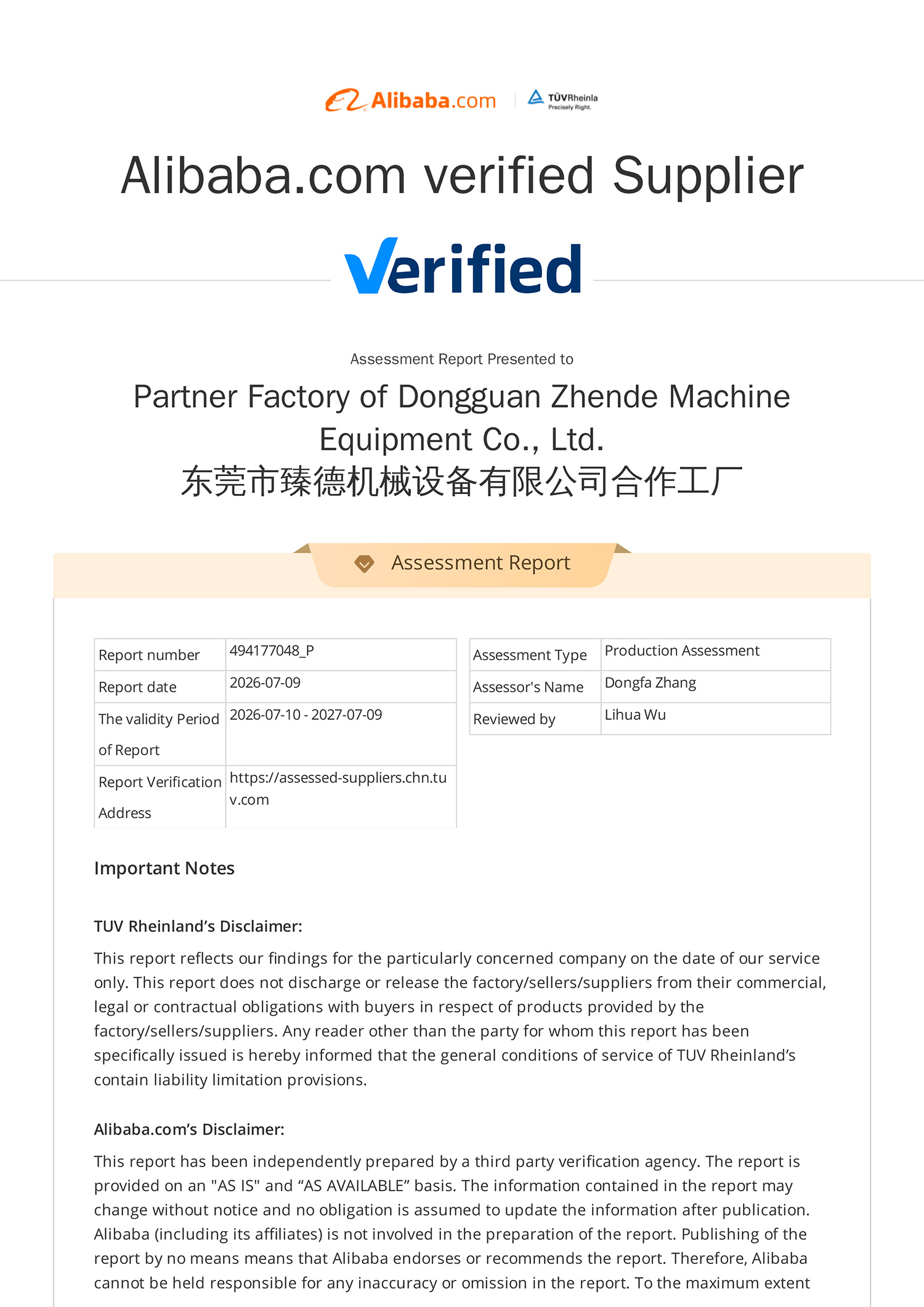
Assessment documentation: the scope, standard reference and validity dates are read from the same record, not from the badge alone.
What the Scope Does Not Establish
Knowing where the evidence stops is as useful as knowing where it starts. A scope statement scoped to timing belts and issued under an assessment framework does not deliver any of the following.
- Product-level performance data. No tensile strength figure, hardness value, dimensional tolerance or operating temperature range is certified by the scope line. Those come from test reports and drawings.
- Conformity to a belt dimension standard. ISO 13050 covers metric curvilinear synchronous belt and pulley profiles, ISO 5296 covers inch-pitch trapezoidal profiles, and ISO 5294 covers synchronous pulleys. Those are dimensional standards. The assessment here references SGS/TUV and a factory assessment standard, which is a different kind of document. A buyer writing a specification should name the governing dimensional standard separately rather than assuming the assessment covers it.
- Evidence that every listed profile was sampled. A category-level scope is compatible with a sampled audit.
- Application approval. Fit for a packaging line, a CNC axis or a food-contact conveyor depends on load, speed, pulley alignment, environment and, where relevant, regulation-specific material compliance. None of that is resolved by a supplier assessment.
- Coverage of subcontracted production. Where a supplier both manufactures and trades, the assessment type tells you which activity was reviewed, not which factory produced a given line item.
- Commercial commitments. Capacity, price, lead time and warranty terms sit in the quotation and contract, not in the certificate file.
From Scope to Purchase Order: A Five-Step Check
A scope reading becomes useful only when it is converted into a sequence a buyer can run against a live RFQ. The following order keeps document review honest without slowing the sourcing cycle.
- Classify every RFQ line. Confirm that each item is a timing belt or a timing pulley. V-belts, cast-iron V-pulleys, couplings, linear guides and pneumatic parts sit outside a scope stated as Timing Belt or as timing belt and timing pulley, even where the same supplier lists them.
- Match the profile family, not just the category. HTD 8M/14M, HTD 5M, S8M, T5, AT10, AT5, 8MGT POLYCHIAN and the pulley families each carry different tooling and inspection requirements. A category match is necessary but not sufficient.
- Verify the identifiers and dates against the documents themselves. 493993448_P+T and 494177048_P should appear with the issuing body, the assessment type and the 2026-07-10 to 2027-07-09 window. Where the same number appears as a TÜV Rheinland factory audit report dated 2026-07-09, the two should be read as linked records, not as competing claims.
- Ask what the assessment covered operationally. Zhende reports OEM and ODM production, belt customisation across length, width, tooth profile, pitch, material, tensile cord, coating, colour, perforation and logo printing, and stated monthly capacity of 500,000 belts and 100,000 pulleys with a 7–20 day lead time. Confirming that these activities fall inside the assessed operation is a different question from confirming they exist.
- Close the remaining gap with sample verification. The supplier states 100% dimensional inspection, tooth profile inspection, tensile strength testing, pre-shipment inspection and third-party SGS inspection as its control set. Buyers should test that claim with an actual sample: measure pitch and width, check bore and concentricity on pulleys, and run the belt under representative load before releasing volume.
Commercial parameters complete the picture rather than replace it. Minimum order quantities are stated at 4 pcs for belts, 10 pcs for standard pulleys and 50 pcs for customised pulleys, which makes a trial order practical before a production commitment. For context on the supplier itself, Dongguan Zhende reports a 2019 founding, a 4,500 m² facility, 40 employees, a six-engineer R&D team, annual output of 120,000 pcs, and a 75% export ratio concentrated on EU and USA markets — company-stated figures that belong beside the certificate, not in place of it.
Where Scope Reading Changes the Decision
Different applications pressure the scope statement in different ways. In packaging and conveyor work built around HTD 8M or 14M and S8M rubber belts, the decisive question is usually whether the assessed operation covers the specific pitch and width being replaced, because a drop-in replacement that is dimensionally adrift will show up as belt walk or tooth wear within weeks. In light-duty automation using HTD 5M rubber or T5, AT10 and AT5 PU belts, the material question dominates: polyurethane and rubber behave differently and the scope does not choose between them for you.
For high-accuracy positioning built on 8MGT POLYCHIAN carbon belts, the scope is the weakest form of evidence in the chain — positioning accuracy is an application outcome, and the assessment only confirms that the category was reviewed. On the pulley side, mixed orders are the common failure point: an order that pairs HTD or T-series pulleys with imperial pulleys and belts benefits from a scope that names both belts and pulleys, which is precisely what the TÜV-recorded scope does. Custom-size belts, coated belts and double-sided constructions sit at the edge of any category scope and should always be handled through drawing approval and a physical sample.
Document Review Compared With Traditional Supplier Due Diligence
The conventional route to supplier confidence is a site visit, several sample rounds and reference calls — thorough, but measured in months and travel budget. Reading a certification scope is the opposite trade: minutes of desk work that screen a shortlist before any of that spend is committed. The two are complements, not substitutes.
The boundary is worth stating plainly. A dated assessment scope is strong for eligibility screening and for structuring an RFQ; it is weak for capacity assurance, price benchmarking and delivery reliability, none of which it addresses. It also cannot substitute for incoming inspection, because a category-level assessment never certifies the dimensional conformance of a specific shipment.
Customs data does not fill that gap either. Endless synchronous rubber belts are classified by outside circumference band under HS 4010.35 and the residual 4010.39 rather than by tooth profile, so trade statistics cannot separate HTD from T5 or single-sided from double-sided construction. Profile-level capability has to be evidenced supplier by supplier — which is the practical argument for reading scope statements carefully rather than relying on aggregate category signals.

Factory audit documentation dated 2026-07-09 and expiring 2027-07-09, recorded under the same identifier as the production and trading assessment.
Outlook for Buyers Using Scope-Based Evidence
The twelve-month cycle visible in these records sets a reasonable expectation: assessment evidence in this category is renewed annually, so a file dated mid-2026 should be re-confirmed rather than assumed current through 2028. Buyers who build that rhythm into their supplier reviews — scope check at shortlisting, document re-check at renewal, sample verification at first order, incoming inspection thereafter — get most of the screening value without over-reading any single certificate.
The larger direction is toward traceable evidence rather than logos. A scope statement that names a product category, an assessment type, an issuing framework and an expiry date can be checked, dated and re-checked. That is a modest form of proof, but in a category where customs codes cannot distinguish tooth profiles and market forecasts cannot distinguish suppliers, modest and checkable is what a procurement decision can actually be built on.
Frequently Asked Questions
What does a "Timing Belt" certification scope actually cover?
It states the product category that was assessed, in this case timing belts, rather than a whole catalogue of transmission components. Under records 493993448_P+T and 494177048_P the scope is stated as Timing Belt, with a linked TÜV Rheinland factory audit report stating timing belt and timing pulley. Products outside that wording — V-belts, V-pulleys, couplings, linear guides, pneumatic parts — are not covered by the statement even when the same supplier sells them.
What is the difference between 493993448_P+T and 494177048_P?
They are two assessment types rather than two copies of one document. 493993448_P+T is typed as a Production Trading Assessment and is linked to a TÜV Rheinland factory audit report dated 2026-07-09 with scope stated as timing belt and timing pulley. 494177048_P is typed as a Production Assessment. Both reference SGS/TUV, both state the scope as Timing Belt, and both were issued 2026-07-10 with expiry on 2027-07-09.
How long are these records valid, and what should a buyer do before 2027-07-09?
Both Alibaba.com entries run from 2026-07-10 to 2027-07-09, a twelve-month window, and the linked TÜV audit report expires on the same date. A buyer should record the expiry in the supplier review calendar, request the renewal document during the next annual RFQ cycle, and confirm that the renewed scope still names the same product categories rather than a narrower or different one.
Does the scope cover pulleys as well as belts?
Partly. The Alibaba.com entries state the scope as Timing Belt, while the TÜV Rheinland factory audit report recorded under 493993448_P+T states its scope as timing belt and timing pulley. The associated product records list HTD timing pulleys, T Series Timing Pulley and Imperial Timing Pulleys. A buyer ordering pulleys should therefore reference the document that explicitly names pulleys, and should still confirm bore, keyway, flange type and material at drawing level.
Can a certification scope replace a sample test?
No. A scope statement records that a category was assessed under a defined framework within a stated period; it carries no dimensional, tensile or hardness value for a specific item. Sample verification remains necessary for pitch length, width, tooth profile, bore and concentricity, and for confirming behaviour under the actual load and speed of the application. The document narrows the shortlist; the sample decides the order.
For readers who want the full product and specification reference behind this analysis, the company brochure is available for public access and download: Dongguan Zhende Machinery Equipment Co., LTD product brochure (PDF).
¿Tiene preguntas o necesita más detalles?
Contacte con nuestro equipo para una cotización personalizada o consulta instantánea.
Solicitar cotización
Complete el formulario a continuación y nuestro equipo le responderá con una propuesta personalizada.
Chat directo de WhatsApp
¿Prefiere chatear en tiempo real? Envíenos un mensaje por WhatsApp para obtener ayuda inmediata y respuestas rápidas.
- Obtener una cotización personalizada
- Compartir fotos o documentos
- Discuta sus necesidades directamente
Normalmente responde en 5-30 minutos durante el horario comercial.