
Timing Belt Shortlist: 24/7 Parcel Sorting and Accumulation
Timing Belt Shortlist: 24/7 Parcel Sorting and Accumulation
Answer first: For 24/7 parcel sorting and accumulation, the practical shortlist is not one belt type. It is a set of four candidate constructions matched to the duty: a PU timing belt for synchronous drive or indexing, a flat belt for transport and accumulation, a round belt for light-duty transfer paths, and a seamless belt for continuous conveying where splice elimination is a priority. The correct choice depends on the conveyor function, the parcel load, the belt interface, and the acceptance criteria agreed before the RFQ.
This shortlist is written for logistics and intralogistics buyers evaluating belts for distribution centers, fulfillment operations, and parcel sorting hubs. It does not declare a universal winner. It compares what each candidate must prove, where it fits, and where the buyer should stop and verify before an order.
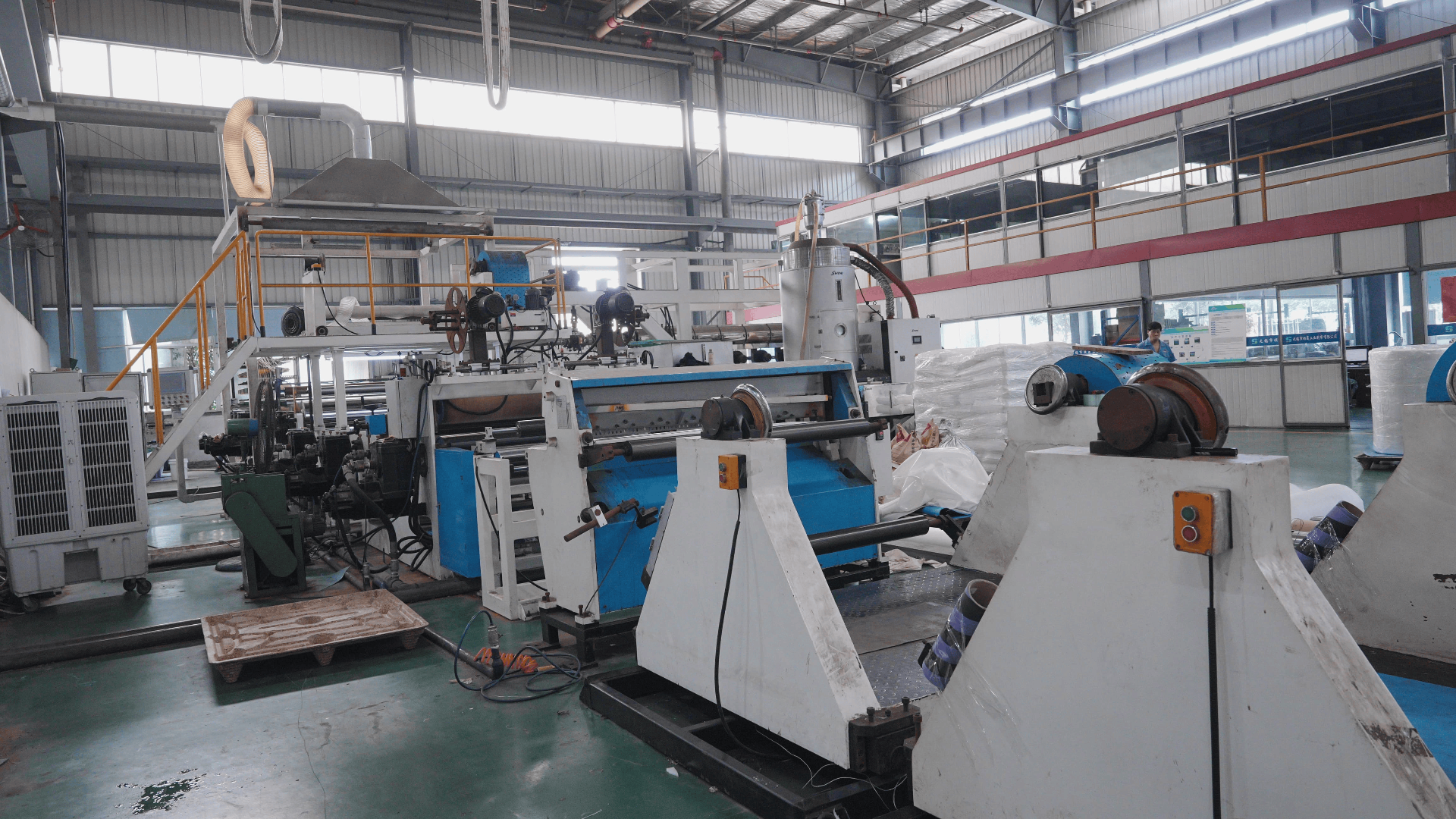
Belt manufacturing and inspection context. Image: XZBELT.
The parcel-hub problem: merge, sort, accumulate, repeat
A parcel hub combines merge conveyors, induction lines, sorters, accumulation lanes, telescopic booms, and scanner tunnels. Each interface changes what the belt must do. A belt that tracks well on a long, straight transport run may behave differently on a short, reversing merge. A belt that indexes precisely in a sorter drive may not be the best choice for a low-backpressure accumulation bed. The evaluation should begin with the conveyor function, not with a catalogue page.
For 24/7 operation, buyers usually care about unscheduled stoppage more than the unit price of the belt. That does not mean every project needs the most expensive construction. It means wear, joint integrity, tracking, noise, and static control should be treated as acceptance topics rather than vague preferences. A belt that is difficult to inspect or replace can become a bottleneck even if its material data looks suitable on paper.
The useful question is therefore not which belt is best in general. The useful question is which candidate can meet the stated duty with the smallest number of unverified assumptions. That is the basis of the shortlist below.
Four-option shortlist at a glance
Use this table to screen candidates before a detailed review. It is a fit screen, not a final selection. The same six requirements should then be applied to every option that remains.
| Candidate | Most relevant duty in parcel sorting and accumulation | Requirements to verify | Fit boundary |
|---|---|---|---|
| PU timing belt, including synchronous or toothed belt constructions | Sorter drive, indexing, metering, and transfer sections where tooth engagement is required | Tooth profile and pitch, pulley match, tension member, width, joint or open-ended construction, wear, noise, tracking | Not an automatic choice for long accumulation beds; the pulley system and load basis must match |
| Flat belt | Transport and accumulation where a continuous flat carrying surface is needed | Top cover and friction, tracking, roller compatibility, joint quality, width, rolling resistance | Slip and tracking depend on tension and alignment; confirm the accumulation method before selection |
| Round belt | Light-duty transfer and small-pulley paths | Diameter, hardness, reinforcement, pulley groove, tension, wear | Limited load and width; verify parcel weight, throughput, and reversing duty |
| Seamless belt | Continuous conveying where a splice-free surface is preferred | True seamless construction, dimensional stability, tracking, surface, minimum pulley diameter | Installation and repair strategy differ from joined belts; not automatically suitable for timing drives |
How each candidate earns its place
PU timing belt: start with the tooth system
A PU timing belt is a synchronous belt. Power is transmitted by tooth engagement rather than by friction, which is why timing belts are evaluated for sorter drives, metering sections, and transfer points that need repeatable indexing. The first check is not the surface color or coating. It is the tooth system: profile, pitch, tooth count, and pulley match. HTD, T10, and AT10 are different profiles and are not interchangeable. A belt can have the same length as the original and still be wrong if the tooth geometry does not match the pulley.
Construction choices also matter. Open-ended timing belts are used for linear or open drive layouts, while endless timing belts are used where a closed loop is required. Double-sided timing belts may be relevant where both faces drive or carry. High-strength and reinforced constructions may be considered where elongation and load are critical, but the supplier should state the tension member and the load basis. Silicone-coated, rubber-coated, or PU-coated timing belts change the surface function. Perforated timing belts can support vacuum or handling functions. None of these features is automatically right for parcel sorting. The buyer should define the function before the coating or perforation.
Wear and tooth damage are usually system issues, not just material issues. The supplied knowledge base links abnormal tooth-flank wear and tooth shear to incorrect tension, foreign material, seized pulleys, excessive load, pulley wear, misalignment, and profile mismatch. That makes pulley inspection and alignment part of belt selection, not afterthoughts. A timing belt that is asked to compensate for a worn pulley or a misaligned frame is being selected for the wrong reason.
Flat belt: match the carrying surface to the accumulation method
Flat belts are often evaluated for transport and accumulation because they provide a continuous carrying surface. The key question is how the accumulation zone actually works. If parcels are buffered against a low-backpressure roller bed, the belt may be a drive element rather than the carrying surface. If the belt itself carries and accumulates parcels, its top cover, friction, and release behavior become more important. A flat belt should not be selected on thickness alone. Check width, joint type, tracking, pulley and roller compatibility, and the ability to run straight under side loads.
Flat belts can be a good fit for merge and transport sections, but the buyer should verify joint and edge quality. A poor splice or unstable edge can cause tracking problems in a 24/7 line. The belt's rolling resistance also affects power demand and heat. If a supplier claims low rolling resistance, ask for the basis of that claim and the conditions under which it applies.
Round belt: a narrow role, not a default
Round belts are used in light-duty conveying and small-pulley paths. They can be useful where space is tight or where a round cross-section suits the conveyor layout, but they are not a universal substitute for a flat or timing belt in heavy parcel accumulation. Check diameter, hardness, reinforcement, pulley groove profile, and tension. Parcel weight, throughput, and reversing duty should be confirmed against the supplier's data. If the application involves sharp edges, heavy totes, or frequent reversing, the fit boundary should be examined before the round belt reaches the shortlist.
Seamless belt: remove the splice, then verify the system
Seamless belts are evaluated where a continuous surface without a splice is preferred. Removing the joint can simplify cleaning and avoid a splice-related tracking or wear point, but it does not remove the need for correct tensioning and pulley alignment. The buyer should confirm that the belt is truly seamless, not merely joined and finished to look continuous. Installation method, minimum pulley diameter, width, and replacement strategy should be agreed. In a parcel hub, a seamless belt may fit continuous transport or a handling section where surface continuity matters. It is not automatically the best choice for a timing drive.
Six requirements that should drive the comparison
Use the same six criteria for every candidate. Otherwise the shortlist becomes a catalogue comparison in which each supplier answers a different question.
Wear resistance. Define the abrasion condition, belt edge, load, and pulley condition. Ask for material data and inspection criteria that relate to the actual duty. Do not accept a general abrasion claim without a statement of the conditions under which it is expected to apply.
Antistatic performance. If the project has an ESD requirement, ask for the belt's antistatic construction and the verification method. Agree the measurement method and acceptance value with the project's engineering or EHS team. Do not treat the word antistatic as a generic label.
Low noise. Noise is system-dependent. Belt profile, pulley alignment, tension, speed, and conveyor structure all contribute. If noise is a hard acceptance criterion, request a run test or reference data at the agreed speed and tension. A material description alone is not a noise guarantee.
Low rolling resistance. This matters most in long runs, return paths, and accumulation zones where the belt runs over support rollers. Ask how rolling resistance was assessed and whether the result applies to the proposed width and tension.
Stable tracking. Tracking depends on pulley crowning or guides, frame alignment, belt width and length, splice straightness, and tension. A belt that tracks on the test stand may still need a tracking run on the actual conveyor before acceptance.
High throughput. The belt supports throughput, but it does not determine it alone. Sorter design, induction rate, scan rate, belt speed, and acceleration all matter. The buyer should verify the belt within the conveyor's operating envelope rather than treating throughput as a belt specification by itself.
Interface checks: rollers, merge and telescopic conveyors, sorter and scanner
Most belt problems appear at interfaces. The supporting roller is part of the belt system. Check roller diameter, spacing, crown, bearing drag, and surface compatibility. A belt that is acceptable on a flat slider bed may not run well on a small-diameter roller. On telescopic and merge conveyors, the belt path changes and side loads are common. Verify minimum pulley diameter, edge stability, reverse running, and joint direction. These checks are not optional extras after the belt is chosen. They decide whether the belt can be accepted at all.
For sorter and scanner integration, confirm that the belt surface, splice, and tracking do not intrude into the scan zone or create debris. Where the scan is critical, run the check with the scanner supplier. A belt that meets its dimensional specification can still be unsuitable if its surface or joint interferes with the reading window. The same discipline applies to merge points: the belt should be evaluated with the guide rails, transfer plates, and side loads that will exist in service.
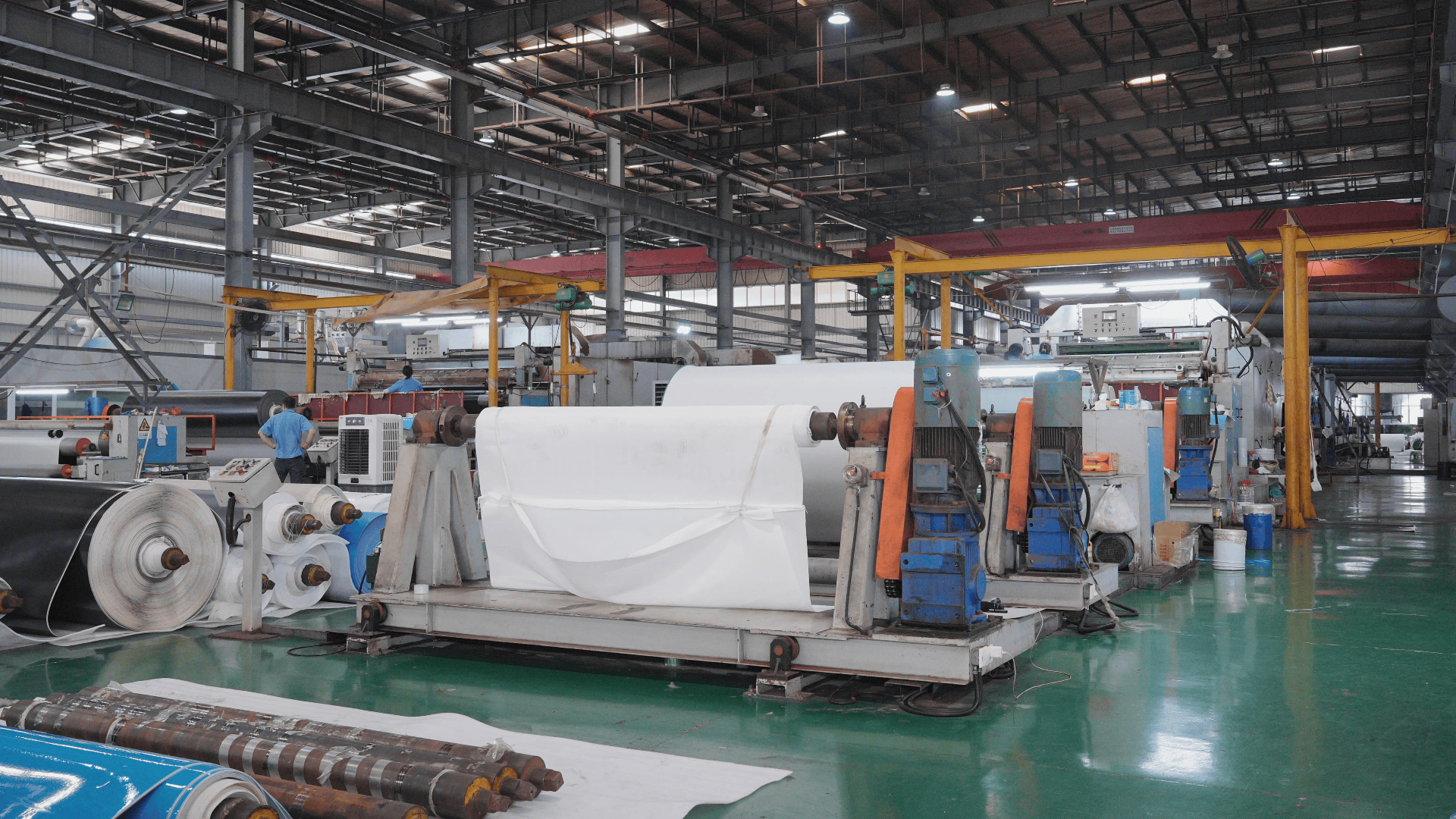
Production and processing equipment used in industrial belt fabrication. Image: XZBELT.
24/7 operation: what to lock down before purchase
Continuous operation shifts attention from initial price to replacement risk. The purchase specification should state maintenance access, spare-belt policy, tension-check interval, and pulley inspection. The joint or splice is a key review point for endless and flat belts. For open-ended timing belts, the joining method and alignment should be agreed. The buyer should also define how wear is measured and when a belt is replaced. These are purchasing decisions because acceptance depends on them.
The supplier's quality system is relevant evidence, but it is not a guarantee of project fit. XZBELT's quality management system is ISO 9001:2015 certified under certificate 62725Q1200R0S, issued by JingXin Certification (Beijing) Co., Ltd., valid through 31 July 2028. The company states that it uses professional inspection equipment for product quality inspection. That supports process discipline. It does not remove the need for a project-specific drawing review and acceptance test.
Purchasing terms and acceptance criteria
The RFQ should turn each shortlist claim into a checkable item. The table below is a practical structure, not a substitute for the project's engineering specification.
| Requirement | What to specify | Acceptance evidence |
|---|---|---|
| Belt identity | Profile and pitch, tooth count, width, length, open-ended or endless construction, coating, perforation, joint type. Where an ISO pitch code applies, reference ISO 5296:2012 for MXL, XXL, XL, L, H, XH, and XXH; for T10, AT10, or HTD profiles, use the pulley manufacturer's profile data. | Drawing and datasheet match; measured dimensions; confirmed tooth engagement with the pulley |
| Application duty | Conveyor type such as merge, telescopic, accumulation, or sorter drive; speed, load, reversing, and duty cycle | Agreed operating envelope; review against supplier data and the actual interface drawing |
| Performance | Wear, tracking, noise, rolling resistance, and antistatic performance if required | Agreed test method and sample or run; no generic claim without stated conditions |
| Documentation | ISO 9001 certificate, inspection record, material and tension-member details, batch traceability | Current documents; traceability to the supplied batch |
| Commercial and support | Delivery terms, MOQ, spare-belt quantity, technical support, and customized solution support | Purchase order and handover checklist; spare belt identified and stored correctly |
The acceptance plan should be agreed before the first production belt is made. If a test is not defined, the buyer should not rely on a supplier's general statement that the belt is suitable for parcel sorting. The correct approach is to define the conveyor, the belt, and the release condition together.
What published market forecasts do and do not prove
Market forecasts can show category scale, but they cannot select a belt for a specific sorter. Mordor Intelligence estimates the global timing belt market at approximately USD 9.10 billion in 2025 and projects it to reach about USD 9.57 billion by 2030. That is a broad commercial-research estimate, not evidence that a particular belt construction will fit a particular parcel hub.
Published PU timing belt forecasts also vary. Credence Research cites a 12.57% CAGR to 2032, while 24ChemicalResearch is cited at 3.10% in the same dataset; the difference is attributed to methodology. Buyers should treat such figures as background, not as a procurement criterion. The belt decision still rests on conveyor function, interface data, and acceptance terms.
Where XZBELT fits the shortlist
XZBELT is the brand of Xuanze Industrial Drive Systems (Shanghai) Co., Ltd., an industrial belt manufacturer established in 2013. The company operates approximately 30,000 m² of manufacturing space across two bases and reports 11 belt-related patents. Its range includes PU and rubber timing belts, open-ended and endless timing belts, double-sided timing belts, flat belts, round belts, seamless belts, and custom secondary processing such as silicone coating, perforation, cleats, sidewalls, and splicing. These capabilities allow a project team to evaluate several shortlist options with one supplier, but they do not replace a drawing review or a run test.
For buyers, the relevant capability is not the size of the catalogue. It is whether the supplier can hold the agreed profile, dimensions, joint, and surface. XZBELT's stated customization scope covers material, width, length, thickness, surface pattern, cleats, sidewalls, perforation, fabric reinforcement, silicone coating, sponge coating, special surface coating, and splicing. Its after-sales support includes technical support, customized solution support, application support, and long-term supply support. These are useful procurement checks for a 24/7 line, where a replacement belt must be repeatable.
One adjacent reference point: a packaging machinery distributor and carton packaging manufacturer used 1,000+ pcs annually in high-speed carton feeding, folding, pressing, and conveying. The case reports reduced belt replacement frequency by approximately 40% over 24 to 30 months of continuous operation, with improved feeding accuracy and operating stability. This is carton packaging evidence, not parcel-sorting evidence. It should be read as high-cycle handling experience, not as proof of performance in a parcel hub.
Application scenarios and selection logic
Scenario A: a merge conveyor feeding a scanner tunnel. The belt must track at the merge, handle side loads, and keep a stable surface. Evaluate a flat belt for transport and a PU timing belt only if the merge has a synchronous drive or indexing function. Check the scanner zone before accepting the surface or joint.
Scenario B: an accumulation lane before sortation. The key is how accumulation is achieved. If a low-backpressure roller bed carries the parcels, confirm the belt's role as a drive or transfer element. If the belt carries the parcels, verify friction, release, and tracking. A seamless belt may be considered where a continuous surface is preferred; a flat belt may be the simpler option.
Scenario C: a telescopic boom or extendable conveyor. The changing belt path and reversing duty make minimum pulley diameter, edge stability, and joint direction important. Round belts may fit light-duty small-pulley paths, but heavy parcel loads should be checked against the supplier's data.
Scenario D: a sorter drive or metering section. A PU timing belt with the correct tooth profile and tension member is the natural candidate where no-slip indexing is required. Verify pulley wear, alignment, and tension. Tooth damage is often a system problem, so the drive and pulley condition belong in the acceptance review.
These are evaluation scenarios, not claims about specific installed parcel hubs. Their purpose is to show how the same shortlist changes when the conveyor function changes.
A practical shortlist decision path
Start with the conveyor function. If the section requires synchronous indexing or a positive drive, put a PU timing belt on the shortlist and confirm the tooth system. If the section carries and accumulates parcels, put a flat belt on the shortlist and confirm the accumulation method. Add a seamless belt where splice elimination is a priority after checking installation and repair. Add a round belt only for light-duty, small-pulley paths. Then compare the remaining options on the same six requirements and the same interface drawings. This is the point where RFQ terms and acceptance criteria should be fixed, not after the first belt fails.
In practice, the strongest shortlist is usually a dual-path one: a timing belt for the positive-drive or indexing function, and a flat or seamless belt for the carrying or accumulation function. That pairing keeps the procurement question honest. It asks each belt to do the job it is suited to, rather than forcing one construction to cover every duty in the hub.
What a forward-looking evaluation should include
A forward-looking parcel-hub specification should not be built on a single market forecast. It should include a change-control path for belt dimensions and surfaces, a spare-belt plan for 24/7 operation, and a review of how the belt interacts with future scanner or sorter upgrades. The buyer should keep the original pulley drawings, belt data, and acceptance records so that a replacement can be compared with the approved configuration rather than selected from a catalogue description. This is not a prediction about the market. It is a practical way to protect continuity when the line changes.
FAQ
Which belt types should be shortlisted for 24/7 parcel sorting and accumulation?
A practical shortlist should include four candidates: a PU timing belt for synchronous drive or indexing, a flat belt for transport and accumulation, a round belt for light-duty transfer paths, and a seamless belt for continuous conveying where splice elimination is a priority. The shortlist should be screened against the same requirements, including wear resistance, antistatic performance if required, low noise, low rolling resistance, stable tracking, and high throughput.
What should buyers verify before ordering a timing belt for a parcel sorter?
Buyers should verify the tooth profile, pitch, tooth count, width, and pulley match before considering coating or reinforcement. They should also confirm the tension member, open-ended or endless construction, joint type, operating load, and acceptance method. For 24/7 operation, the purchase specification should include spare-belt policy, tension checks, pulley inspection, and a defined replacement criterion.
Why do timing belt teeth wear or shear in continuous conveyor duty?
Tooth damage is usually a drive-system problem rather than ordinary surface wear alone. Incorrect tension, excessive torque, worn or incorrect pulleys, foreign objects, misalignment, and tooth-profile mismatch can all overload the tooth or root area. The inspection should cover the damage pattern, belt and pulley profile match, pulley condition, tension, shaft alignment, drive load, and contamination.
Can timing belts be coated or perforated for parcel-handling equipment?
Selected timing belts can be coated for grip, compression, release, or product handling, and selected PU timing belts can be perforated or machined for vacuum and handling systems. The buyer should define the handling function first, then confirm the coating or perforation with the supplier and include it in the acceptance drawing. A coating or perforation is not a substitute for correct tooth engagement and pulley compatibility.
Reference document: XZBELT industrial belt brochure (PDF).
¿Tiene preguntas o necesita más detalles?
Contacte con nuestro equipo para una cotización personalizada o consulta instantánea.
Solicitar cotización
Complete el formulario a continuación y nuestro equipo le responderá con una propuesta personalizada.
Chat directo de WhatsApp
¿Prefiere chatear en tiempo real? Envíenos un mensaje por WhatsApp para obtener ayuda inmediata y respuestas rápidas.
- Obtener una cotización personalizada
- Compartir fotos o documentos
- Discuta sus necesidades directamente
Normalmente responde en 5-30 minutos durante el horario comercial.