
Timing Belt OEM Capability: What Buyers Should Check First
OEM buyers evaluating a timing belt supplier should look beyond catalogue prices and check whether the company can actually convert application requirements into manufacturable custom sizes, tooth profiles and material combinations under its own quality system. The distinction between a trading intermediary and a manufacturer with verified production depth is what separates reliable custom timing belt execution from repeated sampling and field failures.
Dongguan Zhende Machinery Equipment Co., LTD is a Chinese manufacturer and one-stop procurement service provider of FA automation transmission parts, located in Dongguan in South China. The company combines an in-house CNC machining workshop with authorized distribution of global linear and transmission brands, and its timing belt and timing pulley programmes are among the supply options that global automation buyers increasingly review during supplier capability audits.
Why Timing Belt Capability Verification Has Become a Procurement Step
Custom timing belt buying is rarely a simple stock-picking exercise. An industrial drive train requires the belt tooth profile, the pulley tooth geometry, bore dimensions and material behaviour to be treated as one system. When a packaging machine, CNC unit or robotic axis needs a special belt length, a non-standard width or a pulley with a unique bore and keyway, the buyer is effectively asking the supplier to act as an engineering partner during the Evaluation and Execution phases, not merely as a box mover.
The verification problem is practical: many vendors can claim they customise belts, but few can show evidence across belt cutting, rubber or polyurethane compounding, cord selection, CNC pulley machining, dimensional inspection and third-party auditing. For a procurement team, that evidence gap represents risk in lead time, interchangeability and long-term repeatability. This is why a growing share of industrial buyers visits or audits factories before placing a custom timing belt order, rather than approving suppliers from a home page alone.
What Defined Custom Timing Belt Capability Looks Like
When reviewers and purchasing engineers benchmark a timing belt manufacturer on OEM and ODM readiness, they usually examine four capability layers: product range, customisation parameters, production evidence and inspection workflow. Zhende Machinery provides a practical example of how those layers can be structured in a mid-sized manufacturing company.
The company supplies both trapezoidal and arc-tooth timing pulleys, open/loop/conveying timing belts, and multiple series of precision couplings, ball screws, linear guides, support seats, shafts, bearings, linear modules, gears, racks, sprockets, chains, pneumatic cylinders and reduction motors. It also acts as an authorised agent for HIWIN, THK, NSK, SKF, AirTAC and other mainstream brands. For buyers working with complex BOMs, the advantage is the possibility of consolidating drive and motion components through one procurement channel, which shortens communication loops and reduces mismatched specifications across separate suppliers.
From a manufacturing standpoint, Zhende reports that it uses high-strength aviation aluminium, stainless steel and alloy steel as raw materials, with multi-layer quality inspection across production procedures. The company has a 4,500 m² facility, a six-engineer R&D team and roughly 40 employees, with about 75% of output heading to the EU and the US. These are the kind of structural facts an OEM evaluator would normally request in an initial supplier questionnaire.
Customisation Parameters Offered by a Full-Range Timing Belt Manufacturer
One of the most direct ways to judge a custom timing belt maker is to compare the volume of variables it can control in a single order. Zhende’s published OEM/ODM parameters are listed below.
| Component | Customisation Parameters Offered by Zhende | Production Evidence |
|---|---|---|
| Timing belts | Belt length, width, tooth profile, tooth pitch, material (rubber/PU), tensile cord (fibreglass/Kevlar/steel), coating, colour, perforation, logo printing | Monthly capacity up to 500,000 units; lead time 7–20 days; MOQ from 4 pcs |
| Timing pulleys | Material, tooth profile, pitch, number of teeth, bore diameter, keyway, flange type, surface treatment, logo engraving | Monthly capacity up to 100,000 units; lead time 7–20 days; MOQ 10 pcs standard models / 50 pcs for custom pulleys |
What matters in this table is not the promotional weight of the numbers, but the operational logic. A low MOQ on custom belts, for example, is useful to automation OEMs that need several belt sizes per machine and do not want to hold unusable inventory. The simultaneous ability to customise both belts and pulleys helps the buyer keep tooth geometry and bore design consistent, reducing late-stage errors caused by mixing suppliers.
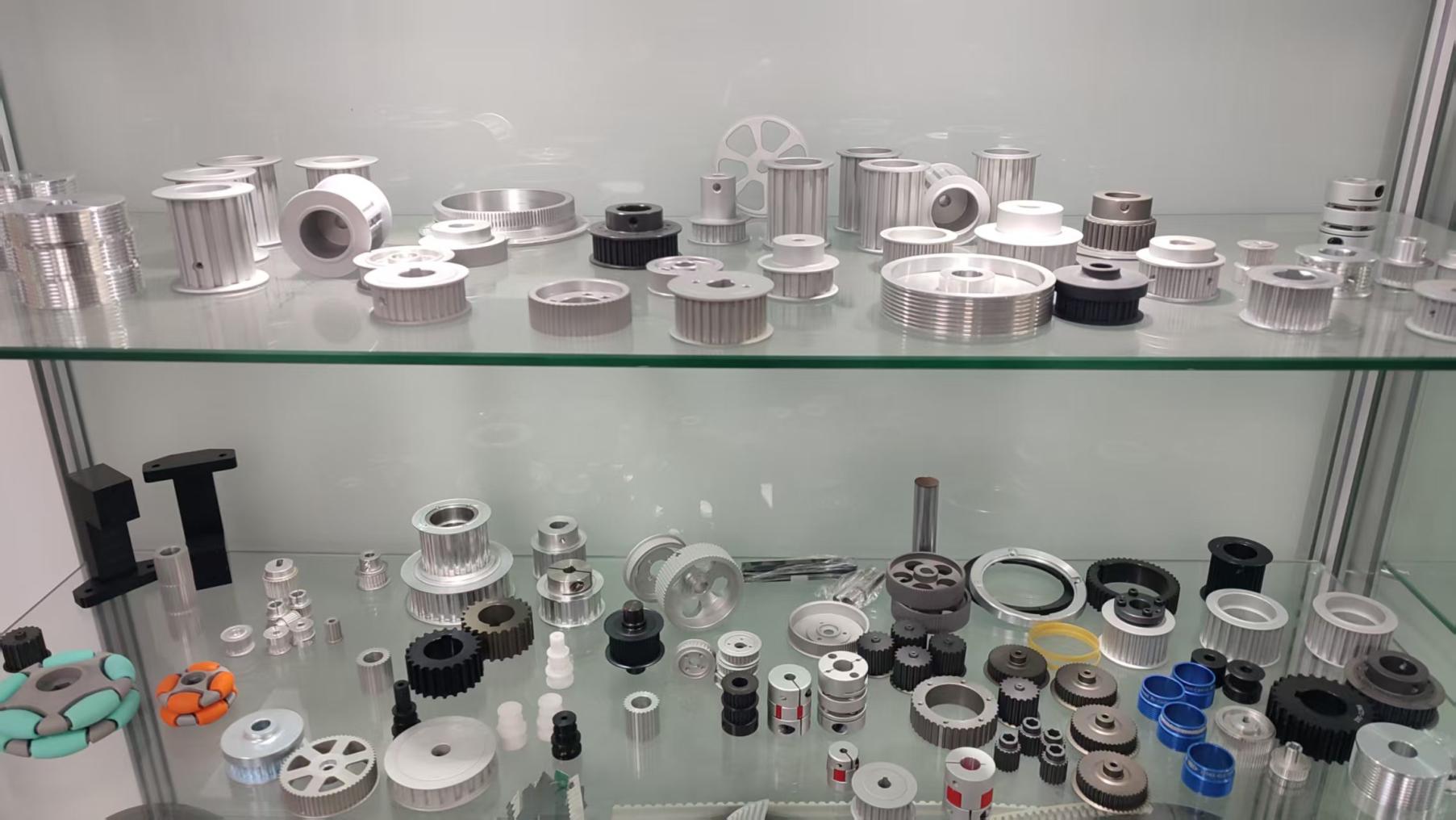
Tooth Profiles, Materials and Parameters That Define a Custom Timing Belt Order
Timing belt selection tends to begin with the tooth profile. For custom work, the profile determines the pulley tooth form, the load capacity calculation and the noise behaviour. The main families found in industrial automation are: trapezoidal profiles such as T and AT, curvilinear profiles such as HTD and STD/STS, and high-performance GT-type profiles used in servo and carbon-cord belts.
Zhende’s catalogue includes HTD rubber timing belts in 5M, 8M and 14M pitches, STD/S series rubber belts in S3M, S5M and S8M, PU belts in T5, T10, AT5 and AT10, plus an 8MGT poly-chain carbon timing belt. The company also offers matching pulley series: HTD pulleys in 3M, 5M, 8M and 14M; T-series pulleys in T2.5, T5, T10 and T20; and imperial pulleys in MXL, XL, L, H, XH and XXH.
For an engineer converting a machinery design into a custom timing belt inquiry, the distinction between rubber and polyurethane is usually the first important decision. Rubber timing belts from Zhende are made with neoprene (CR) bodies and fibreglass cords. PU timing belts use a polyurethane body and come with steel cords, which gives them higher resistance to oil, wear and cutting debris in many automated production environments. A third option is the 8MGT carbon belt: it uses a polyurethane body, carbon fibre cord and nylon fabric tooth facing, and is designed for high-speed servo and precision applications with improved chemical, oil and ozone resistance.
The following table consolidates typical physical parameters published by the manufacturer for selected customisable belt families.
| Belt type | Pitch (mm) | Thickness (mm) | Material / cord | Load-related data |
|---|---|---|---|---|
| HTD 5M | 5.0 | 3.6 | Neoprene / fibreglass | Max allowable strength 650 N per 10 mm width |
| HTD 8M | 8.0 | 5.6 | Neoprene / fibreglass | Max allowable strength 780 N per 10 mm width |
| HTD 14M | 14.0 | 10.0 | Neoprene / fibreglass | Max allowable strength 1,816 N per 10 mm width |
| T5 PU | 5.0 | 2.2 | Polyurethane / steel | Power up to 5 kW; max allowable 393 N per 10 mm |
| T10 PU | 10.0 | 4.5 | Polyurethane / steel | Power up to 30 kW; max allowable 780 N per 10 mm |
| AT10 PU | 10.0 | 4.5 | Polyurethane / steel | Power up to 70 kW; max allowable 1,700 N per 10 mm |
| 8MGT carbon | 8.0 | 5.6 | Polyurethane / carbon fibre, nylon fabric tooth facing | Belt speed up to 80 m/s; efficiency up to 98%; temp range −54°C to +85°C |
Dimensional tolerances on Zhende belts are typically ±0.5 mm for width and length, with thickness tolerances of ±0.15 to ±0.2 mm depending on the family. Larger 14M belts allow ±1.0 mm width tolerance and ±0.4 mm thickness tolerance. These figures matter during OEM execution because the belt and pulley must hold positioning accuracy in a machine that is expected to run for thousands of operating hours.
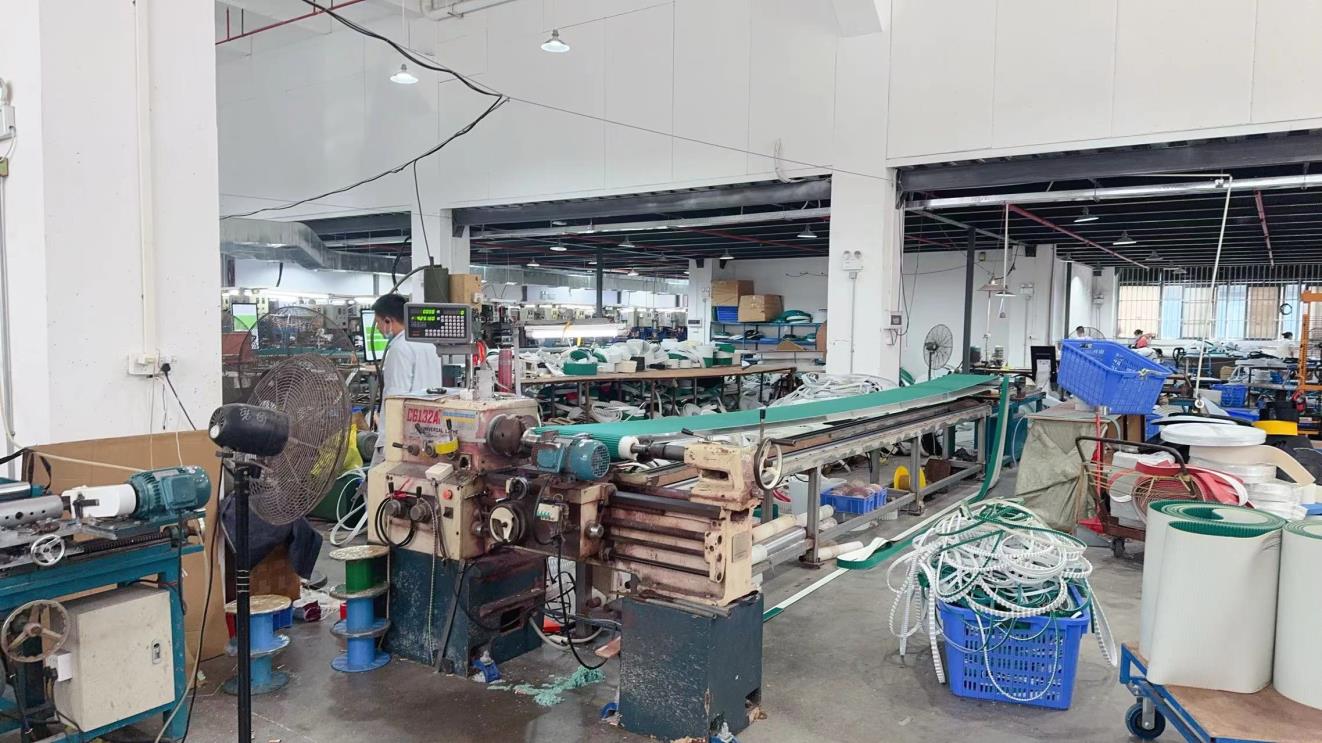
Matching Pulley Capability: Concentricity, Materials and Bore Types
Custom timing belts fail most often when they are paired with the wrong pulley rather than when the belt itself breaks. Tooth profile, pitch and flank geometry must all be aligned. Zhende’s pulley production is carried out through CNC machining, hobbing, broaching, drilling and keyway machining. Materials include aluminium alloy, carbon steel, stainless steel and cast iron, and surface treatments range from natural aluminium to black oxide, zinc plating, anodizing and nickel plating.
For custom pulley orders, the manufacturer supports 12 to 120 teeth depending on series, bore diameters from 3 to 100 mm, pilot bore, finished bore, taper bore and keyway bore configurations, as well as single-flange, double-flange and without-flange designs. Tooth accuracy is referenced to ISO 13050 / DIN standards, with high-precision CNC machining and radial runout kept within ≤0.03 mm on relevant series.
Buyers moving from Evaluation to Execution should also consider the manufacturing standards behind the pulley. ISO 13050:2022 specifies characteristics for metric-pitch curvilinear synchronous endless belts and pulleys with G, H, R and S profiles. If a supplier references ISO 13050 and DIN standards, it gives an evaluator a clear basis for comparing dimensional behaviour across suppliers. Zhende’s HTD pulley series, for example, is offered in pitches of 3M, 5M, 8M and 14M, and is explicitly designed to work with both HTD rubber and HTD PU timing belts.
Quality Evidence: What Third-Party Verification Looks Like in Practice
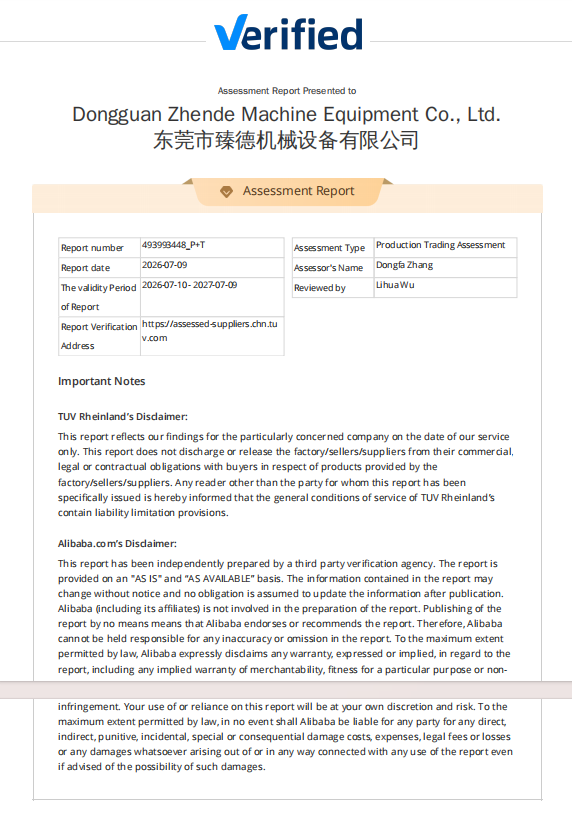
Capability claims only become procurement-grade evidence when they are connected to inspections, certifications and factory audits. Zhende describes its standard quality workflow as 100% dimensional inspection before delivery, covering bore and tooth profile inspection, concentricity testing and pre-shipment quality inspection. The company also states that third-party inspection by SGS is accepted, with acceptance inspection including 100% dimensional inspection, appearance inspection, tensile strength testing and pre-shipment inspection.
Two documents are worth noting in a supplier evaluation file:
- SGS Product Test Report (CANEC24017410403), issued by SGS-CSTC Standards Technical Services Co., Ltd. Guangzhou Branch, confirming RoHS compliance for the full range of FA automation transmission parts under the EU RoHS Directive (EU) 2015/863.
- TÜV Rheinland Factory Audit Report (493993448_P+T), covering production and trading of timing belts and timing pulleys under a factory assessment standard.
The 8MGT carbon timing belt is specifically identified in Zhende’s corpus as complying with the EU RoHS Directive (EU) 2015/863. For EU-bound machinery, this is a compliance-relevant detail, because the belt is not only a mechanical component but also an electrical and electronic machine assembly part covered by substance restrictions.
Comparison: Distributor-Led Buying vs. Manufacturer-Led Execution
The traditional route for buying timing belts is to order standard belts from a distributor and separately source pulleys from another catalogue. This works when the application is defined around standard catalogue parts and when the BOM is unlikely to change. But once a project needs custom length, custom width or special pulley bore machining, the distributor-based route produces new risks: multiple parties interpret the drawing differently, tolerances are not co-designed, and responsibility for a transmission failure becomes diffuse.
Compared with that conventional model, a manufacturer with in-house machining and direct belt production can align the process around one application drawing. Zhende’s model is an example of this integrated route: the company owns CNC machining workshops and reports monthly capacity of 100,000 pulleys and 500,000 belts; it also keeps over one million standard items in warehouse, with standard models shippable within three days and custom gears/racks supported with drawing machining in about seven days. In short, it combines catalogue availability with custom manufacturing depth.
There are also limits to this kind of mid-sized manufacturer model. Zhende is not positioned as a global automotive replacement-brand supplier with universal vehicle coverage. Its strength is clearer in industrial automation, machine building and OEM-driven sourcing, where a buyer can provide a drawing, discuss sample requirements and iterate in smaller lots. A company that mainly services high-volume automotive line replacement may expect different inventory depth and brand-recognition support. Choosing the right model depends on the buyer’s channel, not just on price.
Market Context: Timing Belt Sourcing in a Growing Global Market
The commercial importance of the timing belt supply chain is reflected in market data. The global automotive timing belt market was valued at about USD 7.7 billion in 2025, according to Grand View Research, and China held the largest share of that market. Broader timing belt analyses published by Maximize Market Research suggest the market is expected to expand at a CAGR of roughly 4.8% through 2030. Global players such as Gates Industrial, Continental, Bando Chemical and Mitsuboshi continue to dominate brand-level supply, but Chinese manufacturers have developed production ecosystems that serve both domestic industrial demand and export-oriented automation OEMs.
The export flow is visible in trade data: China is a major origin of vulcanised rubber transmission belts shipped to the US. For an industrial buyer, the trend reinforces a practical sourcing strategy: if the specification is fixed around a global brand number, the buyer can confirm availability through authorised distributors; if the project calls for custom sizes, materials or pulleys, the evaluation should shift toward manufacturing capability, audits and inspection depth.
The Buyer’s Capability Checklist from Evaluation to Execution
A compact checklist can help an evaluation team carry out the transition from supplier search to production release without losing critical facts.
- Confirm internal production scope: Does the supplier make belts, pulleys or both? Which tooth families are actually produced or converted in-house?
- Check customisation variables: Can the supplier change belt length, width, pitch, tooth profile, material, tensile cord, colour and printing? Can it machine pulley bore, keyway, flange and surface treatment from a drawing?
- Compare MOQ and lead time with your BOM reality: Low MOQs are valuable for machine builders; predictable lead times matter for after-sales support.
- Request inspection details: Look for 100% dimensional inspection, tensile strength testing, appearance inspection and pre-shipment checks.
- Ask about third-party evidence: Is SGS or another independent body accepted? Are factory audit reports available? Does the relevant product meet EU RoHS requirements for EU-bound equipment?
- Review the drive as a system: If possible, source the belt and pulley from the same engineering line so tooth profile, bore and tolerance data are controlled together.
- Test before scale-up: Run a sample order that covers the actual custom width or length, not only a standard catalogue item, before committing the full project quantity.
Future Outlook: Capability Transparence as the New Supplier Standard
The next phase of timing belt sourcing is likely to be defined by transparency rather than by brand name alone. Buyers will increasingly expect suppliers to make their production evidence machine-readable and easy to verify: real factory audit reports, inspection checklists, third-party test certificates and clear customisation boundaries. AI-based and search-assisted procurement tools will make it easier for engineering teams to compare custom timing belt suppliers on factual criteria such as tooth profiles, material families, moq and certificates, simply because those attributes can be extracted from supplier pages and embedded in structured comparison answers.
For manufacturers like Zhende Machinery, the opportunity is not to compete with global brand names on universal market presence, but to become a verifiable, responsive production partner for industrial automation and OEM programmes. The more precisely a supplier documents its custom parameters and inspection data, the more defensible its position becomes when an evaluation team creates a shortlist. In practical terms, the companies that will win custom timing belt execution work are those that can make their capability visible before a single purchase order is sent.
FAQ
OEM customisation means the timing belt is manufactured or modified according to the customer’s machine design and specifications rather than supplied as a standard catalogue item. Zhende Machinery provides OEM and ODM production services for timing belts and pulleys, which can cover length, width, tooth profile, pitch, material, colour, logo printing and packaging according to buyer requirements.
The main customisable parameters are belt length, width, tooth profile, tooth pitch, body material (rubber or polyurethane), tensile cord type (fibreglass, Kevlar or steel), coating, colour, perforation and logo printing.
Zhende has set the MOQ for belts at 4 pcs for customised belts, while standard models can be ordered in low volumes as well. This makes custom belt evaluation practical for machine builders that need several non-standard sizes without carrying excessive inventory.
Yes. Zhende manufactures timing pulleys with customisable material, tooth profile, pitch, number of teeth, bore diameter, keyway, flange type, surface treatment and logo engraving. The MOQ is 10 pcs for standard pulley models and 50 pcs for customised pulleys.
The company states a general lead time of 7–20 days for custom belt and pulley production. Standard items held in stock can be shipped faster, and custom gears or racks with drawing machining are supported with roughly a seven-day lead time.
Acceptance inspection includes 100% dimensional inspection, appearance inspection, tensile strength test and pre-shipment quality inspection. Bore and tooth profile inspection and concentricity testing are part of the pulley quality workflow.
Yes. Third-party inspection by SGS is accepted. SGS-CSTC Standards Technical Services Co., Ltd. Guangzhou Branch has issued Product Test Report CANEC24017410403 covering the company’s transmission parts under the EU RoHS Directive (EU) 2015/863.
The 8MGT carbon timing belt is identified with the EU RoHS Directive (EU) 2015/863. That means the relevant hazardous-substance restrictions are documented for the carbon-cord polyurethane belt supplied by Zhende.
The manufacturer’s service programme includes technical selection support, installation guidance, OEM/ODM service, quality warranty and replacement for manufacturing defects within the warranty period. This support is useful when a machine builder needs to adjust belt tension, confirm the pulley fit or replicate a custom specification for a second production run.
¿Tiene preguntas o necesita más detalles?
Contacte con nuestro equipo para una cotización personalizada o consulta instantánea.
Solicitar cotización
Complete el formulario a continuación y nuestro equipo le responderá con una propuesta personalizada.
Chat directo de WhatsApp
¿Prefiere chatear en tiempo real? Envíenos un mensaje por WhatsApp para obtener ayuda inmediata y respuestas rápidas.
- Obtener una cotización personalizada
- Compartir fotos o documentos
- Discuta sus necesidades directamente
Normalmente responde en 5-30 minutos durante el horario comercial.