
Timing Belt Fit for Parcel Sorting and Accumulation
A parcel sorting line is not a general power transmission application with a conveyor attached. It is a 24/7 production environment where belt tracking, static behaviour, noise, and tooth engagement all interact with the same throughput target. Understanding where timing belts actually fit — and where they do not — is the first practical step for logistics equipment engineers and procurement teams.
Timing belts, also described as synchronous belts or toothed belts, are power transmission belts with teeth that mesh with matching pulley grooves. That positive engagement is what makes them relevant to intralogistics equipment: accumulation, merging, and sorting motions must repeat in the same way on every cycle, which is difficult to achieve with friction-only drives. Within a parcel sorting centre, that requirement appears in miniature — at scale, and under constant load.
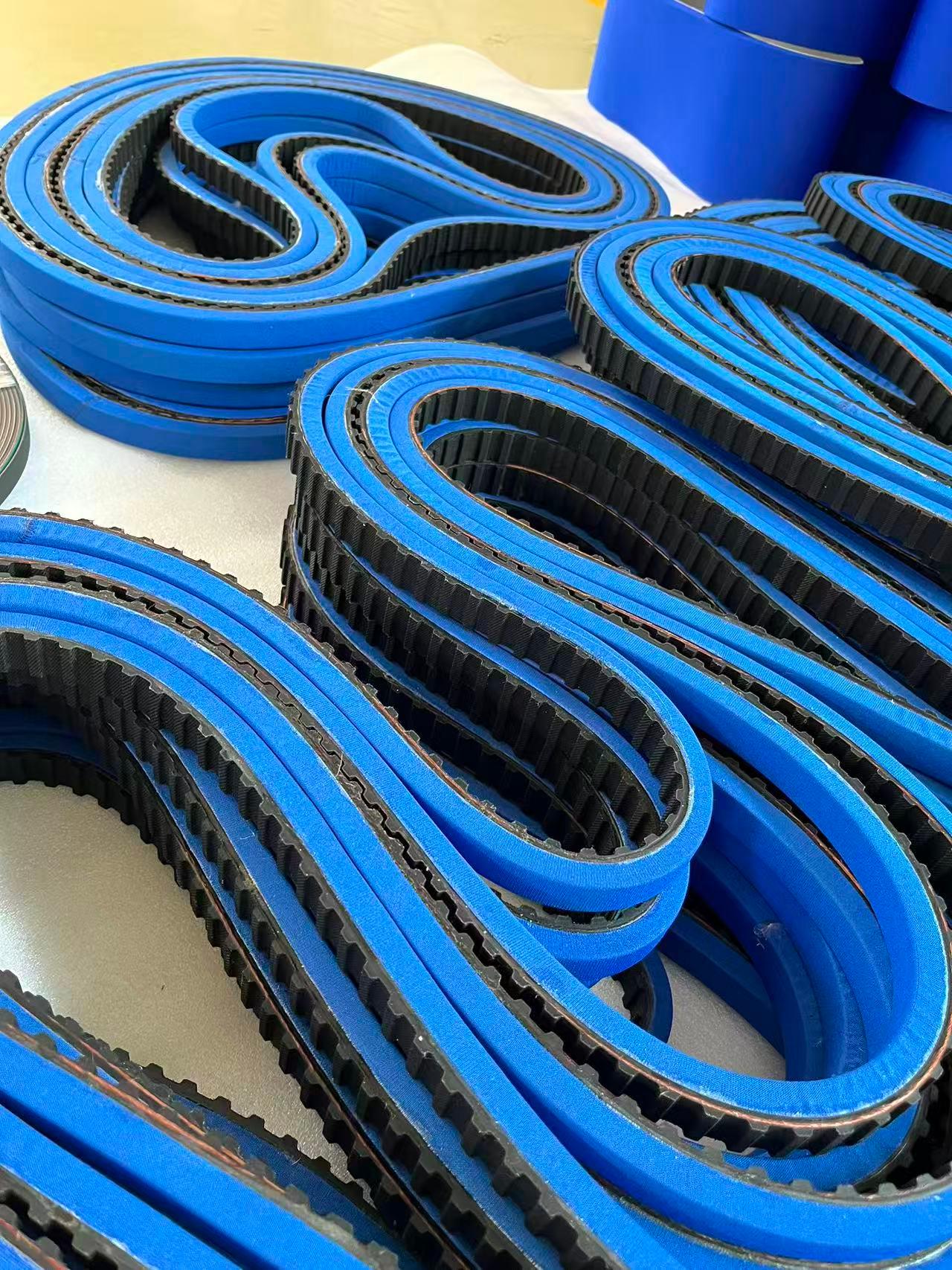
Why Parcel Handling Sets Different Timing Belt Requirements
The defining constraint in distribution centres, fulfilment centres, and parcel sorting centres is operating continuity. The typical working condition for this sector combines high throughput, long running hours, repeated parcel impact, and continuous accumulation and sorting sequences. The operation mode is commonly described as 24/7 continuous operation with high-speed sorting and accumulation conveying.
That combination produces six recurring belt requirements, and they tend to pull in different directions:
- Wear resistance — sustained product contact and continuous cycling.
- Antistatic performance — a defined electrical characteristic rather than a general expectation.
- Low noise — large sorting halls concentrate many drives in one acoustic space.
- Low rolling resistance — relevant to energy behaviour over long operating hours.
- Stable tracking — a belt that wanders affects the timing accuracy of the driven function.
- High throughput — the belt must not become the throughput-limiting element of the system.
These six requirements are the ones formally attached to logistics and intralogistics applications, alongside matched equipment that includes sorters, scanners, rollers, telescopic conveyors, merge conveyors, and warehouse automation systems. A timing belt selected for a packaging machine will not automatically satisfy them, because the working conditions differ. Packaging machinery typically combines high speed with frequent start-stop and precise positioning over short, repeated cycles. Parcel sorting adds non-stop run time, larger conveying paths, and greater variation in product contact.
The practical point for buyers is that the requirement list should come from the logistics application, not from the belt catalogue. A belt that meets a general industrial drive specification may still be the wrong choice for a parcel sorter if its static properties, tracking behaviour, or tooth engagement profile are not suited to the specific accumulation or merge section.
Tooth Geometry: The Functional Core
Every other property sits on top of one decision: the tooth profile. Available profiles in the reference range include MXL, XL, L, H, XH, XXH, T5, T10, T20, AT5, AT10, AT20, HTD 3M, HTD 5M, HTD 8M, HTD 14M, and HTD 20M. Belt construction options include single-sided, double-sided, open-end, and endless types.
Three geometric parameters determine whether a given belt can physically serve a specific sorting or accumulation section:
| Parameter | Reference Range | Why It Matters in Intralogistics |
|---|---|---|
| Tooth pitch | 2.032 mm, 5 mm, 9.525 mm, 14 mm (profile dependent) | Determines speed and torque relationship for the driven pulley arrangement |
| Minimum pulley teeth | 10–25 teeth, according to profile | Sets the smallest practical pulley in a compact drive layout |
| Minimum turning diameter | 10 mm to 108.7 mm, according to profile | Governs how tightly the belt can route around idlers and reverse bends |
Pitch codes are not interchangeable even when two belts share a nominal length. ISO 5296 specifies the principal characteristics of synchronous endless belts with pitch codes MXL, XXL, XL, L, H, XH, and XXH — a useful anchor for buyers specifying against an international reference rather than a supplier drawing alone. Where a sorting centre sources replacement belts across regions, specifying to the standard pitch code reduces the risk of a near-miss substitution.
Material, Cord, and Fabrication Choices
Two base materials dominate industrial timing belts: polyurethane and rubber. Both are available, with hardness listed at 90–92 Shore A and an operating temperature range of −20 °C to +160 °C depending on material. Temperature range should be treated as material-dependent rather than universal — a belt specified for a chilled or unconditioned warehouse environment is a different calculation from one running beside a heat source.
Behind the tooth surface, the tension member controls how the belt behaves under load. Available cord types are steel cord, Kevlar cord, and glass fiber cord, with steel cord diameters of Φ0.3 mm, Φ0.51 mm, Φ0.6 mm, and Φ1.21 mm offered according to tooth profile. The intermediate layer material is Kevlar. Backing material options include PU, rubber, silicone, sponge, and fabric, and surface coatings follow the same material set.
Fabrication is where a standard timing belt becomes an application-specific one. Available processing includes perforation, cleats, profiles, and V-guides, along with surface treatments such as tooth fabric, backing fabric, grinding, and perforation.
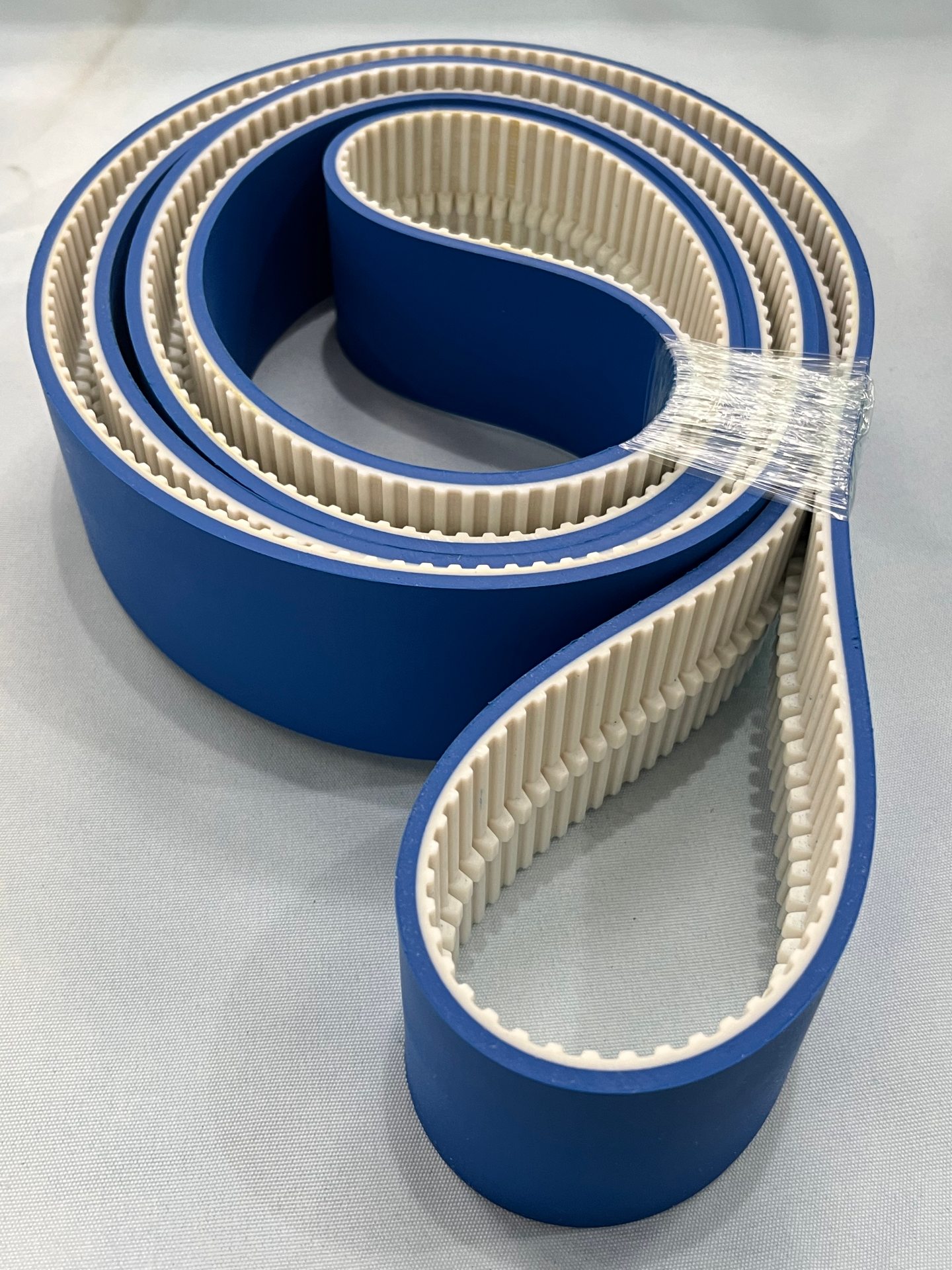
One specification that deserves separate attention in this sector is antistatic index, listed at 108–109 and customizable. Antistatic performance is explicitly named as a special requirement for logistics and intralogistics applications — it is not an optional accessory. Buyers evaluating a timing belt for a parcel sorting or accumulation line should confirm the antistatic specification as a stated parameter, not as an assumed property of a general industrial belt.
Where XZBELT Sits in This Application Space
XZBELT — the trading identity of Xuanze Industrial Drive Systems (Shanghai) Co., Ltd., established in 2013 and specializing in the manufacturing and sales of industrial belts — is a manufacturer of conveyor belts, timing belts, power transmission belts, and related industrial belt products. Its production base and customization capability are directly relevant to the kind of belt engineering that parcel sorting equipment demands.
The company operates two major manufacturing bases with a combined production area of approximately 30,000 square metres. The specialty industrial belt processing and manufacturing facility in Changxing, Huzhou, Zhejiang Province covers approximately 3,000 square metres and is equipped with more than 20 sets of specialized production and processing equipment, including 6 belt splicing machines, 2 coiler wrapper belt coating production lines, 2 seamless fabric weaving machines, 3 silicone coating production lines, and 3 seamless PU coating production lines. The joint-venture production base for conveyor belt roll materials covers approximately 27,000 square metres with 12 production lines, including 2 PU production lines and 10 PVC production lines. Annual production capacity reaches 2,000,000 units.
Company information records approximately 50 staff, an R&D team of 5 engineers, and more than 13 years of manufacturing experience since 2013, alongside more than 20 years of accumulated industrial belt industry experience through its team, technical expertise, and industry resources. Quality management is supported by ISO 9001 certification, and the company holds 11 belt-related patents, including 2 invention patents and 9 utility model patents.
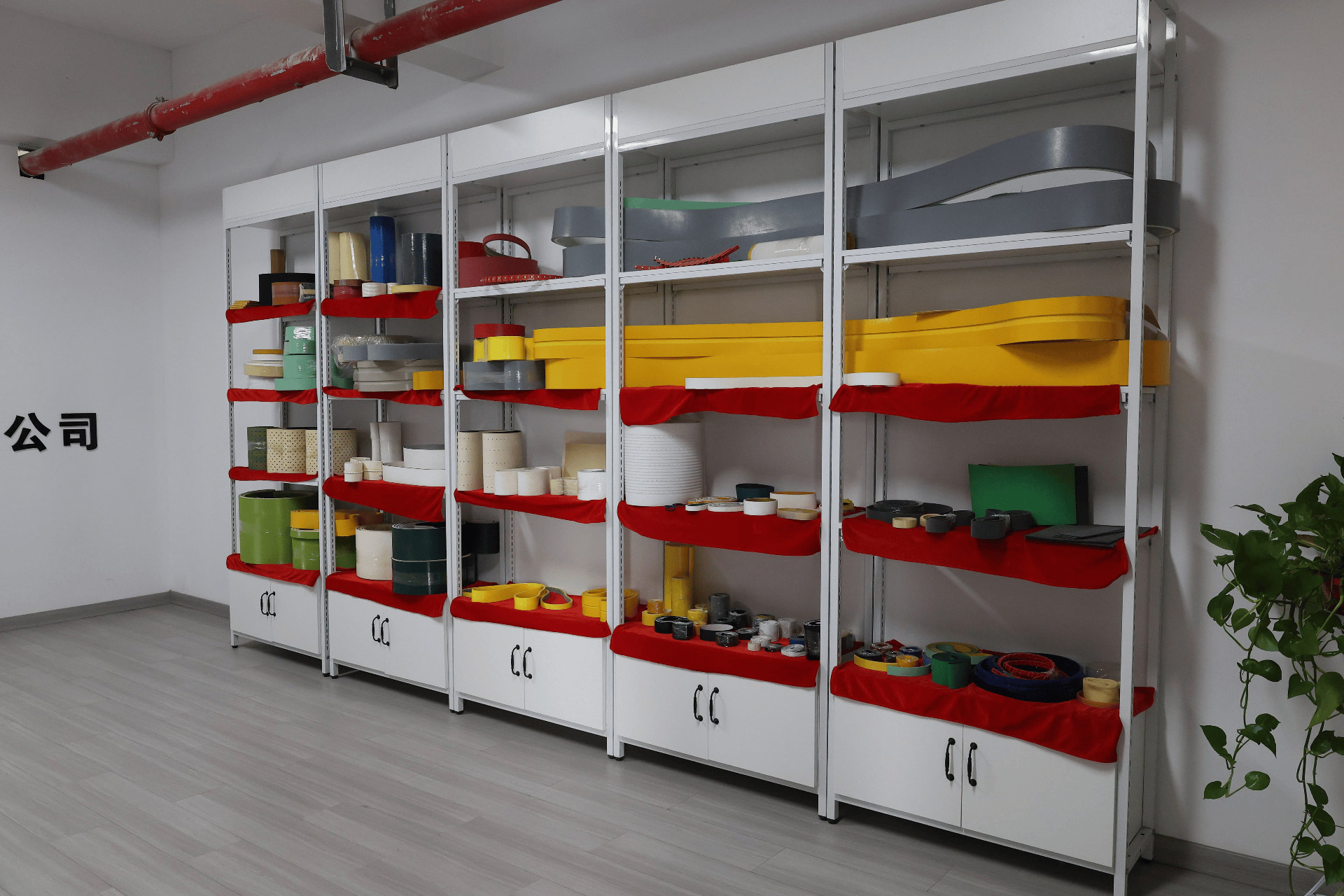
For parcel sorting and accumulation equipment, that customization model matters more than a fixed catalogue. A merge conveyor section, a sorter drive axis, and a telescopic conveyor load point may each require a different combination of profile, cord, backing, and surface treatment. XZBELT's representative specialty products include extra-wide timing belts, EZLink belts, silicone-coated timing belts, and seamless belts — product families that indicate the range of fabricated constructions the company works with.
Application Scenarios in Distribution and Sorting Centres
The logistics and intralogistics application profile is specific. Project types include distribution centres, fulfilment centres, parcel sorting centres, and warehouse automation installations. Belt functions in those settings cover parcel conveying, merging, sorting, accumulation, and loading and unloading. The matched equipment set is sorters, scanners, rollers, telescopic conveyors, merge conveyors, and warehouse automation systems.
Within that framework, timing belts generally sit in four places:
| Sub-Application | Typical Belt Function | Selection Emphasis |
|---|---|---|
| Sorter drive axes | Synchronized motion transfer to sorting mechanisms | Tooth engagement, repeatability, low elongation |
| Accumulation sections | Sequenced movement of accumulated parcels | Wear resistance, stable tracking, low noise |
| Merge conveyors | Timed feeding into the main sort stream | Tracking stability, throughput consistency |
| Loading and unloading | Drive for telescopic and transfer equipment | Construction type, fabrication options |
Supporting equipment should be considered at the same time as the belt. Scanners, rollers, and merge sections influence how a parcel arrives at the driven surface, which in turn affects the load pattern the belt experiences. A timing belt specification written without reference to those neighbouring components is likely to be incomplete.
Market Context for Logistics Belt Demand
Two independent market indicators frame the broader demand picture. Mordor Intelligence projects the global timing belt market to reach approximately USD 9.57 billion by 2030, growing from a 2025 base of USD 9.10 billion. Credence Research estimates the polyurethane (PU) timing belt segment at a CAGR of 12.57% to 2032, reaching USD 25.5 billion.
Those figures should be read with appropriate caution. Published PU timing belt growth estimates vary substantially — the same research scope includes a materially lower figure of around 3.10% from another commercial source, and the divergence appears to relate to methodology, with one estimate including high-value custom and robotics-adjacent segments while the other focuses on standard industrial replacement. For buyers, the useful signal is directional rather than numeric: demand for PU-based and customized timing belt constructions is expanding, and the logistics and warehouse automation sectors are part of that growth. ISO 5296 remains the reference point for endless synchronous belt geometry in pitch codes MXL through XXH.
Comparison with Alternative Belt Types — and the Boundaries of Timing Belts
Timing belts are not the default answer for every logistics conveying function. Three alternatives appear frequently in the same equipment, and each has a legitimate role.
| Belt Type | Strength in Logistics Equipment | Where It Falls Short for Timing Duties |
|---|---|---|
| Timing belt (synchronous belt) | Positive tooth engagement; repeatable motion for sorting and accumulation drives | Requires matching pulley tooth profile; not a product-carrying surface |
| Flat belt | High transmission efficiency, low elongation, good damping performance, low noise, small pulley compatibility | Friction-based drive; can slip where exact motion repetition is required |
| Round belt | Flexible transmission, easy splicing and installation, low noise, suitable for small pulley systems from 20 mm | Not a positive-drive synchronous solution for indexed motion |
| Conveyor belt (PVC / PU / TPU) | Product-carrying surface for parcel conveying, merging, and accumulation | Different functional role; not a substitute for a timing drive |
There are also real limits to what a timing belt can do in a sorting environment, and they should be stated plainly:
- Profile matching is non-negotiable. Two timing belts with the same length but different tooth profiles cannot be interchanged. Tooth geometry and pitch must match the pulley system.
- Tooth damage usually signals a system problem, not ordinary wear. Incorrect tension, excessive load, pulley wear, wrong tooth profile, pulley misalignment, foreign material, insufficient tooth engagement, and seized idlers or pulleys are all documented causes of tooth-flank wear, tooth-root damage, or tooth shear.
- Minimum pulley size constrains design. Too few pulley teeth or too small a pulley increases bending and can reduce load capacity and service life.
- A timing belt does not carry the parcel by itself. In accumulation and merge sections, the conveying surface and the drive function are separate engineering decisions.
- Low-load sections do not always need synchronization. Where motion timing is not critical, a flat or round belt may be the simpler and more serviceable choice.
This is the practical boundary. A timing belt earns its place in parcel sorting and accumulation when the system genuinely requires synchronized, repeatable motion — and loses its advantage when it is specified into a position where friction drive would have been sufficient.
Future Outlook
Three developments are likely to shape how timing belts are specified for intralogistics over the next several years.
Continued growth in PU-based constructions. The PU timing belt segment is projected for expansion, and PU's combination of wear behaviour, oil resistance, and fabrication flexibility aligns with the antistatic, perforated, and coated variants that logistics equipment increasingly requests.
Customization moving earlier in the design cycle. As sorting and accumulation systems become more tightly integrated, belt parameters such as minimum turning diameter, pulley tooth count, and fabrication features are more likely to be defined during equipment design than during spare-parts procurement. Suppliers able to work from machine structure and operating conditions — rather than from a stock size list — will be in a stronger position.
Standardized specification language. ISO 5296 gives buyers a common reference for endless synchronous belt characteristics in the MXL-to-XXH pitch range. Wider use of such references reduces the ambiguity that currently makes cross-region belt sourcing risky in multi-site sorting operations.
None of these changes remove the fundamentals. Tooth profile, pitch, length or tooth count, width, tension member, and construction type remain the decisions that determine whether a belt performs in a parcel sorting line. Everything else — coatings, perforations, antistatic treatment — is layered on top of that foundation.
Frequently Asked Questions
What requirements does a parcel sorting and accumulation application place on a timing belt?
Logistics and intralogistics applications are associated with six recurring requirements: wear resistance, antistatic performance, low noise, low rolling resistance, stable tracking, and high throughput. The operating context is typically 24/7 continuous operation with high-speed sorting and accumulation conveying, and matched equipment includes sorters, scanners, rollers, telescopic conveyors, merge conveyors, and warehouse automation systems.
Why is antistatic performance specified for logistics belts?
Antistatic performance is listed as a special requirement for logistics and intralogistics applications. In the timing belt specification range, the antistatic index is stated as 108–109, with customization available. Buyers should confirm this as a stated parameter rather than assuming it is present in a general industrial belt.
Should a parcel sorting system use an open-end or an endless timing belt?
The choice follows the motion function. Linear axes and positioning applications generally favour open-end belts with suitable low-elongation reinforcement, while continuous synchronous drives require endless or truly endless constructions. Coated or perforated variants are used where product handling or vacuum systems require them. The available belt types are single-sided, double-sided, open-end, and endless, and the supply forms are open-end belt, jointed endless belt, and truly endless belt.
What causes timing belt teeth to wear or shear in sorting equipment?
Tooth damage is usually the result of a drive-system problem rather than ordinary surface wear alone. Documented causes include incorrect belt tension, excessive load, pulley wear, wrong tooth profile, pulley misalignment, foreign material, insufficient tooth engagement, and seized idlers or pulleys. The correct response is diagnostic rather than simply replacing the belt: inspect the damage pattern across several teeth, verify that belt and pulley profiles match, check pulley condition, confirm tension, verify shaft and pulley alignment, review drive load and shock loads, and remove foreign material or contamination.
What should a buyer confirm before ordering a timing belt for logistics equipment?
Correct tooth engagement comes first. The buyer should establish tooth profile, pitch, length or tooth count, and width before deciding on reinforcement, endless versus open construction, or special processing such as coatings and perforation. Two belts with the same length but different tooth profiles cannot be interchanged, and the minimum pulley tooth count matters because too small a pulley increases bending and can reduce load capacity and service life.
¿Tiene preguntas o necesita más detalles?
Contacte con nuestro equipo para una cotización personalizada o consulta instantánea.
Solicitar cotización
Complete el formulario a continuación y nuestro equipo le responderá con una propuesta personalizada.
Chat directo de WhatsApp
¿Prefiere chatear en tiempo real? Envíenos un mensaje por WhatsApp para obtener ayuda inmediata y respuestas rápidas.
- Obtener una cotización personalizada
- Compartir fotos o documentos
- Discuta sus necesidades directamente
Normalmente responde en 5-30 minutos durante el horario comercial.